Showing posts with label 2008. Show all posts

Thursday, January 23, 2025

Redbelt

Written at the time of the film's release. 

 
Redbelt (David Mamet, 2008) One considers carefully before accusing David Mamet of writing a fairy tale.* But, considering the genre in which he's working—the sports film, which is almost always a glucose-encrusted, tears-of-joy-stained fantasy (aren't they, basically, "Cinderella stories?")—one also must admit that he's taken as much of the slop out of the form as he can. And if it strains credulity a bit, well...."you gotta sell a story."

Michael Terry (Chiwetel Ejiofor) is an ex-military, mixed martial arts/self-defense instructor with an emphasis on ju-jitsu, running a small not prosperous training center in the land of make-believe, L.A. He's a good man doing good deeds, cloistering himself, looking to achieve his own personal best (like so many Mamet men). That he believes in honor, and the proper way ("There's always an escape") would appear to be a weakness. But incidents happen to break the hermitic seal of Terry's life and he soon finds that good deeds do not go unpunished. Encounters with an attorney with coping issues (Emily Mortimer), one of his students (Max Martini), a past-his-prime action star (Tim Allen) and his producer (Joe Mantegna) convolute to seemingly improve his life...but at a cost.
Money and legal issues force him to cross a line he'd never thought to cross—and as a result, he becomes a participant in an exhibition match with all its gloss, hyperbole, myth-making and BS. That the match is based on an anecdote that he casually mentions at a swank party, but rigged to take the chance out of it, only compounds his anger and humiliation at the corruption that he's taking part in, and he must find his own way out of a trap of his own devising. A way of his own devising.
It must have been an interesting puzzle for Mamet: "How do I make my own version...my own version...of the most manipulative and phoney-baloney film genre out there and still make it 'Mametian?" And still make it "mean" something. The disciplines and the hierarchical nature of non-exhibition MMA that feed Terry are in direct contrast to the gladiator aspect of the money game, which in the Mamet tradition, is a rigged contest. Even rigged, both Golden Rules
** are in play.
Mamet's films usually exhibit stillness, but here, action is used as exposition and Mamet the director fails to do anything but document the moves, and none too well, at that. Clarity is sacrificed for speed, and no matter how long Ejiofor has trained for those scenes—he's great in the role, by the way—his efforts are for naught due to Mamet's direction and cutting of them. The cast is uniformly excellent with Mamet stock company players
Ricky Jay and Joe Mantegna breezing through their roles. and Ejiofor making a superb protagonist, aided and abutted by Alice Braga as his practical wife. Tim Allen drains the comedy out of himself and is a bit of a revelation in his well-observed role as an actor coasting. You always knew there was a good actor inside the goof-ball and it's interesting to see him come out. Mamet's story-telling, casting and working with actors has never been in question. It's his use of the camera, now, that needs perfecting if he intends to pursue more action oriented films.

* It's not like he hasn't done that before. You could make a case that The Untouchables is so far from the reality of the Elliot Ness-Al Capone story that it's a blood-soaked fairy tale of revenge. But how much that was Mamet, and how much was director Brian DePalma or the producers one can't say.
 
** 1. "Do Unto Others as They'd Do Unto You" 2. "The One With the Most Gold Makes the Rules"

Tuesday, January 14, 2025

Last Chance Harvey

Most of this was written at the time of the film's release. I saw this in a theater because the cast was so good, how could I not?

 
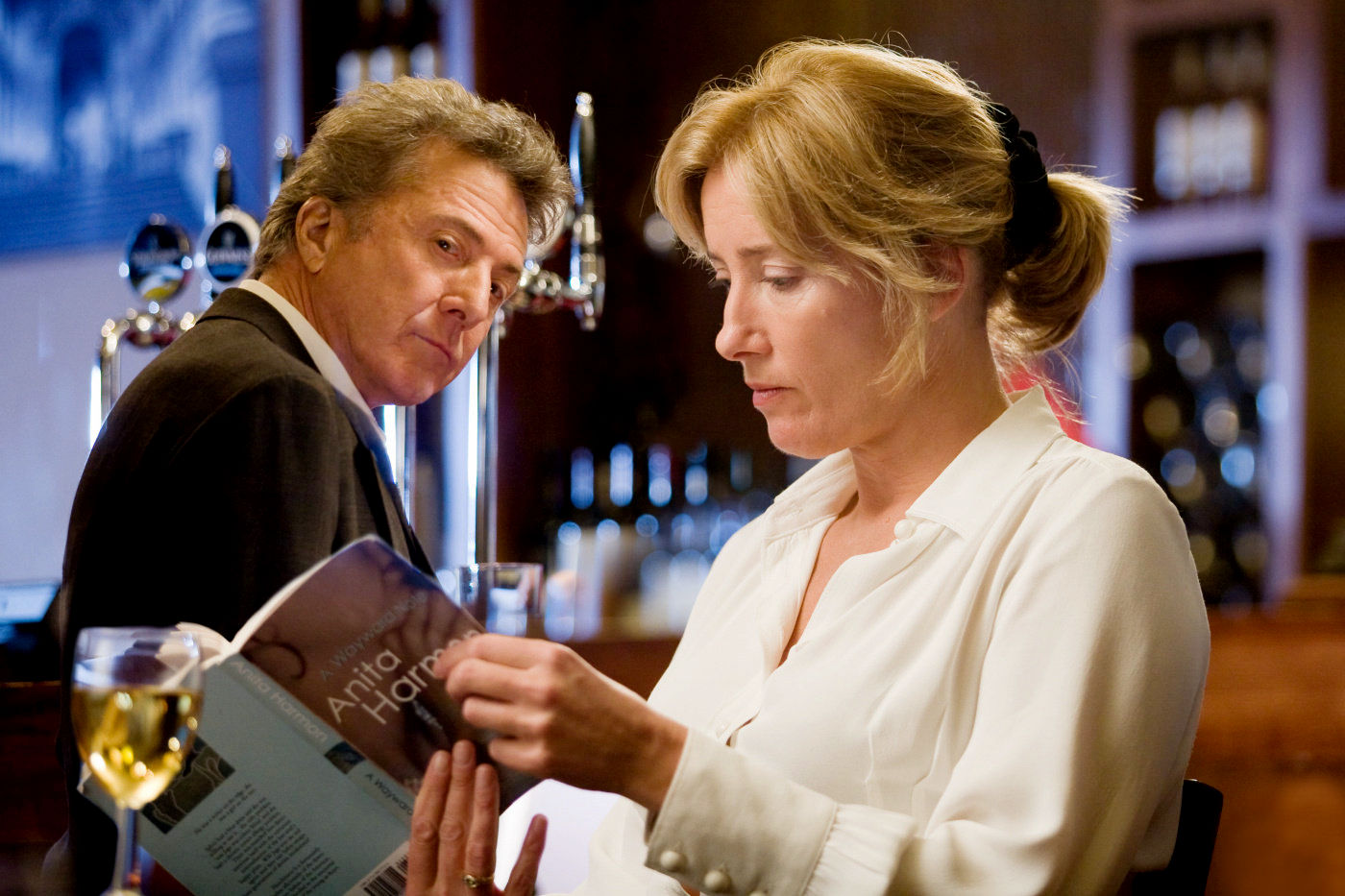
Last Chance Harvey (Joel Hopkins, 2008) Consigned to forgotten corners of the internet amid the dark alleys of the streaming services, this amiable and genial little semi-romantic semi-comedy boasts a fine casting of plucky players trying to make more of it than it is. Maybe it's only on the lists of those completists who want to see every single movie that Dustin Hoffman or Emma Thompson starred in (and certainly those are good goals), but I would be surprised if anybody had ever heard of this movie, which seems a shame. You read the reviews and practically everyone says is that Hoffman and Thompson are magical together, and if it was just them...the movie would be amazing.

The titular Harvey Shine (Dustin Hoffman) is a musician working for ad agencies writing commercial jingles, but he's always wanted to be a jazz pianist. He's been hired to write yet another innocuous ear-worm, but he's on his way to London for his estranged daughter's wedding (he at least feels the absolute need to be there). He's told, rather cruelly by his boss (Richard Schiff) to take his time, enjoy himself...because he won't have a job when he gets back.

Hey...Mazel tov!
Add to that, his estrangement from his family (his ex-wife, played by
Kathy Baker, is now married to James Brolin's character) his awkwardness with social situations in general, and that dear daughter wants her step-dad to give her away, Shine is having a very bad time of it. He spends the wedding at the back of the church (at least he's there), but he's determined to skip the reception and just slink home, until he finds his flight delayed with a long layover. Only thing to do is hit the bar, and once there, he has a strained conversation with Kate Walker (Emma Thompson, always exactly right), an airline worker he previously had blown off while she was just doing her job.
She wouldn't be there if a connection didn't happen
...not merely back to the U.S., but between the two characters...and as I said it's amiable and genial and you probably already know where it is heading. Hoffman is such an adept spur-of-the-moment actor and Thompson is such a quick wit and sharp writer that it's like seeing your two best friends spark off each other and say what you will about the rest of it, but that is a joy.
There is a complication or two of the An Affair to Remember variety—don't worry, no one gets hit by a bus—and we get to witness what may be
the longest wedding reception in history. The slight story-line is fleshed out with Kate's eccentric mother (the wonderful Eileen Atkins) who thinks that there's a Rear Window-style murderer living next door. Hilarity ensues.


Still, you could do worse than this one to kill a little time, especially with such a good cast.

Wednesday, September 11, 2024

The Lucky Ones (2008)

A review of one of the films from the post 9-11 environment, written at the time of the film's release.
 
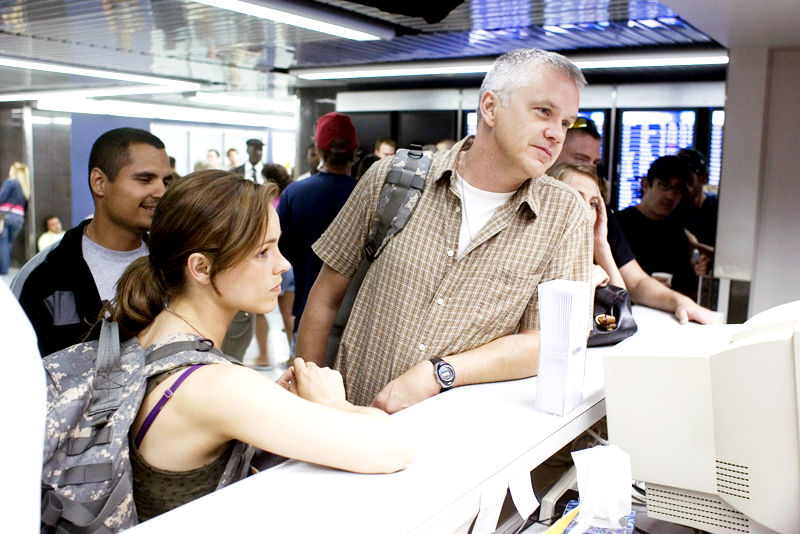
The Lucky Ones (Neil Burger, 2008) Every war, every "police action," seems to have its "re-patriation" film. World War 1 had The Razor's Edge, 2—The Best Years of Our Lives, Vietnam—Coming Home. The Lucky Ones involves returning troops in the ongoing Iraq War, different from their cinematic (and real) fellow troops in that they're not coming home. They're on a 30 day leave before going back as part of the "stop-loss" program. So, this takes place as more of an interruption to their service. What happens when the environment is not so regimented, or as dangerous. The three come back from the war altered, and all have specific goals in mind, all of which change when they actually touch boots to ground in the States.

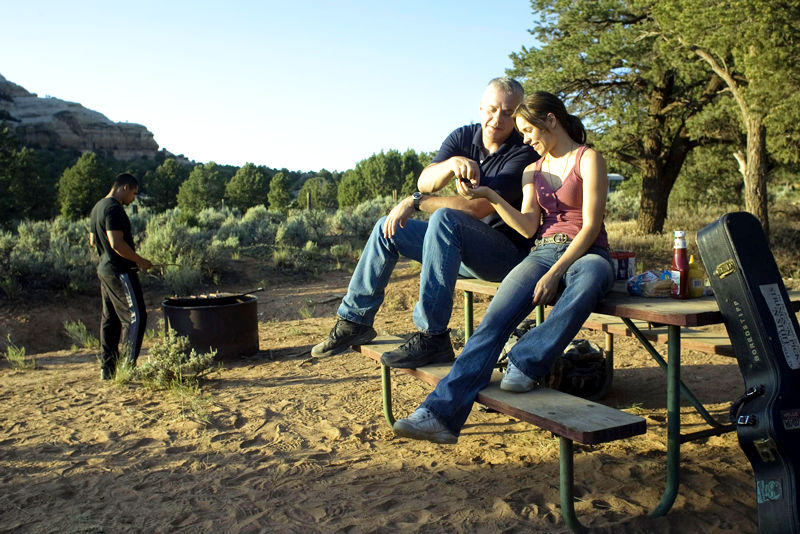
It follows three vets—Cheaver (Tim Robbins), an older sergeant just off his third and last tour, T.K. (Michael Peña), wounded, but gung-ho about going back, and Colee (Rachel McAdams), a neophyte coming back with a mission and a hole in her leg. They're all damaged: Cheaver is psychologically out-of-whack; T.K.'s purpose is to get back to his fiancee to see if "his equipment" still works after being wounded; Colee wants to find the family of the guy she hooked up with there and return his guitar to them. Meeting on the flight state-side, they decide to pool resources to get where they're heading. But, like any road-trip, there are detours, changes of plan, and the occasional loss of bearings. Stability is not to be found at home for any of them, and the trip only reinforces the perception that their fellow soldiers are the only ones who've "got their back."
Some of the episodes reach a bit, while some feel natural, and mostly the film avoids easy answers—less than it avoids mention of the war, except for a brief opening scene. The Lucky Ones is less concerned with Iraq, than it is with the soldier's plight, caught in the demilitarized zone of not fitting in either here or there.
Putting them on the road—in transit—reflects that sense of rootlessness (as most road-movies do) that these perpetual soldiers must have that is unique to this era's soldiers. The film never really tackles that subject head-on, as it almost has a duty to do, instead relying on the various "missions" and destinations to define the characters. Ultimately, the film has nowhere to go once those stories are used up, and the film ends on a logical melancholy note.

Where it shines is in the performances. As with the war, Burger and his co-writer
Dirk Wittenborn are quiet about the soldiers, presenting them as rather independent pawns in a much bigger game, their choices on the road sometimes unconventional, and not S.O.P.  But McAdams, Pena, and especially Robbins (this is some of his subtlest work in the past decade and nice to see), breathe a likable humanity into their characters, buffering the moments of manipulation and contrivance. You like these guys and want them to succeed, even if they are a bit unreadable—enough so that some of their choices surprise, even deep into the movie. That The Lucky Ones manages to do that is no small accomplishment.

Friday, August 16, 2024

Religulous

So...is "Real Time with Bill Maher" on tonight? (Answer: Nope) 

Written at the time of the film's release.

Religulous (Larry Charles, 2008) It may seem a bit like preaching to the choir (or rather fomenting to the heretics) for this critic that he follows the anti-creed* of this roughly assembled documentary featuring Bill Maher. Yes, yes, I believe.
 
But, at the same time, one can't just look at the film and not find the hoariest manipulations of the documentary footage by Maher and director Charles (the "director" of Borat, but really, what is he doing in these films except keeping people in shots, and staying out of the way of the other cameraman?). You think Michael Moore is manipulative? Watch these guys. Maher is the most inclusive of interviewers—if it's including him. He's only too happy to derail a conversation in order to toss in a smart-assed remark, relevant or not. A comedian with an insatiable desire to be noticed and appreciated, Maher is his own best audience. And one frequently wants to slap his hand when he perks up to toss in a punch-line—he's too busy thinking of his next joke than to actively listen and build on a conversation.
Concurrent with that is the manipulative editing (baldly manipulative editing, as Charles tosses in reaction shots from other places in the conversation to get his comedic timing-points), that makes one seriously dis-believe what one is seeing on the screen. 
It works in the short-format "Daily Show" interview, but for a long-form documentary, it's just manipulating reality far beyond what is necessary to make your point, and in some cases, make your interview subject look like a fool. That's their job.
Still, there are a couple of good sequences, particularly one of Maher and his skeleton crew driving up to a double-wide ministry and just engaging the men in debate—one guy stomps off in protest—but the others genuinely step up to respectably talk the issues Maher brings up, and they close bringing Maher into a prayer circle to thank their Lord for the opportunity. Karma runs over dogma, and the groups part ways, both satisfied with the results. It's that sort of level-headedness and confidence that is missing in this documentary, where both sides are pushing their God, be they Jesus, Mohammad, Buddha, (or Bill Maher) in front of the camera.

* That being: At a time when human knowledge now has the inescapable capacity to destroy itself in all sorts of clever ways, that the clinging to divisive religious myths by a genuinely intelligent populace, thus inspiring the shutting down of rational thought at a time when we need it most, is not only dangerous, it will be the flash-point that determines our destruction. Amen.

Thursday, August 1, 2024

What Just Happened

I'd say "written at the time of the film's release" but I mention the DVD commentary, so it must have been a year later or so.

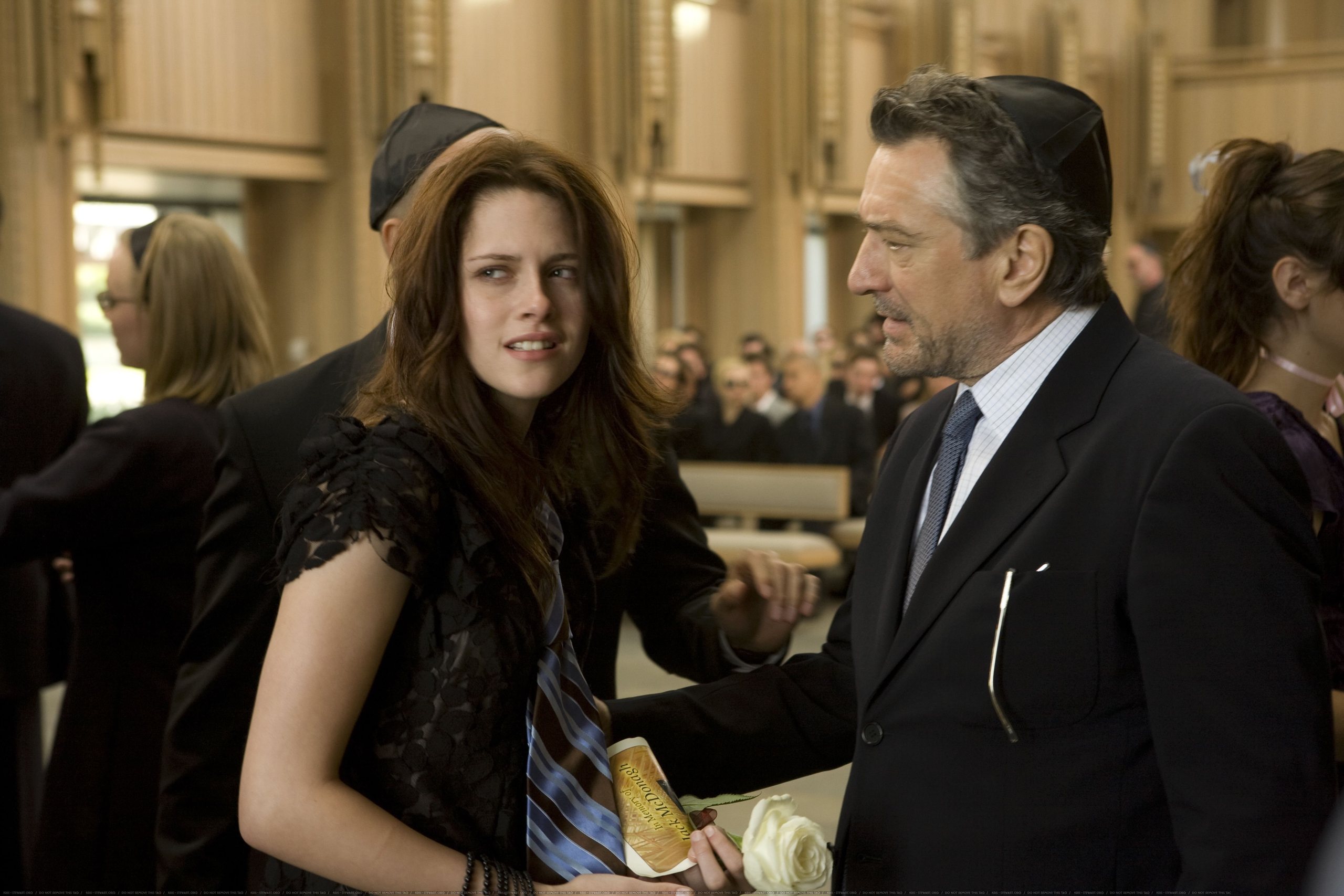
What Just Happened (Barry Levinson, 2008) Ben (Robert De Niro) is a producer in Hollywood and he has a tough life. His new movie starring Sean Penn just previewed and the audience reaction cards don't look good. The director, wanting to be "edgy," has a scene where the bad guys shoot Penn's dog, then kill Penn. Audiences are upset about the dog. The studio (run by Catherine Keener) is upset about the audiences and wants to re-cut the film, the director is upset about his "vision" being changed and refuses to cooperate. Ben wants the to keep the director happy, the studio happy, the audiences happy, the two ex-wives (including Robin Wright) and three ex-children (including Kristen Stewart) happy, while still worrying about where he's standing in a Vanity Fair "Power in Hollywood" photoshoot.

On top of that, he's got a big budget movie starting its shoot on Friday and the star (Bruce Willis playing Bruce Willis) is being payed $20 million to star in it, but there's one little hitch—he's grown "a Grizzly Adams" beard, and the studio is panicking—people want to see Bruce Willis when they see Bruce Willis and they want Ben to coax the temperamental star to shave it off, which he refuses to do for "artistic reasons."* Ben's life is an endless soliloquy of superficial arguments, hastily-composed rationalizations and insincere ego-stroking in the gamesmanship of Hollywood, played over a Blue-Tooth behind the wheel of a constantly in-motion Lexus. 
Based on producer
Art Linson's book (sub-titled "Bitter Hollywood Tales From the Front Line") and adapted by him for this film, it's a nice study of how removed from reality, logic and best practices the industry is. But, at the same time Barry Levinson's film of it, while duly making note of the sliding loyalties Ben displays, also seems to expect you to feel sorry for him. One would, if one didn't want to have this life. There is no tragedy here, merely minor inconveniences that whittle away at Ben's soul and career. But, he still has a roof over his head. He has a car (and the insurance for it), a cell-phone, a blue-tooth, a fancy-schmancy espresso machine, the ear of many Hollywood players, and the phone numbers of ambitious actresses. Boo to the Hoo. Yes, Hollywood's crazy...but it's not homeless and crazy.

That's why backstage dramas in tinsel-town are really only good when played for laughs, and should only be reserved when the writer-director-producer has completely run out of ideas (and when that happens, they should read a book, instead). You look at movies like
The Oscar, or The Big Knife, with the hand-wringing of the elite, and you can look right into the soul of industry people who have lost touch with their audiences**...like Norma Desmond screeching about her woes. It's why Sunset Blvd. is such a classic gem of a movie. Norma is crazy...and pathetic...and clueless.

Howard Hawks
had it right. After awhile, he was making movies about making movies—but, they were well-veiled allegories. Anytime Hawks had a group of disparate people coming together with a single goal in mind, he was talking about what he and his crew did for a living...only they were flying the mail, or capturing live rhinos, driving the cattle, getting the headline, or battling the monster at the research station...anything but making movies. That would be as much fun as watching sausages being made. If you want to complain about being in the entertainment industry, try pumping gas...then, have a drink or climb onto the shrink's couch. Don't get "meta" on the audience. They go to the movies to escape their troubles, not hear about yours.
But, like Fellini, pretty soon the writers start penning their autobiographies.  Linson might be thinking that he did a good job changing the names to protect the innocent, but listening to  his DVD audio commentary with director Levinson, one hears the vagueness, the "rote"-ness of his expressions, as if he's just passing through, and once the credits come up, he's already out the door (he's gone before the "A Barry Levinson Film" credit comes up). The two were in separated facilities recording their tracks, and as Linson gets up he says "Good seein' ya, Barry" "uh...talking to ya," says Levinson. "Oh.  Yeah...well..." says Linson. "We should get together when you come to New York."

Yes, we "really" should.

* True story, although I won't mention the movie or the star (it's easily found, actually).  But, it reminds me of the struggles Richard Donner had while making Superman, the Movie—making a man fly was easy compared to star-negotiations.  Donner had a meeting with Marlon Brando, where the actor was pitching character ideas that would keep him from having to appear on camera, like playing Superman's kryptonian father as a suitcase or "a green bagel," and Gene Hackman didn't want to shave his moustache to play Lex Luthor.  Donner finally said to Hackman on-set. "Look, Gene, you shave yours off and I'll shave mine off."  Hackman agreed, shaved and came back on-set.  "Okay, now it's your turn."  Donner then peeled off the fake moustache he'd been wearing, which delighted Hackman.

** (The same could be said for politicians—anybody in Washington looking at cutting the health-plans for those in the legislative branch...if not, why not?)

Wednesday, July 31, 2024

Internatio-noir: Mother and The Square

Written at the time of the films' American releases. Since then, Bong Joon-ho directed the film Parasite, which won the 2020 Best Picture Oscar, as well as awards for best script and best direction.

"The Knots of the Heart"
 
"A boy's best friend is his mother."

Mother Yoon (Hye-ja Kim) ekes out a living dispensing naturopathic herbs and running an underground acupuncture practice, all for her backward son Do-joon (Bin Won), 28 and a perfect example of not knowing what he doesn't know. With severe ADD, he has problems with memory retention; the least little thing, shiny or not, will distract him. The phrase "Hold that thought" is lost on him, an impossibility with his sieve-like mind. His type never learns.

You'd think his mother would. Mother Yoon watches her son like a hawk, and though she doesn't approve of him running with "a bad crowd," she can do nothing, or else the boy will storm off and get into some other trouble, or go drinking until all hours, or get beat up. Something...and usually bad. The cops know all about him. He's crossed their paths more than once.
So, when a young girl ends up dead on the night Do-joon goes on a bender, the police arrest him and hold him for trial. And he has no answers for what he was doing that night. This sends Mother into a maternal tizzy, and she works the neighborhood, trying to make nice with the victim's family, obtaining the services of a shady lawyer, but when those avenues prove unrewarding, she begins to investigate the case on her own, pursuing every blind alley and path paved with her Good Intentions.

And you know where that leads.
One could say that this is a Hitchcockian nightmare with
its themes of dangerous Moms and wrong-man incarcerations, but Mother (aka "Madeo"), directed by Bong Joon-ho (who directed the monster hit The Host) hails from Polanski-town,with its themes of obsessiveness, self-delusion and destruction. As played by the internalized Kim, the title character is so wrapped up in her maternal self-sacrifice that that she doesn't see how much she's giving up to save her son. As she digs deeper into the victim's past, she must come to grips with her own, and for all the searching her final destination is her own Soul.
Sounds grim, and even a little cruel. Cruel, it is. But, Bong—as he showed with his previous monster movie—has created an intricate little trap of a film, with moments of horror and humor combined, sometimes with their arms so tightly wound each other, they could strangle, whether from love or malice. One senses an ironic glee from the director, who keeps inserting little touches of humor into the proceedings to keep things from getting too heavy, and makes one think that maybe God puts us through such trials, because it's such good sport to see us flail.
_______________________________________________________________________________________

"Thank Christ for infidelity, I say"
 
If Bong is having a good time torching the ants in Mother, Australian director Nash Edgerton is chortling and cracking open a Foster's, making life miserable for the denizens of The Square. It, also, is a tightly wound thriller—more in the classic film-noir mode—with its Aussie blue-collar workers effortlessly slipping into "tough-guy" mode. It begins, as many noir's do—with an illicit affair, and the attempt to make it legit—but it soon crumbles around its own foundation, turning into quicksand. Like construction, it's not a good idea to go in and throw away the blue-print.

Foreman Raymond Yale (
David Roberts in a fine "everyman" performance) is building a resort of "honeymoon suites" for Hubbard Construction in Sydney, Australia. He's getting a bit of side-work in, as well, (or "a bit of mischief" as is the phrase) in an affair with Carla Smith (Claire van der Boom). Both are trapped in loveless marriages: he's just "middle-age-crazy" and her husband (Anthony Hayes) is a low-life criminal. One day she discovers hubby has stashed a bag of cash in the attic—a sizable sum. She decides to tell Ray in an attempt for them to skip out and start anew with a nest-egg. Ray's hesitant. Carla takes that as a sign that an affair is all it's going to be and dumps him.
And if everything was going to be fine..that's where the movie would end. Ray can't give up Carla, so they plan their escape and to hide the theft of the loot, they arrange to burn down the Smith's house—the evidence of the switched bag will burn up, and no one will be the wiser.
Well, the last part's true, anyway. The Square is a noir deep in the tradition-ditch of such illicit classics as
Double Indemnity, The Postman Always Rings Twice, and Body Heat. The perfect plot starts to unravel before it can be set in motion, and soon both Carla and Ray are hip-deep in complications that get worse and worse, and messier and messier—the perfect trial for a relationship. For all the efforts to "make things better," things simply couldn't get worse...until they do.
Director Edgerton, who, before he started turning out short films
* worked as a stunt-man, always finds the good angles to shoot from, and is more than happy to lead the audience into several very uncomfortable situations that have a gritty realism to them, all to make the audience squirm as much as the characters do, then tops it off with a neat little irony that twists the knife. Like his protagonists, this director might be too clever for his own good. It will be interesting to see what he does in the future and whether he'll deepen his material. For now, though, as an exercise in noir, this one is pretty special.

* The Square is preceded by Edgerton's 2007 short Spider, which is a good preparation for how sadistic a film-maker he can be to his audience. The less said the better, but don't be surprised if the film leaves you wary of the director, and tempted to walk out before the feature starts.

Saturday, July 13, 2024

Righteous Kill

Saturday is traditionally "Take Out the Trash" Day...

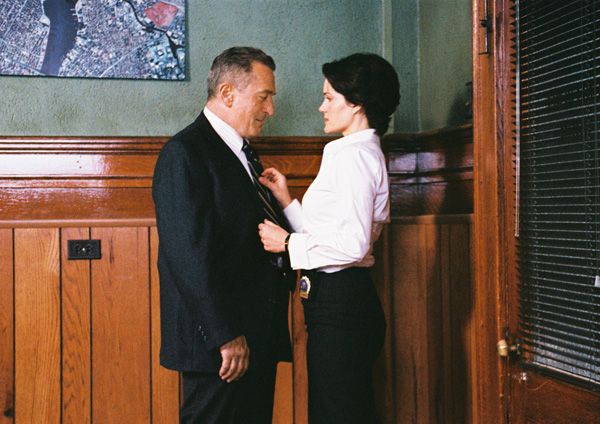
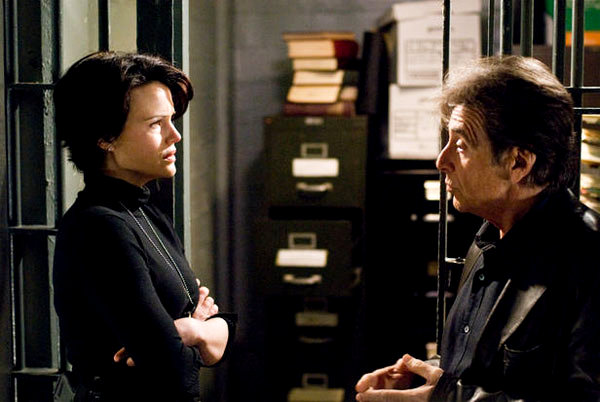
Righteous Kill (Jon Avnet, 2008) Someone is killing "Scott Free's"—those scum-bags that you just know are guilty but have some smooth-talking fancy-pants lawyer or some milque-toast judge who lets 'em walk, sneering, to prey on Society again...until they show up with a bullet-hole in the middle of their forehead. Two buddy cops, Turk (Robert De Niro) and Rooster (Al Pacino) start to add things up when one of the perps they arrested shows up deader than a Keanu Reeves performance. Looks like it's murder "and somebody's responsible." A vigilante? Certainly. But, if its revenge they're after, why are so many of these guys showing up dead? It's then that they think that the killer may be a cop.

But who?

Complicating matters is that most of the cops, including De Niro, Pacino, plus Carla Gugino, John Leguizamo, plus Donnie Wahlberg-o are creeps, so it could be any of 'em, except for the Captain of the squad (Brian Dennehy) but only because you couldn't believe Dennehy could sneak up on anybody but a bed-ridden quadriplegic.

So the question is: which of the crazy actors is playing the crazy character killing all these people?
The answer:
who cares? With a movie this terrible, and victims painted so sneeringly evil they're cartoons it's hard to work up much sympathy or even interest in finding their killer.
That's the problem of the writer. But director Avnet is so ham-fisted, he can't seem to hold a shot or light a set without sabotaging the drama of a scene. He's so busy "nuancing" things that you have trouble following the plot. He's not even talented enough to get out of the way of De Niro and Pacino (or, God forbid, rein them in) to make a scene play.
And, let's face it, having
those two legends on the screen should be a treat: they didn't work together in The Godfather: Part II (obviously), but their scenes in Michael Mann's Heat were tantalizingly short. Here, they're in almost every scene together (although Avnet can't seem to find the wherewithal to keep them in the same shot), and you realize they're like oil and water, or Mumbles and Loudmouth—they're two actors who've known each other for years, but their characters don't seem to. Or else the movie would be over in five minutes. But no, the suspicions and subsequent doubts must be fully explored, the red herrings must stink up the joint, and the script-writer must throw in a couple of feints that make no sense once the movie is over—they're there just to con the audience.*
What a waste. The big mystery is given this script, how could it attract two of the most iconic, respected and (when paired) legendary actors? Sounds like the biggest con was going on behind the scenes. Righteous Kill is the last thing you would expect a film starring De Niro and Pacino would be—a very pedestrian run-of-the-mill movie.

2024 Update: The story goes that at the premiere of this film, De Niro approached Pacino and said that they should never do another movie like this again, that they should find properties they could be proud of appearing in together.
 
As a result, the two actors didn't appear in another film until Martin Scorsese's The Irishman (I Hear You Paint Houses).

* Now, movies are by nature, the manipulation of reality—and the audience—to tell a story.  But, there's doing it well, and there's doing it the Righteous Kill way. 

Thursday, May 30, 2024

Vicky Christina Barcelona

Written at the time of the film's release...

"Juan is the Loneliest Number That You'll Ever Do"

or
"To Javier and Javier Not"


Vicky Christina Barcelona (Woody Allen, 2008) The latest film in what will, no doubt, be called Woody Allen's "Scarlett" period, Vicky Christina Barcelona was shot almost totally in Spain, and benefits from the change of location. It's a large part of what drives the plot and the two women who vacation in Spain for different purposes.

Vicky (Christina Hall) is studying Catalan architecture (particularly Gaudi), and spends the time in Spain as a prelude to getting married to staid, reliable Doug (Chris Messina). Christina (Scarlett Johansson) has just written and directed an 18 minute film starring herself, and broken up with the latest in a series of men in impetuous affairs. She has no business in Spain, but goes to spend time with Vicky and get away. Vicky values the safe and dependable. Christina is searching, "certain only of what she doesn't want," as explained by a ubiquitous Narrator (Christopher Welch), whose constant comments make the film feel less a visual experience than a story with pictures.
While in Spain, the two women are approached by darkly handsome artist Juan Antonio (
Javier Bardem) who offers to fly the women to the town of Oviedo for the weekend to view the Gaudi works, drink wine, and make love. Vicky thinks Juan is a creep. Christina is intrigued, but both women end up going, Vicky to protect her impetuous friend.
Juan is soulful, attentive, but it is obvious he is in love with his ex-wife Maria Elena (
Penelope Cruz), despite the fact a) they couldn't make it work, and b) she stabbed him in a rage. ("Oh, that..." she says dismissively when it's brought up).
Things get complicated, but never enough for the Narrator to be lost for words or explanations, and when Maria Elena shows up again in Juan Antonio's life, the movie turns, at equal turns poetic, and dangerous. Despite the mannered ways that Allen's films can frequently turn out, this group of actors is particularly well-suited to working outside of Allen's tic's and rhythms. The closest any of the characters come to the Allen neurotic persona (a staple in Allen's films, either played by Allen or a stand-in) is Vicky, but she's much more sure of herself, if not her situation.
Bardem is sadly relaxed in the film, but Penelope Cruz is a force of nature, this generation's
Sophia Loren. After being stuck in some unmemorable films with some straight-jacketed performances, the last few years and films have displayed a bravura presence, and she runs a gamut of emotions in this one to full effect. It's a tough role to pull off--she's held up as an icon until she appears, and when she shows up later in the film, arriving bedraggled from the hospital after a suicide attempt, Cruz more than fills the bill, with her extremes of behavior never seeming contrived or phony.
And Johansson has rarely been better represented on-screen—one close-up in particular of Christina listening to Juan Antonio explaining his love for his ex-wife fairly burns on the screen with resentment.
 
It may ultimately prove to be a minor Allen film, but as a change of pace and an expansion of style it couldn't be more successful.

Wednesday, April 10, 2024

The Reader

Written at the time of the film's release...

"Thus Conscience Doth Make Cowards of Us All"

I'm quoting Shakespeare there, so obviously this is a very "serious", and "important" film. But just to raise the hackles of any Weinstein Co. "readers" out there, here's a snarky little blanket quote to start things off:

Take The Summer of '42 and strip all the fun out of it and you have The Reader.

No, really. You've got the moony kid, but instead of 40's Nantucket, move it to early 60's Berlin. Instead of said moony kid having friends who provide the comedy relief, this kid is absolutely friendless, so there is no comedy or relief to be found, and instead of the lovely nubile widow-to-be showing him the ways of the world, you have the dour, nubile former SS-guard showing him just about every position in the book (I counted).
Still, I saw
The Reader with a nearly sold-out crowd, possibly because it's nearing the end of its run in theaters, but also because Kate Winslet is nominated for an Oscar for it (and is most likely to win).
* Stephen Daldry's previous film was The Hours, and this shares that film's chilly demeanor, and emotional opaqueness. But where The Hours resonated over several story-lines to come to a dramatically satisfying conclusion, The Reader moves along its clear-cut path, as the principles age, but seem not to mature. One would think that wisdom would creep into any of these creatures at some point, but it is not to be found. One is left to sit in frustration while actions are carried out—or more specifically, not carried out—despite some ample history lessons contained therein teaching the folly of such a philosophy. Relationships do not alter, although a lifetime of experience may be contained within the boundaries of them. And finally, the film makes a mockery of the word "responsible."
One comes away impressed by a line of dialogue every once in a while (David Hare wrote the script), the period detail seems right, the performances are "correct" (as they both play different ages of the same character, they seem to have found a perfect actor in David Kross who can match Ralph Fiennes for miserableness), but ultimately it's all for naught. This is a film without lesson, without moral, rightly or wrongly, but insists on trying to instill some shred of sympathy for a person responsible for inhuman behavior, based on their shame of a condition that they have the power to change at any time. What a waste.

* Man, you can get cynical with this, but the part has everything: the character is sympathetic/unsympathetic; has an affliction (illiterate, so no appliance-work, or physical moods to use) and a role that requires a lot of de-glamming make-up, as the character is required to age from 40 to 80. I tell ya, it's got everything to grab the gold...and then there's this YouTube video, that refers to this YouTube video.