Showing posts with label John Turturro. Show all posts

Thursday, August 1, 2024

What Just Happened

I'd say "written at the time of the film's release" but I mention the DVD commentary, so it must have been a year later or so.

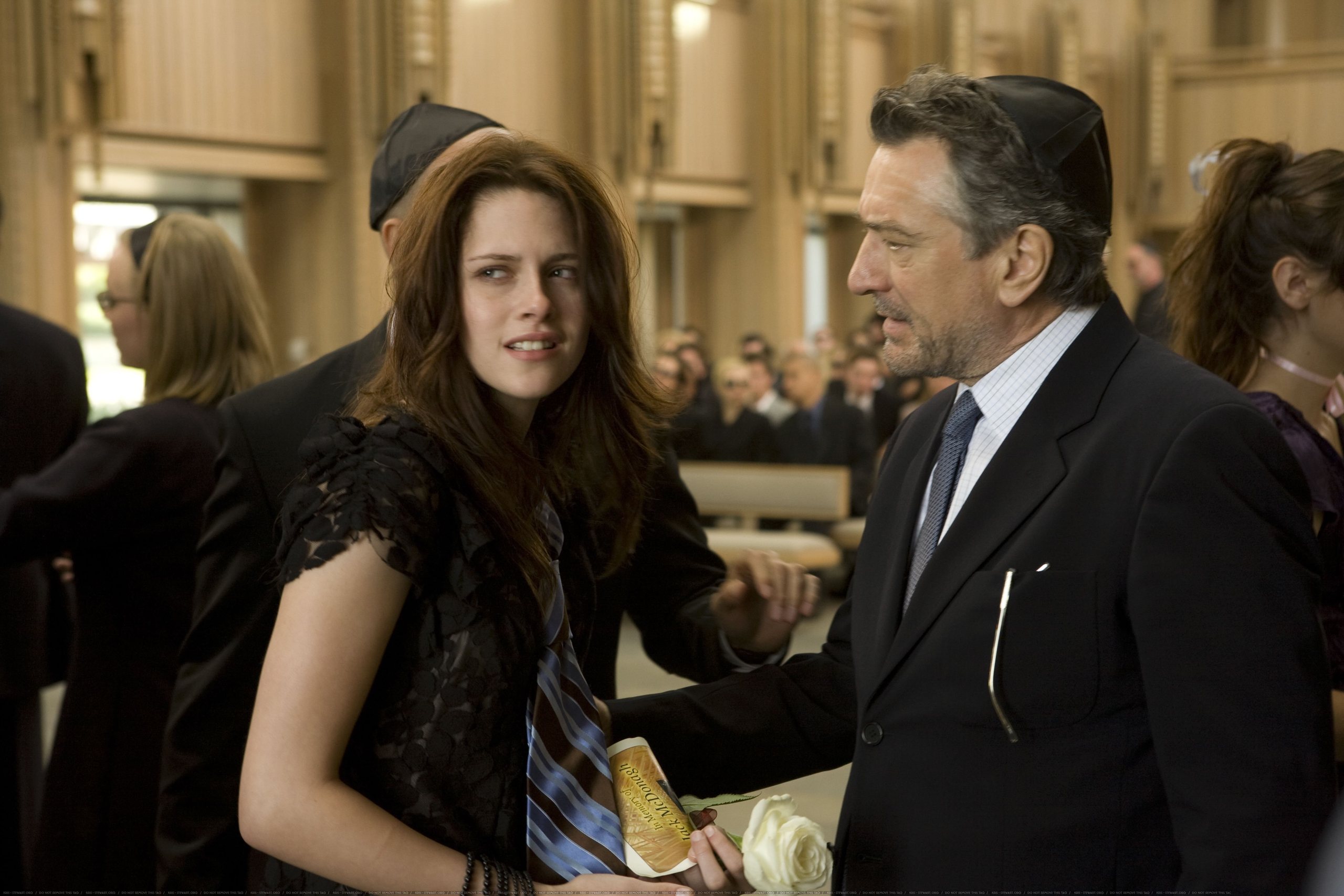
What Just Happened (Barry Levinson, 2008) Ben (Robert De Niro) is a producer in Hollywood and he has a tough life. His new movie starring Sean Penn just previewed and the audience reaction cards don't look good. The director, wanting to be "edgy," has a scene where the bad guys shoot Penn's dog, then kill Penn. Audiences are upset about the dog. The studio (run by Catherine Keener) is upset about the audiences and wants to re-cut the film, the director is upset about his "vision" being changed and refuses to cooperate. Ben wants the to keep the director happy, the studio happy, the audiences happy, the two ex-wives (including Robin Wright) and three ex-children (including Kristen Stewart) happy, while still worrying about where he's standing in a Vanity Fair "Power in Hollywood" photoshoot.

On top of that, he's got a big budget movie starting its shoot on Friday and the star (Bruce Willis playing Bruce Willis) is being payed $20 million to star in it, but there's one little hitch—he's grown "a Grizzly Adams" beard, and the studio is panicking—people want to see Bruce Willis when they see Bruce Willis and they want Ben to coax the temperamental star to shave it off, which he refuses to do for "artistic reasons."* Ben's life is an endless soliloquy of superficial arguments, hastily-composed rationalizations and insincere ego-stroking in the gamesmanship of Hollywood, played over a Blue-Tooth behind the wheel of a constantly in-motion Lexus. 
Based on producer
Art Linson's book (sub-titled "Bitter Hollywood Tales From the Front Line") and adapted by him for this film, it's a nice study of how removed from reality, logic and best practices the industry is. But, at the same time Barry Levinson's film of it, while duly making note of the sliding loyalties Ben displays, also seems to expect you to feel sorry for him. One would, if one didn't want to have this life. There is no tragedy here, merely minor inconveniences that whittle away at Ben's soul and career. But, he still has a roof over his head. He has a car (and the insurance for it), a cell-phone, a blue-tooth, a fancy-schmancy espresso machine, the ear of many Hollywood players, and the phone numbers of ambitious actresses. Boo to the Hoo. Yes, Hollywood's crazy...but it's not homeless and crazy.

That's why backstage dramas in tinsel-town are really only good when played for laughs, and should only be reserved when the writer-director-producer has completely run out of ideas (and when that happens, they should read a book, instead). You look at movies like
The Oscar, or The Big Knife, with the hand-wringing of the elite, and you can look right into the soul of industry people who have lost touch with their audiences**...like Norma Desmond screeching about her woes. It's why Sunset Blvd. is such a classic gem of a movie. Norma is crazy...and pathetic...and clueless.

Howard Hawks
had it right. After awhile, he was making movies about making movies—but, they were well-veiled allegories. Anytime Hawks had a group of disparate people coming together with a single goal in mind, he was talking about what he and his crew did for a living...only they were flying the mail, or capturing live rhinos, driving the cattle, getting the headline, or battling the monster at the research station...anything but making movies. That would be as much fun as watching sausages being made. If you want to complain about being in the entertainment industry, try pumping gas...then, have a drink or climb onto the shrink's couch. Don't get "meta" on the audience. They go to the movies to escape their troubles, not hear about yours.
But, like Fellini, pretty soon the writers start penning their autobiographies.  Linson might be thinking that he did a good job changing the names to protect the innocent, but listening to  his DVD audio commentary with director Levinson, one hears the vagueness, the "rote"-ness of his expressions, as if he's just passing through, and once the credits come up, he's already out the door (he's gone before the "A Barry Levinson Film" credit comes up). The two were in separated facilities recording their tracks, and as Linson gets up he says "Good seein' ya, Barry" "uh...talking to ya," says Levinson. "Oh.  Yeah...well..." says Linson. "We should get together when you come to New York."

Yes, we "really" should.

* True story, although I won't mention the movie or the star (it's easily found, actually).  But, it reminds me of the struggles Richard Donner had while making Superman, the Movie—making a man fly was easy compared to star-negotiations.  Donner had a meeting with Marlon Brando, where the actor was pitching character ideas that would keep him from having to appear on camera, like playing Superman's kryptonian father as a suitcase or "a green bagel," and Gene Hackman didn't want to shave his moustache to play Lex Luthor.  Donner finally said to Hackman on-set. "Look, Gene, you shave yours off and I'll shave mine off."  Hackman agreed, shaved and came back on-set.  "Okay, now it's your turn."  Donner then peeled off the fake moustache he'd been wearing, which delighted Hackman.

** (The same could be said for politicians—anybody in Washington looking at cutting the health-plans for those in the legislative branch...if not, why not?)

Saturday, August 26, 2023

Cars 2/Transformers 3/Audiences 0

It's been a good Summer for Movies. That something you don't see every year. Summers have become the #1 pole position for opening movies—School's Out and kids are getting out—so, the hot months get stuffed with releases for franchises and action movies (the End-of-Year releases are Oscar-bait). But, this year has seen a couple of good, original movies that have beaten the trends—and beaten the franchise box office receipts—and ensured that all the doors of the multiplexes can be opened again.

But, at the time I wrote this—at the time of these films' respective releases—it had been a pretty lousy Summer.

"The Summer of Our Discontent"
or 
"Cash for Clunkers"

You almost don't want to go To the Movies this Summer. Oh, we were warned; so many sequels and comic-book movies, the "experts" pouted and clucked. But the law of averages were in the audience's favor; there had to be something good in "the numbers."* But, this Summer has made me a little gun-shy and I hesitate from pulling the trigger on my credit card for a ticket. Nothing's excited me so far (apart from The Tree of Life**) and it's July already. Of the comics films, only X-Men: First Class had powers and abilities far beyond most super-hero movies—certainly over the previous "X-Men" entries. The 3-D "phenomenon" has constricted budgets, pushed opening dates, and the only thing it seems to add is an extra dimension of "suck" to the productions in the end.

Two recent releases left me so completely unmoved—probably because they were manufactured machine-movies about manufactured machines manufacturing fights with each other—that I thought it best to combine them under one article...so I wouldn't have to spend too much time contemplating their existence, and simply move on. They also evoked the same thought of "What do I care what happens to machines? Machines can be re-built!" 

And movies series can be re-booted. There are a couple I'd like to give the boot to right now.

Ultimately, both films are just long commercials for toys. Better to buy the toys and make your own adventure than what's being served.

"Spare Parts"

I went into the original Cars with exceptionally low expectations, and found a surprisingly fun little film to appeal to the NASCAR crowd and anyone who had a love for the open road. Automobile comedy would seem to be the lowest gear for laughs, but Pixar (and its guru/director John Lasseter, this time co-directing with Brad Lewis) managed a fine film that, if it fell short of the other Pixar products, at least managed to land on all four tires...and that's where the rubber meets the road.

But, what do you do for a victory lap? Go around the field one more time? (Well...yeah). With the novelty of a talking car universe safely a given, Cars 2 expands the concept, so that everything is talking, cars, boats, planes—although the oil-rigs featured are strangely mute.  It also goes global, with an environmental plot about an oil billionaire car (???) who decides to go "green" and develops a new fuel called "Allinol" (heh) and a promotional World Grand Prix to go with it. This gives "Lightning" McQueen (voiced by Owen Wilson) to go head-gasket-to-head-gasket with his racing rival, Francesco Bernoulli (John Turturro, who is having fun) for a best two out of three.
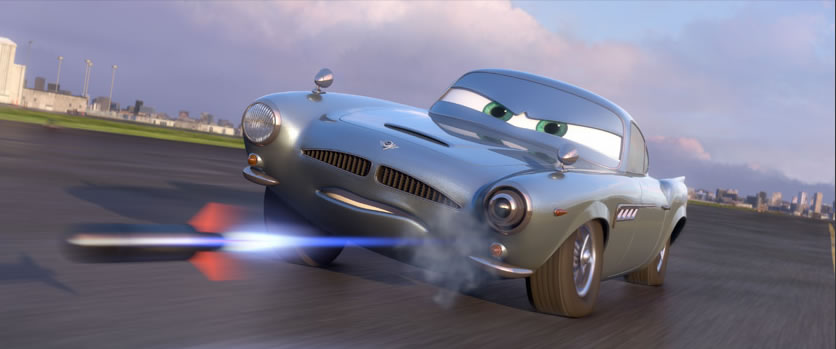
Ah, but there's sand in the gas-tank, when a car-tel of lemon-models (Pacers, Pintos, Gremlins, Ugos) led by an evil genius (my guess it was an Edsel, but I was wrong) wants to exploit a weakness in the gas to destroy the racers in the Grand Prix, and it's up to Special Agent Finn McMissile (voiced by Michael Caine, standing in for a friend, I think)—a gadget-laden Aston Martin/Miata hybrid—and his co-agent Holly Shiftwell (Emily Mortimer) to stop the plot and learn the secret identity of the evil genius behind it all. In a case of mistaken vin numbers, these crack agents think that Mater, the tow-truck (Larry the Cable Guy) is their American contact with information to stop the plot in its tire-tracks.
Now...wait a minute. I know it's a movie about talking cars (fergawdsake), but it takes a new meaning of the term British Intelligence to make that kind of mistake. So, the movie shifts its emphasis from the McQueen caracter to Mater very quickly and the movie never really recovers...I mean, there's only so much Larry the Cable Guy a person can take. The movie's tone has the feel of those '60's films where they used to shoe-horn Rowan and Martin or The Three Stooges into a spy plot because it was "a trend" and they couldn't come up with anything better...or appropriate. 
So, it's all a little "off," the timing chain a little twisted, not sparking on all cylinders. It LOOKS good—the city-scapes haven't looked so lovely since Ratatouille (
although everything looks a little miniaturized, like a play-set), and the movie has a fairly amusing sequence in Japan—but the film moves way too fast to appreciate all the chrome and options and it's too loud and obnoxious that the impulse is to roll the windows up and ignore it. Despite a stellar cast (Vanessa Redgrave voices The Queen?  And did I hear Michael Gambon—uncredited—as the disguised voice of the villain?) and despite its emphasis on Mater, nothing matters—there's no conflict, there's no drama—just a hokey plot, some slip-shod comedy, and everything running on auto-pilot.
As such, it would have been more appropriate to have Roger Moore as the voice of the spy-car.

Cars 2 may be buffed and shined, but its parts are used and worn, and rather than having that "new car" smell, it has a distinct lemon-scent.
(Wilhelm Alert @ 01: 24)
 ——————————————————————————————————————————

"Rock-Em, Suck'n Robots"

You should have no expectations walking into any film, but you really need to lower your guard going into a Michael Bay construction. His early films are such an annihilation of style over substance—to the point where action sequences are a mashugenah mish-mash between what looks like slo-mo Americana commercials for insurance—that you wonder if the guy at that point had any sort of talent whatsoever (I mean, Tony Scott has the same commercial gloss to his films, but at least you can follow them).

Over time, though, Bay's act has gradually gotten better. The action sequences smoothed out without losing any of the kinetic energy the director was striving for. Maybe there was even a good idea or two among the shrapnel flying through the air. But, the emphasis was always, and will always be I suspect, about demolition derby film-making with the occasional "grace note" of grinning nihilism and exploitive misogyny. One suspects that Michael Bay may become a better film-maker, but he will never grow up.
And he's still playing with toys
. He directed all three "Transformer" movies, including the latest,
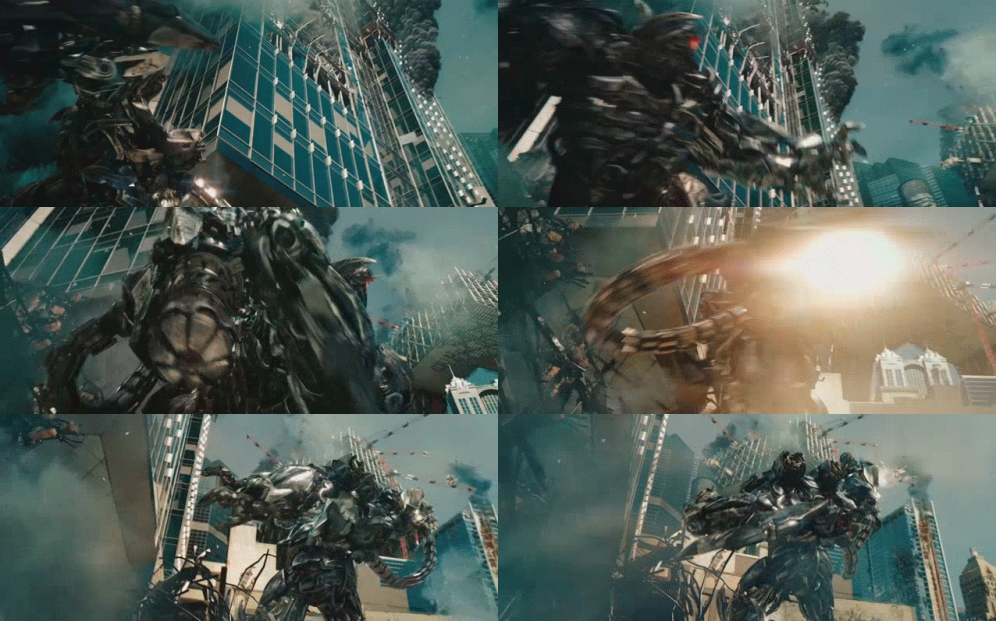
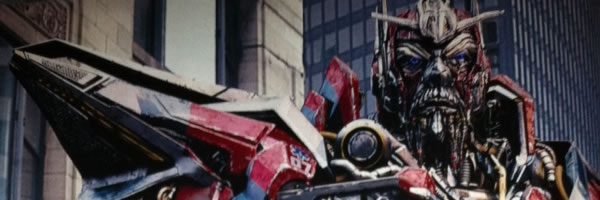
Transformers: Dark of the Moon, and before getting into what's wrong with it, here's what's right: the action sequences, particularly a crazed, high-strung highway chase and a mechanical urban brawl fought on three fronts through the high-rises of Chicago*** are marvels of imagination and quite "followable"—in other words, Bay is starting to understand the logistics of a good action sequence involve perspective and relatable occurrences—the swooping overhead shots let you see the relationships of what's happening, rather than just presenting a hodge-podge of in-your-face shots.  Yes, they go on too long—the evidence being the kids in the audience who couldn't sit in their seats long enough even when things started to go crash and boom—but at least things made sense, rather than merely noise and rubble.  Now, if he could just have things happen simultaneously—rather than have things stop on the other fronts while he concentrates on one sector—Bay might actually generate something his movies always lack: suspense.
So, the technique is improving, but he's still a far distance from being a mature film-maker.  The few women cast in the film, save
Frances McDormand who manages to retain some inventiveness and dignity in her role, are all dressed like hookers with Bay's camera leering over their curves,
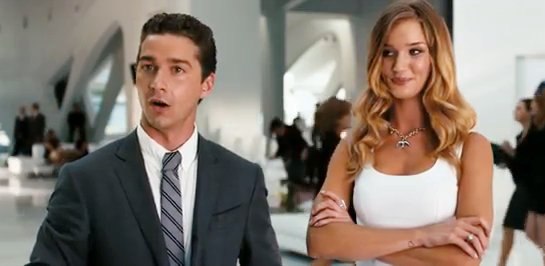
**** the dialogue attempts double entendre but never gets beyond the singular stage, and the annoying Beavis and Butt-head mini-robots from the last film are back and just as juvenile.  The whole movie has the same air of arrested development, although attempts are made to make it seem like it is happening in something more than a fantasy world where aliens disguise themselves as muscle-cars. The plot revolves around a derelict Autobot being salvaged from the Moon—its detection being the genesis of Pres. Kennedy's push for a fast lunar landing (and a cameo by "Buzz" Aldrin attempts to lend credibility to the idea).*****  But, there are also "realish-world" cameos by Kennedy (eerily good effects work), Nixon and Robert McNamara (not so much), Walter Cronkite (TV archival footage) and Bill O'Reilly (which negates the credibility factor...a lot). John Turturro returns, and John Malkovich has a small role as a gung-ho business exec. Shia LaBeouf is on-hand (much more caffeinated than usual, probably to be better noticed and for good comic effect, as, Unicron knows, the robots are DEADLY serious), and there's just enough of his parents in this one to outwear their welcome, whereas they were one of the best things in the original. Here, that role is provided by Alan Tudyk, who enlivens the first half of the film before he's made into a functionary.
But, human interaction other than urgently delivered exposition or awkward comedy is rare as human beings become mere flotsam (sometimes literally) in the crushing of gears against gears. Since I've whined in the past that the "Transformers" movies have suffered from "Saved-by-a-White-Man" Syndrome (where a movie's ethnic entities' problems are solved by the usually-white star), this is actually rather refreshing (in fact, the girl-friend/model is the only one who does anything to influence the fight, by displaying the same kvetching characteristic she does with LaBouef's character, a nice touch if you actually believe it inspires what transpires, rather than her merely being turned into designer-charcoal as an annoyance). 

One looks for small signs of hope wherever one can, when one is dealing with something in so need of repair.

Ultimately, though, for all the metallicrash on the screen, my attention kept returning to my watch...I couldn't wait to get out of there.
One further thought to Bay's detriment: he can't direct 3-D (the format I saw Transformers: DOTM in. On too many occasions, the illusion was spoiled by Bay's insistence in putting an out-of-focus obstructing "something" in between the viewer and the "focus" of the scene...which in 3-D...DOES NOT WORK! The eye wants to focus on the nearest object and move outward in focus, and with merely a "blur" to look at, gets mixed signals, leading to a frustrating viewing experience. Bad idea. And given that Transformers was designed to be shown in 3-D, some bad direction.

* Just because there's a number in the movie title doesn't mean it's going to be bad—it amuses me that the intro on the Cars 2 poster says "From the Makers of Toy Story 3. And there are the inevitable jokes—that Ocean's 11 was followed by Ocean's 12, and I remember a comedian saying about Malcolm X: "I never saw Malcolm I-IX!! I saw Super and Super 8 this Summer...where're the other 6?

** Meek's Cutoff was interesting, but nobody's going to see that.  So much for blazing trails.

*** You shouldn't take these things too seriously or literally, although Roger Ebert in his nicely disingenuous journal entry "On the Origin of Transformers" wonders why such a global conflict should be limited to "the corner of Michigan Avenue and Wacker Drive in Chicago."  Um...budget?

**** Bay's very first shot of the female lead—Rosie Huntington-Whiteley, a Victoria's Secret Model (but still...) is an up-skirt shot of her walking up a flight of stairs. This isn't exactly the tradition of women making a "grand entrance."

***** This is the same "Buzz" Aldrin who, when confronted by an Apollo landing-hoax enthusiast, hauled off and punched the guy!  Who's getting the black eye now?

Saturday, August 12, 2023

Transformers: Revenge of the Fallen

Continuing with my complete repertoire of "Transformers" movie reviews—there are three and I ran out of patience after two—for the next couple of "Take Out the Trash" Days.
 
Can Steven Spielberg convince Martin Scorsese to direct a "Transformers" movie? How about Greta Gerwig? I'd like to see an Aaron Sorkin-scripted Transformers movie (Transformers: The One About the Thing). I must be going through Post-Barbie Depression.
 
"Boys With Toys"
 or
"We Just Dropped Ten Tons of Dead Robot in the Middle of Nowhere."
 
As I recall, my three biggest beefs with the first "Transformers" movie was a) it was your basic racial bait-and-switch movie where the story of a repressed class is sublimated by having the story told through the eyes of a bankable star not of that class, b) the action sequences were ultimately boring and c) Michael Bay made every woman look like a hooker.

Other than that, I didn't mind it as some things were done quite well, indicating that Bay might actually become a filmmaker some day, as opposed to being a well-organized ring-leader and money evaporator.
But Transformers: Revenge of the Fallen* shows no such progression, and is quite a deal worse than the original. The problems with the first film have not been resolved, and the filmmakers have moved on to ignore more weighty problems like coherent writing, clear visual story-telling, or having a point besides making money and providing jobs for friends.
By now, the five-story high Auto-bots have become known to the military (thanks for noticing) if not the public at large, and should be working arm in cog to ward off alien attack, become an early, early warning system, vaporize garbage or at least become part of the motor pool. But it appears their job is to sit in one those ubiquitous governmental underground bunkers, stay out of the way of lucrative weapons manufacturers and kvetch about the government in charge. In other words, they've become part of the legislative branch with the major difference being that they actually go into battle themselves.**
And their nemeses, the evil Decepticons? They're doing much the same thing, except oiling their wounds, going back to the drawing board and plotting revenge. It would appear they have a long-standing grudge against Earth and its inhabitants, which is why this pan-galactic epic battle seems to be centered here, rather than some other arm of the Milky Way. Maybe we really are the Center of the Universe...and it attracts trouble.
***
Speaking of self-absorbed monomania, Sam Witwicky (Shia LaBeouf) is off to college, with more beating of breast and patting of wallet by his braying parents (Julie White, Kevin Dunn) who were a welcome relief last time, but are now just wacky walking punch-lines.
Then there's the only reason fathers are taking their children—
Megan Fox
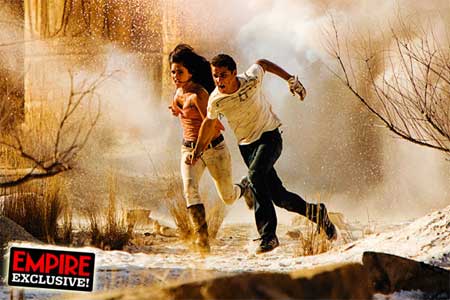
who's achieved a reputation as a Hollywood hottie and probably did a lot of practicing having a cold trying to get out of her contract-mandated participation, and might have done if she were a better actress. Fortunately, she's not required to do much outside of your typical Almay or shampoo commercial, until the latter part of the film where she's required to run in front of large gasoline explosions. I'd be worried for her as her mascara doesn't appear to run at all, but she doesn't lose so much as a false eye-lash.
The movie is built of the spare parts of a lot of past Studio franchises, and as with most out-sourcing a lot of the pieces don't fit. The Decepticons have a tier-structure (the Decepticon Overlord at one point even says "And you will, my apprentice"), a magic bling must save the day, Sam has trouble saying the "L" word, and there are magic scribblings that they have to go to an expert (John Turturro returning to good comic effect), in order to stop the evil erector sets from setting off a device hidden in the Pyramids that will stop the sun (I'm not sure what that would be but I suspect it's some triangular Maytag ice-maker). Take Transformers, strap on "Indiana Jones," plug in "National Treasure," screw on a pneumatic "Star Wars," some "Gremlins," program in some "DaVinci Code," stir a few thousand times to make it incomprehensible and drop it with a huge clank on Independence Day.
Ultimately, it's a big mess with Bay setting up a swooping crane shot for every line of dialog, and the screenwriters setting up their expositions over explosions so you can't hear all their mumbo-jumbo. The only time the movie comes to life is an extended sequence on campus when Sam, possessed by a piece of the evil Decepticon-maker freaks out in a classroom and goes all "Beautiful Mind" scrawling encryption's on his dorm-room wall, while also avoiding the predatory come-on's of a sorority sister, who's actually a Decepticon in drag. At that point, the movie becomes giddy and fun with complication piled on complication and LaBoeuf displaying some of the manic energy that makes him interesting to watch.
But that's ten minutes out of two and a half hours of a loud, obnoxious version of "Rock'em, Sock'em Robots." And that's the bottom line of this mess. It was made for the necessities of the Studio making it, not for any artistic need to tell a story. Just as the Studios plan a few years ahead to make "tent-pole" franchises to strategically shore up dividends in the Summer and Christmas, this movie was constructed of sequences dictated by locations cheap enough to shoot in. That, unfortunately, is how the Bond producers have been manufacturing movies for the past two decades: having run out of Ian Fleming titles, they check to see where they can save the most money and set their movies there, and write the script around the location (Hitchcock would utilize locations for material as well). The problem is there's more to a screenplay than "location, location, location." The Bond series perked up only when they had Fleming's "Casino Royale" to provide that film its spine and heart.
But there's no point and no inspiration to Tranformers: Revenge of the Fallen, there is only contrivance, and the makers were scraping the bottom of the scrap-heap to do that. The old "Transformers" series used to kill off characters to encourage kids to buy their new lines of toys. One can imagine the day when Revenge of the Fallen will overcrowd the dumpsters of America, as well.
* Reviewer Jim Emerson had the foresight to alphabetize it as "Transformers: ROTFL"

** Hey kids! There are new Auto-bots based on Smart-cars, but instead of speaking French, they're street-cred hipsters and are as annoying as a weekend with Jar-Jar Binks. In fact, these characters aren't only annoying they're vaguely racist (!!??), but then there's a major disconnect with this movie about its audience. It's aimed at kids, but amid all the cussing and humping dog jokes, I could see more than a few parents putting their heads in their hands at the questioning up-turned faces of their kids. It's also aimed at the kids who played with "Transformers" in the 70's and...haven't yet evolved. They were the ones "huh-huh-huhing" at off-color humor. Hollywood has yet to learn that the AICN crowd are a fickle bunch and won't necessarily "open" a movie for you. But then, a goodly number of current directors are fan-boys themselves.

*** At one point at an attempt at depth one of the characters says of the robots: "If God made us in his image, who made them?" Hasbro, Einstein! And probably in China.

Saturday, August 5, 2023

Transformers

We talked about the toy-sales aspect of the Barbie movie, although the film-makers had other things on their minds as well. But, you can't say that about the other toy-franchise that keeps manufacturing movie after movie with no other agenda than selling gadgets.

This was written at the time of the first film's release. We'll have the first sequel next week (and after that, I stopped caring.)

Saturday is traditionally "Take Out the Trash" Day.


"I bought a car—turned out to be an alien robot. Who knew?"

One has always suspected from the evidence that Director Michael Bay likes machines more than he does people. The stunts--the "tent-pole" sequences-- have loving care lavished upon them, but character development is there for laughs...people are more effective as collateral damage than the purpose of the story. And if somebody gets squished along the way...well, who cares? After all, another stunt is on the way, and how cool is that? The epitome of this director-fetish occurred in Pearl Harbor (never seen it, for personal reasons) when the "money" shot of the attack was one that followed an air-dropped bomb on its destructive path through the U.S.S. Arizona. Bay said in interviews he did "Pearl Harbor" just so he could do that shot. I've seen that little piece of film numerous times (I keep looking for a CGI version of my father waiting on the dock), and it is impressive. It's also the coldest, most heartless way to present a tragedy I've ever seen. What if Oliver Stone had had a "bullet" shot that traveled from the Texas School Book Depository to the meat of JFK's brain (As cruel as that sounds, I've seen similar things a few times on the CSI shows), wouldn't someone raise a stink about that? It's as if one of these little destructive things is on a hero's quest and we follow it's little travails to its ultimate goal. Boom! "Scoooore!" So I've looked at Bay's career with a jaundiced eye, looking for the day he'd grow up and become a real director.
I don't know that he has, but if he keeps making movies like
Transformers, maybe he shouldn't. One wants to be cynical about a 2 hour 20 minute commercial for Hasbro (the movie is rife with product placement for young and old alike), but damn, if the things isn't as effective an action-comedy that has come down the pike in quite awhile. Aimed directly at where male adolescents live, the movie has the great good sense to cast Shia LaBeouf as its token humanoid.* LaBeouf's fidgety, jittery, always "on" performance is one of those joys to behold in movies-- constantly shifting, feeling like an ad-libbed performance (though the prize for that must go to Julie White as the slightly addled Mrs. Witwicky, always trying to make something positive out of a negative) and holding his own against all comers be they performing veterans or CGI monsters.
The story deals with an invasion of Earth by warring stealth robots, the Autobots and the Decepticons, who hide in plain sight by adapting the forms of the mechana of whatever world they crash-land on. They're decidedly nostalgic, taking on the form of boom-boxes and 70's Camaro's. When we meet hyper high-schooler Sam Witwicky, he is combining a school assignment with a mercenary sales-pitch trying to raise money for wheels. This sets in motion a plot so full of contrivance that it almost knocks your block off (sorry, wrong battling robots), but between the machine gun performances and Bay's constantly moving camera (a bit less shake and quiver than usual), you don't have time to notice, so deeply submerged is the movie in the "now."
Along the way are some interesting performances by Bernie Mac, matching LaBoeuf shift for shift in animation,** Jon Voight, looking florid and dour as the Secretary of Defense, John Turturro, whose agent for the secretive Section 7 ("...never heard of it." "And you never will.") careens into Pacino-like histrionics, and Michael O'Neill from "The West Wing," brings an understated straight-faced gravity in the face of sci-fi mayhem that just allows the movie to survive a lengthy exposition sequence at Hoover Dam. All fit as the tone of the movie is more like the Spielberg-produced Gremlins, than, say, The Iron Giant.
After pulling off a good movie for most of its length, it succumbs to the wishes of the toy-clutching fanboys, and turns into 45 minutes of "Rock'em, Sock'em Robots" in the streets of L.A., which is just as boring as it sounds. All the fun just drains right out of the movie while the titular characters get in each other's grills, kick each other's cans for what seems like an eternity.
That's one of the problems. One can kvell about stereotyping, but I can't think of any minority (or majority, for that matter) not being lampooned (in fact, there's a nice double-shot at white geeks and director Bay when a fan boy reacts to a violent meteor shower--"This is SO cooler than Armageddon!") except for Asians. Didn't "Transformers" start in Japan? Hmmm.
Also, why are two of the more prominent women-roles both made up like 30 year old porn stars? And one's supposed to be in high school? How many grades was she sent down? They may be hawt (I believe the phrase is), but really, the only other person who comes close to having that much make-up caked on them is Jon Voight! And there is the staple of Bay--the slow-motion military shots that look like they've been culled from recruitment ads, and the faux-Hans Zimmer thudding score makes it feel more germanically militaristic than normal.
Still in all, it's the best damned, most entertaining toy commercial I've seen in a long time. Can't wait for "Furby: The Movie."
"Some assembly may be required. Choking hazard."
* Ever been annoyed at black-themed movies where the stars and main characters are white? This is sort of a mechanoid version of that scenario.
 
** Though it does cause some of the dialogue editing to be a bit ragged in places.

Saturday, December 17, 2022

Guillermo del Toro's Pinocchio

Re-Tooling Pinocchio
or
"All Good Things Require Patience"

Good Lord, we're certainly in a nostalgia craze right now, but then self-isolation will do that to you. Spielberg did Fabelmans, Mendes does Empire of Light, and now del Toro makes a film that was inspired by an early childhood movie memory of his youth, his own version of Pinocchio. I can't fault him; I loved that movie as a child—and was obsessed with it, too. But, that was Disney's Pinocchio made in 1940. It's of a different time and a different sensibility.
 
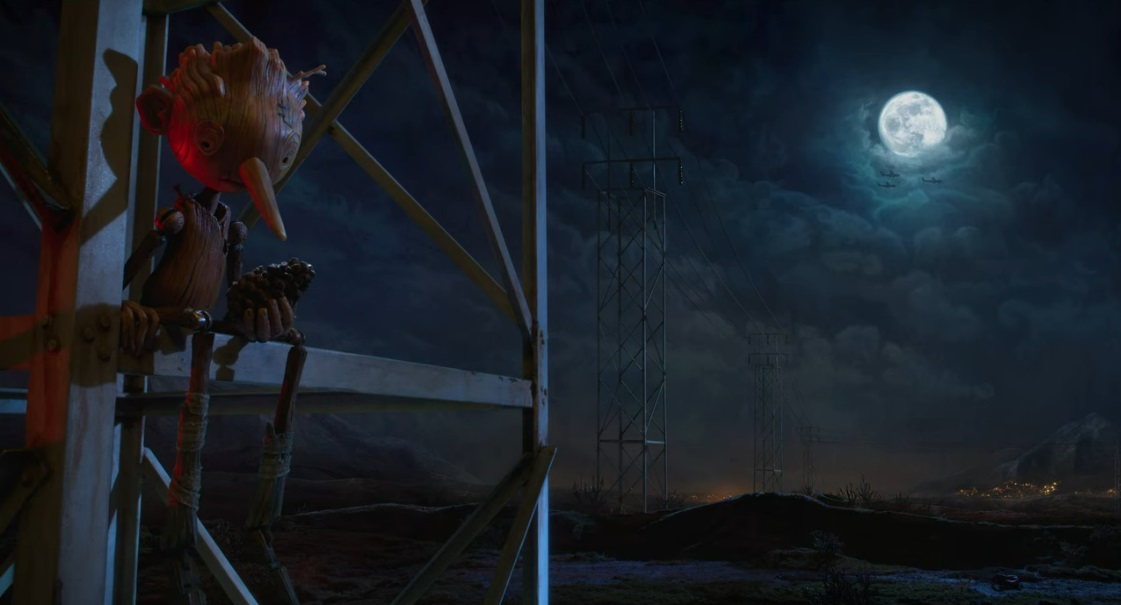
Guillermo Del Toro's Pinocchio is quite another creature entirely. For one thing, it's set in the fascist Italy of the 1930's. And the puppet is a puppet, never losing his bark (as it were) and without the embedded wish of being a real boy. He's real enough and high on, if not life, anthropomorphism. But, he's a block of wood, cut from a tree, without the benefit of paint or clothes as per the Disney version (and the recent Robert Zemeckis adaptation on Disney+). 

And this version isn't 2D animation or CGI as with those. This is stop-motion animation, that pain-staking movie-making done (as with most animation) frame by frame. I've always had a soft spot for this type of work, be it from its earliest days of King Kong, through the mesmerizing work of Ray Harryhausen to the improvements of "go-motion" developed by the wizards like Phil Tippett for the Star Wars films. To think of these guys, with their little play-sets, moving their figures inch by perceptible inch, bearing in mind the incremental differences in perceptible motion and speed!) to create the illusion of life on film reveals not only the imagination but the science and mechanics of making moving pictures. We won't even talking about the commitment of walking to a studio knowing you'll probably only get a minute of film done (if you're lucky) every day.
So, hats off to
Mark Gustafson, who co-directed this—while del Toro was off directing live features, promoting them, winning Oscars, getting married and supervising his vision of what "his" Pinocchio story should be. Gustafson's work is incredible...and convincing. You get lost in this world and its creatures, all with their individual quirks and personalities (they move differently—by design, Gustafson's design). Those are determined by del Toro, they are brought to life by Gustafson's steadfast and steady work.
You know the story. Simplified, the story goes like this; Gepetto is a wood-carver/toy-maker who makes a humanoid marionette with the wish that it might be a real boy. Supernatural powers animate the puppet and, after the usual chaos that an energized blunt instrument can inflict, Gepetto insists that the thing go to school to be socialized, forgetting that society sees Pinocchio as a puppet walking around without strings and thus, something exploitable. Pinocchio gets gathered like kindling and tied up in a traveling show. Much searching occurs until getting swallowed by a whale, at which point, Pinoke proves his worth saving everybody and is rewarded.
But, it's the details. Disney's version leaned on the "wants to be a 'real' boy" wish, starlet-pretty fairies, anthropomorphized animals, and an emphasis on good behavior (while, curiously, demonstrating smoking, drinking, gambling, and vandalism) tent-poled with a lot of classic songs that perpetually show up in modern culture as well as hawking trips to Disneyland. The lesson to it all is "Always Let Your Conscience Be Your Guide," which implies that the conscience leads to good behavior that is accepted by society, the church, and the family. And that "being a real boy" is the sine qua non of life.
 
As they say at "CinemaSins": "That's speciest!"
Del Toro tells a different story, while keeping the nuts and bolts holding the thing together. It's set in the 1930's during fascist Italy (as we've said), and Gepetto (
David Bradley) makes his figure after his beloved son, Carlo, is killed in a bombing. Despairing (and drinking) he builds it from the tree that has grown out of his son's grave. Wood spirits (in the form of a slightly angelic figure—voiced by Tilda Swinton) show up and grant life to the figure and appoint resident cricket Sebastian J. Cricket (Ewan McGregor playing Obi-Wan for Disney a-gain!) as his guide and tutor.
The sight of Pinocchio (Gregory Mann) gallivanting cluelessly and curiously around his work-shop filled with sharp objects understandably freaks out the hung-over Gepetto. And his instincts are to curb his enthusiasms or, failing that, lock him in the closet to minimize the damage he causes. It's easiest to do the latter, ironically when he's going to church) But, Pinocchio cannot be contained and he follows his "Papa" to the humble chapel adorned with a crucifix built by Gepetto.
But, the parishioners are aghast! What unholy thing has desecrated this House of God? It's an abomination and (not only that, says the town's fascist leader, Podesta-voiced by "del Toro regular" Ron Perlman) he's a "dissident. An independent thinker, I'd say." All because Pinocchio looks at the wooden Christ on the cross (also built by his "Papa") and wonder "How come they like him and not me?" Poor Pinocchio. He's a beginning student asking post-grad questions.
Time to send him to school, but he's easily distracted by an offer from the unscrupulous Count Volpe (
Christoph Waltz) to join his circus and become a performer in his traveling puppet act. Soon, Pinocchio is quite the attraction, attracting the attention of a desperate Gepetto and the fascist Podesta—who wants to gain favor with Il Duce, Benito Mussolino (Tom Kenny), who fancies puppets as much as he fancies being the ultimate puppeteer. Dictators always have that fantasy, whether they rule a puppet government or not.
This is all delightful, even if its satire is heavy-handed (fascists deserve no less) at times, and its humor is periodically ghastly (it is del Toro, after all), but it caroms along at a brisk pace, occasionally interrupted by songs (composed by the always inventive
Alexandre Desplat, with lyrics by del Toro and Roeban Katz) that are sometimes interrupted themselves by some boisterous activity that ends them in mid-note.
And it adheres to the "Always Let Your Conscience Be Your Guide" maxim in a way that works in a complicated way where Society may not always be in the right. I like that. Like the movie itself, its heart is is exactly the right place where it should be, even if there is no heart in evidence.
 
This is a Pinocchio I can admire, no strings attached.