Showing posts with label Jon Voight. Show all posts

Saturday, September 28, 2024

Megalopolis

Marcus Unrealius
or
Utopias Turn to Dystopias
 
"Look back over the past, with its changing empires that rose and fell, and you can foresee the future too."
Marcus Aurelius, Meditations

More than a decade ago, at a second-hand book store, I picked up a tome called "The Greatest Movies Never Made,"* which detailed a lot of films that had been proposed, had gotten to the script stage or pre-production and then for whatever reason, it was never made—films like Jodorowsky's conception of Dune, Hitchcock's Kaleidoscope, Philip Kaufman's Star Trek film: Planet of the Titans...
 
 
Now, that book was written a couple decades ago, but the sound of it was intriguing, although a little vague about the details.** It sounded like Fritz Lang meets Ayn Rand in a sci-fi setting. But, Coppola was determined to get it made.
A concept drawing of Megalopolis that I remember from that book.
 
And now, using his own money, he has, at the age of 84. 
 
"A man's worth is no greater than the worth of his ambitions."
 Marcus Aurelius, Meditations
 
Based very loosely on events known as the Catilerian Conspiracy, Coppola's film tells the story of Cesar Catilina (Adam Driver), nephew of the rich and powerful Hamilton Crassus III (Jon Voight) and head of the Design Authority of New Rome in the "Third Millennia, 21st Century," a city divided between the extremely rich and the poor. Catalina has access to a wonderful substance called Megalon—another wonder-element along the lines of adamantium or unobtainium—the purpose of which is simultaneously vague and omni-versatile. With it, Catilina intends to build a "perfect school-city for the future" in the heart of New Rome, while the Mayor of New Rome, Francis Cicero (Giancarlo Esposito) would rather build a new casino, another pleasure-dome for the rich and idle. At a televised unveiling for the proposed gambling complex, Catilina interrupts by reciting Hamlet's soliloquy (almost all of it) and accusing Cicero of being nothing more than a slum-lord.
But, before one gets any further into the plot, there is one curious thing to mention: In the preliminary sequence of the film, it's shown that Cesar seems to have the ability to stop time. Walking precariously to the edge of the Chrysler Building, he leans over and stops time—the fleeting clouds halt and the traffic below comes to a standstill with nary a honk. And in that gap, Cesar rights himself, defying gravity and moves back away from the edge. That would seem to be a really big story-point, but except for another sequence where he does it and some business about losing the ability later in the script, not much is done with it. Is it a fantasy (could be)? A vision (there is evidence of such in Megalopolis)? A delusion (there, too)? As a thesis statement for a movie, it's a powerful one, but rather than hammer it home, it's a neglected conceit. 
 
The movie will have a lot of those.
"The art of living is more like wrestling than dancing, because an artful life requires being prepared to meet and withstand sudden and unexpected attacks."
 Marcus Aurelius, Meditations
 
If Cesar was just in conflict with Mayor Cicero, things would be easy, despite the considerable clout the Mayor commands (aided and abetted by characters played by Jason Schwartzman, Dustin Hoffman, and others). But, there's others including his cousin Clodio Pulcher (Shia LaBeouf), heir to the Crassus fortune, who despises Cesar and seems to live for outliving his uncle to gain his inheritance, a deep-seated attraction to debauchery and finding any means to thwart Cesar at any cost. Then there's Wow Platinum (Aubrey Plaza), a tele-"journalist" with a ravenously ambitious streak attracted to power, starting first as Cesar's mistress and then marrying Crassus with the aim of becoming a rich and powerful widow. 
All of these characters are, to say the least, self-obsessed, but, then, so is Cesar, even if his devotion is to seeing the creation of his Megalopolis and done to his precise vision of what could be possible with Megalon. Aiding him in his quest are his chauffeur/historian Fundi Romaine (
Laurence Fishburne), and a fascinated acolyte, former good-time girl Julia Cicero (Nathalie Emmanuel), daughter of the Mayor, who begins to become fascinated with Cesar after witnessing him stop time during the demolition on the Megalopolis site (how come she isn't frozen and does anybody else notice that...?...let's not quibble as you're not going to get any answers).
The film follows the burgeoning relationship between Julia and Cesar and the various machinations to discredit our hero and his ambitions, even as we're led through the decadence and the moral lassitude of the upper-crust of New Rome, living like there's no tomorrow while the vast majority of New Rome can only gawp at them through chain-link barriers. Oh...and there's one other complication—A Russian space station has become de-stabilized in orbit and will probably land square on New Rome causing mass destruction on a convenient scale.
Coppola has been working on this project since Apocalypse Now, actually starting filming it in 2000—that's where he's getting the city-spires reflecting golden hour magic on a grand scale—but financial ruin, studio cold-feet, 9-11, and his fortune-making wine business all delayed progress, while he dabbled in small films with smaller budgets to see how he could make things more economically. All the time events in the press influenced the script, concept-artists came and went, and Coppola tinkered, re-wrote and tinkered again, the idea always in the back of his mind.

"It is the responsibility of leadership to work intelligently with what is given, and not waste time fantasizing about a world of flawless people and perfect choices."
 Marcus Aurelius, Meditations

So, how is it? A bit of a mess, really. But, a glorious mess. Not unlike his movie Twixt, and not unlike the Redux cut of Apocalypse Now—with the pace-killing French plantation scene which the under-the-gun Coppola finally cut completely, making a tighter more-focused film. One should always be wary of Directors' so-called "dream projects"—sometimes they're just too close to the things to be rigorous about it and lose the sense of the audience's dispassionate perspective. It's nice to have complete control, as long as you don't Ayn Rand the thing to death with the "purity" of your vision. There are whole little bits where the actors are encouraged to improvise (I'm thinking of a scene in Cesar's office where he's supervising co-workers in forming an odd human pyramid to create a geometric shape that—although it might have been fun to do on-set at the time—seems completely nonsensical and...unnecessary to advancing the story) that might have been better left on the cutting-room floor.

Though this be madness, yet there is method in't. 
 Hamlet (Polonius, Act 2 Scene 2)
William Shakespeare
 
But...but...there are moments where the imagery is just too exquisite to ignore. Coppola has always had a great eye, whether as a consumer or as a producer of movies, and there are odes to Fritz Lang (especially his Metropolis which is a spiritual cousin to this), German expressionism in general—even an ending nabbed from The Great Dictator—and his own experiments with practical effects in Bram Stoker's Dracula, Apocalypse Now, and techniques of the silent era—so many irises, split screens, and layered images (his way of showing the satellite's destruction of New York is far more interesting than just another CGI shock-wave and he had one act of violence that propelled me out of my seat) that you can't help but be dazzled.
But maybe not seduced. For all the luxuriousness of the visuals, the story is a little threadbare, lacking some connecting tissue that might have propelled the story along, little details (something Coppola is so good at) that might have prevented some thought-stuttering that wrenches you out of the flow of  experience that a more assured story-narrative would ensure. There are just too many leaps of faith that make the watching less comfortable and more precarious.
It also might have something to do with Coppola being much more versed in the Catilerian Conspiracy than your average movie-goer. Although there's nothing wrong with aspiring to connect with the lowest common demoninating audience, I doubt that many folks will recognize his references—"Oh, yeah, that 'vestal virgin' thing!"—and be merely puzzled as they go over your head like so much satellite debris.
"Everything we hear is an opinion, not a fact. Everything we see is a perspective, not the truth."
Marcus Aurelius, Meditations
 
So, what do we have in Megalopolis?  Let's call it a tentative failure. One should always be cautious with first impressions, even though one should trust their instincts. But, the shock of the new may blind-side you—it happened with Apocalypse Now, after all—and I'm always a bit cautious with late-era directorial efforts, like the casual dismissals of Stanley Kubrick's Eyes Wide Shut or John Ford's 7 Women, both of which get better with every viewing. And one should always give extra credit to a director swinging for the fences even if they never get out of the infield. 
One might go forward by looking back. Coppola has made a wide variety of films, some of which have connected with audiences and some that haven't. With very few exceptions—I'm thinking The Conversation—they have dealt with interconnectedness, of people relating to each other despite differing perspectives, and different personal agendas.
And they're about family, whether it's a formalized family or not, nuclear or not—of the stoic and disciplined against the passionate and unprincipled. And they're about ambition and how it can inspire...or destroy. Those conflicts can exist in any person, but most obviously in artists. It's like Coppola has been making autobiographies about his own conflicting artistic instincts in the same way Howard Hawks' "teamwork" movies were inherently metaphors for making movies. A much younger Coppola would have made Megalopolis end as a cautionary tale. The older, wiser, more hopeful Coppola ends this one with positive reconciliation.
 
Perhaps reappraisals can start with that.

“The first rule is to keep an untroubled spirit. The second is to look things in the face and know them for what they are.” 
 Marcus Aurelius, Meditations
 

* Or something like that. I lent it to someone and, as I'd read it cover to cover, I didn't care if I got it back. Since it's publication, there've been a couple of other books with similar titles about the same subject. 
 
** Coppola always played things tight to the vest. I read an interview with Coppola in Andrew Sarris' "Interviews with Film Directors" where he was asked about what his next movie was (this was around the time of The Rain People) and he answered "I've written a script called "The Conversation". It's about a guy on his 50th birthday." Technically true, but he left a lot of it out.

Saturday, August 5, 2023

Transformers

We talked about the toy-sales aspect of the Barbie movie, although the film-makers had other things on their minds as well. But, you can't say that about the other toy-franchise that keeps manufacturing movie after movie with no other agenda than selling gadgets.

This was written at the time of the first film's release. We'll have the first sequel next week (and after that, I stopped caring.)

Saturday is traditionally "Take Out the Trash" Day.


"I bought a car—turned out to be an alien robot. Who knew?"

One has always suspected from the evidence that Director Michael Bay likes machines more than he does people. The stunts--the "tent-pole" sequences-- have loving care lavished upon them, but character development is there for laughs...people are more effective as collateral damage than the purpose of the story. And if somebody gets squished along the way...well, who cares? After all, another stunt is on the way, and how cool is that? The epitome of this director-fetish occurred in Pearl Harbor (never seen it, for personal reasons) when the "money" shot of the attack was one that followed an air-dropped bomb on its destructive path through the U.S.S. Arizona. Bay said in interviews he did "Pearl Harbor" just so he could do that shot. I've seen that little piece of film numerous times (I keep looking for a CGI version of my father waiting on the dock), and it is impressive. It's also the coldest, most heartless way to present a tragedy I've ever seen. What if Oliver Stone had had a "bullet" shot that traveled from the Texas School Book Depository to the meat of JFK's brain (As cruel as that sounds, I've seen similar things a few times on the CSI shows), wouldn't someone raise a stink about that? It's as if one of these little destructive things is on a hero's quest and we follow it's little travails to its ultimate goal. Boom! "Scoooore!" So I've looked at Bay's career with a jaundiced eye, looking for the day he'd grow up and become a real director.
I don't know that he has, but if he keeps making movies like
Transformers, maybe he shouldn't. One wants to be cynical about a 2 hour 20 minute commercial for Hasbro (the movie is rife with product placement for young and old alike), but damn, if the things isn't as effective an action-comedy that has come down the pike in quite awhile. Aimed directly at where male adolescents live, the movie has the great good sense to cast Shia LaBeouf as its token humanoid.* LaBeouf's fidgety, jittery, always "on" performance is one of those joys to behold in movies-- constantly shifting, feeling like an ad-libbed performance (though the prize for that must go to Julie White as the slightly addled Mrs. Witwicky, always trying to make something positive out of a negative) and holding his own against all comers be they performing veterans or CGI monsters.
The story deals with an invasion of Earth by warring stealth robots, the Autobots and the Decepticons, who hide in plain sight by adapting the forms of the mechana of whatever world they crash-land on. They're decidedly nostalgic, taking on the form of boom-boxes and 70's Camaro's. When we meet hyper high-schooler Sam Witwicky, he is combining a school assignment with a mercenary sales-pitch trying to raise money for wheels. This sets in motion a plot so full of contrivance that it almost knocks your block off (sorry, wrong battling robots), but between the machine gun performances and Bay's constantly moving camera (a bit less shake and quiver than usual), you don't have time to notice, so deeply submerged is the movie in the "now."
Along the way are some interesting performances by Bernie Mac, matching LaBoeuf shift for shift in animation,** Jon Voight, looking florid and dour as the Secretary of Defense, John Turturro, whose agent for the secretive Section 7 ("...never heard of it." "And you never will.") careens into Pacino-like histrionics, and Michael O'Neill from "The West Wing," brings an understated straight-faced gravity in the face of sci-fi mayhem that just allows the movie to survive a lengthy exposition sequence at Hoover Dam. All fit as the tone of the movie is more like the Spielberg-produced Gremlins, than, say, The Iron Giant.
After pulling off a good movie for most of its length, it succumbs to the wishes of the toy-clutching fanboys, and turns into 45 minutes of "Rock'em, Sock'em Robots" in the streets of L.A., which is just as boring as it sounds. All the fun just drains right out of the movie while the titular characters get in each other's grills, kick each other's cans for what seems like an eternity.
That's one of the problems. One can kvell about stereotyping, but I can't think of any minority (or majority, for that matter) not being lampooned (in fact, there's a nice double-shot at white geeks and director Bay when a fan boy reacts to a violent meteor shower--"This is SO cooler than Armageddon!") except for Asians. Didn't "Transformers" start in Japan? Hmmm.
Also, why are two of the more prominent women-roles both made up like 30 year old porn stars? And one's supposed to be in high school? How many grades was she sent down? They may be hawt (I believe the phrase is), but really, the only other person who comes close to having that much make-up caked on them is Jon Voight! And there is the staple of Bay--the slow-motion military shots that look like they've been culled from recruitment ads, and the faux-Hans Zimmer thudding score makes it feel more germanically militaristic than normal.
Still in all, it's the best damned, most entertaining toy commercial I've seen in a long time. Can't wait for "Furby: The Movie."
"Some assembly may be required. Choking hazard."
* Ever been annoyed at black-themed movies where the stars and main characters are white? This is sort of a mechanoid version of that scenario.
 
** Though it does cause some of the dialogue editing to be a bit ragged in places.

Thursday, July 26, 2018

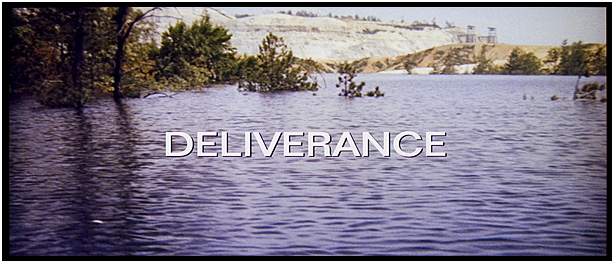
Deliverance

Deliverance (John Boorman, 1972) Let me start with an anecdote: I had a dog who was as feisty as all get-out. There's not too much he was afraid of, other than missing a meal, and, a Blue Heeler, he could be quite aggressive in protecting his perceived territory. 

I would take him camping, which he enjoyed immensely. That is, until it came time to sleep in the tent. At that point, the dog would become quite agitated, especially because he could see through the tent's mesh to the outside world. He could hear what was scrabbling about outside. He could smell anything like it was in the tent with us. Of course, he kept acting as if the whole idea was absolutely insane: "Sleep? Out here? There's nothing but some fabric to protect us! Are you crazy?" He wouldn't sleep all night—and subsequently, neither did I—as he would dutifully pace around to make sure everything was safe, especially his idiot-master who thought a tent—in the wilderness—was the same thing as a well-constructed house in the suburbs. "Are you human beings mad??!"

And the answer was—and  is—"Yes. Yes, we are."
I tell that story only because the dog realized something only a non-biped would realize--that Nature is raw and rife with a thousand natural disasters and is entirely cruel in our scheme of things. Cruel in tooth and claw, as they say. But, even so, "human" Nature's got it beat ten ways from Sunday in finding new demonstrations of cruelty. For every natural disaster we see in the headlines, the disasters imposed by man can fill out the rest of any edition of the Sunday paper.
And so Deliverance, from the novel written by the poet James Dickey that I was quite fond of back in the day...when I was a kid. I was a skinny, un-athletic little nerd with anger issues limited impulse control—what I knew about life, I learned from the movies, so I knew more about melodrama than I did about what living was like. When I read the book, it seemed an indictment of macho posturing and of the inner strength that can be brought to bear when necessity forces it upon you. For me, it seemed a hopeful book—I, too, could find my strength, when confronted by the challenges of life, despite my lack of stature and the emotional immaturity I used to supplant it. What can I say—I was a kid.
At the time Deliverance appeared in theaters I was worried about its adaptation because the simple story, of four city-boys who take on the adventure of canoeing a river about to be dammed out of existence, could have been made into a very crude film. And it skirts that by being so direct and just a shade surrealistic. The actors did their own stunts, the make-up team did some bizarrely realistic injuries that, rather than repulse, seemed almost fascinating—it looked like it hurt like hell, but fascinating nonetheless. And, under the austere direction of John Boorman, it's themes of ecology and fool-hardiness, vain-glory and finding strength where none was expected are enhanced and made into an almost mystical experience by the film-maker.
Four rather complacent suburbanites—Ed Gentry (played by Jon Voight), Lewis Medlock (Burt Reynolds), Drew Ballinger (Ronny Cox) and Bobby Trippe (Ned Beatty), spurred on by Lewis, take a weekend canoeing trip on the soon-to-be dammed Cahulawassee River. For Lewis, there is some urgency because dam construction has already started and soon, the river will cease to exist, to be replaced by a reservoir. All four want to have a weekend with some thrills and a little bit of danger to it.

The mix will be different, and with lasting effects they never counted on.
They car-pool deep into the northern Georgia woods to the river's head-waters and pay some locals to drive their trucks down to the town of Aintrey at the river's mouth where they can find them at the end of their run. It's at this section of the film that the memorable "Dueling Banjos" musical segment occurs. It's fairly apparent that the visitors and the locals don't quite see too much of value in the other.
The animosity between the locals and the "city-boys" (Lewis takes umbrage at that) gets reflected among the four once they get on the river. Lewis and Ed have had outdoors experience, but pals Drew and Bobby are newbies. Drew and Ed are in one canoe, and Lewis and Bobby are in the other. Bobby's a "good ol' boy" but not much of a man, doughy, a bit too loud, a little too easy with talking but not too much with thinking. Lewis, who is posturing and on the macho side of vain, takes a dim view of the overweight and overbearing Bobby, who is also the first to panic and the first to not take anything too seriously. Anything can be bought with a couple bucks, and in a canoe, he's more freight than power. 
This causes a change of partners in mid-stream, and in a competition about getting through some rapids, Bobby and Ed make it through first and beach their canoe to wait for the others. They wander into the shade of the forest, not knowing when they'll show up.
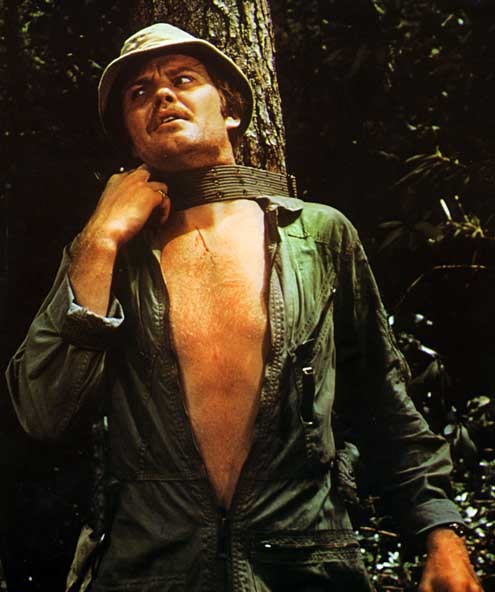
They find two hunters (Bill McKinney, Herbert Coward) who might be poaching but it doesn't matter. They have the drop on Ed and Bobby, and they take advantage of it, threatening with shotguns and attitude. Bobby tries to buy them off, but it just makes them more contemptuous. They take off Ed's belt and neck-tie him to a tree, rendering him immobile, and then they go after Bobby, ordering him to strip and man-handling him before assaulting him. Ed can only watch in horror, knowing that he's next, when he sees something in the trees.
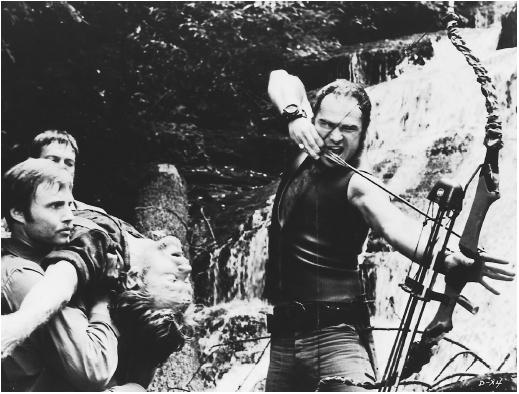
It's Lewis, bow drawn, taking aim. One of the men is shot full through the chest and can only look at the bloody blade of the arrow in disbelief, as he slowly staggers and dies, his accomplice running off into the woods. Lewis starts to think about the next step, as the other three try to pull themselves together. Drew is for reporting what happened to the authorities, but Lewis is against it, thinking they should bury the body instead, and let the reservoir complete the work hiding the body under tons of water. Drew is aghast, but Lewis argues that local justice and clan-vengeance will work against them. And he likes his freedom. Bobby is all for the burial, and Lewis leaves it up to Ed—if he sides with Drew, he'll abide by it, but if it's the burial, it's three votes to one. 
Ed chooses to bury the body. The four take the body of the hunter and bury near the edge of the river, where they're sure the reservoir will hide the body. Lewis fires the killing arrow deep into the river, and the four beat a hasty retreat for Aintrey through the roughest, loudest parts of the river. At one point, Ed looks back at Lewis and he's shouting something desperately, trying to be heard over the river, urging them to move fast through the rapids, and just when they approach the roughest part, drew suddenly lurches forward and is lost in the river.
Bobby and Lewis' canoe crashes into rocks and is split in two and Lewis is thrown into the river, breaking his leg in the process. Bobby and Ed drag him to the edge of the river and through his screams of pain, Lewis tells Ed that he saw something in the cliffs above him when they were going through the rapids, and he's convinced that Drew was shot. Perhaps it was the other poacher, but maybe not. Whichever way it turns, Lewis is sure they were targeted. If that's true, they're trapped there. Somebody has to climb the cliffs and confront the shooter. Given the circumstances, it can only be Ed.
Under cover of darkness, Ed makes his way up the cliff with the bow and arrows—if he falls, he could be killed. If he makes it to the top, he could be killed. But, the situation is desperate and there is no other choice. His friends depend on him, or everybody dies. 
At dawn, exhausted, Ed wakes up to see a distant man with a shotgun, looking down towards the river. Trying to escape notice (which he doesn't), he draws a bead on his target, but his hands shake and wobble under the strain of the bow and the act he must perform; he is not expert with the bow as Lewis is, and an earlier attempt to shoot a deer ended in failure, both because of his lack of strength and an unwillingness to kill. But that was then. This is now...more than ever.
It can't be Lewis, although Lewis would have carried it off. But, Lewis' skills are useless now. It has to be Ed, and there can be no weakness, no doubt, and no hesitation. The word "deliverance" has the meaning "the action of being rescued or set free." "Liberation." "Emancipation." And it comes down to one character to achieve it...for others and in himself.
The situation is simple, primal—man vs. Nature and man vs. man, but ambiguous, both morally and circumstantially, played out under extreme conditions with extreme consequences, and under duress, where hap-hazard thinking or action could doom them all. It must be carried out by one individual only marginally capable of it, and on whose shoulders, the solutions must weigh. 
Boorman accentuates the danger of the surroundings by avoiding clearings and staging so many scenes in the middle of the forest, with a restless camera that shifts perspective around trees, through brush, moving the formations of them around, to the point where you think you can see things in the patterns of the woods. at times you can't see the horrors for the trees, and it's as much a participant as the characters, so enveloping is its dark presence. 
And Boorman presents tangible, visceral horrors not present in the book-- a mountain man newly killed falling forward into the crotch of a small tree and remaining upright; macho Lewis pulling an arrow, slowly, excruciatingly, out of the breast-bone of a backwoods attacker ("Where'd the fletches go..." I thought when the act was done); the exaggerated horror of the men's injuries--the broken thigh-bone that pierces Lewis' leg (Reynolds does an incredible job undercutting his character's uber-stage-manliness with some of the most blood-curdling whimpering I've ever heard), the dislocated shoulder of Drew that has the man cradling his own head, sitting, weirdly on a rock out-crop, and Ed pulling an arrow out of his side to prepare for his final show-down below a sky that simmers in a yellow exposure-pushed sky. We won't even talk about how good and how brave Ned Beatty is. And it was his first film (as Reynolds generously points in interviews these days about what he considers the best work in the film).
If there is a weak performance at all in Deliverance it's by author Dickey as the seething Sheriff who's just a little too-unsubtle in his suggestions. Voight, Beatty, and Cox do great work, and, forgoing insurance, did their own rafting stunts. But Reynolds is terrific in his role, totally dominating the first half of the film, and, though out of action for the rest of the movie, still makes an impression. Hollywood may have a problem with him (doesn't take them...or himself...too seriously, perhaps?) but it would be nice to acknowledge that he can give gifted performances when gifted with good scripts.
In 2008, The Library of Congress chose Deliverance as one of the significant films to be added to the Film Registry.


Thursday, January 25, 2018

Olde Review: Midnight Cowboy

This was part of a series of reviews of the ASUW Film series back in the '70's. Except for some punctuation, I haven't changed anything from the way it was presented, giving the snarky, clueless kid I was back in the '70's a break. Any stray thoughts and updates I've included with the inevitable asterisked post-scripts.

This particular one is a companion piece to the review of The Sound of Trumpets broadcast on KCMU-FM.


Midnight Cowboy (John Schlesinger, 1969) Midnight Cowboy is a film that has been vastly over-rated over the years. So has its director, John Schlesinger. I haven't seen one film of his that has been consistent—content-wise, or quality. Admittedly, Schlesinger does do some great things in his films. but never for long, and that goes for Far from the Madding Crowd, Darling, his marathon sequence in Visions of Eight, and especially last year's The Day of the Locust. Schlesinger couldn't even pull off a simple thriller like Marathon Man without laying it over with unnecessary cross-cutting and lead-balloon pretensions.

The problem? Schlesinger is a cold director and this coldness of attitude combined with a certain heavy-handedness in technique bring movement, but not life, to the subject matter. Add to this Schlesinger's off-and-on fascination with grotesques—as in Midnight Cowboy—and the situation is nearly impossible.


Midnight Cowboy begins well enough, with a rather multi-layered shot of an empty drive-in movie screen overlapped by the sound of thundering hooves. But not from the screen. From a nearby corral. Joe Buck is leaving the farm to go to New York; putting himself out to stud, so to speak. And Joe Buck's bus-trip to New York is very enjoyable with the exception of some coy flashbacks. But once the Big Apple has been reached, Schlesinger begins to feel the need to be...satirical. And his satire has all the subtlety of a brick through a window, as opposed to the subtlety of The Sound of Trumpets.

Jon Voight gives a fine performance. Dustin Hoffman is all right (but his limp keeps changing, and Schlesinger keeps drawing attention to it!) But, above all, the best thing about Midnight Cowboy is the music for the film by John Barry, whose scores include those for the James Bond films and Born Free. His music provided the best satire, the most feeling, and the best humor in the film. One of these days, I'm going to have to do a tribute to him.

Broadcast on KCMU-FM December 5th and 6th, 1976

That last bit referred to film score tributes, basically three minutes in length, that I did for the station. Barry's died in 2011, his last score being for the Michael Apted film Enigma. He didn't score the whole of Midnight Cowboy but he supervised the music, picking and producing the songs, and writing bits and pieces of score that worked gang-busters in the film. If you want something of a tribute, you can find it here: John Barry.
Frequently, when typing up these elderly reviews from a kid I can't even remember being, I've always resisted the urge to change them, edit them, correct them—but I don't. Or I've wished I could go back in time to tell this little twerp what exactly is wrong with his opinion, and I felt that urge this time when I started reading the review. After all, 1) Schlesinger did settle down and do some good things later in his career, and 2) Midnight Cowboy remains to this day the only X-rated film to win the Best Picture Oscar, and 3) it's still considered a "classic." I may not like it, but the Wisdom of the Tribe has spoken and one shouldn't discount it, no matter how "blinkerdly pig-ignorant" it might be (thanks to Monty Python for the phrase).

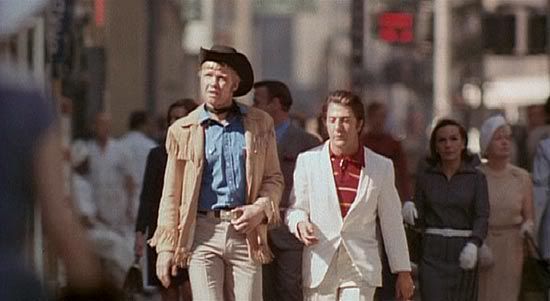
But, have you sat through it lately? I mean, sat through all of it? Midnight Cowboy is a mess, jobbing about from one bit to another, and all the parts that are endlessly played on clip shows ("I'm walkin' heyah!," the final bus ride, Joe Buck's walk through the crowded streets of New York, including satire alert-satire alert the guy who's been assaulted (presumably) lying in the street and everybody's walkin' to the tune of "Everybody's Talkin'"—written by Fred Neil, sung by Nilsson—right by him and....that's about it), those are the parts that people remember and inform their opinion about the whole of the film. Maybe, just maybe, people have a better opinion of the film because they're expected to. It's a counter-culture classic, after all, like Easy Rider (and we all know what a masterpiece that is! sarcasm alert) Reading through this review, I went from "You're being too harsh" to "Yeah, point taken." The things that bug me about Midnight Cowboy are the same things that bugged me then, and it had to do with direction, inconsistency, and just the gosh-awful look of some of those sequences, not to mention a tone-deafness that came, possibly, from Schlesinger, a Brit, observing the terrain of New York and wanting to emphasize it more for the folks back home. It's like Schlesinger took Mike Nichols' bag of tricks from The Graduate and decided to use them poorly. 

I'm surprised it won Best Picture, actually.

What was nominated for Best Picture that year? Anne of the Thousand Days, Butch Cassidy and the Sundance Kid, Hello, Dolly, and Z.
 

.............well, given those choices, maybe I'm not surprised it won, then (though Z is a good film).