Showing posts with label Adventure. Show all posts

Tuesday, January 3, 2023

Captain Horatio Hornblower (R.N.)

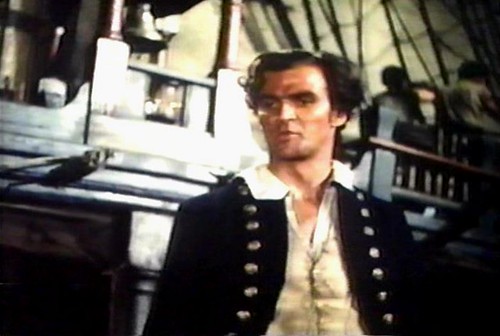
Captain Horatio Hornblower (R.N.)* (Raoul Walsh, 1951) Supposedly C.S. Forester himself adapted his first three Hornblower novels to make the screen-story for this swashbuckling distillation of the Royal Navy's fictional hero. It is 1805, and his majesty has sent the HMS Lydia on a secret mission. England is at war with Spain and France, and Hornblower must enlist the aid of a mad South American dictator in the war efforts a world away. But, upon arriving, Hornblower's distaste for the assignment and the "El Supremo" (Alec Mango) has him violating the Admiralty's standard orders, and when he captures the massive El Natividad (commanded by a very young Christopher Lee), he is forced to turn over the ship to the mad-man. Heading for home, he finds out that Spain is now England's ally (oops!) and he must re-take the massive ship on open seas, risking his crew and an unwanted passenger, Her Ladyship Barbara Wellesley (Virginia Mayo), sister to tthe Duke of Wellington and betrothed to Admiral Leighton (Denis O'Dea).
The crew is very British (
including a young Stanley Baker), but its Captain is played by the very American Gregory Peck
,** ramrod-stiff and stoic, so even though the accent is wrong, the attitude is just so—Forrester's Hornblower is a stoic, constantly questioning himself and his failings, reflected in his constant lecturing and drilling of his crew. And Raoul Walsh is the perfect man to direct, as the action director has a keen eye toward the psychological and characters with complicated motivations. Peck has the attitude, but is a bit uneasy when called upon to display the comical aspects of the still-upper-lip Hornblower—his uneasy "harumphs" are constantly dubbed in to make more of them than Peck could convey on-set. But for the brooding and irritation (and the authoritarian air), Peck is fine.
The battles are well-choreographed for the times—one can practically see the wires yanking pieces of ship-railing past the players—and sometimes the falling masts and ropes get a little out of control, but the model-work and staging are excitingly done. A fine way to spend a rainy afternoon.

* The added "R.N." because the British version of the title included them, the American did not. As with the recent Master and Commander, nothing is made of Hornblower maybe having to fight the American Navy, as he might have seven years in the future.
 
** The screen-rights were acquired for a vehicle for Errol Flynn, but after Flynn's previous movies had poor ticket sales (and the actor was proving difficult to manage), other actors (including Burt Lancaster) were considered. Peck got the part. Lancaster would star in The Crimson Pirate the next year.

Thursday, July 28, 2022

Mogambo

Mogambo  (John Ford, 1953) It's good to be The King. When you're Clark Gable, King of Hollywood, you can forgive a lot of shortcomings on the acting front. Mogambo, situated in Africa, and for a large part photographed there, makes Gable the King of the Jungle and no less predatory than some of the denizens. If the film has a shortcoming, and it has a few, it's that it depends so much on Gable's charisma to carry what is essentially an under-written "man's man" of a role—one who will take a woman in his arms and plant one with a mere change in the barometer, his, hers or Nature's. Gable's Vic Marswell is so fragile in his moods, he's practically bi-polar, swinging from cranky to rapacious to "I don't care," running hot and cold and more than a little unreadable either way. And for the women in the film, Eloise "Honey Bear" Kelly (a plucky Ava Gardner), a recklessly adventurous widow—she has a great summing-up line: "There's a lot of snarling in this joint!"—and Lina Nordley (Grace Kelly, still in her neurotic, fragile period), wife of Marswell's current client, it creates a weird triangle that I.Sosceles himself couldn't figure out. 
Maybe it's the heat of Africa, or maybe it's the wild life of the wildlife, but both of these women, with lots going for them, still neurotically slam themselves like meteors into Winslow's orbit. And while the heat and flash are nice, things burn out mighty quick. And the only explanation is "it's Gable," in a writer's shorthand that defies logic, common sense, or understandable motivation (other than box-office). It's just assumed that any woman's going to throw themselves at the King, no matter how much of a tiger trap he might be.
That shaky "given" aside, it's a nice adventure entertainment, directed by John Ford with a painterly eye trained on a new canvas. The Technicolor cinematography—by Freddie Young (doing the English studio shots) and Robert Surtees—is absolutely gorgeous, whether in the blinding sunlight of a native village, or the shadowy slats of a "civilized" encampment (The film's second unit was directed by famed stunt-man Yakima Canutt). Ford is a long way from the locations he favored in his Westerns, but adjusts, employing his fascination with native culture in the same diversions of including the faces of the tribes, distinguishing them from each other and, in a single set up, putting the flavor of the place on obvious display. He's truly recharged and energized by Africa, his camera roaming all over, finding the picturesque and telling details.
*

And it's interesting to note (to me, anyway) that Ford is essentially making a Howard Hawks movie: a group of professionals and semi-professionals trying to eke out a living (and a kind of focused community) despite their differences. Hawks and Ford would knowingly tip their hats to each other in their projects—if it didn't interfere with their own process—and there are a lot of the Hawks hallmarks here—the group sing-along, the loaning and sharing of a cigarette as relationship sub-text, the strong females (one of whom is "just one of the boys"), and the alpha male who has a code, few words, and manages to mangle them around the opposite sex.
**

Even if the emotions run a little too high and there's way too much drama to get any real work done, there's a lot in Mogambo to like, that is pleasing to the eye. The story's not much, but it sure is interesting to see how Ford tells it.


Gardner and Kelly-revealed in their environments


* One of my favorite shots is a simple one of Gable and company walking the high grass on a trapping trip, shot at ground level, looking up through the wisps at the party.  How much less interesting would that shot have been from any other angle?  How much less would it have said about the conditions there, while making the most of the surroundings?  Ah, I'm probably getting all "academic" here.  Ford probably shot it that way to avoid seeing a garbage heap in the distance.  

** Hawks made his own version of the "African trapper" story—Hatari—ten years later with John Wayne (although internet sources say Gable was to co-star "but who believes the Internet?") with a more cohesive group (the kids have the relationship problems, not the leader) turning the story into a metaphor for a film-making crew).  The differences are night and day—in style and atmosphere—despite the similarities in subject matter.  In Hawks, the relationships are background, while the job is center-stage.  In Ford, it's the other way around.  They'd make an interesting double-bill.

Wednesday, June 23, 2021

Robin Hood (2010)

I mentioned Ridley Scott's version of the "Robin Hood" story last week (which started as a screenplay called "Nottingham"). Here is a review of the resulting film, written at the time of its release.

"Rise...and Rise Again...and Again...and Again"

Every fifteen years or so, there must be a big budget remake of the "Robin Hood" legend—that's a bit less than the turnaround cycle for The Compleate Works of Jane Austen. The last time the fletches flew on the big screen there were two competing Hoods—the flashy Kevin Reynolds/Kevin Costner version and one starring Patrick Bergin. Before them was Robin and Marian, various series, and The Adventures of Robin Hood, the Warner Bros. classic with Errol Flynn, which was itself a remake of silent versions. Then, there have been satiric vignettes in Shrek and Time Bandits,* Mel Brooks

has done a movie (Men in Tights) AND a series ("When Things Were Rotten")—Mel loves his Public Domain. Disney has touched on it a couple times as well, including an animated funny animals version.
The character and his ancillary co-stars have a long oral tradition with many variations of "The Hode," so it's natural that someone drums him up for another "Have at ye" every few years, each reflecting the times in which they were made. Robin has been yeoman and nobleman, Crusader and thief, trickster and military man, young and old.
Although we've been down this well-trod pathe in the glenne before, it was interesting to think about what the
Gladiator team of Ridley Scott and Russell Crowe could do with the story, and how they would approach it. And the answer is: with a little bit of everything. Scott with the help of scenarist Brian Helgeland** has a Robin Hood, an orphan Saxon Crusading with Richard the Lionheart (Danny Huston-he's great in this), who's an expert bowman and strategist by day, and a grifter by night. At the end of the Crusades, he is given a task, the complications of which lead him to Nottingham and the masquerade of being Robert Loxley, slain son of Sir Walter Loxley (Max von Sydow) and spouse of Lady Marian Loxley (Cate Blanchett)—this Robin is both commoner and gentry.
The Sheriff of Nottingham (
Matthew McFadyen) is not given much to do this time 'round, instead the intrigues are by Sir Godfrey (Mark Strong) and King Phillip of France, who plot to undermine the already shaky reign of the new King John (
Oscar Isaac), the last son of King Henry and Eleanor of Aquitaine (Eileen Atkins), and invade England.
The general structure of Robin Hood is superficially similar to “Gladiator” with big battles at both ends, and Scott uses the same stutter-shutter technique to give some verve to the action scenes. But there it ends. Crowe is considerably lighter as Robin Hood, though he does summon up genuine moments of drama. Performances are fine all around with Cate Blanchett and William Hurt (as William Marshall, the first Earl of Pembroke) being stand-outs. But the best performance is by Max von Sydow as the elderly Sir Walter. Blind, but nobody’s fool, Sir Walter takes the news of his son’s death with grim determination and courtesy for its messenger, and comes up with the Robin-as-Loxley ruse to protect Marion from having their land confiscated should he die. Von Sydow has been ill-used of late, playing teutonic villains of similar coldness, but this role shows him at full thespian power, and it would be robbery if he was not nominated for an Oscar for this performance.
The film boasts good values all around, with Scott’s keen eye for cinematography and detail, the writing is clever and often ingenious (I think the fact that it's
another Robin Hood movie sours a lot of people's expectations). The film never drags and offers considerable entertainment value. Only at the end does it falter, with a beach battle that seems overly-stretched in terms of production value and credibility. Either there was not enough planning or extras, but it looks to be constructed to not show something as opposed to creating an epic battle. Too much is made of the presence of landing craft as obstacles, and of one particular participant in the clamor, which seems to be done for scoring political points rather than good story-telling. 

But that is twenty minutes out of 140. For the most part, this new Robin Hood hits its mark. Yes, it might be superfluous (we can say this—with a straight face—with so many sequels headed our way?), but what's there on the screen is an interesting "take" on the legend that has lasted so long.

* John Cleese's immaculate nobleman with a "Bonny Prince Charlie" manner is one of my favorites.

** The original script, by the team of Ethan Rieff and Cyrus Voris, called "Nottingham," was more radical, but interesting in a concept-twist kind of way, but once Ridley Scott came on board, the concept changed.

Thursday, September 6, 2018

The Scarlet Pimpernel (1934)

The Scarlet Pimpernel (Harold Young, 1934) The classic tale of the foppish member of the elite aristocracy who disguises himself to fight the despotic powers for the good of all. No, it's not Don Diego or Bruce Wayne. It's Sir Percy Blakeney, aka the Scarlet Pimpernel (Leslie Howard), master of disguise and master tactician, who, with his loyal League of the Pimpernel, in the case of this film, frees French noblemen from the ruffians of Robespierre during the French Revolution, circa 1792.  

Waitaminnit! Attendre! The ruffians of Robespierre WERE the common people! All too common as it turns out, as director Young and scripters Robert Sherwood, Lajos Biro and S.N. Behrman would have you believe, demonstrated by the common cruelty of the throng awaiting noble be-headings at the guillotine, distracting themselves with knitting, stuffing their faces, and the things most people do during opening acts at a country fair. Such very public gatherings—and executions—make it very difficult to do any serious rescuing, especially when you have the evil Chauvelin (Raymond Massey), the new ambassador to Britain and enforcer for Robespierre (Ernest Milton) himself, breathing down your neck. And necks were very fragile things during the Reign of Terror.
In other words, it's hard out there for a pimpernel.

But, wait, wait, wait. Hold on there, citizens. The Pimpernel isn't Batman. He isn't Zorro or Robin Hood. He's a member of the aristocracy fighting for the aristocracy. Those other guys are examples of the privileged fighting for the common man. The pimpernel doesn't give a pinch of snuff for them. Nope, he's protecting elites who've been caught up in the Revolution against monarchy, authoritarianism by both aristocracy and clergy, as well as against slavery. He's on the wrong side of History, but I suppose when allies, friends and relatives are facing a blade in the village square, higher ideals and an Age of Reason seem a little dull by comparison.

This is because the stories of The Scarlet Pimpernel were written by the Baroness Emmuska Orczy, who knew something of revolutions, he family having fled their native Hungary in 1868, fearing a peasant uprising. The Baroness settled in London, and married an artist named Montague MacLean Barstow, and although it was a happy marriage, Barstow's career as an illustrator did not keep the Baroness in the manner to which she had grown up accustomed. She began to write, somewhat successfully, but she didn't achieve any real success until the two collaborated on a play about the Pimpernel, based on one of her short stories. That play ran for four years, and her novelization of it became a best-seller, inspiring a continuing series of books, and allowed her to buy a villa in Monte Carlo, where she spent most of the remainder of her life.
So, the Baroness' sympathies weren't exactly with democratic ideals, preferring the joys of imperialism and militarism. So, of course, (given her history) she would side with the aristocracy, rather than with the peasants. After all, they can always eat cake. It's just that a guillotine is rather impractical to slice it with. So, no, the Pimpernel is not for the common good unless it's to preserve the status quo. He wouldn't do well in America.

But, then again, these days, he might.
But, where the Baroness did have a good idea was an invention that might have been partially inspired by the works of Edmond Rostan and Alexandre Dumas, that of the "secret identity" (that is taken for granted in today's super-suffused culture). In order to do "what must be done," the hero operates outside the law, which has every inclination to suppress him for their survival. And so, he must operate in disguise, live a double life, so that his actions cannot be detected by the behavior of his "other life." It is also to protect friends, family, and lovers from being used as pawns against him.
But, even here, the Baroness has an odd wrinkle—for Percy Blakeney, English baronet, is married to the Lady Marguerite (the spectacularly photogenic Merle Oberon), both French and aristocratic by birth, and even though her brother is suspected of being in the Pimpernel's infernal "League," she has no idea that her foppish husband could be the daring Pimpernel (doesn't she wonder about any unexplained absences? Could she be suffering from "Lois Lane blindness?"). Her suspected ties to the Pimpernel (oh, if they only knew) makes her just the sort of weapon that can be used against him, and so her friend, the Chauvelin coerces her to try and find out the true identity of his nemesis. At one point, she actually sends her husband into a trap and only realizes the truth and what she's done in time to warn him.
Of course, there wouldn't be a series of books if he got caught, and the black hat/white hat dichotomy is so starkly presented that no one in their right mind would favor Raymond Massey's fortunes over Leslie Howard's. And so, the Pimpernel persists into legend.

We seek him here, we seek him there, 
Those Frenchies seek him everywhere. 
Is he in heaven? — Is he in hell? 
That damned, elusive Pimpernel 

Thursday, July 26, 2018

Deliverance

Deliverance (John Boorman, 1972) Let me start with an anecdote: I had a dog who was as feisty as all get-out. There's not too much he was afraid of, other than missing a meal, and, a Blue Heeler, he could be quite aggressive in protecting his perceived territory. 

I would take him camping, which he enjoyed immensely. That is, until it came time to sleep in the tent. At that point, the dog would become quite agitated, especially because he could see through the tent's mesh to the outside world. He could hear what was scrabbling about outside. He could smell anything like it was in the tent with us. Of course, he kept acting as if the whole idea was absolutely insane: "Sleep? Out here? There's nothing but some fabric to protect us! Are you crazy?" He wouldn't sleep all night—and subsequently, neither did I—as he would dutifully pace around to make sure everything was safe, especially his idiot-master who thought a tent—in the wilderness—was the same thing as a well-constructed house in the suburbs. "Are you human beings mad??!"

And the answer was—and  is—"Yes. Yes, we are."
I tell that story only because the dog realized something only a non-biped would realize--that Nature is raw and rife with a thousand natural disasters and is entirely cruel in our scheme of things. Cruel in tooth and claw, as they say. But, even so, "human" Nature's got it beat ten ways from Sunday in finding new demonstrations of cruelty. For every natural disaster we see in the headlines, the disasters imposed by man can fill out the rest of any edition of the Sunday paper.
And so Deliverance, from the novel written by the poet James Dickey that I was quite fond of back in the day...when I was a kid. I was a skinny, un-athletic little nerd with anger issues limited impulse control—what I knew about life, I learned from the movies, so I knew more about melodrama than I did about what living was like. When I read the book, it seemed an indictment of macho posturing and of the inner strength that can be brought to bear when necessity forces it upon you. For me, it seemed a hopeful book—I, too, could find my strength, when confronted by the challenges of life, despite my lack of stature and the emotional immaturity I used to supplant it. What can I say—I was a kid.
At the time Deliverance appeared in theaters I was worried about its adaptation because the simple story, of four city-boys who take on the adventure of canoeing a river about to be dammed out of existence, could have been made into a very crude film. And it skirts that by being so direct and just a shade surrealistic. The actors did their own stunts, the make-up team did some bizarrely realistic injuries that, rather than repulse, seemed almost fascinating—it looked like it hurt like hell, but fascinating nonetheless. And, under the austere direction of John Boorman, it's themes of ecology and fool-hardiness, vain-glory and finding strength where none was expected are enhanced and made into an almost mystical experience by the film-maker.
Four rather complacent suburbanites—Ed Gentry (played by Jon Voight), Lewis Medlock (Burt Reynolds), Drew Ballinger (Ronny Cox) and Bobby Trippe (Ned Beatty), spurred on by Lewis, take a weekend canoeing trip on the soon-to-be dammed Cahulawassee River. For Lewis, there is some urgency because dam construction has already started and soon, the river will cease to exist, to be replaced by a reservoir. All four want to have a weekend with some thrills and a little bit of danger to it.

The mix will be different, and with lasting effects they never counted on.
They car-pool deep into the northern Georgia woods to the river's head-waters and pay some locals to drive their trucks down to the town of Aintrey at the river's mouth where they can find them at the end of their run. It's at this section of the film that the memorable "Dueling Banjos" musical segment occurs. It's fairly apparent that the visitors and the locals don't quite see too much of value in the other.
The animosity between the locals and the "city-boys" (Lewis takes umbrage at that) gets reflected among the four once they get on the river. Lewis and Ed have had outdoors experience, but pals Drew and Bobby are newbies. Drew and Ed are in one canoe, and Lewis and Bobby are in the other. Bobby's a "good ol' boy" but not much of a man, doughy, a bit too loud, a little too easy with talking but not too much with thinking. Lewis, who is posturing and on the macho side of vain, takes a dim view of the overweight and overbearing Bobby, who is also the first to panic and the first to not take anything too seriously. Anything can be bought with a couple bucks, and in a canoe, he's more freight than power. 
This causes a change of partners in mid-stream, and in a competition about getting through some rapids, Bobby and Ed make it through first and beach their canoe to wait for the others. They wander into the shade of the forest, not knowing when they'll show up.
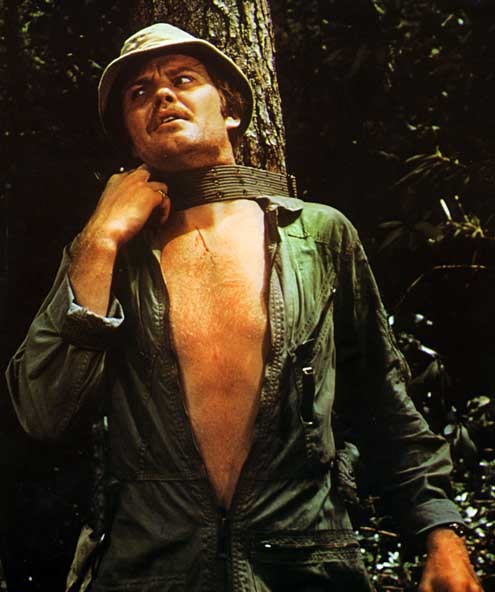
They find two hunters (Bill McKinney, Herbert Coward) who might be poaching but it doesn't matter. They have the drop on Ed and Bobby, and they take advantage of it, threatening with shotguns and attitude. Bobby tries to buy them off, but it just makes them more contemptuous. They take off Ed's belt and neck-tie him to a tree, rendering him immobile, and then they go after Bobby, ordering him to strip and man-handling him before assaulting him. Ed can only watch in horror, knowing that he's next, when he sees something in the trees.
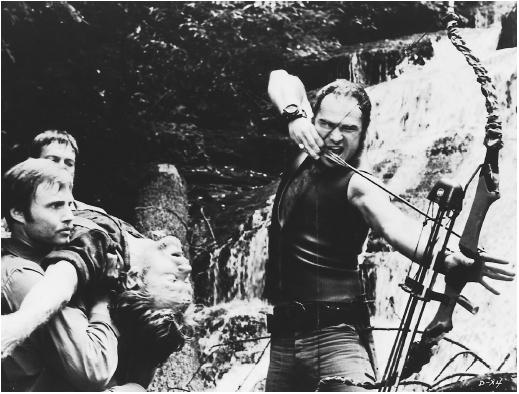
It's Lewis, bow drawn, taking aim. One of the men is shot full through the chest and can only look at the bloody blade of the arrow in disbelief, as he slowly staggers and dies, his accomplice running off into the woods. Lewis starts to think about the next step, as the other three try to pull themselves together. Drew is for reporting what happened to the authorities, but Lewis is against it, thinking they should bury the body instead, and let the reservoir complete the work hiding the body under tons of water. Drew is aghast, but Lewis argues that local justice and clan-vengeance will work against them. And he likes his freedom. Bobby is all for the burial, and Lewis leaves it up to Ed—if he sides with Drew, he'll abide by it, but if it's the burial, it's three votes to one. 
Ed chooses to bury the body. The four take the body of the hunter and bury near the edge of the river, where they're sure the reservoir will hide the body. Lewis fires the killing arrow deep into the river, and the four beat a hasty retreat for Aintrey through the roughest, loudest parts of the river. At one point, Ed looks back at Lewis and he's shouting something desperately, trying to be heard over the river, urging them to move fast through the rapids, and just when they approach the roughest part, drew suddenly lurches forward and is lost in the river.
Bobby and Lewis' canoe crashes into rocks and is split in two and Lewis is thrown into the river, breaking his leg in the process. Bobby and Ed drag him to the edge of the river and through his screams of pain, Lewis tells Ed that he saw something in the cliffs above him when they were going through the rapids, and he's convinced that Drew was shot. Perhaps it was the other poacher, but maybe not. Whichever way it turns, Lewis is sure they were targeted. If that's true, they're trapped there. Somebody has to climb the cliffs and confront the shooter. Given the circumstances, it can only be Ed.
Under cover of darkness, Ed makes his way up the cliff with the bow and arrows—if he falls, he could be killed. If he makes it to the top, he could be killed. But, the situation is desperate and there is no other choice. His friends depend on him, or everybody dies. 
At dawn, exhausted, Ed wakes up to see a distant man with a shotgun, looking down towards the river. Trying to escape notice (which he doesn't), he draws a bead on his target, but his hands shake and wobble under the strain of the bow and the act he must perform; he is not expert with the bow as Lewis is, and an earlier attempt to shoot a deer ended in failure, both because of his lack of strength and an unwillingness to kill. But that was then. This is now...more than ever.
It can't be Lewis, although Lewis would have carried it off. But, Lewis' skills are useless now. It has to be Ed, and there can be no weakness, no doubt, and no hesitation. The word "deliverance" has the meaning "the action of being rescued or set free." "Liberation." "Emancipation." And it comes down to one character to achieve it...for others and in himself.
The situation is simple, primal—man vs. Nature and man vs. man, but ambiguous, both morally and circumstantially, played out under extreme conditions with extreme consequences, and under duress, where hap-hazard thinking or action could doom them all. It must be carried out by one individual only marginally capable of it, and on whose shoulders, the solutions must weigh. 
Boorman accentuates the danger of the surroundings by avoiding clearings and staging so many scenes in the middle of the forest, with a restless camera that shifts perspective around trees, through brush, moving the formations of them around, to the point where you think you can see things in the patterns of the woods. at times you can't see the horrors for the trees, and it's as much a participant as the characters, so enveloping is its dark presence. 
And Boorman presents tangible, visceral horrors not present in the book-- a mountain man newly killed falling forward into the crotch of a small tree and remaining upright; macho Lewis pulling an arrow, slowly, excruciatingly, out of the breast-bone of a backwoods attacker ("Where'd the fletches go..." I thought when the act was done); the exaggerated horror of the men's injuries--the broken thigh-bone that pierces Lewis' leg (Reynolds does an incredible job undercutting his character's uber-stage-manliness with some of the most blood-curdling whimpering I've ever heard), the dislocated shoulder of Drew that has the man cradling his own head, sitting, weirdly on a rock out-crop, and Ed pulling an arrow out of his side to prepare for his final show-down below a sky that simmers in a yellow exposure-pushed sky. We won't even talk about how good and how brave Ned Beatty is. And it was his first film (as Reynolds generously points in interviews these days about what he considers the best work in the film).
If there is a weak performance at all in Deliverance it's by author Dickey as the seething Sheriff who's just a little too-unsubtle in his suggestions. Voight, Beatty, and Cox do great work, and, forgoing insurance, did their own rafting stunts. But Reynolds is terrific in his role, totally dominating the first half of the film, and, though out of action for the rest of the movie, still makes an impression. Hollywood may have a problem with him (doesn't take them...or himself...too seriously, perhaps?) but it would be nice to acknowledge that he can give gifted performances when gifted with good scripts.
In 2008, The Library of Congress chose Deliverance as one of the significant films to be added to the Film Registry.


Thursday, May 31, 2018

Northwest Passage: Book 1 - Roger's Rangers

Northwest Passage: Book 1- Roger's Rangers (King Vidor, 1940) The posters warned Northwest Passage was "Not Suitable for Children" which it might be, with its stories of atrocities, men who fight with muskets and axes, and the "good of the many" philosophy. But, it's such a "Boy's Own" adventure...if "for" adults...that one is tempted to dismiss the warning. But, one does so at their peril.

It's 1759, during the French and Indian Wars (look it up) in North America, and young Langdon Towne (Robert Young) has come back to Portsmouth, New Hampshire from Harvard (after being expelled) to ask the hand of his sweetheart, Elizabeth Browne (Ruth Hussey). Bad timing. Beyond that, Dad Browne, a clergyman, thinks Towne's profession, an artist, is a poor prospect for his precious daughter, and Langdon, rebuffed, goes out and does what any young man would do under the circumstances—he goes out to the local pub and insults the local British constabulary...who just so happen to overhear him from the next room. With the help of "Hunk" Marriner (Walter Brennan), friend and fellow flagon-drainer, the two manage to get in a fight with the two red-coats (to avoid being arrested) and are soon on the lam.
On the lam to another bar, that is. If Mr. Browne thought Langdon was lousy husband material before, it's a good thing he isn't around to look down his nose at this. At that rustic pub, they meet Major Robert Rogers (Spencer Tracy) who treats the two fugitives to his favorite drink, "Flip," and tales of his explorations. The stories are very good, but the rum must be better, because the next morning they wake up at Fort Crown Point as recruits for Rogers' latest mission—to take on the Abenakis native tribe and stop the French at the town of St. Francis, the starting point for a lot of attacks on "civilized" settlements. Langdon's secondary mission, and apparent only usefulness, is to map the route for future expeditions...and posterity. 
That is...if he survives. That trek is arduous, even without the man-made hazards along the way (director Vidor filmed in the wilds of Idaho), which are recounted in vivid excruciating detail. 142 men start on the mission, which starts out with the best of intentions and the best of planning, but Nature has a way of upending plans and what Nature doesn't delay, men and happenstance will.
After taking whaling boats up Lake Champlain, Rogers and troop hoofs it to make their way up to St. Francis, fully expecting to be able to meet up with the boats at the end of the expedition and fully expecting for their provisions to last the journey...with hunting being the fall-back. But rifle-fire will give away their position, so they have to make do with rationing what they have and what they haven't lost. Men are lost to attack and to injury, and rather than continue with the troop, slowing them down and leaving them vulnerable, they are merely left...to fend for themselves or die trying...or not trying.
It's a more dangerous version of The Lost Patrol, with the men gradually being picked off, moving forward even when they're convinced they have no chance of success, their return-boats and extra provisions stolen, and finally making it to St. Francis, where they stage an attack so intense and complete that they've become indistinguishable—in methods and ferocity—from the very people they've condemned as savages. There is no parsing for cause or motivation. It's just "kill 'em quick and kill 'em dead" where by flintlock, bayonet or tomahawk, and, just as with the men they've left behind, there's no time for funerals. If there's any message to be sent it's in the mutilated bodies and burning village.
But, that burning village is sure to be noticed from a distance. And with their left-behind provisions already taken and no food to be had except for dried corn in the village, the Rangers attempt to get to the closest fort, Fort Wentworth, and hope that they're met by re-enforcements and food. In the hope that they can find fishing and game, they head to Fort Wentworth by way of Lake Memphremagog, only to find they shouldn't tarry as there are signs that the French are nearby. Staggering behind them is Langdon, shot during the battle at St. Francis ("First thing I've had in my stomach for days...") and unwilling to be left behind.

Leave it at that. The travails of Northwest Passage only get worse—and even plunge deep into the macabre as mutiny, insanity and cannibalism all work against Rogers' increasingly hollow "only a few miles left, men" optimism. "A Boys Own" adventure? Hardly. It is tough, unrelenting in its depiction and description of the hard-scrabble life and "take no prisoners" racial hatred in the early "civilized" days of the country. And despite its eye-popping photography, the expense of the location Technicolor work kept the movie from making a profit and cancelled any attempts to make a "Book 2." Still, an interesting, troubling, starkly surprising film that makes you amazed at what "they" got away with back in the studio days.