Showing posts with label Grace Kelly. Show all posts

Thursday, July 28, 2022

Mogambo

Mogambo  (John Ford, 1953) It's good to be The King. When you're Clark Gable, King of Hollywood, you can forgive a lot of shortcomings on the acting front. Mogambo, situated in Africa, and for a large part photographed there, makes Gable the King of the Jungle and no less predatory than some of the denizens. If the film has a shortcoming, and it has a few, it's that it depends so much on Gable's charisma to carry what is essentially an under-written "man's man" of a role—one who will take a woman in his arms and plant one with a mere change in the barometer, his, hers or Nature's. Gable's Vic Marswell is so fragile in his moods, he's practically bi-polar, swinging from cranky to rapacious to "I don't care," running hot and cold and more than a little unreadable either way. And for the women in the film, Eloise "Honey Bear" Kelly (a plucky Ava Gardner), a recklessly adventurous widow—she has a great summing-up line: "There's a lot of snarling in this joint!"—and Lina Nordley (Grace Kelly, still in her neurotic, fragile period), wife of Marswell's current client, it creates a weird triangle that I.Sosceles himself couldn't figure out. 
Maybe it's the heat of Africa, or maybe it's the wild life of the wildlife, but both of these women, with lots going for them, still neurotically slam themselves like meteors into Winslow's orbit. And while the heat and flash are nice, things burn out mighty quick. And the only explanation is "it's Gable," in a writer's shorthand that defies logic, common sense, or understandable motivation (other than box-office). It's just assumed that any woman's going to throw themselves at the King, no matter how much of a tiger trap he might be.
That shaky "given" aside, it's a nice adventure entertainment, directed by John Ford with a painterly eye trained on a new canvas. The Technicolor cinematography—by Freddie Young (doing the English studio shots) and Robert Surtees—is absolutely gorgeous, whether in the blinding sunlight of a native village, or the shadowy slats of a "civilized" encampment (The film's second unit was directed by famed stunt-man Yakima Canutt). Ford is a long way from the locations he favored in his Westerns, but adjusts, employing his fascination with native culture in the same diversions of including the faces of the tribes, distinguishing them from each other and, in a single set up, putting the flavor of the place on obvious display. He's truly recharged and energized by Africa, his camera roaming all over, finding the picturesque and telling details.
*

And it's interesting to note (to me, anyway) that Ford is essentially making a Howard Hawks movie: a group of professionals and semi-professionals trying to eke out a living (and a kind of focused community) despite their differences. Hawks and Ford would knowingly tip their hats to each other in their projects—if it didn't interfere with their own process—and there are a lot of the Hawks hallmarks here—the group sing-along, the loaning and sharing of a cigarette as relationship sub-text, the strong females (one of whom is "just one of the boys"), and the alpha male who has a code, few words, and manages to mangle them around the opposite sex.
**

Even if the emotions run a little too high and there's way too much drama to get any real work done, there's a lot in Mogambo to like, that is pleasing to the eye. The story's not much, but it sure is interesting to see how Ford tells it.


Gardner and Kelly-revealed in their environments


* One of my favorite shots is a simple one of Gable and company walking the high grass on a trapping trip, shot at ground level, looking up through the wisps at the party.  How much less interesting would that shot have been from any other angle?  How much less would it have said about the conditions there, while making the most of the surroundings?  Ah, I'm probably getting all "academic" here.  Ford probably shot it that way to avoid seeing a garbage heap in the distance.  

** Hawks made his own version of the "African trapper" story—Hatari—ten years later with John Wayne (although internet sources say Gable was to co-star "but who believes the Internet?") with a more cohesive group (the kids have the relationship problems, not the leader) turning the story into a metaphor for a film-making crew).  The differences are night and day—in style and atmosphere—despite the similarities in subject matter.  In Hawks, the relationships are background, while the job is center-stage.  In Ford, it's the other way around.  They'd make an interesting double-bill.

Saturday, May 8, 2021

Green Fire

Saturday is traditionally "Take Out the Trash" Day

Green Fire (Andrew Marton, 1954) 

"...never agree to a role before reading the script."
Grace Kelly

"I had the misfortune to being in the only really bad movie that Grace ever made." 
Stewart Granger

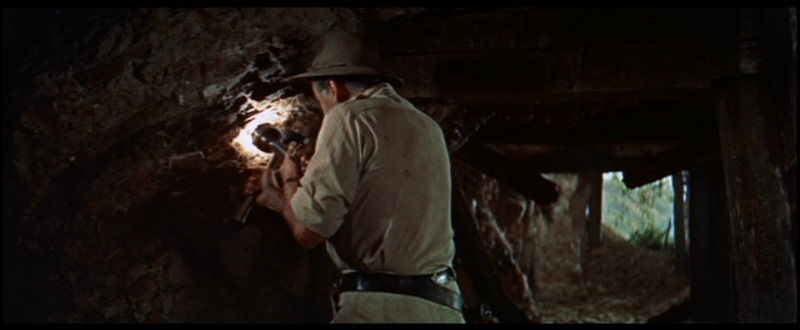
SeƱor Rian Mitchell (Stewart Granger) is a miner entrepreneur, a man who "looks like he's done things and been places." On one particularly eventful day he's digging around an abandoned mine high in the South American mountains somewhere in Colombia, when he finds a green rock more than the size of his fist, then, making his way from the mine, he's attacked by bandito's, kills one, is clobbered by another, pushed off a cliff, and then nearly attacked by a jaguar, but is saved by a sharp-shooting Spanish monk just in the nick of time. He's done things, alright. But, first impressions say he's had things done TO him!
The "fastest friar in the South" tends to Mitchell's wounds as best he can for the journey off the mountain and takes him to the nearest outpost, the Knowland coffee plantation, home to Catherine (Grace Kelly) and her brother Donald (John Ericson). Tended to by the generosity of the Knowlands and the servitude of their workers, Mitchell makes a quick recovery, regaining consciousness after only a day of bed's rest. He rewards this hospitality by saying he's got to catch the next boat up the river and wanting to find his pants because he has something very valuable in them...like...his car-keys (Yeah, that's it. The car-keys!). Ignoring everyone's protests, Mitchell hurries up and suits up.
He's interrupted by his savior, Father Ripero (Robert Tafur), who lets him know that he found a "valuable ore deposit" while going through his trousers. Mitchell assures him that it's nothing by lying through his teeth and the priest then informs him that he, too, once found the legendary emerald mine, Carrero, once worked by the conquistadors, but covered it up and kept it secret because 1) he's a priest and 2) he knew such riches would only lead to greed, lust, gluttony and the other deadly sins before everyone got tired out and turned to sloth. He then tells Mitchell to say three "hail Mary's" for lying to him. Mitchell just wants to get on the boat, but he tells Ripero he'll back for the emeralds and that the gluttony and lust stuff sound pretty good, too.
The Knowland coffee plantation, located just on the border of a Colombia matte painting.

Mitchell gets back to his business' base, just in time to find out that his partner, Vic Leonard (Paul Douglas) has quit in frustration after twelve years. Mitchell tries, to no avail, to get him to stay, but when the boat is delayed leaving Vic finds Mitchell at a bar, proceeds to get drunk, miss his boat, and Mitchell gambles the funds from the refunded ticket to set up an expedition to the mine and start a mining operation. Vic is mad, but Mitchell convinces him that their efforts will soon pay off.
Vic and Mitchell's boat-trip upriver hits port not too far from the Knowlands'. After a bit of local difficulty, they assemble a work-crew and travel to the mountains to begin work. But, they're under the watchful eye of the bandit leader, El Moro (Murvyn Vye) and he's just as interested in a fortune in emeralds as Mitchell and Vic are. Things become contentious, especially when El Moro tries to sabotage things to discourage the miners from staying, leaving him to collect the spoils. Concurrently, Mitchell and Catherine continue a building interest that heats up when she invites Mitchell and Vic to dinner at the plantation.
Things start to sour in the romance department, when a sudden tunnel collapse halts operations before the emerald deposits are found. Desperate and just-plain-greedy, Mitchell then influences Donald Knowland to lend money and laborers to the mining effort and takes him on as a partner. This puts Catherine in high dudgeon, as the plantation is already short of help to produce a successful harvest. When news of Mitchell's chicanery makes it to Vic, he quits in disgust and offers help to Catherine, whom she takes on as a partner. Trouble is, Vic is also in love with Catherine.
If that doesn't complicate things, brother Donald is killed in a boulder-fall, just as he's discovered the long-sought-after emerald deposits. Mining efforts begin in earnest, but no one is celebrating, especially at the Knowland plantation, where after the death of her brother, the plantation is threatened with flooding due to the mining efforts, putting Catherine's life and livelihood at risk. Mitchell becomes a pariah due to myopic efforts to strike it rich. Maybe he should visit that priest...say a few hundred "Hail Mary's."
You look at Andrew Marton's IMDB page and it's incredible. He did second unit work on some of the biggest movies—where the second unit work was frequently the best part of the picture—and his long string of directing credits—including King Solomon's Mines—shows an inclination towards the exotic with lots of location work spent in far-flung lands and underwater. And he delivers on some good action with explosions and gun-fights amid precipitous locations.
But, the script—by Ivan Goff and Ben Roberts (they wrote the classic, over-the-top White Heat!) is one of those "write me a Clark Gable movie" concoctions where the star is a bad-boy who has to go from a bastard to the side of virtue and have you on his side from the first reel, despite whatever boorishness he displays. That's not Stewart Granger. Granger could play "rogue," but there is always a veneer of civility to it, and Grace Kelly plays one of those poor creations who reluctantly falls for the bad boy against all signs pointing to the obvious that it's a bad match. Kelly can play "sly" and she can play "doormats" (as long as they wise up by the end), but she rarely was good at conveying bad taste.
And the script lets both actors down. It delivers exotic and it delivers last-minute tension and action, but motivations are mighty light and the resulting actions emanating from them are bewildering. It's drama for the sake of drama that merely gets the job done so they can turn up the house-lights. But, a movie shouldn't make you grateful for the occasion.

Friday, July 6, 2018

The Swan (1956)

The Swan (Charles Vidor, 1956) Based on a play by Ferenc MolnĆ”r and filmed twice previously—once in 1925 and in 1930—this M-G-M produced version of The Swan is historically notable in film history as being Alec Guinness' first American film and Grace Kelly's last released before marrying Prince Rainier of Monaco (her last filmed role was in High Society).

Curiously, It is a movie remake of an Actor's Studio production aired on CBS television June 9, 1950, which featured an early starring performance by the same Grace Kelly, effectively book-marking her career.

And that's about it. The Swan is a bit of a trifle, if not a truffle, of how tough the privileged have it, if only to reassure us commoners that they are as capable of having complicated, melancholy lives as we are. Poor dears.
The Swan tells the story of Princess Alexandra (Kelly, naturally) who is the "of-marrying-age" daughter of a once-powerful family of a European patriarchy (the closest we get to specifics is an opening legend: "The Place—Central Europe...The Time—1910"). To fortify their fortunes, they take advantage of an impending visit by the Crown Prince Albert (Guinness) to try to match the two and retake the crown. Chief conspirator is Alexandra's mother Beatrix (Jesse Royce Landis, who played Kelly's mother in the previous year's To Catch a Thief). But, although she's a bit late to the proceedings (only showing up towards the film's end), it appears Albert's mother Dominika (Agnes Moorehead) is thinking along the same lines.
All well and good. Except Alexandra is an independent sort, very much involved with her books and her fencing to be too giddy about becoming an arm-ornament to an arranged suitor. What about love, for instance? It also doesn't help that because her mind's in the wrong place, the usually quite competent and confident princess comes off being something of a goof. And not a particularly charming goof, at that.
The Crown Prince is conveniently scheduled to visit the family on a ceremonial visit. The family pills out all their best finery to impress the Prince, who, upon his arrival, is quite a bit different from what the old family is expecting.
The prince is a bit of a cold fish, and calling him "eccentric" would be kind. Albert is more interested in band music than matrimony, and, as his interests seem decidedly puerile, he's a bit more of a man-child, which, to him, is only natural—he's on vacation, after all. He can let his hair down and he wants to do what he enjoys, as opposed to his job being "the prince."
Although his behavior slightly ruffles the fine feathers of the family, it does not deter them from pushing the two together. Alexandra is torn: she is not impressed with Guinness' prince, and a bit irked that he isn't more awestruck by her, and she's actually a bit more attracted to her tutor, Dr. Nicholas Agi (Louis Jourdan, not at his best), who is worldly, charming, a heck of a dancer, and interested in her, as well. But, he's also conflicted: he knows that a future with a commoner like him will not improve her standing, or that of her family. So, as much as the prospect of running off with Alexandra is attractive, his sense of duty overrides his feelings.
So, as she leans towards Agi and away from the prince, Agi leans away, which confuses and disappoints Alexandra. This only makes her want to pursue him more, beyond what family and tradition might consider seemly. Plus, she has to be feeling a bit worthless, with everybody making a fuss over her, but both her potential suitors being less than interested.
So, what does she want? She is pre-disposed, given the example of her uncle (Brian Aherne) to become a monk to choose her heart over duty (which is apparently what Prince Albert does, too) and she begins to rebel, pursuing Agi, even if he chooses to rebuff her. What's a princess to do? If you're to believe The Swan, it is absolutely no fun to be a princess, no matter what Disney—or the Princess Diana Story—says.
What the movie seems to promote is contrary behavior: Prince Albert is more interested in the double bass and football than being regal, and the antics of Landis, Moorehead, Estelle Winwood and butler Leo G. Carroll seem much more entertaining than the concerns of the love-birds portrayed.
Ultimately, the movie is a downer, as Alexandra seems consigned to a life of artifice and keeping up appearances, rather than getting a life she might actually enjoy. One comes away wondering why, after this movie, Grace went ahead with her storybook wedding.