Showing posts with label Agnes Moorhead. Show all posts

Friday, June 18, 2021

Anytime Movies #2: Citizen Kane

While I catch up on the reviews still in "Draft" phase here, I'll re-run a feature I ran when I first started this blog seven years ago,* when it was suggested I do a "Top Ten" List.

I don't like those: they're rather arbitrary; they pit films against each other, and there's always one or two that should be on the list that aren't because something better shoved it down the trash-bin.

So, I came up with this: "Anytime" Movies.


Anytime Movies are the movies I can watch anytime, anywhere. If I see a second of it, I can identify it. If it shows up on television, my attention is focused on it until the conclusion. Sometimes it’s the direction, sometimes it’s the writing, sometimes it’s the acting, sometimes it’s just the idea behind it, but these are the movies I can watch again and again (and again!) and never tire of them. There are ten (kinda). They're not in any particular order, but the #1 movie IS the #1 movie.

So obvious a choice.

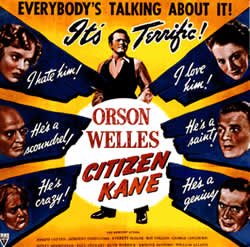
Yet Citizen Kane (or RKO 281) has been fielding off re-appraisals and critical backlash since the day of its premiere. Is it really "the greatest American film ever made?"

Yes.

So far….

Part of the argument against it is that it can’t be since it was the product of a 26 year old who had never made a film before. But
Orson Welles was a 26 year old who grew up pampered and precocious—who read Shakespeare at an age when other kids are reading Seuss. As a teen he made his way in the world by his brio and his considerable talents and his nerve to try just about anything. He was an artistic sociopath who staged alternative Shakespeare productions and avant-garde radio plays for years before being given, as Kane puts it, the candy store”—a carte blanche contract with a film studio to make any film of his choice, any way he wanted with final cut and a stipulation that said no one could alter it in any way in perpetuity (This is the reason why Turner Broadcasting in its rush to colorize movies could never put so much as a pink pixel to Citizen Kane. Some contract!). With it, he gathered his seasoned Mercury Theater actors (some of whom would go on to major Hollywood careers), one of the most innovative and painterly cinematographers, Gregg Toland, young, daring editor Robert Wise, the arrogant and brilliant composer Bernard Herrmann, and the amazing technical crew at RKO who produced such amazing feats as King Kong and the Astaire-Rogers musicals and turned them loose on Herman Mankiewicz’s long-in-the-planning screenplay that he believed could never be produced.

Out of all that talent at the top of its game, Welles produced the best American movie ever made, and as a reward he was never allowed that freedom again. Ever. No good movie goes unpunished.
His next film, The Magnificent Ambersons was a more mature and accomplished–looking film, but RKO chopped it up, re-shot the ending giving its albeit happy finale a certain incomprehensibility and threw it on the bottom of a cheesy double bill. Welles always thought it would have been his best film and the evidence certainly indicates it might have been.  He then barely worked in Hollywood again, except as an actor, and used the funds to make films dear to his heart or sensibility (which veered from Shakespeare to pulp) on a catch-as-catch-can basis. Welles’ Falstaff movie The Chimes at Midnight was the project closest to his heart, and might be better if not for the logistical and technical hurdles Welles had to jump in order to make it.

But Kane is the grail—the stuff of legend, and has been looked on ever since with avarice by would-be auteurs with more guts than talent, and therein lies the danger. That reputation could make Kane as cold and lifeless as one of the statues in Xanadu’s basement. It’s actually more like one of Susan Alexander Kane’s puzzles—intricate and maybe unsolvable without a lot of effort. There’s one shot where Welles shows his hand. It occurs after Susan has left him, accompanied by the screeching cockatiel superimposed on the screen (“I wanted to wake the audience up at that point,” Welles joked. Really, Orson? Right there?) and right after he trashes her room—destroying the acquisitions of her life and his—Kane picks up the snow-globe that will fall from his hand at his death. “Rosebud,” he murmurs (both times) and then walks as in a daze out of her room, into the hall, and past his servants. He then crosses through a mirrored hallway that reflects an endless line of Kanes that recede and disappear. After Kane (and his many reflections) has passed, the camera then pushes into the mirror and out, back to the sequence's surrounding reverie of the butler (“Sentimental fella, aren’t you?” “Mmm. Yes and no.”)
That shot is the exit from the worlds of memory through which we have seen many reflections of Kane—the house of mirrors that makes up the bulk of
Citizen Kane, the movie. It is also our last image of Kane, himself, in the film. He’s talked about through to the end, of course, but that splintered mirror-shot is our final impression of him (Kane—and Welles—are not even seen in the End Credits review of actors). At that point it becomes clear (as crystal) that the entire film is like that hall of mirrors that reflected back the aspects of Kane important to each narrator—a process that began with the newsreel that quickly jumped through the highlights of Kane’s life as a public figure and set up the film’s surface mystery—what is the meaning of Kane’s last word (and so serves as a stand-in for “who was Kane, really?”).
In the course of the various reflections there are all sorts of legerdemain—little tricks and in-jokes—that Welles, who was an amateur magician, clearly loved pulling off even if an audience didn’t immediately “get” them. One of my favorites is the craning shot through the model of the “El Rancho” nightclub where ex-wife Susan Alexander performs and drinks herself into a stupor every night. The night of the first attempt at an interview by newsreel reporter Thompson, it’s storming outside and flashes of lightning hide the camera’s passage through the roof sign and through the glass transom into the nightclub inside. When, half the movie later, we again travel through that transom it’s broken—presumably by our first trip through it. In the film’s original framing (unfortunately not in the DVD presentation) there is the slightest nudge of the camera to the right in the rather severe shot of Mrs. Kane signing little Charles away to the banker, and we see, just on the edge of the frame, that significant snow-globe that keeps popping up in dramatic moments. In the newsreel there is a shot of a newspaper of the entire Kane family. Later in the film, we actually see that shot being taken. Another is the way Kane’s hectoring “Sing-Siiiiing!” to “Boss” Jim Gettys is cut off by a shutting door, but it is continued by a braying car-horn out on the street. These are little filigrees to the grand architecture of lighting, framing and editing tricks that Welles and his crew pull off.** 
But that central question “who was Kane?” is purposely never answered, not by a word, not by an object, and not by a person. In the end, the film says that it can’t solve the problem, that it can only present it, and leave us with the acknowledgement of its complexity.

So what are we left with as the remnants of Kane and his life fly up from the furnace of Xanadu? An answer to the mystery of "Rosebud," but not an answer to the man. For Kane was many things to many people, but as Kane himself passed judgment on himself, he was never great. Given gifts that many of us will never ever have, he ultimately squandered them. Insular, wasteful, in his house of mirrors, he is left alone to contemplate himself.

We all have our gifts. What do we do with them? Citizen Kane is like that glass globe that we can peer inside and see the illusion of life…and consider our own lives. And in the end we are left with its final image to contemplate, and one may consider in that contemplation that Kane was a master illusionist himself, pretending greatness where there was none, and utilizing the very same tools used by those other illusionists—magicians and very young film directors—to create those illusions.

Those tools being smoke…and mirrors.

Anytime Movies:
Citizen Kane
Once Upon a Time in the West
-Only Angels Have Wings
The Searchers


* And, on Sunday, we'll put up a "Don't Make a Scene" feature from each week's film.

** Orson Welles is unique in the group of directors of movies that I’ve seen in that every time I exit from a new film of his, I come out looking at the world with new eyes…or with a new perception of the old world--one that seems filled with possibilities.

Thursday, December 12, 2019

Dark Passage

Dark Passage (Delmer Daves, 1947) Soapish film noir with "Bogey and Baby" that manages to have a few interesting things to recommend it, amidst some howler material.

The story isn't much: Vincent Parry (
Humphrey Bogart, eventually), convicted of murdering his wife, escapes from San Quentin, and is able to make his way back to San Francisco with the help of Irene Jansen (Lauren Bacall), a rich-girl painter who knows all about Parry's case—because her own father was falsely accused of murdering her mother.

Small damn world.

Irene gives Parry a place to crash, and a change of clothes. Then, making his way to Frisco to meet an old buddy, his cab-driver gives him a line on
a disgraced plastic surgeon, who's not adverse to doing last-minute surgeries at 3 a.m. It takes Parry a week to heal, which he does at Irene's—something he didn't want to do, but seeing as his buddy was murdered and all...

Grave-eye view of a post-op Bogart finding his musician-buddy dead.
Wait a minute! If you hadn't said that yet, what kept you? It would appear that San Francisco (nice location work, by the way) is the smallest town in America, as everybody knows everybody else and their business, besides. While convalescing at Irene's, Parry becomes aware that the place is being watched by a couple people, a potential blackmailer (Clifton Young) and Madge (Agnes Moorehead), the buttinsky friend of Irene's who used to go out with Bob (Bruce Bennett), Irene's current beau, but was also old friends with the Parry's back in the day. As Bogart would say, "Everything's starting to look nice and cosy..."
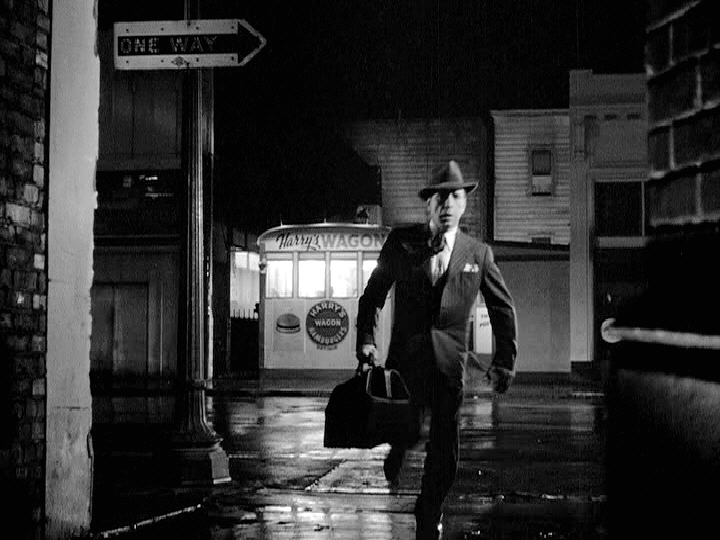
When the bandages come off, we get to see The Man with Bogart's Face, but before then, all we're allowed to see of Parry was his picture in the paper, or his face in shadow. Daves employed a technique not much used in movies—the first-person subjective camera, so we see everything from Parry's point-of-view; there's a lot of people speaking right at us throughout the first part of the movie and answered back by Bogart's disembodied voice. Daves pulls off some miraculous inter-cutting between location-work and studio set-ups (in a moving car, yet!), and it's interesting to see how he gets himself out of jams of timing and transitions. He also employs an interesting angle every now and again, like the vantage point of a murder scene...from below the floor!
There's a lot to quibble about (did I mention the plastic surgery only takes an hour?), but any excuse to see Bogart-Bacall together again, and to see another of Agnes Moorehead's unabashedly demonstrative performances. Those are enough reasons to give Dark Passage a watch.
Here's looking at you looking at me, kid.
Subjective POV of Lauren Bacall in Dark Passage

Friday, July 6, 2018

The Swan (1956)

The Swan (Charles Vidor, 1956) Based on a play by Ferenc Molnár and filmed twice previously—once in 1925 and in 1930—this M-G-M produced version of The Swan is historically notable in film history as being Alec Guinness' first American film and Grace Kelly's last released before marrying Prince Rainier of Monaco (her last filmed role was in High Society).

Curiously, It is a movie remake of an Actor's Studio production aired on CBS television June 9, 1950, which featured an early starring performance by the same Grace Kelly, effectively book-marking her career.

And that's about it. The Swan is a bit of a trifle, if not a truffle, of how tough the privileged have it, if only to reassure us commoners that they are as capable of having complicated, melancholy lives as we are. Poor dears.
The Swan tells the story of Princess Alexandra (Kelly, naturally) who is the "of-marrying-age" daughter of a once-powerful family of a European patriarchy (the closest we get to specifics is an opening legend: "The Place—Central Europe...The Time—1910"). To fortify their fortunes, they take advantage of an impending visit by the Crown Prince Albert (Guinness) to try to match the two and retake the crown. Chief conspirator is Alexandra's mother Beatrix (Jesse Royce Landis, who played Kelly's mother in the previous year's To Catch a Thief). But, although she's a bit late to the proceedings (only showing up towards the film's end), it appears Albert's mother Dominika (Agnes Moorehead) is thinking along the same lines.
All well and good. Except Alexandra is an independent sort, very much involved with her books and her fencing to be too giddy about becoming an arm-ornament to an arranged suitor. What about love, for instance? It also doesn't help that because her mind's in the wrong place, the usually quite competent and confident princess comes off being something of a goof. And not a particularly charming goof, at that.
The Crown Prince is conveniently scheduled to visit the family on a ceremonial visit. The family pills out all their best finery to impress the Prince, who, upon his arrival, is quite a bit different from what the old family is expecting.
The prince is a bit of a cold fish, and calling him "eccentric" would be kind. Albert is more interested in band music than matrimony, and, as his interests seem decidedly puerile, he's a bit more of a man-child, which, to him, is only natural—he's on vacation, after all. He can let his hair down and he wants to do what he enjoys, as opposed to his job being "the prince."
Although his behavior slightly ruffles the fine feathers of the family, it does not deter them from pushing the two together. Alexandra is torn: she is not impressed with Guinness' prince, and a bit irked that he isn't more awestruck by her, and she's actually a bit more attracted to her tutor, Dr. Nicholas Agi (Louis Jourdan, not at his best), who is worldly, charming, a heck of a dancer, and interested in her, as well. But, he's also conflicted: he knows that a future with a commoner like him will not improve her standing, or that of her family. So, as much as the prospect of running off with Alexandra is attractive, his sense of duty overrides his feelings.
So, as she leans towards Agi and away from the prince, Agi leans away, which confuses and disappoints Alexandra. This only makes her want to pursue him more, beyond what family and tradition might consider seemly. Plus, she has to be feeling a bit worthless, with everybody making a fuss over her, but both her potential suitors being less than interested.
So, what does she want? She is pre-disposed, given the example of her uncle (Brian Aherne) to become a monk to choose her heart over duty (which is apparently what Prince Albert does, too) and she begins to rebel, pursuing Agi, even if he chooses to rebuff her. What's a princess to do? If you're to believe The Swan, it is absolutely no fun to be a princess, no matter what Disney—or the Princess Diana Story—says.
What the movie seems to promote is contrary behavior: Prince Albert is more interested in the double bass and football than being regal, and the antics of Landis, Moorehead, Estelle Winwood and butler Leo G. Carroll seem much more entertaining than the concerns of the love-birds portrayed.
Ultimately, the movie is a downer, as Alexandra seems consigned to a life of artifice and keeping up appearances, rather than getting a life she might actually enjoy. One comes away wondering why, after this movie, Grace went ahead with her storybook wedding.


Wednesday, June 11, 2014

Anytime Movies (Transplanted): Citizen Kane

While I have a few reviews "in the works," It's as good a time as any to re-boot (actually transplant from the old movie blog) a feature I started years ago, when it was suggested I do a "Top Ten" List. 

I don't like those: they're rather arbitrary; they pit films against each other, and there's always one or two that should be on the list that aren't because something better shoved it down the trash-bin. 

So, I came up with this: "Anytime" Movies. 

Anytime Movies are the movies I can watch anytime, anywhere. If I see a second of it, I can identify it. If it shows up on television, my attention is focused on it until the conclusion. Sometimes it’s the direction, sometimes it’s the writing, sometimes it’s the acting, sometimes it’s just the idea behind it, but these are the movies I can watch again and again (and again!) and never tire of them. There are ten (kinda). They're not in any particular order, but the #1 movie IS the #1 movie.

So obvious a choice.

Yet Citizen Kane (or RKO 281) has been fielding off re-appraisals and critical backlash since the day of its premiere. Is it really "the greatest American film ever made?"

Yes.

So far….

Part of the argument against it is that it can’t be since it was the product of a 26 year old who had never made a film before. But
Orson Welles was a 26 year old who grew up pampered and precocious—who read Shakespeare at an age when other kids are reading Seuss. As a teen he made his way in the world by his brio and his considerable talents and his nerve to try just about anything. He was an artistic sociopath who staged alternative Shakespeare productions and avant-garde radio plays for years before being given, as Kane puts it, the candy store”—a carte blanche contract with a film studio to make any film of his choice, any way he wanted with final cut and a stipulation that said no one could alter it in any way in perpetuity (This is the reason why Turner Broadcasting in its rush to colorize movies could never put so much as a pink pixel to Citizen Kane. Some contract!). With it, he gathered his seasoned Mercury Theater actors (some of whom would go on to major Hollywood careers), one of the most innovative and painterly cinematographers, Gregg Toland, young, daring editor Robert Wise, the arrogant and brilliant composer Bernard Herrmann, and the amazing technical crew at RKO who produced such amazing feats as King Kong and the Astaire-Rogers musicals and turned them loose on Herman Mankiewicz’s long-in-the-planning screenplay that he believed could never be produced.

Out of all that talent at the top of its game, Welles produced the best American movie ever made, and as a reward he was never allowed that freedom again. Ever. No good movie goes unpunished.

His next film,
The Magnificent Ambersons was a more mature and accomplished–looking film, but RKO chopped it up, re-shot the ending giving its albeit happy finale a certain incomprehensibility and threw it on the bottom of a cheesy double bill. Welles always thought it would have been his best film and the evidence certainly indicates it might have been.  He then barely worked in Hollywood again, except as an actor, and used the funds to make films dear to his heart or sensibility (which veered from Shakespeare to pulp) on a catch-as-catch-can basis. Welles’ Falstaff movie The Chimes at Midnight was the project closest to his heart, and might be better if not for the logistical and technical hurdles Welles had to jump in order to make it.

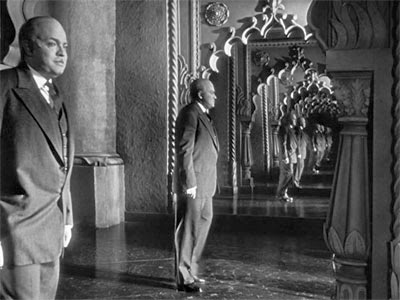
But Kane is the grail—the stuff of legend, and has been looked on ever since with avarice by would-be auteurs with more guts than talent, and therein lies the danger. That reputation could make Kane as cold and lifeless as one of the statues in Xanadu’s basement. It’s actually more like one of Susan Alexander Kane’s puzzles—intricate and maybe unsolvable without a lot of effort. There’s one shot where Welles shows his hand. It occurs after Susan has left him, accompanied by the screeching cockatiel superimposed on the screen (“I wanted to wake the audience up at that point,” Welles joked. Really, Orson? Right there?) and right after he trashes her room—destroying the acquisitions of her life and his—Kane picks up the snow-globe that will fall from his hand at his death. “Rosebud,” he murmurs (both times) and then walks as in a daze out of her room, into the hall, and past his servants. He then crosses through a mirrored hallway that reflects an endless line of Kanes that recede and disappear. After Kane (and his many reflections) has passed, the camera then pushes into the mirror and out, back to the sequence's surrounding reverie of the butler (“Sentimental fella, aren’t you?” “Mmm. Yes and no.”)


That shot is the exit from the worlds of memory through which we have seen many reflections of Kane—the house of mirrors that makes up the bulk of Citizen Kane, the movie. It is also our last image of Kane, himself, in the film. He’s talked about through to the end, of course, but that splintered mirror-shot is our final impression of him (Kane—and Welles—are not even seen in the End Credits review of actors). At that point it becomes clear (as crystal) that the entire film is like that hall of mirrors that reflected back the aspects of Kane important to each narrator—a process that began with the newsreel that quickly jumped through the highlights of Kane’s life as a public figure and set up the film’s surface mystery—what is the meaning of Kane’s last word (and so serves as a stand-in for “who was Kane, really?”).
In the course of the various reflections there are all sorts of legerdemain—little tricks and in-jokes—that Welles, who was an amateur magician, clearly loved pulling off even if an audience didn’t immediately “get” them. One of my favorites is the craning shot through the model of the “El Rancho” nightclub where ex-wife Susan Alexander performs and drinks herself into a stupor every night. The night of the first attempt at an interview by newsreel reporter Thompson, it’s storming outside and flashes of lightning hide the camera’s passage through the roof sign and through the glass transom into the nightclub inside. When, half the movie later, we again travel through that transom it’s broken—presumably by our first trip through it. In the film’s original framing (unfortunately not in the DVD presentation) there is the slightest nudge of the camera to the right in the rather severe shot of Mrs. Kane signing little Charles away to the banker, and we see, just on the edge of the frame, that significant snow-globe that keeps popping up in dramatic moments. In the newsreel there is a shot of a newspaper of the entire Kane family. Later in the film, we actually see that shot being taken. Another is the way Kane’s hectoring “Sing-Siiiiing!” to “Boss” Jim Gettys is cut off by a shutting door, but it is continued by a braying car-horn out on the street. These are little filigrees to the grand architecture of lighting, framing and editing tricks that Welles and his crew pull off.
But that central question “who was Kane?” is purposely never answered, not by a word, not by an object, and not by a person. In the end, the film says that it can’t solve the problem, that it can only present it, and leave us with the acknowledgement of its complexity.

So what are we left with as the remnants of Kane and his life fly up from the furnace of Xanadu? An answer to the mystery of "Rosebud," but not an answer to the man. For Kane was many things to many people, but as Kane himself passed judgment on himself, he was never great. Given gifts that many of us will never ever have, he ultimately squandered them. Insular, wasteful, in his house of mirrors, he is left alone to contemplate himself.
We all have our gifts. What do we do with them? Citizen Kane is like that glass globe that we can peer inside and see the illusion of life…and consider our own lives. And in the end we are left with its final image to contemplate, and one may consider in that contemplation that Kane was a master illusionist himself, pretending greatness where there was none, and utilizing the very same tools used by those other illusionists—magicians and very young film directors—to create those illusions.

Those tools being smoke…and mirrors.
-Only Angels Have Wings
The Searchers
Mr. Smith Goes to Washington
Chinatown
American Graffiti
To Kill a Mockingbird
Goldfinger

Bonus: Edge of Darkness


* Orson Welles is unique in the group of directors of movies that I’ve seen in that every time I exit from a new film of his, I come out looking at the world with new eyes…or with a new perception of the old world--one that seems filled with possibilities.