Showing posts with label Brian Aherne. Show all posts

Wednesday, February 19, 2020

Sylvia Scarlett

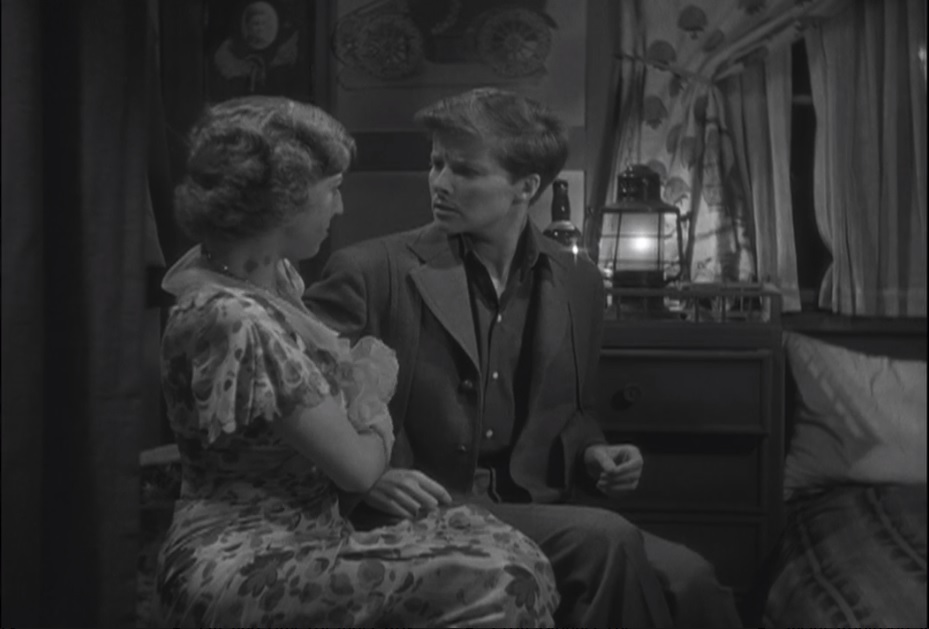
Sylvia Scarlett (George Cukor, 1935) This one can't be considered a movie of the libertine, free-and-wheelin' "Pre-Code" era of movie-making, but it takes mild chances (if only teasingly), but hardly enough to account for its reputation as one of the most financially disastrous movies on the 1930's despite a good script, solid direction by George Cukor and the pairing of Cary Grant and Katherine Hepburn (though it being their first—Hepburn had met Grant at Paramount and recommended him to Cukor—no one could anticipate their subsequent chemistry). The film's lack of success labeled Hepburn as "box-office poison" and she didn't become bankable again until she bought herself the rights to "The Philadelphia Story" and revived her career with it...also with Grant in the movie version.

But, it looks tame today, even quaint. And it wouldn't so much as cause a pursed lip among the blue-haired old ladies who went to see Victor, Victoria or Shakespeare in Love. It was just before its time, although Cukor—who was euphemistically esteemed throughout his career as "a woman's director"—enjoyed depicting the sexes in sometimes challenging ways, often as satire, often as comedy. Sylvia Scarlett is a light-hearted drama (until it turns dark) and a comedy of manners (if those manners only tease but don't commit, and Judith Martin would certainly not call that "manners"). It's a little bit of everything, but more soufleé than stew. 
In Marseilles, when the seamstress wife of Henry Scarlett (Edmund Gwenn) dies, he becomes desperate to flee the country from French officials. He's been embezzling funds from the lace factory where he was employed as a bookkeeper, and lost all the funds to gambling. With some lace that he has stolen, he decides to head back to England to start anew, but tells his daughter Sylvia (Hepburn) that he will go alone and send for her later. She will have none of that, and so cuts off her hair and tells him that if she travels with him as a boy, the police will be confounded in their search for a man and his daughter.
While ferrying across the channel, they make the acquaintance of one Jimmy Monkley (Grant), a charming Cockney con artist and grifter, who uses his acquaintance with the Scarlett's to throw suspicion off himself when they go through customs (he rats out Henry's lace so as to distract from the diamonds he's smuggling in his shoe). Despite the seeming betrayal (and the £100 Monkley gives the Scarlett's for their trouble), the three decide to hook up as con artists using Monkley's contacts in London. The living arrangements are a bit problematic, as Monkley can't seem to figure out while "Sylvester"—the name Sylvia goes by in her disguise—is nervous about sharing a room with him, and gets downright agitated about dressing down for the night. What is wrong with the boy?
The first scam attempt involves Maudie Tilt (Dennie Moore), a lady's maid whom Monkley tries to seduce to steal her lady's expensive pearl necklace. The escapade doesn't pan out but it does manage to hook Maudie up with the band, partially because she's attracted to "Sylvester" which worries Sylvia, but not as much as when her father starts to fall for Maudie. Sylvia/Sylvester, having a crisis of conscience, insists they give up the dangerous grifter life, and instead become travelling show-people, "The Pink Pierrots," a cavorting harlequin troupe caravaning from small town to small town entertaining the villagers.
In one town, they meet bohemian artist Michael Fane (Brian Aherne), who is enchanted by the group, but, curiously, most by Sylvester—who, in turn, is attracted to him—prompting Fane to gasp the most famous line to pass the censors: "I say, I know what it is that gives me a queer feeling when I look at you..."
pause for effect
"...There's something in you to be painted!" 

Of course. That must be it. Artistic inspiration. While Sylvia Scarlett (the movie) flirts and teases with the gay mystique, there is nothing beyond girl-on-girl pecking (mistaken or otherwise) that produces something akin to horror in Hepburn's character. Even Aherne's outburst is provincially couched in Sylvia's subterfuge—he's attracted to her because she's a woman, though dressed as a man. Safe enough. And when "Sylvester", smitten with Fane, borrows ladies' gear to appear all flowery and girly, he is charmed but ultimately dismissive once learning the truth of Sylvia, going back to his un-British—in fact, Russian-European—mistress.
The sexual politics is flummery—just a tease—because once things settle—and people settle—things are safely hetero, but, at least, they take one chance: the pairings are not based on Hollywood archetypes of who should be with whom (we've all seen disastrously mis-paired types in many a final fade-out), but rather in personality types; the romantics are together and the churlishly cynical are as well, being matches of the soul, rather than the romantic heart.
At least that is a bit different; the couples deserve each other, for good or ill. It's not much of a revolution, certainly not enough to inspire a reprisal at the box-office. In fact, it's merely common sense, but that's something rarely found in romantic films.

Or in romance, for all that.

Friday, July 6, 2018

The Swan (1956)

The Swan (Charles Vidor, 1956) Based on a play by Ferenc Molnár and filmed twice previously—once in 1925 and in 1930—this M-G-M produced version of The Swan is historically notable in film history as being Alec Guinness' first American film and Grace Kelly's last released before marrying Prince Rainier of Monaco (her last filmed role was in High Society).

Curiously, It is a movie remake of an Actor's Studio production aired on CBS television June 9, 1950, which featured an early starring performance by the same Grace Kelly, effectively book-marking her career.

And that's about it. The Swan is a bit of a trifle, if not a truffle, of how tough the privileged have it, if only to reassure us commoners that they are as capable of having complicated, melancholy lives as we are. Poor dears.
The Swan tells the story of Princess Alexandra (Kelly, naturally) who is the "of-marrying-age" daughter of a once-powerful family of a European patriarchy (the closest we get to specifics is an opening legend: "The Place—Central Europe...The Time—1910"). To fortify their fortunes, they take advantage of an impending visit by the Crown Prince Albert (Guinness) to try to match the two and retake the crown. Chief conspirator is Alexandra's mother Beatrix (Jesse Royce Landis, who played Kelly's mother in the previous year's To Catch a Thief). But, although she's a bit late to the proceedings (only showing up towards the film's end), it appears Albert's mother Dominika (Agnes Moorehead) is thinking along the same lines.
All well and good. Except Alexandra is an independent sort, very much involved with her books and her fencing to be too giddy about becoming an arm-ornament to an arranged suitor. What about love, for instance? It also doesn't help that because her mind's in the wrong place, the usually quite competent and confident princess comes off being something of a goof. And not a particularly charming goof, at that.
The Crown Prince is conveniently scheduled to visit the family on a ceremonial visit. The family pills out all their best finery to impress the Prince, who, upon his arrival, is quite a bit different from what the old family is expecting.
The prince is a bit of a cold fish, and calling him "eccentric" would be kind. Albert is more interested in band music than matrimony, and, as his interests seem decidedly puerile, he's a bit more of a man-child, which, to him, is only natural—he's on vacation, after all. He can let his hair down and he wants to do what he enjoys, as opposed to his job being "the prince."
Although his behavior slightly ruffles the fine feathers of the family, it does not deter them from pushing the two together. Alexandra is torn: she is not impressed with Guinness' prince, and a bit irked that he isn't more awestruck by her, and she's actually a bit more attracted to her tutor, Dr. Nicholas Agi (Louis Jourdan, not at his best), who is worldly, charming, a heck of a dancer, and interested in her, as well. But, he's also conflicted: he knows that a future with a commoner like him will not improve her standing, or that of her family. So, as much as the prospect of running off with Alexandra is attractive, his sense of duty overrides his feelings.
So, as she leans towards Agi and away from the prince, Agi leans away, which confuses and disappoints Alexandra. This only makes her want to pursue him more, beyond what family and tradition might consider seemly. Plus, she has to be feeling a bit worthless, with everybody making a fuss over her, but both her potential suitors being less than interested.
So, what does she want? She is pre-disposed, given the example of her uncle (Brian Aherne) to become a monk to choose her heart over duty (which is apparently what Prince Albert does, too) and she begins to rebel, pursuing Agi, even if he chooses to rebuff her. What's a princess to do? If you're to believe The Swan, it is absolutely no fun to be a princess, no matter what Disney—or the Princess Diana Story—says.
What the movie seems to promote is contrary behavior: Prince Albert is more interested in the double bass and football than being regal, and the antics of Landis, Moorehead, Estelle Winwood and butler Leo G. Carroll seem much more entertaining than the concerns of the love-birds portrayed.
Ultimately, the movie is a downer, as Alexandra seems consigned to a life of artifice and keeping up appearances, rather than getting a life she might actually enjoy. One comes away wondering why, after this movie, Grace went ahead with her storybook wedding.