Showing posts with label Remake. Show all posts

Saturday, March 29, 2025

Snow White (2025)

What Do You Mean By "Fairest"?
or
Snow White (and the Height-Challenged, but Competently-Abled and Platonic POSSLQ's)—There, That "Woke" Enough For Ya?
 
The seven dwarfs were each on different little trips. Happy was into grass and grass alone … Happy, that's all he did. Sleepy was into reds. Grumpy, too much speed. Sneezy was a full blown coke freak. Doc was a connection. Dopey was into everything. Any old orifice will do for Dopey. He's always got his arm out and his leg up. And then, the one we always forget, because he was Bashful. Bashful didn't use drugs. He was paranoid on his own. Didn't need any help on that ladder.
George Carlin
 
Disney made the first Snow White and the Seven Dwarfs in the mid-1930's, and gosh, "not much has changed". I'm being sarcastic, of course. It premiered during The Great Depression, Hitler had not yet attacked Poland (but the Japanese had invaded China). And the world was about to evolve, rendering the tropes of "Snow White"—the biases, the weak role of women, the "princessy" thing, the deus ex machina of the necessity of a rescuing handsome prince—all of that would age as gracefully as an Evil Queen into a Crone. It's almost unfathomable that, at the time, Disney's Snow White and the Seven Dwarfs was something of a revolution in the animated art-form. It was the first cel-animated feature film (the ads announced it "in multiplane technicolor"), and the first animated feature ever made in the United States. At the time, Disney was discouraged by business partners, other Hollywood moguls, and potential backers that a feature cartoon just couldn't "work," for diametrically opposed reasons: either it couldnt hold an audience's attention for longer than the accustomed 7 to 10 minute running time, or the length would simply exhaust them (and in fact, at the time, the young Disney company depended on the more robust RKO Studios to distribute the film to theaters—Disney is still very much around; RKO is not). It's release and success changed everything, and despite its calcified ideals, it remains a classic of the form, still topping recent 10 best lists for animated films. And, in fact, the United States Library of Congress deemed the film "culturally, historically, or aesthetically significant" and selected it as one of the very first 25 films for preservation in the National Film Registry in its first year in existence in 1989.
So, why remake it? To make money, of course (one does have to go back to the mine...and the well). And maybe, aesthetically, as a way to "update" it for a new generation not born in the previous century. Then, also, there's the legal matter that the original 1937 film is going to become part of the public domain in 1933. There is that. Plus, there has been an awful lot of competition lately from other versions of the exact same story: Snow White and the Huntsman (2012) and its Snow White-less sequel (2014), 
Tarsem's Mirror, Mirror (2012), Snow White: A Tale of Terror (1997). Of the Grimm fairy tales, it is the most adapted for film. And Disney's version is iconic. Were it not for the 1937 film, one doubts the other versions would exist.
Now, the optimal movie-going experience is to go in without prejudices or expectations (I mean, if one is doing it "right"). However, as this is a remake, you can pretty much throw that out the window. This puts me on an even par with about every single movie reviewer or internet hack, as the grousing, bitching, and over-dramatic moaning about this release has reached new levels of "hair-on-fire." Me, I wanted to see what they could do to make it less of a dinosaur of the Depression-era (I mean, the first feature came out before Gone With the Wind!), how much of the classic songs were retained, and if the new film-makers—
Marc Webb, primarily, he of the Andrew Garfield Spider-mans, the films (500) Days of Summer and Gifted, and I'm something of a fan—could make their third act top the action scene of the dw...oh, let's call them "colliers", shall we? (nobody can argue with that unless they're being trenchantly snippy)...chasing the evil crone who poisoned Snow White to fall off a cliff. And if they could balance the light and dark as effectively as old Walt did back in the day (the thing that's always impressed me about Disney is that he could scare of the tar out of his intended audience of children, and in such a way that he'd gain the cynical respect of their parents).
So...how is it? Actually, quite good, better than I was anticipating.
To my points, it is still quite a dinosaur and of another time, but, this iteration of
Snow White (and Disney's Snow White, if there were any questions) still tries to be relevant to the times, even if it can't quite distance itself from the ghosts of the earlier version, rooted as it was in what was being done in films of the time, still taking cues from Broadway, vaudeville and musical theater. Even more than the first one, you can smell a song coming on, and there are far more of those song-breaks than previously.
How are those songs? Genuinely good...and smart. Yes, they trot out "Heigh-ho" (and damn if that song doesn't still work) and they've done a buff-and-polish on the lyrics, using it as an introduction to the various...colliers. "Whistle While You Work" is revived, also with new lyrics, some of them quite surprisingly funny.* Some of the lyrics make use of modern idioms, which is momentarily jarring, but it passes. "I'm Wishing" (the first of the now de rigeur Disney "I Wish" songs) is pitched, replaced with a new one "Waiting on a Wish", and "Some Day my Prince Will Come" has been been tossed for all sorts of reasons, the primary one being the story's lack of an actual prince, handsome or otherwise. Instead, there is a roguish thief (
Andrew Burnap), living with his band of cut-throats out in the forest, having been banished from the kingdom.
And there are a bunch of new ones. One song in particular stands out, as it makes a point of calling out the story's short-comings and considers the world at large (much more than the film's opening "world-building" number "Good Things Grow") and that there might be bigger fish to fry than Snow's deposition and loss of status, and that is the ingeniously titled "Princess Problems":
Self-aware and brings up a point that if you're living under an evil regime, there might be some people suffering worse than you. I found that refreshing—but, then, I've never been concerned with the "plights" of royalty.
How about that ending, which was visceral and exciting (if a little too much an easy fix)? Well, I can't say this one's that exciting, although it does work in a story-logic kind of way and I like how, metaphorically, the Queen (
Gal Gadot) is dispatched by her own narcissism. It just doesn't get the heart pumping as much, but then Disney animators have always had a penchant for making dramatically hysterical resolutions.
Okay, you want to know about the casting. Let's start with Snow White. As far back as my review of Spielberg's version of West Side Story, I've thought that Zegler seems to have been genetically engineered to be a Disney princess with eyes too big for her head just like she was animated that way (it's a Disney design trope to draw big eyes in order inspire warm feelings like you were looking at a baby). So, she looks preternaturally perfect for this. And the thing is, Snow is a tough sell—just as Maria in West Side Story is—where the character is just so cutesy—and not in a self-aware way—you want to sit her down on a tuffet and tell her to wise up and stop being such a victim. Snow in this has a bit more grit and certainly is more expressive than the plasticene-rotoscoping allowed in the 1937 version. And she's not a sap...or a simp. I like that. Plus, Zegler's singing voice has always been astounding and she belts out the songs the way every Disney princess should, full-throated but with enough character to make her more relatable when she drops the arias.
And Gal Gadot is great as the Evil Queen. I don't know what she's done to deserve this "bad-Kevin-Costner" phase of her career, But she trods the thin line between camp and making her Evil Queen a serious threat, which is what she should do. It's the same tactic Michelle Pfeiffer takes when playing villains: be evil but show you're enjoying it, like any good autocrat. There's one moment when Gadot's Queen snaps her head in fury at the huntsman (
Ansu Kabia) ordered to kill Snow White and I swear she did it in a mere film-frame of time that was jolting. And the theatricality she throws into her musical numbers threatens the set-rafters, CGI or not.
So...uh...how are the "colliers?" I must admit, I was a bit taken aback by them, but then they don't have the rubbery cartoonishness of their animated ancestors.  They're a lot more starchy and have a bizarre facial structure that makes them all-jaw—they look like hummel figurines you'd find in a some rural backyard in Ochsenwerder (Hey, why didn't we just call them "gnomes" in the first place?) and they're the same attribute-centric personalities they were in the 1937 version ( rejected contenders at the time were Hoppy, Jumpy, Baldy, Hickey, Stuffy, Burpy, Tubby and Dizzy). After awhile, you get used to them, although the character of Dopey kept reminding me of Alfred E. Neuman
of Mad Magazine fame.
Those are quibbles. I find the 2025 to be a fairly successful effort to make a problematic—if beloved—part of history a bit more "present". It's certainly nothing—nothing—to engender the vitriol I've been seeing online. Look. I'm as evil as they come when I see something bad and write something snarky. But, then, I don't have an "agenda" other than a critical one and I certainly don't make a living at it, amping up my outrage as a cottage industry). I don't know what they're "on" or "on about" but it's not there in the movie.
Children (as I witnessed) will be delighted by it. "Bro's" who haven't grown up...won't (Hence, the film's low IMDB score perpetrated by basement-dwellers who haven't actually seen it, as IMDB has no way of checking veracity). There's a big difference between having prejudices (as I had) and agendas.**

So, the new truncated Snow White is good, sometimes incrementally better in places and a good effort, but it is hardly revolutionary. And so nobody should treat it as if it is.
 
 
* Even if it can't quite shake the specter of how the song was satirized and mocked by—of all things—Disney's own Enchanted. Sometimes, you just have to hand it to the Mouse-house for being so smart, clever, and self-aware:

** Oh, one little piece of advice to the "bro's" out there who swamped IMDB with negative scores—don't do the job "too well" or the basic law of averages will point out the obviousness of the ploy.
Live by the aggregate, die by the aggregate.

Wednesday, January 8, 2025

Nosferatu (2024)

Come To Me, My Melancholic Baby
or
"He's Italian!?"

Robert Eggers' new remake of F.W. Murnau's classic 1922 silent horror film Nosferatu: A Symphony of Horror, is respectful of the original—it's on the director's list of favorite films—but allows for Eggers' darker interpretations of myths, his sexualization of those myths, as well as his emphasis (as with David Lynch) on texture. 
 
Murnau's original (if we can use the phrase ironically) was a knock-off of Bram Stoker's "Dracula", the names changed to protect the filmmakers from copyright considerations—although they were sued by the Stoker estate—and is genuinely creepy, owing to the German Expressionist manner of lighting and filming. Plus, Murnau was an extraordinarily clever filmmaker who could use rudimentary special and camera effects to create arresting images. But, then, so is Eggers, and his version of Nosferatu* is respectful, but also tries to achieve Murnau's evocation of dread through its own means, given the advantages of modern cinematography and (something Murnau didn't have access to) sound. More on that in a bit.
Eggers also has an advantage in that he's had over a hundred years of cinema to be inspired by in the years between Murnau's version and his. Watching his Nosferatu one can see the debt he owes to Francis Ford Coppola's Bram Stoker's Dracula (with its shadow-play and use of miniatures), but also in the addition of making the attraction between Count Orlok (Bill SkarsgÃ¥rd) and Ellen Hutter (Lily-Rose Depp) a predestined certainty—Ellen has been diagnosed as "melancholic" for her sleep-walking and agitation in her youth and it only intensifies once her husband Thomas (Nicholas Hoult) falls into the orbit of the Count. This "love for the ages" concept wasn't originally part of the "Nosferatu" heritage.
The other major influence is from Stanley Kubrick's The Shining. Eggers shares Kubrick's love of framing his shots with the one-point-perspective, but here he employs it the way it was done in the Stephen King adaptation—that one-point-perspective leads the eye to a negative space, which is why the effect is so creepy and audience-disorienting. Here, all those tangential lines may lead only to an empty spot on the horizon...or a castle in the distance. There are whole sequences that give you a vertiginous feeling, as if one could fall into that screen, pulled by gravity and it's not a pleasant experience. For a horror movie, it's ideal. Unnerving, but ideal.
And he does something else: his camera may be fluid, but it's also austere. He'll frequently do a 360° turn of the camera and do it slowly, determinedly, placing the audience in the perspective of the character watching his environment, dreading whatever might be at the edge of the frame. It's been awhile since I've seen either movie, so I can't remember if it was Murnau or Carl Theodore Dryer's Vampyr where the camera makes similarly slow circular movements that, rather than make you wonder why you're making the trip, fill you with dread. They're nice touches and are nice little updates to the story-telling.
And it's a familiar story—anyone familiar with Stoker's "Dracula" knows it. A solicitor is sent to the castle of a count to finalize the selling of an estate. The man is sent through the machinations of his boss who is under the throes of the Count's influence, as the man is, in fact, a vampire. He makes his way to the new estate and begins to set upon the citizens there, most prominently, the woman closest to that poor solicitor.
This leads to visits by doctors, who, being scientists, cannot explain the malady and so a specialist in the "unconventional" is called upon, and it is he who deduces that the plague in their midst is a vampire and must be dispatched. This being Nosferatu, the names are changed, but the situations are basically similar. "Dracula" takes place in England; Nosferatu takes place in Germany. All the arcana we associate with vampires is stripped to the bone—no silver bullets or crucifixes (much in display but ineffectual), not even a clove of garlic is to be seen. Those killed by vampires die and stay dead, and although a stake through the heart is effective to kill them (if one comes prepared), the surest way is to distract him with a nice virginal meal until the sun comes up and...that vampire's toast.
The acting is quite good, with particular nods to the three leads, Hoult, Depp and Skarsgård. Hoult has the unenviable task of having to act like he has no idea what the audience is fully expecting to happen, but manages to make his Thomas Hutter still sympathetic when he makes the effort to complete his job even after all the signs tell him him should just turn around and go home. And Depp's performance is just plain scary. Her fits look truly traumatic with her eyes rolling back in her head and her body contorting and spasming into Exorcist-like exercises.
And Skarsgård's Count Orlok has been carefully distanced from Max Schreck's rat-like vampire. Described as "very old and very eccentric...he has one foot in the grave already" Orlok is a hulking figure, stooped and wrapped in a dark bear-like coat with a coarse, brushy mustache. He is barely visible in his first scenes, just a overpowering presence, but the more you see, the more he resembles a rotting corpse, his skin flayed off in places and as far afield from any semblance to a romantic figure (ala 1979's Dracula) as you could get.
But, it's his vocal performance more than anything that's fascinating. Speaking in a low, rattly and sepulchral growl (augmented electronically so it fills every speaker in the theater) every syllable is e-nun-ci-ated slowly only to be broken off by the driest asthmatic breath-intake you can imagine this side of an iron lung. If the theater allows such things, I would take a big bag of cough-drops or lozenges. Super-size the soft-drinks.
Face it, it's those new approaches to things are what you're looking to see the movie for, because the story has been done to death...and after...and has more lives than Christopher Lee's Dracula. Just when you think you can't squeeze any more blood out of the thing,** it comes back to haunt you. So, just remember: you're the one who invites him back.
 
In the meantime, Eggers' version will do...and do quite well...until the next vampire movie rises from the grave.

* His version? There have been other versions of Nosferatu—aside from the official remakes of the Dracula novel—including one that was released just a year ago. There's also Werner Herzog's 1979 Nosferatu the Vampyre and also 2000's Shadow of the Vampire, which told a tale of the making of the original with John Malkovich as Murnau and Willem Dafoe (who's also in Eggers' film) as Nosferatu player Max Schreck. Plus, little nods to the original can be found in vampire designs of the 1979 TV-version of "Salem's Lot" and in Taika Waititi's original What We Do in the Shadows.
 
** Geez, I didn't even mention the ghastly sucking sounds he makes when he's feeding on his victims.... 

Tuesday, December 24, 2024

Everybody's Fine

Written at the time of the film's release...

"Everybody's Fine. But the Film? N'yeah, Not So Much!
"
 
Widower Frank Goode (Robert De Niro) has a big family reunion planned when all the kids at the last minute cancel. Assuming, as do we, that they're just avoiding seeing "the old man," he packs his bags, his keys and his pills, and buses and trains across the country to drop in, unannounced, on each and every one of them, with a mystery note. He doesn't fly, you see, as he's suffering from pulmonary fibrosis, which he's acquired from his job of weather-coating phone-cable with PCB's. It is the very nature of this movie to let no plot-detail go underutilized in this bubble-world of a movie, so, of course, that becomes important later.

When visiting each kid, he realizes that they're leading somewhat less successful lives than they and his late wife had led him to believe. And he's determined to get everybody back together for a big get-together at Christmas. It sounds like the excellent Christmas "ABC Movie of the Week," "The Gathering," in which a dying Edward Asner attempts to have one last Christmas with all his estranged adult kids before he goes to the Great Gift Return in the Sky. But this is actually based on an Italian film by Cinema Paradiso director Giuseppe Tornatore called Stanno Tutti Bene (or "Everybody's Fine") and de-cultured, simplified, sweetened and topped by an ineffectual Paul McCartney song by Kirk Jones (who made Waking Ned Devine and Nanny McPhee and should know better).
I haven't seen the original (shame on me,
I loved ...Paradiso*), but I know it wasn't as slick and as simple-minded as this version. For example, it hinges on the false premise that nobody ever talks in this family...ever.
The entire movie could have been solved in an hour by
Dr. Phil. Everybody keeps secrets, sure. But usually not very well. How long did these kids think they could keep their charades going, especially with the major life-changes they entail? The machinations that daughter Rosie (Drew Barrymore) has to go through are herculean and more than a little uncredible for what she's hiding, and also speak of a lack of feeling that the rest of her performance belies.
Added to that, the plot device of inflating your importance to your parents has been used in every sit-com ever conceived—but pulling it off on an elaborate movie budget tends to make the concept explode like shrapnel. It's especially frustrating, after seeing a mature film for adults like
Up in the Air to see froth like this, designed for the eye-candy-and-blue-hair crowd, where no opportunity for closure goes unachieved with an unsubtle slam.

The cast in uniformly great, however. De Niro (man, he looks plasticized in that poster—they airbrushed out all his wrinkles to attract a younger crowd?) schlumpfs around the country, asking, ironically, "Are you not talking to ME?" and still manages to find simple, interesting ways to be "a joe." The kids are played by Barrymore,
Kate Beckinsale and Sam Rockwelll
**, who all do fine jobs given the paucity of material, though Rockwell looks particularly frustrated with his role.

Who could blame him? This isn't a film. It's a "project," gussied up with an all-star cast of available talent who have nothing in common other than they wanted to work with De Niro; a constuct that looks good on the surface, but has no underlying thought to it that would make it legitimate in its own right, and plausible as a story. It's
Meet the Fockers done as drama, a collection of parts that don't fit for a coherent film, much less as a representation of real life. Everybody involved should be sentenced to a year of working in theater where they might stumble on some actual characters to play and thoughts to express. Their aspirations are too low, and need to be adjusted.

* That's another thing: there's no way De Niro could have had these three kids without marrying three different wives. Nobody looks like they belong in the same family. It looked good on paper on the Miramax ledger-sheet, I'm sure, but it looks like sham on the screen.

Friday, October 11, 2024

Frankenweenie (2012)

In this recycled review, I spend a lot of time complaining about Tim Burton recycling material...("...the nerve!")

Speaking of nerves and things, this was written at the time of the film's exhumation....

Recycled Material From the Grave
or
"I Can Fix This..."

Really, it's a little soon for Tim Burton to be re-making one of his own films—albeit his first live-action short for Disney. One worries that maybe he's run out of ideas, or that he's simply doing what he's always done—take a property and combine it with that goofy blend of the kinky and ghoulish that he has made his own...it's just that this time the property is his...and he's already made it his own once. Maybe, he looked at this product of his younger self with limited resources and thought "I can do better. I can do more." Or along the lines of young Victor Frankenstein, he looked at it his earlier creation and vowed "I can fix this."
At the time of the live-action short, Disney looked at the product of their young animator...and promptly dumped it...only acknowledging it when Burton became an A-list director (with some studio hesitancy) with the first "Batman" film.
* Now, Disney is crowing about its brand new Burton movie, and one can only imagine the wry smile that must produce for the director. It was natural for Disney to want an expansion—they owned the property—and although this new version of Frankenweenie has a lot of (dare I say) re-animation of material, it did give Burton a chance to give it a little more depth and play around without the inhibitions of live action.
I say inhibitions rather than limitations because the differences are exhibited in a weird and rather contrary way, given that the film is done with puppet figures: emotion. The character of
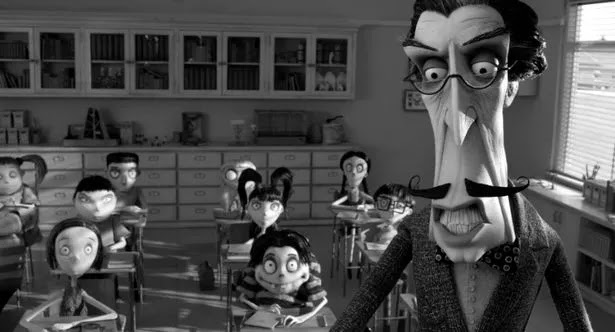
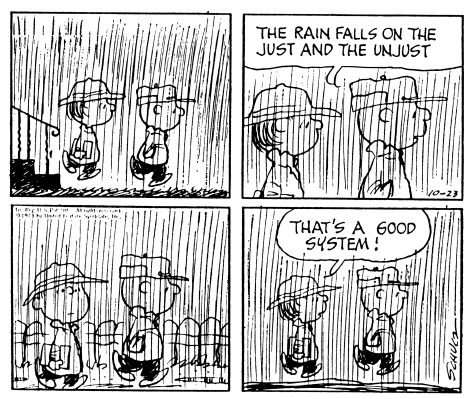
Sparky exhibits a far greater depth of moods than a trained pit-bull terrier could exhibit in live action, not only in its darker moments, but especially in moments of joy—the animation of the dog running elicits fond feelings immediately, as the puppet is rarely touching the ground in motion, not unlike Charles Schulz's "Peanuts" kids who hover over the ground in transit. And although the human figures are Burton cyphers (resembling the human character designs of his first film Vincent) they are still soulful, their eyes expressing more emotions than their faces will betray.
Given that the subject matter is about a mad scientist of a little boy who runs the parallel path of his literary namesake to re-animate his beloved dog, killed in a traffic mishap, there's a lot of room for high emotion there, and far more than in the motivations of the original story.

But, Burton takes it further and makes it more than about young Victor. Taking pages from The Nightmare Before Christmas and Batman Returns, he stages the denouement at a city festival that brings all parties together in one spot, the communal experience gone awry.
Seems that Victor's work has attracted a lot of attention among his classmates, and as there's a science fair going on, all the kid's are doing the same thing—literally, the same thing, bringing to life their dead pets with very mixed results, and providing Burton a chance to explore other species of monster movies (and recreating scenes from them) than just the one, paying tribute to each, just as he does by including a scene from friend Christopher Lee's turn as "Dracula."
Like Victor's experiment, this is a labor of love as Burton—just as with the earlier short—resurrects the movies he loved as a kid, long-buried memories that never really leave, and have influenced Burton throughout his career. It's a fun, resonant electrification of his earlier work, with just enough fresh in it to make it worth the effort and bring it back to new life in leeched black-and-white (which Burton always manages to make look sumptuous). Now, if only we could see something wholly new and original from him, that would be some experiment.

The original Frankenweenie


Brad Bird's "Family Dog" (from Steven Spielberg's "Amazing Stories") based on animation designs by Tim Burton

* It did find it's way to Paul Reubens who'd been trying to find a suitable director to collaborate on his long-in-the planning Pee-Wee Herman movie he'd been dreaming about.  Frankenweenie convinced him to contact Burton.


Friday, June 2, 2023

The Little Mermaid (2023)

A Woman Needs a Man Like a Fish Needs a Bicycle ("I've Got Twenty!")
or 
Mermaids Aren't Real But Racism Sure Is.  

Disney's The Little Mermaid was a revelation when it came out in 1989. At the time, Disney had been in the doldrums, creatively and financially (hard to believe, I know—this was before they found a new creative voice and, if not having it, buying it). Oh, they'd experiment a bit half-heartedly and always with an eye to the budget, which would constrain the imagination or goals. And the Disney brain-trust, "The Nine Old Men" as those original brilliant animators were called, were one-by-one dying off.
 
Then, Jeffrey Katzenberg came in on the coat-tails of in-coming Disney CEO Michael Eisner. A head-strong Paramount exec who finally tired of that studio's inexhaustible ability to shoot itself in the foot in order to assuage middle management egos, Katzenberg skedaddled to Disney and determined to take it back to its glory days of being THE animation studio. Directors John Musker and Ron Clements had the idea of making an animated version of Hans Christian Anderson's "The Little Mermaid" (not knowing the studio had once considered doing that in 1935). A Broadway veteran now working at Disney, Howard Ashman—with composer Alan Menken, the two had a hit with their musical version of "Little Shop of Horrors"—was approached to help with structuring the story and songs, and, together, Ashman and Menken took a Broadway musical approach to the proposed film. The result of that work is legendary.
Now, with Disney recycling their past cartoon triumphs as live action films, eventually they had to revisit this one, the first of the Disney "renaissance" films. The 2023 "live" version of The Little Mermaid
is as good as it can be, given that it couldn't possibly live up to its animated version; this was the problem with Aladdin, Beauty and the Beast, and most of the others in this doubling-down effort. Live-action (even live-action enhanced by CGI) just can't live up to the pace of animation, so there are moments that drag and make you wish for a song to interrupt things.
As for those songs, they're the best thing about this version (although there are three new ones—by Menken and Lin-Manuel Miranda—that are good but can't compete) and produce moments that are positively goose-bumpy (one song—the giddy and murderous "Les Poissons" was dropped, perhaps wisely). One interesting aspect to this version is the choreography for the already-Oscar winning song "Under the Sea" was done by the Alvin Ailey dance troupe.
Anything new in the mix that's good? Well, I like that they've moved the locale to the West Indies, as opposed to colonial Europe. That's a breath of fresh air and certainly justifies the Caribbean rhythms in the songs. And, the casting, certainly (and we won't even address the initial internet bitching...which never made any sense to me). As Ariel, the mermaid who wants to get out of the pool, Halle Bailey is a real find. Exotic of features to seem truly otherworldly, she carries the entire movie on her shoulders and belts out the songs exquisitely, throwing her own spin on them and taking them to a higher level.
I can't even imagine the tortures she had to go through making this movie—the location work on water, the constantly moving underwater shots that had to be done in front of a green-screen, and the awkwardness of basically having to work only from the waist up and project joy and grace while doing it. That's tough duty for what is essentially a first feature starring role. You think there's pressure underwater? Try pulling something like that off!
In the role of Atlantica's crusty-as-coral-King Triton, Javier Bardem takes the too-familiar pater familias character from the cartoon and, as usual, slyly informs it with little subtle bits of business one doesn't expect and appreciates. Awkwafina is a fine substitute for Buddy Hackett as Ariel's squawking friend Scuttle, Daveed Diggs is just fine as crabby Sebastian (although the character design is a bit...off), and, hey, Art Malik gets to not play a villain after so many years! I just wish Jacob Tremblay (who is usually scary good!) had more to do in his fish part.
But, the piece de resistance is
Melissa McCarthy's turn as the sea-witch Ursula—the part played by Pat Carroll with such venom in the original. McCarthy is a comic gem, who has too often settled on sub-par movies that she has troopered through trying to improve. Here, she's got a great part, a great song—"Poor Unfortunate Souls"—with an "Angela-Lansbury-nightmare" intensity, combined with a whip-saw sense of timing that's simply amazing. And give some credit to Jessica Alexander who manages to match it for Ursula's human guise.
Even the traditional Prince Charming chap is okay (Jonah Hauer-King), unthreateningly handsome in a bewildered sort of way, the way Disney likes them. And adapter
David Magee has made sure that Ariel and the Prince at least share the dissatisfaction of living in royally oppressive households so they have something in common. Still didn't solve the issue of why Ariel just doesn't write what she needs to say after her voice-ectomy.
But, there's another issue that didn't come up with the original and that mostly has to do with timing. In an environment when we've had Brave and Frozen in the children's entertainment mix, isn't the old canard about "true love" and a "handsome prince" pretty old-hat? Sure, it seemed commonplace in the 1950's and any number of rom-coms still depend on it, and, yes, the 1989 version presented it unquestioningly. But, they could have changed it, challenged it, maybe nuanced it a bit more; after all, the 1989 cartoon changed the ending of Anderson's story where the mermaid didn't get the prince and died. Children would have been traumatized, of course. The tears would have flowed like rivers down the aisles, breaking like waves against the concession stands.
Speaking of concessions, I don't know why, given Triton's apparent powers, he couldn't make things a bit more even-keeled in the sacrificing department of the Ariel-Eric relationship. He can give his daughter legs, but can he also change the Prince into mer-Eric? How are the couple going to visit Atlantica on holidays? Why does she have to change? Why can't he? Her song says "Part of Your World" not "I'm diving in with both"...(what's the word?) "feet." A little parity would have been nice. A little less stalking of the human, and maybe a little less "once they find true love it'll all turn out all right"*.
 
No one believes THAT fairy-tale!
* It's what bothered me about the Wonder Woman films, too.