or
Mermaids Aren't Real But Racism Sure Is.
Disney's The Little Mermaid was a revelation when it came out in 1989. At the time, Disney had been in the doldrums, creatively and financially (hard to believe, I know—this was before they found a new creative voice and, if not having it, buying it). Oh, they'd experiment a bit half-heartedly and always with an eye to the budget, which would constrain the imagination or goals. And the Disney brain-trust, "The Nine Old Men" as those original brilliant animators were called, were one-by-one dying off.
Then, Jeffrey Katzenberg came in on the coat-tails of in-coming Disney CEO Michael Eisner. A head-strong Paramount exec who finally tired of that studio's inexhaustible ability to shoot itself in the foot in order to assuage middle management egos, Katzenberg skedaddled to Disney and determined to take it back to its glory days of being THE animation studio. Directors John Musker and Ron Clements had the idea of making an animated version of Hans Christian Anderson's "The Little Mermaid" (not knowing the studio had once considered doing that in 1935). A Broadway veteran now working at Disney, Howard Ashman—with composer Alan Menken, the two had a hit with their musical version of "Little Shop of Horrors"—was approached to help with structuring the story and songs, and, together, Ashman and Menken took a Broadway musical approach to the proposed film. The result of that work is legendary. Now, with Disney recycling their past cartoon triumphs as live action films, eventually they had to revisit this one, the first of the Disney "renaissance" films. The 2023 "live" version of The Little Mermaid is as good as it can be, given that it couldn't possibly live up to its animated version; this was the problem with Aladdin, Beauty and the Beast, and most of the others in this doubling-down effort. Live-action (even live-action enhanced by CGI) just can't live up to the pace of animation, so there are moments that drag and make you wish for a song to interrupt things.


Anything new in the mix that's good? Well, I like that they've moved the locale to the West Indies, as opposed to colonial Europe. That's a breath of fresh air and certainly justifies the Caribbean rhythms in the songs. And, the casting, certainly (and we won't even address the initial internet bitching...which never made any sense to me). As Ariel, the mermaid who wants to get out of the pool, Halle Bailey is a real find. Exotic of features to seem truly otherworldly, she carries the entire movie on her shoulders and belts out the songs exquisitely, throwing her own spin on them and taking them to a higher level.  I can't even imagine the tortures she had to go through making this movie—the location work on water, the constantly moving underwater shots that had to be done in front of a green-screen, and the awkwardness of basically having to work only from the waist up and project joy and grace while doing it. That's tough duty for what is essentially a first feature starring role. You think there's pressure underwater? Try pulling something like that off!


In the role of Atlantica's crusty-as-coral-King Triton, Javier Bardem takes the too-familiar pater familias character from the cartoon and, as usual, slyly informs it with little subtle bits of business one doesn't expect and appreciates. Awkwafina is a fine substitute for Buddy Hackett as Ariel's squawking friend Scuttle, Daveed Diggs is just fine as crabby Sebastian (although the character design is a bit...off), and, hey, Art Malik gets to not play a villain after so many years! I just wish Jacob Tremblay (who is usually scary good!) had more to do in his fish part. But, the piece de resistance is Melissa McCarthy's turn as the sea-witch Ursula—the part played by Pat Carroll with such venom in the original. McCarthy is a comic gem, who has too often settled on sub-par movies that she has troopered through trying to improve. Here, she's got a great part, a great song—"Poor Unfortunate Souls"—with an "Angela-Lansbury-nightmare" intensity, combined with a whip-saw sense of timing that's simply amazing. And give some credit to Jessica Alexander who manages to match it for Ursula's human guise.
 Even the traditional Prince Charming chap is okay (Jonah Hauer-King), unthreateningly handsome in a bewildered sort of way, the way Disney likes them. And adapter David Magee has made sure that Ariel and the Prince at least share the dissatisfaction of living in royally oppressive households so they have something in common. Still didn't solve the issue of why Ariel just doesn't write what she needs to say after her voice-ectomy.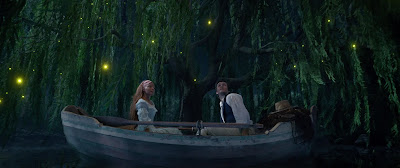


But, there's another issue that didn't come up with the original and that mostly has to do with timing. In an environment when we've had Brave and Frozen in the children's entertainment mix, isn't the old canard about "true love" and a "handsome prince" pretty old-hat? Sure, it seemed commonplace in the 1950's and any number of rom-coms still depend on it, and, yes, the 1989 version presented it unquestioningly. But, they could have changed it, challenged it, maybe nuanced it a bit more; after all, the 1989 cartoon changed the ending of Anderson's story where the mermaid didn't get the prince and died. Children would have been traumatized, of course. The tears would have flowed like rivers down the aisles, breaking like waves against the concession stands. Speaking of concessions, I don't know why, given Triton's apparent powers, he couldn't make things a bit more even-keeled in the sacrificing department of the Ariel-Eric relationship. He can give his daughter legs, but can he also change the Prince into mer-Eric? How are the couple going to visit Atlantica on holidays? Why does she have to change? Why can't he? Her song says "Part of Your World" not "I'm diving in with both"...(what's the word?) "feet." A little parity would have been nice. A little less stalking of the human, and maybe a little less "once they find true love it'll all turn out all right"*.

No one believes THAT fairy-tale!
 * It's what bothered me about the Wonder Woman films, too.