Showing posts with label Awkwafina. Show all posts

Friday, June 2, 2023

The Little Mermaid (2023)

A Woman Needs a Man Like a Fish Needs a Bicycle ("I've Got Twenty!")
or 
Mermaids Aren't Real But Racism Sure Is.  

Disney's The Little Mermaid was a revelation when it came out in 1989. At the time, Disney had been in the doldrums, creatively and financially (hard to believe, I know—this was before they found a new creative voice and, if not having it, buying it). Oh, they'd experiment a bit half-heartedly and always with an eye to the budget, which would constrain the imagination or goals. And the Disney brain-trust, "The Nine Old Men" as those original brilliant animators were called, were one-by-one dying off.
 
Then, Jeffrey Katzenberg came in on the coat-tails of in-coming Disney CEO Michael Eisner. A head-strong Paramount exec who finally tired of that studio's inexhaustible ability to shoot itself in the foot in order to assuage middle management egos, Katzenberg skedaddled to Disney and determined to take it back to its glory days of being THE animation studio. Directors John Musker and Ron Clements had the idea of making an animated version of Hans Christian Anderson's "The Little Mermaid" (not knowing the studio had once considered doing that in 1935). A Broadway veteran now working at Disney, Howard Ashman—with composer Alan Menken, the two had a hit with their musical version of "Little Shop of Horrors"—was approached to help with structuring the story and songs, and, together, Ashman and Menken took a Broadway musical approach to the proposed film. The result of that work is legendary.
Now, with Disney recycling their past cartoon triumphs as live action films, eventually they had to revisit this one, the first of the Disney "renaissance" films. The 2023 "live" version of The Little Mermaid
is as good as it can be, given that it couldn't possibly live up to its animated version; this was the problem with Aladdin, Beauty and the Beast, and most of the others in this doubling-down effort. Live-action (even live-action enhanced by CGI) just can't live up to the pace of animation, so there are moments that drag and make you wish for a song to interrupt things.
As for those songs, they're the best thing about this version (although there are three new ones—by Menken and Lin-Manuel Miranda—that are good but can't compete) and produce moments that are positively goose-bumpy (one song—the giddy and murderous "Les Poissons" was dropped, perhaps wisely). One interesting aspect to this version is the choreography for the already-Oscar winning song "Under the Sea" was done by the Alvin Ailey dance troupe.
Anything new in the mix that's good? Well, I like that they've moved the locale to the West Indies, as opposed to colonial Europe. That's a breath of fresh air and certainly justifies the Caribbean rhythms in the songs. And, the casting, certainly (and we won't even address the initial internet bitching...which never made any sense to me). As Ariel, the mermaid who wants to get out of the pool, Halle Bailey is a real find. Exotic of features to seem truly otherworldly, she carries the entire movie on her shoulders and belts out the songs exquisitely, throwing her own spin on them and taking them to a higher level.
I can't even imagine the tortures she had to go through making this movie—the location work on water, the constantly moving underwater shots that had to be done in front of a green-screen, and the awkwardness of basically having to work only from the waist up and project joy and grace while doing it. That's tough duty for what is essentially a first feature starring role. You think there's pressure underwater? Try pulling something like that off!
In the role of Atlantica's crusty-as-coral-King Triton, Javier Bardem takes the too-familiar pater familias character from the cartoon and, as usual, slyly informs it with little subtle bits of business one doesn't expect and appreciates. Awkwafina is a fine substitute for Buddy Hackett as Ariel's squawking friend Scuttle, Daveed Diggs is just fine as crabby Sebastian (although the character design is a bit...off), and, hey, Art Malik gets to not play a villain after so many years! I just wish Jacob Tremblay (who is usually scary good!) had more to do in his fish part.
But, the piece de resistance is
Melissa McCarthy's turn as the sea-witch Ursula—the part played by Pat Carroll with such venom in the original. McCarthy is a comic gem, who has too often settled on sub-par movies that she has troopered through trying to improve. Here, she's got a great part, a great song—"Poor Unfortunate Souls"—with an "Angela-Lansbury-nightmare" intensity, combined with a whip-saw sense of timing that's simply amazing. And give some credit to Jessica Alexander who manages to match it for Ursula's human guise.
Even the traditional Prince Charming chap is okay (Jonah Hauer-King), unthreateningly handsome in a bewildered sort of way, the way Disney likes them. And adapter
David Magee has made sure that Ariel and the Prince at least share the dissatisfaction of living in royally oppressive households so they have something in common. Still didn't solve the issue of why Ariel just doesn't write what she needs to say after her voice-ectomy.
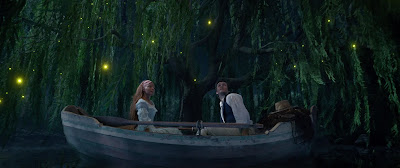
But, there's another issue that didn't come up with the original and that mostly has to do with timing. In an environment when we've had Brave and Frozen in the children's entertainment mix, isn't the old canard about "true love" and a "handsome prince" pretty old-hat? Sure, it seemed commonplace in the 1950's and any number of rom-coms still depend on it, and, yes, the 1989 version presented it unquestioningly. But, they could have changed it, challenged it, maybe nuanced it a bit more; after all, the 1989 cartoon changed the ending of Anderson's story where the mermaid didn't get the prince and died. Children would have been traumatized, of course. The tears would have flowed like rivers down the aisles, breaking like waves against the concession stands.
Speaking of concessions, I don't know why, given Triton's apparent powers, he couldn't make things a bit more even-keeled in the sacrificing department of the Ariel-Eric relationship. He can give his daughter legs, but can he also change the Prince into mer-Eric? How are the couple going to visit Atlantica on holidays? Why does she have to change? Why can't he? Her song says "Part of Your World" not "I'm diving in with both"...(what's the word?) "feet." A little parity would have been nice. A little less stalking of the human, and maybe a little less "once they find true love it'll all turn out all right"*.
 
No one believes THAT fairy-tale!
* It's what bothered me about the Wonder Woman films, too.

Friday, September 10, 2021

Shang-Chi and the Legend of the Ten Rings

Because, Well..."Magic"
or
It Always Pays to Accessorize...
 
Shaun (Simu Liu), your friendly valet down at that swanky San Francisco hotel is seen by most not to be living up to his potential, and that includes the family of his pal, Katy (Awkwafina), who also valets, and she might agree with them, if she didn't also enjoy the slacker lifestyle and its freedoms.
 
But, they don't know the half of it. Not even the tenth of it. Shaun is actually Shang-Chi, son of the immortal villain Xu Wenwu (Tony Leung, MVP), who, after the death of his mother (Fala Chin) by enemies of his father, was trained as a martial arts assassin to avenge her death. When charged by Wenwu to carry out an assassination, Shang-Chi disappeared, leaving behind his sister Xialing (Meng'er Zhang) and becoming invisible in the world, and leaving behind the world of evil in which his father lives. 
 
All this is to say: tip your valet next time. You don't know what he's been through to get there.
Look. This movie has spent a long time getting made. Marvel was going to do something with "The Ten Rings" as far back as the original Iron Man movie, kind of fluffed the chance when they botched the character of The Mandarin in Iron Man 3—it is alluded to here in this film—and it looks—for now—that they're going to center "Phase 4" of the Marvel films around it (at least until something better comes along). 
I mean, c'mon, if nothing else this movie has Tony Leung in it...Tony Leung!
 
That's great. One could speculate as to why Marvel chose to go with "The Infinity Stones" story-line in the last phase, but it would be to the detriment of the studio and its perception of their audience. No, let's just say this next step opens up the Marvel Universe to other cultural worlds and can expand their exploration of the Asian culture beyond ninja's and sumurai.
Because, let's face it, the origin of Shang-chi (or "Master of Kung Fu" or "Brother Hand" as he's been known) at Marvel is a little cringe-worthy: unable to obtain the rights to adapt the TV series "Kung Fu" to comics, Stan Lee and the creators at Marvel decided to make their own, snagging the rights to Fu Manchu and creating Shang-Chi as his son. When the "Fu" rights expired, the writers changed the story-line/origin story and allowed the character to mature beyond pulp stereotypes.
The Ten Rings story is an interesting one—not unlike the Infinity Stones, but they're more complex and can do more things,* and it appears that the MCU is making them bracelets as opposed to the comics' finger-rings to make them visually more distinct than the Infinity Gauntlet thing. I'm sure there will be moans from the comics fans that everything isn't completely faithful to the originals, but then, the X-men never wore leather in the comics, either.
So, how's the movie? Pretty good—the first Marvel character movies have traditionally been good to great and then slide into mediocrity (with the exception of the Captain America series, interestingly) although the story is not much to write home about—Delusional Evil Dad wants son back and sends his agents to find him and bring him home. What makes it special is Tony Leung Chiu-Wai is such a great actor that you actually work up some sympathy for him. Plus, Michelle Yeoh is there as "Aunt Nan" (really) and she's always welcome.
Director Cretton keeps things fast and moving, including the dialogue, and as so much of this movie is fighting, he has a great way of filming choreography, which is always a plus in a genre where one should be as expert as possible in animating fisticuffs. 
 
Again, an interesting start for Marvel which makes one excited for things to come.

* And I guess that may be my major complaint about the movie—the Rings aren't explained, they're just a given. They're magic. They do magical things. Why? And how? It tends to negate any sense of tension when there aren't any rules or limitations explained, so that when somebody gets the upper hand you think "Wait! Can he do that?" It's like playing a board game without reading the instructions. There's no meaning to it. It's an adjunct of the visually stunning Marvel comics that had those magnificent ships appearing over a cityscape and having it explained by a character that said "I don't know what it is, but it sure is BIG!"

Thursday, August 15, 2019

The Farewell (2019)

Would I Lie To You?
or
"I Know. I Know. I Know. I Know. I Know."

Truth is stranger than fiction. 

That is usually the case. But, when that truth involves a lie, it makes things a bit complicated, like a knot in the time-space continuum. 


Given the political situation these days, I should be sick of lying and lying liars, but Lulu Wang's lovely film, The Farewell ("based on an actual lie" is the witty tag-line) is a tonic in its story of a lie done for a good cause, and rather slyly shows the ease and universality of lying in every-day life—"what they don't know won't hurt 'em" or "what they don't know will get me off the phone faster..."

Wang's film is based on an actual family story that she had related in a story on "This American Life"—that font of interesting story-telling that specializes in the absurd and the ironic (Steve Soderbergh's The Informant! came from there, as did Paul Feig's Unaccompanied Minors and Mike Birbiglia's Sleepwalk with Me). It is filled with the expected humor and irony of a situation—a conspiracy, really—where family members go to a lot of trouble to maintain a falsehood for the best of intentions, even as the subterfuge inspires guilt and second thoughts for those who carry it out.
It involves a Chinese family who have split up around the world, but come together in a moment of crisis, despite misgivings and general anxiety about their actions. It revolves around the oldest member of the family.

The matriarch, affectionately called "Nai Nai" (played by Shuzhen Zhao), goes for a routine check-up about a cough. She gets some bad news. Or, more accurately doesn't get some bad news. She has cancer, and the prognosis is not good—she has maybe three months to live. She would have gotten the bad news, but her younger sister, "Little Nai Nai" (Hong Lu, basically playing herself), who took her to her appointment, is told the results. Little Nai Nai thinks, breathes and tells Nai Nai that nothing is wrong. It's just "benign shadows." Everything's fine. Nai Nai is relieved. Satisfied, they go home. And then, the story must be told and upheld.
Little Nai Nai contacts Nai Nai's children, the sons, one of whom, Haiyan (Tzi Ma) lives in the States and the other, Haibin (Yongbo Jiang) who lives in Japan, that their mother has three months to live. They are devastated. But, they agree to not tell Nai Nai. Because when you tell someone they have cancer, they die. But, if you don't tell them, they can enjoy their remaining time without worry and carefree. Ignorant, maybe, but carefree.

It's a bit like Schrodinger's Nai Nai; as long as she doesn't know, she doesn't have anything to worry about. 
Fine for Nai Nai. But, the family is grieving. So, they decide to compound the lie by planning a trip to China to say their good-byes to Nai Nai (without letting her know she's going away). The family decides to move up the marriage of her grandson Hao Hao (Han Chen) to his Japanese bride Aiko (Aoi Mizuhara) by a year as an excuse to make the visit and allow Nai Nai to revel in the celebration of her first grandchild's marriage...and for the family to say good-bye. There's a lot of mixed emotions in such the family trip, more so than the normal tensions amid interactions between three generations.
For granddaughter Billi (Awkwafina), it's especially rough, as she has a close relationship with her grandmother, who tells her that she has emotions "like a zoo," so much so that the family suggests that she not even go, lest she betray the secret. Of course, she does go and quite defiantly. When she first gets there, she is so afraid that her feelings will betray themselves that she acts like a zombie, which is almost as bad as giving full vent to her maelstrom of emotions.
Plus, she's torn. She's lived most of her life in America and so the farthest afield from the logic that it's better to keep the cancer prognosis from her grandmother. She's very conflicted about it, and her stoicism is explained away as "jet-lag" (not too dissimilar to "benign shadows"), but eventually she loosens up and is able to enjoy the time she has with her beloved Nai Nai.
A lot of conflicts, a lot of inherent comedy in that, and Wang's simple direction keeps the focus on the staid reactions of the family members, who have their own individual betrayals of the truth, while not betraying the lie.

It's a wonderful film with a final truth of irony. Six years after the diagnosis, "Nai Nai" (the real one) is still alive. So is, as the movie shows, exceptional, surprising film-making.

One hopes, though, that she never sees the movie.