Showing posts with label Michelle Yeoh. Show all posts

Thursday, December 12, 2024

Wicked (Part 1)

Galindafied and Elphabatized
or
Defying Gravitas ("Well, That's a Little Perky...")
 
I didn't know from "Wicked". Never saw the show. Never read the book. The only thing I knew was from YouTube videos watching Idina Menzel and Kristen Chenoweth doing songs from the show. That doesn't give you any sense of what the show is and what the story is about. You can glean that it's a "ret-con" origin story for the Wicked Witch of the West (played by Margaret Hamilton in the version of The Wizard of Oz that everybody knows and loves).
 
It's a trend. As I wrote in my review of Maleficent: "I don't mind when a villain gets his just desserts, but I don't want to "feel for" them when they receive it. I want no sympathy for villainy, no matter the lawyering of its arguments. The fact is I don't care why the Grinch stole Christmas, why the Wicked Witches terrorize Oz, or why Booth shot Lincoln or Oswald shot Kennedy. I don't care why the creep killed those people at USC. Some things cannot be explained away, or understood for their motivations. God help me when I do understand the terrible actions in this world. They are acts of evil, un-pure and simple."

"It is a tragedy that we even have the opportunity to ponder them at all."
 
"Making Maleficent sympathetic diminishes us...and diminishes her."
I haven't changed much in my thinking. Other than to suppose that argument is a little heavy for something like "Wicked". And it does a good job of making the black-and-white/good-and-evil extremes of L. Frank Baum's stories more complex and nuanced. (So, calm down, you musical-theater students! I'm just pondering here and I wouldn't do that if "Wicked" didn't have some significance). I felt the need to see it, anyway, because, after seeing all the corporate tie-ins involved with the thing ubiquitously on television commercials, I began to think that not seeing it might make the economy collapse. I had to do my part.
So, here's John M. Chu's version of
Wicked (Part 1 it should be emphasized, this part ends right at the intermission of the play, with the rest of it to be released next year), and it takes full advantage of green-screens and movie-magic (just as the 1939 The Wizard of Oz made the most of the special effects technology of its day*) and is choreographed, production-designed, and cinematographed within an inch of its stage-life, except now taking advantage of the new camera technologies that give you a flying-monkey's perspective of Ozian landscapes.
The film begins in media res of events of The Wizard of Oz with the camera gliding over the homicide scene of the Wicked Witch of the West's watery demise, with its sodden floor, the empty robes and the unadorned hat the only signs of what had gone before. We're whisked—past the figures of Dorothy and her companions making their way to the Emerald City to present the witch's broom to the Great and Powerful Oz—to Munchkinland where the decidedly un-heighth-challenged citizens celebrate the death of the one remaining bad witch when Glinda the good witch (Ariana Grande) confirms that, indeed, the Wicked Witch of the West has been liquidated, and her muted reaction to the news is muted. She reveals that she knew the Wicked Witch and reveals that, yes, they were even friends.
She recalls that the Witch (
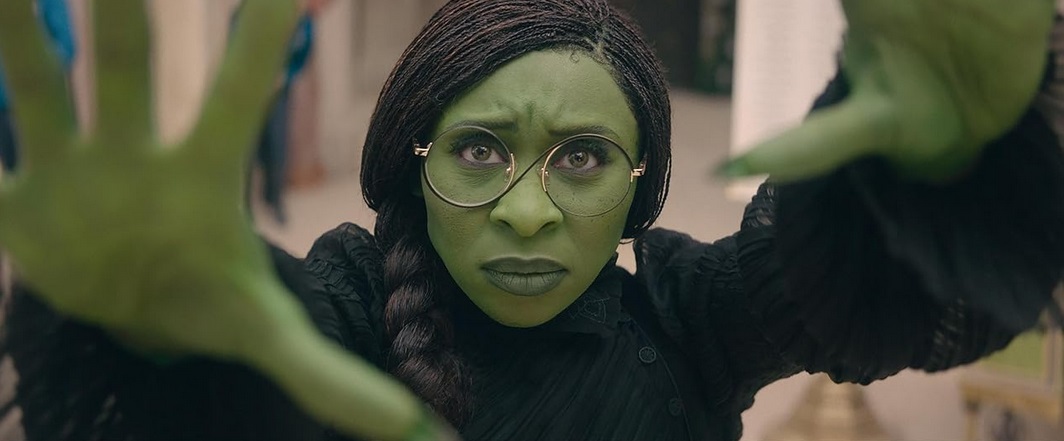
Cynthia Erivo) was named Elphaba Thropp—conceived as a result of an affair between the Munchkinland Mayor's wife and a traveling salesman and disowned by the Mayor when she is born with green skin-tones, making her an outcast. They have a second child, Nessarose (Marissa Bode), who is born paraplegic and so the parents' affection and care gravitate to her with Elphaba seen as merely a caretaker. When the Mayor has Nessarose enrolled at Shiz University, Elphaba accompanies her, but when things get a little dire, she displays unbridled magical powers that attract the attention of Shiz's Dean of Sorcery Studies, Madame Morrible (Michelle Yeoh). She is enrolled over the Mayor's protestations with Morrible becoming her private tutor and is roomed with Galinda Upland (Grande), the perpetually bubbly social queen of Shiz.
They do not get along. Galinda sees Elphaba as a drag and Elphaba sees Galinda as...typical. But, the two do see moments of value in the other, especially when Elphaba begins to stick up for animal rights at Shiz—talking animals being the legacy instructors at the University. But, the animal professors are being replaced by biped instructors by order of the Wizard of Oz (
Jeff Goldblum) and that they be prohibited from talking, instructionally or otherwise, and to the ostracized Elphaba that feels more than specist, it feels authoritarian and she's had enough of that in her personal life, thank you. It's not nearly bad or merely bad, but really and sincerely bad.
That's the gist—The growing trust between Galinda and Elphaba and the growing distrust between Elphaba and the Wizard, and what to do about it. Oh, there's boyfriends, too (
Jonathan Bailey and Ethan Slater) just to complicate things, and lots and lots of ancillary characters on the fringes because they have to have dancers. It's a musical, after all.
I'm hot-or-cold with musicals. The form always makes me suspicious, even while understanding that breaking into song is a better expression of feeling than "talking it out." But, those songs and those feelings have to be really strong to earn their place in the narrative. Anything less and you're wasting story-telling time and just harmonizing-in-place. Here, that number is "Dancing Through Life" which is just a pace-killer (although it serves as the intro piece to Prince Heartthrob, Fiyero). The thing just goes on forever and had me thinking of P.L.Travers' critique of Disney films with their
"cavorting, twinkling, and prancing to a happy ending like a kamikaze." Fortunately, that's the only point where, if I had a watch, I'd be checking it. The rest of the film sails right on by with something always entering frame to goggle at or enjoy a vocal performance.
And let's face it, the show is a bit of a two-hander between the characters of Elphaba and Galinda/Glinda and that's where Wicked is at its best. Grande is a natural for Glinda although the performance is leavened somewhat by the introduction of a cool aloofness that helps solve the problem of Glinda perky-power-housing through the show to the detriment of the more austere Elphaba character. The movie transfers some of that energy to the chorus of characters surrounding the two and it allows you to really appreciate one thing.
And that's the concentrated subtlety of Cynthias Erivo's performance. While the rest of the movie is "twinkling and cavorting" she earns every slight tilt of the head, wry pull of the mouth, and doesn't waste anything. And she acts through her songs, so even through context, you know exactly what she's singing about—from everybody else, a lot of the lyrics get lost in the jumble. And when she tornadoes through a power-ballad, it shakes the theater-speakers and pummels the heart-strings. I dropped a tear or two during that "Defying Gravity" finale, and that's probably a little threatening to the character.
 
But, it made me want to see Part 2—and not just for the sake of the economy. I have to admit, it did cast a spell.

* The book, of course, didn't have to hew to any visual conception. The stage-musical leaned heavily into the 1939 movie version of things.

Wednesday, September 20, 2023

A Haunting in Venice

A Haunting We Will Go/A Haunting We Will Go/Hi-Ho-Confuse Poirot/A-Haunting We Will Go
or
"Lighten Up, Pal! You Might Have Fun!"
 
It is 1947. "World's greatest detective" Hercule Poirot (Kenneth Branagh), he of fusty ways (oh god, they haul out the "egg joke" again!) and the elaborate mustache—that looks like superimposed Aston Martin/Bentley logos—is in retirement. In Venice. "A gorgeous relic sinking into the sea" compares mystery novelist Ariadne Oliver (Tina Fey), who has skipped the long line of desperate potential clients waiting outside his door to tempt Poirot with a case which just might revivify her career after three critically-panned books. 
 
Poirot will have none of it. A veteran of the first World War (as was shown in the previous film, Death on the Nile), he has lived long enough to see that its reputation as "the war to end all wars" has proved false and, having seen too much of death, has foregone his profession to ease the strain on his little grey cells. But, Oliver is persistent, and so he joins her on Hallowe'en night to the palazzo of opera star Rowena Drake (Kelly Reilly) to witness a festive party for local Venician children, and, for an adult after-party, a seance performed by the medium Joyce Reynolds (Michelle Yeoh) to try to quell the spirits haunting the Drake place, one of whom might be Rowena's daughter Alicia, who died "under mysterious circumstances" years before.
"Under mysterious circumstances" may be overstating, as the girl drowned in a city that is nothing but waterfront property—sort of like being surprised when there's an explosion at a munitions factory ("Non-smoking? Who knew?"). I'm just saying that the Venice polizia usually don't ask "cause of death?" as they fish another tourist out of the canal. That aside, there is some question as to whether Alicia's death was a suicide or an accident or...was it murder?
Poirot, he does not care. He's there to expose the medium using his powers of observation and his absolute disbelief in the supernatural ("scary stories make life less scary"), suspecting that some grift will ensue from the proceedings. His convictions are only solidified when Alicia's former fiancee Maxime Gerard (

Kyle Allen) arrives after a mysterious invitation is sent his way so many months after the tragedy. Also in attendance is the family's doctor Leslie Ferrier and his son Leopold (Jamie Dornan and Jude Hilll, who played father and son in Branagh's Belfast) and the housekeeper Olga Seminoff (Camille Cottin), all of whom figured in the care-taking of the daughter before her death. It all seems very neat and tidy.
The seance is anything but. It's a convincing show, with Reynolds going into a trance, speaking in the dead girl's voice, spinning in place and with messages appearing on a typewriter ("I think of myself more of a secretary than anything" says Reynolds), seemingly written by "the lost girl from beyond." Nature conspires with the supernatural as a violent thunderstorm permeates the whole procedure. But, the mysteries linger on with Poirot nearly killed bobbing for apples (true!), strange voices permeating the house, flashes of the dead girl from beyond, and...a couple of grisly murders most foul.
A Haunting in Venice is based on Dame Agatha Christie's 1969 novel "Hallowe'en Party" and in much the same way that later James Bond movies are based on Ian Fleming novels—that is, not very. Scenarist Michael Green (he's done the scripts for all of Branagh's Poirot films as well as Logan and Blade Runner 2049) has retained some of the names, but murdered Christie's plot and hatched one of his own (mind you, all with the tacit approval of the Christie Estate). Although it ties up all physical loose ends, it ends up with an implicit endorsement of the supernatural (if only in sub-text, but is rather jarring when its chief detective is committed to exposing the charlatan exploiters of the belief, and a couple of glaring motivations amidst a couple of suspects.
Perhaps because he knew the weakness of the script, Branagh the director works overtime establishing an atmosphere that disorients and distracts. His compositions are full of dutch angles and high and low shots, fish-eye lenses, and full of conversations with askance sight-lines. That's not "normal" film-making (and by that I mean "professional" film-making that obeys "all the rules" and creates a comfortable-to-the-eye-and-mind viewing experience). Branagh's choices are Wellesian in their disregard for viewer comfort; discomfiture is actually key to making the film work. By setting audiences "on edge" and making things look "off" you can get away with a lot of chicanery in a burst of style over substance.
That may sound dismissive, but Branagh has typically been a director of verisimilitude—making things look real. Here, he deliberately makes things surreal, claustrophobic and, often, acrophobic (which is a lot of work!), but it breaks a cardinal rule—never call attention to your directing (a rule too often ignored by beginning film-makers.) The result is so showy and over-the-top that one just might forget the story-line for all the sights to see.
In this case, it's a good strategy. The script is a let-down, full of incident and the occasional zinger of a line, but too convenient and incredulous simultaneously to make a well-conceived plot both among the movie's conspirators and behind-the-scenes in the writer's room. Branagh's work and collaboration with cinematographer Haris Zambarloukos (he's done Branagh's last few films...AND ), however, overcompensates to a degree that one feels that one has seen a real show, full of acrobatics and elephants in the room (and one abrasive cockatoo!) to marvel at, even if the little grey cells are not entirely engaged and unconvinced.
It sure looks good, even if it's as insubstantial as a ghost. 

Thursday, April 14, 2022

Everything Everywhere All at Once

The Cosmic Comedy
or
"It's Going To Be So Hard To Explain This To You!"
 
For the longest time, the IMDb description for it was "a woman tries to do her taxes." Not something to create a surge at the box office (although I found I couldn't get a seat in a theater for it this weekend).
 
Oh, Everything Everywhere All at Once is about that. But, it's a lot of other things, too.
 
The best way I can describe it is as a negative. Imagine the pitch to Michelle Yeoh: "So, Michelle (I can call you Michelle?)...what kinds of movies HAVEN'T you done? And do you want to do them all in one movie?"
 
That makes it a little bit easier to categorize it than by the seemingly infinite series of hyphenated genres I was coming up with by the end of the thing. Or, by the seemingly infinite number of references and "inside" jokes that permeate through it.
 
No, EEAAO* is it's own thing. Let's create a new genre: Dizzying.
Evelyn Wang (Yeoh) is having a crisis.  Well, okay, several crises in various stages of resolution. It's a mid-life crisis—she's a Chinese immigrant, caught between languages and cultures and married to a man, Waymond (
Ke Huy Quan and yes, he was Short Round), who is cheerily ineffectual, whom her father (James Hong) warned her not to marry. She has a daughter, Joy (Stephanie Hsu) who's adolescent and gay—not culturally...cultural. She helps run the family laundromat and they are late on their taxes and there are questionable deductions that are being spotted by the sharp-eyed, sharp-tongued Mrs. Deirdre Beaubeirdra** (Jamie Lee Curtis), who wants all the documentation by the end of the day. The laundromat had a water leak and it's stained one of the ceiling tiles, and her father—the one who disowned her?—has just moved over to the U.S. from China and is living with them, and Evelyn is planning a birthday celebration for him. Plus, she doesn't know...or hasn't noticed...that Waymond has just filed divorce papers.
 
Life happens, am I right?
And whatever doesn't kill you makes you stronger. But, instead of having a nervous breakdown, Evelyn has an intervention of sorts. At the headquarters of the IRS, a suddenly very focused Waymond tells her to put on some ear-buds that look like blue-tooth, and gives her a list of instructions to do if things go awry. And while listening to her auditor drone on and on about documentation and receipts, Evelyn suddenly has her attention pulled away...that blue-tooth thingy beeps and, soon, following those written instructions, her attention isn't alone.
As any nerd will tell you, there is a multiverse of possibilities created every time we make a decision in our lives, and Evelyn has been visited by the Waymond of the Alpha Universe to implore her help in a desperate crisis. The Alpha-Evelyn of that Universe is dead, having developed a technology that allows jumping between universes and employing the skills of other similar entities in alternate realities. In other words, Evelyn can download the skills and experiences of those other Universe-Evelyn's in order to defeat the purposes of an entity called Jobu Tupacki.
Why isn't the Alpha-Evelyn doing this? She's dead because she jumped Universes so much her brain fried. Why is this Evelyn being tasked with it? Because of all the Evelyn's in all the Universes, she is the biggest failure, and so her potential is much bigger and she's in less danger of having her brain crisped. So, with the help of Alpha-central and the control room that is feeding her instructions and coordinates—all while they are being attacked by this Jobu Topacki, by the way—she is able to tap into this seemingly infinite number of Evelyns and their skills and experiences.
And they are legion—there's the Evelyn who is a master of martial arts (and a separate one who has learned the mastery of "pinky-fu"), the Evelyn who's an expert at sign-twirling, the master chef, the singer, the actress, the dominatrix, all the Evelyns that have ever been, in all walks of life and forms and sexual orientations, all available to be used, perused and abused, depending on what's available and whether she can perform the actions necessary to receive them. All in the service of circumventing the all-powerful Jobu Topacki.
And the film-makers, Dan Kwan and Daniel Scheinert (call them "Daniels") have a seemingly endless supply of ideas and references to call upon, be it "The Twilight Zone" and Brainstorm and The Matrix and The Wizard of Oz, the malleability of Charlie Kaufman, and the anything-goes zen of "The Hitchhiker's Guide to the Galaxy", the movies of Stanley Kubrick and Wong Kar Wei, Disney/Pixar cartoons, horror movies, teen angst meltdowns, Amy Tan, martial arts, pop-culture, even Japanese porn, in a story that boils down to a domestic drama where the stakes are literally life and death. All done as a comedy; I haven't giggled so much in a movie in years.
Nor have I been as thrilled with the inventiveness of cinema at the hands of film-makers who never let go of the fact that they can do absolutely anything to tell a story. In a way, they have spoiled the multiverse pool for everybody else using the concept for the rest of time. It may even become its own genre after this.
The cast, of course, is perfect. Michelle Yeoh has always been a deft performer, only held back by the reticence of her characters who express themselves more in action. Here, she has a chance to do everything, titularly, and she is amazing, conspiring with film-makers who have  built a love-letter to a performer who has always been superb, but rarely allowed to stretch things to show just how superb she can be (Jackie Chan was the original choice to star and the film-makers sagely changed tacks to create a film of more depth).
Quan is a revelation, utilizing his child-star enthusiasm with a more mature presentation, but still keeping that playfulness and total commitment. Stephanie Hsu is a genuine find and traverses seamless transitions from drama to comedy and back with the mastery of an old pro. Speaking of whom, James Hong is here—it is always a pleasure to see him—and, having done literally everything in his 78 year career, this is a welcome opportunity to see a master, still in his prime at 93. Then there's Jamie Lee Curtis, giving a comedic performance (that at times allows her to show her inner "Jason") that is sometimes horrific, sometimes buffoonish, always funny, and always recognizably human. She's a treasure. They all are.
It's a tough movie to sum up, or even let go of, to put "30" to it and not have it careening through your head, assaulting your synapses and simultaneously tickling and tugging your heart, but I think the best to do so is in this distillation of its after-glow penned by Jake Coyle of The Chicago Sun-Times: "And though Everything Everywhere All at Once (a movie that very much lives up to its title) can verge on overload, it’s this liberating sense of limitless possibility that the movie leaves you filled with, both in its freewheeling anything-goes playfulness and in its surprisingly tender portrait of existential despair."

 
*Now, that I think about it—they didn't make a joke about "Old McDonald's Farm" in it. Maybe they did. I may have to see it a fifth time before I catch it.
 
** And I just realized while typing that that it's a reference to the song, "The Name Game"--this movie is DEEEP. 

Friday, September 10, 2021

Shang-Chi and the Legend of the Ten Rings

Because, Well..."Magic"
or
It Always Pays to Accessorize...
 
Shaun (Simu Liu), your friendly valet down at that swanky San Francisco hotel is seen by most not to be living up to his potential, and that includes the family of his pal, Katy (Awkwafina), who also valets, and she might agree with them, if she didn't also enjoy the slacker lifestyle and its freedoms.
 
But, they don't know the half of it. Not even the tenth of it. Shaun is actually Shang-Chi, son of the immortal villain Xu Wenwu (Tony Leung, MVP), who, after the death of his mother (Fala Chin) by enemies of his father, was trained as a martial arts assassin to avenge her death. When charged by Wenwu to carry out an assassination, Shang-Chi disappeared, leaving behind his sister Xialing (Meng'er Zhang) and becoming invisible in the world, and leaving behind the world of evil in which his father lives. 
 
All this is to say: tip your valet next time. You don't know what he's been through to get there.
Look. This movie has spent a long time getting made. Marvel was going to do something with "The Ten Rings" as far back as the original Iron Man movie, kind of fluffed the chance when they botched the character of The Mandarin in Iron Man 3—it is alluded to here in this film—and it looks—for now—that they're going to center "Phase 4" of the Marvel films around it (at least until something better comes along). 
I mean, c'mon, if nothing else this movie has Tony Leung in it...Tony Leung!
 
That's great. One could speculate as to why Marvel chose to go with "The Infinity Stones" story-line in the last phase, but it would be to the detriment of the studio and its perception of their audience. No, let's just say this next step opens up the Marvel Universe to other cultural worlds and can expand their exploration of the Asian culture beyond ninja's and sumurai.
Because, let's face it, the origin of Shang-chi (or "Master of Kung Fu" or "Brother Hand" as he's been known) at Marvel is a little cringe-worthy: unable to obtain the rights to adapt the TV series "Kung Fu" to comics, Stan Lee and the creators at Marvel decided to make their own, snagging the rights to Fu Manchu and creating Shang-Chi as his son. When the "Fu" rights expired, the writers changed the story-line/origin story and allowed the character to mature beyond pulp stereotypes.
The Ten Rings story is an interesting one—not unlike the Infinity Stones, but they're more complex and can do more things,* and it appears that the MCU is making them bracelets as opposed to the comics' finger-rings to make them visually more distinct than the Infinity Gauntlet thing. I'm sure there will be moans from the comics fans that everything isn't completely faithful to the originals, but then, the X-men never wore leather in the comics, either.
So, how's the movie? Pretty good—the first Marvel character movies have traditionally been good to great and then slide into mediocrity (with the exception of the Captain America series, interestingly) although the story is not much to write home about—Delusional Evil Dad wants son back and sends his agents to find him and bring him home. What makes it special is Tony Leung Chiu-Wai is such a great actor that you actually work up some sympathy for him. Plus, Michelle Yeoh is there as "Aunt Nan" (really) and she's always welcome.
Director Cretton keeps things fast and moving, including the dialogue, and as so much of this movie is fighting, he has a great way of filming choreography, which is always a plus in a genre where one should be as expert as possible in animating fisticuffs. 
 
Again, an interesting start for Marvel which makes one excited for things to come.

* And I guess that may be my major complaint about the movie—the Rings aren't explained, they're just a given. They're magic. They do magical things. Why? And how? It tends to negate any sense of tension when there aren't any rules or limitations explained, so that when somebody gets the upper hand you think "Wait! Can he do that?" It's like playing a board game without reading the instructions. There's no meaning to it. It's an adjunct of the visually stunning Marvel comics that had those magnificent ships appearing over a cityscape and having it explained by a character that said "I don't know what it is, but it sure is BIG!"

Wednesday, April 11, 2018

Sunshine (2007)

Written at the time of the film's release.

"...They went at night."

Our sun is dying. Mankind faces extinction. Seven years ago the Icarus project sent a mission to restart the sun but that mission was lost before it reached the star. Sixteen months ago, I, Robert Capa, and a crew of seven left earth frozen in a solar winter. Our payload a stellar bomb with a mass equivalent to Manhattan Island. Our purpose to create a star within a star. Eight astronauts strapped to the back of a bomb. My bomb. 

Sunshine is Danny Boyle's homage to 2001* while serving up an environmental metaphor in a sci-fi setting, a dissertation on the uses of faith, while also landing in the "Incredible Mess" subcategory of films.

It goes like this: Our sun (as they say) is dying. Seven years ago, the spaceship "Icarus I" headed out for the sun to drop a payload the "mass" of Manhattan Island to re-ignite it and stop the new Ice Age developing on Earth. The ship disappeared mysteriously, and so, "Icarus II" was launched, same mission, same payload. You'd think with the luck they had with the first one, they wouldn't name the second ship the same thing. Plus, if you're going to the sun, "Icarus" might not be the most inspiring legend to name your ship after.**
Be that as it may, the ship is as "green" as can be, with its own eco-system/garden (overseen by Michelle Yeoh) providing oxygen for the ship. But it wouldn't be much of a space drama if things went smoothly, now, would it? And before you can radio "Houston, we've got a problem," people get hot under the helmet-collar and things start to come apart faster than an "O" ring on a chilly day. The ship's shrink may be getting a bit too much sun. The "payload expert" (Cillian Murphy) and systems engineer (Chris Evans) are not getting along in what the pilot (Rose Byrne) calls "an excess of manhood breaking out in the com-center," and a slight miscalculation by the navigator creates a series of unfortunate events, and turns him suicidal.
Geez, folks, go outside. Get some sun.

Danny Boyle can be counted on to breathe new oxygen into any genre, like Trainspotting for the "kitchen-sink" film, 28 Days Later for the "zombie" movie, but Sunshine has so many echoes of Kubrick's 2001 right down to color schemes, ship designs, POV shots, "Icarus's" somewhat fussy computer behavior, freeze-frames in vague situations and close-up eye shots that A Space Odyssey is never too far from his frame (Murphy even has a slight resemblance to Keir Dullea). 
The dynamic of the crew is right out of Scott's Alien, and the denouement is subject to interpretation (after the "multiple endings" debacle of 28 Days Later). One also suspects that to secure a rating, or due to some preview-audience's expressed discomfort, some make-up effects have been toned down to near-imperceptibility. But, by and large, its a fascinating exercise in a genre that, if it asks too much of a leap of faith from its audience, can become laughable. Sunshine is far from that. It's always a little bit exhilarating to see a sci-film that obeys the laws of orbital mechanics, knows the dangers of space-travel (where math can be fatal), and doesn't have one ray-gun.
Best to see it on a big screen, though, as it's full of little details that won't translate on video.

* in fact, it's a bit scary how many little ties to 2001 there are. Why, you'll even see a black monolith or three in this film.

** In his acceptance of the D.W. Griffith Award from the Director's Guild in 1999 Kubrick evoked the Icarus story to talk about D.W. Griffith's rise and fall in the film business. "I always felt the message of the 'Icarus' story wasn't "Don't fly too high," but, rather, "Do a better job on the wax and feathers!" You can see that speech here.