Showing posts with label Cillian Murphy. Show all posts

Saturday, July 29, 2023

Oppenheimer

Ch-Cha-Chain (Reactions) of Fools
or
Fallout: If the Radioactive Doesn't Get Ya, The Political Will 
 
I took a course in college called "The History of the Atomic Bomb," so I already knew about J. Robert Oppenheimer and the Manhattan Project, and Lester Groves, and Edward Teller, and Enrico Fermi, and Niels Bohr, and Richard Feynman. Our best and brightest...as well as Germany's best and brightest, having escaped the Nazis.

I've listened to the plays, seen previous adaptations, know the story backwards and forwards. I got a C+ on my final paper around the subject of "Should we have dropped the bomb on Japan?" (I don't remember which side I took, but I believe it was favoring the Demonstration scenario).
 
But, I've been interested in seeing Oppenheimer, because I wanted to see what director Christopher Nolan would do with it. J. Robert Oppenheimer led a life that could have filled a few movies, but Nolan has compressed it into one three hour film, with the highs and the lows, and of the parallel tracks and rippling occurrences that underscored and undercut his career, and made the man who oversaw the construction of an atomic bomb from theory to reality become a pariah to the very country he handed it to on a desperately sizzling platter.
And Nolan in the past has been a wizard of sorts playing with the possibilities of story-telling and film-making, and juggling and parsing scenarios so as to create  adrenaline-generating third acts that brings everything together for a thematic jolt. One could say he creates these puzzles in the editing room, if the conceits of the films weren't so inextricably linked to the construction.
But, here, Nolan keeps it rather simple: two stories running parallel to each other, both involving hearings on their subject matters. They're sub-titled 1: "Fission" (in which atoms are split): in color, involving an older Oppenheimer in 1954 being grilled by a back-room secreted committee over whether he would retain his top security clearance; 2: "Fusion" (in which atoms are combined): in black and white, involving the very public hearing of Lewis Strauss to become Secretary of Commerce in Eisenhower's cabinet in 1959.
Two seemingly unrelated stories, but tied together so deeply that to split the two would be like splitting atoms, as they both deal with brilliance, arrogance, ego, and their limitations. There couldn't be one story without the other. And just as you can't have a nuclear explosion without fallout, both men—Oppenheimer and Strauss—would learn of consequences, that will haunt them to the end of their days.
Nolan starts the movie with a peaceful image—rain falling in water—but, as serene as it is, it's the natural image to describe the film. Just as rain falling will ripple out in concentric circles, actions will have reactions and those will spread without much control, a chain reaction that will only dissipate until it runs out of energy. And Oppenheimer is a film interrupted with small moments—a spark, a ripple, the sound of stamping feet, a line of poetry—that will echo throughout the film as mysterious fragments until we see them in context and realize their importance to the whole, like little figments of conscience that haunt until they are reasoned into clarity.
We see the the path of Oppenheimer (brilliantly played by
Cillian Murphy) to Los Alamos—a terrain he loves ("If I could combine physics with New Mexico, my life will be perfect"), through European studies—he gives lectures in Dutch—meeting the great minds of physics—Heisenberg, Bohr—then re-enters the U.S. to teach at Berkeley, hoping to initiate a field of study in quantum physics, which starts with one student, then many. Concerned with unionizing the colleges for faculty and techs, he flirts with the Communist Party, but, does more with one of their members, Jean Tatlock (Florence Pugh), who will challenge him, mystify him, and ultimately be used against him.
He marries Kitty Puening (
Emily Blunt), has a child, and although he's playing with things nuclear, he can't seem to manage a nuclear family. He's approached by General Leslie Groves (Matt Damon) to lead the Manhattan Project to develop a nuclear bomb before the Nazis, and although Groves knows Oppenheimer's leftist leanings, he still wants "Oppie" to lead the project—"I wonder if you could tell me how the Army would treat a humble physicist" "I would if I ever met one"—and as part of the project, Oppenheimer figures out the best rail-access for delivering fissionable material from three corners of the country and winds up with New Mexico, isolated, empty of population and surveillance, to build something that is only a theory...before the Nazi's do. "We have one advantage," Oppenheimer tells Groves. "Antisemitism." Germany has driven out its top nuclear physicists.
Well, you know the story. We've all lived in a world with constant nuclear brinksmanship, and the few souls who remember a time before "The Bomb" are dying off. We're used to it now (which seems inconceivable to me) and we're at a time of such complacency that you still hear mentions on the news of "nuclear options" and "tactical nukes." But, Oppenheimer takes us back to a time when the Atom Bomb was not only apocalyptic, but also inconceivable. At the time of its creation, there were a lot of "unknowables" about the Bomb. All they knew was that it would be big and cause a lot of destruction in a wide area—a city destroyer. But, at the time of the Trinity test, nobody knew if the chain reaction in the air would stop or if it would keep feeding on itself, incinerating the area, and possibly more. And, they didn't know anything about fallout.
The fallout—of all kinds—is the new thing here. With the responsibility of building a weapon with so much destructive power—with the complete agency of the government to do it—comes with it the emergence of those who see that power and covet it. And this is where the Strauss story comes in. Played quite amazingly by 
Robert Downey Jr., Lewis Strauss is a political operative and functionary, whose ego cannot merely appreciate the accomplishments of Oppenheimer and his team, so he must control it, harness it, and by doing so, subvert it to his own ends. As Oppenheimer did to nuclear fission, Strauss does to Oppenheimer and does so with a cold-blooded zeal. And given Oppenheimer's past propensity to fill any intellectual void with affairs and radical politics, Strauss is given the very weapons needed to undermine any attempts to prevent the scientist's efforts to keep the destructive genie contained, slowing nuclear proliferation and ever-increasing mega-tonnage. "Amateurs chase the sun and get burned," Strauss says at one point "Power stays in the shadows."
Oppenheimer is a solid three hours long, packed pillar to post with detail and small roles by very good actors—Nolan newbies like
Rami MalekCasey AffleckAlden Ehrenreich, Josh HartnettJames RemarJason Clarke, and vets of past films like Kenneth Branagh, David Dastmalchian, Matthew Modine, Tom Conti, Gary Oldman—and one may begin to think that the Strauss story gets a bit superfluous and should even be cut, but it is essential to the story and theme of how one man can make a difference, for good, evil or both. And of how power corrupts—even the pursuit of power corrupts—and though one may blaze with brilliance like a nuclear flash, it is not self-perpetuating...and fades...even if it consumed by itself.
Yeah, I took a course in college. But, you learn something new every day...if you're doing it right.
 
Nolan wrote the screenplay, based on the 2005 biography "American Prometheus: The Triumph and Tragedy of J. Robert Oppenheimer" and starts with these apt words: "Prometheus stole fire from the gods and gave it to man. For this he was chained to a rock and tortured for eternity."
The haunted gaze of the elder Oppenheimer
—a look both accusing and guilty

Friday, February 10, 2023

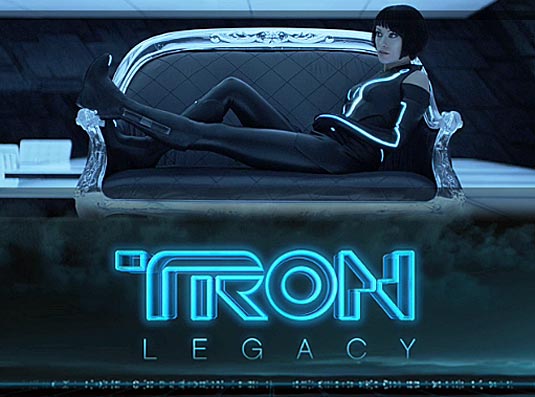
Tron: Legacy

Written at the time of the film's release...

"A Shaggy God Story" 
or 
"Rebel Without a CLU"
 
A sequel to Tron seems unnecessary: the first film was not that good.* A simple story of corporate (analog) white-collar crime that is resolved and revenged in the digital realm of computers, it only came to life in the (at the time**) high-tech sequences that were computer-generated with simple high-contrast wire animations. But, given the advances in techniques since 1982, it seems inevitable that a more sophisticated sequel be envisioned and given the green neon light. Anyone looking at the original Tron in the modern light of CGI must look at it as if they were watching australopitheci playing with femurs and utter a contemptuously chauvinistic "Aww, isn't that cu-ute?...and so primitive?"
Tron: Legacy, set 28 years later (and directed by Joseph Kosinski), is a better film in construction and underlying story-line—it has to be. The Matrix films, which resemble Tron in a tesseracted inside-out way, raised the stakes, so audiences are no longer satisfied with cycle-chases and neon-frisbee duels.  Gladiator games are no longer enough. The story must matter, and be relatable, tap into a collective story...and mean something. Even if what it means is dumb.
The movie tries hard. At times you see glimpses of Matrix, Terminator, and The Dark Knight, "
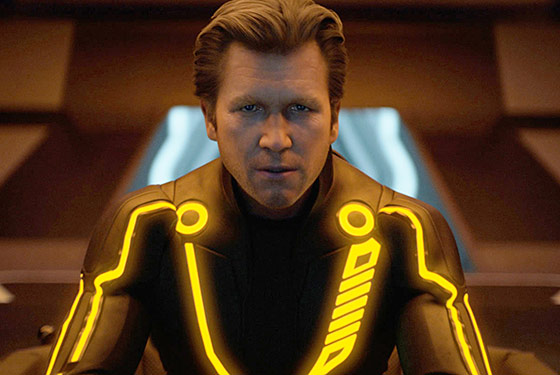
Frankenstein," the Star Wars prequels, with an underlying "Daddy" conflict out of Oliver Stone. But, to their credit, there's some Despero there, too.  The Jeff Bridges character Kevin Flynn, CEO of ENCOM (as a result of events in the first film) turns into a messianic figure, part Steve Jobs, part Steve Ballmer, whose vision of life under his brave new cyber-world, promises much—but only if you're not related to him. He's gone missing, with only grandparents to raise his entitled son, Sam (who grows up to be Garrett Hedlund). Sam lives a solitary life (although he is a majority stakeholder in ENCOM) wanting nothing to do with the family business—maybe some Godfather in there too?—except for a yearly prank to keep the board from getting complacent. Alan Bradley (Bruce Boxleitner) is still around,
*** and a stray page from the old Flynn's arcade compels Sam to visit, and (wouldn't you know it?) he gets zapped to Tronleyland, which has had some extensive renovation done.
With the help of his digi-gangers to his analog counterparts, Tron, Clu and the others,
Flynn has constructed a civilization in his cyberworld, until life, finding its way, is generated on its own. The ISO's, as they're called, are a new lifeform, that could bring new possibilities to life outside the grid in Flynn's vision. But every Creator must have his serpent, and Flynn's counterpart visionary, CLU, has his own designs for the future, which includes the invasion and occupation of territory—our world.  The stage is set for a confrontation between Flynn and his monstrous creation over their mutual goal, with Flynn's son, Sam, as the ghost in the machine, the spanner in the works.
The actors do fairly good work, given that they all performed in a green-screen purgatory
, and Hedlund, with the biggest role, is okay, sometimes even engaging. But it's Jeff Bridges' film. Playing two roles, Flynn as his scruffy self, and CLU in a digitized de-aged '80's version of himselfpretty darned good, if the mouth movement is a little dodgy at timeshe manages to push through two versions of the same personality, one that has grown older and wiser, the other that just stayed locked in his decades-old fantasy. Every once in awhile, Bridges' Flynn will say something "Dude-ish" that seems more clever than it is, merely for the fact that it provides a refreshing touch of analog in a digital construct.
A construct, and very derivative. But with so many bits and megabits from so many sources, it does add up to some genuine sparks of ingenuity there, far beyond the original's "parallel wars" equation, and certainly moving beyond merely the highlight of the first film, the gladiatorial games theme. Tron: Legacy is a bit like taking code from different sources to make new, more sophisticated functions. The key element being: you have to go with the program.

* My opinion, of course.  There are lots of folks who've been influenced by Tron, including John Lasseter of Pixar/Disney, and Roger Ebert, who booked Tron into his first Overlooked Film Festival.

** Okay. Here's a factoid: the computer they did the SFX on at the time had only 2MB of memory.

*** Look for Cillian Murphy in an un-credited cameo as ENCOM's chief programmer.

 
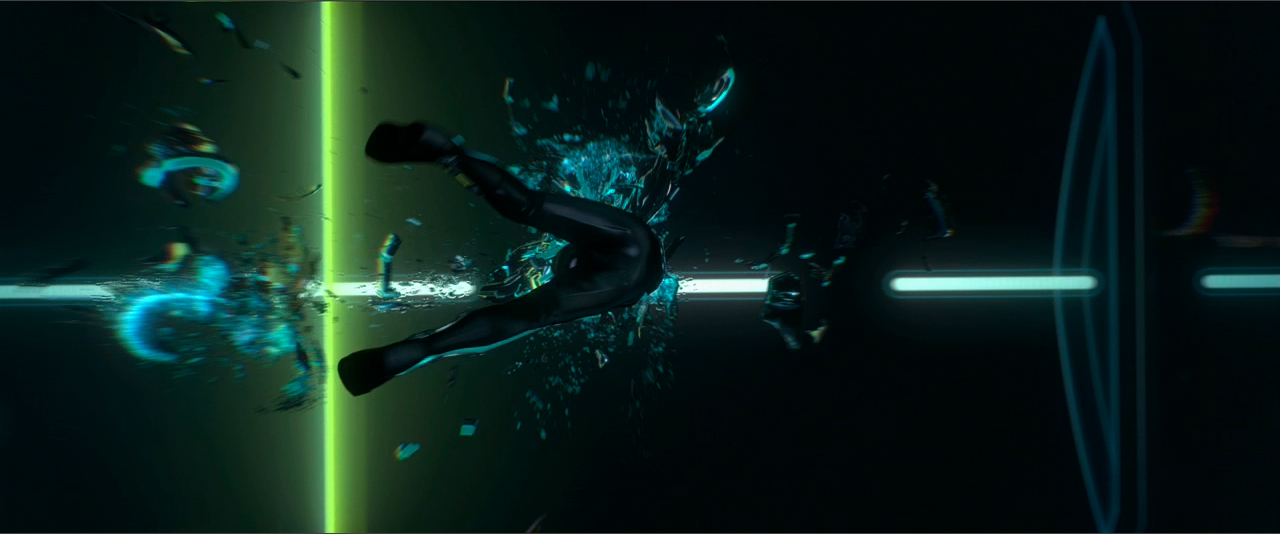
The original light-cycle sequence from Tron (1982)
How far we've come.


Wednesday, August 10, 2022

The Dark Knight

The Warner Bros can't seem to catch a break making movies—although "The Sandman" mini-series is very good*—so, let's go back to those halcyon days (or knights) when they seemed to know what they were doing with their DC Comics properties. Like 2008.

Written at the time of the film's release.


"Ya Wanna See an Actor Disappear?"


No, that title is not what you think it is (and shame on you for going there), but Heath Ledger does such a sick, twisted, inspired version of Batman nemesis The Joker, he blows away all pre-conceived notions of the character and his own acting history. Ledger literally gets lost in The Joker, with the smeary, sloppy make-up, his voice that goes from wormy-Richard Dreyfuss to bellowing Ahab-roar (with occasional stops at Bugs Bunny chirpiness), and a gait that sometimes shambles, sometimes totters, sometimes Frankenstein-stomps. All that theatricality is entertaining, but it's the moments of lucidity that are scary. "You're insane!" says Gotham mob-boss Sal Marone (Eric Roberts, doing relaxed, sleazy work), not without reason. "No, I'm not," replies the self-proclaimed Agent of Chaos resignedly. "No...I'm no...tt!"
Ledger's not the only show in town in
The Dark Knight
. Aaron Eckhart makes a complicated "White Knight" of DA Harvey Dent (it's really his story), Christian Bale's Bruce Wayne and booming Batman are deeper than the portrayal of Batman Begins--more soulful, less Bush-brash--and Michael Caine and Morgan Freeman do able support for roles slightly more down-played than the last film's. This time, Gary Oldman's Lt. Gordon has more to do, and the longer he's on-screen, the better you like him, and Maggie Gyllenhall gives the character of Rachel Dawes more of a spine (with a contrarily slinky walk) than Katie Holmes was able to provide.
The buttoned-up script is full of triangulation. There's the good-guys—Gordon, Dent and Batman—against an Axis of Evil—The Mob, Joker and Chinese financiers (and when one disappears from the screen they're replaced by another). And that's about as black-and-white as things get. Everything else is in convoluted, mordant shades of gray. There's the romantic triangle of Dawes and Dent, with Bruce Wayne as third-wheel. The Batman "team" of Wayne,
Alfred and Lucius Fox (all ensconced in the Wayne Enterprises high-rise while Stately Wayne Manor is being rebuilt).
The plot devices are triangulated traps that have an either/or scenario with a third more-horrific option--which becomes The Joker's trademark, ensuring that something bad will
happen no matter what. Targets are coordinated in sets, separating the weak from the herd and laying a further trap. It's Joker's way of providing Gotham "a better class of criminal." Batman's vigilantism has made the common petty thief think twice about stepping out of line. Now the Joker sets up elaborate conspiracies that bait and switch and then turn on a dime to a more complicated and deadly resolution.
"You've changed things." he crows at Batman. "There's no going back." When Wayne begins to question whether he needs to take deadlier action because Joker has "crossed the line," Alfred reminds him "You crossed that line first, Master Bruce." Hours before, Wayne had considered giving up the fight with a legitimate civic-minded public figure arriving for Gotham in Dent. Now, he's fighting harder than ever, if only to not step further across that moral line dealing with the new criminal madness. And The Joker? He starts to take actions protecting The Dark Knight, realizing that they can't kill each other: "You.. complete me" he cackles, in one of the chilling laugh-lines he spouts in an interrogation scene.

The Dark Knight ticks along (although it's overlong by half an hour--Director Nolan has a hard time knowing where to stop the escalating madness), with increasingly bizarre acts of cruelty (the film gets a PG-13 only because Nolan cuts away from some of the more grisly aspects--but takes the character design of one iconic Bat-villain in a more charred and eaten-away manner than even the comics devised).
By the end, some of the cast has been culled, and a long entrapment scene has gone on far too long, with still another set-piece just around the corner. At some point, every one of the good guys takes a hit, usually for noble purposes, but each keeps plugging away, trying to prevent having to put tooth-paste back in the tube, as consequence upon consequence piles up. And in the end, The Batman must re-adjust his modus operandi, taking on a new guise in his battle, one that he can only accomplish alone. At the same time, he handicaps himself to ensure he can't cross the line with too much power. He's left running in front of a metaphorical fast-moving train, knowing that at any moment he's going to have to turn and stop it.
"Dark Knight?" This thing is black as pitch.

In fact its relentlessly gloomy, and the sick thing is one looks forward to Ledger showing up for some light sickness to contrast the darkness. In fact, what has distinguished the "Batman 2.0" series of films is how they take the super-hero tropes and make them...practical and familiar. Nolan has kept this film-world translation of Gotham City looking gritty and realistic--far more so than the high-spired, mono-railed futuristic Gotham of Batman Begins--and the feel of the film is of an intricate crime drama, rather than a super-hero epic. The opening bank robbery is a nicely taut set-piece with more than one twist. And Nolan is far more adept at staging his action than previously. But by de-clowning The Joker, one wonders how some of The Dark Knight's three-color villains will translate to this milieu. One wonders where one goes from here. And one anticipates the next installment when this one has ended.
And that's a genuine accomplishment.

* Will I do a review? We-ell, I don't usually do streaming mini-series (although I broke that rule with the old British mini "Edge of Darkness") We shall see. You can dream, can't you?
 

Wednesday, April 11, 2018

Sunshine (2007)

Written at the time of the film's release.

"...They went at night."

Our sun is dying. Mankind faces extinction. Seven years ago the Icarus project sent a mission to restart the sun but that mission was lost before it reached the star. Sixteen months ago, I, Robert Capa, and a crew of seven left earth frozen in a solar winter. Our payload a stellar bomb with a mass equivalent to Manhattan Island. Our purpose to create a star within a star. Eight astronauts strapped to the back of a bomb. My bomb. 

Sunshine is Danny Boyle's homage to 2001* while serving up an environmental metaphor in a sci-fi setting, a dissertation on the uses of faith, while also landing in the "Incredible Mess" subcategory of films.

It goes like this: Our sun (as they say) is dying. Seven years ago, the spaceship "Icarus I" headed out for the sun to drop a payload the "mass" of Manhattan Island to re-ignite it and stop the new Ice Age developing on Earth. The ship disappeared mysteriously, and so, "Icarus II" was launched, same mission, same payload. You'd think with the luck they had with the first one, they wouldn't name the second ship the same thing. Plus, if you're going to the sun, "Icarus" might not be the most inspiring legend to name your ship after.**
Be that as it may, the ship is as "green" as can be, with its own eco-system/garden (overseen by Michelle Yeoh) providing oxygen for the ship. But it wouldn't be much of a space drama if things went smoothly, now, would it? And before you can radio "Houston, we've got a problem," people get hot under the helmet-collar and things start to come apart faster than an "O" ring on a chilly day. The ship's shrink may be getting a bit too much sun. The "payload expert" (Cillian Murphy) and systems engineer (Chris Evans) are not getting along in what the pilot (Rose Byrne) calls "an excess of manhood breaking out in the com-center," and a slight miscalculation by the navigator creates a series of unfortunate events, and turns him suicidal.
Geez, folks, go outside. Get some sun.

Danny Boyle can be counted on to breathe new oxygen into any genre, like Trainspotting for the "kitchen-sink" film, 28 Days Later for the "zombie" movie, but Sunshine has so many echoes of Kubrick's 2001 right down to color schemes, ship designs, POV shots, "Icarus's" somewhat fussy computer behavior, freeze-frames in vague situations and close-up eye shots that A Space Odyssey is never too far from his frame (Murphy even has a slight resemblance to Keir Dullea). 
The dynamic of the crew is right out of Scott's Alien, and the denouement is subject to interpretation (after the "multiple endings" debacle of 28 Days Later). One also suspects that to secure a rating, or due to some preview-audience's expressed discomfort, some make-up effects have been toned down to near-imperceptibility. But, by and large, its a fascinating exercise in a genre that, if it asks too much of a leap of faith from its audience, can become laughable. Sunshine is far from that. It's always a little bit exhilarating to see a sci-film that obeys the laws of orbital mechanics, knows the dangers of space-travel (where math can be fatal), and doesn't have one ray-gun.
Best to see it on a big screen, though, as it's full of little details that won't translate on video.

* in fact, it's a bit scary how many little ties to 2001 there are. Why, you'll even see a black monolith or three in this film.

** In his acceptance of the D.W. Griffith Award from the Director's Guild in 1999 Kubrick evoked the Icarus story to talk about D.W. Griffith's rise and fall in the film business. "I always felt the message of the 'Icarus' story wasn't "Don't fly too high," but, rather, "Do a better job on the wax and feathers!" You can see that speech here.

Thursday, August 10, 2017

Dunkirk (2017)

Stranded on the Beach
or
"This Was Our Finest Hour/Day/Week"

The events of the evacuation of Dunkirk are well known (at least they SHOULD be, whether or not you're a student of History). In May of 1940, the Nazi's had pushed British and French troops to the continent's edge with nowhere else to go but the ocean. And across that channel was home...and safety. Unless you're a member of The Channel Swimming Association, there is no way out. You have literally been "pushed to the sea." 

The Tribal Wisdom is what the imagination produces and what propaganda encourages without attention to detail—thousands of troops stuck on the beach that are rescued by the efforts of the maritime industry and common Brits with boats who saw the need and took to the sea to do their part and bring "the boys" home. Very dramatic. Very inspiring. 

And quite false...to a degree. There's less drama if you know that the evacuation took over a week (unless you're on the beach waiting, of course). There's less inspiration if you find out that the "little ships" of the rescue were mostly commandeered by the British Navy and piloted by sailors to Dunkirk with or without the help of the owners. But, not all of them; civilians did take part. Just not in the numbers the wisdom of the tribe can accommodate and be pleased and amazed and proud of itself and have the story go from happenstance to legend. Inspiration for a war that still had a long way to go.

So, how does writer-director Christopher Nolan handle this? He has it both ways. Quite ingeniously.
We start by following a small patrol of British troops walking down a Dunkirk street in the rain. A rain of leaflets. Dropped by German Messerschmitt's strafing the area, they are propaganda fliers telling the Brit's to give up because their position is untenable. They are surrounded. There's just enough time to take in this message when truth is given to the threat—bullets start flying sporadically and the patrol changes their pace from a casual march to a disorganized run.

We will never see the advancing Nazi army throughout the movie—their presence will only be noted by bullets, bullet-holes and the presence of Messerschmitt's in the air.* Despite sprinting to the sides of the streets, climbing over fences, taking the cover provided by the back-alleys behind the brownstones, one by one, the patrol is cut down leaving only Tommy (Fionn Whitehead), to dart for the French lines crouched behind sand-bag enforcements defending the sea and makes it towards the beach.
The Mole/ a Week
Talk about a beachhead: acres of beach stretch between the open sea and the sea-wall, expanding and contracting with the tides, enticingly narrowing the gap between entrapment and home by mere yards. That beach is covered by meandering soldiers, the transports they came in, beached boats uselessly stranded, and bodies, waiting for a burial that might occur by the shifting sands if they cannot be transported to an internment at home. Even that represents a evocation of time, a slow race of forces that will be decided one way or another...given time. Time is a major player in Dunkirk.
The time on the Dunkirk beach is taken up with two activities—waiting for the ships to dock by the mole (the long pier that juts out into the channel at high tide) and trying to survive, as the area is strafed by German planes that make periodic runs trying to inflict as much damage on the soldiers on the mole and the beach, with an arsenal much more damaging than leaflets. For the soldiers, the time is spent just trying to survive until rescue arrives. But time and tide wait for no man and one has to work to increase one's chances, given the opportunity.
On the beach, Tommy connects with another soldier who he encounters burying one of the soldiers on the beach. Gibson (Aneurin Barnard), is one of the thousands waiting for the transports that seem to take forever to cross the Channel. Together, they conspire about how to get on the next ship at the earliest possible opportunity. It doesn't take long for them to see that the wounded, for whom time is the shortest, are given priority on the mole. They "volunteer" themselves and one of the many wounded left unattended to "cut the lines" and get on the next ship. They are dismayed to find that even though the wounded are given priority, their attendants are not.
Their next step is to hide in the cross-beams under the mole to try to smuggle themselves on the next ship. While doing that, they are shocked to see the ship they had planned to take destroyed in a bombing attack. They manage to help another soldier named Alex (Harry Styles of "One Direction"). With Alex, their next attempt is more successful, managing to scramble onto the next ship, but once in the channel, the ship is struck by a torpedo and sunk. A number of skiffs, one commanded by a soldier played by Cillian Murphy, start the journey back to the beach...and more waiting.
And at this point, things may get a bit confusing for the audience. We have already seen Cillian Murphy's unnamed soldier, but earlier, in another section of the film, plucked from the sea and suffering from a debilitating shell-shock. This will take some explaining (even though Nolan announces his intentions with a mathematical economy).
Dunkirk is Nolan's shortest feature, save only for his first, Following. That economy of time is split up by three points of interest: The Mole/One Week (which we've been talking about), The Sea/One Day, which takes place over a single day (fudging history a bit), and The Air/One Hour. All sequences are spread evenly throughout the film's 106 minute running time, creating a juxtaposition of events that doesn't match a linear timeline. Nolan plays with the sequence of events, cutting across the ones that took a week to play out, the ones that took a day, and that only take an hour of time, warping the chronology in a consciously planned jumble to create the biggest pay-off for the film, a strategy he used in Following, Memento, Inception, and—thanks to the time-warping abilities of black holes—Interstellar. And so that 106 minutes contains the week of the stranded soldiers on the beach, the day of one particular mariner, Mr. Dawson (the ever-reliable Mark Rylance), who, with his son (Tom Glynn-Carney) and his friend (Barry Keoghan), takes on the rescue journey himself rather than have his boat conscripted by the military, and an hour of time for two RAF pilots, Collins (Jack Lowden) and Farrier (Tom Hardy, who continues to show why he's amazing), who are attempting to knock out the stuka's from making their withering attacks before their own fuel runs out.
The Sea/ a Day
The Air/ an Hour
Even though Nolan puts a title to the beginning of each sequence, that strategy might not sink in—or will be long forgotten by the time linear discrepancies start popping up, leaving some in the audience, like the soldiers in the film, feeling stranded on the beach. With an awful lot of actors of limited fame on-screen, the audience might have long given up trying to follow the details of who's who/what's what/ and when's when and find themselves not caring, or even thinking that the careful film-making has gotten terribly sloppy. That's not true, but in its conception, Nolan might have over-estimated his audience. But, the studios said the same thing about Inception and no one had a problem with that (and if they did, the visuals made people go back for a second viewing).
That may happen with Dunkirk, too, although the material is far more bitter and tragic, even if sometimes you have to shake yourself to realize what it is you're seeing. The set-pieces and episodes of each time-line are of a piece, although of the three, the one that has to do the continuity heavy-lifting is The Mole sequences—Nolan plays each one to its logical conclusion of where it is safe to cut away, usually once one of the beached trio achieves some sort of safety. The other sequences—The Sea and The Air—being much shorter through-stories afford to have hanging themes that are interrupted by The Mole sequences without doing much damage.
If The Mole is a survival story, The Sea is drama, with conflicts between the participants as Rylance's Mr. Dawson forges ahead with his part, despite arguments and set-backs, especially once Murphy's shell-shocked soldier is dragged aboard. Rylance is a versatile and cunning actor and his devotion to the enterprise is communicated with an unwavering tone to his voice and a purpose behind the eyes, the source of which is only explained eventually. Such is Rylance's skill that never once does one suspect him of being crazy, although he is clearly setting off on a channel-crossing that may prove suicidal.
And the shortest of the film-length sequences—but the busiest—is the very compact one in The Air, which is pure action, and unrelenting action at that. Three RAF planes attempt to take out the clutch of German planes interfering with the evacuation. Before long, the squadron leader is taken out, leaving two pilots to take on the Germans. If Nolan's work in the other sequences is stately (in the Mole) and shaky-cam personal (in the Sea), The Air is a tour de force of aerial acrobatics and keeping a tight reign on camera positions to keep the audience focused on who has whom in one's sights. It is also testament to how good an actor Tom Hardy is, as, for the most part, he does most of his acting with his eyes, his face hidden behind an air-mask (not unlike his Bane character in The Dark Knight Rises).
Nolan manages to make it all mesh and come together for a final fifteen minutes that makes it feel like a love-letter to the British Isles, warts and all, certainly to the souls who came together, conscripted or not, to actually "bring the soldiers home" rather than just paying lip-service to it. At that point, civilian and military become one, an idea that seems almost unimaginable today with lengthy adventures half-a-world away. It displays an unselfish, even heroic, payback from the protected to the protectors that our global conflicts make practically impossible. These are the things one thinks about during Dunkirk, with its long stretches that go without dialog or exposition, but just let events play out visually, without having some chatty by-stander keeping the audience informed about what's at stake.
At the same time that Nolan is messing with the filmic space-time continuum, he's also saying something about the dichotomy of truth and the greater good. In more than a few occasions in the film a character will come to a conclusion that just isn't born out in fact, or withhold a truth because it is the right—the decent or most practical thing—thing to do. It's like with so much sacrificing going on, the actuality of things becomes just another casualty, even if it's to keep a person without hope to keep going, to provide solace to the wounded, or to shore up a country in desperate need of solidarity, when truths are anything but self-evident.
Dunkirk takes chances, sometimes in thrilling ways. It's good to see Nolan find a bit more footing and discipline—a discipline that involves experimentation—that marks his work at its best. But, one becomes weary of the film around the half-way mark. Perhaps it's Hans Zimmer's concretish, thudding score, which seems to have as its major instrument a metronome—in case anyone hadn't figured out the whole time-motif thing—that more often interferes with the story-telling than it supports. It creates a disconnect that fights against Nolan's immersive experience, creating irritation more than something that pulls the movie together.

* Not precisely true: we do see them at the end out of focus and mere presences, but despite their constant threat and actions, to reveal anything else would be a spoiler. Another Nolan dichotomy.