Showing posts with label Rami Malek. Show all posts

Saturday, July 29, 2023

Oppenheimer

Ch-Cha-Chain (Reactions) of Fools
or
Fallout: If the Radioactive Doesn't Get Ya, The Political Will 
 
I took a course in college called "The History of the Atomic Bomb," so I already knew about J. Robert Oppenheimer and the Manhattan Project, and Lester Groves, and Edward Teller, and Enrico Fermi, and Niels Bohr, and Richard Feynman. Our best and brightest...as well as Germany's best and brightest, having escaped the Nazis.

I've listened to the plays, seen previous adaptations, know the story backwards and forwards. I got a C+ on my final paper around the subject of "Should we have dropped the bomb on Japan?" (I don't remember which side I took, but I believe it was favoring the Demonstration scenario).
 
But, I've been interested in seeing Oppenheimer, because I wanted to see what director Christopher Nolan would do with it. J. Robert Oppenheimer led a life that could have filled a few movies, but Nolan has compressed it into one three hour film, with the highs and the lows, and of the parallel tracks and rippling occurrences that underscored and undercut his career, and made the man who oversaw the construction of an atomic bomb from theory to reality become a pariah to the very country he handed it to on a desperately sizzling platter.
And Nolan in the past has been a wizard of sorts playing with the possibilities of story-telling and film-making, and juggling and parsing scenarios so as to create  adrenaline-generating third acts that brings everything together for a thematic jolt. One could say he creates these puzzles in the editing room, if the conceits of the films weren't so inextricably linked to the construction.
But, here, Nolan keeps it rather simple: two stories running parallel to each other, both involving hearings on their subject matters. They're sub-titled 1: "Fission" (in which atoms are split): in color, involving an older Oppenheimer in 1954 being grilled by a back-room secreted committee over whether he would retain his top security clearance; 2: "Fusion" (in which atoms are combined): in black and white, involving the very public hearing of Lewis Strauss to become Secretary of Commerce in Eisenhower's cabinet in 1959.
Two seemingly unrelated stories, but tied together so deeply that to split the two would be like splitting atoms, as they both deal with brilliance, arrogance, ego, and their limitations. There couldn't be one story without the other. And just as you can't have a nuclear explosion without fallout, both men—Oppenheimer and Strauss—would learn of consequences, that will haunt them to the end of their days.
Nolan starts the movie with a peaceful image—rain falling in water—but, as serene as it is, it's the natural image to describe the film. Just as rain falling will ripple out in concentric circles, actions will have reactions and those will spread without much control, a chain reaction that will only dissipate until it runs out of energy. And Oppenheimer is a film interrupted with small moments—a spark, a ripple, the sound of stamping feet, a line of poetry—that will echo throughout the film as mysterious fragments until we see them in context and realize their importance to the whole, like little figments of conscience that haunt until they are reasoned into clarity.
We see the the path of Oppenheimer (brilliantly played by
Cillian Murphy) to Los Alamos—a terrain he loves ("If I could combine physics with New Mexico, my life will be perfect"), through European studies—he gives lectures in Dutch—meeting the great minds of physics—Heisenberg, Bohr—then re-enters the U.S. to teach at Berkeley, hoping to initiate a field of study in quantum physics, which starts with one student, then many. Concerned with unionizing the colleges for faculty and techs, he flirts with the Communist Party, but, does more with one of their members, Jean Tatlock (Florence Pugh), who will challenge him, mystify him, and ultimately be used against him.
He marries Kitty Puening (
Emily Blunt), has a child, and although he's playing with things nuclear, he can't seem to manage a nuclear family. He's approached by General Leslie Groves (Matt Damon) to lead the Manhattan Project to develop a nuclear bomb before the Nazis, and although Groves knows Oppenheimer's leftist leanings, he still wants "Oppie" to lead the project—"I wonder if you could tell me how the Army would treat a humble physicist" "I would if I ever met one"—and as part of the project, Oppenheimer figures out the best rail-access for delivering fissionable material from three corners of the country and winds up with New Mexico, isolated, empty of population and surveillance, to build something that is only a theory...before the Nazi's do. "We have one advantage," Oppenheimer tells Groves. "Antisemitism." Germany has driven out its top nuclear physicists.
Well, you know the story. We've all lived in a world with constant nuclear brinksmanship, and the few souls who remember a time before "The Bomb" are dying off. We're used to it now (which seems inconceivable to me) and we're at a time of such complacency that you still hear mentions on the news of "nuclear options" and "tactical nukes." But, Oppenheimer takes us back to a time when the Atom Bomb was not only apocalyptic, but also inconceivable. At the time of its creation, there were a lot of "unknowables" about the Bomb. All they knew was that it would be big and cause a lot of destruction in a wide area—a city destroyer. But, at the time of the Trinity test, nobody knew if the chain reaction in the air would stop or if it would keep feeding on itself, incinerating the area, and possibly more. And, they didn't know anything about fallout.
The fallout—of all kinds—is the new thing here. With the responsibility of building a weapon with so much destructive power—with the complete agency of the government to do it—comes with it the emergence of those who see that power and covet it. And this is where the Strauss story comes in. Played quite amazingly by 
Robert Downey Jr., Lewis Strauss is a political operative and functionary, whose ego cannot merely appreciate the accomplishments of Oppenheimer and his team, so he must control it, harness it, and by doing so, subvert it to his own ends. As Oppenheimer did to nuclear fission, Strauss does to Oppenheimer and does so with a cold-blooded zeal. And given Oppenheimer's past propensity to fill any intellectual void with affairs and radical politics, Strauss is given the very weapons needed to undermine any attempts to prevent the scientist's efforts to keep the destructive genie contained, slowing nuclear proliferation and ever-increasing mega-tonnage. "Amateurs chase the sun and get burned," Strauss says at one point "Power stays in the shadows."
Oppenheimer is a solid three hours long, packed pillar to post with detail and small roles by very good actors—Nolan newbies like
Rami MalekCasey AffleckAlden Ehrenreich, Josh HartnettJames RemarJason Clarke, and vets of past films like Kenneth Branagh, David Dastmalchian, Matthew Modine, Tom Conti, Gary Oldman—and one may begin to think that the Strauss story gets a bit superfluous and should even be cut, but it is essential to the story and theme of how one man can make a difference, for good, evil or both. And of how power corrupts—even the pursuit of power corrupts—and though one may blaze with brilliance like a nuclear flash, it is not self-perpetuating...and fades...even if it consumed by itself.
Yeah, I took a course in college. But, you learn something new every day...if you're doing it right.
 
Nolan wrote the screenplay, based on the 2005 biography "American Prometheus: The Triumph and Tragedy of J. Robert Oppenheimer" and starts with these apt words: "Prometheus stole fire from the gods and gave it to man. For this he was chained to a rock and tortured for eternity."
The haunted gaze of the elder Oppenheimer
—a look both accusing and guilty

Wednesday, May 17, 2023

Larry Crowne

Written at the time of the film's release...although...I still remember parts of it that delighted me, despite my half-hearted review at the time.

T. Hanks for the Mediocrity
or
My Big Fat Career Mistake

I'm sure the intentions were better (aren't they always?), possibly saying something about the displacement of late baby-boomers in the job market, and how "it's never too late to learn" belying the "old dogs/new tricks" canard. Maybe co-writer/director/acting lead Tom Hanks just wanted to make something hopeful and sunny in bad economic times...a flare in the night-sky...the proverbial single candle rather than curse the darkness.

Well, it's more like a candle in the wind, and this blows. Formulaic, with an implied "wah-wah" comedy goose at the end of every scene, Larry Crowne has a "made-for-TV" movie feel that gets under your skin like intravenous sand-paper.  Larry (Hanks) is in his early fifties, divorced, a twenty-year Navy vet working at a box-store, where he's received "Employee of the Month" fetes nine times.  He's one of those guys who owns everything he does, taking a certain pride in all aspects of his job, even picking up and disposing the stray trash he finds in the parking lot. The implication is already there: while the rest of the world goes on its self-absorbed way, Larry "cares." And that can't come to any good.
Called in for what he thinks is his tenth EOTM award,
he is fired instead; corporate has crunched the numbers and sees him, as never having gone to college, as not being "advancement" material—he's already been passed over for promotions by duller, but degreed, employees. Adrift, Larry finds no work, and so goes to community college in his '50's, with similar outcasts (though dissimilar aspects) most younger, but without the team-player skills that Larry has acquired.

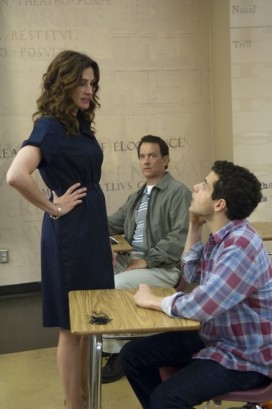
Teaching one of those classes—Speech 217—is Mercedes Tainot (
Julia Roberts), bored, tired, unmotivated, with a dead-beat author-husband (the wonderful Bryan Cranston), who, like Larry at the beginning of the film, doesn't know she's in the process of transitioning, so cynical is her world-view. Her students are an odd collection of rabbits, that she's just trying to keep awake and inspire the one thing she can't seem to muster up—giving a rip. And Crowne is the oddest rabbit in the bunch. She glowers, as she sees him slowly change under the influence of younger students—particularly women, and particularly one student who has it in mind to completely "make-over" Larry to his puzzlement and the vexation of her boyfriend.
This area of the movie has more than its share of "wah-wah" moments
, and as much fun as Roberts' slow-burn is (and she's great at it), they have the feel of sit-com situations that might be fun for the matinee crowd. It's there that the writing hand of Nia Vardalos, she of My Big Fat Greek Wedding, is the most evident. Hanks and his wife, Rita Wilson (who is also in this with a small, rather frightening part) were the ones who took Vardalos' one-woman show and shepherded the development of it into a Big Fat Success. The demographic for Larry Crowne skews a little bit to the same age, with the same toothless observational satire that never offends, even when it tries to be a little "naughty."  It's all for naught.


And yet. And yet...
Hanks and one of his co-studen...
WAIT A MINUTE! That's Rami Malik!
I had the opportunity once to tell a clerk who thought she was "too forward" approaching me in a store aisle: "Take it from an 'old guy:' never regret being delightful." That lesson applies here. Twenty-four hours after "grumping" my way through Larry Crowne, the saccharine had dissolved in my mind and the "good stuff" remained...Larry's unexpected, all-inclusive, concise and perfect final project in class that nicely ties a bow around the movie, a cast of great people getting to be charming (Cedric the Entertainer, Taraji P. Henson—she's a favorite of mine—Wilmer Valderrama—!!, George Takei!!!, a little spitfire named Gugu Mbatha-Raw—late of "Dr. Who," MI-5, and "Undercovers"—that you just want to hug, and...almost too good to be true...the always-welcome, never-failing Pam Grier). The thing is...for as saccharine as the movie feels going down, it leaves a pretty good after-taste. One forgets just how much one might have suffered through it, and how unsufferable it can be, and is left remembering the good parts. Meaning that Larry Crowne is a similar experience to childbirth.
Not a ringing endorsement...but it could be worse.
But, 12 years later, I still remember how good that final class project was. One may gripe. One may be cynical. But, delightful lasts.

Wednesday, October 12, 2022

Amsterdam (2022)

"What Fresh Hell Is This?"
or
The Endurability of Good Intentions. ("He Followed the Right God Home...")
 
Who knows when it really, really started in the scheme of things, but it really started to get intense with the dead Senator in the box with no lid.
 
Just back from Europe by ship, he turns up dead and his daughter (Taylor Swift) wants an autopsy. So, she calls two guys from the former General's old integrated unit in WWI, Burt Berendsen (Christian Bale), a doctor of "experimental medicine," and Harold Woodman (John David Washington), Columbia University-trained lawyer, to oversee the procedure. To ensure that the procedure is done without prejudice, Dr. Irma St. Clair (Zoe Saldana) does the autopsy.
 
What the autopsy reveals is suspicious, but when Harold and Burt attend a pre-arranged meeting with the general's daughter to report their findings, they see her running away for their rendezvous, stricken. "He knew something. He saw something terrible," she says while she can.
 
Join the crowd.
Before the night is over, Burt and Harold are on the run from the police, accused of a murder they didn't commit, but sure of who committed it, not that it matters in the short run. They have to hide...and they have to find out who killed the General and who's behind all this...because...they're veterans. Their commander has died. And they owe him.
But, that's history. In that history, Burt found himself the medic for the 369th Infantry, an integrated unit in WWI France. Its commander was such a racist that he required the black infantry to wear French uniforms, rather than American ones due to white soldier complaints, but he was replaced by his commander General Bill Meekins (
Ed Begley Jr.), and to further cement fences, Berendsen made a pact with the most vocal soldier, Woodman, that they would always have each other's backs. Even during "The Argonne."
Berendsen and Woodman are severely wounded, requiring many operations to remove shrapnel by a diligent French nurse named Valerie (Margot Robbie), who repairs their wounds and forms a bond with the two men, eventually taking them to Amsterdam, ostensibly to take Burt to a company called Cambridge Glass (run by characters played by Michael Shannon and Mike Myers), manufacturers of the best quality glass eyes, but more to live together in peace and fellowship and recover from "the war to end all wars." They become "lost."
It is an idyll that can't last. "Choice matters over needs." Burt, finally becoming comfortable in his scarred skin, decides to return to America out of his devotion to his wife. Harold stays with Valerie, but sees no future in it ("We only exist in Amsterdam") and returns to America to pursue a law degree. Then, their General comes home in a box.
David O. Russell's Amsterdam is being marketed as a star-filled cream-puff of a movie, but it isn't that. Instead, it's a good-natured political screed on the dangers of fascism roosting in America, basing it on the "Business Plot", a little remembered attempt by conservative business interests, unhappy with liberal Franklin Roosevelt's election, to use veteran protests over delayed bonuses by the Hoover administration, to install an un-elected military official to essentially oust FDR as President. As a modern context, let's suppose that the MyPillow guy and the CEO of Overstock didn't like the results of the 2020 election and were taking aggressive actions to have it over-turned. Couldn't happen, right?
 
It's a curious little gremlin of a movie. There are going to be a certain number of people—on the far right, maybe fascist, certainly white supremacist side—that would never see this movie. And then there are others—people who are stuck in the post Nixon era cynical groove (which has only atrophied during the Trump years to the point where late-night comedians can barely keep up) who will look at it and pooh-pooh it as satire-lite, which is easy to do if you're viewing it with the same attitude as one would have now.
But, the folks depicted in this movie didn't live through Nixon. They lived through World War I and came home to depressions, both Great and small. They still believed in government and they still believed in the United States, no matter what tough times they'd been through. The same starry-eyed patriots who volunteered in droves during World War II. Because they believed in something bigger than themselves. That's not a popular sentiment these days.
And Russell's movie may be off-putting for those who want their messages obvious and with the tone of righteous indignation (that is also popular these days) instead of the quick-paced Wes Anderson whimsy that it evokes. Still, it doesn't shirk from portraying grievous war-wounds—praise must be heaped on the make-up department for their relentless consistency—on people who refuse to see themselves as victims.
These are people who, despite their quirks, walk the talk and aspire to good intentions despite the consequences. Burt, being Half-Jewish, Half-Catholic goes to war at the behest of his Park Avenue in-laws only to find that the means are more important than the ends, especially considering that their respect for the military doesn't extend to veterans. He is kicked out of his lofty office address and starts work in the streets and then in Harlem, to the point of moving out of the apartment he shares with his wife...he's so straight an arrow that he doesn't even think that's perverse. Woodburn is black in an early 20th century—he already knows the heartbreak of good intentions when your skin isn't the predominant color. Yet, he has found validity and valediction in another country fighting for a country that wouldn't consider giving it. And Verna is a rich girl considered a kook, but whose dedication in the operating room goes above and beyond the requirements and limitations of triage. Their actions all make sense in a society that ignores their sacrifices while reaping the rewards of the very things they fought to protect.
The cast is uniformly excellent with Bale coming up with a fully realized character taking advantage of the limitations of a back-brace and glass eye and turning it into a performance reminiscent of Peter Falk—and in moments of agitation, Martin Scorsese, while Washington is his most relaxed since BlacKKKlansman. Robbie has a little trouble with accents, but manages to make a performance that is both alluring and comedic, and it's all photographed with a slight sepia tone by
Emmanuel Lubezki, who manages to turn out top-tier work under technically challenging conditions.  
One has to admit, though, that Amsterdam is better in the after-glow than in the light of projection. Free from its manic energy in that post-viewing meditation, two aphorisms come to mind—for a movie that is full of them. One (that I've heard quoted so many times it defies origination) is "If you have a message, call Western Union", something that Amsterdam does with tenacity in its reckless abandon to obfuscate with comedy. The other I heard from legendary baseball announcer "Red" Barber on one of his weekly talks with Bob Edwards on the NPR Morning Edition. He said
"It's not the one with the most toys, wins. God doesn't count the toys. He counts the scars."
 
There are a lot of scars in Amsterdam. I like that.

Tuesday, August 9, 2022

The Master

Written at the time of the film's release. As a bit of context, the incident in the first paragraph referred to the 2012 attack on American facilities in Benghazi, Libya, which was initially blamed on Islamists fired up by a video trailer for a film called Innocence of Muslims, The attack was lately determined to be pre-meditated.

The Master: Scientologist-Baiter
or
"Tom and I Are Still Friends"


One wonders why, if a (laughable) movie trailer was so important to cause bloodshed in the Middle East, The Master isn't causing a ruckus in Los Angeles, the home of Scientology. Perhaps Scientologists have thicker skins (and more tolerance) than radical Islamists, who seem to find any excuse to cause harm at the drop of a Koran, or perhaps it would cause a worrisome spike in the members' auditing, or because—really—it has less to do with Scientology than other issues...like what would draw someone to a situation like Scientology—or any belief system—in the first place.

Paul Thomas Anderson's latest film has a similar theme to his previous films—the combustibility of individuals in a collective, and takes a similar tack—get the best individuals in their fields, wind them up and let them go, producing an oblique open-ended vessel into which audiences can pour their interpretations. It's not that Anderson doesn't have anything to say, so much as he'll be damned if he comes right out and says it, and sets up situations that suggest relevancy, waiting for the happy accident that will inform the whole. It's not that there isn't a directorial hand here—there's a reason there are so many close-up's—it's that there's isn't a sure directorial stance.
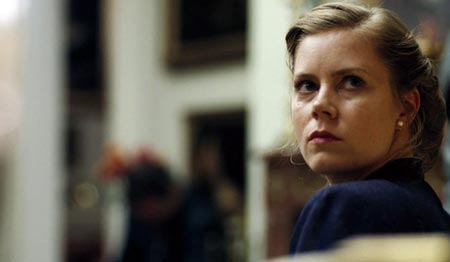
After useless psychoanalysis, Freddie turns the examination on others. 

So, you have a lot of surface, the brilliant spot-on "feel" of the production design by Jack Fisk and David Frank, the crisp cinematography of Mihai Malairemare Jr. , the individual performances of Philip Seymour Hoffman, Amy Adams, and (especially) Joaquin Phoenix on display, to an amorphous end that challenges, and often begs for, interpretation. Fortunately, the material is strong enough, and Anderson's contextual thesis is rich enough that one can throw all manner of thoughts into the stew, and make one's own meal out of it. 
We first encounter Freddie Quell (Phoenix) in the Navy during the battles in the South Pacific during World War II.
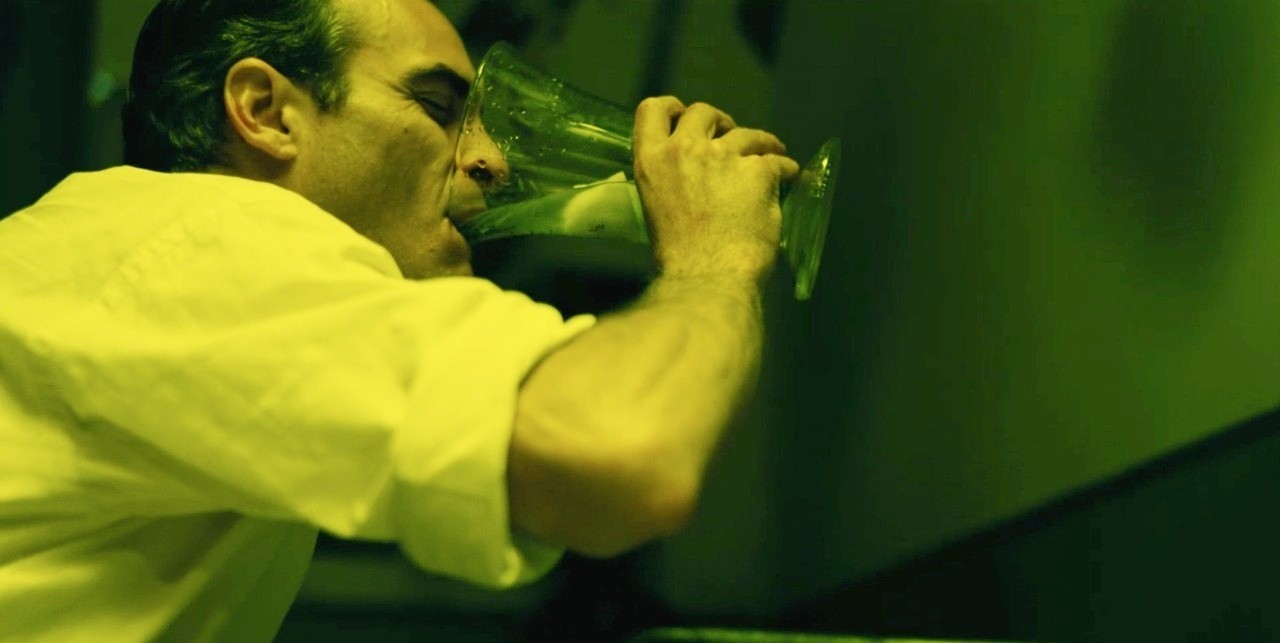
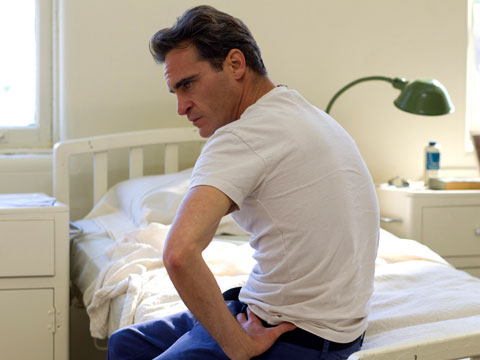
* Even there, in the midst of hundreds of young men in close quarters, he's an outsider, a loner connecting with no one except for his one discernible skill-mixing noxious brain-cell killing concoctions out of anything handy. He spends his time isolated, in some form of inebriation, the limits of behavior and humor blurred to indiscernibility, and when he's out of the service, he's immediately transferred to a psych division, where he is examined endlessly to no avail—the doctors are spending all their time trying to find the answer to what's wrong. 
It's all too obvious what's wrong—he's a barely functioning alcoholic obsessed with sex—but there's no cure for a complete lack of self-awareness or perspective, and Quell is released to the world, unchanged and unremorseful, just another problem that can't fixed and so is dispatched out of anyone's responsibility, to let Nature or Darwinism deal with him. He's a perpetual outcast on the edge of functionality, unstable and instinctually acting out. A job as a department store photographer ends up as an ironic choice—he spends his days looking in, trying to document normalcy, while on breaks, he uses his darkroom chemicals to create some bizarre cocktail to fry his brain and ease his isolation, while trying to make time with a store model. 
Phoenix is brilliant in this
, a raw nerve and not just mercurial, but mercurial at a high boil. The photography job ends with a violent incident of his own making, and he winds up as a migrant worker where, again, he moonlights with moonshine, and has to go on the lam where he stows away on a boat that has been commandeered for a wedding party.
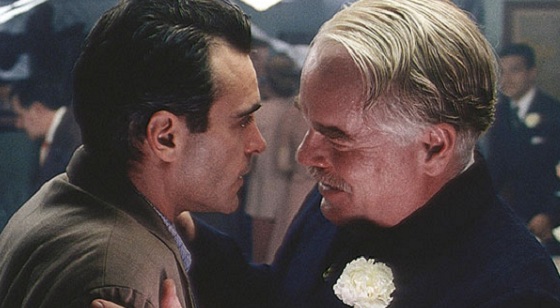
It's here that he meets Lancaster Dodd (Hoffman in a varied, extravagant performance that feels a bit like Orson Welles in Citizen Kane) self-described as "a writer, a doctor, a nuclear physicist and a theoretical philosopher. But above all, I am a man, a hopelessly inquisitive man, just like you."

 
"Just like you."
Yes and no. Dodd is the gypsy-evangelist of something called "The Cause," a nebulous philosophy for which he is the architect and messiah. The rules of The Cause change a bit according to need and the whims of Dodd (who erupts in petulant anger when challenged on it, by believers and non- alike) even though the origins of it supposedly date back "trillions of years" (later, his son will tell Quell "he's just making all this up as he goes along").
He's drawn to Quell for his potent concoctions, for his raw contrariness, which Dodd finds a challenge to his self-improvement methods (called "processing"), and because Quell's feral anti-social fury is a reflection of Dodd's free-thinking, but with the irresponsibility that he doesn't have the freedom to practice. Both men are self-medicating outliers, unable or unwilling to fit in—square pegs in the rounded holes of society.

For Quell, Dodd's processing is a tonic, though not as bracing as what he can make himself, a form of questioning self-examination that, instead of making one feel bad about oneself, makes one feel good. And for Quell, seeming to belong for the first time in his life, The Cause feels like home and family.

What color are her eyes?  You decide.

Not all the family is happy, though. Dodd's followers, including his Lady McBeth of a wife (Adams), fear Quell's aggressiveness and unpredictability, she especially questions whether Quell will ever improve and worries about the effect he will have on her husband and their cottage industry. Quell may be the best patient for the very therapy that they espouse, but the danger lies in how much damage he will prove to their house of cards in the process. It's a battle of co-dependents for The Cause, while the two men find the limits to their visions of paradise. There's a lot of room for mis-interpretation here, most especially in Dodd and Quell's scene in which the older man seeks to calm the emotions of both of them by singing, as if it was a lullaby, "(I'd Like to Get You on a) Slow Boat to China" which ends with the phrases "All to myself/Alone," emphasizing the isolation of both the Messiah and the acolyte, as they set themselves adrift.
So, in the end, once the credits have rolled up, what does it all mean? What's the point?** I'm honest enough with myself to say I don't have a flippin' clue, except what I've laid out here as themes and observations, but will admit that it is all up there on the screen, ready to be interpreted in as individual a manner as any audience member can provide, which is what makes Anderson (along with Terrence Malick, who is a bit more focused) one of our most enigmatic of filmmakers. Whether that makes him a visionary or a charlatan—like the filmmakers, captains of industry, and religious leaders he portrays, making it up as he goes along—depends on our interpretation, as well. And it is enough for me that he continues on the path he takes—not going for the easy superhero flick, or facile rom-com—without compromising anything...not even his intentions. It makes him brave, admirable...and always watchable. Challenging to be sure, but I like a challenge.
No, really. We're all together in this.

* One of the running motifs of the film is the time spent on ships of some sort, adrift.

** It's been amusing to read film critics struggling with this one, some finally merely knocking over their king to just call it a "character study."  It's a tough one, alright.  But, it is trying to say something about the human condition, even if only to say it has no easy answers, either, not even for those who espouse and specialize in easy answers.  I like that, but one wishes there was more provided by the film-maker, rather than just providing a rorschach test for us to throw our interpretations onto.

Friday, October 8, 2021

No Time to Die

James Bond's Swann Song
or
In The War of Orphans, Winning is Who You Leave Behind
or
"Tell Mother I Died Game" ("Well, It Just Goes to Show No One's Indestructible")
 
The continuity-conscious Daniel Craig era of the James Bond series has had a through-line simmering throughout all of its previous four films—"Don't trust anyone." 

From Craig's first film, Casino Royale, when the newly designated "00" agent James Bond has a moment of romantic weakness with the wrong person, continuing to the next film when he finds that his service has been compromised, and that the allied CIA works to cross-purposes, through Skyfall, where his boss "M" (Dame Judi Dench) sacrifices agents (including himself) indiscriminately, to the last one, where he discovers he can't even trust his past, this version of Bond walks under a cloud of suspicion, never letting his armor down, lest he be betrayed...by anyone. 

By the time of Craig's fourth film, SPECTRE, he has tipped so far over the edge that he draws down on a random mouse to ask it "Who sent you? Who are you working for?"   

As the song (from Quantum of Solace) says: "...someone that you think that you can trust is just another way to die."

The official series' 25th entry*, No Time to Die, sees Craig's James Bond retired in Jamaica and recruited—by CIA pal Felix Leiter (Jeffrey Wright)—for an operation that eventually reunites him with the people he does trust to go after people he can't, something involving a missing scientist. Another one. Hey, the series has been going on for nearly 60 years, everything can't be original and nor would the many "James Bond" devotees not allow the "familiarity factor" to creep into the story ("Where's the Aston Martin?" "Where's the martini line?" "I didn't hear 'Bond...James Bond!" "Is he going 'rogue' again?"**).
Still, with all the Fleming novels having been filmed—in one form or another—and a good smattering of the short stories included, the filmmakers have been hard pressed to keep Bond current, the movie-plots being set "a few minutes from now" with call-backs from past novels and films spattered in, as well as acknowledgments from other sources that the producers use to know that they know they're being watched.*** And the films have for the most part been formulaic—Pre-Credit Sequence/Main Title/Meeting with M/Visit to Q/Two Women (at least) with one being of mixed loyalty/The Sacrificial Lamb/Meet the Villain/Big Finish (with Explosion)/Sting in the Tail With a Challenging Henchman/"James Bond Will Return in..."—so that there were things you could count on. Rules were played with, but some you just didn't violate.
 
No Time to Die up-ends them.
As I mentioned, the Craig films are continuity-conscious. When last we left James Bond (Daniel Craig, pushing it this time, in all aspects—age, acting, etc...), he had crushed the international crime league, S.P.E.C.T.R.E., and brought to ground (literally) its ring-leader, Ernst Stavro Blofeld (Christoph Waltz)—but didn't kill him—instead walking off into the London night with Dr. Madeleine Swann (Lea Seydoux), daughter of the mysterious SPECTRE middle-man Mr. White (seen in three of the Craig's). The last shot of SPECTRE had the two seated in Bond's recently re-constructed Aston Martin, sharing smug, self-satisfied smiles. They were meant for each other.
No Time to Die begins with an episode from the past (not involving Bond, but will), and the story of the two scar-crossed lovers on a European honeymoon of sorts that is ruined when Bond is attacked visiting the grave of...Vesper Lynd (the "other woman" from Casino Royale). Coincidence? Not much of one, and as Swann and Bond are high-tailing it out of there, it's revealed that Blofeld has engineered the whole thing from his prison and implicates Madeleine. Despite her protests, Bond puts her on a train and she's out of his life. Bond and his trust-issues again.
In the past, we'd gotten used to the disappearing Bond-girl act, where after the final clinch of each movie, she is never seen...or mentioned...again. "Who?" But, the fact that Seydoux is even there—and she's the only actress playing the same Bond-woman part over two movies—means that she's special. And that the producers have "borrowed" a piece of music from the series' past (written by John Barry!!) to serenade the Bond-Swann romance means she's more than special. More on that later—Madeleine Swann Will Return.
Five years later and Bond is retired in Jamaica and alone, spending his days fishing, cooking and (probably) drinking. One day, he comes back to his house and sees evidence that someone had been there—someone who smokes cigars. He goes into town, realizes he's being followed, and manages to catch the culprits in the act. It turns out to be Leiter and a State Department official Logan Ash (Billy Magnussen) who are trying to get Bond to help track down Valdo Obruchev (David Dencik), a biochemist who has recently been kidnapped by SPECTRE. Bond had a hand in bringing him in during his tenure, and under the agency's careful watch, the man had been working on something called the Heracles Project, a form of targeted weaponized virus. MI6 lost him and the CIA is trying to get him back.
But, they're not the only one. Also tracking him in Jamaica is a "00" agent from MI6, in fact, the new "007" ("I'll bet you thought they'd retired it"), Nomi (Lashana Lynch), who's also on the look-out for the chemist. Despite her warnings to back off, Bond travels to Cuba, where SPECTRE agents seem to be gathering. Nomi is there too, and with the help of a new CIA agent (Ana de Armas), Bond walks right into a viper's nest.
The Cuba sequence, with its fights, the jokey repartee of Bond and "Paloma," their pauses to drink, while Nomi is skulking in the background looking for opportunity is probably the highlight of the film. It works like a violent dance, with a Cuban jazz background (part of Hans Zimmer's functional score) that gives it verve and a sense of hysteria. That it follows one of the creepiest scenes in a Bond film probably helps to provide that sense of chaotic relief.
But, just because that's the giddy apex of the movie doesn't mean the rest of its bad. There's a hell-bent Aston Martin chase in an Italian villa, a spooky cross-country shoot-out through a foggy Norwegian forest that is terrific, and another example of those spectacular villain lair designs that have always set the series apart from its competitors. 
This is another of those Bond films that stun for how well done the practical effects are, the cinematography—by not one of the upper tier of photographers—is lush and colorful, the editing is crisp and tight (while giving you a sense of continuity and flow—something not apparent in Quantum of Solace), and the sheer kinetic verve of the action sequences goggle. Credit director Cary Joji Fukunaga for his precise direction and making a movie that never feels like it's 2 hours 46 minutes in length ("We Have All the Time in the World," indeed!). It's a bit of a miracle, really.
Fukunaga has also inspired Craig's most intense performance as Bond, part of which must also be credited to Phoebe Waller-Bridge's re-write of the original Purvis/Wade script. Fukunaga's practice of letting the actors "wing it" gives the film a richer, fuller life, much more than the standard Bond direction of "line (beat)/funny line (beat-beat)" that makes the viewing of the older films of the series seem awkward. Here the dialogue fairly scampers when Craig's present, and only slows to a crawl when Rami Malik's puppet-master Safin appears. "He's kinda creepy" is how he's described early and, indeed, he is, reminiscent of a trembling Peter Lorre, with a philosophy that's a bit hard to decipher, though natter on about it he does. The Bond villains have some motivation, whether it be greed, errant activism, or a power grab. Safin is simply crazy, but a self-important, rambling crazy.
Now, this is going to be a spoiler-free review, but, as mentioned, this one up-ends things, but not in a way that anyone who's read a book by Bond-creator Fleming wouldn't recognize. Because the Bond films have only flirted with a strict continuity lately means they can get away with it with no harm done. The older films had a strict "Bond is fresh with each adventure" edict, which the Craig films have ignored. Bond never got hurt in the old films, but now they keep track of the scars. This is Craig's last film—he's been doing it for 16 years, longer than anybody, and wife Rachel Weisz was getting annoyed he was coming home broken. There will be another Bond, but whether the series will be as continuity-conscious next go-'round hasn't been decided. 
Original Bond producer Cubby Broccoli always maintained that Bond should be "at the top of his game" and that nobody would be interested in an "early Bond" origin story. When his kids got control, they tried it with Craig and it's worked. But, now that they've done it, there's no need to do it again. Bond may go a different route, like going back to stand-alone movies. Maybe they'll do Cold War period pieces. Maybe they'll remake a couple of the bad ones. Who's to say? And who's to say who'll be the next Bond. Finding Craig was something of a miracle despite the initial nay-saying, so I'll trust their judgment on the matter.
 
One thing is certain and that is, as the credit says "James Bond will Return." As long as the British flag flies, and the box office receipts are healthy.


* "Official" refers to the films made by EON Productions (founded by Harry Saltzman and Albert R. Broccoli), starting with Dr. No in 1962, and featuring the Ian Fleming titles they had the film-rights to, which—at the time—excluded "Casino Royale" and (owing to an early '60's plagiarism suit) "Thunderball". "Casino Royale" appeared ("unofficially") as an episode of CBS-TV's "Climax" (starring Barry Nelson as "Jimmy" Bond, American) and a 1967 "spoof" film starring David Niven, Peter Sellers and Woody Allen, before EON got the rights to it for the first of Daniel Craig's films. Thunderball became an EON presentation when the fellow who won that lawsuit wanted to make his movie with Sean Connery and worked out a deal with EON to "present" the film—with Connery—thus avoiding any competition that might hurt box-office receipts. However, when that same guy wanted to remake Thunderball (which, contractually, he could do after ten years), things were so contentious between him and EON that both sides battled in court before that remake (called Never Say Never Again and starring Sean Connery) was released in 1983, the same year as EON's Octopussy starring Roger Moore. EON now owns the rights to both the books "Casino Royale" and "Thunderball" (even including those "un-official" movie versions). They've since been doing original stories for ages, (and over several agents), and it's a wonder when some morsel of the original Fleming writing sneaks undercover into the films.
 
** The series' Bond has "gone rogue" in On Her Majesty's Secret Service, Licence To Kill, Die Another Day, Casino Royale, Quantum of Solace, Skyfall, and SPECTRE. It's as if the producers have preferred Bond's role to be less a company man and more of a rebel.
 
*** Hmm. Live and Let Die was put in during the craze for "Blax-ploitation" films, The Man with the Golden Gun was taken out of its novel-locale of Cuba to be set in Hong Kong, Thailand, and Cambodia to catch the "Kung-Fu" craze, Moonraker timed to take advantage of the Star Wars-prepped audience, Octopussy threw in some Indiana Jones action, Goldeneye's Xenia Onatopp was a soul-sister to Never Say Never Again's Fatima Blush, the fight sequences of late owe much to the "Bourne" series, and the Austin Powers movies stole all of the series' leering jokes leaving the Craig films to be a bit more stoic—although the Bond screenwriters stole the "villain-is-a-relation-to-the-hero" bit from Goldmember...as either series might say "Tit for Tat"