Showing posts with label Tom Hanks. Show all posts

Friday, January 17, 2025

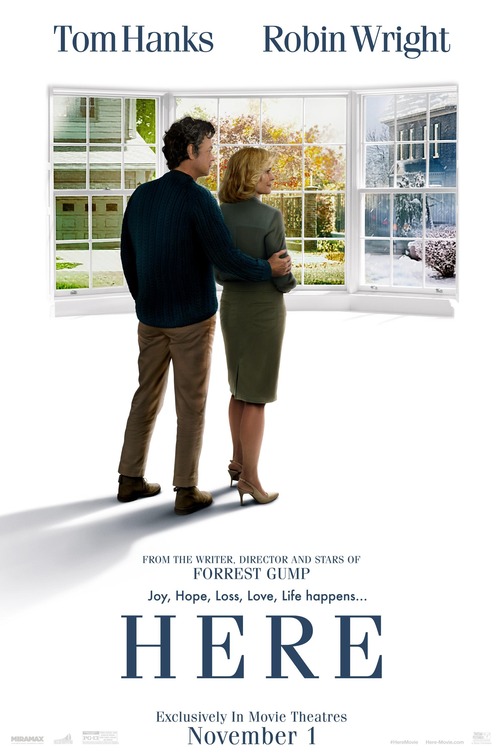
Here (2024)

Here...But Not Really There
or
"Time Sure Does Fly, Doesn't It?" ("And Then I Blink...")

I kept thinking of Robert De Niro in The Deer Hunter while watching Here, the latest film by director Robert Zemeckis.
 
"One shot." "One shot."
 
Which is what Here is. Based on a graphic novel* (by Richard McGuire, which is done the same way), the film eliminates the one major creative decision for a director—"where do I put the camera?"—and takes it, literally, out of the picture. Zemeckis, as a director, is a weird cat. Where a lot of directors will look for thematic material and then build the technical aspects around it, Mr. Z seems to think of the technical challenge first and then find the story to fit it. He was ground-breaking in making mo-cap animation films and as the Uncanny Valley started to get flooded with product so that nobody could see it any more, he started to trust the CGI with drama. It can be done. But, as amazing as Zemeckis' films can look, they sometimes have the heart of a demonstration disc. Inspiration but not aspiration.
So, here's Here. And, technologically, it is pretty amazing, but for reasons that have nothing to do with story-line (except in some nicely worked-out places) or the fact that it re-teams 
Tom Hanks and Robin Wright nostalgically from Forrest Gump. They are basically irrelevant other than box-office draw (frankly, I was more intrigued to see Kelly Reilly—from "Yellowstone" and the Downey Jr. "Sherlock" movies—and Michelle Dockery—from "Downton Abbey"—in it. It's not a movie where you can judge performances, scattered as they are in this movie's timeline.
And the incidences feel like snap-shots—or worse, like "Saturday Night Live" skits—they pop up, do a bit of business and generally exit on a laugh or a dramatic hit ("And...scene"). God forbid that they should interrupt one of those slices-of-life in mid-chaos and have it resolve later in the story. That would have felt random, instead of calcified and calculated as this movie too-often feels like.
It starts out with its gambit efficiently enough—that one angle—whether it's in a house on that particular parcel of real estate or in its origins as primordial ooze when the boxes start fading in, initially with subtle borders around them until we get the knack of it and then those borders start fading away and they begin to make transitions so we see the neighborhood go from dinosaur stomping ground to hellish landscape to ice age (only one of two times when the camera actually moves) to Native American habitat to the neighborhood of William Franklin (Benjamin's ever-loyal-to-the-king non-rebellious son) to the story-heavy 20th century.
The Franklins' eventual neighbors are The Harters (he's excited that an "aerodrome" will be built nearby and intends to fly—something his wife is dead-set against); there's the bohemian Beekmans, she's a free-spirit and he's an inventor, perfecting a chair he calls the "Relaxo-boy"; post WWII, the non-surnamed folks we'll spend most of the time with (let's call them "The Gumps") move in, sail through the 50's and television, raise Tom Hanks, who gets his girlfriend Robin Wright pregnant, they get married and move in with the folks and eventually age out of the house; then we get the Harris', the only minority couple—besides the Native Americans—that reside there. We get nudged a lot about how things change—the Harris' give their son "The Talk"—and not—frailty and death are inevitable, as apparently is influenza.
For the most part, these folks are chess-pieces that get moved around depending where the boxes show up and those boxes highlight the transitions between entertainment systems, gas-lights to electric, rugs versus hardwood (versus verdant forest), couches to sectionals. Art changes, but the view rarely does. Dramatically, the film underwhelms except in some key places. But, it's not a waste of time...or space. Not at all.
We are used to being manipulated in movies by mise-en-scene and blocking. Directors let us see what they want us to see and use blocking to change the focus of our attention. This gives us the illusion that we're peeping through a letter-boxed slot-view a 360° world-view (we're not, of course; it's an illusion). Here subverts that. We are given one angle to look at—the world may change within it, but it's basically that one section of cinema real-estate, like we're looking at the Closed Circuit Camera of Eternity.
That's where McGuire's boxes come in. Yes, blocking will direct the eye, but it's those moving boxes and their shifting perspectives through time (but not space) that directs your attention, whether it's what's on the television screen, or the silhouette of the car (or buggy) going by the window. Transitions flash in the wink of an electrical storm or a camera flash. Things shift, warp, grow their hair out and stoop but only for a moment of time. If only to have The Beatles on Ed Sullivan accompany the wedding shot (see below).
And—as with McGuire's work—that's the point it's making. Life seems long. But, in the scope of things, it's transitory, gone in the blink of an eye. And that little plot of space we inhabit will still be there, long after the seas rise, the epidemics cull us, idiots atomize us, and we're just dust. Like George Carlin said "Earth Day?! The Earth will be FINE! WE'RE screwed!" Enjoy the details, the movie seems to tell us. We're just passing through.
A couple of shots—little clever instances I liked. The one below, which is the only time we see the rest of the main floor courtesy of a moved bureau.
And this one haunts (and pays a little respect to the McGuire work): while 
Paul Bettany's "Dad" sleeps on the couch, a box appears to show an earlier version of his long-since-passed wife (Reilly) and she says the first words of McGuire's graphic novel: "Hmm. Now why did I come in here again?" That raised goose-bumps.
It's an interesting experiment for a movie that somebody might come up with a dramatic reason to exploit. But, the point's been made. Like the guy who invents the La-Z-Boy you have to ask yourself—what's it good for?

 
* McGuire's work is so seminal and so tied to the film's strategy—and expanded to different platforms—that the Zemeckis film is almost unnecessary. It started out in 1989 as a 6 page story in Raw Volume 2 #1:
The original's time-frame is from 500,957,406,073 BC to 2033 AD
In 1991, the story was adapted into a student film by Timothy Masick and Bill Trainor, students at RIT's Department of Film and Video.
 
In 2014, McGuire expanded "Here" into a 304-page graphic novel with vector art and watercolors and extending the timeline from 3,000,500,000 B.C. to A.D. 22,175: 

That would be a herculean jump enough, but the Ebook addition of "Here" allowed you to scroll between pages with animated gifs inserted. Which is mind-blowing enough, but at the 2020 Venice Film Festival, a VR version of it was presented.

 See what I mean about the 2024 movie being "unnecessary"—it feels like, artistically and technologically, we've already moved beyond it.

Wednesday, November 13, 2024

Toy Story 3

A lot of times I write and I "make do." It's alright. I think I got the point across.

And sometimes, I nail it. It's rare, but I'm capable of it. Even if the movie is just about toys. I remember a comment for this post (on that "other" site) was simply "Dude. It's Toy Story 3." (Where are you, Simon?) Yes. And good movies about love can come from anywhere.

Written at the time of the film's release...

"And if You Can't Be with the One You Love, Honey..."

One has suspected a subtle sub-text in the "Toy Story" series—every Pixar film has evoked that feeling (which is why they tower over Dreamworks and every other animation supplier and make even their rivals' three-dimensional films seem more two-dimensional) since the first film premiered (what was it?) fifteen years ago.
 
 Toy Story 3 is no less rich in sub-text. Sub-texts like the given that the toys have stayed the same, but their little owner Andy has grown up and is on his way to college by the time we hit 3; First sub-text: Change or be passed over. Any one looking for a job in these troubled times has had to be confronted with their inadequacy in some department while they're winning the daily bread. And like the toys of "Toy Story," time may be their enemy, staying consistent while the world evolves too quickly.
But, at the pace-making heart of the "Toy Story" movies has been one constant, and that is its contemplation of the nature of Love, which puts it in the same movie-case with such seminal works as
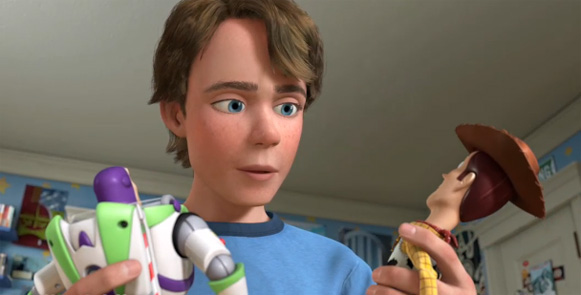
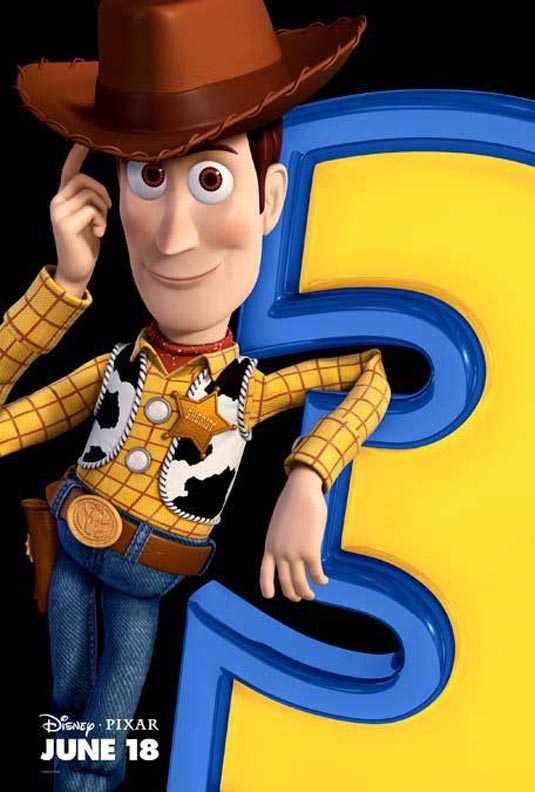
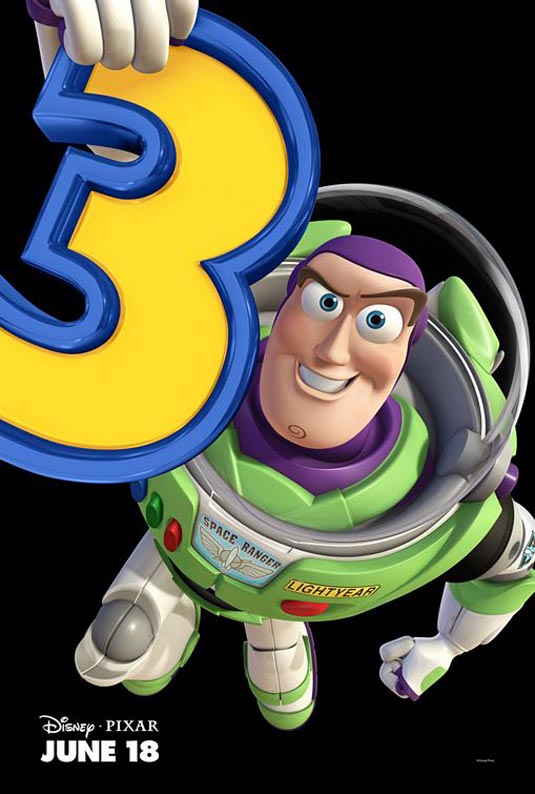
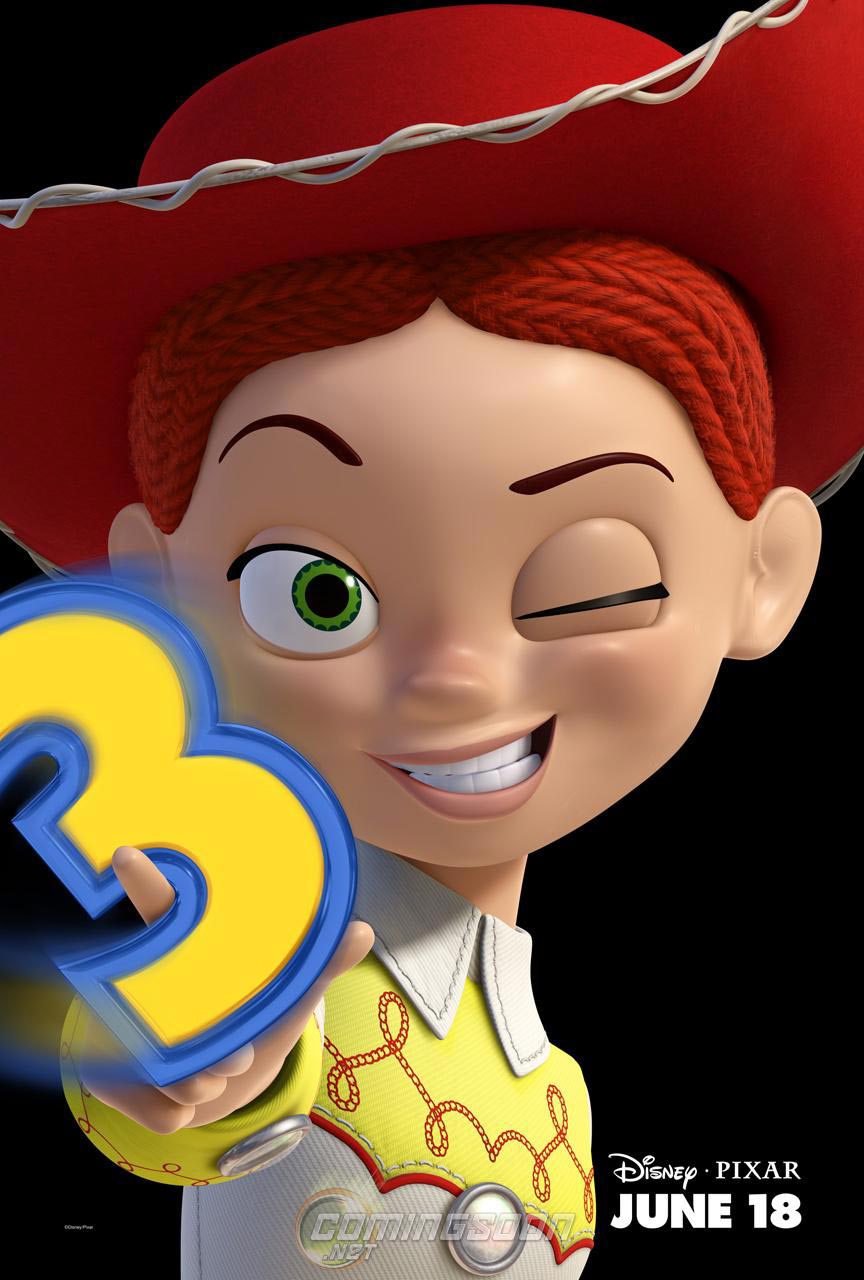
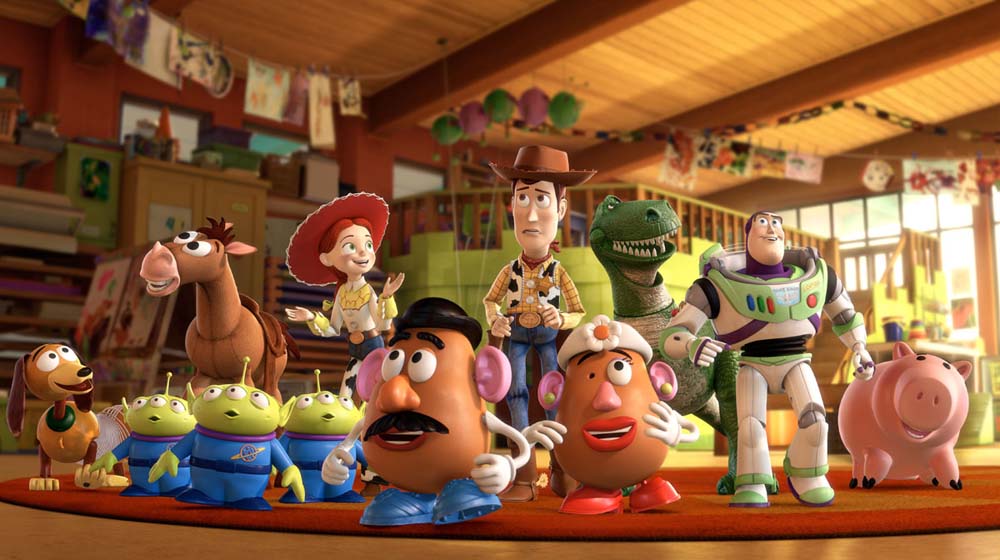
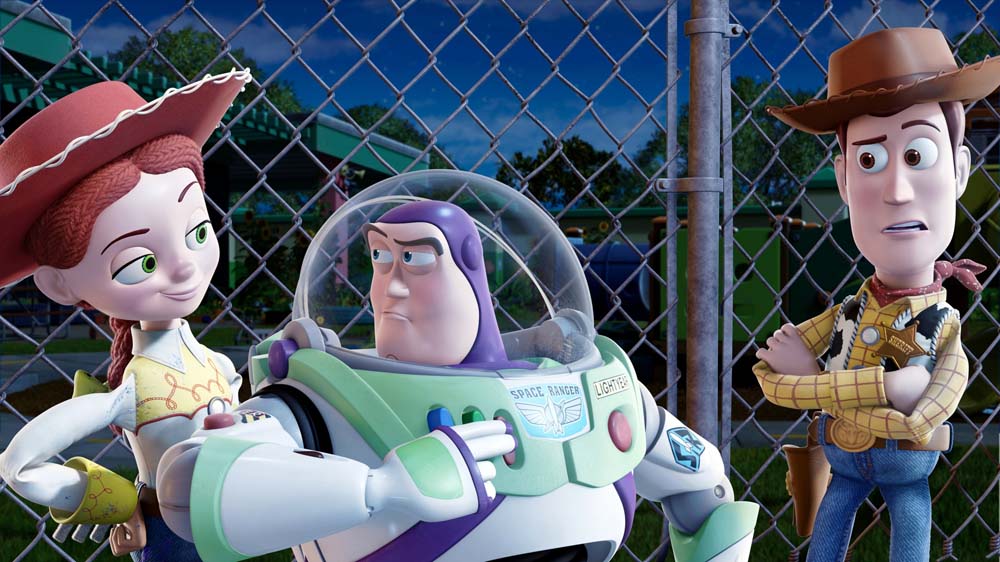
Vertigo and A.I. In the first Toy Story, cowboy-doll Woody (voiced by Tom Hanks) watched in horror as the affection of his beloved Andy was supplanted by the new space-age toy Buzz Lightyear (voiced by Tim Allen). The stakes doubled in Toy Story 2 when we witnessed the discarding of cow-girl Jessie (voiced by Joan Cusack) as her owner grew up and put away childish things (see the video below). And we witnessed Woody turned from an object of play to a rarified objet collectionner, the very definition of a "trophy love." Toy Story 3 takes Jesse's plight and applies it to the entire toy corps, facing abandonment (the attic) and, worse, discarding (at the sidewalk on garbage day). The toy soldiers take action and evacuate the premises first: "Once the garbage bags come out, the army men are the first to go" barks the commander (R. Lee Ermey) before para-sailing out of Andy's bedroom window. 
 
The others are left to contemplate their fate. 
 
Play-time's over.*

There is one axiom I've held to my heart from the moment I first recognized its truth—I'm sure it originates elsewhere, but I first read it from thriller writer John D. MacDonald: "Love is not the opposite of Hate; love and hate are merely two sides of the same coin. The opposite of love is indifference."
 
There are a lot of instances of indifference on display in Toy Story 3 (though certainly not at the hands of the creative team behind it, who have filled it with pithy circumstance and finely-wrought detail in a cartoonish 3-D photo-realism
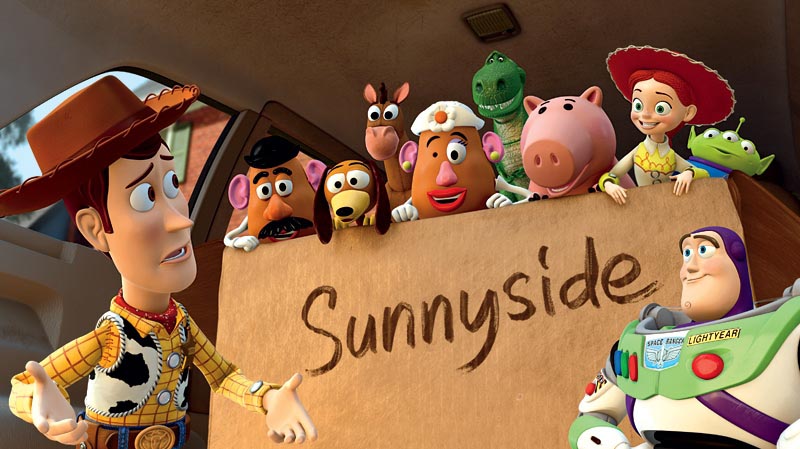
**). But, so is love, in the through-line from the first movie, first warbled in Randy Newman's opening song "You've Got a Friend in Me." It is the banding together of the community, standing stuffed shirt to plasticene shell through adversity, the toys' answer to "Can't We All Just Get Along?" All the movies have centered around the toys—diverse as they are—keeping the group together, and welcoming the new. That reaches its dramatic climax here as the team locks hands as they face absolute destruction in a truly frightening version of Hell.
The forging of the community has been a theme running throughout the history of film (especially Westerns) since Edison, certainly John Ford, and we've all seen those films where the protagonist loses a family in order to gain another, sometimes not by choice. Those bonds are infused with strength to take on all comers and all challenges, but the heart of that coming-together has always been the one unofficial but over-arching Commandment: Love thy Neighbor.

 
I mentioned putting away childish things earlier. That's from The Bible (1 Corinthians 13), and looking over that verse again, I saw images spring up from Toy Story 3—"And though I bestow all my goods to feed the poor, and though I give my body to be burned, and have not love, it profiteth me nothing," particularly.  But especially its last devastating quality in its check-list of Love's qualities, which always makes me tear up a little when I contemplate it, and I contemplate love and loss. For toys break, batteries corrode, fabric burns and plastic will melt. But Love "never faileth."
 
Love never dies.
 
To Infinity.
 
And Beyond.
 
* How many times have we said that, as adults, mourning the loss of childhood from adult responsibilities?

** But, man, you want to see Pixar push the envelope?  Check out the sophisticated opening short Day & Night, a wordless combination of 2-D and 3-D, line animation and computer graphics, filled with rich imaginative ideas and a brilliant sound design.  The work of animator Teddy Newton, this little gem, puts him at the top of exciting animators to watch.

Tuesday, June 27, 2023

Asteroid City

Meep! Meep!
or
Margot Robbie's in the Tupperware
 
Asteroid City does not exist. It is an imaginary drama created expressly for the purposes of this broadcast. The characters are fictional, the text hypothetical, the events an apocryphal fabrication."

Well, of course they are! It's a Wes Anderson movie!
 
Early on, with Anderson's movies—back before they got really stylistic with consistent lateral camera moves and a severe one-point perspective, and looked like they could have happened in the "real world"—there was a depth to the subject matter that was undeniable. That has remained to this day, even while the visual look of the films have become more juvenile and seem to be contained in toy-like play-sets that defy good construction practices or even three-dimensionality. Characters became types moving around in play-houses that seem to be defiantly artificial...like shooting in a western town that were deliberately shown to be propped up stage settings and mere facades. Most directors try to expand their horizons along with their budgets and to take pains to make things more realistic and less like pre-planned photographed dramatizations. Not Wes Anderson.
Hitchcock said of Spielberg that he was "the first one of us who doesn't see the proscenium arch" noting that Spielberg grew up with film, rather than the stage. But, Anderson is going a different direction. He WANTS you to see the proscenium arch, and will go out of his way...with a child-like glee...to make sure it's noticed and appreciated to be artificial. His new film, Asteroid City is one more step in that direction as it's story looks like it takes place in one of Maurice Noble's desert landscapes in the Road-runner cartoons.*
But, that's one aspect of Anderson's film (he usually has at least two he's presenting in his movies). Usually, he's as stringent in his story through-line as he is with a tracking shot (his The French Dispatch, with its a handful of stories, being an exception). This one, he's made a layered story, through several simulated media—television, stage, and film—each one has its place in the film and each one is subject to being violated, one by the other.
Now, Asteroid City tells the story of what happens when a bunch of "super-genius" kids arrive with their families at the titular city—famed for its vicinity to  the "Arid Springs Meteorite" impact crater—for the "Junior Stargazer/Space Cadet" convention put on by "The Larkings Foundation" and the U.S. Military under its United States Military-Science Research and Experimentation Division. They're to be given awards for their inventions—it should be noted that those inventions (jet-packs, destructo-rays, projecting on the Moon) were not viable in the setting of 1955, but would be just the sorts of things kids would want to invent. Each family have their issues and quirks, and they become unwitting witnesses to a major event in the history of mankind.
So, that's the plot. But, it's not the whole movie. We begin—in black-and-white and a square Academy ratio—with a television program (of the arts-programming "Omnibus" variety) where the host (
Bryan Cranston) intones that they are presenting a special production of a play by famed playwright Conrad Earp (Edward Norton) called "Asteroid City" and after a brief episode where Earp meets actor Jones Hall (Jason Schwartzman), we begin with a wide-screen version of the play in the colors of a faded post-card you'd find in a rack at a tourist trap.
Augie Steenbeck (played by Jones Hall played by Jason Schwartzman)—photographer—arrives (barely) at 'Roid City with his three daughters Andromeda, Pandora, and Casseiopeia as well as his son Woodrow (Jake Ryan), who is participating in the awards contest. Augie was a war photographer, still has shrapnel in his head, and takes his station wagon in to be serviced (by mechanic Matt Dillon)—it having given up the ghost miles down the road. It's decided that they will stay in town for the convention, rather than stay with Augie's father-in-law, Stanley Zak (Tom Hanks).
Stanley is concerned about this, but he's more distressed that Augie hasn't told the kids that Augie's wife/his daughter died two weeks ago, and don't you think it's about time to do that? So Augie stoically tells the kids—"Are we orphans now?" "No, I'm still alive."—which affects them all deeply, despite Woodrow being steeped in all things science and the three daughters, embracing mysticism seeing themselves as witches (well, two witches and one vampire). To allow the kids to grieve, Augie lets the kids bury their mother's ashes (contained in a Tupperware container) temporarily in the car-park until their grandfather can arrive to take them to his home for a more proper burial.
Also there for the awards ceremony is actress Midge Campbell (played by Mercedes Ford, played by
Scarlett Johansson), who is studying her lines for a new play and develops a curious relationship with Augie—seeing as their neighbors and all. Like the majority of the actor/characters, they are demonstratively undemonstrative, and—if I may use the word again—"stoic." These are, after all, adults in the 1950's, having lived through a ghastly world war, only to see it emerge with advances in technology and weaponry that dwarf, and could ultimately consume them. The many small inconveniences of living in a desert tourist trap not to far away from a nuclear test-site, leave them unfazed.
It is only when a cosmic event happens that is ultimately beyond their understanding that things change. Asteroid City, due to that happenstance is shut down and quarantined, leaving the temporary residents stranded. But, true to their nature—or perhaps the nature that Conrad Earp has given them—they react more to the minor annoyances that the quarantine imposes, rather than the perspective shock that its cause should have created.
Seems a bit like real life, doesn't it?
Anderson and consigliere Roman Coppola were writing this in 2020, so the COVID quarantine may not have been the genesis for the project, but filming during COVID restrictions certainly did, necessitating the recasting of Bill Murray when he came down with the plague. Still, when the outrage in real life is over the inconvenience of wearing masks rather than the loss of more than a million souls (you can't make this stuff up!), one can infer that it was on the creative minds.
Six feet apart?
But, there is one attitude shift present from the happenstance; Anderson abandons his persistent horizon-bisecting in the frame for something else—overhead shots looking down on the players. Oh, everything still has that one-point perspective, but from above with no horizon in sight, putting (in camera-terms) the people on screen at a disadvantage, making them smaller, vulnerable, putting them in their place—at least from the perspective of an observing extra-terrestrial. It's a bit jarring, but completely apt. It's the only evidence of a new perspective in the movie.
So, I found it fascinating, but then, I always look forward to Anderson's films. They may not come to an all-encompassing conclusion, but instead take on the mantle of a childish inquiry without answers. They make me feel a little younger, where playfulness was everyday, and not in those moments in between crises. They embrace innocence, but leave plenty of room for cynicism and mild bemusement, rather than a-musement. And the cultural touchstones he invokes are pretty sophisticated, even if he's not being sophisticated about them. I'm all in for that.
 
I hope he never grows up and loses it.
And Asteroid City is the perfect come-back for all those scary A-I generated parodies of "visionary director" Wes Anderson that are flooding YouTube now ad nauseum. Whatever the "brave new world" of AI generates, Anderson will always top it. I find that reassuring.

 * Anderson even throws in an occasional stop-motion road-runner just so we get the point.
"Wow"
 
Some more shots from Asteroid City, just because they amuse me...