For the Wonder Woman Who Has Everythingor
"Cheetahs Never Prosper" (Despite Magical Thinking)
In 1985, DC Comics published a "Superman Annual" (#11), that contained a "Superman" story that was much beloved of comic fans called "For the Man Who Has Everything." It was commissioned by Editor Julius Schwartz and the rumor is, he merely wanted the artist Dave Gibbons to draw it and Gibbons had the choice of who to write it.
He chose Alan Moore, who had been writing comics in Britain in 1984 and had achieved acclaim for his work cross-pollinating the "Swamp Thing" comic series and allowing its fortunes to bloom. Moore would go on to write "Watchmen" for DC Comics and "Batman: The Killing Joke" (two of the most critically acclaimed stories in the DC history) when he was allowed to play with "all the toys" in the DC Multi-verse cast-list, but for this "Superman" one-off he wrote a melancholy and savage story of Superman on his birthday being "gifted" by a villain with a present ("The Black Mercy," a telepathic, parasitic alien plant*) that granted whomever it latched on to their heart's desire, lulling them into defenselessness—in Kal-el's case, it is a mental fantasy that Krypton never exploded and that he has grown up on his home planet with his original parents—only to find that, in his fantasies, an un-cracked Krypton is not all it is cracked up to be. 
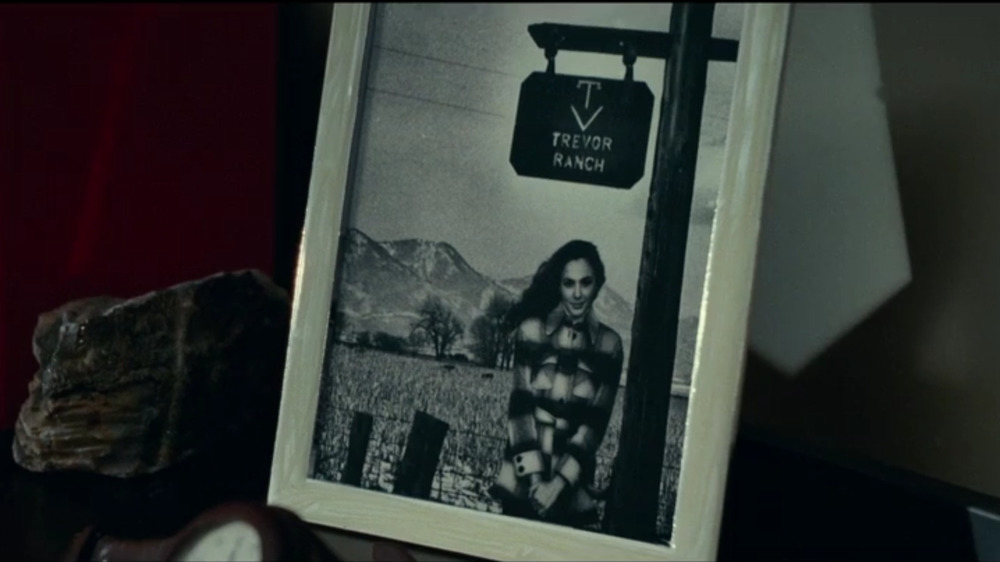
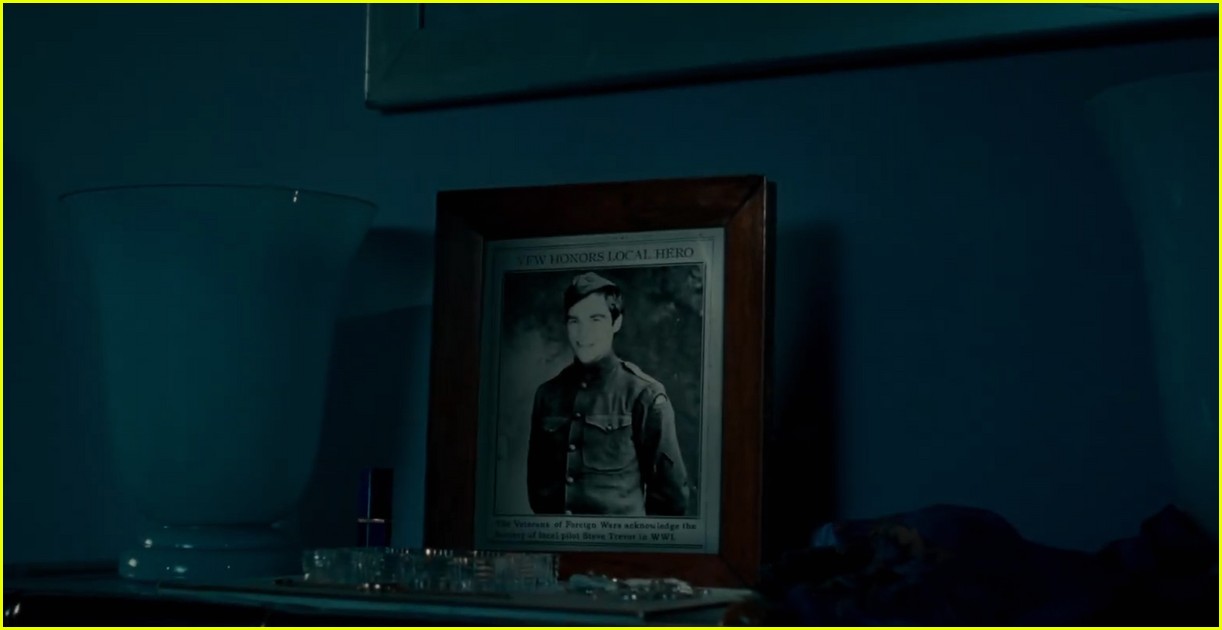
Director Patty Jenkins, who directed the first sublime WW movie, and scenarists Geoff Johns and David Callaham—he had a hand in writing The Expendables, the latest Godzilla, and Zombieland: Double Tap (which does not inspire confidence)—have "homaged" that story for Wonder Woman 1984, which finds Princess Diana of Themyscira (Gal Gadot, MVP) working for the Smithsonian in Washington, D.C. as Diana Prince and surreptitiously super-heroing as the Amazin' Amazon—we've been told in Batman v. Superman that she's one of the "secret meta-humans" operating under the radar and hasn't been seen since WWI. Not that she hasn't been busy—there are moments (but they are moments) when she takes pains to make sure there's no record of her being there, but they are weak attempts...and one jewelry-heist bust-up is so out-in-the-open that the only way people wouldn't remember it would be unless there was a post-robbery visit by the Men in Black. 
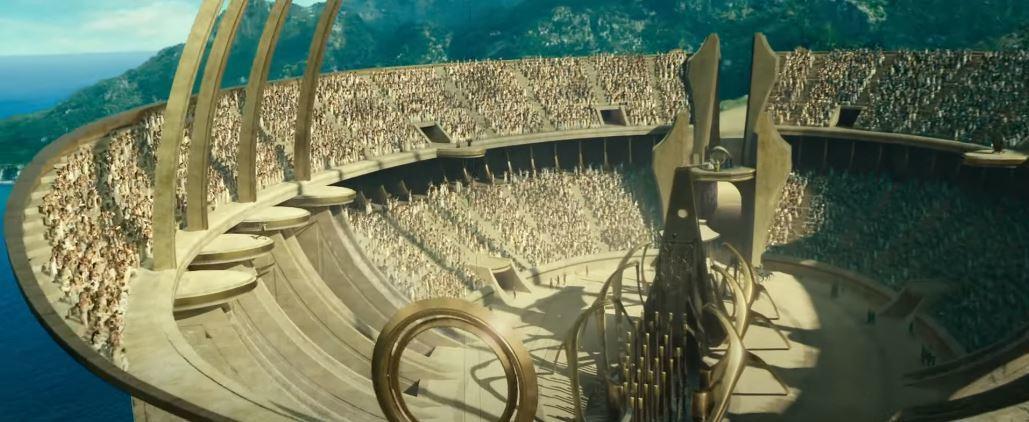
The Themyscira scenes from both Wonder Woman and Justice League are fondly remembered, but here it's limited to a Themysciran version of "The Titan Games" and Quidditch rolled into one. The ten year-old Princess Diana (Lilly Aspell, also back) is competing against women twice her age and when she gets in trouble, takes a short-cut and is prevented from completing the course by Antiope (Robin Wright), much to her consternation: "You took the short path. That is the truth...The true hero is not born from lies, but patience, diligence and the courage to face the truth."
Okay, then, roll credits.
Zip ahead to 1984 and that mall-heist, the tone of which is rather winky, feeling a bit in tone like those fights in the "Batman" TV-series—or even the "Wonder Woman" TV-series—for all the threatening the bad-guys do, they're by turns mean or comical. It doesn't help that Jenkins piles on the "strange" sartorial splendors of the 1980's here, as it tends to undercut any feeling of menace—it's preceded by some street-action life-saving that reminded one of the Richard Lester-directed "Superman" films. A lot of little girls are shown getting inspired by a strong kick-ass woman, even though the impression is supposed to be fleeting. I mean, Diana tiara-smashes a lot of incriminating security cameras, but she stops to smile and wink at the little girls? It's also where the first brain-disconnect moment occurs: the bad guys rob the mall-jewelry store because there are ancient artifacts being smuggled there on the black market. Really? In a mall? A high traffic area mall? Anyway, it's always good to see Gadot playing Wonder Woman. She's the best thing in the picture and although the movie doesn't live up to expectations, she's never less than fully committed and pulls off a lot of janky scenes just by her persuasiveness. That's a great component of the "Wonder Woman" persona, even if the movie sometimes forgets what she's all about. Except Diana. The two have a mutual interest in the Dreamstone, but neither realize its importance: It's base has a Latin phrase carved into it—"Place upon the object held but one great wish"—and it gives the bearer it's heart's specific desire...but at a cost not known to the stone-wisher. Diana wishes that Steve Trevor was back. Barbara wants to be more like Diana.
But, there's another man who covets the Dreamstone and that would be Maxwell Lorenzano (Pedro Pascal), who has changed his name to "Maxwell Lord"** and become a fixture on TV for his company Black Gold Cooperative, hawking the public with the idea that, sure, "Life is good. But it can be better! Why shouldn't it be? All you have to do is want it." Max has bought up a bunch of oil properties that have come up dry holes—and is in debt up to his well-coiffed hair to one Simon Stagg (Oliver Cotton), who up to this point has bankrolled his schemes. But, those debts are catching up to him. Desperate for a solution, he charms and seduces Barbara into getting his hands on the stone and does what every good entrepreneur does—eliminating the middle man by wishing the stone to convey its powers to him directly, so anyone who touches him making a wish will have it granted and, in reward, bestowing him with...something. Certainly power of some kind. Now, granted, what will stick in people's minds is gonna be that Max Lord is supposed to be Donald Trump in disguise. That will be the people who are "woke" enough to Trump's S.O.P. or those in the Trump Camp who are feeling like Hollywood is picking on Their Savior. Well, Citizen Kane is all about William Randolph Hearst...except it isn't. Similarities, sure, but differences, too. The 1980's has gone down in History as the "Greed" Decade, so any entrepreneur, empowerment coach (Tony Robbins, hello), or televangelist would fit the bill. Jenkins has gone on record that Gordon Gekko—of Wall Street (1987) fame—is a model, but George W. Bush could be, as well, given the oil tactics. Besides, this Maxwell Lord has self-image problems and wants to look like a "winner" to his son. Trump doesn't care what others think about him. All he cares about is maintaining his own self-image. Maxwell Lord is just like his comics character, a snake-oil salesman running a ponzi scheme.
But, he is successful enough with this stone that pretty soon he's a billionaire, has all sorts of mineral rights in the Middle East, has the U.S. and Russia hemorrhaging nuclear missiles and firing at each other, and—via an orbiting communication system—has the entire world making wishes that are destroying the world in an apocalypse of entitlement and self-absorption.
Wait, wait, wait. Which of the screenwriters thought this was a good idea? The scenario would include so many conflicting wishes that literally nothing would work—people's wishes would cancel each other out, negate others, and end up not making anybody's wishes come true. Forget any "monkey's paw" "be careful what you wish for" homilies, the scenario is just blinkerdly stupid, reminding me of the world-"Super-Computer" idea of Superman III or the Riddler's tapping into everybody's brain-waves "Box" in Batman Forever. The idea is "big" enough to sell a Warners Exec, but dumb enough to have no discernable logic to it other than as a polemic against mass-greed. Oh, along the same lines: Diana's wish is to get Steve Trevor back.*** I can't think of any reason beyond contractual obligation to do that. Wouldn't she wish for world peace? At least an end to war? Isn't that why she's in "Man's World"? How about a little sexual equality—there are enough leering jag-off's in this film to inspire that. How about wishing to go back to Themyscira? See Hyppolyta for a little pep-talk, maybe—a refresher course on the Games competition? A speech is given to Diana: "I give and give and give and all I ask is for this one thing..." Gadot sells it, but I lost a little respect for the character in that one exchange. And Trevor's soul has to inhabit another guy's body to do it? That's a little creepy. But, then selfishness, at other's expense, is what the movie's all about. If they'd limited it to Barbara Minerva, whose wish turns her into a being as strong as Diana (by decreasing Diana's power), and then into the sub-human Cheetah, then we could have had The Big Lesson, but not the confusion, or the lame "Kumbayah" at the end of it
But, also, the whole movie is about Magical Thinking...even in regards the film itself. If you build it, the audience will come. They may come, but they may not come to buy. There's another significant Latin phrase, not written on the base of any stone that says "Caveat Emptor." And the movie is full of Magical Thinking: Diana and Steve steal a jet-plane from the Smithsonian to go to the Mid-East—the jet is fueled up? Enough to fly that far? And Steve can fly it when the last thing he flew was bi-planes? Diana suddenly can turn things invisible (thus, bringing into the movie WW's Invisible Jet, which she shouldn't need as she's supposed to be able to fly)? Steve's rather vague notion of flying teaches her to do that? I'm all for ideology and visualization, and you can even have "The Secret," but I've seen too many Roadrunner cartoons to teach me that wishing doesn't make it so. It is such a disappointment. But, then, second films in a series tend to lag. Oh, it has its moments. Gadot, of course, is splendid and her scenes with Pine are excellently played, especially when their roles are reversed from the first film and Diana have to show him the ropes of life in 1984 (I just wish they hadn't been written), and both Kristen Wiig and Pedro Pascal do terrific work selling their material, as weak and ill-considered as it is. And the movie LOOKS terrific, even if Jenkins seems to have abandoned her wide-screen sensibilities to make this movie look like it was shot to avoid being panned-and-scanned on a square TV (the way directors compensated in the old days before HD TV's). Definitely a big step down. There is a visual thematic thread throughout Wonder Woman 84 that is used again and again and it's a bit of a distraction—that video "fritz" effect that sometimes transitions scenes, introduces titles, and generally breaks up the picture. I don't know what it's doing there. To show the ever-presence of media in the 1980's? A way for Warner Brothers to unite the latter DCEU movies with obtrusive graphics? Cynically, I see it as a metaphor. You don't get those "glitch" kinds of defects unless there are flaws in the material. There's an abundance of them in WW84. Stick around for the mid-credits scene for a cameo—not a preview—that will, however, make you smile...another nod to nostalgia. I just wish they hadn't made me nostalgic for the last movie. (See that about wishes?...doesn't work.)
"We can do better..." Yes, you can.
* Fans of the "Supergirl" TV-series will notice that the same plot and device was used in the Season 1 13th episode "For the Girl Who Has Everything."
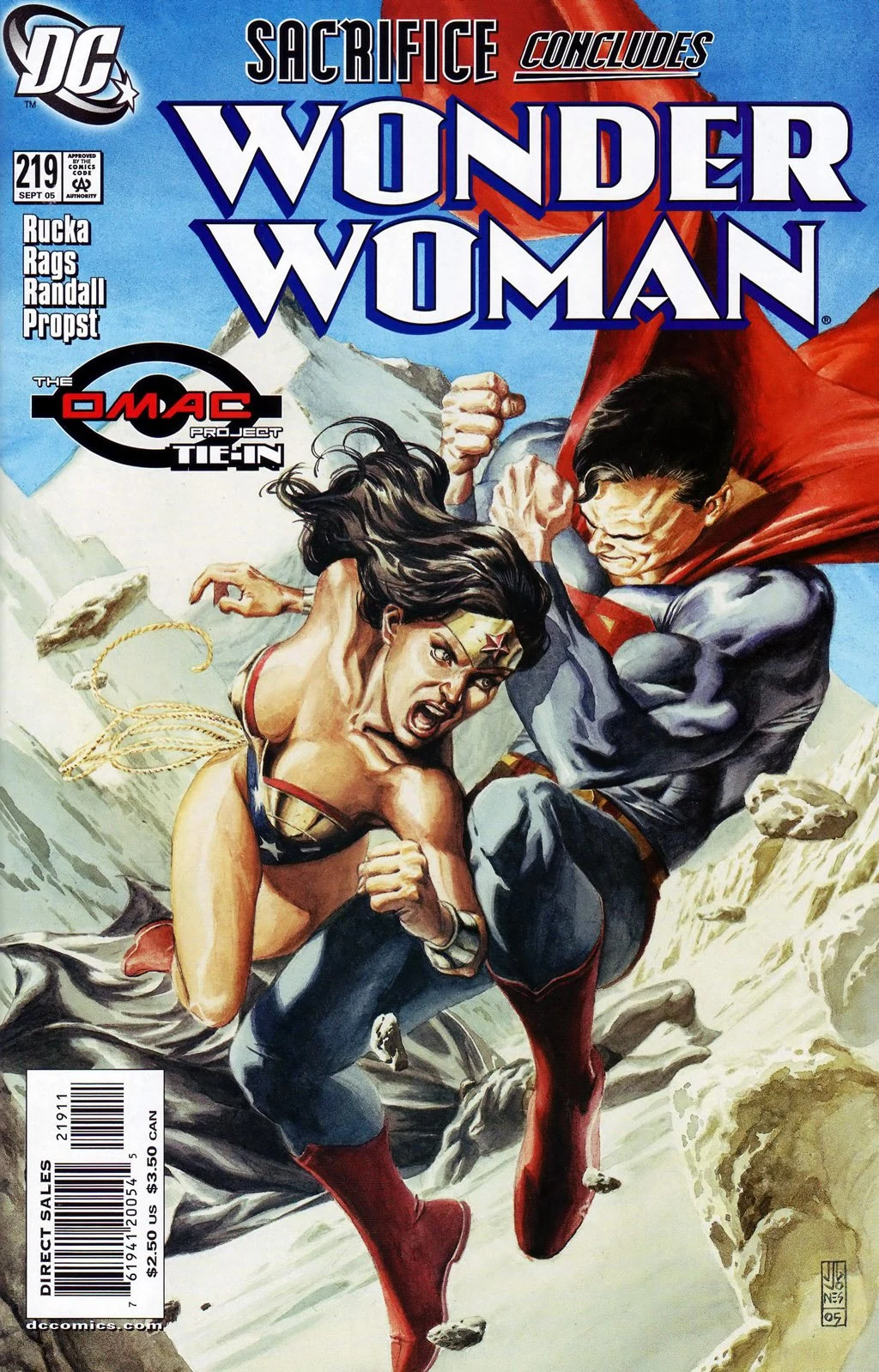
** The choice of Maxwell Lord as the villain of the piece is interesting for his history in the DCU. In the DC comics, Max was an entrepreneur/con-man who brought together an incarnation of the Justice League called Justice League International, which did not operate on U.S. soil (it included Wonder Woman in its original line-up, but due to her being used for her own book and to avoid any character dis-connect, she was never seen in the JLI). In one of the big "event" storylines for their publishing year—called "The Omac Project"—Lord uses an ability to telepathically control others to make the DC super-heroes look bad in the eyes of the press and public (in Wonder Woman Issue 219). When he takes over Superman, Wonder Woman narrowly defeats S-man by knocking him out, and Lord tells her, when bound by her lasso, that once Superman comes to, he'll just control him again. WW asks him how she can prevent that and Lord says, simply, "Kill me." So, she snaps his neck. *Krk!* Not something the comics-Superman or Batman would do, but then, WW is an Amazon warrior. It was still controversial among fan-boys. Lord's neck is saved, in many ways, in WW 1984.
*** I LIKE Chris Pine. He's a terrific actor. Plus, he and Gadot riff off of each other like nobody's business, and they do so in this movie. They're terrific together. But, he wasn't necessary. And there were better ideas that could be explored for that wish trope. As good as he is—as good as THEY are—I hope they don't bring Steve Trevor back in the future. As they used to say on Themyscira, a woman needs a man like a fish needs a bicycle and Wonder Woman doesn't need a bicycle, either. Or an invisible jet. The woman can fly on her own.
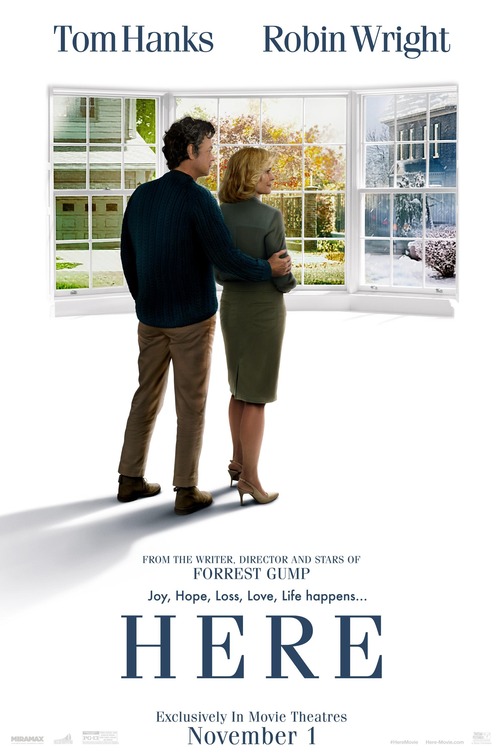
 So, here's Here. And, technologically, it is pretty amazing, but for reasons that have nothing to do with story-line (except in some nicely worked-out places) or the fact that it re-teams Tom Hanks and Robin Wright nostalgically from Forrest Gump. They are basically irrelevant other than box-office draw (frankly, I was more intrigued to see Kelly Reilly—from "Yellowstone" and the Downey Jr. "Sherlock" movies—and Michelle Dockery—from "Downton Abbey"—in it. It's not a movie where you can judge performances, scattered as they are in this movie's timeline.
 And the incidences feel like snap-shots—or worse, like "Saturday Night Live" skits—they pop up, do a bit of business and generally exit on a laugh or a dramatic hit ("And...scene"). God forbid that they should interrupt one of those slices-of-life in mid-chaos and have it resolve later in the story. That would have felt random, instead of calcified and calculated as this movie too-often feels like.
 It starts out with its gambit efficiently enough—that one angle—whether it's in a house on that particular parcel of real estate or in its origins as primordial ooze when the boxes start fading in, initially with subtle borders around them until we get the knack of it and then those borders start fading away and they begin to make transitions so we see the neighborhood go from dinosaur stomping ground to hellish landscape to ice age (only one of two times when the camera actually moves) to Native American habitat to the neighborhood of William Franklin (Benjamin's ever-loyal-to-the-king non-rebellious son) to the story-heavy 20th century.
  The Franklins' eventual neighbors are The Harters (he's excited that an "aerodrome" will be built nearby and intends to fly—something his wife is dead-set against); there's the bohemian Beekmans, she's a free-spirit and he's an inventor, perfecting a chair he calls the "Relaxo-boy"; post WWII, the non-surnamed folks we'll spend most of the time with (let's call them "The Gumps") move in, sail through the 50's and television, raise Tom Hanks, who gets his girlfriend Robin Wright pregnant, they get married and move in with the folks and eventually age out of the house; then we get the Harris', the only minority couple—besides the Native Americans—that reside there. We get nudged a lot about how things change—the Harris' give their son "The Talk"—and not—frailty and death are inevitable, as apparently is influenza.
 For the most part, these folks are chess-pieces that get moved around depending where the boxes show up and those boxes highlight the transitions between entertainment systems, gas-lights to electric, rugs versus hardwood (versus verdant forest), couches to sectionals. Art changes, but the view rarely does. Dramatically, the film underwhelms except in some key places. But, it's not a waste of time...or space. Not at all.
 We are used to being manipulated in movies by mise-en-scene and blocking. Directors let us see what they want us to see and use blocking to change the focus of our attention. This gives us the illusion that we're peeping through a letter-boxed slot-view a 360° world-view (we're not, of course; it's an illusion). Here subverts that. We are given one angle to look at—the world may change within it, but it's basically that one section of cinema real-estate, like we're looking at the Closed Circuit Camera of Eternity.