Showing posts with label Disney. Show all posts

Saturday, March 29, 2025

Snow White (2025)

What Do You Mean By "Fairest"?
or
Snow White (and the Height-Challenged, but Competently-Abled and Platonic POSSLQ's)—There, That "Woke" Enough For Ya?
 
The seven dwarfs were each on different little trips. Happy was into grass and grass alone … Happy, that's all he did. Sleepy was into reds. Grumpy, too much speed. Sneezy was a full blown coke freak. Doc was a connection. Dopey was into everything. Any old orifice will do for Dopey. He's always got his arm out and his leg up. And then, the one we always forget, because he was Bashful. Bashful didn't use drugs. He was paranoid on his own. Didn't need any help on that ladder.
George Carlin
 
Disney made the first Snow White and the Seven Dwarfs in the mid-1930's, and gosh, "not much has changed". I'm being sarcastic, of course. It premiered during The Great Depression, Hitler had not yet attacked Poland (but the Japanese had invaded China). And the world was about to evolve, rendering the tropes of "Snow White"—the biases, the weak role of women, the "princessy" thing, the deus ex machina of the necessity of a rescuing handsome prince—all of that would age as gracefully as an Evil Queen into a Crone. It's almost unfathomable that, at the time, Disney's Snow White and the Seven Dwarfs was something of a revolution in the animated art-form. It was the first cel-animated feature film (the ads announced it "in multiplane technicolor"), and the first animated feature ever made in the United States. At the time, Disney was discouraged by business partners, other Hollywood moguls, and potential backers that a feature cartoon just couldn't "work," for diametrically opposed reasons: either it couldnt hold an audience's attention for longer than the accustomed 7 to 10 minute running time, or the length would simply exhaust them (and in fact, at the time, the young Disney company depended on the more robust RKO Studios to distribute the film to theaters—Disney is still very much around; RKO is not). It's release and success changed everything, and despite its calcified ideals, it remains a classic of the form, still topping recent 10 best lists for animated films. And, in fact, the United States Library of Congress deemed the film "culturally, historically, or aesthetically significant" and selected it as one of the very first 25 films for preservation in the National Film Registry in its first year in existence in 1989.
So, why remake it? To make money, of course (one does have to go back to the mine...and the well). And maybe, aesthetically, as a way to "update" it for a new generation not born in the previous century. Then, also, there's the legal matter that the original 1937 film is going to become part of the public domain in 1933. There is that. Plus, there has been an awful lot of competition lately from other versions of the exact same story: Snow White and the Huntsman (2012) and its Snow White-less sequel (2014), 
Tarsem's Mirror, Mirror (2012), Snow White: A Tale of Terror (1997). Of the Grimm fairy tales, it is the most adapted for film. And Disney's version is iconic. Were it not for the 1937 film, one doubts the other versions would exist.
Now, the optimal movie-going experience is to go in without prejudices or expectations (I mean, if one is doing it "right"). However, as this is a remake, you can pretty much throw that out the window. This puts me on an even par with about every single movie reviewer or internet hack, as the grousing, bitching, and over-dramatic moaning about this release has reached new levels of "hair-on-fire." Me, I wanted to see what they could do to make it less of a dinosaur of the Depression-era (I mean, the first feature came out before Gone With the Wind!), how much of the classic songs were retained, and if the new film-makers—
Marc Webb, primarily, he of the Andrew Garfield Spider-mans, the films (500) Days of Summer and Gifted, and I'm something of a fan—could make their third act top the action scene of the dw...oh, let's call them "colliers", shall we? (nobody can argue with that unless they're being trenchantly snippy)...chasing the evil crone who poisoned Snow White to fall off a cliff. And if they could balance the light and dark as effectively as old Walt did back in the day (the thing that's always impressed me about Disney is that he could scare of the tar out of his intended audience of children, and in such a way that he'd gain the cynical respect of their parents).
So...how is it? Actually, quite good, better than I was anticipating.
To my points, it is still quite a dinosaur and of another time, but, this iteration of
Snow White (and Disney's Snow White, if there were any questions) still tries to be relevant to the times, even if it can't quite distance itself from the ghosts of the earlier version, rooted as it was in what was being done in films of the time, still taking cues from Broadway, vaudeville and musical theater. Even more than the first one, you can smell a song coming on, and there are far more of those song-breaks than previously.
How are those songs? Genuinely good...and smart. Yes, they trot out "Heigh-ho" (and damn if that song doesn't still work) and they've done a buff-and-polish on the lyrics, using it as an introduction to the various...colliers. "Whistle While You Work" is revived, also with new lyrics, some of them quite surprisingly funny.* Some of the lyrics make use of modern idioms, which is momentarily jarring, but it passes. "I'm Wishing" (the first of the now de rigeur Disney "I Wish" songs) is pitched, replaced with a new one "Waiting on a Wish", and "Some Day my Prince Will Come" has been been tossed for all sorts of reasons, the primary one being the story's lack of an actual prince, handsome or otherwise. Instead, there is a roguish thief (
Andrew Burnap), living with his band of cut-throats out in the forest, having been banished from the kingdom.
And there are a bunch of new ones. One song in particular stands out, as it makes a point of calling out the story's short-comings and considers the world at large (much more than the film's opening "world-building" number "Good Things Grow") and that there might be bigger fish to fry than Snow's deposition and loss of status, and that is the ingeniously titled "Princess Problems":
Self-aware and brings up a point that if you're living under an evil regime, there might be some people suffering worse than you. I found that refreshing—but, then, I've never been concerned with the "plights" of royalty.
How about that ending, which was visceral and exciting (if a little too much an easy fix)? Well, I can't say this one's that exciting, although it does work in a story-logic kind of way and I like how, metaphorically, the Queen (
Gal Gadot) is dispatched by her own narcissism. It just doesn't get the heart pumping as much, but then Disney animators have always had a penchant for making dramatically hysterical resolutions.
Okay, you want to know about the casting. Let's start with Snow White. As far back as my review of Spielberg's version of West Side Story, I've thought that Zegler seems to have been genetically engineered to be a Disney princess with eyes too big for her head just like she was animated that way (it's a Disney design trope to draw big eyes in order inspire warm feelings like you were looking at a baby). So, she looks preternaturally perfect for this. And the thing is, Snow is a tough sell—just as Maria in West Side Story is—where the character is just so cutesy—and not in a self-aware way—you want to sit her down on a tuffet and tell her to wise up and stop being such a victim. Snow in this has a bit more grit and certainly is more expressive than the plasticene-rotoscoping allowed in the 1937 version. And she's not a sap...or a simp. I like that. Plus, Zegler's singing voice has always been astounding and she belts out the songs the way every Disney princess should, full-throated but with enough character to make her more relatable when she drops the arias.
And Gal Gadot is great as the Evil Queen. I don't know what she's done to deserve this "bad-Kevin-Costner" phase of her career, But she trods the thin line between camp and making her Evil Queen a serious threat, which is what she should do. It's the same tactic Michelle Pfeiffer takes when playing villains: be evil but show you're enjoying it, like any good autocrat. There's one moment when Gadot's Queen snaps her head in fury at the huntsman (
Ansu Kabia) ordered to kill Snow White and I swear she did it in a mere film-frame of time that was jolting. And the theatricality she throws into her musical numbers threatens the set-rafters, CGI or not.
So...uh...how are the "colliers?" I must admit, I was a bit taken aback by them, but then they don't have the rubbery cartoonishness of their animated ancestors.  They're a lot more starchy and have a bizarre facial structure that makes them all-jaw—they look like hummel figurines you'd find in a some rural backyard in Ochsenwerder (Hey, why didn't we just call them "gnomes" in the first place?) and they're the same attribute-centric personalities they were in the 1937 version ( rejected contenders at the time were Hoppy, Jumpy, Baldy, Hickey, Stuffy, Burpy, Tubby and Dizzy). After awhile, you get used to them, although the character of Dopey kept reminding me of Alfred E. Neuman
of Mad Magazine fame.
Those are quibbles. I find the 2025 to be a fairly successful effort to make a problematic—if beloved—part of history a bit more "present". It's certainly nothing—nothing—to engender the vitriol I've been seeing online. Look. I'm as evil as they come when I see something bad and write something snarky. But, then, I don't have an "agenda" other than a critical one and I certainly don't make a living at it, amping up my outrage as a cottage industry). I don't know what they're "on" or "on about" but it's not there in the movie.
Children (as I witnessed) will be delighted by it. "Bro's" who haven't grown up...won't (Hence, the film's low IMDB score perpetrated by basement-dwellers who haven't actually seen it, as IMDB has no way of checking veracity). There's a big difference between having prejudices (as I had) and agendas.**

So, the new truncated Snow White is good, sometimes incrementally better in places and a good effort, but it is hardly revolutionary. And so nobody should treat it as if it is.
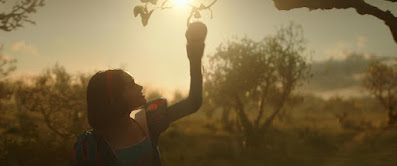
 
 
* Even if it can't quite shake the specter of how the song was satirized and mocked by—of all things—Disney's own Enchanted. Sometimes, you just have to hand it to the Mouse-house for being so smart, clever, and self-aware:

** Oh, one little piece of advice to the "bro's" out there who swamped IMDB with negative scores—don't do the job "too well" or the basic law of averages will point out the obviousness of the ploy.
Live by the aggregate, die by the aggregate.

Wednesday, August 14, 2024

Jim Henson: Idea Man

I'm Your Puppet
or
Having a Hand in Everything
 
When I was growing up, I fixated on several things to the point of obsession. One was the comic-strip Peanuts. One was America's Space Program. Howdy Doody. Looney Tunes cartoons. J.P. Patches (if you know, you know).
 
Puppets. I think I watched everything that Paul Winchell did. Kukla, Fran and Ollie, Shari Lewis.
 
And Jim Henson. This was before he became the creator of "The Muppets," and was an up-and-coming skit contributor—he'd appear on "The Ed Sullivan Show" and other variety venues, and he had a regular "gig" on "The Jimmy Dean Show" with Rowlf the Dog.
 
But, Henson did things differently. His "bits" would be his bizarre looking puppets (including one which would become well-known as "Kermit the Frog") lip-syncing to some popular record and the bit would usually end with some 90° turn, sometimes violently. They were hilarious and seemed to erupt from some fertile ground of imagination that none of the other entertainers on "The Tube" seemed to have access
.
Henson hadn't intended to become a pioneering puppeteer. He just wanted to get into television, a medium that fascinated him. Although he'd been introduced to puppetry watching the tube, he wasn't personally involved with the art until his last year at Northwestern High School in Hyattsville, Maryland, continuing to study it at The University of Maryland, College Park, where he met his "Muppets" partner and future wife, Jane Nebel.
With wife Jane, Henson devised the skits and bits that the Muppets performed on local and national television shows, as well as doing commercials. On weekends, he began experimenting with film projects, exploring stop-motion animation, rhythmic editing, and juxtaposed cross-cutting. His first, Time Piece, was Oscar-nominated for "Best Live Action Short" in 1965 (it's presented in its entirety below).
Kermit's origins began from the discarded green coat of Henson's mother.
The rest you no doubt know, from Henson's work on Sesame Street—also directing many short avant-garde films for various "numbers" segments—with its vast array of puppets and full-size figures to walk on-set, "The Muppets Show" and movies, "Fraggle Rock," a brief recurring stint on the first season of "Saturday Night"—the percursor title for "SNL," the films The Dark Crystal and Labyrinth. Hundreds of hours of content for movies and television. Plus innovations in puppet-performing, animatronics, special effects, and film-making...not to mention overseeing the construction and manufacturing of building imaginative creatures.
Painted halved ping-pong balls for eyes...
Now, Ron Howard just made a documentary about Henson—Jim Henson: Idea Man—and has been the case for Howard's product lately, it didn't get a theatrical release, but went straight to Disney+ for streaming (except for an appearance at the Cannes Film Festival) on May 31, 2024. So, what was it doing as an ABC special this past Sunday? Disney+, being notoriously stingy with their streaming product, put it on broadcast television within 3 months of its premiere...that's a bit unprecedented. But, follow the logic: Henson's Muppet properties (except those wholly owned by Henson) are owned by Disney. Disney also owns the ABC network, and the night it premiered NBC was airing the closing ceremonies of a much-storied Olympic Games. ABC needed to put something special up rather than roll over and die in the ratings. It's as simple as ABC. Or ABC/Disney.
The fledgling Muppet crew
Howard, who has had an illustrious career as a director—aside from his acting career—has turned in another "safe" documentary. Chapter headings, talking heads (good ones!), a smorgasbord of clips that would even please The Swedish Chef, and a design sense based on things Henson himself had innovated. It's by-the-numbers, like a Ken Burns documentary without that director's eye towards the breath-taking shot, the spurious but telling anecdote and the impeccable eye towards getting the most out of a photograph. Howard colors inside the lines.
Howard is no innovator. His films have no mystery, they never haunt, and they never linger in the mind with deeper implications. He tells the story, simply, effectively, and gets out leaving no after-image. Where a recent documentary on Fred Rogers by a great documentarian like Morgan Neville will leave you in contemplation, Howard makes you feel like you've heard the story enough to feel satisfied. It's like a bed-time story told by a competent nanny. Henson would have never done an auto-biographical film, but he would have made it a thrill-ride with thrills, near-spills and a bit of danger to it.
Those elements are best inhabited by the words of Henson's co-workers, kids, ships that passed, and stars that shined for him. Like Frank Oz, who joined Henson as a high-schooler and under his tutelage became a brilliant puppeteer, actor, personality and director and in his interview seems to share a weight of gratitude. Rita Moreno talks about guesting on "The Muppet Show" and blowing take after take because she couldn't stop laughing until the last take where she barely holds it together...and they used it! "The nostril-flares tell you I'm about to lose it." Jennifer Connelly talks about being a 14 year old on a Henson set...co-starring with David Bowie and feeling like the place was a playground.
 
And in a way, it was, one that we all had access to and could play in. We couldn't see the dollars spent, the hours of prep, the uncomfortable positions (try holding your arm up for 10 minutes!), nor could we see the actual performers, merely their avatars, hidden behind desks, tables, props, out of sight and, rather miraculously, out of mind—even to the people they were performing with. We saw the tip of the ice-berg of creativity, that by the time it appeared on-screen had been honed to a science, made easy to laugh at, without having to consider the men (and women) behind the curtain. 
 
Like Oz.

Henson never played it safe. Maybe, someday, there will be a documentary that will take his same radical tack at looking at this man perpetually behind the curtain while simultaneously so on-stage and call the man what he was: a magical genius.


Saturday, December 23, 2023

A Christmas Carol (2009)

Christmas is Monday. B/CL is closed on Mondays...like theaters and like museums...so I won't be posting then. Besides, it's Christmas, Scrooge!  So, here's what I would've posted on Monday were I posting.

Written at the time of this version's release (Oh, don't worry! I'm sure another version is coming out shortly).


"God Bless Us, Every Mega-Pixel"
 
  
Everyone has a favorite "Christmas Carol" (or I should say, "version" of "A Christmas Carol").* A novella, it is the perfect length for adaptation to movie (with some padding) or television special (with some commercials). And being as it's in the Public Domain, anybody can adapt it without paying any money to Mr. Dickens (who probably haunts the producers, every one!). Hence the title: Disney's 'A Christmas Carol.'tm **
 
Disney may own it, but it's Robert Zemeckis and Jim Carrey's "A Christmas Carol," and it stands up against even beloved ghosts of "Christmas Carols" past. Face it. There are so many, that presentation becomes the main criterion to base a judgement, like "Hamlet." And format has a lot to do with what drives Zemeckis' version. Skip the 3-D aspect for a moment. This motion capture-CG "take" does some very interesting things with the story (adapted within a farthing of Dickens' original by Zemeckis himself) that are only possible with animation—the ghosts being integral to the story.
"A Christmas Carol" is a ghost story. The ghosts and their tours of Scrooge's life past, present and future must be enough to slap Scrooge giddy, make him "scared straight," turn his perspective from "profit" to "a common good." 
In other words, it must turn him from a "cool, conservative man" to a "bleeding heart liberal."*** You have to have really scary ghosts to do that. Really scary ghosts. Any half-steps and Scrooge would be a "champagne liberal," and what good are they?
In this version,
Carrey not only plays "Scrooge" (through Zemeckis' ever-improving "motion-capture" technique) but also the three Ghosts: a cooing Irish flame for the past, a roaring Scottish present, and a funereally silent Future. Each has their own presentation of their visions, Past whisking Scrooge to his old haunts, Present turning Scrooge's sitting room into a camera obscura to spy the current Christmas, flinging Scrooge to a stage street to present Want and Ignorance, two feral spirits—the one growing up violent behind prison bars, the other morphing into a hooker and into a straight-jacketed mad-woman. And Future, in a neat touch, forms itself from Scrooge's own shadow. 
There emerges during the sequence a chase as Scrooge is pursued by his own nightmarish funeral cortege pulled by two red-eyed horses, a bit that old Walt would have been proud of. It soon deteriorates into a demonstration of 3-D (which Zemeckis and Pixar are already masters of—the previews of
James Cameron's Avatar shows a few problems) as bedlam as a mouse-sized Scrooge must scramble through the sewers to escape a terrible fate. One could live without it, as well as the "snuffing" episode of Christmas Past were the sequence not a vivid demonstration of just how well Zemeckis uses the technology to bring a life-like edge to the movie. And that's where this "Christmas Carol" truly makes its mark. 
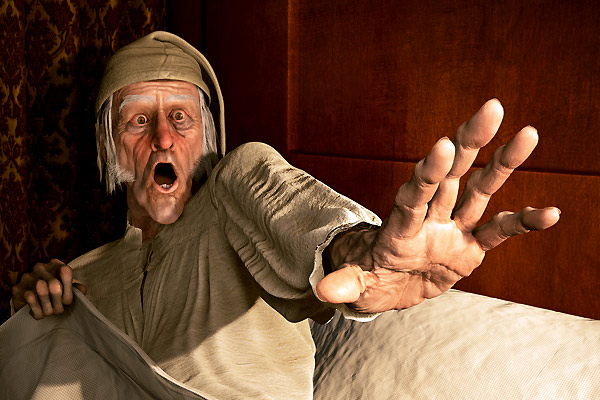
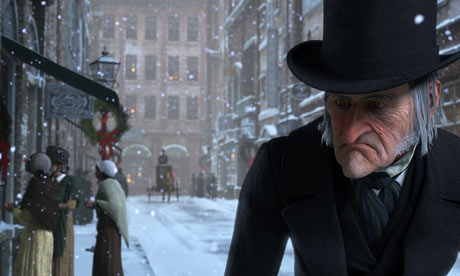
Where this version of "A Christmas Carol" is unique is that this marks the occasion when "motion capture" CG "got the faces right." Zemeckis' previous experiment in this realm,
Beowulf, had an odd, plasticene feel to it, mouths didn't crinkle correctly in speech, faces wobbled in perspective. Not here. Carrey is a broad actor, to be sure. But he's also an actor of simultaneous quicksilver subtleties, and this film captures it all. It's one thing to flit the camera perspective through snow-storms and sail through the chains of a scale, falling chestnuts, and the "eye" of a wreath (all done in the film's credits), but it's quite another artistic thing to capture the look of pleased instant love
on young Ebeneezer's face when he first meets his beloved Belle (Robin Wright Penn), or to show the pleading terror and remorse when a ghostly Scrooge comes "face-to-face" with a mourning Bob Cratchit (a perfect Gary Oldman). Keep your dizzying flights of fancy 3-D. It's in those moments of intricate expression when "Disney's 'A Christmas Carol'" truly soars.

* Well, since you asked, I have my own favorites—usually the ones that are a bit scarier in their psychic psychological warfare on Scrooge. I like the "Alastair Sim" version often sighted as a favorite, and love the "George C. Scott" version for television from 1984 (he's scarier at the end than at the beginning!), but my favorite—and this is probably a case of "Mom's Apple Pie Syndrome"—is "Mr. Magoo's Christmas Carol," which, even though it is a musical, even though it is a cartoon and even though Scrooge is Jim Backus, still manages to pack an emotional wallop, more than any "live" version I've seen, including this version.  

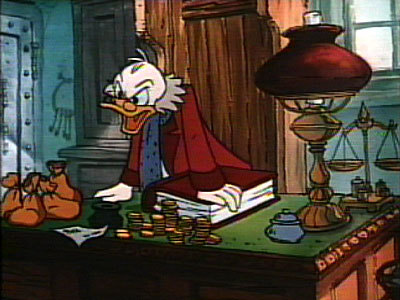
** They've already done a version with Mickey Mouse: "Mickey's Christmas Carol" (1983). Scrooge McDuck played Scrooge. Natch.  

*** I have to bring this up: a couple years ago one of the Zucker bros. directed a conservative version of "A Christmas Carol," but it took the Christmas out of it—I guess it's "An X-mas Carol," then,...talk about your "Wars on the Holidays"(sic)—called "An American Carol" in which a Michael Moore type (played by Chris Farley's brother—more popularly known as "Chris Farley's brother") is shown the Ghosts of America Past, Present, and Future in order to "scare" him into being more conservative—frankly the Bush II Administration had the opposite effect on me. Not to paint with too large a brush, but conservative political humor tends to be so ham-fisted and structurally unsound that it can't even see its own hypocritical ironies.

Friday, June 2, 2023

The Little Mermaid (2023)

A Woman Needs a Man Like a Fish Needs a Bicycle ("I've Got Twenty!")
or 
Mermaids Aren't Real But Racism Sure Is.  

Disney's The Little Mermaid was a revelation when it came out in 1989. At the time, Disney had been in the doldrums, creatively and financially (hard to believe, I know—this was before they found a new creative voice and, if not having it, buying it). Oh, they'd experiment a bit half-heartedly and always with an eye to the budget, which would constrain the imagination or goals. And the Disney brain-trust, "The Nine Old Men" as those original brilliant animators were called, were one-by-one dying off.
 
Then, Jeffrey Katzenberg came in on the coat-tails of in-coming Disney CEO Michael Eisner. A head-strong Paramount exec who finally tired of that studio's inexhaustible ability to shoot itself in the foot in order to assuage middle management egos, Katzenberg skedaddled to Disney and determined to take it back to its glory days of being THE animation studio. Directors John Musker and Ron Clements had the idea of making an animated version of Hans Christian Anderson's "The Little Mermaid" (not knowing the studio had once considered doing that in 1935). A Broadway veteran now working at Disney, Howard Ashman—with composer Alan Menken, the two had a hit with their musical version of "Little Shop of Horrors"—was approached to help with structuring the story and songs, and, together, Ashman and Menken took a Broadway musical approach to the proposed film. The result of that work is legendary.
Now, with Disney recycling their past cartoon triumphs as live action films, eventually they had to revisit this one, the first of the Disney "renaissance" films. The 2023 "live" version of The Little Mermaid
is as good as it can be, given that it couldn't possibly live up to its animated version; this was the problem with Aladdin, Beauty and the Beast, and most of the others in this doubling-down effort. Live-action (even live-action enhanced by CGI) just can't live up to the pace of animation, so there are moments that drag and make you wish for a song to interrupt things.
As for those songs, they're the best thing about this version (although there are three new ones—by Menken and Lin-Manuel Miranda—that are good but can't compete) and produce moments that are positively goose-bumpy (one song—the giddy and murderous "Les Poissons" was dropped, perhaps wisely). One interesting aspect to this version is the choreography for the already-Oscar winning song "Under the Sea" was done by the Alvin Ailey dance troupe.
Anything new in the mix that's good? Well, I like that they've moved the locale to the West Indies, as opposed to colonial Europe. That's a breath of fresh air and certainly justifies the Caribbean rhythms in the songs. And, the casting, certainly (and we won't even address the initial internet bitching...which never made any sense to me). As Ariel, the mermaid who wants to get out of the pool, Halle Bailey is a real find. Exotic of features to seem truly otherworldly, she carries the entire movie on her shoulders and belts out the songs exquisitely, throwing her own spin on them and taking them to a higher level.
I can't even imagine the tortures she had to go through making this movie—the location work on water, the constantly moving underwater shots that had to be done in front of a green-screen, and the awkwardness of basically having to work only from the waist up and project joy and grace while doing it. That's tough duty for what is essentially a first feature starring role. You think there's pressure underwater? Try pulling something like that off!
In the role of Atlantica's crusty-as-coral-King Triton, Javier Bardem takes the too-familiar pater familias character from the cartoon and, as usual, slyly informs it with little subtle bits of business one doesn't expect and appreciates. Awkwafina is a fine substitute for Buddy Hackett as Ariel's squawking friend Scuttle, Daveed Diggs is just fine as crabby Sebastian (although the character design is a bit...off), and, hey, Art Malik gets to not play a villain after so many years! I just wish Jacob Tremblay (who is usually scary good!) had more to do in his fish part.
But, the piece de resistance is
Melissa McCarthy's turn as the sea-witch Ursula—the part played by Pat Carroll with such venom in the original. McCarthy is a comic gem, who has too often settled on sub-par movies that she has troopered through trying to improve. Here, she's got a great part, a great song—"Poor Unfortunate Souls"—with an "Angela-Lansbury-nightmare" intensity, combined with a whip-saw sense of timing that's simply amazing. And give some credit to Jessica Alexander who manages to match it for Ursula's human guise.
Even the traditional Prince Charming chap is okay (Jonah Hauer-King), unthreateningly handsome in a bewildered sort of way, the way Disney likes them. And adapter
David Magee has made sure that Ariel and the Prince at least share the dissatisfaction of living in royally oppressive households so they have something in common. Still didn't solve the issue of why Ariel just doesn't write what she needs to say after her voice-ectomy.
But, there's another issue that didn't come up with the original and that mostly has to do with timing. In an environment when we've had Brave and Frozen in the children's entertainment mix, isn't the old canard about "true love" and a "handsome prince" pretty old-hat? Sure, it seemed commonplace in the 1950's and any number of rom-coms still depend on it, and, yes, the 1989 version presented it unquestioningly. But, they could have changed it, challenged it, maybe nuanced it a bit more; after all, the 1989 cartoon changed the ending of Anderson's story where the mermaid didn't get the prince and died. Children would have been traumatized, of course. The tears would have flowed like rivers down the aisles, breaking like waves against the concession stands.
Speaking of concessions, I don't know why, given Triton's apparent powers, he couldn't make things a bit more even-keeled in the sacrificing department of the Ariel-Eric relationship. He can give his daughter legs, but can he also change the Prince into mer-Eric? How are the couple going to visit Atlantica on holidays? Why does she have to change? Why can't he? Her song says "Part of Your World" not "I'm diving in with both"...(what's the word?) "feet." A little parity would have been nice. A little less stalking of the human, and maybe a little less "once they find true love it'll all turn out all right"*.
 
No one believes THAT fairy-tale!
* It's what bothered me about the Wonder Woman films, too.

Friday, February 10, 2023

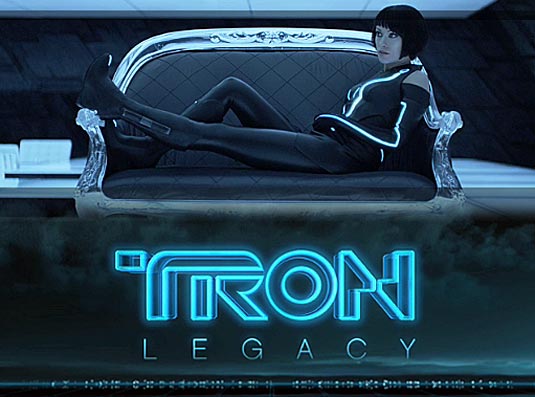
Tron: Legacy

Written at the time of the film's release...

"A Shaggy God Story" 
or 
"Rebel Without a CLU"
 
A sequel to Tron seems unnecessary: the first film was not that good.* A simple story of corporate (analog) white-collar crime that is resolved and revenged in the digital realm of computers, it only came to life in the (at the time**) high-tech sequences that were computer-generated with simple high-contrast wire animations. But, given the advances in techniques since 1982, it seems inevitable that a more sophisticated sequel be envisioned and given the green neon light. Anyone looking at the original Tron in the modern light of CGI must look at it as if they were watching australopitheci playing with femurs and utter a contemptuously chauvinistic "Aww, isn't that cu-ute?...and so primitive?"
Tron: Legacy, set 28 years later (and directed by Joseph Kosinski), is a better film in construction and underlying story-line—it has to be. The Matrix films, which resemble Tron in a tesseracted inside-out way, raised the stakes, so audiences are no longer satisfied with cycle-chases and neon-frisbee duels.  Gladiator games are no longer enough. The story must matter, and be relatable, tap into a collective story...and mean something. Even if what it means is dumb.
The movie tries hard. At times you see glimpses of Matrix, Terminator, and The Dark Knight, "
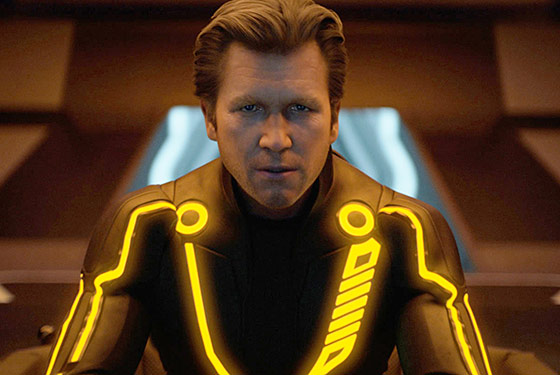
Frankenstein," the Star Wars prequels, with an underlying "Daddy" conflict out of Oliver Stone. But, to their credit, there's some Despero there, too.  The Jeff Bridges character Kevin Flynn, CEO of ENCOM (as a result of events in the first film) turns into a messianic figure, part Steve Jobs, part Steve Ballmer, whose vision of life under his brave new cyber-world, promises much—but only if you're not related to him. He's gone missing, with only grandparents to raise his entitled son, Sam (who grows up to be Garrett Hedlund). Sam lives a solitary life (although he is a majority stakeholder in ENCOM) wanting nothing to do with the family business—maybe some Godfather in there too?—except for a yearly prank to keep the board from getting complacent. Alan Bradley (Bruce Boxleitner) is still around,
*** and a stray page from the old Flynn's arcade compels Sam to visit, and (wouldn't you know it?) he gets zapped to Tronleyland, which has had some extensive renovation done.
With the help of his digi-gangers to his analog counterparts, Tron, Clu and the others,
Flynn has constructed a civilization in his cyberworld, until life, finding its way, is generated on its own. The ISO's, as they're called, are a new lifeform, that could bring new possibilities to life outside the grid in Flynn's vision. But every Creator must have his serpent, and Flynn's counterpart visionary, CLU, has his own designs for the future, which includes the invasion and occupation of territory—our world.  The stage is set for a confrontation between Flynn and his monstrous creation over their mutual goal, with Flynn's son, Sam, as the ghost in the machine, the spanner in the works.
The actors do fairly good work, given that they all performed in a green-screen purgatory
, and Hedlund, with the biggest role, is okay, sometimes even engaging. But it's Jeff Bridges' film. Playing two roles, Flynn as his scruffy self, and CLU in a digitized de-aged '80's version of himself—pretty darned good, if the mouth movement is a little dodgy at times—he manages to push through two versions of the same personality, one that has grown older and wiser, the other that just stayed locked in his decades-old fantasy. Every once in awhile, Bridges' Flynn will say something "Dude-ish" that seems more clever than it is, merely for the fact that it provides a refreshing touch of analog in a digital construct.
A construct, and very derivative. But with so many bits and megabits from so many sources, it does add up to some genuine sparks of ingenuity there, far beyond the original's "parallel wars" equation, and certainly moving beyond merely the highlight of the first film, the gladiatorial games theme. Tron: Legacy is a bit like taking code from different sources to make new, more sophisticated functions. The key element being: you have to go with the program.

* My opinion, of course.  There are lots of folks who've been influenced by Tron, including John Lasseter of Pixar/Disney, and Roger Ebert, who booked Tron into his first Overlooked Film Festival.

** Okay. Here's a factoid: the computer they did the SFX on at the time had only 2MB of memory.

*** Look for Cillian Murphy in an un-credited cameo as ENCOM's chief programmer.

 
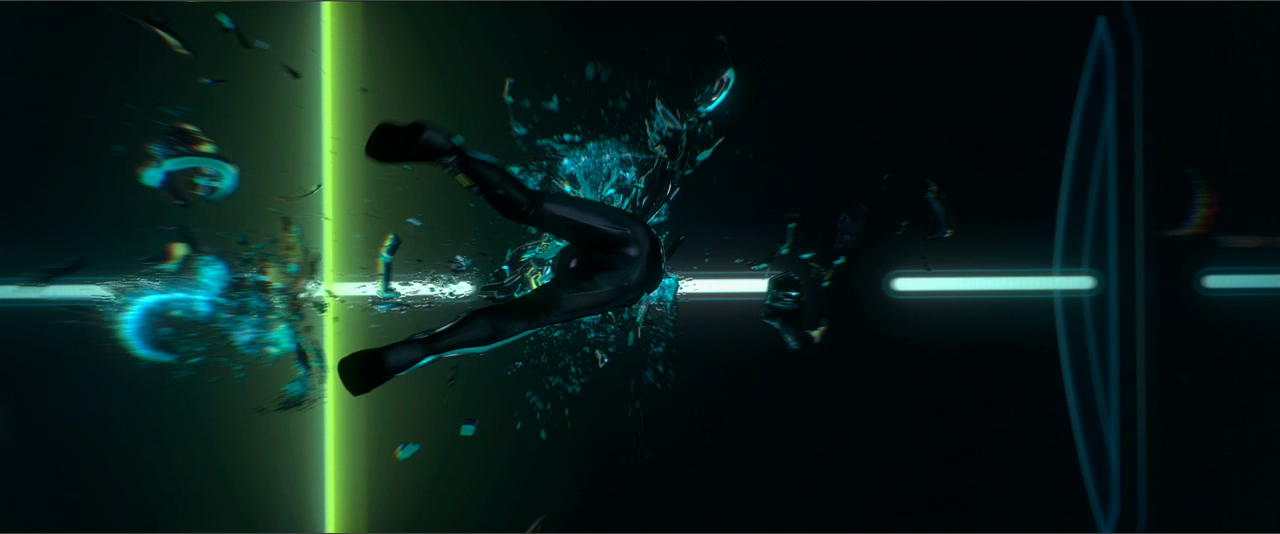
The original light-cycle sequence from Tron (1982)
How far we've come.