Showing posts with label Marc Webb. Show all posts

Saturday, March 29, 2025

Snow White (2025)

What Do You Mean By "Fairest"?
or
Snow White (and the Height-Challenged, but Competently-Abled and Platonic POSSLQ's)—There, That "Woke" Enough For Ya?
 
The seven dwarfs were each on different little trips. Happy was into grass and grass alone … Happy, that's all he did. Sleepy was into reds. Grumpy, too much speed. Sneezy was a full blown coke freak. Doc was a connection. Dopey was into everything. Any old orifice will do for Dopey. He's always got his arm out and his leg up. And then, the one we always forget, because he was Bashful. Bashful didn't use drugs. He was paranoid on his own. Didn't need any help on that ladder.
George Carlin
 
Disney made the first Snow White and the Seven Dwarfs in the mid-1930's, and gosh, "not much has changed". I'm being sarcastic, of course. It premiered during The Great Depression, Hitler had not yet attacked Poland (but the Japanese had invaded China). And the world was about to evolve, rendering the tropes of "Snow White"—the biases, the weak role of women, the "princessy" thing, the deus ex machina of the necessity of a rescuing handsome prince—all of that would age as gracefully as an Evil Queen into a Crone. It's almost unfathomable that, at the time, Disney's Snow White and the Seven Dwarfs was something of a revolution in the animated art-form. It was the first cel-animated feature film (the ads announced it "in multiplane technicolor"), and the first animated feature ever made in the United States. At the time, Disney was discouraged by business partners, other Hollywood moguls, and potential backers that a feature cartoon just couldn't "work," for diametrically opposed reasons: either it couldnt hold an audience's attention for longer than the accustomed 7 to 10 minute running time, or the length would simply exhaust them (and in fact, at the time, the young Disney company depended on the more robust RKO Studios to distribute the film to theaters—Disney is still very much around; RKO is not). It's release and success changed everything, and despite its calcified ideals, it remains a classic of the form, still topping recent 10 best lists for animated films. And, in fact, the United States Library of Congress deemed the film "culturally, historically, or aesthetically significant" and selected it as one of the very first 25 films for preservation in the National Film Registry in its first year in existence in 1989.
So, why remake it? To make money, of course (one does have to go back to the mine...and the well). And maybe, aesthetically, as a way to "update" it for a new generation not born in the previous century. Then, also, there's the legal matter that the original 1937 film is going to become part of the public domain in 1933. There is that. Plus, there has been an awful lot of competition lately from other versions of the exact same story: Snow White and the Huntsman (2012) and its Snow White-less sequel (2014), 
Tarsem's Mirror, Mirror (2012), Snow White: A Tale of Terror (1997). Of the Grimm fairy tales, it is the most adapted for film. And Disney's version is iconic. Were it not for the 1937 film, one doubts the other versions would exist.
Now, the optimal movie-going experience is to go in without prejudices or expectations (I mean, if one is doing it "right"). However, as this is a remake, you can pretty much throw that out the window. This puts me on an even par with about every single movie reviewer or internet hack, as the grousing, bitching, and over-dramatic moaning about this release has reached new levels of "hair-on-fire." Me, I wanted to see what they could do to make it less of a dinosaur of the Depression-era (I mean, the first feature came out before Gone With the Wind!), how much of the classic songs were retained, and if the new film-makers—
Marc Webb, primarily, he of the Andrew Garfield Spider-mans, the films (500) Days of Summer and Gifted, and I'm something of a fan—could make their third act top the action scene of the dw...oh, let's call them "colliers", shall we? (nobody can argue with that unless they're being trenchantly snippy)...chasing the evil crone who poisoned Snow White to fall off a cliff. And if they could balance the light and dark as effectively as old Walt did back in the day (the thing that's always impressed me about Disney is that he could scare of the tar out of his intended audience of children, and in such a way that he'd gain the cynical respect of their parents).
So...how is it? Actually, quite good, better than I was anticipating.
To my points, it is still quite a dinosaur and of another time, but, this iteration of
Snow White (and Disney's Snow White, if there were any questions) still tries to be relevant to the times, even if it can't quite distance itself from the ghosts of the earlier version, rooted as it was in what was being done in films of the time, still taking cues from Broadway, vaudeville and musical theater. Even more than the first one, you can smell a song coming on, and there are far more of those song-breaks than previously.
How are those songs? Genuinely good...and smart. Yes, they trot out "Heigh-ho" (and damn if that song doesn't still work) and they've done a buff-and-polish on the lyrics, using it as an introduction to the various...colliers. "Whistle While You Work" is revived, also with new lyrics, some of them quite surprisingly funny.* Some of the lyrics make use of modern idioms, which is momentarily jarring, but it passes. "I'm Wishing" (the first of the now de rigeur Disney "I Wish" songs) is pitched, replaced with a new one "Waiting on a Wish", and "Some Day my Prince Will Come" has been been tossed for all sorts of reasons, the primary one being the story's lack of an actual prince, handsome or otherwise. Instead, there is a roguish thief (
Andrew Burnap), living with his band of cut-throats out in the forest, having been banished from the kingdom.
And there are a bunch of new ones. One song in particular stands out, as it makes a point of calling out the story's short-comings and considers the world at large (much more than the film's opening "world-building" number "Good Things Grow") and that there might be bigger fish to fry than Snow's deposition and loss of status, and that is the ingeniously titled "Princess Problems":
Self-aware and brings up a point that if you're living under an evil regime, there might be some people suffering worse than you. I found that refreshing—but, then, I've never been concerned with the "plights" of royalty.
How about that ending, which was visceral and exciting (if a little too much an easy fix)? Well, I can't say this one's that exciting, although it does work in a story-logic kind of way and I like how, metaphorically, the Queen (
Gal Gadot) is dispatched by her own narcissism. It just doesn't get the heart pumping as much, but then Disney animators have always had a penchant for making dramatically hysterical resolutions.
Okay, you want to know about the casting. Let's start with Snow White. As far back as my review of Spielberg's version of West Side Story, I've thought that Zegler seems to have been genetically engineered to be a Disney princess with eyes too big for her head just like she was animated that way (it's a Disney design trope to draw big eyes in order inspire warm feelings like you were looking at a baby). So, she looks preternaturally perfect for this. And the thing is, Snow is a tough sell—just as Maria in West Side Story is—where the character is just so cutesy—and not in a self-aware way—you want to sit her down on a tuffet and tell her to wise up and stop being such a victim. Snow in this has a bit more grit and certainly is more expressive than the plasticene-rotoscoping allowed in the 1937 version. And she's not a sap...or a simp. I like that. Plus, Zegler's singing voice has always been astounding and she belts out the songs the way every Disney princess should, full-throated but with enough character to make her more relatable when she drops the arias.
And Gal Gadot is great as the Evil Queen. I don't know what she's done to deserve this "bad-Kevin-Costner" phase of her career, But she trods the thin line between camp and making her Evil Queen a serious threat, which is what she should do. It's the same tactic Michelle Pfeiffer takes when playing villains: be evil but show you're enjoying it, like any good autocrat. There's one moment when Gadot's Queen snaps her head in fury at the huntsman (
Ansu Kabia) ordered to kill Snow White and I swear she did it in a mere film-frame of time that was jolting. And the theatricality she throws into her musical numbers threatens the set-rafters, CGI or not.
So...uh...how are the "colliers?" I must admit, I was a bit taken aback by them, but then they don't have the rubbery cartoonishness of their animated ancestors.  They're a lot more starchy and have a bizarre facial structure that makes them all-jaw—they look like hummel figurines you'd find in a some rural backyard in Ochsenwerder (Hey, why didn't we just call them "gnomes" in the first place?) and they're the same attribute-centric personalities they were in the 1937 version ( rejected contenders at the time were Hoppy, Jumpy, Baldy, Hickey, Stuffy, Burpy, Tubby and Dizzy). After awhile, you get used to them, although the character of Dopey kept reminding me of Alfred E. Neuman
of Mad Magazine fame.
Those are quibbles. I find the 2025 to be a fairly successful effort to make a problematic—if beloved—part of history a bit more "present". It's certainly nothing—nothing—to engender the vitriol I've been seeing online. Look. I'm as evil as they come when I see something bad and write something snarky. But, then, I don't have an "agenda" other than a critical one and I certainly don't make a living at it, amping up my outrage as a cottage industry). I don't know what they're "on" or "on about" but it's not there in the movie.
Children (as I witnessed) will be delighted by it. "Bro's" who haven't grown up...won't (Hence, the film's low IMDB score perpetrated by basement-dwellers who haven't actually seen it, as IMDB has no way of checking veracity). There's a big difference between having prejudices (as I had) and agendas.**

So, the new truncated Snow White is good, sometimes incrementally better in places and a good effort, but it is hardly revolutionary. And so nobody should treat it as if it is.
 
 
* Even if it can't quite shake the specter of how the song was satirized and mocked by—of all things—Disney's own Enchanted. Sometimes, you just have to hand it to the Mouse-house for being so smart, clever, and self-aware:

** Oh, one little piece of advice to the "bro's" out there who swamped IMDB with negative scores—don't do the job "too well" or the basic law of averages will point out the obviousness of the ploy.
Live by the aggregate, die by the aggregate.

Tuesday, January 2, 2024

The Amazing Spider-Man

Written at the time of the film's release.

Don't worry. New stuff tomorrow....


Spider-man v. 2.0
or
"With Great Power Comes Sequels, Re-Boots, Etc....(A Spider-man's Work is Never Done)"

It may be a web-strand too soon to be doing a re-boot of the "Spider-man" franchise, but The Amazing Spider-man does do one thing that justifies its existence—it's better than the Tobey McGuire/Sam Raimi first film in the original trilogy, and right off the ledge manages to have the fun, energy, pop-soapishness, and inventiveness of the second film in that series, the one with Dr. Octopus. We have to go through the origin story again (but that's okay, we seem to have to with every "Superman" film, and evidently will with the next one).

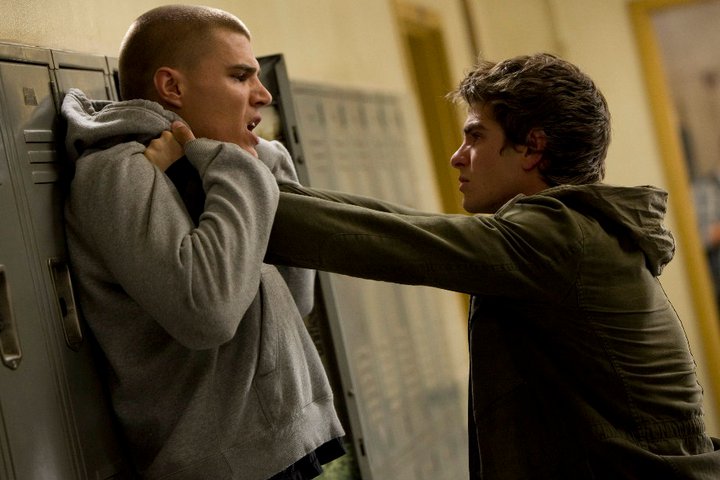
The story is basically the same—Peter Parker (Andrew Garfield) is a smart high school geek with a photog' hobby, and his first encounter with an industrial science lab manages to put the bite on him, arachnidally-speaking, then strange things start happening as he does whatever a spider can, conflicts, conflicts, conflicts (of the physical and angst variety), "with great power comes great responsibility," yadda yadda yadda. But there's a lot of "Spidey"-history to draw on, and the writers (James Vanderbilt, Alvin Sargent—who added a lot to Spiderman 2—and Steve Kloves—who mentored Harry Potter) have tinkered and brought a lot of missing pieces to the table. 
This time the love interest is Gwen Stacy (Emma Stone, who appears to be the oldest person in school, but that may be part of the appeal of the character, certainly to Parker), daughter of an NYPD captain (Denis Leary, who plays it straight, tough, and with impeccable comic timing), and bowing to the fan-boyish, his web-powers are not so organiche's got the little web-shooters now, although interestingly, he doesn't develop the web-goo. Oscorp is still around, although we never see its CEO (or do we?), so's the Daily Bugle—but Parker doesn't have a job there yet, so there's no J. Jonah Jameson (how could replace or improve on J.K. Simmons' interpretation?). The villain is another industrial bio-scientist, Curt Connors (played as if was Peter O'Toole by Rhys Ifans and he's terrific), who—not giving anything away here—eventually turns into the Lizard.

What's different is motivation and sub-text. Echoing the Potter series, attention and emphasis is paid to what happened to Peter's parents (Campbell Scott and Embeth Davidtz) that put him in the care of Uncle Ben and Aunt May (Martin Sheen and Sally Field, both extraordinarily good) and indications are that is the story which will run throughout this movie-arc (as well, I suspect, as the consequences of keeping secrets (as I said, there's a lot of history to drawn on).
 

What's also different and good is how everybody's perfected the formula, including director Marc Webb (who made the, to me, extraordinarily fine
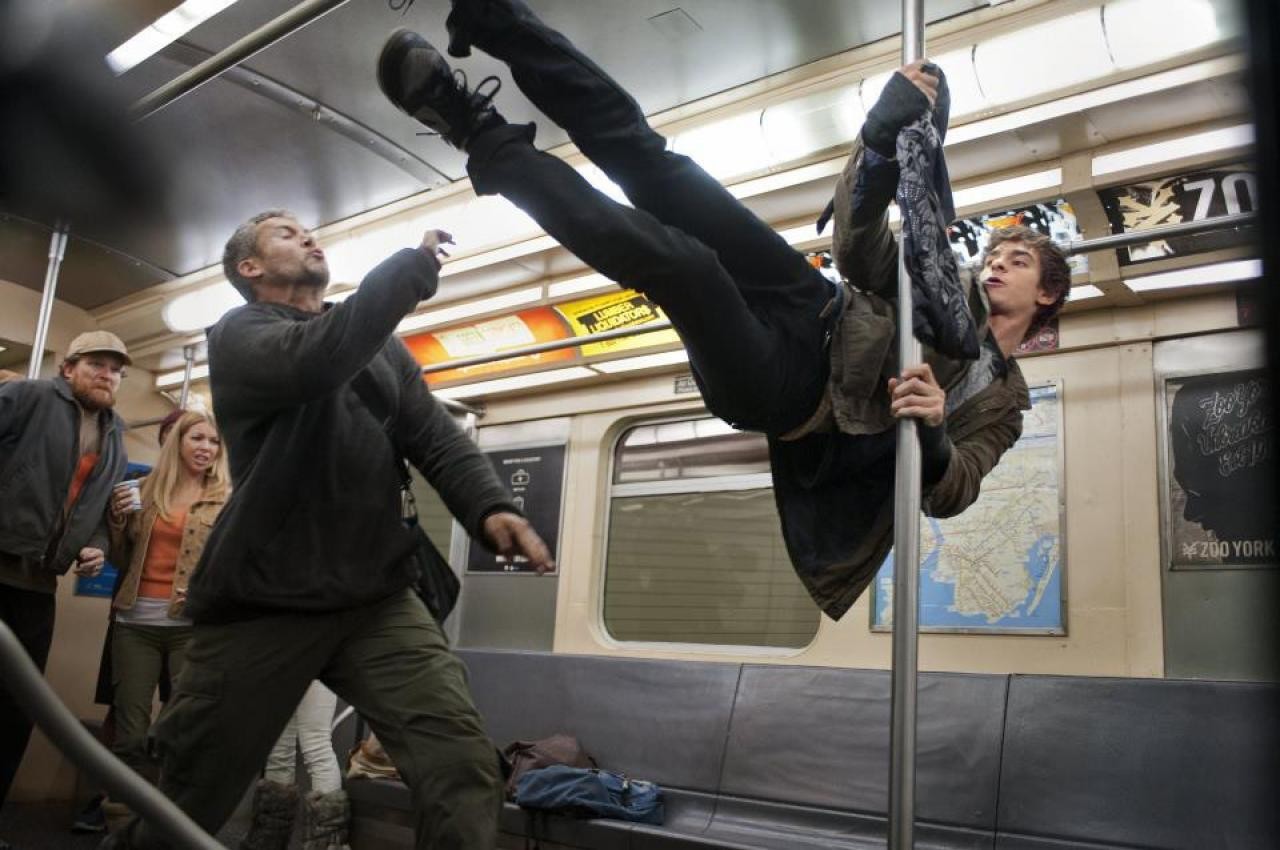
(500) Days of Summer): Garfield's Parker is more in line with the comic character, mood-swinging as well as web-slinging, and his Parker is awkward, stammering, frequently inarticulate and perceived outwardly as something of a jerk, a simp, or worthless* (hey, wow, they got the character of a misunderstood teenager down), and the fights, which in the past have been rushed and often unfollowable, now flow and, frequently—thanks to CGI—in one continuous shot that swoops, loops and parallels Spider-man's flight patterns.
The pace is still there, but thanks to stunt arranger and second-unit director Vic Armstrong (a few of the Bonds and Indiana Jones), it's not all a blur. Also, under Raimi, some of these fights were brutal and sadistic, and, don't get me wrong, these are no less savage, and take more of a toll on the participants.
** But the desperation is there, and the "wrong-ness" of the abuse of power, which kept my moral compass (or is it "Spidey"-sense?) from peaking out in the red zone.  

So, yes, it's the same story, but more sure-footed (by having its hero less so), and also intriguing for what it might hold in the future. The first trilogy seemed to be a little wobbly as it went along, searching for story. This one already feels like it knows where its going, and will find the best and most opportune path to get there.
***

* And—a nice touch—he's thin and ungainly, not buffed-out, like the typical "strong-man" super-hero, which is the way he was when Steve Ditko first drew him.  Nice.

** This does bring up something that will be difficult to sustain: Parker is frequently shown battered, bruised, and slashed from these fights, which makes his encounters post-fight with Aunt May a little illogical.  And at some point, when will she clamp down on him, or child-protective services step in? 

*** A couple more things: there's no interpretation of the "Spider-man" theme from the 60's cartoon ("Hey there, there goes the Spider-man!") but James Horner's score is his most inventive in a long time—if a little needlessly bombastic in rare instances; there is a "coda" of sorts, but early in the credits (so you won't be missing anything if you don't stay for the full credit roll); and the Stan Lee cameo actually made me smile and feel affectionate towards the man.  Now, that's amazing.

Friday, August 18, 2017

Gifted

Bad Will, Hunting
or
How Do You Solve a Problem Like a Math-Whiz?

Marc Webb, did the very enjoyable (500) Days of Summer, a film I very much admire. He parlayed that success into a journey to Big Budget Marvel-land, where he directed the re-booted and re-webbed "Spider-man" franchise, making it "The Amazing" Spider-man (I and II), with Andrew Garfield and Emma Stone. The first one worked like gang-busters, but the second one suffered from "super-villain bloat" and a commitment to the infamous "Gwen Stacy Syndrome" story-line of the comics. Whatever, the reason, the box-office fell off a bit and intended plans for an "Amazing Spider-man III" were "Green-Lit No More!"*

One of the things I've read directors say after they've done a taxing blockbuster is "Next, I want to do a simple love story with just two people..." Rarely happens. But, Webb is a sharp talent with good instincts and his first post-spider-film film is, if not terribly inspired, terrifically realized in the directorial sense, showing that, as a director, he hasn't lost his touch with casting, directing, and of the off-beat, all things proven in Gifted.
Frank Adler (Chris Evans) has a little problem. Eking out a stable living repairing boat-motors in a seaside Florida town, the former professor is trying to prepare his niece Mary (the almost too-good McKenna Grace) for her first day at school. Not that she needs it. Mary is a math savant, being home-schooled by her genius uncle. But, there's only so much he can do. He's taking care of Mary because her Mom—his sister—committed suicide. An accomplished math-theoretician herself, she succumbed to the pressure of work and home and legacy, leaving Frank as care-taker.
He's been home-schooling Mary in their trailer-park, with the added social skills of neighbor Roberta (Octavia Spencer, who is good in a role that has "Octavia Spencer" written all over it**), but he's decided to to enroll her in school to socialize with kids her own age ("This is going to be fun! You'll meet kids today you'll be able to borrow money from the rest of your life!"). As her previous playmates have been adults and her play-time consisting of stacking algorithms like they were blocks, he thinks that one so endowed is only missing one thing—a childhood. 
Her first day does not go well. What takes the other kids 30 minutes to do, she does in two. While they are coping with Dr. Seuss, she's curious about the term "ad nauseum." And where their concerns are about who's "King of the Hill," she asks her Uncle if there's a God (after his initial hedging, she annoyed: "Just tell me..."). She's a kid and a math genius, all things have an answer. It's just a matter of working it out. She is(per my favorite line from "The Simpsons") "a Spalding Gray in a Rick Dees world." And lest she become like Holly Hunter's depressed news producer in Broadcast News ("It must be nice to be the smartest person in the room—to think you're always right and everyone else is wrong." "No, it's not. It's awful!"), Frank wants to put her on another path. When school administrators bring him to protest that she should be put in an institute of higher learning, his answer is simple: "...If we separate our leaders - if we segregate them from people like you and me - you get 'congressmen. So, just dumb her down to a decent human being. Everybody wins."
But, Frank is soon visited by his mother, Evelyn (Lindsay Duncan), Mary's grandmother, who has finally tracked him down after months of searching. She holds Frank in contempt, not only for abandoning his own professorial career-path, but, also for what she sees as his stunting Mary's potential. Mom has issues—she gave up her own sterling academic career to raise Mary's Mom and she was clearly using her daughter to compensate for her arrested goals. But she also has a lawyer, and she threatens a child custody battle to take Mary away from Frank, despite her daughter's wishes.
You'd think a math scholar would come up with a better solution than simple division by court order. But, she's driven. And desperate. And a real shrew. Fortunately, she's played by Duncan who suggests the neurosis and vulnerability in the character, in order to keep audiences from throwing popcorn at the screen. She's matched by Evans, who manages to make Frank less of a super-dad "Captain America-style" as a victim of conflictions and burn-out. But, the laurels go to the kid. Grace is going to eclipse everybody else in this movie in people's memory—which may not be fair as her work was no doubt influenced by everybody. 
"He's a dude and he's a guy/And he only has one eye/
Fred, Fred, Fred/Freddy, Fred, Fred"
Fred, the Amazing One-Eyed Cat
But, it's a miracle performance in that you believe the kid could be a math genius, while also being charming enough to be a handful. Director Webb never takes things easy, never appeals to the lowest common denominator, but always puts some sand in the sugar to make things seem a bit more real than is expected. And Gifted promises that he hasn't been derailed in that regard by his studies in super-hero myth.

 And that is a gift in itself.

* Yeah, yeah. It's been re-booted with Tom Holland.

** Probably not fair, but Spencer's so good she could do this role while in a coma.  It's not much of a challenge, and doesn't present the kind of opportunities  that Spencer is capable of. I would love to see her do something beyond "proudly restrained sass."

Saturday, July 25, 2015

(500) Days of Summer

Written at the time of the film's release.


The Splintered Arc of a Love Affair
or
"Something as Permanent as a Greeting Card" ("Color My Life with the Chaos of Trouble")


Once in a blue moon a little movie comes along that takes you completely by surprise if you're walking in with low expectations and an objective demeanor. If (500) Days of Summer isn't the best movie of the summer season—now seemingly locked into alternating between "tent-pole" franchises and Film-Fest pick-ups, of which this is the latter—then it will do until something better comes along. And halfway through July that looks very unlikely.

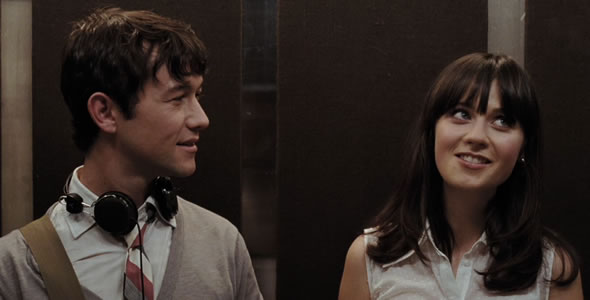
The nice thing about (500) Days is that it's hard to classify—romance, comedy, drama, maybe "bromance," but not really—but what it is not is a "chick flick," as, here, the traditional roles in such a froth are reversed. Boy, Tom Hanson (
Joseph Gordon-Levitt), a "perfectly adequate greeting card writer" meets Girl, Summer Finn (Zooey Deschanel), assistant to his boss (director Clark Gregg—now more famous as Agent Coulson from the Marvel films and TV). Owing to what the narrator calls "The Summer Effect" that elicits "18.4 double-takes" on every bus-ride, Tom takes an immediate interest in her and begins a luring, enticing pursuit that to his shock and delight manages to hook the odd, off-putting Summer.


Then, the trouble begins, as it seemingly has before. Tom, you see, is a hopeless romantic—an oxymoron if ever there was one—while Summer doesn't believe in star-crossed romance, soul-mates, "Chasing Amy," or "hikes along the Appalachian Trail." She just wants to be happy, have fun and enjoy herself now, while she can.

This would be dreadful taken chronologically. But director Marc Webb and his scripters Scott Neustadter and Michael H. Weber* (who start off with a great touch) shake up the story and spill it out on the screen in a complex timeline that flies back and forth between good times and bad, reflecting the bi-polar extremes of Tom (which veer between music-video exuberance and plate-smashing depression) and the shifting moods of Summer (who runs hot and cold). The juxtapositions are great grist for comedy and the laughs are smart and plentiful. Throughout, Tom is advised by his small posse (Geoffrey Arend, Matthew Gray Gubler) and little sister (Chloe Moretz), all surprising in ways one doesn't expect.

It's the two leads that are exceptional. Zooey Deschanel is a fringe-actress roller-skating the edge of fame and one would hope that this was the role that gooses her career choices. Deschanel has always been good at the atypical waif,
but her Summer has a solid spine that makes her the leader in the dance. And Deschanel is just interesting to watch for her choices. During a party scene when asked, "What brought you here?" her brow furrows and her poached-egg eyes rattle through five fast and different expressions before she says anything, in sentences that are eerily elongated on certain words. And as the lovelorn Summer lover, Joseph Gordon-Levitt shows a hither-to unseen range of ways to elicit comedy. If Tom is on a self-imposed short-leash, Gordon-Levitt is given a lot of rope to play with. It's a great, wise, funny performance that belies the actor's Keanu-like outer calm.


But it's the film-makers at play that finally wins you over—not just in the intricately shifting timeline that a second viewing will only confirm, but in one magical sequence that is so painfully honest and wonderfully cruel to romantic notions that you wonder why someone hasn't done it before. A sequence of Tom going to a party at Summer's split-screens to show his expectations of how the night should go alongside the brutal reality that sends him running into the night backed by an ironic pop-song (of which the film is full). It's a great idea carried off masterfully, as so much of this film is. But technique is one thing. What the film gets brutally right is the anticipation of love, the thrill of receiving it and the abject horror of losing it. And the film cracks wise about it at every step. As Tom says at one point (I believe it's Day 122), "Loneliness. It's underrated."

"It's underrated."


* Webb has gone on to direct the Andrew Garfield-Emma Stone "Amazing Spider-man" movies (where the interactions between the two leads were the best parts of the movie) and Neustadter and Weber subsequently have adapted two great films about young people, The Spectacular Now and The Fault in Our Stars.

Sunday, July 19, 2015

Don't Make a Scene: (500) Days of Summer

The Story: I loved (500) Days of Summer. It rang of truth to me, not the myth of Hollywood Romance which a lot of us now take for "love," (and it could be, if they didn't cut the bad bits out, or end it at the best "Happily Exit After"). For one thing, it exploded the rom-com "given" that the girl is going to be the one head-over-heels for the guy.  Here, the guy is all gooey-romantic to the point where he can't see straight, certainly where she's concerned. It also nicely tweaks the "soul-mate" myth...or "the one" (you know, who's been waiting all your life, to be the perfect match, out of the billions of people in the world).

Only a "guy" could believe a concept that dumb. That there's "one." The only other person who could believe something so silly would a "girl." Either one, would have to be "romantic" enough (or should we say "particular" enough, or "needy" enough, or "naive" enough)  to buy into the "soul-mate" nonsense. It's building up the notion of attraction to folkloric heights of such scale and impossibility that it sets one up automatically to fail, either if "the one" doesn't work out, or if it is never attained.

And if it doesn't go right, it's devastating, prompting all sorts of odd behavior, either acting out or staying in (for example, the opening titles of the film, which calls out—then insults—some fictional "ex" of one of the film-makers). (500) plays with the concept, and manages to milk observational comedy out of it.  My favorite take-away was Tom's concept of love based on (as we're told) "a total misreading of...The Graduate," which, if one is paying attention, manages to question the viability of Ben and Elaine's "love-conquers-all" romance before the end of the second-to-last shot.  

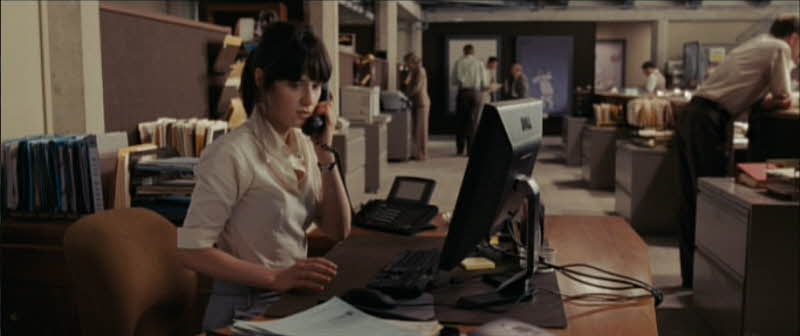
Director Marc Webb (The Amazing Spider-man) does not follow the scripters' advice to show Tom and Summer in split-screen right before their meeting, instead giving them their own spaces, joining them once in a distant pan of the greeting card company office where they both work. They don't occupy the same frame or the same space (except in the "488" section) at this stage of the film until after we're informed "this is not a love story."

Which isn't really true. It is a love story, but it's a love story born out of naivete and lack of experience and more of obsession. Yes, there may be a "one and only" but one can only find their "only" within one's self, through commitment and character. 

The Set-Up:  No story yet.  This is the beginning of the movie.  Tom is Joseph Gordon-Levitt.  Summer is Zooey Deschanel.

Action!
SIMPLE BLACK ON WHITE CREDITS ROLL TO BIG STAR'S "I'M IN LOVE WITH A GIRL." When all is said and done, up comes a single number in parenthesis, like so:
(478)
EXT. PARK - DAY
For a few seconds we watch A MAN (20s) and a WOMAN (20s) on a park bench. Their names are TOM and SUMMER. Neither one says a word.
CLOSE ON her HAND, covering his. Notice the wedding ring.
No words are spoken. Tom looks at her the way every woman wants to be looked at.
A DISTINGUISHED VOICE begins to speak to us.
NARRATOR This is a story of boy meets girl.
CUT TO: 
(1)
INT CONFERENCE ROOM - DAY
The boy is TOM HANSEN. He sits at a very long rectangular conference table. The walls are lined with framed blow-up sized greeting cards. Tom, dark hair and blue eyes, wears a t- shirt under his sports coat and Adidas tennis shoes to balance out the corporate dress code. He looks pretty bored.
NARRATOR The boy, Tom Hansen of Margate, New Jersey, grew up believing that he'd never truly be happy until the day he met his... "soulmate." "the one."
CUT TO: INT LIVING ROOM - 1989
PRE-TEEN TOM sits alone on his bed engrossed in a movie. His walls are covered in posters of obscure bands. From the TV, we hear: "Elaine! Elaine!"
4. NARRATOR This belief stemmed from early exposure to sad British pop music and a total misreading of the movie, "The Graduate."
CUT TO: INT OFFICE CUBICLE - PRESENT DAY
The girl is SUMMER FINN. She files folders and answers phones in a plain white office. She has cropped blonde hair almost like a boy's but her face is feminine and pretty enough to get away with it.
NARRATOR The girl, Summer Finn of Shinnecock, Michigan, did not share this belief.
CUT TO: INT BATHROOM - 1994
Teenage Summer stares at herself in the mirror. Her hair extends down to her lower back.
NARRATOR Since the disintegration of her parents' marriage, she'd only loved two things. The first was her long blonde dark hair.
She picks up scissors from the counter and begins to slice.
NARRATOR The second was how easily she could cut it off... And feel nothing.
CUT TO: SPLITSCREEN. INT BOARDROOM/ INT CUBICLE - SAME
On the right side of the screen, Tom continues to listen to some boring presentation. On the left, Summer answers a call, takes a message, and walks out of her cubicle down a long narrow hallway.
5. NARRATOR Tom meets Summer on January 8th in a San Francisco office building.
NARRATOR In an instant, he will know she's the one he's been looking for.
CU Summer opening the door to the boardroom, about to come face to face with Tom for the first time.
NARRATOR This is a story of boy meets girl.
But before they do,
CUT TO: BLACK. 
NARRATOR You should know up front, this is not a love story.

(500) Days of Summer

Words by Scott Neustadter & Michael H. Weber

Pictures by Eric Steelberg and Marc Webb

(500) Days of Summer is available on DVD from Twentieth Century Fox Home Entertainment.