Showing posts with label Romance. Show all posts

Friday, March 8, 2024

Roman Holiday

Roman Holiday
(
William Wyler, 1953) The legend has it that when Gregory Peck returned from filming Roman Holiday with Audrey Hepburn on location in Rome, he advised someone at Paramount that they might have to change the billing and put her name above the title—"that girl's going to win an Academy Award!"
But, getting to that point was a long, involved road. It originated with Dalton Trumbo, who, following a year-long stint in prison for contempt of Congress for not "naming names" to the House Un-American Activities Committee, was living in Mexico City. He was in financial straits, not being able to sell scripts to Hollywood—who'd provided a good income to him since 1935—owing to being "blacklisted" by the industry. He still wrote, producing 10 screenplays, and forwarded them to "fronts" who would sell the ideas to the studios for a cut of the proceeds. Trumbo's reverse-Cinderella story, Roman Holiday, was sold to Frank Capra's Liberty Films by one such front, Ian McLellan Hunter for $50,000 (all of which he paid to Trumbo), and Hunter was hired by the studio to work on the script.
 
The first director attached to it was Frank Capra himself, who wanted Cary Grant and Elizabeth Taylor for the parts of the deceptive reporter and princess, respectively. Taylor was unavailable and Grant, after reading the script, decided his part would be overshadowed by the part of the princess. Capra left the project when his budget demands would not be met, and he sold the script back to Paramount.
George Stevens was briefly attached, but it ended up with director William Wyler, who had some stipulations: a larger budget, Jean Simmons and Cary Grant to star, and filming to be done totally in Rome. Grant—again—wouldn't do it and Simmons was under contract to RKO and its owner Howard Hughes wouldn't loan her out except for a sizable fee. So, Wyler opted to cut his losses—he insisted on filming in Rome (and Paramount had some frozen funds that could be utilized and Rome's studio Cinecittà was back up and running). Gregory Peck—who was looking for lighter roles than he was being offered—was signed (although he, too, was worried about being overshadowed by the female lead), and Wyler decided to look for an unknown actress, which is when he heard about a new European actress, who was doing theater in small parts in movies.

 
Wyler left instructions to keep the camera rolling after the screen test—so the story goes—and the young actress was asked questions about her background, including her time growing up in Belgium during World War II. Everyone who saw the test was charmed by it. Hepburn got the role. But, first, she had a commitment to a Broadway role starring in "Gigi"—she had been picked by Collette herself for the role—and as Peck was held up in over-runs shooting The Snows of Kilimanjaro, the production was delayed.

In the meantime, many writers' hands worked on Roman Holiday besides Hunter, including Ben Hecht, Preston Sturges, Valentine Davies, and—when in Rome—John Dighton, who was there to punch up scenes whenever a location found by Wyler would peak his interest. Cast and crew were not afraid to make changes or make suggestions.
The film begins with a Paramount Newsreel examining Princess Ann (Hepburn) from "one of Europe's oldest ruling families" (although they never mention of what country
*) on a tour to "improve trade relations" and although she projects a serene calmness publicly she's starting to crack. She's 19, royally supervised and expected to amiably meet and greet hundreds of dignitaries, all of whom seem to belie the term. And although this is a reverse-Cinderella story, she does have one thing in common with her fairy-tale predecessor—she has shoe problems. There's only so much time you can spend standing in the damn things! Plus, although she is touring Europe, she sees very little of it, cloistered in luxurious quarters with her only bed-time reading her full itinerary for the next day. And yet outside her window, life is happening, people are partying and enjoying life. And Rome, even though it's the Eternal City, can't wait forever.
 
She melts down. to the point where she has to be sedated to get some sleep so she can keep up the busy tour. And maybe it's the sleep-drug talking, but the princess gets it in her crowned head to escape her gilded dignitary's cage and go out into the night, un-escorted, unchaperoned, and unceremoniously. Where Cinderella wanted to see how the other 2% lived, Ann wants the 98% of possibility the world just within her regal wave can offer. She sneaks out of her embassy and finds her way into town.
And then, the sedative kicks in. 
 
Lucky for her, Joe Bradley (Peck), a reporter for a Rome-based wire service is late coming home from an evening poker game among colleagues and happens upon her. Thinking her drunk, he tries to get her on her feet, then pours her into a cab and, with no place else to put her, takes her to his apartment ("Is this the elevator?" she bleerily asks when they get there) to sleep it off. There is some chaste teasing about sleeping arrangements that ends up with Bradley being late for his day's assignment—an interview with Princess Ann—only to discover...she's been sleeping in his bed. And suddenly he concocts a scheme to get a big story, given his special "access."
Her government has put out a cover story to explain her mysterious disappearance has had to cancel all activities due to a "sudden illness"...so Joe makes a bet with his boss that he can get an exclusive with the princess. All well and not exactly good. A lot of subterfuge has to be done to get that story. The princess wants to have her adventure but not let on that she's at any way royal. Joe conspires to get his story without letting on that he's a reporter—and he wants pictures, which he gets with the third wheel of the adventure, bohemian photographer Irving Radovich (an ebullient and funny 
Eddie Albert), who is constantly taking photographs with camera concealed in a lighter.
The production was, basically, a working holiday for cast and crew, and the incidents on the princess' "day off" center on aspects and sights of an elaborate tour of Rome with the Colosseum, the Trevi Fountain, the Spanish Steps, with stops for gelato, vespa-hopping, dinner and dancing and, ironically, "the Mouth of Truth" which might prove to be daunting to two people who spend the day under false identities.
Peck has rarely been allowed to be this light—and he's surprisingly subtle and slyly humorous playing a roguish Prince Charming, and Hepburn is perpetually adorable as a princess with the crown off. As Pauline Kael remarked "when she smiles, we're all goners," but leavened somewhat by eyes that always have a shade of melancholy—her wartime childhood probably had something to do with that—and it comes in handy for her scenes as a princess trying to escape the weight of her heritage while knowing that she'll never be able to get away with it...or from it.
Just as Cinderella had to return from the ball and back to the ashes, Princess Ann's fantasy has to come to an end and she must return to her origins. But, Cinderella got to have a happy ending. For Princess Ann, no ending can be completely happy. But, Roman Holiday does, at least, provide a modicum of satisfaction where the lies fall away along with the fantasies. If someone can only acknowledge the truth...however painful it might be...one can at least admit that they're being true...to themself.
 
And that's the lovely thing about Trumbo's story. It's not a sad ending (although not a happy one), but there is a level of satisfaction in the warm glow of memory, free of fairy tales, despite all the pomp and circumstances getting in the way. And the memory of Roman Holiday always brings an admiring smile to my face.
Dalton Trumbo was finally acknowledged to have written the story that won the 1953 Academy Award and in 1993 an Oscar was given to his widow. Trumbo died in 1976. 
"...She has us all in thrall, and when she smiles we're all goners."
Pauline Kael

* The film never says, but one can assume that it isn't any of the stops on the tour which include London, Amsterdam, Paris or Rome. Although I did find an example of a script excerpt, which names the country as "Coravia" (wherever that is).


Saturday, December 30, 2023

Past Lives

Past Lives
(Celine Song, 2023) "Woah!"
 
"There is a word in Korean – inyeon. It means providence or fate. But it's specifically about relationships between people. I think it comes from Buddhism and reincarnation. It's an inyeon if two strangers even walk by each other on the street and their clothes accidentally brush because it means there must have been something between them in their past lives. If two people get married,they say it's because there have been 8,000 layers of inyeon over 8,000 lifetimes."*

It begins from an outside perspective. Three people sit at a bar—two men, one woman (not that it would matter, really)—two of them are Korean and one is Caucasion/Jewish (not that it would matter, really). We never see who's talking, but a man and a woman are talking about them—"Who do you think they are to each other?" There's idle speculation over who's the couple, what the "third wheel" is doing there then, and what the trio (if they are a trio) are doing at a New York Greenwich bar at 4 a.m.? The ideas keep getting more elaborate and less specific and finally the woman just gives up the little tavern game: "I have no idea."
The story will span 24 years, but not the full 24. There will be long stretches that we're not privy to, and we'll see only the sporadic bursts of activity that have brought us—and them—to this bar and this conversation. It's like it was meant to happen...but not in this way.
Past Lives is a love story, but it might as well be a multi-verse movie, too. No super-heroes, no diverging time-lines, although it's not without divergence. It tells the story of Hue Sang (played
Leem Seung-min as a child, then Teo Yoo as an adult) and Na Young (Moon Seung-ah in childhood)—or "Nora" as she will call herself (Greta Lee as an adult)—two very intelligent students—they're constantly competing about who'll get the best grades in school—in South Korea. When Na comes in second, she cries, and Hue is always there to comfort her...not that it happens too often. They are best of friends and in "puppy love"—Na announces that she will marry him—and they seem inseparable. But, in reality, they are: Na Young's father is a filmmaker and to advance his career decides to move his family to Canada. The two have a pre-arranged date before she leaves, and then, she is gone.
Twelve years pass and Nora is now 24 and living in the United States. One day, she asks her Mother if she can remember the name of her long-lost friend and tries to find him through the internet. To her surprise, she discovers that he is trying to find her, leaving a message/comment years ago on her father's web-site. She follows up and they begin to talk on Skype, reconnecting and catching up, and then becoming inseparable despite the distance and time-zones...and the vagaries of the internet. She's pursuing a writing career and he's studying engineering and they start adjusting their schedules to talk every day, even if they miss sleep or are late for class. They make the time. They've missed each other and make plans to meet again, whether in New York or in Seoul. But, the plans don't solidify with each others' commitments, and they can only leave it at a hopeful "See you then." Life's what happens when you're busy making other plans.
Then, Nora says they have to take a break. The visit's not happening any time soon—even though she's constantly looking up flights to Seoul—and he's committed to a language exchange program in China for a year and a half, and she has a residency in Montauk and she really wants to make a "go" of it in New York. It's a devastating decision, but they both agree to give each other space, even as they wonder at why it's mutually heart-breaking. This is crazy that something as ephemeral as an internet connection should be so important that its loss can wound. What is love, anyway, but something we imagine, something we hope, something we dream, even if its impossible?
I think about this often and too much, actually, to be practical. When I wrote about my favorite Hitchcock film, Vertigo, I started it recalling that old song "What is this thing called love?" To me, love is a form of insanity—and even that is too simplistic (and too cynical)—it gets in the way, complicates matters, makes you do things against your self-interest, and can knock you for a loop if it isn't letter-perfect. Love pulls at the heart-strings. And we don't HAVE heart-strings! We have connections...which are metaphorically the same thing. Yes, love gets in the way. But, it also makes the way better, the way sugar sweetens your coffee, even though you'd drink coffee, anyway. And the effects of sugar are ephemeral, too, they don't last, even though we keep reaching for the spoon. It makes the medicine go down, after all.
And, as I mentioned in that Vertigo article, I like movies that question love, and distrust the ones that make it look so easy, with their formulaic tropes of
the "meet-cute," the "song-montage," "the-rough-road," and the "happily-ever-after,"—which always reminds of the Orson Welles quote "If you want a happy ending, that depends, of course, on where you stop your story." Movie love stories, especially "rom-coms," usually stop with the swell of strings and all complications resolved at the best of times...and then stop, leaving us with the sugar-rush of good feelings.
But, it ain't sugar. It's saccharine, which only feels like the same thing.
 
So, how does Past Lives resolve itself? Do they ever meet again? Well, I'm putting up the pictures, you can see for yourself, that, yes, of course they do! Do they still love each other? Yes, of course they do! Are they still bonded to each other and understand each other in ways no one else can? Of course they do. And a lesser film-maker than Celine Song would have ended it there.
So, of course, she doesn't. Along with her lovely shot choices, her impeccable casting and direction, and her seemingly simplistic and natural writing, she manages to make something so natural and common and ever-present, and yet so singularly individual, something really big. And something to contemplate and wonder at, like the sun coming up in the morning, or looking to the horizon and wanting the best life we could possibly have. She makes it look so easy.
But, good and wise movies...like love...are hard work.
 
This might be my favorite film of the year.
 
* Yeah. Before we make a throw pillow of this or jot it down to use as conversation at dinner parties, the character who says this—Nora—will parenthetically add "
That's just something Koreans say to seduce someone." Hmm. Maybe you can use it at dinner parties.

Wednesday, September 13, 2023

The Adjustment Bureau

"I Guess The Lord Must Be in New York City"
or
"Dicking Around with People's Lives..."

The stories of Philip K. Dick have provided all sorts of story-fodder for the movies for both good or ill: Blade Runner, Total Recall, Minority Report, Paycheck, A Scanner Darkly, Next, and Impostor.
 
They feature the sort of high-concept story-spine that easily translates into genre-bending sci-fi/fantasy films that are the easiest thing to translate to the screen short of a superhero property. Just put a slight spin on a story concept—a police force that stops crimes before they happen, spies and detectives who are mentally undercover, a guy who can see into the future, but just eight minutes out—all odd concepts that illuminate the character dilemma in a way that a straight story might not highlight. You don't have to be a genius to "get" what the movie says. And the inevitable SFX look great on trailers.
So, here's
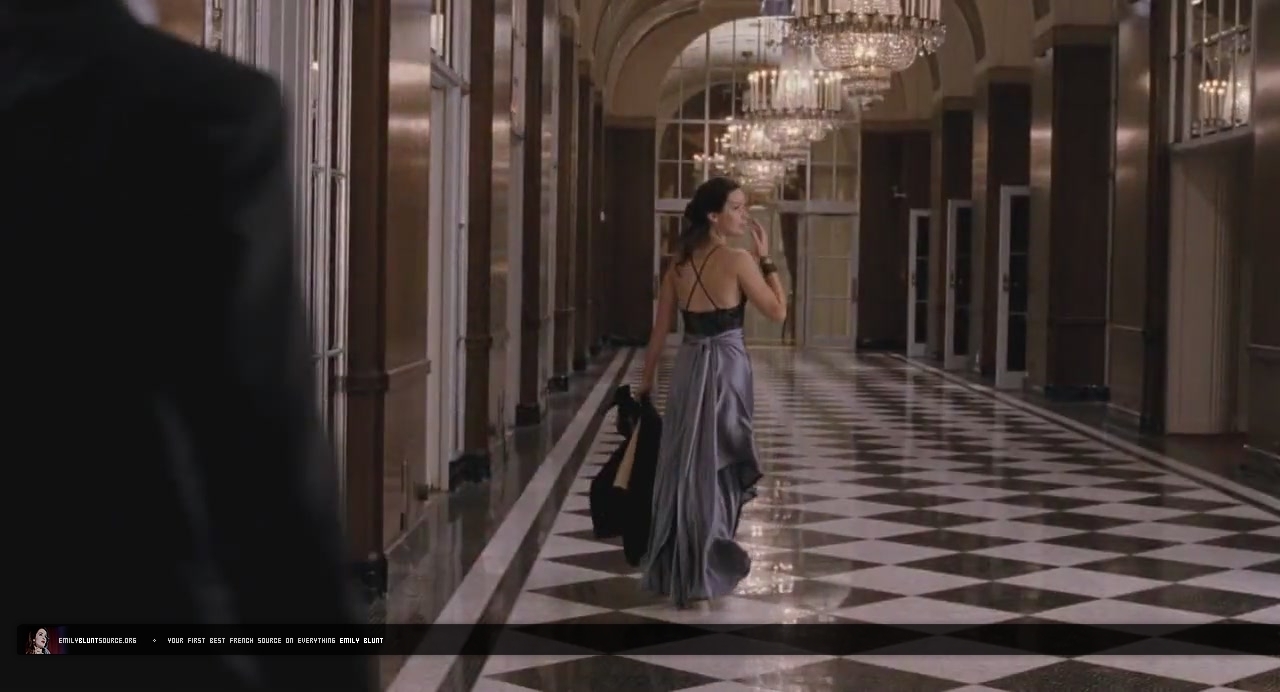
The Adjustment Bureau, a paranoid conspiracist's validation of all things manipulated. Young senatorial candidate David Norris (Matt Damon) is about to lose an election big-time, due to some ill-considered party-decisions earlier in his life. In the men's room of the Waldorf, he practices his contrite, yet defiant acceptance speech, only to find that he is being overheard by Elise Sellas (Emily Blunt), who is evading hotel security after crashing a wedding upstairsIt's a "meet-cute" as the two banter about Norris' loser-status and Elise becomes intrigued enough to plant a lip-lock on him. His campaign manager (the always welcome Michael Kelly) walks in just in time to catch this and bust it up to get Norris to the ballroom to admit defeat. I'd've fired him on the spot.

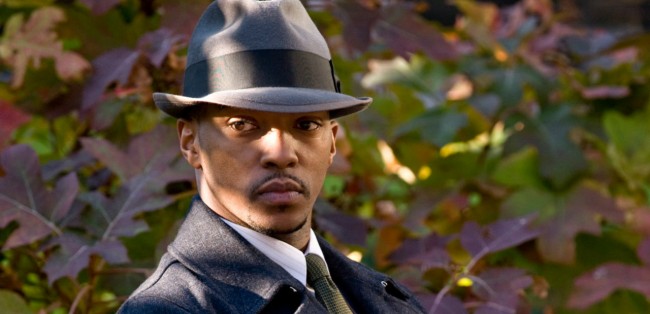
It's some time later and Norris is working for an investment capital firm with his manager. He's running a little late, so he doesn't notice a team of angular men in business suits and fedoras are shadowing him. One in particular—Harry (Anthony Mackie)—has an assignment: Norris must spill coffee on his shirt by 9:05 am, not any later. It's his job, says Agent Richardson (John Slattery), so don't screw it up. 

But, if he didn't, there wouldn't be a movie.
There's no use crying over un-spilled coffee, but as a result, the rest of the movie is the Team attempting to solve the mess the non-mess creates: Norris is able to catch his bus on-time,
where he once again encounters Elise, and gets to work just in time to see the Pre-Destinators (my term) sweeping the office, the personnel frozen, and key players receiving a "mind-wipe." Norris catches on quickly, and tries to evade the invaders, only to find them around every office corner, calmly telling him that, really, he should take it easy and cooperate and "this" will all go a lot easier.

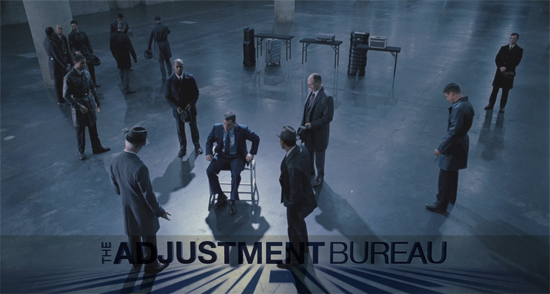
He wakes up in an empty warehouse
, with his pursuers deigning to tell him the truth about things: "You've just seen behind the curtain you never knew existed."  They're a team of agents who manipulate events among humankind—a kind of Uber-illuminati ('"sometimes it's chance, sometimes it's us
")—at the behest of "The Chairman." They lay down the law: He can't have a relationship with Elise, which David objects to ("Your entire world just changed and you're thinking about a woman?") as it's not in "the plan," and if he tells anybody about what he's seen, they'll make everyone think he's crazy, and "reset" him, leaving him basically lobotomized.
* 
Norris is too much a free-thinker
to obey the "button-down men of Fate" and the rest of the movie entails him "changing the curtains," as it were. It's very clever and director George Nolfi, (who wrote the screenplay for the similarly time-trippy Timeline, had fun adapting his screenplay "Honor Among Thieves" into what would become Ocean's Twelve, and was one of the team who wrote—and re-wrote—The Bourne Ultimatum) ingeniously keeps things moving at a good clip, while also staying one jump ahead of the story-complications inherent in the plot...while also doing enough cinematic sleight-of-hand to keep the Doubting Thomases in the audience from falling into plot-holes. He gets good performances out of everyone—allowing enough ad-libbing in the scenario to make it seem real and fresh, sort of a real-life version of the film's conceit of re-writing History in pencil before the Cosmic Ink dries. It's fast, fun, and fresh and avoids pretentiousness or taking itself too damn seriously. It is only after a little Time has passed that it feels a bit slight, but who could have anticipated that?

One thing is for sure:
I gotta get me one of them hats!

* At that point I flashed on former CBS news-anchor Dan Rather walking down a New York Street and being attacked by men and all they said was "What's the frequency, Kenneth?"  Everybody acted like Rather had had "a spell," but I wonder if his attackers were wearing hats.

Tuesday, September 5, 2023

The Young Victoria

Written at the time of the film's release...

 "Her Serene Highness"
 
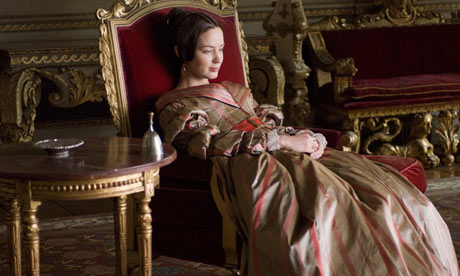
William Jefferson Clinton famously called The White House the crown jewel of the U.S. prison system. Young Queen Victoria (Emily Blunt) says early on in The Young Victoria, "Even a palace can be a prison." As the only heir to England's throne in the Royal House of Hanover, the young princess is managed and controlled, ostensibly for her safety, but also for the power that an unprepared and naive queen can offer her advisers. The last image we see before the title of the film is a gate swinging towards us and slamming shut with a bang.

Go to black. Title up.

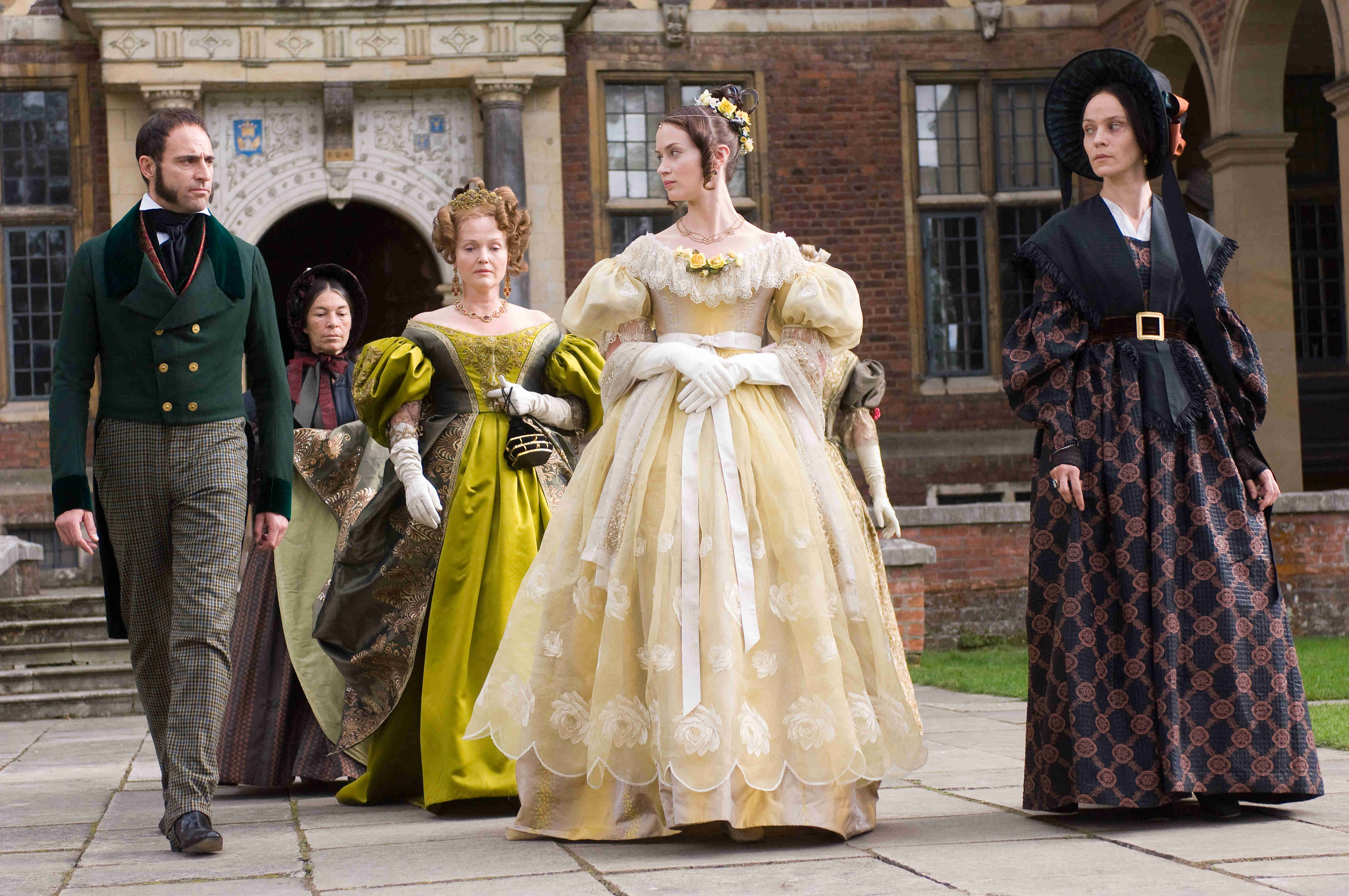
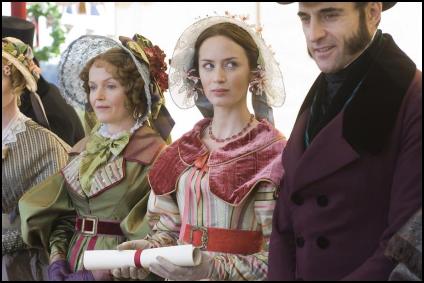
There are a lot of shuddering doors in The Young Victoria, as the upstart princess, well aware of the red carpet ahead, defies her manipulaters and her mother (Miranda Richardson), who is cowed by their presence, especially that of Lord John Conroy (Mark Strong—his second villain role this year after Sherlock Holmes—risking typecasting, he'll be playing Sir Godfrey in the upcoming Robin Hood) who viciously seeks to be made regent in case of the death of King William (Jim Broadbent). Ambition is on everyone's mind, except the one who will be getting the power. And ambition is what the young queen must learn, if only to be used as a weapon.
Director Jean-Marc Vallée (and his script-author Julian Fellowes, who wrote Gosford Park and a little something called "Downton Abbey") spend a lot of time concentrating on Victoria's noggin. It is focussed on, framed and discussed. "Look at that demure little head," says Lord Melbourne (Paul Bettany) at her coronation. "And all of us wondering what's inside it." He, like the rest of the court, really couldn't care less. If her mind can be changed, then it doesn't matter. But there is enough rebellion, and enough fighting the gold shackles binding her, that can be used to sway her.
It should be noted at this point that one of the producers of The Young Victoria is none other than Sarah Ferguson, the Duchess of York, who endured her own time of constraints while married to Prince Andrew. "Fergie" was known to be quite feisty, herself, and one looks at the movie and wonders how much of its editorial stance originated with her, as it is pretty sly in its view of the monarchy as being both a blessing and a curse. Whatever animosities Ferguson has incurred with the current Royal family, there seems to be an understanding of just what is asked of a monarch, and with The Queen, it shares a similar visual touch—the Royal de-focussing of the eyes that appear to see nothing, but are merely providing a non-commital mask for the public to see, the eyes looking, instead, inward.*
Given that,
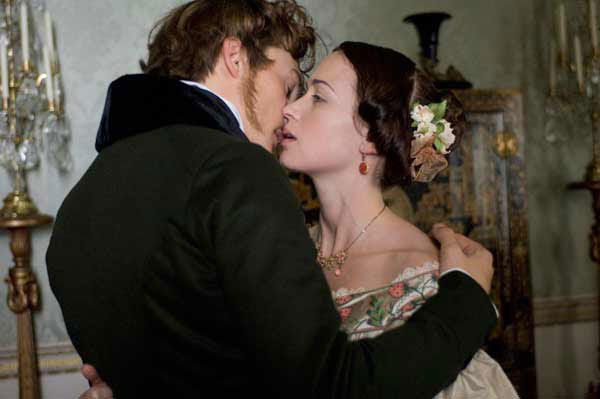
enter Prince Albert (Rupert Friend) of the Belgians. Groomed as a suitor by his father King Leopold (Thomas Kretschmann), the young Prince also resents being kept in a can, and upon meeting Victoria goes off-script, showing himself to be of equal mind. During a supervised chess game, they compare notes on their similar circumstances. "I know what it means to live inside your own head," he offers. "You must learn the rules of the game, so you can play it better than they can," and as if we don't get the point, he takes her Queen and sweeps it off the board, captured.
Vallée keeps things properly ornate and unfussy in his direction, save for some odd little rack-focuses interrupting the continual focus on Emily Blunt's head of restrained expression. At one point, though, he does indulge. At the Queen's entrance to a Royal Ball, upon seeing Albert, he keeps Blunt locked in position and then yanks her away from her party, as if pulled, floating to her paramour. A neat little trick that, and very dependent on Blunt keeping her muted expression while having her transport taken completely away. It's indicative of Vallée knowing that his best weapon in the movie is Blunt's subtle whisps of expression; one is drawn to her face to see how she'll react, even if, until the last frame, it is reluctant to reveal.

* At the end, there is a title stating that Victoria was the longest reigning British monarch (that would be be 63 years and 216 days). And as if to tweak the ex-mother-in-law a bit, with a wink, a new title emerges below it—"To date." 

Elizabeth II surpassed her great-great-grandmother's reign on September 09, 2015.  She went on to serve 70 years and 250 days. Only the reign of Louis XIV of France was longer.

Saturday, June 24, 2023

The Perks of Being a Wallflower

Written at the time of the film's release...

Something from Nothing
or
No Man is an Island of Misfit Toys 

Charlie (Logan Lerman) is starting his first year in High School as a freshman and he has a lot to learn. He's shy, introverted, and fragile the result of some trauma we know not what going in. He walks the corridors friendless, a punching bag for the cool kids and their posses. His parents (Dylan McDermott and Kate Walsh) are lightly caring, and his English teacher (Paul Rudd) reassures—"If you make one friend on your first day, you'll do good." "If my English professor is the only friend I make today, that'll be sorta depressing."

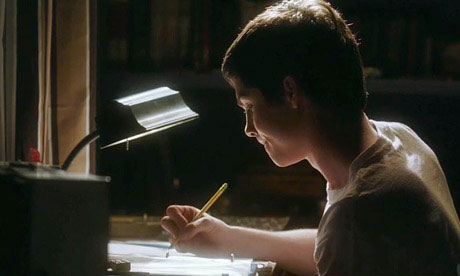
But Charlie does have one friend, writing to him about his experiences, pouring out his frustrations and observations in letter after letter about his "trying not to be a loser." The friend is anonymous, may not even exist, or once existed, but those letters keep Charlie going and serve as his avenue of expression, rather than having his day pulled out of him at the family dinner table. It's an uphill battle from some valley that isn't discussed, but Charlie is self-aware enough to know some perspective. "My life is officially an after-school special," he grouses.

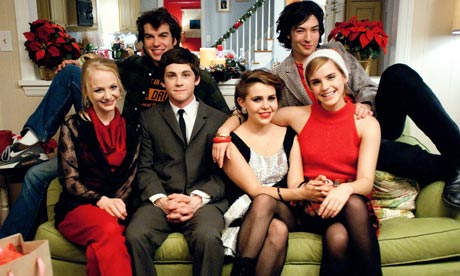
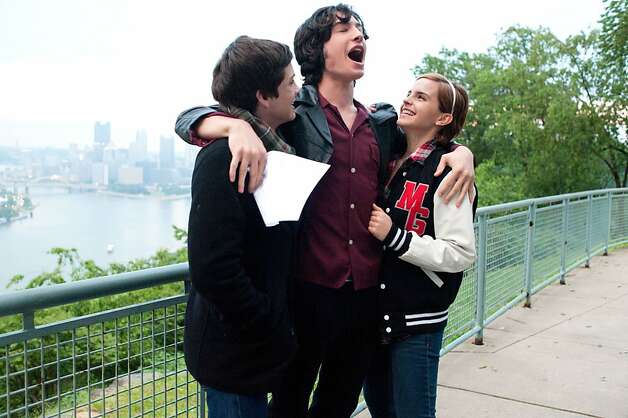
At a football game, he meets Patrick (Ezra Miller), a senior and the subject of some casual bullying, but Patrick has a wicked sense of humor that he throws out with no hesitancy as a shield. Charlie gravitates to him, and meets Patrick's step-sister Sam (Emma Watson), also a Senior, but who is coming back from "having a reputation." After the football game, the three hang out at a diner and compare notes of commonality, which involve a distinct lack of fitting in with the high school social structure, and Charlie is introduced to more of the group, who hold fast, hang out, and provide safety in numbers and a fresh perspective on the puerile benefits of normalcy.

The Perks of Being a Wallflower
(written and directed by Steven Chbosky from his own novel) is a fine quirky example of a "Coming of Age" movie, that sub-set of the teen flick where lessons are learned (his life really is an after-school special) and is not so much a film about growing up, as growing out. Growing out of the insular self-inspection, narcissism and selfishness that is comfortable and has no risk, it's dark and warm and safe in that little "black cave of the psyche." But is it? That cave only echoes one's own thoughts back to us, providing no perspective and no horizon to reach to or for.

Yeah, it's pretty safe in there...if there aren't any demons or other creatures of the nightmare lying in wait to strike when you're most vulnerable. And we all have those. And even if we don't, the echoes of our own thoughts are only phantoms and zephyrs, not sustaining, and if that's all we cling to, they become echoes of echoes, distorting, becoming less clear, and often impenetrably undecipherable—a feedback loop. 


And feedback loops, uninterrupted, can become weapons.
Charlie is scared. And ashamed. And that limits his choices, when he does make a choice. Most of the time, things are just foisted on him and he has to make a decision: like this, or don't? Comfortable or not? Aware, or comatose? And by the time, he makes a decision, it's usually too late, putting him a tail-spin, and another trap. His fellow wallflowers are in traps, too (isn't that what High School is all about?), but one thing he learns is that they're not the only ones and the traps, self-made or imposed are universal.

It's a good film, with good imagery, but a neophyte director's tendency to hit things a little too square—the shot from the communion wafer to the LSD tab, please—but the performances feel real, Emma Watson is a helluva dancer, and it's a good trip down memory lane, now that it's gone and out of our lives. "See ya, wouldn't wanna be ya"


For the truth of the matter is, we all grow out. We couldn't survive if we didn't. Yes, "we are infinite" as the movie's tag line wants to be sure we know.  

But not individually.

And not by ourselves.
Out of the black cave and into the light

Thursday, September 15, 2022

Three Thousand Years of Longing

Be Careful What You Wish For (Three Thousand Years of Writing)
or
"My Imagination Has Been Getting the Better of Me"
 
Alithea Binnie (Tilda Swinton) is a "narratologist" by trade and preference, an academic, content to live alone, although she will attend a convention or two, give a lecture, but mostly study the story-form, which she speed-reads while her foot is nervously keeping a rhythm of what she absorbs. That's the only action she gets out of life, her scholarly ruminations being a way to avoid it, like so many cinema-collegiates of the past (and film critics for that matter). They're book-learned but street-dumb, cloistered in the metaphorical Ivory Tower that keeps them high above the fray. They can study, but only vicariously experiencing life through witness testimony. She is—to quote a line from Play It Again, Sam—"one of the world's great watchers" ("great" being used ironically). 
 
While on a working vacation to Istanbul, she has two instances of hallucinations—walking through the airport, a wizened little person accosts her rolling luggage and when she protests—and her minders at a conference approach her—it runs away and disappears in the crowd. Then, after going to her hotel and settling in, she is sitting on stage preparing to be introduced to speak when she sees a demonic shamanic figure sitting in the audience, shifting into increasingly closer seats until, with a blink, he is standing before her and....
She faints. She recovers, but shakily, and insists on going on, what, to her, is a traditional addition to her every itinerary—a visit to a bazaar to purchase a memorial trinket, usually of glass. She becomes enamored of a fluted bottle, deeply encrusted with age and the dust of ages and determines to clean it in her hotel room sink. Before doing that, one should always check about double occupancy with the concierge (and if you've booked a smoking room).
And, of COURSE, a genie (Idris Elba) comes out of the bottle—haven't you seen the previews? After a slight period of adjustment—language, electronics—we get down to the essential matter: freed from the lamp, blah-blah-blah, three wishes, Heart's desire, blah-blah-blah, don't ask for any more wishes,* and we don't even have to sing along to "A Friend Like Me." Alithea is familiar with all of that—she's read all the stories. She knows the tropes. She's an academic! And the problem is academic. Three wishes? "There's no story about wishing that isn't a cautionary tale." Damn straight! The iconography is full of people who end up with a million ducks or a twelve-inch pianist or end up as Hitler. So...she just doesn't want to do it. She's happy. She's comfortable. She makes a living, if not exactly living, but she's okay with that. Why risk it, when there's the possibility that her djinn is a trickster...or worse, a literalist? Three wishes? Go blow smoke!
This is very frustrating for the djinn.
"There is no human, nor angel, nor demon, who wouldn't grasp at the chance to fulfill their deepest longings. And I am saddled with the one who claims to want nothing at all? Alithea Binnie, you are a liar!" Not really, though. What sort of teacher would she be? But, without a hat-trick of granted wishes, he is tied to her and can't be released to his freedom in Djinnsleyland. Such a fate would even make Barbara Eden grumpy. Intrigued by his frustration and because she is who she is, Alithea compels the djinn to tell his story of the three "incarcerations" (as he calls them) that have kept him trapped for three thousand years. The first of which involves Solomon and Sheba, the second involves the court of Suleiman the Magnificent, where the the Djinn is forced to wander for 100 years, and finally, the third, of the wife of a Turkish merchant, whose final wish banishes the djinn to the bottle where Alithea has found him, trapped. Hence, the title Three Thousand Years of Longing.

Writer-director (phd) stages these events with the same characteristic inventiveness and momentum that he brings to his "Mad Max" films, but where those films (and most of his output) has had a boy's own hard edge to them, this tale (from the  77 year old director) shows itself to be not only a rich fantasy film, but a resonant and uncynical love story as well. For all the djinn's stories have, as their basis, the djinn's devotion to his "masters" and their resolution by repaying that devotion with some form of rejection. The first by replacement, the second by forgetting, the third by denial. They are all melancholic, sad stories from the djinn's point of view, in which he is the one who is tricked and suffers his own forms of banishment by those he was bound to serve. Alithea hears these stories and realizes the djinn is no trickster—just the opposite—and resolves to find a different solution to his problem, all the while keeping wishes in reserve.

The stories are fascinating and rich in detail and color, like a Korda film gone riotous, taking you from palaces to sewers in vivid compositions that sometimes feel like an assault, sometimes a caress, all at the service of a debate between a scholar and all-powerful spirit about the dangers of service and promises and of love, none of which are for the faint of heart or shallow of character.
The heavy-lifting acting goes to Elba who is ever-present as narrator and djinn and clicks on all cylinders here with maximum effectiveness (as he can be when he's given something to work with). He's ably helped by Swinton's Alithea, who's so suffused with myth that she takes a djinn in stride and keeps her head about her to counter his arguments. Swinton's "read THAT story already" sensibility in her interactions has its own Buster Keaton-ish "squareness" and dead-pan humor that keeps the two engaging.**
And the film is enriched by a wealth of actors with short CV's but have the proper look even if they don't have a word of dialogue to speak. It's a sumptuous banquet of a movie, filled with wonders for the eyes and ears and heart.
But, then, this film is right in my emotional wheel-house. I think of myself as a "cynical sentimentalist." I can be moved by a film of feeling even while I know that I'm being manipulated at 24 frames per second. At the same time, I have a jaundiced, less-romantic view of what "love" is. "Love" is a stew of hormones and serotonin, influenced by subconscious memory and sociological prodding. And marketed beyond all reasonableness. Given that description, Big-L "Love" is reduced to a form of mental illness, a chemical imbalance, like depression, only with the sparks dialed up to "11".
To counter that curmudgeonly view, I look to the Bible's analysis of "Love" (or "Charity" depending on your printing, which calms things down a bit) via Paul's First Letter to the Corinthians for a better understanding...at least, a more subdued one...that explores that "mystery" in a behavioral context, one that might explain such actions of love as self-sacrifice. And there, Three Thousand Years of Longing seems to have its Rosetta Stone, with its mentioning of fantastical elements of moving mountains and knowing all things, which the movie shows or implies. It certainly puts it head and shoulders above your standard Julia Roberts/J-Lo rom-com where the stakes and aspirations are considerably lower. And, for me, it makes it the love story of the year.
That Dr. Miller has made such a voluptuous film of it—and Tom Holkenburg's score even uses melody!—just makes it a wish fulfilled.

My three wishes would be that everybody go see this in a theater in a big screen for its visual splendor, its inventive use of ATMOS sound and the ability to be swept away. Seeing it at home or streaming would be so much dust.
 
*Someone came up with a great solution for this: "I wish you'd forget how to count..."

** In a recent podcast about the film that I participated in, there was much critical emphasis on Tilda Swinton's accent swerving. I haven't paid attention to accents at all since Sean Connery's Scottish burr coming out of an Arab Berber worked in The Wind and The Lion. One can be too Henry Higgins about these things, especially in a multi-national world where communications is no longer an issue. Is the performance good or is it a phonics test?