Showing posts with label Gregory Peck. Show all posts

Saturday, March 15, 2025

Marooned

Saturday is traditionally "Take out the Trash" day.

Marooned
(
John Sturges, 1969) Martin Caidin's book "Marooned" presented the dilemma of an astronaut stranded in Earth orbit in a Mercury capsule whose retro-rockets—designed to slow its speed and have it fall back to Earth—failed to fire. That astronaut was doomed to remain in space—although eventually, in years, its orbit would decay enough that it would re-enter the atmosphere on its own—until his meager supply of oxygen ran out and he suffocated. As a book, it was merely okay, taking into account the logistics of actually spending the money and disrupting testing schedules and safety protocols over one man's life. 

There have been some close calls. The accidents of both the American and Soviet space programs are well-documented, and Apollo 13 came within a cat's whisker of skipping off the atmosphere on its return journey after an explosion disrupted their oxygen and power supply. But, no being—since the days of testing capsules with animals—has ever been stranded in space. Technically, it happened June 2024, when two astronauts, who were supposed to only spend 8 days up at the International Space Station, had to abandon their return, and have been up there ever since. Supposedly, the new "rescue" mission was supposed to launch this week...but it's been postponed.
Now, a movie was made in 1969 based on author Caidin's book, but, by the time of its release, the space program had advanced enough that there had already been one manned landing on the Moon with another scheduled days away. So, they looked at future NASA plans—one of which would be called Skylab, a low-tech space station using a spare third stage rocket casing as the orbiter—and based the fictional "Ironman One" mission of Marooned on that. Three astronauts (
Richard Crenna, James Franciscus, and Gene Hackman) go up in their capsule to rendezvous, dock and spend seven months on their ersatz, roomy space station, but when Hackman's character gets a little space-woozy after just five months, everybody decides it's time to come home and *pfft* the retro-rockets don't work. Oh, the little green-light that says they're working is on ("We're gonna decorate it for Christmas!" the commander cracks). 
Now, the easiest solution is to get back to their little crude space-station which has plenty of oxygen—their space capsule having a limited supply—but since their big engine won't work, it makes it a little out of reach, space-wise. They have maneuvering thrusters, but they don't have the oomph to do anything but spin the space-craft around. So, NASA has to figure out a way to get their astro-boys back before the air runs out in 42 hours. And that's where the proverbial pooches really get screwed. Oh, NASA's good at schedules, and launch-windows, and prepping enough Tang, but when it comes to seat-of-your-pants Hail Mary plays, well...let's have a meeting about that.
Thank God, that Charles Keith (
Gregory Peck) is, as he likes to tell everybody "head of Manned Space," and as soon as you say "Houston, we've got a problem" it's his problem, too. The thing is, after looking at all the read-outs and not being able to repeat the problem with a similar retro-rocket on Earth, he's ready to give the "it's a risky business, and we will go on in their name" speech, he's told by Astronaut Lead Ted Dougherty (David Janssen)—who's "head of Space Man," I guess—that they should launch a rescue mission with an unproven booster, an untested vehicle prototype and with a hurricane bearing down on Florida and do it in 42 hours. What could go wrong?
But, before you can say "hand me those frozen "O"-rings, Keith shoots it down as being too risky and could only make a bad situation worse. That's when he gets a call from the President—it was Nixon, at the time—who says "Make a bad situation worse? I'm all for it!" Daugherty starts training for the mission—it should be the remedial lesson to save time—but, God turns the hurricane towards Florida, delaying the launch, which leads to the decision to launch when the eye of the hurricane is over the cape. That's some precise hurricane. But, the delay will mean that the trapped crew's oxygen supply will run out.
That is, the oxygen supply for three astronauts. Two might just make it. So, Keith gets to make one of the most cringe-worthy conversations in the history of space movies:
 
Charles Keith: Jim... how do you uh... how do you evaluate... the oxygen situation? 
Jim Pruett: Um... Well, we have whatever oxygen's left in the spacecraft system. And, there are only, uh... two bottles of emergency oxygen on board, five minutes each, that's uh... ten man-minutes. Um... my backpack, and uh... Lloyd's and Stone's, but um... there's not much oxygen left in them.
Charles Keith: Well, you'll have to save your backpacks for the EVA transfer.
Jim Pruett: Yeah I know that. 
[pause] 
Jim Pruett: 55 minutes, 
[longer pause] 
Jim Pruett: we'll be dead by then. 
Charles Keith: Well, only if you... continue to use oxygen at the present rate...
Jim Pruett: Well, uh, we can't cut down. 
Charles Keith: Let's... think about that... 
Jim Pruett: Do, uh... do you want us to lower the partial pressure again? 
Charles Keith: No, we've examined that, it won't work... 
Jim Pruett: Well we're lyin' here like corpses now... uh... what else can we do?
Charles Keith: You must... think... 
[astronauts exchange glances, realizing the unspoken implication of Keith's statement] 
Jim Pruett: Yeah, we're... thinkin'... 
Charles Keith: Are we talking about the same thing? 
Jim Pruett: Yeah. 
Charles Keith: Why don't you... talk it over. If you could... work out something... it would be of great help... 
Jim Pruett: Yeah we'll talk it over.
Charles Keith: I must point out Jim, that any *effective* action must be taken immediately... 
Jim Pruett: Look, don't tell me what to do! We've been takin' your god damned orders and where the hell are we? From now on WE'RE gonna make all the decisions! Whatever we do, you're OUT OF IT! 
Charles Keith: Oh I uh... appreciate what you're saying Jim... and I agree with you... You're exactly right...
  
MAD Magazine (#138, October, 1970) had a field-day with that dialog:
As a "space-kid" growing up, eyes glued to the television every time a space mission happened, this seemed absolutely ludicrous (we hadn't had a death in space yet, only during training, and NASA's lucky streak on their space-flights was nothing short of amazing, but you couldn't tell me that). I was already sitting in my seat, arms folded tightly across my chest with a scowl on my face as the depictions of the vehicles in orbit around the Earth wouldn't have passed muster as a "simulation" the networks always used when they didn't have "picture" for what was happening during their coverage (and that was pretty dicey, even though it inspired the movie Capricorn One and hundreds of resultant conspiracy theories).
Look, I was 14 and that's an age when "fair" is a foreign concept. But, Marooned was released a full year after 2001: a Space Odyssey, with its pristine special effects, and I considered this movie one giant leap backwards. Nothing looked right, or even realistic. The space hardware was pristine, no wads of aluminum foil hanging off the ships (used to reflect sunlight and heat at the time), no wear-and-tear, and they resembled the older Aurora models I used to cement together, in fact, I could have sworn at the time I saw glue on the obvious seams of the Marooned ships. These days, I'm more charitable, but back then, I considered the movie "a travesty"—big word for 14!—but, I told my Dad I liked it...hey, he took me to the movie. I was a punk but I wasn't an ingrate.
And the thing won an Oscar for special effects. Granted, it's only competition was Krakatoa: East of Java (and, as we all know, Krakatoa was WEST of Java, so those were some pretty special effects!). You think you've got a gripe with your favorite picture not winning an Oscar? I've got you beat. I'm torqued because this one DID win an Oscar.
David Janssen flying out of the eye of a hurricane.
Marooned has one big Legacy feature: it's the most expensive, star-filled movie ever to have been featured on "Mystery Science Theater 3000" (albeit in a truncated form entitled "Space Travelers") as the first episode of their fourth season. This is the version of the movie that I prefer to watch.
So, the stranded astronauts still in orbit dredged up the memory of this movie. And I've read a lot of pearl-clutching and rending of garments over their fate, being stuck in orbit floating around Earth with plenty of food, water, oxygen, and the best view in the Solar System. You want to know how the astronauts who've been marooned on the ISS feel about having to stay when they were only scheduled for 8 days? NPR interviewed another member of the astronaut corps and her reply was telling: "Well, I can tell you what the rest of us astronauts down here feel—we're jealous!"
 
Now, that's The Right Stuff. 

Friday, March 8, 2024

Roman Holiday

Roman Holiday
(
William Wyler, 1953) The legend has it that when Gregory Peck returned from filming Roman Holiday with Audrey Hepburn on location in Rome, he advised someone at Paramount that they might have to change the billing and put her name above the title—"that girl's going to win an Academy Award!"
But, getting to that point was a long, involved road. It originated with Dalton Trumbo, who, following a year-long stint in prison for contempt of Congress for not "naming names" to the House Un-American Activities Committee, was living in Mexico City. He was in financial straits, not being able to sell scripts to Hollywood—who'd provided a good income to him since 1935—owing to being "blacklisted" by the industry. He still wrote, producing 10 screenplays, and forwarded them to "fronts" who would sell the ideas to the studios for a cut of the proceeds. Trumbo's reverse-Cinderella story, Roman Holiday, was sold to Frank Capra's Liberty Films by one such front, Ian McLellan Hunter for $50,000 (all of which he paid to Trumbo), and Hunter was hired by the studio to work on the script.
 
The first director attached to it was Frank Capra himself, who wanted Cary Grant and Elizabeth Taylor for the parts of the deceptive reporter and princess, respectively. Taylor was unavailable and Grant, after reading the script, decided his part would be overshadowed by the part of the princess. Capra left the project when his budget demands would not be met, and he sold the script back to Paramount.
George Stevens was briefly attached, but it ended up with director William Wyler, who had some stipulations: a larger budget, Jean Simmons and Cary Grant to star, and filming to be done totally in Rome. Grant—again—wouldn't do it and Simmons was under contract to RKO and its owner Howard Hughes wouldn't loan her out except for a sizable fee. So, Wyler opted to cut his losses—he insisted on filming in Rome (and Paramount had some frozen funds that could be utilized and Rome's studio Cinecittà was back up and running). Gregory Peck—who was looking for lighter roles than he was being offered—was signed (although he, too, was worried about being overshadowed by the female lead), and Wyler decided to look for an unknown actress, which is when he heard about a new European actress, who was doing theater in small parts in movies.

 
Wyler left instructions to keep the camera rolling after the screen test—so the story goes—and the young actress was asked questions about her background, including her time growing up in Belgium during World War II. Everyone who saw the test was charmed by it. Hepburn got the role. But, first, she had a commitment to a Broadway role starring in "Gigi"—she had been picked by Collette herself for the role—and as Peck was held up in over-runs shooting The Snows of Kilimanjaro, the production was delayed.

In the meantime, many writers' hands worked on Roman Holiday besides Hunter, including Ben Hecht, Preston Sturges, Valentine Davies, and—when in Rome—John Dighton, who was there to punch up scenes whenever a location found by Wyler would peak his interest. Cast and crew were not afraid to make changes or make suggestions.
The film begins with a Paramount Newsreel examining Princess Ann (Hepburn) from "one of Europe's oldest ruling families" (although they never mention of what country
*) on a tour to "improve trade relations" and although she projects a serene calmness publicly she's starting to crack. She's 19, royally supervised and expected to amiably meet and greet hundreds of dignitaries, all of whom seem to belie the term. And although this is a reverse-Cinderella story, she does have one thing in common with her fairy-tale predecessor—she has shoe problems. There's only so much time you can spend standing in the damn things! Plus, although she is touring Europe, she sees very little of it, cloistered in luxurious quarters with her only bed-time reading her full itinerary for the next day. And yet outside her window, life is happening, people are partying and enjoying life. And Rome, even though it's the Eternal City, can't wait forever.
 
She melts down. to the point where she has to be sedated to get some sleep so she can keep up the busy tour. And maybe it's the sleep-drug talking, but the princess gets it in her crowned head to escape her gilded dignitary's cage and go out into the night, un-escorted, unchaperoned, and unceremoniously. Where Cinderella wanted to see how the other 2% lived, Ann wants the 98% of possibility the world just within her regal wave can offer. She sneaks out of her embassy and finds her way into town.
And then, the sedative kicks in. 
 
Lucky for her, Joe Bradley (Peck), a reporter for a Rome-based wire service is late coming home from an evening poker game among colleagues and happens upon her. Thinking her drunk, he tries to get her on her feet, then pours her into a cab and, with no place else to put her, takes her to his apartment ("Is this the elevator?" she bleerily asks when they get there) to sleep it off. There is some chaste teasing about sleeping arrangements that ends up with Bradley being late for his day's assignment—an interview with Princess Ann—only to discover...she's been sleeping in his bed. And suddenly he concocts a scheme to get a big story, given his special "access."
Her government has put out a cover story to explain her mysterious disappearance has had to cancel all activities due to a "sudden illness"...so Joe makes a bet with his boss that he can get an exclusive with the princess. All well and not exactly good. A lot of subterfuge has to be done to get that story. The princess wants to have her adventure but not let on that she's at any way royal. Joe conspires to get his story without letting on that he's a reporter—and he wants pictures, which he gets with the third wheel of the adventure, bohemian photographer Irving Radovich (an ebullient and funny 
Eddie Albert), who is constantly taking photographs with camera concealed in a lighter.
The production was, basically, a working holiday for cast and crew, and the incidents on the princess' "day off" center on aspects and sights of an elaborate tour of Rome with the Colosseum, the Trevi Fountain, the Spanish Steps, with stops for gelato, vespa-hopping, dinner and dancing and, ironically, "the Mouth of Truth" which might prove to be daunting to two people who spend the day under false identities.
Peck has rarely been allowed to be this light—and he's surprisingly subtle and slyly humorous playing a roguish Prince Charming, and Hepburn is perpetually adorable as a princess with the crown off. As Pauline Kael remarked "when she smiles, we're all goners," but leavened somewhat by eyes that always have a shade of melancholy—her wartime childhood probably had something to do with that—and it comes in handy for her scenes as a princess trying to escape the weight of her heritage while knowing that she'll never be able to get away with it...or from it.
Just as Cinderella had to return from the ball and back to the ashes, Princess Ann's fantasy has to come to an end and she must return to her origins. But, Cinderella got to have a happy ending. For Princess Ann, no ending can be completely happy. But, Roman Holiday does, at least, provide a modicum of satisfaction where the lies fall away along with the fantasies. If someone can only acknowledge the truth...however painful it might be...one can at least admit that they're being true...to themself.
 
And that's the lovely thing about Trumbo's story. It's not a sad ending (although not a happy one), but there is a level of satisfaction in the warm glow of memory, free of fairy tales, despite all the pomp and circumstances getting in the way. And the memory of Roman Holiday always brings an admiring smile to my face.
Dalton Trumbo was finally acknowledged to have written the story that won the 1953 Academy Award and in 1993 an Oscar was given to his widow. Trumbo died in 1976. 
"...She has us all in thrall, and when she smiles we're all goners."
Pauline Kael

* The film never says, but one can assume that it isn't any of the stops on the tour which include London, Amsterdam, Paris or Rome. Although I did find an example of a script excerpt, which names the country as "Coravia" (wherever that is).


Tuesday, January 3, 2023

Captain Horatio Hornblower (R.N.)

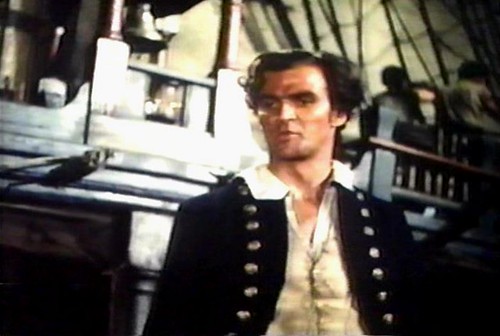
Captain Horatio Hornblower (R.N.)* (Raoul Walsh, 1951) Supposedly C.S. Forester himself adapted his first three Hornblower novels to make the screen-story for this swashbuckling distillation of the Royal Navy's fictional hero. It is 1805, and his majesty has sent the HMS Lydia on a secret mission. England is at war with Spain and France, and Hornblower must enlist the aid of a mad South American dictator in the war efforts a world away. But, upon arriving, Hornblower's distaste for the assignment and the "El Supremo" (Alec Mango) has him violating the Admiralty's standard orders, and when he captures the massive El Natividad (commanded by a very young Christopher Lee), he is forced to turn over the ship to the mad-man. Heading for home, he finds out that Spain is now England's ally (oops!) and he must re-take the massive ship on open seas, risking his crew and an unwanted passenger, Her Ladyship Barbara Wellesley (Virginia Mayo), sister to tthe Duke of Wellington and betrothed to Admiral Leighton (Denis O'Dea).
The crew is very British (
including a young Stanley Baker), but its Captain is played by the very American Gregory Peck
,** ramrod-stiff and stoic, so even though the accent is wrong, the attitude is just so—Forrester's Hornblower is a stoic, constantly questioning himself and his failings, reflected in his constant lecturing and drilling of his crew. And Raoul Walsh is the perfect man to direct, as the action director has a keen eye toward the psychological and characters with complicated motivations. Peck has the attitude, but is a bit uneasy when called upon to display the comical aspects of the still-upper-lip Hornblower—his uneasy "harumphs" are constantly dubbed in to make more of them than Peck could convey on-set. But for the brooding and irritation (and the authoritarian air), Peck is fine.
The battles are well-choreographed for the times—one can practically see the wires yanking pieces of ship-railing past the players—and sometimes the falling masts and ropes get a little out of control, but the model-work and staging are excitingly done. A fine way to spend a rainy afternoon.

* The added "R.N." because the British version of the title included them, the American did not. As with the recent Master and Commander, nothing is made of Hornblower maybe having to fight the American Navy, as he might have seven years in the future.
 
** The screen-rights were acquired for a vehicle for Errol Flynn, but after Flynn's previous movies had poor ticket sales (and the actor was proving difficult to manage), other actors (including Burt Lancaster) were considered. Peck got the part. Lancaster would star in The Crimson Pirate the next year.

Friday, November 19, 2021

The Big Country

The Big Country (William Wyler, Robert Swink, 1958) One of those films you hear so much about—when one is talking about "epics"—that, once you see it, you wonder what all the fuss is about. Oh, the technical specs are there: stunning cinematography by Franz Planer in Technicolor and Technirama (although early videos before remastered DVD's tended to look a bit washed out and squeezed); a top-notch cast where Charlton Heston is only fourth-billed; and a rousing score by Jerome Moross that busily pumped up the excitement when nothing much was happening (director Wyler evidently hated the score, but it rarely flags—much the same way Elmer Bernstein's score for The Magnificent Seven goosed that film a couple years later). And William Wyler's framing has just enough "edge" to it that when he went off to prep Ben-Hur in Rome (leaving second unit director Robert Swink to finish it) the difference is extremely noticeable. Swink managed to solve some story-issues, but the "snap" of Wyler's visual flair just isn't there, especially in its use of the Technirama frame.
East-coaster James Mackay (Gregory Peck), a sailor by trade, has traveled out West to San Rafael to marry his beloved, Patricia Terrill (Carroll Baker), daughter to "The Major" (Charles Bickford), wealthy land-baron and owner of the Ladder ranch. He's met by ranch foreman Steve Leech (Heston), who takes one look at McKay's city-slicker duds and pegs him for a "rube," especially galling as he's a little sweet on his boss' daughter, as well.
What McKay doesn't know is he's stepped right into a situation not too far afield of Dashiell Hammett's "Red Harvest" where two warring factions are competing for supremacy—the Terrill's and the Hannassey's (led by the blustery Rufus Hannassey played by Burl Ives in an Oscar-winning turn). San Rafael may be "Big Country" (as McKay is continually told by locals), but it doesn't seem to be big enough for two ranches and their respective herds of cattle. The burr under everybody's saddles is the Maragon spread, which has an accommodating body of water for watering the parched cows out on the chaparral. The late owner of the area kept the peace by allowing access to everyone, but things seem to have gotten out of control, now that it's run by Maragon's daughter, school-teacher Julie (Jean Simmons). Seems the strategy for dealing with her is to either make her sell or marry her and she's not having any of it.
And McKay is metaphorically a fish out of water. He doesn't fit in out West. He does things differently than they're used to in the passive-aggressive West. When a bunch of Hannassey's men (led by son Chuck Connors) have a little fun drunkenly hog-tying McKay, the Terrill's want to string them up—and even shoot up the Hannassey ranch over it—but McKay dismisses the attack and doesn't want anybody escalating the tensions on his behalf. That's not how they do things out West! And McKay is taken to be a coward, something driven home when Leech offers the use of the horse "Old Thunder"—withholding the information that "Thunder" is a notorious ill-tempered bronco—which McKay refuses, not wanting to be made sport of.
While the Terrill's are off on their little pissing match, McKay secretly works with the horse, constantly being bucked off*, until it finally is worn down and acquiesces to being ridden. McKay chooses to keep that knowledge secret—he doesn't give a rip what the others think of him, nor does he check with anyone when he takes a solo sortie out to the Maragon place to inquire about purchase. The Terrill's go into a panic at his disappearance, not realizing that McKay knows how to navigate...and evidently never having seen a compass.
McKay's "otherness" is played up in a lot of the film for drama and comedy—McKay's never acquiring the hang of greeting with "Howdy" or "Good Morning" garners an exquisite Peck triple-take—and his stoicism may be the biggest point of the film. Wyler had some dealings with water-rights in his private life, but he saw The Big Country as a Cold War allegory of oneupmanship and territorial transgressions using the philosophy of "Might Makes Right." His protagonist is no antagonist. Peck's McKay doesn't like violence, and though he does carry guns in the film—they're a gift to the Major in a fancy case—he only fires one once...and quite deliberately. In a wild west with so many characters shooting promiscuously (as they say in The Wind and the Lion), McKay's naval Captain makes a third act resolution a little problematic—the film was constantly being rewritten while in production (much to the consternation of the actors). It's what happens when you concentrate on "The Message" rather than "The Story."
It's an odd Western where so much of the footage is of someone thinking rather than acting (or "reacting"). It throws the pacing off—Moross' score helps speed through the gaps—and there are a couple of dodgy "within-the-take" edits indicating that someone was aware of the pokiness. The overall effect is to make one think that the West is some kind of "Crazy Town"—maybe there's something in that water!—where everyone is just a little too quick to make assumptions and stubbornly adhere to them no matter what anyone says. Except for the one stranger who sticks to his lack of guns and is comfortable in his own skin, no matter what anybody else thinks. One may initially think that the heads of the Terrill and Hannassey clans are the stubborn ones, but there's enough mule-headedness in everyone to go around.
The West is thus a place of contradictions—you have to be strong and stand up for yourself, but in a way that the community approves of, and if you change to accommodate them isn't that going against that principle? Maybe that's what Peck is thinking about throughout the movie (the Westerners certainly don't appear to be thinking!)—stay methodical and tenacious and consistent and maybe you can wear people down in the same way as "Old Thunder." And...if you do that enough over time...maybe, just maybe...you can bring life to the desert and bring civilization to the wild.


* Peck, of course, doesn't do the stunts himself for obvious safety reasons, but in addition  the horse's owner insisted on doing the stunts himself. That owner was Slim Pickens.

Tuesday, September 14, 2021

The Chairman (1969)

The Chairman
(aka The Most Dangerous Man in the World) (J. Lee Thompson, 1969) Oh, the memories I have of this one. I saw it when it was first released at the long-gone John Danz Theater, and even then, I knew the film was a bit of a mis-fire...but not for want of trying.
 
American Nobel-winning chemist John Hathaway (Gregory Peck) is recruited by the military working out of the American Embassy in London for a special assignment on behalf of an uneasy alliance between the U.S., Britain, and the Soviet Union. His old University professor, Soong Li (Keye Luke) has traveled back to his native China, now undergoing upheaval with the Cultural Revolution. They all think that Soong has some secret formula or other that all the governments want. Hathaway wants nothing to do with the intrigue, but is convinced to go by a personal phone call from the President (as that would be Nixon at the time, he'd be going there in a few years, anyway—why didn't he go ask about the formula?)
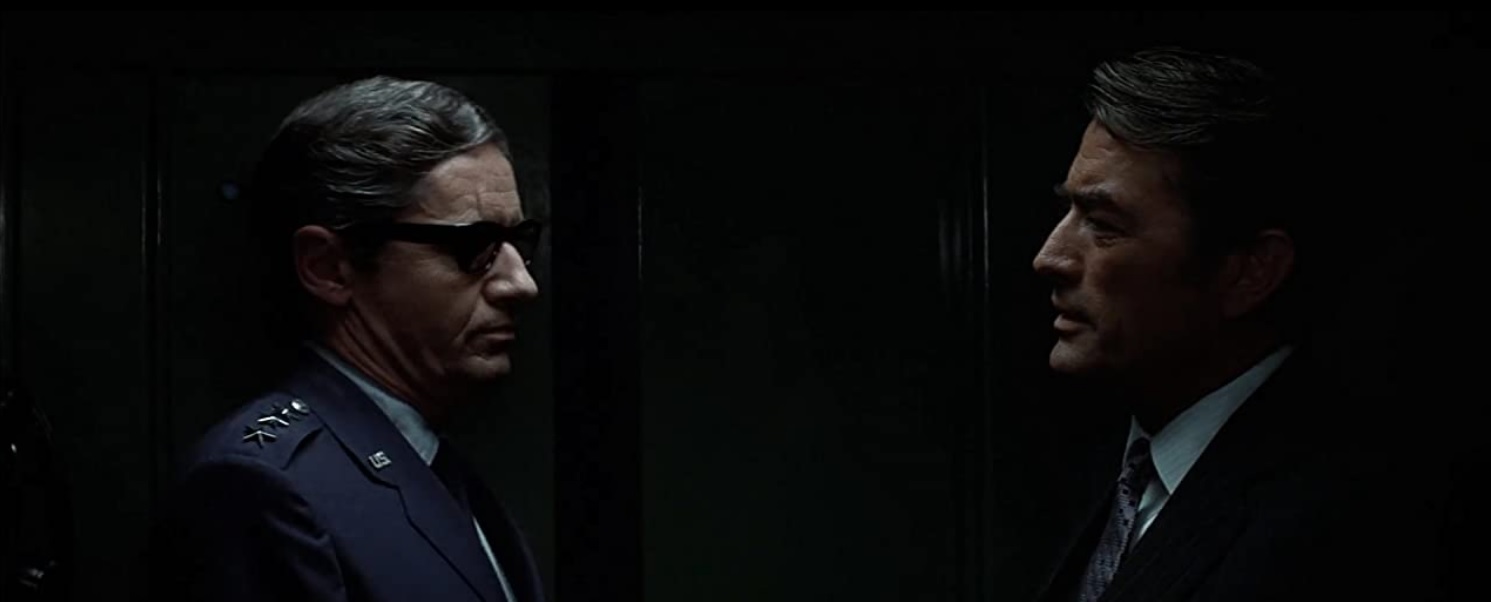
Lt. General Shelby (Arthur Hill, sporting glasses with the right lens blacked out) is the American liaison overseeing the trip from the Embassy, and he has a cute little scheme—as the governments want a constant report from Hathaway on his progress, they tell him they're surgically implanting a transceiver in his skull—in the days of land-lines and in a communist country where all radio communications are monitored, it's a handy-dandy way for Hathaway to report back—by appearing to talk to himself in his hotel rooms...and it can also track his movements, pre-GPS. It can also do something else, but more on that later.
Hathaway has the surgery, then makes the journey—after visiting his long-suffering lady-friend (Anne Heywood, second billed, but only in the movie five minutes) for maybe the last time, given the danger of the mission. It's at this point that the movie gets interesting. Given the nature of the film, shooting in Hong Kong (then as part of the separate state of Taiwan), Thompson gets his "travelogue" footage by shooting it surreptitiously in markets (where the over 6 foot Peck just happens to be standing out in the crowd). Hathaway is led around, baited with a honey-trap, and formally introduced to Mr. Yin (Eric Young), who's pleasure it is to follow Hathaway around for the Chinese government in full sight because they're in charge, why be secretive about it?
Hathaway is escorted around and then one day, Yin tells him he's going to meet the most important man in the world, and is taken to see Chairman Mao (Conrad Yama)—who, rather inanely is introduced playing ping-pong. He engages Hathaway in a game and then proceeds to quiz his guest about his intentions by taking on Hathaway's role while making him see his point of view. The result? An unlikely agreement that Hathaway can visit Soong without any interference—Mao believes that Soong's working perfecting an enzyme that encourages plant growth in any environment would be good for China...and the world (as long as it works).
But, what Hathaway doesn't know—or his unwitting host for that matter—is that little implanted transceiver that nobody's supposed to know about—also has an explosive device cooked into it. If something goes wrong, or Hathaway is captured—BOOM!—one of Hollywood's great profiles gets obliterated. There's an amusing scene where Shelby and his British counterpart realize that they're listening in to a conversation between Hathaway and Mao, and going rushing off to a super-secret telephone—requiring two keys—to alert the President of what's going on and suggesting that (let's explore the possibility) they could set off the explosive right then and kill Mao at the same time. There's a pause on the other end of the line and the words "Great idea.....don't do it."
The rest of the movie is fairly standard undercover work—Hathaway finds out where things are kept, he's a chemist so he gets some acid to gain access, Soong gets attacked by an angry mob of students to show their loyalty to the Communist Party—at the behest of Soong's daughter (okay, that's different), and once our hero gets what he needs he makes an escape for the Chinese border on the Russian side...but there's just the possibility that he could get caught, and so the program to explode his skull begins to count down. 
 
And, yes, it's probably where the creators of "The Suicide Squad" got the idea.
 
It's a staid little film—in the way Arthur Jacobs productions can be—but there's just enough cheek and outre ideas to make it interesting...and memorable after 53 years.
"I hear ticking...."

Friday, April 30, 2021

Anytime Movies #9: To Kill a Mockingbird

While I catch up on the reviews still in "Draft" phase here, I'll re-run a feature I ran when I first started this blog seven years ago,* when it was suggested I do a "Top Ten" List.

I don't like those: they're rather arbitrary; they pit films against each other, and there's always one or two that should be on the list that aren't because something better shoved it down the trash-bin.

So, I came up with this: "Anytime" Movies.


Anytime Movies are the movies I can watch anytime, anywhere. If I see a second of it, I can identify it. If it shows up on television, my attention is focused on it until the conclusion. Sometimes it’s the direction, sometimes it’s the writing, sometimes it’s the acting, sometimes it’s just the idea behind it, but these are the movies I can watch again and again (and again!) and never tire of them. There are ten (kinda). They're not in any particular order, but the #1 movie IS the #1 movie. And we begin in as contrary a way as possible (so as to avoid any comparison to a "Top Ten" list). This one is unusual in that it's a bonus (like the joke in This is Spinal Tap, "Anytime Movies" go all the way up to eleven). 

What is it about this film that puts it on so many favorites lists.
Horton Foote’s masterful telescoping of Harper Lee’s frail, powerful novel? The fact that, as movie adaptations go, this is certainly one of the best? That it has an impeccably picked cast, directed to feel absolutely real, including three of the best child-performances in all of movies, by one of the best directors of actors, Robert Mulligan? The beautiful, fragile score by Elmer Bernstein, certainly contributes.

I remember seeing
To Kill A Mockingbird when I was seven years old, and not “getting it” much. I remember being annoyed with my Mom for trying to cover my eyes during the “scary” parts—although Robert Duvall as “Boo” Radley did genuinely creep me out back then (in fact, he still does, a bit). I didn’t “get” the dog-shooting (“He won’t kill a mockingbird, but he’ll sure-as-shootin' kill a dog!”) But I remember that it was a scary movie for a kid. In the film, the night was so dark, and any light cast spooky elongated shadows and trees moved and leaves rustled. The World seemed restless and alive, full of mysteries and secret terrors just out of sight, when it should have been still and asleep. It was a world that, under the pretense of peace and calm, seethed with menace and dread just under the surface.
And that’s the key, I think. There seemed to be, in the movie, at least, a sense that the tremulous world was lurching and struggling to change—that the very earth was metamorphosing and demanding it, while the people entwined in that world, moved along, oblivious to the change, holding onto a complacent life that would inevitably end. At the same time, Mockingbird has the feel of nostalgia—the palpable sense that life flows through our fingers like sand, and that we’re always in danger of losing that life we hold precious. 
But you don’t think of these things when you’re a child. Summers are endless. Life is eternal. If born into a nurturing, protecting household (and that is key) there is the illusion that the world is benign and all things are possible…under heaven.
Heaven is a concept easily grasped by a child. If you’ve been “good” in your life, as a reward after death, you go to a “good” place to spend Eternity. In the years of growth, a child struggles to understand its world and to assert itself in an environment it has no control over. In a world too complex to understand, the concept of Heaven is a comfort to a child. It’s simple. It’s uncomplicated. It’s black and white. Like Good and Bad.

Like integrity.

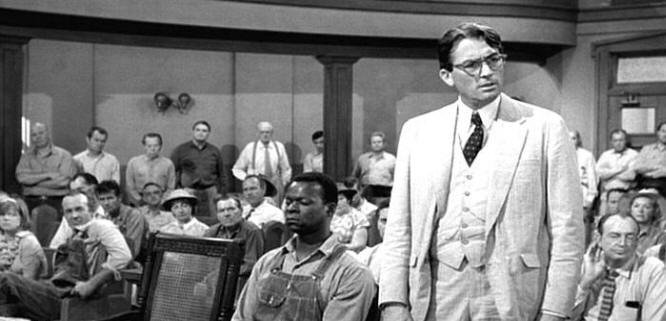
Atticus Finch (Gregory Peck) awaits a lynch-mob, that first—to his initial dismay 
and then wonder—is shamed and turned away by his own children. He shouldn't have wondered.

The children in To Kill a Mockingbird learn the world isn’t nearly as simple as they thought. That the Radley “kid” may not be the evil thing they whisper about in the dark before they go to sleep. That other peoples’ lives may not resemble their own. That their father is many things—but he is also fallible. Jem breaks down when Tom Robinson is convicted of raping a white woman, but I would doubt that he’s crying for Robinson. He’s crying for his father’s failure—a disappointment as palpable as his father being not willing to play football for the Methodists. Jem and Scout are too young to understand the idea of integrity. No, that's not quite accurate. They’re too young to understand the pressures of a world where integrity might be compromised. And they’re too young to understand that their father’s belief in right and good could actually cause them harm. 

But it is that integrity that makes their father dependable, despite the tragedies of the summer. It is that integrity in a fragile, changing world that will sustain and endure and remain a constant as sure as the north star in the void. And that echoes long in our minds at the end of the film with its last line of narration: “He would be in Jem’s room all night. An he would be there when Jem waked up in the morning.”
When the American Film Institute held a vote for the cinema’s best hero, the honor did not go to the Sergent Yorks or the Skywalkers or the Bonds or any of the roles played by Eastwood, Willis or Schwarzenegger. It went to a character of gentle heroics who in the course of the movie only fires one shot, who does not raise a hand in anger, and with jaw set and quiet voice does what he knows to be right. It was a shock that Atticus Finch would be voted the greatest movie hero, but it was the best choice possible, and legitimized the idea of holding such a silly poll in the first place.

Stephen Frankfurt's evocative title sequence.
Music by Elmer Bernstein


Horton Foote died March 4th, 2009. Director Robert Mulligan died right before Christmas, 2008. William Windom, in 2012. Brock Peters died in 2005. Rosemary Murphy died in 2014. Peck, in 2003. My favorite actor in this and many things, Frank Overton, died in 1967. Survivors are Robert Duvall (Arthur "Boo" Radley), and the Finch kids.

And Harper...Harper "Nelle" Lee died February 19, 2016, just shy of her 90th birthday.

Except for her one gentle novel that stood like a golden spike in the Civil Rights Era, Nelle Harper Lee published no other major works, only a scattering of essays. Not a recluse, she merely avoided the public spotlight. She, in her shy ways, did no public speaking. She said what she is going to say. And that should be enough.**

Harper endures.


Anytime Movies:
To Kill a Mockingbird
Goldfinger
Bonus:  Edge of Darkness


* And, on Sunday, we'll put up a "Don't Make a Scene" feature from each week's film.

* * Just before her death, her agent published her first submitted work, "Go Set a Watchman," the rejected first novel that inspired her editor to tell her to try again and "write about the kids" which became "To Kill a Mockingbird."