Showing posts with label Keye Luke. Show all posts

Wednesday, February 23, 2022

The Good Earth

The Good Earth
(Sidney Franklin, Victor Fleming, George W. Hill, Sam Wood and Gustav Machatý, 1936) This is a film (as Leonard Maltin would say) "very much of its time"—Hollywood critical code for saying that if it was made this way today it would be picketed and protested and denounced on the Senate floor (well, maybe not the last one). So, let's just get it out of the way. There's a lot of racism in The Good Earth, from the casting of Paul Muni* and Luise Rainer (and many of the principals, including Walter Connolly and...Charley Grapewin?!), all Caucasians, as Asians,** which is unfortunate, the music is Hong-Kong china-gong cliche-ridden, the pigeon-English of the screenplay insulting. Absolutely true.

Give them points for trying in bloody 1936, though. The original plan for the film, as envisioned by author Pearl Buck and M-G-M honcho Irving Thalberg was to create an all-Chinese film, but studio pressure for "better profits with bigger stars" from M-G-M head Louis B. Mayer (who didn't want to make the film, whether it was profitable or not) compromised the plan—Paul Muni was cast as farmer Wang Lung. And, because of anti-miscegenation language built into the Hays Code, as Wang was being played by a white guy, a Chinese actress could therefore not be cast as Mrs. Wang. So the part went to Luise Rainer, who had won the Oscar for Best Actress for "The Great Ziegfeld."***
Original director George W. Hill traveled to China to film location footage that was supplemented by California locations and sets. Hill died before principal photography could take place and Sidney Franklin was hired as director—but as, with other big M-G-M productions, other directors stepped in for some sequences, including the ubiquitous Victor Fleming (of Gone with the Wind and The Wizard of Oz fame), and Sam Wood, who directed the genuinely frightening scenes of the looting at The Great House.  This one tears the "auteur" theory to shreds as it was, very much, a Producer's picture. Thalberg (fictionalized in "The Last Tycoon" by F. Scott Fitzgerald), oversaw the whole thing, picking directors from his stable of them to maximize the thrill of specific sequences to enhance the spectacle of his "prestige" picture, and despite the clashing styles, the thing seems to work rather seamlessly.
Beyond the piece-meal approach and industrial racism, though, The Good Earth is frequently thrilling with production value and subtle in its politics. In it, we see a lower-caste family go through the travails of living off the soil. When The Good Earth turns against them and a drought threatens the family, they're forced to movie "to the city" to look for work. Glossy this production may be, but it doesn't turn a blind eye to tragedy, with surprisingly dire consequences for the family. Their fortunes turn—through theft—and they prosper, but that good fortune corrupts, distancing the family from the community. Only when the future is threatened with a devastating invasion (and it literally looks like it) of locusts—through a combination of M-G-M effects wizardry and micro-photography—does the village, now a small city, band together and defeat a Nature they can beat back with sticks and fire.
As I stated, the film is worrisome for its attempts at political correctness and political duplicity at the expense of caricature and wrong-headed casting, but it does deliver an unblinking look at the havoc that can be wrought on people caught between the gales of Nature and their own natures. Rainer is fairly luminous throughout, and it is particularly heart-warming to see
Keye Luke, whom I'd only known as an old man, young and strapping as the best educated (and thus least respected) of the farmer's sons.
The Good Earth
should be seen in the spirit of "The Big Epic" (with all the frothing, high dudgeon and drama inherent in such enterprises).  It is best, flaws known and forgiven...if not ignored.

 * I'm as Chinese as Herbert Hoover" was Muni's retort to his suggested casting.

** And, look, as sure as Anthony Quinn was Arabian, you can bet that box-office potential wins out over authenticity every day.  Only a couple of years ago, there was a furor that Chinese actress Zang Ziyi was cast in the lead of Memoirs of a Geisha.  Of course, authenticity and cultural sensitivity should be the basis of casting (along with such minor considerations as talent and ability to pull off the role...), but...Zhang Ziyi?  If you could land her for a movie...wouldn't you?

*** Rainer at this writing is alive and well and celebrated her 100th birthday January 10th, 2010. She won back-to-back Oscars in 1935 and 1936, which she stated was "the worst possible thing" for her career. She has mostly stayed out of the lime-light, but occasionally does acting jobs that have struck her fancy--like a dual-role on "The Love Boat," in 1983.  
 
Addendum: Luise Rainer died December 30, 2014

Tuesday, September 14, 2021

The Chairman (1969)

The Chairman
(aka The Most Dangerous Man in the World) (J. Lee Thompson, 1969) Oh, the memories I have of this one. I saw it when it was first released at the long-gone John Danz Theater, and even then, I knew the film was a bit of a mis-fire...but not for want of trying.
 
American Nobel-winning chemist John Hathaway (Gregory Peck) is recruited by the military working out of the American Embassy in London for a special assignment on behalf of an uneasy alliance between the U.S., Britain, and the Soviet Union. His old University professor, Soong Li (Keye Luke) has traveled back to his native China, now undergoing upheaval with the Cultural Revolution. They all think that Soong has some secret formula or other that all the governments want. Hathaway wants nothing to do with the intrigue, but is convinced to go by a personal phone call from the President (as that would be Nixon at the time, he'd be going there in a few years, anyway—why didn't he go ask about the formula?)
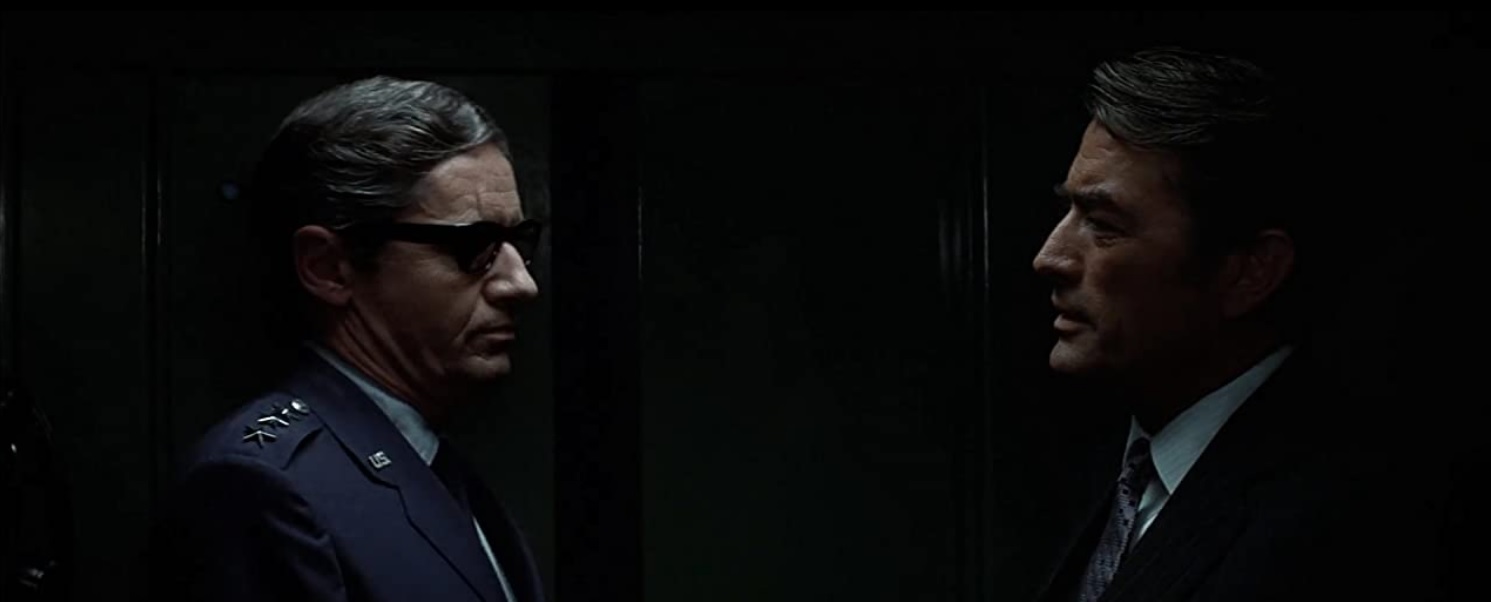
Lt. General Shelby (Arthur Hill, sporting glasses with the right lens blacked out) is the American liaison overseeing the trip from the Embassy, and he has a cute little scheme—as the governments want a constant report from Hathaway on his progress, they tell him they're surgically implanting a transceiver in his skull—in the days of land-lines and in a communist country where all radio communications are monitored, it's a handy-dandy way for Hathaway to report back—by appearing to talk to himself in his hotel rooms...and it can also track his movements, pre-GPS. It can also do something else, but more on that later.
Hathaway has the surgery, then makes the journey—after visiting his long-suffering lady-friend (Anne Heywood, second billed, but only in the movie five minutes) for maybe the last time, given the danger of the mission. It's at this point that the movie gets interesting. Given the nature of the film, shooting in Hong Kong (then as part of the separate state of Taiwan), Thompson gets his "travelogue" footage by shooting it surreptitiously in markets (where the over 6 foot Peck just happens to be standing out in the crowd). Hathaway is led around, baited with a honey-trap, and formally introduced to Mr. Yin (Eric Young), who's pleasure it is to follow Hathaway around for the Chinese government in full sight because they're in charge, why be secretive about it?
Hathaway is escorted around and then one day, Yin tells him he's going to meet the most important man in the world, and is taken to see Chairman Mao (Conrad Yama)—who, rather inanely is introduced playing ping-pong. He engages Hathaway in a game and then proceeds to quiz his guest about his intentions by taking on Hathaway's role while making him see his point of view. The result? An unlikely agreement that Hathaway can visit Soong without any interference—Mao believes that Soong's working perfecting an enzyme that encourages plant growth in any environment would be good for China...and the world (as long as it works).
But, what Hathaway doesn't know—or his unwitting host for that matter—is that little implanted transceiver that nobody's supposed to know about—also has an explosive device cooked into it. If something goes wrong, or Hathaway is captured—BOOM!—one of Hollywood's great profiles gets obliterated. There's an amusing scene where Shelby and his British counterpart realize that they're listening in to a conversation between Hathaway and Mao, and going rushing off to a super-secret telephone—requiring two keys—to alert the President of what's going on and suggesting that (let's explore the possibility) they could set off the explosive right then and kill Mao at the same time. There's a pause on the other end of the line and the words "Great idea.....don't do it."
The rest of the movie is fairly standard undercover work—Hathaway finds out where things are kept, he's a chemist so he gets some acid to gain access, Soong gets attacked by an angry mob of students to show their loyalty to the Communist Party—at the behest of Soong's daughter (okay, that's different), and once our hero gets what he needs he makes an escape for the Chinese border on the Russian side...but there's just the possibility that he could get caught, and so the program to explode his skull begins to count down. 
 
And, yes, it's probably where the creators of "The Suicide Squad" got the idea.
 
It's a staid little film—in the way Arthur Jacobs productions can be—but there's just enough cheek and outre ideas to make it interesting...and memorable after 53 years.
"I hear ticking...."