Showing posts with label 1936. Show all posts

Wednesday, January 10, 2024

Wife vs. Secretary

Well, gosh, here's an oddity: One of those reviews where I can pinpoint right where and when I wrote it. 

I was living on Whidbey Island, which—at the time—had very little cable/internet service (I lived smack-dab in the middle of the island and "intermittent-net" only got to those residences on the North and South parts of the island closest to the mainland). I relied on a Hughes satellite dish system for the internet (and my first forays into the blogosphere), and I think the TV might have depended on rabbit-ears. But, I missed those old movies; I started a habit of renting DVD's from the library. But, here, I got to luxuriate in a cable experience.

Wife vs. Secretary (Clarence Brown, 1936) One of those forays off "The Rock" allowed me an evening of cable TV, and when I have a choice I head straight for Turner Classic Movies-easily the best channel for watching movies on the television dial. 

TCM treats the movies they show with respect--without commercial interruption, and in the proper theatrical aspect (widescreen if its a widescreen movie). They also show rare films, silent films, foreign films, things that any other channel with "movie" in its name wouldn't dare show in their efforts to cram as many commercials into each film as possible (Hello, AMC, you whore!)*

So, that night I had the chance to catch a movie I'd never heard of, called Wife vs. Secretary, which starred Clark Gable, Myrna Loy (as the "Wife") and Jean Harlow (as the "Secretary").
It was an M-G-M programmer, designed to exploit three of its biggest stars, and particularly Gable—the man is given so many loving close-ups, you actually begin to think he was being shot through gauze. Anyway, his V.S. Stanhope is a publishing tycoon, seeking to expand his properties—he's aggressive, a "man's man," and keeps terrible office-hours, seeing his loving, trusting wife only for an early breakfast and a late formal dinner party. 
His "Girl Friday" is Helen "Whitey" Wilson, a career-girl who keeps pace with Stanhope for the sheer exhilaration of seeing how fast the company can grow. That leaves her boy-friend a bit mopey, and considering he's played by a proto-
Jimmy Stewart, that's saying quite a bit. An extended business trip to Cuba that leaves the Stanhope and Wilson drunk and in the same hotel room almost sparks a romance, but both of them are just sober enough to think it's a dumb idea. But that doesn't keep the wife and boyfriend from suspecting the worse. It's interesting to see a pretty standard melodrama done with such snap—the timing of the stars crackles.
Now, I said this was a programmer,
Gable had been in three previous films with Loy and four with Harlow, so they were all old veterans, and the movie sails by with quick dialog, impossibly rich surroundings (it's M-G-M), quite a few sophisticated laughs, and a very old school lesson in morality and suspicions gone awry. But it all turns out right in the end, as long as the career-girl gives up her job and "settles down," that is. Retro-chauvinism aside, though, it's a fascinating look at a typical night at the movies from 1936, cranked out like an automobile, but with obvious care, a nice sheen, and only the best parts.
* My! Where did THAT come from? Well, a little history is in order for those of you showed up late. AMC started life—on October 1, 1984—as American Movie Classics, which had the innovative idea of running old movies commercial-free and unedited, and even (by the time I got around to it) in letter-boxed format for widescreen films (rather than using the widely available "pan-and-scan" versions that filled up a television screen but cut the amount of the movie's picture-image. When I first got addicted to AMC the host was broadcaster Nick Clooney, brother of Rosemary and father of George. But—and I did not know this at the time I wrote this—they faced severe competition when Ted Turner bought the M-G-M/Warner Brothers film library (AMC were showing quite a few of those movies, but not exclusively). By the time Turner Classic Movies started up, AMC was feeling the heat and, facing competition from TCM—as well as legal issues with TCM—the channel began taking commercials, first between films, and then interrupting their movies for them. By 2007, with the acquisition of the series "Mad Men," AmC started moving away from old movies and started pursuing original programming...where it stands today.
 
If you're wondering why Scorsese and Spielberg and being so vocal about TCM not changing under the aegis of Warner Brothers Discovery, it's because they've seen it happen before...with AMC.

Tuesday, May 2, 2023

My Man Godfrey

Turner Classic Movies' Star of the Month is William Powell, who seems to have fallen out of the consciousness and discussion of Great Hollywood Actors. I will avail myself of seeing a bunch of his films, as I've always found him astonishingly creative and real.

My Man Godfrey (Gregory LaCava, 1936)  Bill Powell isn't given nearly enough credit in Hollywood history.

Popular in his day, he worked just enough to maintain his reputation and dignity, then retired and kept to himself. But you watch him in something like My Man Godfrey—a not quite screwball comedy of the "The Rich, They are a Peculiar Lot" school—and you see him stretch a little bit, and definitely see him playing a different character than the familiar Powell persona (even an extended drunk scene is played differently than his pleasantly soused Nick Charles from the "Thin Man" series), but still retains that measure of insinuation that took every line of dialogue and made it spin on its heels. His character, Godfrey Pike, starts out as a bum living in a dump underneath the Brooklyn Bridge, where he's picked up by socialite-heads as part of a charity scavenger hunt for the idle rich.
He attracts the attention of Irene Bullock (Carole Lombard, formerly Mrs. Powell) probably because he's different, a genuine "find," and he does stick out like a sore, if well-manicured, sore thumb among the derelicts. Articulate and dignified, he's quietly worldly-wise, politely sarcastic (neat trick to pull off, that) and keeps a cool eye on the rich partiers for whom he's an oddity, a curiosity—like watching a car wreck—and slightly discounted, although he's  probably better than all of them as a human being. Mentored by Irene, he assumes a position as a gentleman-butler for her family, a job that's bested a steady stream of other men. But he does the job well, keeping his opinions to himself, the most sane man in a palatial asylum.
And an asylum it is, with the father (the foghorn-voiced Eugene Pallette, staple of Capra comedies) the only one with any sense (or schedule), and who has long given up on his family making any steps to adulthood. Mother (Alice Brady) is a drama queen, who can only be distracted by her protege Carlo (Mischa Auer) and other daughter Cornelia (Gail Patrick) has to fill her empty life with schemes and conspiracies.
But Irene is a dreamer. In Godfrey, she finds a competent supplement, practical, in marked contrast to her flibbertigibbet, caring to her carelessness.
Such a creature, alien to her environment, makes her fall in love with the old boy, while he still tries to make his way through Society, and back to the life he has previously abandoned.
It's all high-style and fast-paced. And even though Lombard's society gal is a comic cry-baby notched up to "11" on a scale of "10," she is leavened somewhat by the tolerating, sly performance by Powell—who insisted that Lombard, his ex-wife, get the part.

Powell was the epitome of well-mannered play-acting, while never, ever betraying a dull moment. He made style which—when done in the hands of amateurs can look confining—seem effortless, while also being insouciant, and fun.

Tuesday, April 4, 2023

Come and Get It!

Come and Get It
!
(Howard Hawks
, William Wyler, Richard Rosson* 1936) Edna Ferber's novel was purchased by Samuel L. Goldwyn to turn into a Hollywood blockbuster and Howard Hawks hired to direct. But Hawks was a maverick, and when Goldwyn came back from a long illness to see how things had progressed, he was shocked, shocked (I tell you), to see that Hawks had drifted afield of the Ferber source novel. For one reason or another, Hawks was fired (or quit, depending who was asked) and replaced by Goldwyn favorite William Wyler (who was just finishing up Dodsworth for Goldwyn).
 
The result is a revelation on very many levels: that Hawks' signature style was so evident it couldn't be mistaken for any other director; that the difference between Wyler's and Hawks' scenes are night and day; that Edward Arnold, known to modern audiences as a supporting player in Capra films could carry a movie so handily; Walter Brennan could be a versatile and nimble actor; and that Frances Farmer was an incredibly gifted actor of enormous facility and subtlety.
The story of a logging "pirate," Bernard Glasgow (Arnold) falls in love with a saloon girl (Farmer), but gives her up to marry the boss's daughter, win himself a partnership and become one of the richest men in Missouri. Hawks' part is a fast-moving, rollicking story of rapacious men grabbing as much as they could to line their pockets. Shot in mostly waist-level fast set-ups, with a rarely moving camera, the emphasis is what's in the frame and not how it's framed, so most of the scenes are crowded with people, the actors stepping over each other's lines and character bits of business that are not called attention to (including the requisite cigarette lighting without being asked). Highlights are a saloon fight with serving trays used as dangerous flying discs, a couple of fights in which Arnold solidly smacks his opponents, a game of chance turned on its ear, and an Oscar-winning turn (the first to be given to a supporting actor) by Walter Brennan, rangy, ebullient and sporting a high Swedish accent.
But Farmer steals this section (she dominates the whole movie, actually) with her performance as the ultimate "Hawks dame:" her Lotta Morgan is gum-chewing, moose-jawed, with big movements and a dusky drawled voice, with more than a hint of Marlene Dietrich's insolence (courtesy of frequent Hawks collaborator Jules Furthman, who'd written a couple Dietrich films). That Farmer then plays her daughter (also named Lotta) later in the film in a high-toned, fluttery manner—she even sings differently—with a more subdued jaw-line and a smile not so crooked as her mother's is one of those nuanced things of such complexity that you remember how clever these "old" movies can be.
Farmer is able to keep up the performance when Wyler takes over, and it's pretty obvious when that is—when the Bostrom clan and Glasgow (now smitten with the daughter of the woman he left behind) take a fancy trip to Chicago. The pace slows. The actor's get out of the way of each other's lines.** The Gregg Toland photography is a bit more finicky and lush, not having to rush to make Hawks' schedule but accommodating to Wyler's. Scenes are staged more angularly and more obviously, telegraphing future camera moves and upcoming "business." And attention is paid to more obvious scene-fussiness, even to including cut-away's—a boy-girl flirtation is built around a taffy pull, and a later scene between Glasgow and his daughter doesn't communicate their "reflection of each other" relationship as Hawks did, but is, instead, based around a child's balancing toy. Wyler has enormous taste and style, but as much as he tries to emulate Hawks' off-the-cuff way of doing things, the more it feels staged and unnecessary, even making more of a Joel McCrea ad-libbed-over gaffe in Hawks's section than is necessary.

Hawks is more adept at making his points, too. Where he has a quick discussion of the duplicity of homesteading to acquire more timber land from the government for nothing ("Well...it's not illegal" says the company CEO), and shows Glasgow's utter disregard for re-planting ("Ah, nothin'll grow back there!"), whereas
Joel McCrea's son has the "planting for the future" line in Wyler's section—a conversation that puts the older Bostrow's to sleep.
It's an interesting study in contrasts in directing style—Hawks's attention to material and Wyler's attention to presentation—that may be lost on those caught up in Ferber's soapish story ("the famous novel by Edna Ferber" is how it's described in the credits. There's plenty of reason to go hunting for this film. And a hunt it will be; this film is notoriously snake-bit.
*** Maybe because of the melodrama behind the scenes, or Goldwyn's lack of enthusiasm for the result—the film went way over budget, capping at more than a million 1935 dollars—and was not a box-office success. Then there's the troubled career of Frances Farmer, which no studio wanted to gamble on promoting. For whatever reason, Come and Get It!, holds up very well and seems downright prescient for its asides on ecological issues and corporate ethics. And it is the film that Farmer was proudest of, despite its many issues in front of and behind the camera. She would never be as satisfied with her work and the conditions to achieve it again in her life.

Come and Get it! premiered in Seattle, Washington at The Liberty Theatre, where Frances Farmer had once been an usherette.

"Our Lady of Perpetual Rebellion:" Frances Farmer
Publicity Glamour photo by George Hurrell

* With all the attention made to Hawks' and Wyler's separate efforts there was a third director for Come and Get It!—Hawks's talented assistant director Richard Rosson who traveled to Idaho to photograph the incredible logging footage contained in the early part of the film.

** Is it preposterous for me to think that Wyler was taking a jab at Hawks' dialogue direction by having Brennan and Mady Christians—playing his niece—stop a conversation dead by saying the same thing over each other a couple times and then give up trying to inject into the conversation?

*** As an indication of this on a personal note, it took far more effort than normal to find a vintage poster of Come and Get It!. Until the last minute, the best I could uncover was a newspaper ad.

Friday, July 22, 2022

H.G.Wells' Things To Come

They (Stanley Kubrick and Arthur C. Clarke) also screened many films, including Destination Moon, The Day the Earth Stood Still, and Forbidden Planet. Kubrick soon discovered that Clarke was far too forgiving of material he found embarrassingly shallow and badly made. When the author insisted he screen the 1936 British science fiction classic Things to Come, written by H.G. Wells and based on a number of his stories, Kubrick "exclaimed in anguish, 'What are you trying to do to me? I'll never see anything you recommend again!'" Clarke remembered in 1972.
Space Odyssey, Michael Benson © 2018
I cannot imagine Stanley Kubrick "exclaiming in anguish" so much as mocking testily. But, if the director did indeed say that, he did have a point. Wells' later science fiction work in light of "The War That Ends All Wars" casts its eye less on the fantastical and more on the sociological, with the world's fate hanging on the desires of the gifted and the merely covetous. It may sound fine in the abstract, but Wells seems to forget that History is the slaughterhouse registry of the Powerful against the power-less.
It is 1940, and a Christmas party is being thrown by scientist John Cabal (Raymond Massey). But the festivities are overshadowed by the fear of an imminent war being radioed on the news. Cabal's fellow guest Harding (Maurice Braddell) is also glum, but Pippa Passworthy (Edward Chapman) is not so pessimistic, and looks on the bright side—even if it happens, it will spur technological progress, which is a good thing, right? Cabal sticks to the basics: "If we don't end war, war will end us." And, as if to mock everyone's sentiments, the attacks begin that night.
It turns out that everybody is right. The war does advance technology, at least in the sort of armored vehicles and flying battalions that reign terror. As for the people, they are literally bombed into the stone age, fleeing to underground bunkers and sewers for protection from the devastation, and, in their struggle to survive, allow themselves to be ruled by autocratic strong men—their proverbial man on a white horse—who fill the vacuum and their pockets as those craving power always do. In this case, it's "The Boss" Rudolph (Ralph Richardson), who has taken over the management of "Everytown" since the end of the war in 1966. But, the conditions have led to a pandemic of a final biological tactic, "the wandering sickness," and "The Boss" ignores the efforts of Dr. Harding (Maurice Braddell) with his own solution—shoot the sick down in the street, and expands his plans by ordering his mechanic, Richard Gordon (Derrick De Marney) to try to fix the remaining planes to bomb the outliers beyond his control in "The Floss Valley" and take over their deposits of oil and shale to turn into oil for the planes.
But, in 1970, an answer arrives from the skies. John Cabal arrives on a newly designed airplane and informs Harding and Gordon that he has come from Basra, Iran, where survivors of the war have established a new government, World Communications, where mechanics and engineers have formed The Brotherhood of Efficiency to bring new technology to the survivors to rebuild civilization and join the new government in banning war and advancing mankind. Sounds good, except to the guy in charge. Following the maxim that "Equality is seen by the privileged as oppression," Rudolph captures Cabal and forces him to work with Gordon on the old planes, but his plans are thwarted when the "Wings Over the World" contingent of World Communications is alerted to, and they fly over, releasing their "peace gas," which sounds like a bad euphemism, but merely gives the citizens a good night's sleep.
All except for Rudolph, who has a bad reaction to the "peace gas"—a fatal conflict of interest, maybe—and dies. It's a little convenient, but metaphorically apt, it seems. It allows Cabal to announce that old autocracies are as dead as Rudolph, allowing a new world to start, allowing "a new life for mankind." No one mentions that it also means no technological solution can be perfect.
 
And...scene.
There follows another montage of the building of that "new life" as the world's population moves underground and start building new bright and shiny civilization-cities, where people are able to progress and live in peace. So much so, that Cabal's grandson Oswald (Massey again) looks to conquering new worlds and expanding our horizons off the Earth with a planned moon-shot. But...there's always gotta be a critic. "Sure, you can Build Back Better," but how are ya gonna pay for it? In this case, it's the sculptor Theotocopulus (
Cedric Hardwicke), who's pissed because he's lost an art grant of something because of all the money spent on Cabal's space-cannon, or something. 
Actually, no. His argument is less practical. He believes that humanity is tired of progress. "All sorts of people" are saying it, I guess. Enough so that he forms a mob to try and storm the space-cannon to try and stop it from launching (wouldn't you volunteer to stop a rocket launch...like one of those Saturn 5's that turn the surrounding acreage crispy?). But, Cabal, having seen the rise of petty autocrats before, decides he's going to ignore the mob (in all his Randian objectivism) and is able to send the manned probe into space, despite the Luddite uprising, and looks to the audience and intones "All the Universe, or nothing? Which will it be? Which will it be?"
Me? I'd look for a third option.

I gently mock, but Wells' story is all vague philosophizing without any practical demonstrations or innovations. Things look nice, and all, in that futuristic Fritz Lang Metropolis kind of way.* But, is everybody benefiting from the new technology? Is everybody housed and fed? Is everybody working...or do they need to work? And if they're working, are they working for bad bosses? And this "Brotherhood of Efficiency"...if they're using "metrics", you can count me out. There's no details here, just a sleek gloss-over. And the black and white of it isn't just in the photography, but in the binariness of choices. Is it always just a choice between progress and...(oh, what's the opposite of "pro?" Oh, yes) "congress?" And Wells' thinking seems to be that all the world needs to get along in technological advancement (if, of course, everyone advances equally regardless of class or income—if, indeed, there are such concepts in his utopia). One would argue that television, the computer, and the internet all have negative consequences, despite the best of intentions. Maybe even enough to tilt things out of balance. There's a limitation to what you can convey with a monolithic society...as opposed to extra-terrestrial monoliths
Kubrick did take something from Things to Come, though, and that is in the use of long stretches of montage, not to convey the passage of time (he did that in a single famous edit), but, rather, as a visual instruction manual on how things have changed and have become in the film (despite the technological advancements and accomplishments) every-day and banal. As a result, there are less moments of upturned faces and speechifying in grandiloquent tones. That seems less human to me and more autocratic, which, if I'm reading the film correctly, is just the sort of Coming Things Wells cautions against.

* One should put out that Things to Come is probably most influenced by Metropolis, which was made just nine years earlier, right down to the binary philosophical arguments, although Lang (and his scenarist Thea von Harbour) did come up with that third option. Mind? Heart? How about working in conjunction?

Wednesday, February 23, 2022

The Good Earth

The Good Earth
(Sidney Franklin, Victor Fleming, George W. Hill, Sam Wood and Gustav Machatý, 1936) This is a film (as Leonard Maltin would say) "very much of its time"—Hollywood critical code for saying that if it was made this way today it would be picketed and protested and denounced on the Senate floor (well, maybe not the last one). So, let's just get it out of the way. There's a lot of racism in The Good Earth, from the casting of Paul Muni* and Luise Rainer (and many of the principals, including Walter Connolly and...Charley Grapewin?!), all Caucasians, as Asians,** which is unfortunate, the music is Hong-Kong china-gong cliche-ridden, the pigeon-English of the screenplay insulting. Absolutely true.

Give them points for trying in bloody 1936, though. The original plan for the film, as envisioned by author Pearl Buck and M-G-M honcho Irving Thalberg was to create an all-Chinese film, but studio pressure for "better profits with bigger stars" from M-G-M head Louis B. Mayer (who didn't want to make the film, whether it was profitable or not) compromised the plan—Paul Muni was cast as farmer Wang Lung. And, because of anti-miscegenation language built into the Hays Code, as Wang was being played by a white guy, a Chinese actress could therefore not be cast as Mrs. Wang. So the part went to Luise Rainer, who had won the Oscar for Best Actress for "The Great Ziegfeld."***
Original director George W. Hill traveled to China to film location footage that was supplemented by California locations and sets. Hill died before principal photography could take place and Sidney Franklin was hired as director—but as, with other big M-G-M productions, other directors stepped in for some sequences, including the ubiquitous Victor Fleming (of Gone with the Wind and The Wizard of Oz fame), and Sam Wood, who directed the genuinely frightening scenes of the looting at The Great House.  This one tears the "auteur" theory to shreds as it was, very much, a Producer's picture. Thalberg (fictionalized in "The Last Tycoon" by F. Scott Fitzgerald), oversaw the whole thing, picking directors from his stable of them to maximize the thrill of specific sequences to enhance the spectacle of his "prestige" picture, and despite the clashing styles, the thing seems to work rather seamlessly.
Beyond the piece-meal approach and industrial racism, though, The Good Earth is frequently thrilling with production value and subtle in its politics. In it, we see a lower-caste family go through the travails of living off the soil. When The Good Earth turns against them and a drought threatens the family, they're forced to movie "to the city" to look for work. Glossy this production may be, but it doesn't turn a blind eye to tragedy, with surprisingly dire consequences for the family. Their fortunes turn—through theft—and they prosper, but that good fortune corrupts, distancing the family from the community. Only when the future is threatened with a devastating invasion (and it literally looks like it) of locusts—through a combination of M-G-M effects wizardry and micro-photography—does the village, now a small city, band together and defeat a Nature they can beat back with sticks and fire.
As I stated, the film is worrisome for its attempts at political correctness and political duplicity at the expense of caricature and wrong-headed casting, but it does deliver an unblinking look at the havoc that can be wrought on people caught between the gales of Nature and their own natures. Rainer is fairly luminous throughout, and it is particularly heart-warming to see
Keye Luke, whom I'd only known as an old man, young and strapping as the best educated (and thus least respected) of the farmer's sons.
The Good Earth
should be seen in the spirit of "The Big Epic" (with all the frothing, high dudgeon and drama inherent in such enterprises).  It is best, flaws known and forgiven...if not ignored.

 * I'm as Chinese as Herbert Hoover" was Muni's retort to his suggested casting.

** And, look, as sure as Anthony Quinn was Arabian, you can bet that box-office potential wins out over authenticity every day.  Only a couple of years ago, there was a furor that Chinese actress Zang Ziyi was cast in the lead of Memoirs of a Geisha.  Of course, authenticity and cultural sensitivity should be the basis of casting (along with such minor considerations as talent and ability to pull off the role...), but...Zhang Ziyi?  If you could land her for a movie...wouldn't you?

*** Rainer at this writing is alive and well and celebrated her 100th birthday January 10th, 2010. She won back-to-back Oscars in 1935 and 1936, which she stated was "the worst possible thing" for her career. She has mostly stayed out of the lime-light, but occasionally does acting jobs that have struck her fancy--like a dual-role on "The Love Boat," in 1983.  
 
Addendum: Luise Rainer died December 30, 2014

Tuesday, February 1, 2022

Fury (1936)

Fury
(
Fritz Lang, 1936) Fritz Lang's first American film (after fleeing Nazi Germany) taking on a compelling story that, like his German work, exposes the cracks of society within a strong story narrative, this time focusing on this country's scourge of lynching and the fragile way that rights can be trampled by mob rule and political cowardice. Although somewhat compromised by a last-minute studio mandate to tack on a more happy ending to the story, it plumbs the depths of the cruelty that humans can do to each other. 
 
The heads at M-G-M had good reason to be scared. Spencer Tracy stars as an ordinary Joe—Joe Wilson, in fact—engaged to Katherine Grant (Sylvia Sidney) but too poor to get married. Katherine decides to leave Chicago to take a job in the town of Strand, hoping to save enough money so she can come back and marry Joe. For his part, Joe stays in the Windy City with his two brothers, Tom and Charlie, who are mixed in with organized crime. Joe convinces them to go straight and together they open a gas station, which turns enough of a profit that Joe decides to not wait the full year as intended and takes a car to Strand to bring Katherine home, writing her to tell her the time and place they will meet.
His timing could be better. Stopping to camp out half-way between the two cities, he reads about a kidnapping and thinks nothing of it—tomorrow, he'll be in the town of Strand and starting a new life with Katherine.
 
He has no idea that by the next time tomorrow night, his life will be over.
The next morning, driving up to Strand to meet Katherine, he's pulled over by a cop (
Walter Brennan) for his out-of-state plates, suspicious that they might be tied to the kidnappers. When told to empty his pockets, Joe tells him that all he has in his pockets are peanuts that he munches on. "Whole shell?" asks the cop. Yes. That's enough reason to bring him to the sheriff (Edward Ellis), and Joe's questioned about the peanuts—the ransom note had traces of peanut dust on them—and about a $5 bill he's carrying—part of the ransom. Joe protests his innocence and tells the Sheriff to call his brothers, they'll vouch for him. The sheriff, being cautious, puts Joe in a holding cell and tells him he'll do some digging.
Pretty soon—thanks to a little of the arresting cop's bragging and encouragement from what they used to call an "outside agitator" (Bruce Cabot) passing through town—a  crowd starts to gather outside the jail, wanting to talk to the sheriff about the prisoner, demanding to see him. The sheriff posts a guard outside the jail and tells them that there's an investigation and that the prisoner is innocent until proven guilty and protected by the law. The city council is also riled up, but are told the district attorney is looking into the case, but hasn't called back, and they should be patient, despite what the news might bring to the town. He also warns them that unless things come under a little bit more control, he's going to call the National Guard on the crowd.
But, the district attorney is told that the Governor won't send out the Guard—towns don't like troops descending on them and making such a move would be a risky political move. By now, the sheriff and his men have moved back inside the jail because the mob has started throwing bricks and refuse at them. Stymied by the locked and barricaded door, the crowd decides to ram it in and take Joe by force. The police fight them off.
By this time, Katherine has been waiting awhile for Joe at their rendezvous and wondering what's happened to him. She's informed that the Strand police have arrested a "Joe Wilson" for the big kidnapping and he's being held in the town jail. Alarmed, Katherine runs to the town to find what's going on. What she finds is a scene right out of hell...and being filmed for the news reels.
Joe is trapped inside the jail as it's set on fire and can only plead with the crowd as they jeer outside, screaming for his death. As if to seal the deal, one of the mob throws dynamite through a cell window and it explodes. The jail burns to the ground. In the morning, the headlines are also screaming, but the town has fallen silent. When the sheriff's office starts their investigation, the town is substantially quieter, no one is willing to speak, lest they themselves get arrested and the district attorney is having trouble drawing up a case. But, wait...remember that news-reel film? In lieu of selfies, it goes a long way to identifying the perp's.
The district attorney indicts twenty-two people...but for what crime? It's not murder, because no body has been found in all the debris. The newsreel footage shows Joe was in the building, but, due to lack of forensic evidence, it looks like the rioters will get away scot-free. Will there be no justice for poor Joe?
Well, don't feel so bad for "poor Joe." It seems he escaped death, and reveals himself to his brothers staying in town to help authorities. And Joe is mad. Mad that the mob who wanted him to burn to death may not getting everything that's coming to him. He wants the death penalty for all of them, and he's willing to do whatever it takes—in secret—to make sure that they're punished for his death...even though he's still alive. He wants to teach a lesson. But, the lesson is not what he thinks. For Joe has become just as vengeful as the mob that burned down the jail. He has become as bad as they were.
 
Revenge stories have always left a bad taste in my eyes. They perpetuate the myth of "an eye for an eye"—which only makes people more blind. And movies—action movies, thrillers, "adventure" movies—are full of these types of themes, giving an impotent public a visceral thrill, supposedly balancing the books—but with a sledge-hammer. What makes Fury different is that it dares to show consequences where the hunter of tigers...actually becomes the tiger. It shows the lynched become the lyncher. And it's not pretty. It's not even satisfying. It is a wrong piled on top of a wrong and Fury knows it's not right. Sure, the mob is vilified. They should be. But, in seeking his revenge, Joe becomes a villain, too. There's no "they got what they deserved" satisfaction to it when the victim becomes a vigilante with murder on his mind. Lang had just come away from a society that lost any sense of justice and lived by the twisted morals of the mob.
 
He found the same symptoms in America. He'd still find them today.

Tuesday, September 7, 2021

Mary of Scotland

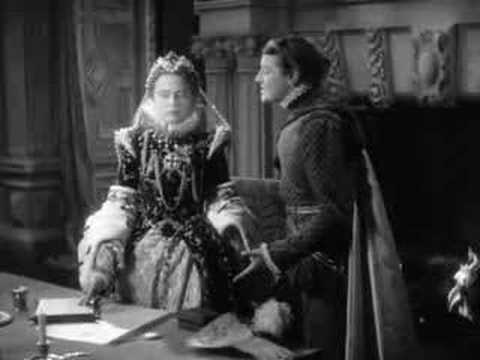
Mary of Scotland (John Ford, 1936) The film, written by Dudley Nichols from Maxwell Anderson's play, begins with an odd preamble, giving an overview of the whole Mary, Queen of Scots/Elizabeth R situation, and ending with the hopeful suggestion that they are "all equal now," buried close to each other in Westminster Abbey. Cheery thought, and, despite what the play and movie say, the only time that Elizabeth and Mary were in the same room together.*

It's a problematic film. betraying its stage roots (the speeches are very formal, stylized, and performed theatrically, with no overlap and AT THE TOP OF EVERYBODY'S LUNGS, as if trying to reach the last row of the balcony) although Ford works overtime to find interesting angles to shoot from. So much Hollywood gossip swirls around this film**part of Hepburn's "box-office poison" cycle (she'd just bombed with Sylvia Scarlett and more were on the way)—that one is hesitant to bring it up as sources for the film's problems, which are many. 

But the main fault lies with Anderson's play, which lionizes Mary (Katherine Hepburn) while demonizing Elizabeth, and the production goes right along with it—Mary's first lines are a prayer to God for returning safely to Scottish shores, while Elizabeth's is ordering people around and played (by Florence Eldridge) as if she were Edward G. Robinson. It would have been nice if this subject were a little more nuanced, as it involves two strong women in positions of power with men as being subjective, if constant irritants. One wishes that the two could have gotten together and agreed that all the men surrounding them were jerks and done something about that, rather than engaging in power plays for England's throne.
But, that's not how history went, and the play plays fast and loose enough with the facts as it is. And this is Mary's movie, to the point where Hepburn is the only cast member with close-ups—jarring close-ups that have the feel of insert shots as the lighting changes dramatically from the establishing shotsElizabeth is only seen in full shots that emphasize costume over performance.
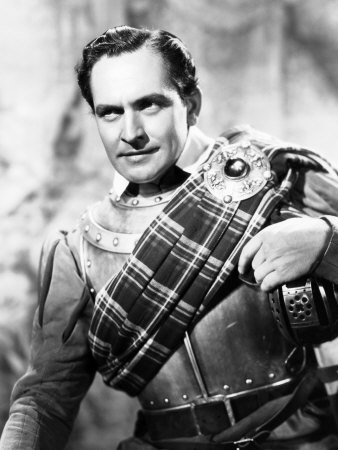
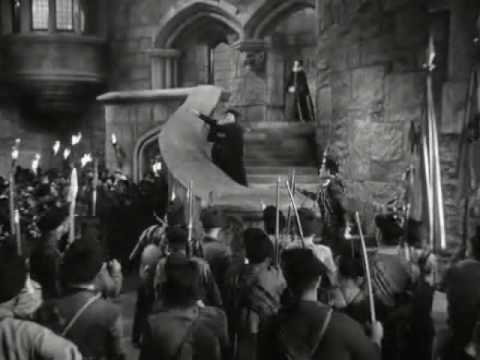
There are joys to be had, though. Ford's penchant to use unruly horses is much in evidence, and the animals are particularly out of control on the sound-stages that dominate the film. And Frederic March is something of a revelation, boisterous and accented, his is the best performance in the film. And Ford's presentation is never less than spectacular, as has been mentioned, giving the film a scope that it wouldn't have had in other's hands.
 
 
A not-altogether successful film, but interesting to see.


* This is a problem with most of the films dealing with Mary, Queen of Scots—historically, they never did appear (that we know—something Lucy Worsley might some day let us in on it) in the same room, although there were letters sent back and forth. It might have something to do with studio politics and ginning up the drama. Traditionally, the two have been played by stars (Vanessa Redgrave and Glenda Jackson in 1971's Mary Queen of Scots, and more recently Saoirse Ronan and Margot Robbie in 2018's Mary Queen of Scots) and so there must be some re-writing of history in order to get Acting Queens to spar off each other, even if the real Queens did not.
 
** Ford was unhappy making it, and—as he occasionally did—walked off the film in the midst of shooting on day. I can't be sure, but when I read Hepburn's autobiography, I seem to recall her saying that she directed for the rest of the day and seemed to think nothing of it. And...take a look at this scene on YouTube. There is a portion where Mary addresses James Stuart, Earl of Mowbray, where the conversation is at cinematically clashing angles, perhaps to favor a flattering angle...well, let's face it, of both actors. It's an odd choice by Ford if he, indeed, did make it.