Showing posts with label William Cameron Menzies. Show all posts

Saturday, January 18, 2025

Deadline at Dawn

Deadline At Dawn
(Harold ClurmanWilliam Cameron Menzies , 1946) One of those movies that, I'm sure, grows on you over time, once all the shocks have worn off.
 
But, if you're peeping at it in for the first time...well, all I can say, pally, is it's a lot to take in. Oh, it's got a lot of familiar tropes of the noir-type: everything takes place at night, shadows seem to be the popular decor, there's good people and bad people, good people get accused of doing bad things, there are a couple of desperate chases between desperate people, and it's entirely black-and-white, the only color being the complications along the way which are, more times than not, red herrings. And if you can't follow it too well, that's understandable because it starts getting confusing with in the first ten minutes. Watching it drunk or sober won't help you with the film's terrain—you're going to be bumping into walls either way. Oh, and don't get attached to characters because most of them will disappear before the sun comes up. It's not that they die or anything, it's just that they have their fifteen seconds in what passes for a spotlight in a film-noir and then they just go away, never to be seen again. That's life in the big city.
Enough with the opening narration (there isn't any, that would be too helpful). A sailor-boy (Bill Williams) is gonna be shipped off to his next hell-hole and he spends the eve of it getting black-out drunk. He wakes up at a newsie's where he's been sleeping it off with no idea where he's been or what he's been doing. All he knows is that he's got $1400 bucks he didn't know he had. "Found money" is always a nice surprise, but not when there's four hours to kill and you're a possiible target. What better thing to do than hide in the arms of a frail (you could always use her for cover!), so he goes to a dance club and ends up with a handful of a hostess named June Goffe (Susan Hayward) who's dead-on-her-feet and doesn't get interested until sailor-boy shows her his $1400 wad. Naturally, she invites him over to her place for a sobering sandwich and the story of how he got it...if he can remember.
Pretty soon, things start going "Hayward". The sailor isn't as much of a shoe-cruncher as she thought he was but insists on thinking of him as "a baby." But, he had managed to crawl to a drinks-provided poker game (not sure if that's a euphemism or not) at the apartment of Edna Bartelli (Lola Lane), who, with her brother (Joseph Calleia) regularly ran a scam of luring rubes off the street and then robbing them of their wits and their bankroll. Somehow, he'd gotten the better end of the deal with more money than he could spend in four hours. But, he's "a baby" and he wants to return the money because it's the right thing to do (even to people who'd rolled you) and he doesn't want to spend his last four hours of furlough looking over his duffel bag to see if the cops are looking to pick him up for theft. He is in uniform, after all.

Yeah, well, no good deed goes unpunished and sometimes you get exactly what you're trying to avoid, especially in noir movies. June and Alex ('the baby") go over to the address and instead of finding the woman dead-drunk (like he left her), they find her just plain old dead. Like he left her? Well, that's the question. Either June's running around with a killer or there's a killer somewhere else running around after them. That's the question. And they only have a shrinking four hours before Alex gets deployed.
"I hear a whistle blowing" says June, metaphorically
...or is that "Odetically"?
It has the simple par-boiled "jeopardy" plot one comes to associate with its original author Cornell Woolrich (he wrote the original stories for Rear Window, The Bride Wore Black, The Window, Mississippi Mermaid and Phantom Lady) where "trust" (or lack of it) is the one thing drum-soloing through the characters' minds as they try to unravel the plot. But, Deadline at Dawn doesn't so much provoke a sense of associative paranoia as "what in the black-and-blue-blazes are you talking about?" It's scripted by Clifford Odets, who wrote it as a favor to his old Group Theater pal, director Harold Clurman, and it is Odets at his Fink-iest, feeding lines to the cast that are all starch and pepper. Odets took theater out of the drawing-room and into the tenements—and a lot of Deadline at Dawn takes place on the streets and back-alleys of early-hours New York.
Oh, it begins interestingly enough, as we watch a blind ex-husband (Marvin Miller) of future murder-victim Edna Bartelli hammer on her door to collect the $1400 she promised she had for him (the very money the sailor-boy had made off with)—and our introduction to her is properly sordid for the "Code" days where she's so stinking drunk that a fly is pirouetting around on her face. The ex is blind-mad: "You'll never change, Edna. You're bad. I loved you very much. But you're bad." 
But, once we leave the place for the murder to happen, "
Golly, the misery that walks around in this pretty, quiet night." Everybody's kvetching, philosophizing, giving you their dime's worth when all you wanted was a nickel. And complaining about the heat even though nobody's sweating much. Everybody's an overripe wise-guy even the cabbie (Paul Lukas) who hears June's "misery" comment replies with "the logic you are looking for... the logic is that there is no logic. The horror and terror you feel, my dear, comes from being alive. Die, and there is no trouble. Live, and you struggle." I don't know that she was searching for any "logic" there, just making idle conversation. But, everybody's over-explaining in Odets-burg, like when another cabbie bleats "Listen, I don't wanna get in no trouble. I work. I'm just a parasite on parasites." TMI, buddy! Especially with a paying customer in your hack.
Deadline at Dawn is filled with such distractions and so many blind-alleys that you can get lost very easily, but despite the density of the population on display, the solution returns you to the same bubble-world that feels a little too neat for all the obfuscation of the community-building going on. Maybe that was to enrich the plot, but it does nothing to ramp up the tension or unease one usually finds from Woolrich. One shouldn't substitute "overwritten" for "overwrought."

Friday, July 22, 2022

H.G.Wells' Things To Come

They (Stanley Kubrick and Arthur C. Clarke) also screened many films, including Destination Moon, The Day the Earth Stood Still, and Forbidden Planet. Kubrick soon discovered that Clarke was far too forgiving of material he found embarrassingly shallow and badly made. When the author insisted he screen the 1936 British science fiction classic Things to Come, written by H.G. Wells and based on a number of his stories, Kubrick "exclaimed in anguish, 'What are you trying to do to me? I'll never see anything you recommend again!'" Clarke remembered in 1972.
Space Odyssey, Michael Benson © 2018
I cannot imagine Stanley Kubrick "exclaiming in anguish" so much as mocking testily. But, if the director did indeed say that, he did have a point. Wells' later science fiction work in light of "The War That Ends All Wars" casts its eye less on the fantastical and more on the sociological, with the world's fate hanging on the desires of the gifted and the merely covetous. It may sound fine in the abstract, but Wells seems to forget that History is the slaughterhouse registry of the Powerful against the power-less.
It is 1940, and a Christmas party is being thrown by scientist John Cabal (Raymond Massey). But the festivities are overshadowed by the fear of an imminent war being radioed on the news. Cabal's fellow guest Harding (Maurice Braddell) is also glum, but Pippa Passworthy (Edward Chapman) is not so pessimistic, and looks on the bright side—even if it happens, it will spur technological progress, which is a good thing, right? Cabal sticks to the basics: "If we don't end war, war will end us." And, as if to mock everyone's sentiments, the attacks begin that night.
It turns out that everybody is right. The war does advance technology, at least in the sort of armored vehicles and flying battalions that reign terror. As for the people, they are literally bombed into the stone age, fleeing to underground bunkers and sewers for protection from the devastation, and, in their struggle to survive, allow themselves to be ruled by autocratic strong men—their proverbial man on a white horse—who fill the vacuum and their pockets as those craving power always do. In this case, it's "The Boss" Rudolph (Ralph Richardson), who has taken over the management of "Everytown" since the end of the war in 1966. But, the conditions have led to a pandemic of a final biological tactic, "the wandering sickness," and "The Boss" ignores the efforts of Dr. Harding (Maurice Braddell) with his own solution—shoot the sick down in the street, and expands his plans by ordering his mechanic, Richard Gordon (Derrick De Marney) to try to fix the remaining planes to bomb the outliers beyond his control in "The Floss Valley" and take over their deposits of oil and shale to turn into oil for the planes.
But, in 1970, an answer arrives from the skies. John Cabal arrives on a newly designed airplane and informs Harding and Gordon that he has come from Basra, Iran, where survivors of the war have established a new government, World Communications, where mechanics and engineers have formed The Brotherhood of Efficiency to bring new technology to the survivors to rebuild civilization and join the new government in banning war and advancing mankind. Sounds good, except to the guy in charge. Following the maxim that "Equality is seen by the privileged as oppression," Rudolph captures Cabal and forces him to work with Gordon on the old planes, but his plans are thwarted when the "Wings Over the World" contingent of World Communications is alerted to, and they fly over, releasing their "peace gas," which sounds like a bad euphemism, but merely gives the citizens a good night's sleep.
All except for Rudolph, who has a bad reaction to the "peace gas"—a fatal conflict of interest, maybe—and dies. It's a little convenient, but metaphorically apt, it seems. It allows Cabal to announce that old autocracies are as dead as Rudolph, allowing a new world to start, allowing "a new life for mankind." No one mentions that it also means no technological solution can be perfect.
 
And...scene.
There follows another montage of the building of that "new life" as the world's population moves underground and start building new bright and shiny civilization-cities, where people are able to progress and live in peace. So much so, that Cabal's grandson Oswald (Massey again) looks to conquering new worlds and expanding our horizons off the Earth with a planned moon-shot. But...there's always gotta be a critic. "Sure, you can Build Back Better," but how are ya gonna pay for it? In this case, it's the sculptor Theotocopulus (
Cedric Hardwicke), who's pissed because he's lost an art grant of something because of all the money spent on Cabal's space-cannon, or something. 
Actually, no. His argument is less practical. He believes that humanity is tired of progress. "All sorts of people" are saying it, I guess. Enough so that he forms a mob to try and storm the space-cannon to try and stop it from launching (wouldn't you volunteer to stop a rocket launch...like one of those Saturn 5's that turn the surrounding acreage crispy?). But, Cabal, having seen the rise of petty autocrats before, decides he's going to ignore the mob (in all his Randian objectivism) and is able to send the manned probe into space, despite the Luddite uprising, and looks to the audience and intones "All the Universe, or nothing? Which will it be? Which will it be?"
Me? I'd look for a third option.

I gently mock, but Wells' story is all vague philosophizing without any practical demonstrations or innovations. Things look nice, and all, in that futuristic Fritz Lang Metropolis kind of way.* But, is everybody benefiting from the new technology? Is everybody housed and fed? Is everybody working...or do they need to work? And if they're working, are they working for bad bosses? And this "Brotherhood of Efficiency"...if they're using "metrics", you can count me out. There's no details here, just a sleek gloss-over. And the black and white of it isn't just in the photography, but in the binariness of choices. Is it always just a choice between progress and...(oh, what's the opposite of "pro?" Oh, yes) "congress?" And Wells' thinking seems to be that all the world needs to get along in technological advancement (if, of course, everyone advances equally regardless of class or income—if, indeed, there are such concepts in his utopia). One would argue that television, the computer, and the internet all have negative consequences, despite the best of intentions. Maybe even enough to tilt things out of balance. There's a limitation to what you can convey with a monolithic society...as opposed to extra-terrestrial monoliths
Kubrick did take something from Things to Come, though, and that is in the use of long stretches of montage, not to convey the passage of time (he did that in a single famous edit), but, rather, as a visual instruction manual on how things have changed and have become in the film (despite the technological advancements and accomplishments) every-day and banal. As a result, there are less moments of upturned faces and speechifying in grandiloquent tones. That seems less human to me and more autocratic, which, if I'm reading the film correctly, is just the sort of Coming Things Wells cautions against.

* One should put out that Things to Come is probably most influenced by Metropolis, which was made just nine years earlier, right down to the binary philosophical arguments, although Lang (and his scenarist Thea von Harbour) did come up with that third option. Mind? Heart? How about working in conjunction?

Tuesday, May 29, 2018

The Thief of Bagdad

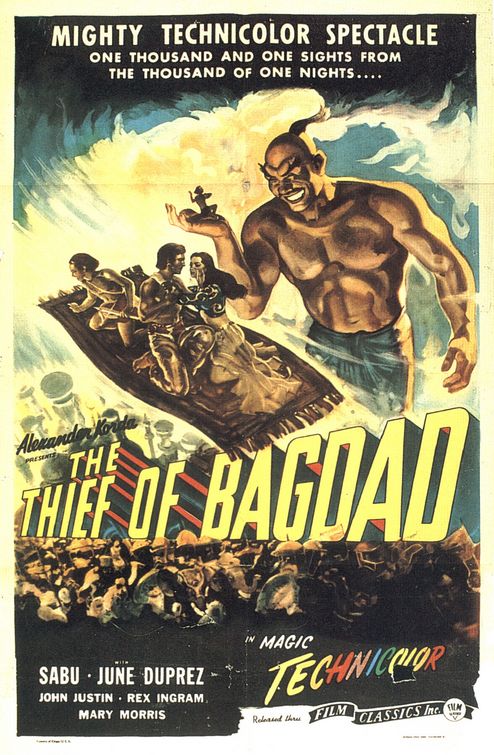
The Thief of Bagdad (Michael Powell, Ludwig Berger, Tim Whelan, etc., 1940) Epic Alexander Korda production, with considerable work from his brothers Vincent and Zoltan, and the grand production designer William Cameron Menzies, that boasted three directors, filming on two continents (interrupted by the Blitz) and became a fantasy favorite.

It's still amazing, even if the two leads are a little leaden (and if we don't get too picky that all of the featured players are extraordinarily ethnically inaccurate—
Sabu was born in Mysore, then a part of British India, and Conrad Veidt...was German!), but if one takes it with a light-heartedness, and a mighty roaring laughter worthy of the Djinn (played by the larger-than-life—even without special effects—Rex Ingram), there are more than enough wonders that would enchant and entice a watcher (as it did with the young Francis Ford Coppola and Martin Scorsese, who both count it as their favorite childhood film).
Because it all comes together, all the disparate elements in eye-popping Technicolor, that somehow manages to make the real world look drab and shabby by comparison. I've had that experience where movies change your outlook:  every new Orson Welles film made me see the world—and its possibilities—differently; a theater screening of the cinematography documentary Visions of Light was followed by an extended parking lot discussion in which the lights of the city (even in that drab corner of Seattle) never looked more beautiful to the eye; a screening of Don't Look Now (in the very same theater, coincidentally) had me walking back to the car, obsessively looking for the color red.
And The Thief of Bagdad has that same effect. Between Menzies' sets (and his insistence on how they be filmed), the vibrant color sense and stylishness of the entire production, one yearns that movies might be more like this one, let alone the world (oh, by the way, give me a chance at those three wishes)...and isn't that illusion why we go to the movies, anyway?

The visually eye-popping The Thief of Bagdad