Showing posts with label Edward Arnold. Show all posts

Tuesday, April 4, 2023

Come and Get It!

Come and Get It
!
(Howard Hawks
, William Wyler, Richard Rosson* 1936) Edna Ferber's novel was purchased by Samuel L. Goldwyn to turn into a Hollywood blockbuster and Howard Hawks hired to direct. But Hawks was a maverick, and when Goldwyn came back from a long illness to see how things had progressed, he was shocked, shocked (I tell you), to see that Hawks had drifted afield of the Ferber source novel. For one reason or another, Hawks was fired (or quit, depending who was asked) and replaced by Goldwyn favorite William Wyler (who was just finishing up Dodsworth for Goldwyn).
 
The result is a revelation on very many levels: that Hawks' signature style was so evident it couldn't be mistaken for any other director; that the difference between Wyler's and Hawks' scenes are night and day; that Edward Arnold, known to modern audiences as a supporting player in Capra films could carry a movie so handily; Walter Brennan could be a versatile and nimble actor; and that Frances Farmer was an incredibly gifted actor of enormous facility and subtlety.
The story of a logging "pirate," Bernard Glasgow (Arnold) falls in love with a saloon girl (Farmer), but gives her up to marry the boss's daughter, win himself a partnership and become one of the richest men in Missouri. Hawks' part is a fast-moving, rollicking story of rapacious men grabbing as much as they could to line their pockets. Shot in mostly waist-level fast set-ups, with a rarely moving camera, the emphasis is what's in the frame and not how it's framed, so most of the scenes are crowded with people, the actors stepping over each other's lines and character bits of business that are not called attention to (including the requisite cigarette lighting without being asked). Highlights are a saloon fight with serving trays used as dangerous flying discs, a couple of fights in which Arnold solidly smacks his opponents, a game of chance turned on its ear, and an Oscar-winning turn (the first to be given to a supporting actor) by Walter Brennan, rangy, ebullient and sporting a high Swedish accent.
But Farmer steals this section (she dominates the whole movie, actually) with her performance as the ultimate "Hawks dame:" her Lotta Morgan is gum-chewing, moose-jawed, with big movements and a dusky drawled voice, with more than a hint of Marlene Dietrich's insolence (courtesy of frequent Hawks collaborator Jules Furthman, who'd written a couple Dietrich films). That Farmer then plays her daughter (also named Lotta) later in the film in a high-toned, fluttery manner—she even sings differently—with a more subdued jaw-line and a smile not so crooked as her mother's is one of those nuanced things of such complexity that you remember how clever these "old" movies can be.
Farmer is able to keep up the performance when Wyler takes over, and it's pretty obvious when that is—when the Bostrom clan and Glasgow (now smitten with the daughter of the woman he left behind) take a fancy trip to Chicago. The pace slows. The actor's get out of the way of each other's lines.** The Gregg Toland photography is a bit more finicky and lush, not having to rush to make Hawks' schedule but accommodating to Wyler's. Scenes are staged more angularly and more obviously, telegraphing future camera moves and upcoming "business." And attention is paid to more obvious scene-fussiness, even to including cut-away's—a boy-girl flirtation is built around a taffy pull, and a later scene between Glasgow and his daughter doesn't communicate their "reflection of each other" relationship as Hawks did, but is, instead, based around a child's balancing toy. Wyler has enormous taste and style, but as much as he tries to emulate Hawks' off-the-cuff way of doing things, the more it feels staged and unnecessary, even making more of a Joel McCrea ad-libbed-over gaffe in Hawks's section than is necessary.

Hawks is more adept at making his points, too. Where he has a quick discussion of the duplicity of homesteading to acquire more timber land from the government for nothing ("Well...it's not illegal" says the company CEO), and shows Glasgow's utter disregard for re-planting ("Ah, nothin'll grow back there!"), whereas
Joel McCrea's son has the "planting for the future" line in Wyler's section—a conversation that puts the older Bostrow's to sleep.
It's an interesting study in contrasts in directing style—Hawks's attention to material and Wyler's attention to presentation—that may be lost on those caught up in Ferber's soapish story ("the famous novel by Edna Ferber" is how it's described in the credits. There's plenty of reason to go hunting for this film. And a hunt it will be; this film is notoriously snake-bit.
*** Maybe because of the melodrama behind the scenes, or Goldwyn's lack of enthusiasm for the result—the film went way over budget, capping at more than a million 1935 dollars—and was not a box-office success. Then there's the troubled career of Frances Farmer, which no studio wanted to gamble on promoting. For whatever reason, Come and Get It!, holds up very well and seems downright prescient for its asides on ecological issues and corporate ethics. And it is the film that Farmer was proudest of, despite its many issues in front of and behind the camera. She would never be as satisfied with her work and the conditions to achieve it again in her life.

Come and Get it! premiered in Seattle, Washington at The Liberty Theatre, where Frances Farmer had once been an usherette.

"Our Lady of Perpetual Rebellion:" Frances Farmer
Publicity Glamour photo by George Hurrell

* With all the attention made to Hawks' and Wyler's separate efforts there was a third director for Come and Get It!—Hawks's talented assistant director Richard Rosson who traveled to Idaho to photograph the incredible logging footage contained in the early part of the film.

** Is it preposterous for me to think that Wyler was taking a jab at Hawks' dialogue direction by having Brennan and Mady Christians—playing his niece—stop a conversation dead by saying the same thing over each other a couple times and then give up trying to inject into the conversation?

*** As an indication of this on a personal note, it took far more effort than normal to find a vintage poster of Come and Get It!. Until the last minute, the best I could uncover was a newspaper ad.

Tuesday, October 25, 2022

The Devil and Daniel Webster (1941)

The Devil and Daniel Webster (aka All That Money Can Buy) (William Dieterle, 1941) I've known about this film for years, because it was the film that won composer Bernard Herrmann his only Oscar for Best Score ("of a Dramatic or Comedy Picture"), over 19 other scores nominated that year, including his own music from Citizen Kane
 
The score is the stand-out element of the movie, with Herrmann accompanying the presence of "Mr. Scratch" with a particularly saw-toothed violin jig that raises the hair on the back of your neck. It is for sure that Academy voters had never heard anything quite like it, even if it did include some American folk-tunes (including "Pop Goes the Weasel!"). I was well acquainted with the music before I could track down the actual film.
It tells the story of Jabez Stonr (James Craig) a farmer, not making it in 1840 New Hampshire, who sells his soul to the Devil (Walter Huston) for seven years of prosperity, which he gets, along with a swelled head, the enviousness of the community, and a reputation as a cruel businessman and a cool husband. Still, he is prominent enough to make the acquaintance of Daniel Webster (Edward Arnold), famed orator, lawyer and politician—who has (so far) resisted Scratch's offer to make him President of the United States. But, as the contract date comes near, Mr. Scratch doubles down on the offer, tempting Jabez for the soul of his new-born son. Stone turns to Webster for legal help with the Devil, naturally.
The Devil and Daniel Webster, adapted from the Stephen Vincent Benet's 1936 short story published in The Saturday Evening Post, had a checkered history at the studio, though. After doing less than blockbuster business, RKO Studios cut it by 20 minutes and released it with a sexier, less folksy ad campaign (see right) under the name All That Money Can Buy, which would seem  to celebrate the profligate life-style its protagonist comes to regret wishing for in the film, rather than the altruistic, socialist one ultimately preached.
It seems that Jabez Stone only really finds redemption until he's joined the Grange. I may be revealing the ending here, but, really, the outcome is inevitable considering the extraordinarily heavy hand that is used to show the tyrannies of wealth, lust, and greed that are the by-products of selling your soul to the Devil. Fortunately, the great orator
Daniel Webster is around to plead the case for the defense when a breach of contract occurs. Usually these scenes are the highlights, but in this film it's a disappointment. 
Even though played vigorously (by the least likely actor,
Edward Arnold, well-known for playing power-brokers and fascists in many a movie) the Webster homilies that are spun are so much sentimental goo and would curl the lip of Aimee Semple McPherson, much less the hardened denizens of Hell that make up the jury in the matter. Even Frank Capra must have rolled his eyes. But Dieterle seems to have shirked those sections to go all-out for his scenes with The Devil. Mr. Scratch's entrances are extravaganzas with light and smoke, he has the best lines (of course), and a truly creepy performance by Walter Huston (John's dad) with maliciously twinkling eyes, and a smile that's so broad that it may turn feral at any moment. Huston is the thing to see in this film, although Jane Darwell (Ma Joad from The Grapes of Wrath) and Simone Simon (just before she became big with Cat-People) do wonders with their material as well.

Friday, May 21, 2021

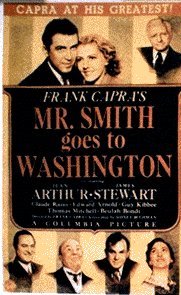
Anytime Movies #6: Mr. Smith Goes to Washington

While I catch up on the reviews still in "Draft" phase here, I'll re-run a feature I ran when I first started this blog seven years ago,* when it was suggested I do a "Top Ten" List.

I don't like those: they're rather arbitrary; they pit films against each other, and there's always one or two that should be on the list that aren't because something better shoved it down the trash-bin.

So, I came up with this: "Anytime" Movies.


Anytime Movies are the movies I can watch anytime, anywhere. If I see a second of it, I can identify it. If it shows up on television, my attention is focused on it until the conclusion. Sometimes it’s the direction, sometimes it’s the writing, sometimes it’s the acting, sometimes it’s just the idea behind it, but these are the movies I can watch again and again (and again!) and never tire of them. There are ten (kinda). They're not in any particular order, but the #1 movie IS the #1 movie. 

I’m very suspicious of patriotism (I always recall the "last resort of a scoundrel" remark), yet nothing moves me so much like a movie extolling the virtues of America. The promise "to form a more perfect Union," as it was outlined in The Constitution, as opposed to lining people's pockets, or to lionize the undeserving, or to maintain the status quo because it's comfortable.

Anybody who's fought for this country knows it's not comfortable (and if they did, they were promoted too soon!)

It wasn’t until I was voting on the
Emmy’s that I sat down and watched TV's “The West Wing.” I figured it was going to be a vapid “America-Love It or Leave It” tract (starring Rob Lowe), even if it did have Martin Sheen playing the President, in which case, I could leave it. But TWW was a serious look at government work—its glories and  disappointments, the combination of ego and sacrifice. It could criticize individuals and “ideology for ideology’s sake,” but one thing it never ever criticized was the idea of Public Service, no matter what side of the aisle it was on. At the same time the country is being run by crooks specializing in an institutionalized form of bribery and graft, there is an infrastructure of people for whom government service is a sacred trust (well, there’s gotta be ONE!) “The West Wing” paid tribute to that corps of people wherever they might be, week after week, and it made for refreshingly positive TV. It also made for a refreshing look at our nation as it stands.

And so, too, does
Mr. Smith Goes to Washington. Made in 1939, it plays like it was written yesterday. When I saw it for the first time—right after “Watergate”—I found it amazingly prescient. But, no, it was talking about its own times. The problems just keep re-occurring again and again. And again. Whoever doesn’t know history is doomed to repeat it, and with every fresh crop of people governing, they’ll keep making the same mistakes. Maybe they think they’re unique. Maybe they just don’t know history. They say that if you keep making the same mistake over and over, it’s a sign of insanity. Well, psychology never factored in term limits.

Mr. Smith… is the story of a local youth leader who is appointed to the Senate after the incumbent suddenly dies. This runs afoul of the state’s political machine that ran that late senator as well as the state's senior Senator, Paine (Claude Rains)—who just happens to be an idol of the new senator’s. But, "The Machine" lets it happen, as Smith is a yokel, and their boy, Paine, will be able to keep him in line.
It wouldn’t work if director Frank Capra didn’t have tall awkward Jimmy Stewart—not James, Jimmy—whose every stammered syllable bespoke humility. But get him talking about America or Liberty of The Capitol Dome and the stutter disappears in a fervent stage whisper that trails off in awe. Mr. Smith isn’t sure of himself, but he’s sure sure of the Country.
And Washington, D.C. is just the place to shake him up with a few lashes of the Beltway. Stewart could be frustratingly folksy, but for Capra (and for Hitchcock and Anthony Mann) he could be unnervingly vulnerable and, at the other end of the bi-pole, dramatically unhinged. The last act of Mr. Smith…—the filibuster against false charges of graft—features Stewart in both phases. At one point, he's knee-deep in political hate-mail, clutching it in his hands and looking skyward like Jesus at Gethsemane. Then a few short paragraphs about “lost causes” later, he’s at his most defiant. “You think I’m licked! You ALL think I’m licked!!” That was his Oscar-winning performance, not the next year’s The Philadelphia Story where the “cynical reporter” bit just didn’t wash with someone who looked so homespun. The filibuster scene always brings a lump to my throat, and it’s not sympathy pains for Stewart’s frayed larynx.
Now, I’ve read the original screenplay to “Mr. Smith Goes to Washington.” It ends with a big parade honoring the completely vindicated Smith, surrounded by his boy-rangers, supported by the woman-he-loves (Jean Arthur, again, who manages to make her extraordinarily jaded Senate Aide adorable, even when she’s at her worst—and she has a great drunk scene with Thomas Mitchell. Hmmm, Thomas Mitchell, again). Why, even the disgraced Senator Paine is being lionized in the sequence. Oh, it’s just so sweet, your eyes could roll back in their sockets and jam and stick that way. As Arthur’s Miss Saunders tipsily says in the film, “Nah, I can’t think of anything more shappy!” “Capra-corn” is what the very self-aware director called it.
So, he cut it. Orson Welles has said: "If you want a happy ending that depends, of course, on where you stop your story." Capra leaves his story’s ending ambiguous. Oh, you could call the riotous goings-on at the end a Happy Ending—but all of Paine’s Senate pals are trying to calm him down, telling him it’s okay…everything’s all right, we're still on your side. The only solace Jefferson Smith is granted is in the sympathetic smile from the Vice-President (played by John Ford’s silent cowboy film-star Harry Carey) before he collapses in a heap of his enemy’s mass-generated letters. The movie "celebration" has all the weight of an Al Gore victory celebration on Election Day 2000--a case of premature exaltation. But nothing's been solved. No one's been cleared. Nothing has been decided. There is just misunderstanding and confusion. Carey leans back and has a chaw while the chaos of Democracy continues unabated. It may not be a "happy" ending, considering the sequence that was shelved. It may not even be a dramatically satisfying ending. But it is representative of the loud, messy process that turns the gears of Democracy. 

However slow-moving, however off-course, they still turn.

Jeferson Smith (Jimmy Stewart) looks for guidance.

Anytime Movies:
Chinatown
American Graffiti
To Kill a Mockingbird
Goldfinger

Bonus: Edge of Darkness

Washington turns out for the Mr. Smith premier—they weren't happy.
From Wikipedia:  "Alben W. Barkley, a Democrat and the Senate Majority Leader, called the film 'silly and stupid', and said it 'makes the Senate look like a bunch of crooks'."

* And, on Sunday, we'll put up a "Don't Make a Scene" feature from each week's film.

Saturday, February 13, 2021

My Brother Talks to Horses

Saturday is traditionally "Take Out the Trash" Day....

My Brother Talks to Horses (Fred Zinnemann, 1947) Oh now, THIS is a curiosity...Ten years after he'd immigrated to the U.S. from Austria and started making short films at M-G-M, five years after graduating to B-features and three years after his first hit for the studio, The Seventh Cross (starring Spencer Tracy), director Fred Zinnemann—who would go on to make High Noon, From Here to Eternity, A Man for All Seasons, The Nun's Story, The Day of the Jackal and other great films—made this odd one, his second film in a row to feature child-actor Jackie "Butch" Jenkins.

Jenkins had been a hit with audiences in roles in The Human Comedy and National Velvet, where he was a spunky little performer, far afield from the "perfect-looking" child stars that M-G-M usually trotted out in kid roles. Young Jenkins had lazy wide-set-apart eyes and splayed teeth and perpetually looked like that "phase" your parents hope you grow out of. But, he was just popular enough to graduate from playing Mickey Rooney's little brother to...Peter Lawford's little brother...? Well, at least he gets top billing.
Young Master Jenkins plays Lewie Penrose, an odd little boy from an odd little family just this side of Thornton Wilder, living in the Baltimore of 1909. Ma Penrose (Spring Byington) insists that her dinner guests practice yoga before saying pre-meal grace. Ma's boarder, Mr. Puddy (an inventor) is proud to offer the diners his latest invention for refreshment—beer...in an edible bottle. Ma's other son John (Lawford) is an inventor, as well, and he's courting Martha Sterling (Beverly Tyler) but his prospects are meager if his affections are ardent.
Lewie talks to horses, all kinds of them. His best equine friend is The Bart, a racehorse owned by Mr. Bledsoe (Edward Arnold), with whom he regularly converses on his way to school. The Bart's trainer, Mr. Mordechai (Ernest Whitman) confirms this. Complications ensue, especially when Mr. Bledsoe takes Lewie and John to the races, and after having a confab with the horses, confidently tells the party who's going to race...and that horse then does. Word gets around and pretty soon everybody, including some pretty shifty gamblers, see Lewie as a way to get rich quick. That's a lot of pressure to put on a kid.
It's lightweight stuff, and what the filmmakers do with it takes on some dark tones, especially when the gamblers start to rough little Lewie up. I'm not sure that a little darkness in a kid's movie is a bad thing, but if I were a gifted child and saw the complications that this movie described, I might want to act a little less gifted. Adults are creeps!

On the other hand, it is not too surprising to see Zimmermann's touch on this—especially once one has seen it. For a low-budget kid's movie, it looks very good and revels in its period details—so many straw hats and fascinators! It's not that much a leap to see how Zinnemann would leap into one of the great movie craftsmen, able to pick and choose his assignments—I mean, if he can make My Brother Talks to Horses look good...—and his next movie—also a kind of kid's movie—would provide the good transition from making entertainment for kids to entertainment for adults, without insulting the intelligence on anybody. Not even the horses.

Wednesday, May 14, 2014

Anytime Movies (Transplanted): Mr. Smith Goes to Washington

While I have a few reviews "in the works," It's as good a time as any to re-boot (actually transplant from the old movie blog) a feature I started years ago, when it was suggested I do a "Top Ten" List. 

 I don't like those: they're rather arbitrary; they pit films against each other, and there's always one or two that should be on the list that aren't because something better shoved it down the trash-bin. 

 So, I came up with this: "Anytime" Movies. 

 Anytime Movies are the movies I can watch anytime, anywhere. If I see a second of it, I can identify it. If it shows up on television, my attention is focused on it until the conclusion. Sometimes it’s the direction, sometimes it’s the writing, sometimes it’s the acting, sometimes it’s just the idea behind it, but these are the movies I can watch again and again (and again!) and never tire of them. There are ten (kinda). They're not in any particular order, but the #1 movie IS the #1 movie.


I’m very suspicious of patriotism (I always recall the "last resort of a scoundrel" remark), yet nothing moves me so much like a movie extolling the virtues of America.

It wasn’t until I was voting on the
Emmy’s that I sat down and watched “The West Wing.” I figured it was going to be a vapid “America-Love It or Leave It” tract (starring Rob Lowe), even if it did have Martin Sheen playing the President, in which case, I could leave it. But TWW was a serious look at government work—its glories and disappointments, the combination of ego and sacrifice. It could criticize individuals and “ideology for ideology’s sake,” but one thing it never ever criticized was the idea of Public Service, no matter what side of the aisle it was on. At the same time the country is being run by crooks specializing in an institutionalized form of bribery and graft, there is an infrastructure of people for whom government service is a sacred trust (well, there’s gotta be ONE!) “The West Wing” paid tribute to that corps of people wherever they might be, week after week, and it made for refreshingly positive TV. It also made for a refreshing look at our nation as it stands.

And so, too, does
Mr. Smith Goes to Washington. Made in 1939, it plays like it was written yesterday. When I saw it for the first time—right after “Watergate”—I found it amazingly prescient. But no, it was talking about its own times. The problems just keep re-occurring again and again. And again. Whoever doesn’t know history is doomed to repeat it, and with every fresh crop of people governing, they’ll keep making the same mistakes. Maybe they think they’re unique. Maybe they don’t know history. They say that if you keep making the same mistake over and over, it’s a sign of insanity. Well, psychology never factored in term limits.

Mr. Smith… is the story of a youth leader who is appointed to the Senate after the incumbent dies. This runs afoul of the state’s political machine that ran that senator as well as the senior Senator, Paine (Claude Rains)—who just happens to be an idol of the new senator’s.
It wouldn’t work if director Frank Capra didn’t have tall awkward Jimmy Stewart—not James, Jimmy—whose every stammered syllable bespoke humility. But get him talking about America or Liberty of The Capitol Dome and the stutter disappears in a fervent stage whisper that trails off in awe. Mr. Smith isn’t sure of himself, but he’s sure sure of the Country.

And
Washington, D.C. is just the place to shake him up with a few lashes of the Beltway. Stewart could be frustratingly folksy, but for Capra (and for Hitchcock and Anthony Mann) he could be unnervingly vulnerable and, at the other end of the bi-pole, dramatically unhinged. The last act of Mr. Smith…—the filibuster against false charges of graft—features Stewart in both phases. At one point, he's knee-deep in political hate-mail, clutching it in his hands and looking skyward like Jesus at Gethsemane. Then a few short paragraphs about “lost causes” later, he’s at his most defiant. “You think I’m licked! You ALL think I’m licked!!” That was his Oscar-winning performance, not the next year’s The Philadelphia Story where the “cynical reporter” bit just didn’t wash with someone who looked so homespun. The filibuster scene always brings a lump to my throat, and it’s not sympathy pains for Stewart’s frayed larynx.
Now, I’ve read the screenplay to “Mr. Smith Goes to Washington.” It ends with a big parade honoring the completely vindicated Smith, surrounded by his boy-rangers, supported by the woman-he-loves (Jean Arthur, again, who manages to make her extraordinarily jaded Senate Aide adorable, even when she’s at her worst—and she has a great drunk scene with Thomas Mitchell. Hmmm, Thomas Mitchell, again). Why, even the disgraced Senator Paine is being lionized. Oh, it’s just so sweet, your eyes could roll back in their sockets and jam and stick that way. As Arthur’s Miss Saunders tipsily says in the film, “Nah, I can’t think of anything more shappy!” “Capra-corn” is what the very self-aware director called it.


So, he cut it. Orson Welles has said: "If you want a happy ending that depends, of course, on where you stop your story." Capra leaves his story’s ending ambiguous. Oh, you could call the riotous goings-on at the end a Happy Ending—but all of Paine’s Senate pals are trying to calm him down, telling him it’s okay…everything’s all right, we're still on your side. The only solace Jefferson Smith is granted is in the sympathetic smile from the Vice-President (played by John Ford’s silent cowboy film-star Harry Carey) before he collapses in a heap of his enemy’s mass-generated letters. The movie "celebration" has all the weight of an Al Gore victory celebration on Election Day 2000--a case of premature exaltation. But nothing's been solved. No one's been cleared. Nothing has been decided. There is just misunderstanding and confusion. Carey leans back and has a chaw while the chaos of Democracy continues unabated. It may not be a "happy" ending, considering the sequence that was shelved. It may not even be a dramatically satisfying ending. But it is representative of the loud, messy process that turns the gears of Democracy. However slow-moving, however off-course, they still turn.

Jeferson Smith (Jimmy Stewart) looks for guidance.

Chinatown
American Graffiti
To Kill a Mockingbird
Goldfinger

Bonus: Edge of Darkness