The one-two punch of two Spielberg movies opening within a week of each is almost an embarrassment of riches, and in going from Tintin to War Horse it's a journey from the ridiculous to the sublime. We've seen what happens when Spielberg tries to make a Kubrick film (A.I.: Artificial Intelligence), a David Lean film (Empire of the Sun) or cut up like Hitchcock (Jaws), but what happens when he makes a John Ford film? The answer isWar Horse,based on the 1982 children's book by Michael Morpurgo, which was subsequently staged as a play adapted by Nick Stafford at London's National theater. Somewhere on this journey, Spielberg got wind of it, and the tale of World War I told from a horse's point of view became Spielberg's second Christmas release. Horse movies have all the sentimental elements of fables, which is why children love them, but the circumstances of this one have little to do with childhood concerns, but have more to do with kinship between man and beast in an unsentimental, often brutal world of adults.
It has all the elements of Ford: the Irish flavor as it begins in Devon, with the Narracott familyacquiring a noble, unbreakable horse for plowing their hard-scrabble field; the horse—named Joey—learning to trust its first master, young Albert (Jeremy Irvine); the family being threatened with eviction by an uncaring bank (personified by David Thewlis' examiner); the "it takes a village" atmosphere that Ford engendered in his films (and not necessarily to come together in a common purpose, so much as to comment and gossip on it); the low comedy relief of animals—Spielberg makes goofy use of a particularly belligerent farm-goose and Ford favored horses that acted against training and merely acted like horses. Even the town of Devon looks precisely like the 20th Century Fox back-lot recreation of the Welsh mining town in Ford'sHow Green Was My Valley.
But tough economics trumps sentimentality here and the horse is sold into service in WWI to keep the family going, and The Great War passes the horse from hand to surviving hand, some gentle, some harsh as the battles change the landscapes and fortunes of those in the European theater.
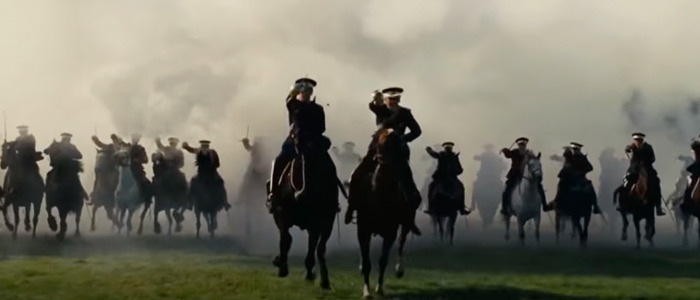
The war goes from planned charges to muddy trench warfare, Spielberg opens it up with a spirited run where, Joey, alone and ownerless for the first time in the film, makes a desperate gallop for freedom (something possibly learned by a former caretaker), through, over and past the soldiers huddled in the trenches and ironically ending his gallop in the middle of No Man's Land, where warring parties must watch and wonder at the sight between them that has nothing to do with the concerns of Man.
But, where War Horse most resembles Ford's work is pictorially—Spielberg sticks to close shots for moments of drama, but when he opens up, it calls to mind advice that the old Commander gave the young director when he was still dreaming of making movies (see video below). He's definitely paying attention to the horizon in this one, and the film, especially in its final moments, seems to come from a different era, one more rich in design and purpose.
In its color, both in sentiment and photographically, War Horse hearkens back to another period of cinema, one that was simpler and more direct, but it never betrays anything less than sophistication of subject matter and maturity of purpose, while still maintaining a high level of entertainment value. At this point in his career, Spielberg is presenting a master class in film-making, evoking the past when it suits him, but maintaining a personal growth that seems to never flag.
Tomorrow is Father's Day and we'll be doing a yin-yang on the subject this weekend. "Good Dad" today. "Bad Dad" tomorrow.
Although today is traditionally "Take Out the Trash" Day, we'll forgo it for Good ol' Dad.
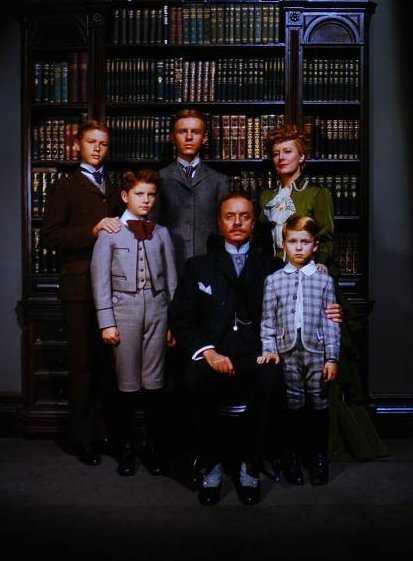
Life with Father(Michael Curtiz, 1947) "Oh, GAD!" Another one of those movies I've always had the opportunity to see but never did. A perennial for local television stations to have in their "libraries" for weekend programming (this was back in the day when local stations didn't fill their schedules with info-mercials), I had plenty of chances to catch this one on the tube, (and I would for fifteen minutes—tops—then move on) but I never did. My bad. This one needs to be taken in in one sitting, (preferably in a theater because the Technicolor is breath-takingly sharp), telephone off, and at full attention. "I am the character of my household!" booms Clarence Shephard Day, as he's choosing the latest in a long line of maids, which he has chased out of his employ in the last few months, many of them in tears and some in hysterics. Truer words were never spoken. He is the titular patriarch of Life with Father, from the hit Broadway play,*based on the remembrances of Clarence Day, Jr. of turn-of-the-century living with a father-figure who paces slowly in his own grooved path. William Powell plays the role, one he actively petitioned for.
It's a charming film, full of easy irony about the mores and prejudices of the time, where male pomposity poses as dignity, and more separates people than unites them—easy excuses for keeping things nice and orderly on the surface, while underneath, they are broiling with chaos that is easily ignored and denied. Clarence Day, Sr. denies at the top of his lungs, and his monologues—against politics, taxes, unnecessary expenses, and organized religion (organized against him, it seems)—built individually in intensity and volume, are performances for an audience of one—himself. His barely suffering wife (played by Irene Dunne as if she were singing the entire role) has more influence over him than he is willing to admit, or recognize...or even remember. And his kid's are "mini-me's" of him, all boys, all carrot-tops, and as they age they morph further into miniature versions of The Old Man, down to his expletives and bluster.
The material doesn't need much else. It's strongly forced, comically subtle and has an undercurrent of mature content, that you just don't see in movies nowadays. Life with Father is from a far subtler era in which sub-texts flew over kid's heads, while the adults exchanged knowing glances and suppressed chuckles (that way you don't have to explain it to the youngsters with a simple "you'll understand some day").
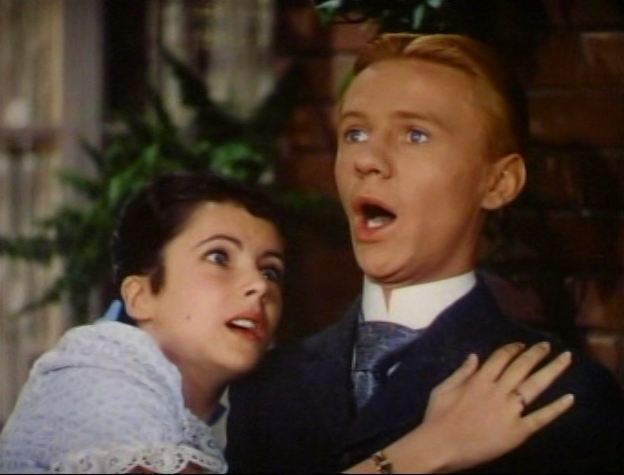
And the sub-text is sex. Clarence, Jr. is growing up, voice changed (but his violin playing still has noticeable cracks) and he's noticing girls—and when it's Elizabeth Tayloras a visiting friend's daughter, one can't help noticing. At the time of the film, it was still early in Taylor's career and her performance is breathy, needy and comes from the same type of ingenue training that produced Marilyn Monroe's early performances. Clarence wants to impress Taylor's Mary, but he can't do so in Dad's ill-fitting hand-me-down suits. The excuse is they're practical, but, as he says, "I can't do anything in Dad's clothes." But, the truth is he gets...uncomfortable...in Taylor's presence. It's not bluntly said, it's danced around, implied, suggested, but never spelled out (as would be the norm today). It's hilarious, charming, and pays off in some ironically comic laugh-lines throughout the film.
Yeah, they "don't make 'em like this anymore." More's the pity. Life with Father deserves its classic status—for some reason, it's not in the National Film Registry—because it's smart, pointed...and hilarious. GAD!
* It still holds the record for the longest run of a non-musical stage-play.
The Devil and Daniel Webster(aka All That Money Can Buy)(William Dieterle, 1941) I've known about this film for years, because it was the film that won composer Bernard Herrmann his only Oscar for Best Score ("of a Dramatic or Comedy Picture"), over 19 other scores nominated that year, including his own music from Citizen Kane.
The score is the stand-out element of the movie, with Herrmann accompanying the presence of "Mr. Scratch" with a particularly saw-toothed violin jig that raises the hair on the back of your neck. It is for sure that Academy voters had never heard anything quite like it, even if it did include some American folk-tunes (including "Pop Goes the Weasel!"). I was well acquainted with the music before I could track down the actual film.
It tells the story of Jabez Stonr (James Craig) a farmer, not making it in 1840 New Hampshire, who sells his soul to the Devil (Walter Huston) for seven years of prosperity, which he gets, along with a swelled head, the enviousness of the community, and a reputation as a cruel businessman and a cool husband. Still, he is prominent enough to make the acquaintance of Daniel Webster (Edward Arnold), famed orator, lawyer and politician—who has (so far) resisted Scratch's offer to make him President of the United States. But, as the contract date comes near, Mr. Scratch doubles down on the offer, tempting Jabez for the soul of his new-born son. Stone turns to Webster for legal help with the Devil, naturally.
The Devil and Daniel Webster, adapted from the Stephen Vincent Benet's 1936 short story published in The Saturday Evening Post, had a checkered history at the studio, though. After doing less than blockbuster
business, RKO Studios cut it by 20 minutes and released it with a sexier, less
folksy ad campaign (see right) under the name All That Money Can Buy,
which would seem to celebrate the profligate life-style its protagonist comes to regret wishing for in the film, rather than the
altruistic, socialist one ultimately preached.
It seems that Jabez
Stone only really finds redemption until he's joined the Grange. I may
be revealing the ending here, but, really, the outcome is inevitable
considering the extraordinarily heavy hand that is used to show the
tyrannies of wealth, lust, and greed that are the by-products of selling
your soul to the Devil. Fortunately, the great orator Daniel Webster
is around to plead the case for the defense when a breach of contract
occurs. Usually these scenes are the highlights, but in this film it's a
disappointment.
Even though played vigorously (by the least likely
actor, Edward Arnold,
well-known for playing power-brokers and fascists in many a movie) the
Webster homilies that are spun are so much sentimental goo and would
curl the lip of Aimee Semple McPherson, much less the hardened denizens of Hell that make up the jury in the matter. Even Frank Capra
must have rolled his eyes. But Dieterle seems to have shirked those
sections to go all-out for his scenes with The Devil. Mr. Scratch's
entrances are extravaganzas with light and smoke, he has the best lines
(of course), and a truly creepy performance by Walter Huston (John's
dad) with maliciously twinkling eyes, and a smile that's so broad that
it may turn feral at any moment. Huston is the thing to see in this
film, although Jane Darwell (Ma Joad from The Grapes of Wrath) and Simone Simon (just before she became big with Cat-People) do wonders with their material as well.
"Every Picture Tells a Story, Don't It?" or "Framing the Argument" (The Uncanny Valley to Cavalry)
Anyone who tries to do something new in films should be applauded, no doubt about it. But one should not come away from the experience calling to mind other films and experiences—then you merely get the sound of one hand clapping. Or the white-noise bustle of a disinterestedly browsing museum-crowd (with which the film begins and ends).
Not that film-maker Lech Majewskididn't try something new. His new filmThe Mill and the Crosstakes as its subject matter Flemish painter Peter Brueghel's painting "The Way to Calvary," and constructs the scenario inside the painting, with the artist (played by Rutger Hauer) and his patron (Michael York) walking through the painting as the artist sketches, puts it all together in his mind and takes it to completion.
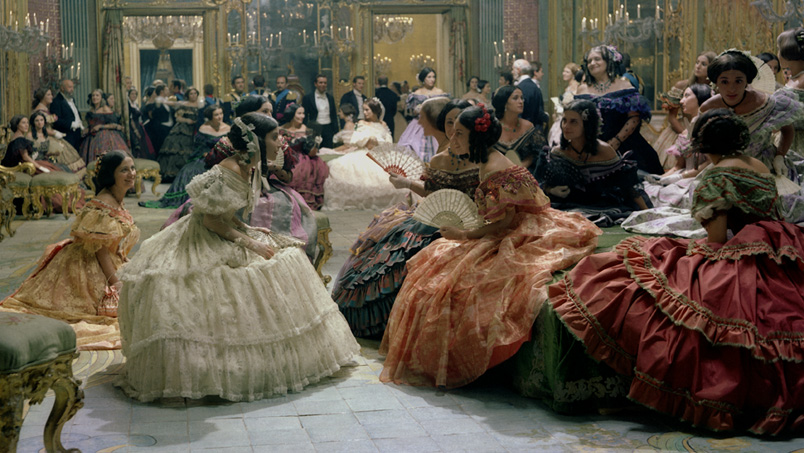
Films are, themselves, like paintings, if you can go with the analogy—both are contained in frames and there is the implied understanding that those frames are the limitations of our vision, that maybe without the frame they might go on to dimensions of breadth or depth and that what we see is the scope of the artists' vision, directing us to what is important, the focal point of the subject matter. Some of the most gorgeous films I've seen, like Barry Lyndon or The Leopard, inspire a wish to merely hang images from them on my wall.
No such thoughts crept to mind during The Mill and the Cross, as ingeniously as Majewski endeavored to bring the many facets of "The Way to Calvary" to life. Rather than having any "life" to it, it feels like a passionless exercise, the characters impenetrable cyphers, meandering around trying to "inspire" the moment of the painting (which holds far more activity than the film seems to want to evoke). All those new ideas are solely in the design and conceptual stage and not in the actual realization of the film. Pretty much limited to sets and blue screen, there is a flatness of tone that sometimes occurs when actors are restricted to surroundings that are uninspiring. And even with the technical wizardry required to pull it off, there is a tendency for the actors to appearvisually separated from their backgrounds (as if the lighting were off) in the same way that the blue-screened citizens of Tokyo seemed like they were never in danger of being trampled by Godzilla.
But, it's not only technically that the movie falls...as flat as a canvas. There's a paucity of dialogue for any of the characters, so that their motivations and actions are completely unclear. Things happen, people are tortured, bread is baked, Christ is crucified—then what that's over, everybody gets up and dances away like the fools at the end of The Seventh Seal, but without Death leading the way. It is, after all, only a painting (no one was killed in the making of this picture, all the subjects got up and went home).
Besides The Seventh Seal, The Mill and the Cross also reminded me of a graphic novel that I've long admired, Neil Gaiman's "Signal to Noise,"*in which a dying film-maker decides to make his one last epic, a project that he knows will never be put to celluloid. And so, because it remains in script-form, it will be as close to his original vision without the compromises of budget or time...or collaboration. It is as pure as it can be, only susceptible to the impressions it forms in the reader's mind. In a sense, all the barriers—technical, budgetary and time—that must be overcome from written word to image on film or video are opportunities for compromise that can erode that concept from its inception as inspiration to its final presentation. In attempting to get below the paint of "The Way to Calvary," Majewski, rather than explaining, expanding, and presenting the process of the artist and the "life" of the art only gets further afield of the source in an intellectually safe, shallow interpretation. We get the surface and never the depth of the characters that he presents, and so, The Mill and the Cross is an exercise of adaptation—just as a film-maker adapts the written word (a novel, say, and part of Majewski's source for the film is Michael Francis Gibson's analysis of the painting)—that fails. The only thing unique and laudatory about it is that it attempts to "realize" another medium. But the result—technically savvy but paper-thin—makes it a kindred spirit with so many of the current CGI blockbusters—an art-house version of a "Transformers" movie.
"The Way to Calvary"—far more interesting than the movie
* In pre-digital audio terms, "signal to noise" is the ratio of pure program sound to static or interference inherent in the analog medium on which it is imprinted. It is a measure of signal quality, a meter (if you will) for perfection, which Gaiman then ascribed to purity of vision).
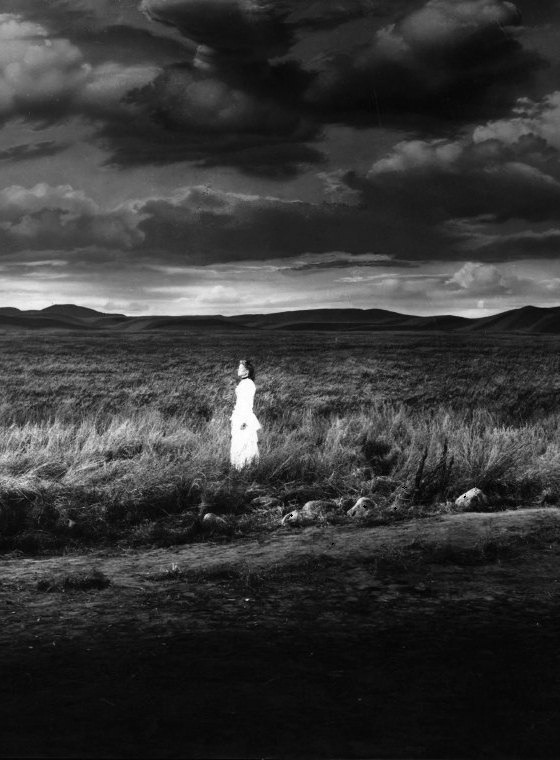
The Sea of Grass(Elia Kazan, 1943) It's Kazan's third feature as a director, playing in Louis B. Mayer's sandbox (literally—the film is shot in-studio at M-G-M, making use of stock-footage of rolling fields already in the can, with some location back-projection), and the founding member of The Actor's Studio has a cast of anybody but—Spencer Tracy and Katherine Hepburn (in their third film together), Melvyn Douglas, Harry Carey Sr. and Edgar Buchanan, all pro movie actors who'd already figured out the best way to project on film, without having to rely on sense-memory for it.
Kazan hated this film and discouraged anybody who'd listen from seeing it. But, despite its soap-ish tendencies as a romance, it has an underlying ecological message. Colonel Jim Brewton (Tracy) is a very well-landed cattle baron and resists any efforts by the "guv'mint" towards granting homesteading rights or development on the open range. For him, its a matter of keeping it unspoiled. "God's work," as he calls it. That's his purpose, but he's a might surly, mulish and uncommunicative. Along comes city-girl Lutie (Hepburn) into his life, and he bends slightly, like the trees she insists be planted at the entrance to their estate, as they sway in the harsh prairie winds. He'll bend with a "wait-and-see" attitude, as in "Wait—you'll see." He yields to Lutie on her friends's homesteading near his property. But, a clash is inevitable. "Fences are a curse word in these parts, he informs her.
There are other complications. She's a city girl on the prairie and distances between people are daunting. Then, there's the town lawyer, Chamberlain (Douglas) who has two strikes against him in Brewton's suspicious eyes—he wants the land open to homesteading, and he has his own eyes for Lutie, waiting to pounce whenever there's a crack in the Brewton marriage, which is inevitable. What his motivations are in both areas are suspect—Brewton Chamberlain are bitter enemies, politically and socially. Chamberlain just might be making the fight personal and can't help himself. With both the open fields and Lutie, he can't leave well enough alone.
The rise in Chamberlain's political career (becoming a judge in the district) dooms Brewton's ecological dreams, and soon the prairie becomes home to sod-busters, dependent on weather for their success, and when the rains stop, the crops fail and the farmers leave, the countryside becoming a barren dust-bowl. It's a hollow, dry victory for Brewton—he's proven right (which no one will admit) and the land goes to waste. And, in the meantime, Lutie has left, leaving Brewton and cook Jeff (Buchanan) to raise the kids: loyal but neglected Sara Beth (Phyllis Thaxter), and black sheep son Brock (Robert Walker), who it is more than suggested may be Chambelain's child.
One can see why Kazan, Tracy and Hepburn were attracted to the material. The ecology theme (even if espoused by a bull-headed "protect-what's-mine" cattle rancher) should have been close to the sod of anybody who'd come out of the depression, and the "unbranded scarlet letter" theme must have been attractive to Hepburn who enjoyed tilting at societal windmills. At this point, Tracy and Hepburn knew each other's tricks on-set. And it's interesting to see that their personal back-and-forth's in this film are much the same as they are in Guess Who's Coming to Dinner decades later. She's adoringly passive with a steel spine, and he's remote until his face collapses with emotion. Kazan would come out of this film feeling compromised—and, indeed, this film about the vastness of open land and the prairie feels like it was filmed inside a glass ball—and would explore other ways to make movies, as opposed to being stuck on the sound-stage. He'd start insisting on location work and even filming with a documentarian's eye. His search for authenticity in artifice could not be held behind stage-doors and artificial light.
Moonfleet(Fritz Lang, 1955) Fritz Lang's only film in Cinemascope—a format he famously described as only good for shooting "snakes and funerals" (well, he says it in Contempt, anyway!).
"Moonfleet" was a popular novel published in 1898 and was considered a classic of literature—on a par with Robert Louis Stevenson's "Treasure Island"—but not so much in the U.S. Producer John Houseman, working at M-G-M, maybe influenced by the success of Disney's 1950 version of Stevenson's classic, wedged in Moonfleet between prestige pictures, but on a limited budget—no ocean scenes, no tall ships, no cluttered sword-riots, no piratey aspects that required crowds and location work. Lang, who actually preferred studio work over the capricious lighting of location scenes, was hired two weeks before shooting started and hadn't worked at M-G-M since his first film in America, the 1936 production of Fury. The script had aspects of the novel, but didn't follow it too closely, taking the novel's hero and making him a child, as opposed to the young man of the novel, who depends on an older mercenary smuggler to pursue his quest of a legendary diamond belonging to the pirate Blackbeard.
That's one way to use the Cinemascope frame.
Well, it's "Redbeard" in the movie (public domain issues?). Young John Mohune (Jon Whiteley) is sent by his dying mother to the town of Moonfleet, site of the original Mohune estate, to seek out a man with whom she had a past, Jeremy Fox (Stewart Granger). Exhausted by his travel, young John wakes up in a tavern surrounded by ruffians—including Dan Seymour and Jack Elam—who search him and find a letter from the boy's mother, appointing Fox as John's guardian. It's convenient because Fox just happens to be the man now occupying the Mohune manse.
It's inconvenient because, when Fox hears this, he wants nothing to do with the boy, being a man of the world and all. But, he does acknowledge knowing the mother, being fond of her, and that he and the boy may have more in common than Fox will acknowledge—like the boy's nightmares of being attacked by dogs echoing the scars on Fox's back from such an attack while he was running from the Mohune house so many years ago. Probably as many years as the boy's been alive, but the film skirts this issue, while hinting that it's probably true. Still, he plans to have the boy sent packing in the morning, while he continues on to Moonfleet.
He, of course, hasn't reckoned with the boy being a Mohune, and a tenacious one at that. The boy manages to make his escape and, with the help of some locals, make his way back to his family's estate, where he finds Fox in mid-debauch, hosting several drunken lords, complete with entertainment by a gypsy dancer (Liliane Montevecchi). Young John insists he won't be sent away this time and that he intends to stay with Fox as per his mother's wishes. Fox is impressed by the boy, but secretly intends to send him away to the colonies on the next boat. When Fox's mistress Mrs. Minton (Viveca Lindfors) accuses Fox of his actions towards John as being proof of his continuing love for the boy's mother, he tells her that, in that case, she can leave on the same boat with him.
The next day, John attends church services, where he is informed—via a fiery sermon about superstition—that the villagers fear that the spirit of the pirate Red Beard, who was a Mohune, is haunting the church graveyard looking for the diamond that made him renounce his military career and become a pirate. While walking the grounds that night, John falls into an open grave that leads to the catacombs under the church full of broken caskets and the bones of the departed. But Fox's pirates come down there, too, looking for potential riches, and the boy finds a locket while hiding away from sight.
When rescued from the catacombs by Fox, his band is ready to slit the boy's throat for anything the kid might have found, and when Fox defends the boy, the pirates—being pirates—turn against him. This puts Fox in a difficult position—he is being challenged by his own band at the same time he's trying to finagle a deal with the duplicitous magistrate Lord Ashwood (venomed by George Sanders, as only George Sanders can) and his equally devious wife (played by the ever-delightful Joan Greenwood in her first American role).
That locket John has snatched will contain a secret that must be decoded and from there, Fox and friend must evade his former co-conspirators, as well as the Ashwoods, and the authorities to find the diamond and extricate it from its hiding place smack-dab in the middle of a military prison, even while they're considered wanted fugitives. This gives plenty of opportunity for composer Miklós Rózsa to create bustling tension music (which sounds like it's a dress rehearsal for his score for Ben-Hur), while the duo put themselves directly in harms way to achieve their goals.
It's not the novel—which shares the diamond and the locket and the clues, and that's about it—but Lang makes the most out of the material scraped from the book to accommodate Granger's starring persona, while directing it from the vantage of a child's point of view, and enveloping it in a child's nightmare of Gothic structures and macabre situations, with a mentor who is as questionable a father-figure as one could encounter (outside of Dickens). Maybe that's why it never found an audience—too "mature" for kids, too cynical for adults, and not "family-friendly"—which led Houseman to write: "All too often, in those days, I felt that the director was receiving credit for the producer's work. This time (Lang) was taking the blame for the producer's errors." Hard to believe that—with all of his fanciful German work, Moonfleet was the most expensive film, Lang ever worked on.
The Three Musketeers(George Sidney, 1948) Every few years, a new generationhas to put theirimprint onAlexander Dumas' adventure tale on the chicaneries and hidden agendas during the rule ofKing Louis XIIIandCardinal Richelieu, when it seems everyone was challenging the rule of theocracy masquerading as monarchy. Every time, a group of four actors can be found to collaborate rather than hog the show, a new version is produced and a different spin is put on the first part of thed'Artagnan Romances, telling of a sword-skilled Gascony bumpkin who goes to Paris to join the King's Musketeers of the Guard—knights on the cusp of a new technology who prefer their battles to be sharp and personal—and learns the ways of the world in love, loss, and politics and how they all cross swords.
But there have been so many others, going back to the silent era. One of the oddest, despite being a fairly straight adaptation is the Technicolor M-G-M version from 1948, starring Gene Kelly as d'Artagnan, high in the step and long in the tooth, where the fights are choreographed more as dance in natural settings. All movie fights are choreographed to some extent, but the '48 version of "3M" has a particularly dancerly feel with Kelly. There's a "lark" aspect to the whole thing, with a winking feel as if to say "isn't this all preposterous?" It feels even more so in Kelly's love scenes with June Allyson playing Constance, confidante to the Queen (Angela Lansbury) and daughter (in this one) of his landlord. Their scenes have a campy, artificial leaning, layered over with a version of Tchaikovsky's "Romeo and Juliet" theme, which was probably a cliche for love in '48. It makes any emotional investment in the romance so much embarrassing vapor.
Impressive cast, though, with Lana Turner top-lined (probably to assuage her fears that it was a secondary role) as the villanous Milady deWinter, Vincent Price is finely oily as Prime Minister Richelieu (evidently he was defrocked for the film, owing to pressure from the Catholic Church), Van Heflina good, but not great Athos, Gig Young as Porthos, and Keenan Wynn providing comedy as d'Artagnan's servant Planchet.
And it has one scene that makes the highlight reels—Kelly's tribute to Douglas Fairbanks, vaulting over (M-G-M stage) French roof-tops to rescue his lady-love. It's nicely staged athleticism, marking a sharp contrast to the play-acting of the rest of the film.
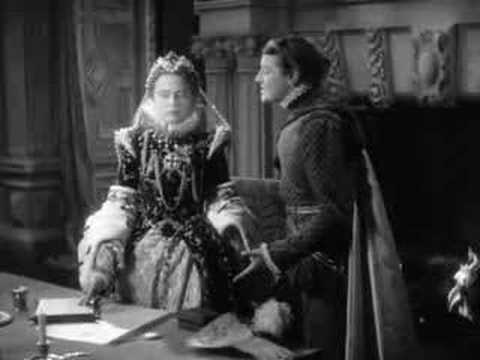
Mary of Scotland (John Ford, 1936) The film, written by Dudley Nichols from Maxwell Anderson's play, begins with an odd preamble, giving an overview of the whole Mary, Queen of Scots/Elizabeth R situation, and ending with the hopeful suggestion that they are "all equal now," buried close to each other in Westminster Abbey. Cheery thought, and, despite what the play and movie say, the only time that Elizabeth and Mary were in the same room together.*
It's a problematic film. betraying its stage roots (the speeches are very formal, stylized, and performed theatrically, with no overlap and AT THE TOP OF EVERYBODY'S LUNGS, as if trying to reach the last row of the balcony) although Ford works overtime to find interesting angles to shoot from. So much Hollywood gossip swirls around this film**—part of Hepburn's "box-office poison" cycle (she'd just bombed with Sylvia Scarlett and more were on the way)—that one is hesitant to bring it up as sources for the film's problems, which are many.
But the main fault lies with Anderson's play, which lionizes Mary (Katherine Hepburn) while demonizing Elizabeth, and the production goes right along with it—Mary's first lines are a prayer to God for returning safely to Scottish shores, while Elizabeth's is ordering people around and played (by Florence Eldridge) as if she were Edward G. Robinson. It would have been nice if this subject were a little more nuanced, as it involves two strong women in positions of power with men as being subjective, if constant irritants. One wishes that the two could have gotten together and agreed that all the men surrounding them were jerks and done something about that, rather than engaging in power plays for England's throne.
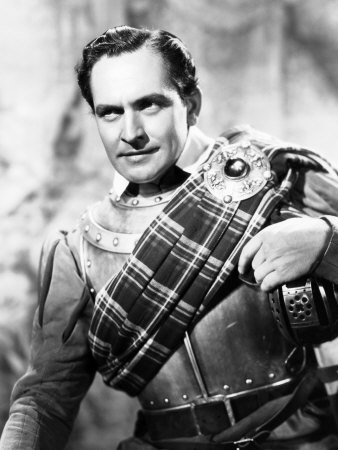
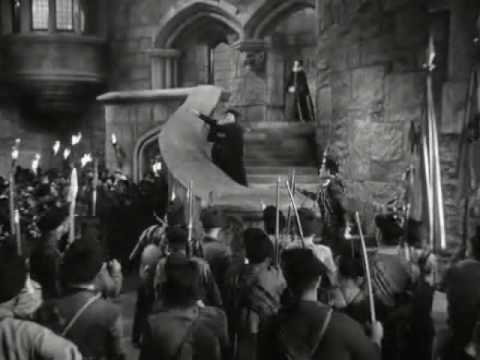
There are joys to be had, though. Ford's penchant to use unruly horses is much in evidence, and the animals are particularly out of control on the sound-stages that dominate the film. And Frederic March is something of a revelation, boisterous and accented, his is the best performance in the film. And Ford's presentation is never less than spectacular, as has been mentioned, giving the film a scope that it wouldn't have had in other's hands.
A not-altogether successful film, but interesting to see.
* This is a problem with most of the films dealing with Mary, Queen of Scots—historically, they never did appear (that we know—something Lucy Worsley might some day let us in on it) in the same room, although there were letters sent back and forth. It might have something to do with studio politics and ginning up the drama. Traditionally, the two have been played by stars (Vanessa Redgrave and Glenda Jackson in 1971's Mary Queen of Scots, and more recently Saoirse Ronan and Margot Robbie in 2018's Mary Queen of Scots) and so there must be some re-writing of history in order to get Acting Queens to spar off each other, even if the real Queens did not.
** Ford was unhappy making it, and—as he occasionally did—walked off the film in the midst of shooting on day. I can't be sure, but when I read Hepburn's autobiography, I seem to recall her saying that she directed for the rest of the day and seemed to think nothing of it. And...take a look at this scene on YouTube. There is a portion where Mary addresses James Stuart, Earl of Mowbray, where the conversation is at cinematically clashing angles, perhaps to favor a flattering angle...well, let's face it, of both actors. It's an odd choice by Ford if he, indeed, did make it.
 "The Lives That Pass Through a Horse"


_2.JPG)







_04.jpg)



_01.jpg)