Showing posts with label Michael Curtiz. Show all posts

Saturday, June 17, 2023

Life With Father

Tomorrow is Father's Day and we'll be doing a yin-yang on the subject this weekend. "Good Dad" today. "Bad Dad" tomorrow.

Although today is traditionally "Take Out the Trash" Day, we'll forgo it for Good ol' Dad.


Life with Father (Michael Curtiz, 1947) "Oh, GAD!" Another one of those movies I've always had the opportunity to see but never did. A perennial for local television stations to have in their "libraries" for weekend programming (this was back in the day when local stations didn't fill their schedules with info-mercials), I had plenty of chances to catch this one on the tube, (and I would for fifteen minutes—tops—then move on) but I never did. My bad. This one needs to be taken in in one sitting, (preferably in a theater because the Technicolor is breath-takingly sharp), telephone off, and at full attention.
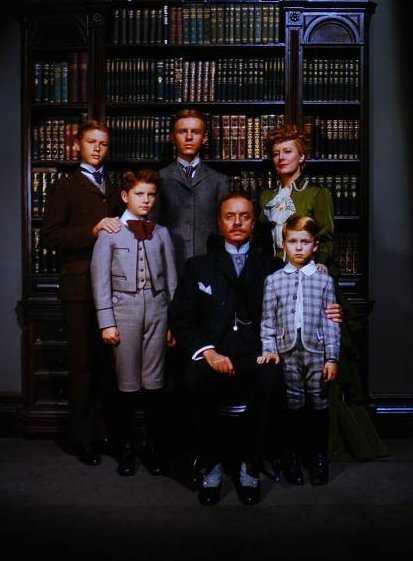
"I am the character of my household!" booms Clarence Shephard Day, as he's choosing the latest in a long line of maids, which he has chased out of his employ in the last few months, many of them in tears and some in hysterics. Truer words were never spoken. He is the titular patriarch of Life with Father, from the hit Broadway play,* based on the remembrances of Clarence Day, Jr. of turn-of-the-century living with a father-figure who paces slowly in his own grooved path. William Powell plays the role, one he actively petitioned for.
It's a charming film, full of easy irony about the mores and prejudices of the time, where male pomposity poses as dignity, and more separates people than unites them—easy excuses for keeping things nice and orderly on the surface, while underneath, they are broiling with chaos that is easily ignored and denied.   Clarence Day, Sr. denies at the top of his lungs, and his monologues—against politics, taxes, unnecessary expenses, and organized religion (organized against him, it seems)—built individually in intensity and volume, are performances for an audience of one—himself. His barely suffering wife (played by Irene Dunne as if she were singing the entire role) has more influence over him than he is willing to admit, or recognize...or even remember. And his kid's are "mini-me's" of him, all boys, all carrot-tops, and as they age they morph further into miniature versions of The Old Man, down to his expletives and bluster.

Michael Curtiz directs formally and breezily, with his actors performing at top gear, and the director altering pace in editing and filling the frame with as much set decoration as it can hold.

The material doesn't need much else. It's strongly forced, comically subtle and has an undercurrent of mature content, that you just don't see in movies nowadays. Life with Father is from a far subtler era in which sub-texts flew over kid's heads, while the adults exchanged knowing glances and suppressed chuckles (that way you don't have to explain it to the youngsters with a simple "you'll understand some day").

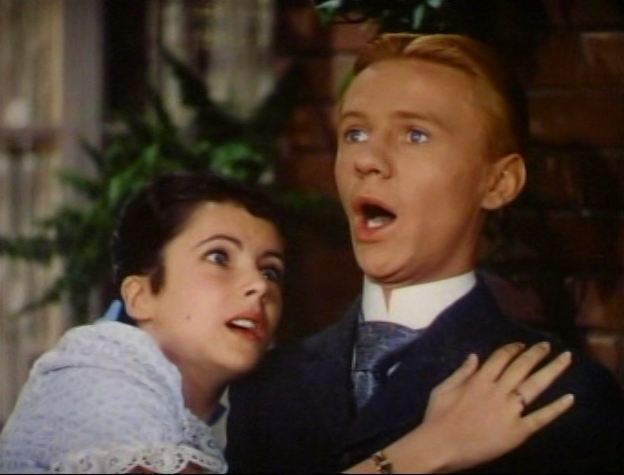
And the sub-text is sex. Clarence, Jr. is growing up, voice changed (but his violin playing still has noticeable cracks) and he's noticing girls—and when it's Elizabeth Taylor as a visiting friend's daughter, one can't help noticing. At the time of the film, it was still early in Taylor's career and her performance is breathy, needy and comes from the same type of ingenue training that produced Marilyn Monroe's early performances. Clarence wants to impress Taylor's Mary, but he can't do so in Dad's ill-fitting hand-me-down suits. The excuse is they're practical, but, as he says, "I can't do anything in Dad's clothes." But, the truth is he gets...uncomfortable...in Taylor's presence. It's not bluntly said, it's danced around, implied, suggested, but never spelled out (as would be the norm today). It's hilarious, charming, and pays off in some ironically comic laugh-lines throughout the film.

Yeah, they "don't make 'em like this anymore." More's the pity. Life with Father deserves its classic status—for some reason, it's not in the National Film Registry—because it's smart, pointed...and hilarious.  


GAD!

* It still holds the record for the longest run of a non-musical stage-play.

Wednesday, July 4, 2018

Yankee Doodle Dandy

Yankee Doodle Dandy (Michael Curtiz, 1942) It's the Fourth of July. Traditionally, I've stop-gapped the date by just tossing out James' Cagney's signature dance routine of "Yankee Doodle Dandy" (and not to stop the tradition, it's below).

But, I've never reviewed it, musicals not being my particular cup of tea.


But, Yankee Doodle Dandy is a little different. The biggest reason: Cagney. That man's presence is enough to make me want to watch any movie. But, he had made his name in films playing tough guys and gangsters—smart-alecks, who were strangely likable although capable of extreme, often shocking violence. Maybe it was because he was so believable, and so damn confident. And he had a tough grace with coiled intensity, an economy of movement and a theatrical flair. That quality might have been inherent as Cagney considered himself more of a song and dance man—"a hoofer," as he described it, even if his singing wasn't the best, the man sold songs so convincingly and with such brio, you didn't much care.


11 years in vaudeville (his first on-stage role was actually in drag), then starting his career in movies,  the opportunities came more from acting than dancing. And he became—in the opinions of no less peers than Orson Welles and George C. Scott*—the best of the old studio actors, in that he was more than merely truthful and authentic, he was also theatrically interesting. But, his favorite performance was his Oscar-winning turn as George M. Cohan for the Warner Brothers bio-musical Yankee Doodle Dandy. It was a project born of a certain political necessity for the star, who considered it only after it had been tossed around as potential film material for years, owing to the difficulty in obtaining the cooperation of its subject, who was still alive at the time. With Cagney's enthusiasm assured—and studio-head Jack L. Warner had had issues with the star previously—Warner struck a deal with the stage entrepreneur to push the project forward.**
The film is told in flashback mode: George M. Cohan (James Cagney) has left retirement behind for the chance of playing President Roosevelt in a staging of a satirical musical "I'd Rather Be Right" and, after a night's performance, is called to the White House to meet with the sitting President. Fearing the worst (His wife Mary—played by Joan Lesliereassures him "Don't worry, dear they don't telegraph you to come and be shot at dawn."), Cohan is escorted to the Oval Office, where he is greeted warmly by the President—the first time in American films that a current President had been depicted—and is asked to tell him his story. Cohan is only too happy to comply—in the film, Cohan's rival Eddie Foy (played by his son Eddie Foy, Jr.), looking at how many times Cohan's name is mentioned on a show poster, cracks that the "M" must stand for "Modest."
Cagney's Cohan tells of being born on the fourth of July, 1878 (it was actually July 3rd, but....1) it's a musical not a documentary and 2) it's the legend, so...) to a variety performer, Jerry Cohan (Walter Huston) and his wife Nellie (Rosemary DeCamp). With the edition of a sister Josie (Cagney's sister, Jeanne), the family becomes its own travelling troupe as per Cohan's narration:
I guess the first thing I ever had my fist on was the American flag. I hitched my wagon to thirty-eight stars. And thirteen stripes. You know, I was six or seven years old before I realized they weren't celebrating my birthday on the Fourth of July. Then my folks got a real break when my little sister, Josie, made her entrance. She grew to love show business just as she loved everybody and everything. We toured the kerosene circuit in a tank show called 'Daniel Boone on the Trail.' Everybody doubled in brass. Dad walloped the bass drum. For some reason they teamed me with a donkey. I was a good Democrat, even in those days. Mother and Josie threw out handbills. Their smiles would have sold tickets to wooden Indians. They kept putting new stars in the flag and the Cohans kept rushing out to meet them. We had jokes to match every cornfield. We sang at every milk station.
"I was a good Democrat, even in those days"—but Cohan (in real life) was actually a staunch conservative Republican. Well, it's not a documentary. The narration continues: 
We trouped through depression and inflation. Part of the country's growing pains. We froze in winter and roasted in summer. But it was a good life. It's a lucky family that dances together every day. Eighteen ninety-one found our fortunes flat as a pancake. Then came a bolt from the blue. Jobs for the whole family in a play called "Peck's Bad Boy." We opened in Brooklyn. The town was noted for its spirited audiences. Even before it had a ball team.
"Peck's Bad Boy" becomes a hit for the family, and young George becomes the stand-out star, giving the kid a swelled head, and causing some friction in the family and amid the theater circuit. He's a constant self-promoter, always pushing himself, his songs, his plays—it gets to the point where the theater community blackballs him for his incessant braggadocio and grandstanding, which runs the risk of scuttling his family's careers and that of his new wife, Mary (Joan Leslie), herself a singer. The film follows Cohan's path from failure to success juxtaposing scenes of dealing and composing with musical sequences, showing off Cagney's skills—which are truly amazing at times—performing the various "greatest hits" of his career in back-rooms and on stage.
Many of the musical sequences copy the stagings of the original presentations , which is where the movie most adheres to some kind of truth. When songs were written and in what plays they appeared is all askew. And, the film suffers from the type of "he was inspired to write this" moments that make their way into most musical biographies. Also, Cohan had married twice—neither of his wives were named "Mary"***—and his mother died before his father. Cohan was only months before passing away and the production was a bit rushed in post, so that he could see a private presentation of it. It is said that, once the lights came up, he remarked: "It was a good movie. Who was it about?" But, that's such a good line, I even doubt the truthfulness of that (after all, he was the technical consultant on it).
But, more charitably he said "I'd hate to follow that act." One can see why given the energetic brio that the star brought to the performance and the movie in general. Cagney also manages to make Cohan extremely likable, no matter what shenanigans he pulls off, no matter how much a blowhard he is portrayed as. After all, if the man could make gangsters sympathetic...why not an accomplished hoofer? And, with the country gearing up for war (the film was in production when Pearl Harbor was attacked), the film's overt patriotism and pro-war stance—Warner was the one studio in Hollywood that wasn't afraid to be pro-intervention and publicly anti-Nazi—was perfectly timed to benefit from a country attacked and ready for a fight. Its patriotism served another purpose as well.
Cagney's battles with studio management—Jack Warner called him "The Great 'Againster,'" a term he reveled in—and his battles for Unions in positions both in front of and behind the camera in Hollywood (and, in his vaudeville days, he'd not been a fan of Cohan's after the man had sided with the producers' side in the 1919 Actor's Strike) put Cagney in a predicament with the House Un-American Activities Committee. The head of the Los Angeles chapter of the Communist Party had included Cagney when "naming naming" in secret grand jury testimony, and Cagney had been subpoenaed. The New York Times published a headline naming Cagney a Communist. Although exonerated of the charges, Cagney's business manager, his brother William, determined that, if they wanted to dispel any suspicions in the public's mind, "we’re going to have to make the goddamndest patriotic picture that’s ever been made." So, they campaigned Jack Warner to make the movie, with Cohan's approval (Cohan preferred Fred Astaire, but Astaire turned it down as the two men's dancing styles were, to his mind, too far apart). Cagney got the lead and the headlines stopped.
Liberals, progressives—whatever label you want to hang on it—have always had a history of being an irritant to this country. The status quo don't like being told that they're actually old fogies rather than protectors of the flame. So, the country's history is rich with the investigations into anti-American activities whether they're red or even slightly pinko. It is the tradition of the left to be chased by dinosaurs in the time they have before they become extinct. It's the big joke if a liberal survives the chase for long enough, they'll turn into the old fogey rallying against the next evolution of liberal. And it's been that way since a bunch of radicals created the concept of this country, saying to their bewigged masters-in-absentia an ocean away that government had more to do with what you could bring to the table, rather than who your father was. I'm sure they were called much worse than "lib-tards" for that idea. But, we celebrate them today, quite forgetting the squabbling of history. History is always the best judge.


*


** Cohan, while working with screen-writer Robert Buckner, asked "Would anyone go to see it? I don't want to be connected to a box-office flop." Buckner replied "Tell you what, we'll give away dishes and make sure." When the film was completed, it is reported after seeing the film by himself at a requested preview, he wired the writer "Thanks, kid. Hope you don't run out of dishes.

*** This was evidently because Cohan's ex-wife was putting pressure for money if she was depicted. Truth is more expensive than fiction.

Sunday, June 17, 2018

Don't Make a Scene: Life with Father

The Story:  It's Father's Day today.  So, for our regular "Don't Make a Scene" feature, we have one from Michael Curtiz's film of the hit stage play Life with Father from 1947.  A staple of film catalogs sold to local television stations "back in the day" (probably because it fell into the public domain), it was one of those films I regularly ignored in the programming black holes of weekends in the time before infomercials and other balderdash.

But it's a great film, funny and wise and before its time, a sort of upper-class "All in the Family" set in the 1883, with an authority figure who sees himself as Lord of the Manor, but who in reality is lord of a house of cards.  He is loved and respected (of course), but he's more than a little pedantic, and the joke is that everybody, family, audience, everyone knows he's full of malarkey.  Everybody except him.

Now, this scene has an undercurrent running through it, which is one of those veiled references that the adults might get, but will go right over "the kids'" heads, and is rather surprising for the post-Code era of 1947.  Clarence Jr. has an advanced yearning for friend of the family Mary Skinner, which leaves him in an advanced state of awkwardness.  She is equally smitten, but...  

But this is 1883. 

Even in the scene before this when Mary and Clarence go out to the balcony—alone—to discuss how they can keep in communication after her leave-taking, he's warned by his Mother, "Remember, this is Sunday."

Things are not helped when she sits on his lap, and he panics: "Get up!  Get up! Get up!"  She thinks he is alarmed by her behavior, but he's probably more alarmed at his own...if you get my drift.

Yeah, this is about sex, but nobody comes right out and says it, the most being stated is that Clarence, wearing one of his father's old suits, feels uncomfortable in the old thing, as it probably doesn't fit and because in his words, he “can’t do anything in them that father wouldn’t do.”

Oh, gad.

There, then proceeds a lecture about women that is completely off the subject, irrelevant, and very much to the Father's concerns, and when it gets to his son's...the subject is closed.  That's the joke.  But, it's one of my favorite scenes from this one for what it says, and what it doesn't say.

Apologies for the screen-caps.  The source for them is a DVD which has a poor print for the transfer, the usually eye-popping Technicolor is faded, the images soft, very grainy and very multi-generational.  I have seen it in all its sharp glory on TCM, but, for now, and probably while it remains in public domain, all DVD versions of it will be terrible.

The Set-Up: The Day household is in turmoil. And the problems usually concern the head of the household who rules with an iron hand—Clarence Day, Sr (William Powell), who seems to think he has everything under control, and has nothing under control.  A stockbroker by trade, a malcontent by habit, he is subtly pushed and prodded by the demands of his loving and respectful family.  In this scene, oldest son Clarence, Jr. (Jimmy Lydon) has just talked to the girl he's got a crush on, Mary Skinner (Elizabeth Taylor) about keeping up a correspondence after she leaves that day.  And as these things can go, it goes badly, especially when Mary sits of young Day's lap, sending him into a panic and putting her into rejected hysterics, which Day Sr can't help but notice as she runs through his office. 

Action!

CLARENCE SENIOR: Clarence!
CLARENCE JR: Yes, father?
CLARENCE SENIOR: That young lady’s crying..in tears.  
CLARENCE SENIOR: What’s the meaning of this?
CLARENCE JR: I’m sorry, father, it’s completely my fault.
CLARENCE SENIOR: Nonsense!  What’s that girl trying to do to you?
CLARENCE JR: Oh..n-n-no, she wasn’t.  It was all my fault.
CLARENCE SENIOR: (chuckles) Well, whatever the quarrel was about, Clarence, I’m glad you held your own.
CLARENCE JR:  Father, I’ve got to get a new set of clothes! You’ve got to give me the money for it!
CLARENCE SENIOR: Young man, do you realize that you are addressing your father?
CLARENCE JR:  I’m sorry, father.  I apologize.  But you don’t know how important this is to me.
CLARENCE SENIOR: A new suit of clothes is so import...well, why should...  
CLARENCE SENIOR: Clarence. Has your need for a suit of clothes anything to do with that young lady?
CLARENCE JR:  ...Yes, father.
CLARENCE SENIOR: Why, Clarence...
CLARENCE SENIOR: Well, this comes as quite a shock to me.
CLARENCE JR:  What does, father?
CLARENCE SENIOR: Well, your being so...grown up.
CLARENCE SENIOR: Still, I might have known with your going to college this Fall. Yes, you’re at the age when you’ll soon be meeting girls.
CLARENCE SENIOR: Clarence, there are things about women I think I think you ought to know. (Looks around) (Ahem) Sit down.
Senior goes to the door, looks around, closes it.
CLARENCE SENIOR: Yes, I think it is better for you to hear this from me than to have to learn it for yourself.
CLARENCE SENIOR: Clarence, women aren’t the angels that you think they are.
CLARENCE SENIOR: Well now, first let me explain this to you.
CLARENCE SENIOR: You see, Clarence, we men have to run this world.  And it’s not an easy job. It takes work. And it takes thinking. A man must reason things out.
CLARENCE SENIOR: Now, you take a woman.  A woman thinks...
CLARENCE SENIOR: No! I’m wrong right there. 
CLARENCE SENIOR: A woman doesn’t think at all.
CLARENCE SENIOR: She gets stirred up.  And she gets stirred up over the most confounded things. Now, I love my wife just as much as any man. But that doesn’t mean I should stand for a lot of falderal.  
CLARENCE SENIOR: By gad, I won’t stand for it.
CLARENCE JR: Stand for what?
CLARENCE SENIOR: That’s the one thing I shall not submit myself to. Clarence, if a man thinks a certain thing is wrong, he shouldn’t do it.  If he thinks it’s right, he should do it.  Now, that has nothing to do with whether he loves his wife or not.
CLARENCE JR: Who says it has, father?
CLARENCE SENIOR: They do!
CLARENCE JR: Who, sir?
CLARENCE SENIOR: Women!  They get stirred up! And then they try to get you stirred up, too.
CLARENCE SENIOR: But, don’t you let them do it, Clarence.  Don’t you let them do it!  
CLARENCE SENIOR: Now, if you can keep reason and logic in the argument... 
CLARENCE SENIOR: ...a man can hold his own, of course.
CLARENCE SENIOR: But, if they can switch you, pretty soon the argument is about whether you love them or not!
CLARENCE SENIOR: I swear I don’t know how they do it.
CLARENCE SENIOR: But, don’t you let them, Clarence...
CLARENCE SENIOR: ...don’t you let them!
CLARENCE JR:  I see what you mean so far, father. If you don’t watch yourself, they can make you do a lot of things you don’t want to do.
CLARENCE SENIOR: Exactly!
CLARENCE JR:  But, if you do watch out and know just how to handle women...
CLARENCE SENIOR: Then you’ll be alright. All a man has to do is be firm!
CLARENCE SENIOR: You know how sometimes I have to be firm with your mother.
CLARENCE JR:  Yes, but father...what can you do when they cry?
CLARENCE SENIOR: Hmmmm.
CLARENCE SENIOR: Well, uh….that’s quite a question.
CLARENCE SENIOR: You just have to make them understand that what you’re doing is for their own good.
CLARENCE JR: I see.
CLARENCE SENIOR: Well, Clarence, now you know all about women!
CLARENCE JR:  But...father...
CLARENCE SENIOR: Yes, Clarence?
CLARENCE JR:  I thought you were going to tell me about…
CLARENCE SENIOR: About what?
CLARENCE JR:  ...about...women.
CLARENCE SENIOR: Clarence.  There are some things gentlemen don’t discuss.  
CLARENCE SENIOR: I’ve told you all you need to know.
CLARENCE SENIOR: The thing you need to remember is...be firm!
Clarence leaves, bewildered.


Words by David Ogden Stewart (from the play by Howard Lindsay and Russell Crouse from the book by Clarence Day)


Life with Father is available on DVD from Alpha Video.