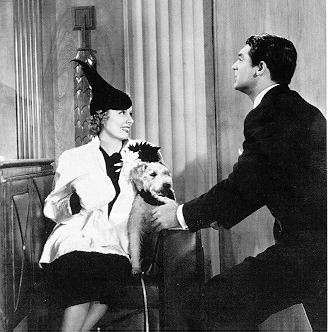
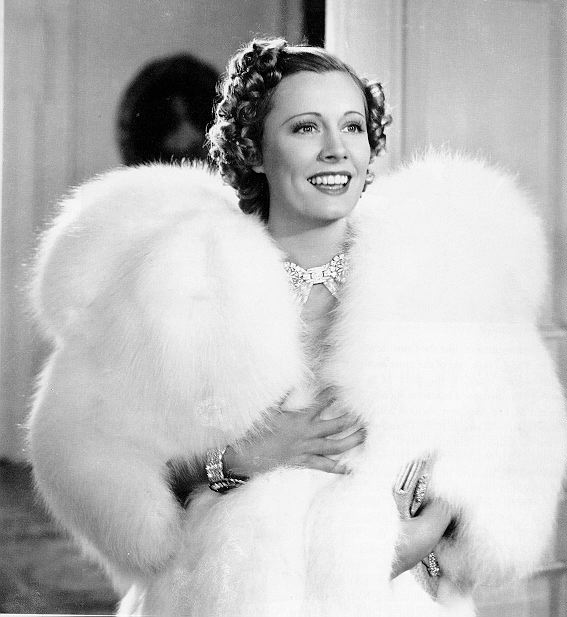
Tomorrow is Father's Day and we'll be doing a yin-yang on the subject this weekend. "Good Dad" today. "Bad Dad" tomorrow.
Although today is traditionally "Take Out the Trash" Day, we'll forgo it for Good ol' Dad.
Life with Father (Michael Curtiz, 1947) "Oh, GAD!" Another one of those movies I've always had the opportunity to see but never did. A perennial for local television stations to have in their "libraries" for weekend programming (this was back in the day when local stations didn't fill their schedules with info-mercials), I had plenty of chances to catch this one on the tube, (and I would for fifteen minutes—tops—then move on) but I never did. My bad. This one needs to be taken in in one sitting, (preferably in a theater because the Technicolor is breath-takingly sharp), telephone off, and at full attention.
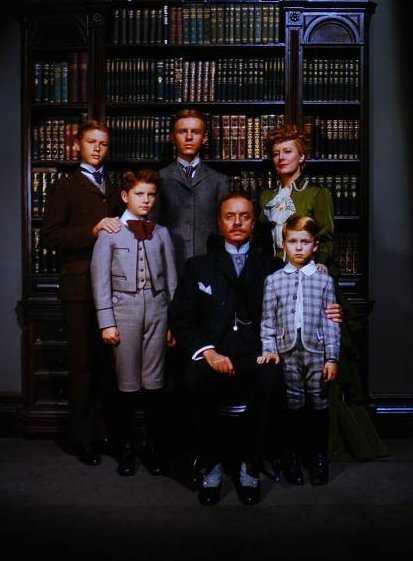
"I am the character of my household!" booms Clarence Shephard Day, as he's choosing the latest in a long line of maids, which he has chased out of his employ in the last few months, many of them in tears and some in hysterics. Truer words were never spoken. He is the titular patriarch of Life with Father, from the hit Broadway play,* based on the remembrances of Clarence Day, Jr. of turn-of-the-century living with a father-figure who paces slowly in his own grooved path. William Powell plays the role, one he actively petitioned for.
It's a charming film, full of easy irony about the mores and prejudices of the time, where male pomposity poses as dignity, and more separates people than unites them—easy excuses for keeping things nice and orderly on the surface, while underneath, they are broiling with chaos that is easily ignored and denied. Clarence Day, Sr. denies at the top of his lungs, and his monologues—against politics, taxes, unnecessary expenses, and organized religion (organized against him, it seems)—built individually in intensity and volume, are performances for an audience of one—himself. His barely suffering wife (played by Irene Dunne as if she were singing the entire role) has more influence over him than he is willing to admit, or recognize...or even remember. And his kid's are "mini-me's" of him, all boys, all carrot-tops, and as they age they morph further into miniature versions of The Old Man, down to his expletives and bluster.
Michael Curtiz directs formally and breezily, with his actors performing at top gear, and the director altering pace in editing and filling the frame with as much set decoration as it can hold.
The material doesn't need much else. It's strongly forced, comically subtle and has an undercurrent of mature content, that you just don't see in movies nowadays. Life with Father is from a far subtler era in which sub-texts flew over kid's heads, while the adults exchanged knowing glances and suppressed chuckles (that way you don't have to explain it to the youngsters with a simple "you'll understand some day").
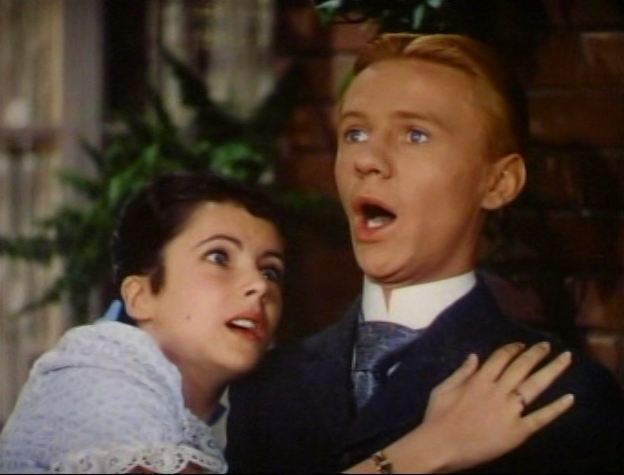
And the sub-text is sex. Clarence, Jr. is growing up, voice changed (but his violin playing still has noticeable cracks) and he's noticing girls—and when it's Elizabeth Taylor as a visiting friend's daughter, one can't help noticing. At the time of the film, it was still early in Taylor's career and her performance is breathy, needy and comes from the same type of ingenue training that produced Marilyn Monroe's early performances. Clarence wants to impress Taylor's Mary, but he can't do so in Dad's ill-fitting hand-me-down suits. The excuse is they're practical, but, as he says, "I can't do anything in Dad's clothes." But, the truth is he gets...uncomfortable...in Taylor's presence. It's not bluntly said, it's danced around, implied, suggested, but never spelled out (as would be the norm today). It's hilarious, charming, and pays off in some ironically comic laugh-lines throughout the film.
Yeah, they "don't make 'em like this anymore." More's the pity. Life with Father deserves its classic status—for some reason, it's not in the National Film Registry—because it's smart, pointed...and hilarious.
GAD!
* It still holds the record for the longest run of a non-musical stage-play.
 A Guy Named Joe (Victor Fleming, 1943) A Guy Named Joe is a wartime fantasy film—it was made in 1943 during the second world war—that was such a favorite of Steven Spielberg's (when he was watching movies on television while he was growing up) that he remade it as his own film, titled Always, in 1989. One can see why, despite the latter film's torturous transition changing the milieu from World War II bombers to forest fire-fighting in modern times. It has a lot of diverse plot elements and crosses many genres: love story, war story, fantasy, action. Yet it's also a personal story with a character arc close to Spielberg's heart: a man-child has to learn to grow up. But, instead of committing to something, here the key to maturity is letting go...making the sacrifice. Of course, that story is only one dangerous mission away from being told in any war film. In a story about fire-fighting, not so much.

But, back to Spielbergian motivations—the best reason to remake this movie? The love story in the first one doesn't work. Whatever passes between Spencer Tracy and Irene Dunne in this movie feels more like mere tolerance than a quickening flame. One hesitates to bring Hollywood gossip into discussing the results on film; what is on-screen should be taken at face value, and the situations and logistics on-set should, if all goes well, be invisible to the casual movie-goer (and Fleming, a yeoman director who skirted the complexities of Gone with the Wind and The Wizard of Oz is better than most at surmounting them). But, the chemistry between Tracy and Dunne, that is so important to making the rest of the film work is not there. The two did not get along during filming, and Tracy's entire performance comes off as aloof and "above-it-all," not heartfelt as it should be. In his update, Spielberg overcompensated by going the other way, with Richard Dreyfuss' work being a little too smiley and treacly and trying too hard to be "winning," thereby making his character seem petty and destructively selfish during Always' darker passages.
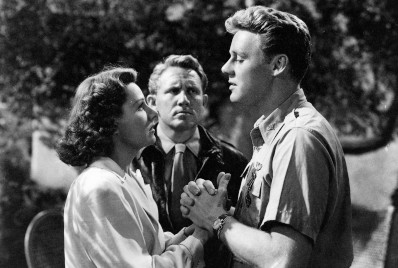
But, the story is a compelling one: Pete Sandidge (Tracy) is a chances-taking bomber pilot in the European theater of WWII. He's best buddies with Al Yackey (Ward Bond) and sweet on Durinda (Dunne), a pilot in her own right. During one mission, however, Pete is killed and, finding himself in the after-life, is tasked by "The General" (Lionel Barrymore) with helping to train a young pilot, Ted Randall (Van Johnson in his first major screen role) in the Japanese theater. Durinda comes back into the picture, still shattered by Pete's death, but at the urging of Yackey, she ends up nearby, and, though reluctant, finds herself falling for Ted.
For Pete, this is agony, watching their budding romance, and leaves him conflicted about his "mission" and his feelings, and only an extremely melodramatic act of sacrifice forces him to "see the light," as it were.
The screenplay is by Dalton Trumbo, and he works hard—maybe a bit too hard—to balance the conflicting emotions in Pete, and as good as Tracy is, he can't seem to find the right balance to give Pete the depth of character integration to keep the different aspects of his personality together. The motivations are there in the script, but Tracy, fine in individual scenes, can't seem to make Pete a whole human being, giving a slightly disinterested air to the character. Some scenes were re-shot later in the studio to find a better balance (which, ironically, might have led to the problem), but the results on-screen don't pay off. Maybe it's the integration of fantasy elements with a war film that causes the conflict, and although the film comes to a resolution satisfyingly, it leaves one feeling a little melancholy, as if something more could be done. Partially, that's the film and how its elements might have more fully gelled. But, it's also the resolution of the film, too. Realistically (and bear in mind we're talking about a fantasy film here) the proper resolution is to face facts and accept and let go, for spirits on both sides of the astral plane...to accept grief and move on, parting. A bitter pill, even if for a greater good (which is always suspect). In the end, it comes down to making the best out of loss, and given the time of strife in which the film was made, that's a heartening statement to make, if superfluous, given the very real individual losses the world was producing during that war.

Interesting if not completely successful. However, three years later, Michael Powell and Emeric Pressburger would take similar themes and turn it into the far superior, and more fantastical, A Matter of Life and Death (or as it was known in the States, Stairway to Heaven).
The Awful Truth (Leo McCarey, 1937) When Leo McCarey accepted his Oscar for Best Director for The Awful Truth, (which also won "Best Picture" that year) he famously said in his acceptance speech "You gave it to me for the wrong one!" Having not seen Make Way for Tomorrow(the other one he did that year), one has to content oneself with the reputation of the Award-winner, which I was familiar with because of an in-joke Howard Hawks inserted into Bringing Up Baby a year later* But The Awful Truth was the crowd-pleaser (allowing Cary Grant to become a top-billed star--as opposed to here, where Irene Dunne leads), whereas Make Way... was a box-office disappointment.
Based on a successful stage-play by Arthur Richman (which had already been filmed twice before), The Awful Truth belongs to that sub-category of "Romantic Comedy," "Much Ado About Nothing," where squabbling couples take the consequences to the edge of divorcement, and back again.** The scriptwriters were Vina Delmar and Sydney Buchman (who wrote Holiday, Mr. Smith Goes to Washington, The Talk of the Town, Here Comes Mr. Jordan, and was thanked for his hand being in so many classics by being blacklisted by the Hollywood industry for refusing to name names).McCarey kept things moving briskly and encouraged the actors to ad-lib to increase the pace (McCarey also directed pictures featuring the Marx Brothers, where ad-libbing didn't need to be encouraged and, practically, couldn't be prevented!) Grant took to the technique particularly well--he wasn't comfortable in his role, and would have preferred to play Ralph Bellamy's part.*** His Jerry Warriner became a template for Grant's light comedy roles to follow. He's matched by Irene Dunne "the best actress to never win an Oscar," who may not excell at the off-hand remark, but knew how to fill space with a sarcastic faux-laugh. She could also effortlessly play foolish while maintaining a glamorous veneer--a trick she uses to great advantage in The Awful Truth. 
Entertaining and a crowd-pleaser, The Awful Truth pales a bit in comparsion with its more savage progenitors, but to contemporary audiences it must have seemed like a roller-coaster ride.Tomorrow: Make Way for Tomorrow
* In Bringing Up Baby, Susan (Katherine Hepburn) with most of the cast in jail, pretends to be a wise-cracking moll and refers to the hapless David as if he's a mob-boss named "Jerry The Nipper," which is a laugh-line regarding Grant's character in The Awful Truth. Orson Welles also mentions McCarey's Oscar remark in his recorded remarks in "This is Orson Welles."
**Besides, "Much Ado...," such films in the sub-category include The Philadelphia Story, Private Lives, His Girl Friday, Mr. and Mrs. Smith, etc. Cary Grant excelled at them
*** Which provided another joke for Hawks in His Girl Friday. When Grant's character is asked to sum up his ex-wife's (Rosalind Russell) fiancee, says "He reminds me of that actor...Ralph Bellamy," apt because Bellamy played the part!


_2.JPG)






_01.jpg)