Showing posts with label Frederic March. Show all posts

Tuesday, September 7, 2021

Mary of Scotland

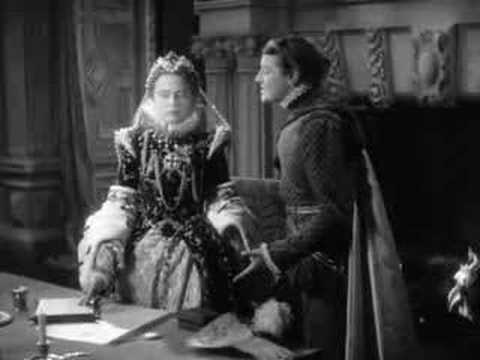
Mary of Scotland (John Ford, 1936) The film, written by Dudley Nichols from Maxwell Anderson's play, begins with an odd preamble, giving an overview of the whole Mary, Queen of Scots/Elizabeth R situation, and ending with the hopeful suggestion that they are "all equal now," buried close to each other in Westminster Abbey. Cheery thought, and, despite what the play and movie say, the only time that Elizabeth and Mary were in the same room together.*

It's a problematic film. betraying its stage roots (the speeches are very formal, stylized, and performed theatrically, with no overlap and AT THE TOP OF EVERYBODY'S LUNGS, as if trying to reach the last row of the balcony) although Ford works overtime to find interesting angles to shoot from. So much Hollywood gossip swirls around this film**part of Hepburn's "box-office poison" cycle (she'd just bombed with Sylvia Scarlett and more were on the way)—that one is hesitant to bring it up as sources for the film's problems, which are many. 

But the main fault lies with Anderson's play, which lionizes Mary (Katherine Hepburn) while demonizing Elizabeth, and the production goes right along with it—Mary's first lines are a prayer to God for returning safely to Scottish shores, while Elizabeth's is ordering people around and played (by Florence Eldridge) as if she were Edward G. Robinson. It would have been nice if this subject were a little more nuanced, as it involves two strong women in positions of power with men as being subjective, if constant irritants. One wishes that the two could have gotten together and agreed that all the men surrounding them were jerks and done something about that, rather than engaging in power plays for England's throne.
But, that's not how history went, and the play plays fast and loose enough with the facts as it is. And this is Mary's movie, to the point where Hepburn is the only cast member with close-ups—jarring close-ups that have the feel of insert shots as the lighting changes dramatically from the establishing shotsElizabeth is only seen in full shots that emphasize costume over performance.
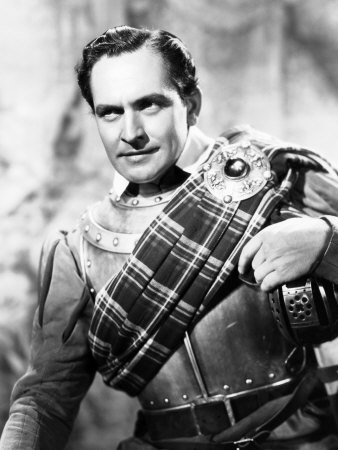
There are joys to be had, though. Ford's penchant to use unruly horses is much in evidence, and the animals are particularly out of control on the sound-stages that dominate the film. And Frederic March is something of a revelation, boisterous and accented, his is the best performance in the film. And Ford's presentation is never less than spectacular, as has been mentioned, giving the film a scope that it wouldn't have had in other's hands.
 
 
A not-altogether successful film, but interesting to see.


* This is a problem with most of the films dealing with Mary, Queen of Scots—historically, they never did appear (that we know—something Lucy Worsley might some day let us in on it) in the same room, although there were letters sent back and forth. It might have something to do with studio politics and ginning up the drama. Traditionally, the two have been played by stars (Vanessa Redgrave and Glenda Jackson in 1971's Mary Queen of Scots, and more recently Saoirse Ronan and Margot Robbie in 2018's Mary Queen of Scots) and so there must be some re-writing of history in order to get Acting Queens to spar off each other, even if the real Queens did not.
 
** Ford was unhappy making it, and—as he occasionally did—walked off the film in the midst of shooting on day. I can't be sure, but when I read Hepburn's autobiography, I seem to recall her saying that she directed for the rest of the day and seemed to think nothing of it. And...take a look at this scene on YouTube. There is a portion where Mary addresses James Stuart, Earl of Mowbray, where the conversation is at cinematically clashing angles, perhaps to favor a flattering angle...well, let's face it, of both actors. It's an odd choice by Ford if he, indeed, did make it.

Wednesday, March 4, 2020

Inherit the Wind (1960)

Inherit the Wind (Stanley Kramer, 1960) I'm of a liberal frame of mind, which, if you take it as a true meaning, means that you are open to new ideas—even conservative ones. I know this may sound heretical to some and pollyannaish to others, but that's okay. It's my frame of mind, nobody has to picture it but me, though I may hang.

But, there are some movies with a liberal bent that just chap my hide and this Stanley Kramer film of Jerome Lawrence and Robert E. Lee's 1955 fictionalized play (adapted by Nedrick Young and Harold Jacob Smith) about the Scopes Trial that centered on whether evolution could be taught in schools is one of them.

I say "fictionalized" because it does not feature Clarence Darrow and William Jennings Bryan (who argued on both sides in the 1925 Scopes Trial), but "Henry Drummond" (played in the film by Spencer Tracy) and "Matthew Harrison Brady" (played in the film by Fredric March) as court-opponents. Heck, John T. Scopes is named "Bertram Cates" (and played by, let's face it, the simian-looking Dick York) and "E.K. Hornbeck" (played by Gene Kelly) is a stand-in for H.L. Mencken
Do a comparison of the trial's events and the play and you'll find so many deviations and fabrications and omissions (did you know that Bryan offered to play Scopes' fine if convicted?) that you begin to wonder if the game is rigged. It is, and the authors defended that by saying they weren't doing a dramatization of events (no, no, no, no!), but the play as a metaphor for McCarthyism and social "thought control."

But, an audience might be convinced that what they're seeing is how things ...evolved.

First off, the Scopes Trial was a sham. The issue was The Butler Act, not evolution. A court can't decide on the validity of scientific theory, but can question the constitutionality of laws regarding free speech and public schools.
The Butler Act said, in part: "That it shall be unlawful for any teacher in any of the Universities, Normals and all other public schools of the State which are supported in whole or in part by the public school funds of the State, to teach any theory that denies the Story of the Divine Creation of man as taught in the Bible, and to teach instead that man has descended from a lower order of animals." Joseph W. Butler was a Tennessee State Rep and a member of the World Christian Fundamentals Association who'd heard that (no doubt "from a lotta people") that kids were coming home from school telling their parents that the Bible was bunk.

The ACLU wanted a test case. Scopes, a substitute science and math teacher agreed to be the defendant when asked by Dayton business leaders—prominently George Rappleyea—to test the law, believing it would bring a lot of publicity to Dayton. Remember that. Butler's Law had one big thorn in it. Tennessee public school teachers were required to use a textbook, Hunter's "Civil Biology", which had a chapter on evolution. In other words, if a science/biology teacher did their job using that required text, they'd be violating the Butler Act. Rock meet Hard Place. But, Scopes—after some initial reluctance agreed saying "If you can prove that I've taught evolution and that I can qualify as a defendant, then I'll be willing to stand trial."
Scopes couldn't remember if he'd actually taught evolution, but coached students to say he did in order for an indictment to be made. When the gran jury recommended trial, the prosecutors—who were friends of Scopes'—reached out to Bryan—who had been very vocal in his support of the Butler Act to join their team. Bryan, never the shyest of men, agreed, although credit for the request went to the head of the WCFA. The defense reached out to Darrow, who initially refused so as to keep the whole thing from becoming a circus, but as it was becoming one, anyway, accepted. 
"The trial," (such as it was) was broadcast on radio, with witnesses for evolutionary theory blocked, prejudicial instructions from the judge and a completely unnecessary debate between Bryan and Darrow on the last day because Bryan, believing he'd been one-upped by the defense's arguments regarding the Bible (the jury did not hear them because the judge excused them from that part of the defense's case, pending dismissing that part of the testimony) wanted the last word. The thing was, he was being questioned by Darrow and that last, seventh day of the trial (held outdoors because of the stifling heat) devolved into arguments and was finally gavelled finished by the judge.
Ultimately, the jury found Scopes guilty, he was charged a $100 fine by the judge and the verdict was overturned on appeal by a technicality. That technicality being inherent in the Butler Act, itself: the judge fined Scopes $100 as per the tenets of the Butler Act, but Tennessee judges under the state constitution could not charge fines more than $50, only juries could. And that was the end of the Scopes Trial. The Butler Act was repealed in 1967.
Inherit the Wind would have you believe that the judge only fined Scopes $100 out of political expediency and because he didn't want to give the town any publicity. But, publicity is what the whole trial was about and its purpose for being. And the film also makes its Darrow stand-in so warm-and-fuzzy and tolerant about the Bible that it runs afoul of Darrow's attitude throughout the trial. The movie's theme is "(Gimme That) Old Time Religion," but it should have been "Kumbaya."

Inherit the Wind is a plea for tolerance merely, but to see it as anything more runs afoul of everything about the actual incidents as they took place in 1925, incidents that were staged and manipulated for maximum exposure and cotton candy sales, as real and as truthful as a television reality show. To further compound it by fictionalizing it is to lend it a credence that it never had and a relevancy that it never achieved...for either side.
Where do I stand on the evolution debate—not that that is what Inherit the Wind is about? Well, I'm more scientifically prejudiced towards the evolution side—frankly, I prefer my flu shots to be the current, robustly effective ones than a ten year old variety that will do nothing against a flu-strain that has evolved beyond the ability for that vaccine to kill it.
But, then, I've always liked Stanley Kubrick's "take" on the idea, as expressed in 2001: a Space Odyssey (about to hit its fifty-second anniversary next month), which took the question of "were we created by a god, or, did we evolve, naturally, over time as the fittest survivors?" and came up with the answer "in a Universe of possibilities, why can't it be a little bit of both?"


Tuesday, April 9, 2019

Design for Living

Design for Living (Ernst Lubitsch, 1933) High class production about the bohemian class. Noel Coward's play (which had nothing to do with the bohemian class) about a menage a trois (and, by association, a menage a quatre) is given a rinse of the more suggestive parts by Ben Hecht (it's Pre-Code, so they don't go through too many cycles on this one, just to keep both the prudes and the lascivious in a lather) and an added dash of charm by director Lubitsch and cast with a collection of players that folks wouldn't have bat an eye at before, but in retrospect (given subsequent histories), is a bit unexpected.

En route to Paris, graphics artist Gilda Hopkins (Miriam Hopkins) shares a train compartment with two American down-on-their-heels artistic wanna-be's, painter George Curtis (Gary Cooper) and playwright Thomas Chambers (Fredric March), both of whom become enchanted with Gilda, and she with them (“A thing happened to me that usually happens to men. You see, a man can meet two, three, or even four women and fall in love with all of them, and then by a process of interesting elimination, he is able to decide which he prefers. But a woman must decide purely on instinct—guesswork—if she wants to be considered nice. Oh, it’s quite all right for her to try on a hundred hats before she picks one out.”) but agree with her to keep things merely friendly and professional, as she starts to act as confidante and muse for both their lives and their art. That she is also sought-after by her much-too-old boss, Max Plunkett (Edward Everett Horton) only complicates matters.
George, Thomas and Gilda decide to share a loft and make a pact of no hanky, no panky and no combination of the two, as the off-beat living arrangements create a certain amount of tension between the three. Meanwhile, Gilda uses her connections to jump-start the two men's careers. Thomas' latest play is put in the hands of a London producer, and soon, he's flying off to help with re-writes and overseeing production.

"No sex. A gentleman's agreement..."
In his absence, Gilda and George begin an affair while, in London, Tom's absence makes his heart grow fonder and he decides then and there to marry Gilda once the play opens. But running into Plunkett at the theater, he discovers that George and Gilda are now a couple, and rushes back to Paris only to find that the lovers have moved out of the loft. George, however, is in Nice working on a commissioned portrait, and so Tom seizes the opportunity to make a stand. 
"Unfortunately, I'm no gentleman."
Gilda reluctantly agrees to see Tom, and—wouldn't you know it?—she decides she's really in love with Tom and they begin an affair while George is out of town. Except, George comes back and finds the two lovers in his own penthouse love-nest and things turn ugly. It seems that three's company and two's are not to be trusted. What's a girl to do?
She complicates things, of course. Gilda decides to marry her boss, Plunkett, but the marriage cannot be consummated when George and Tom send over potted plants as gifts ("It would have been much more tactful for them to forget!") which so upsets Gilda that she hides in her room, crying. Then, at a large soiree the couple is throwing for Plunkett's clients, Tom and George crash it, making mischief wherever they go, including Gilda's bedroom, which infuriates Plunkett. The marriage is over and the three decide to move back in together.
Now, this is in the Pre-Code era before content restrictions were self-imposed on studio's, so although it may seem raunchy, everything is merely suggested. In fact, Hecht's adaptation (although Coward bitched it was hardly that) makes the trio far more relatable to the movie-going public by taking it out of the rarefied air of British manners and class, and making the two artist-types Americans. You couldn't mistake March, a deft farceur, or Cooper—still in his glamour days before he aged into more rural authenticity—for upper-crust, even if you dress them in tails. And Horton maintains his professional befuddlement. 

Hopkins, of course, has the toughest role, making her designer charming despite an inability to make up her mind and a tendency towards—dare we say it?—capriciousness (we didn't dare say it). But, it's perfectly true that she's merely playing a man's game in the sexually sampling context and the men play by the same rules. This was 1933 and it seems like (now) the only women in movies who take the same attitude are labelled promiscuous or villainous. This is progress?

The film stays light, funny, extraordinarily quotable—without any Coward—and froths with "The Lubitsch Touch." At the same time, in that time or ours, it's also a little revolutionary. Vive le révolution.


Wednesday, October 24, 2018

I Married a Witch

I Married a Witch (René Clair, 1942) A Preston Sturges production (that he quit over differences with the director), partially written by Dalton Trumbo (who quit over his differences with Preston Sturges—maybe he should have waited until Sturges and Clair started to have meetings), I Married a Witch is one troubled flick, and, sadly, it shows. Where it should be charming (and dare I say "magical"?), it's merely cloying. And all of the behind-the-camera wrangling wasn't the only thing causing havoc on the picture, as there was quite a bit of cursing and hexing among the actors in front of the camera, too. Joel McCrea (who would have been a better match here) passed on the starring role after his difficulties with Veronica Lake on Sullivan's Travels ("Life's too short..." was his comment) and Frederic March—a better actor and no slouch at comedy (see Nothing Sacred) was inserted.  But, his efforts comes off forced and flat, and Lake's antics off-screen soured any chemistry when the two were photographed together. 
And yet, Lake is great.  She didn't take any of this too seriouslyit's a fantasy, after all—and she's that perfect combination of alluring and goofy.* Her character, a witch named Jennifer burned at the stake during the witch-trials by one of the ancestors of March's character, places a curse on the male family-line to always marry the wrong woman. By the time, lightning strikes a gnarled tree which frees the spirits (in smoke form), the latest of the Wooley clan is a scion running for political position and is on the hallowed eve of marrying the starchy daughter (Susan Hayward) of his chief supporter, a newspaper publisher (Robert Warwick). Everything seems well-orchestrated and on-schedule, prim and proper and corrupt. What's needed is a little black magic.
And where there's smoke, there's fire. Wooley and Jennifer "meet cute"...in a burning building—whatever the merits of the film, you can't say it's "formula"—and Jennifer's witch starts popping up everywhere, most notably in Wooley's pajamas in his bed, which makes things...complicated. Now, that "formula," which we mentioned earlier, comes to the fore, when the witch decides to seal the deal with a love potion to ensure Wooley's love for her. Guess who drinks it?  You don't need magic powers to guess.
Where the film picks up (and actually does catch fire) is in the drawn-out wedding sequence, where Jennifer's manipulations (along with her father's, played in corporeal form by Cecil Kellaway) manage to derail the most staged of political-social weddings and does so four times.** The wedding singer sings "I Love You Truly," the wedding march begins, and then (boom) something happens and everything gets pushed back to the starting point—"I Love You Truly." Having to pick up the pieces and re-stage something so elaborate that many times is comedy gold, and Clair and the writers (including Robert Benchley who has a prominent role) keep ramping up the stakes when returning to the ritual, leading to a fine capper involving the ceremony's stodgy wedding singer.
But, then, things turn "charming" again, undercutting the satire and the basic push-pull of organization and chaos. But, for a brief time, anarchy reigns supreme, turning the greased gears of prominence and political glad-handing into a thudding, shuddering mess, seeing a processional and wanting to pull the rug out from under it. No wonder Sturges wanted to do it. And Trumbo? He knew a lot about witch-trials (but not as much as he would). Benchley is nicely droll throughout, light on the irony, heavy on the farce. There's a constant battle between the wisenheimer and the twee and the result is rather milquetoast.  What should have bubbled like a cauldron comes across as rather tepid.
But that wedding section. It's crashingly good. 
"that perfect combination of alluring and goofy"
  
* What is it with blondes and comedy?  As much as Hollywood tries to shoe-horn gorgeous blonde-types into drama, some of the most alluring women are at their best doing comedy—Carole Lombard, Grace Kelly, Kim Basinger, Cybill Shepherd, Charlize Theron (all serenely beautiful) were at their best (in my opinion) when they were sly and antic, as if there was something in their DNA (or peroxide) that compelled them to find the "funny" in a situation, especially their own, and blow it up. One of those little mysteries that occupy my brain in stray moments.

** The bride is played by pre-stardom/America's sweetheart Susan Hayward, who's character is such a straight-laced sour-puss that she has to be reminded by her newspaper-editor of a father to smile at her own wedding, which she manages to do only the first three times. It's among the collection of running gags in the extended sequence that builds to a satisfyingly disruptive conclusion.

Thursday, October 6, 2016

Dr. Jekyll and Mr. Hyde (Twinned)

Private Joker: I think I was trying to suggest something about the duality of man, sir. 
Pogue Colonel: The what? 
Private Joker: The duality of man. The Jungian thing, sir. 
Pogue Colonel: ...Whose side are you on, son? 
Full Metal Jacket

"(Cocaine) enhances your personality!"  "Well, what if you're an asshole!?"
Bill Cosby from Bill Cosby, Himself

Better living through chemistry? And whose side, indeed? This Hallowe'en season we haven't been looking at monsters, and creatures and other outside forces that threaten us and make us come face to face with horror (as we have in the past). We've been looking at those that attack us from within. Not at the monsters that peer at us from outside our bedroom window, but the ones that look at us indoors in our very own mirrors. What special horror it is, when we come face to face with our enemy, and it's our own. No better example of that came from the pen of Robert Louis Stevenson in the year 1861.

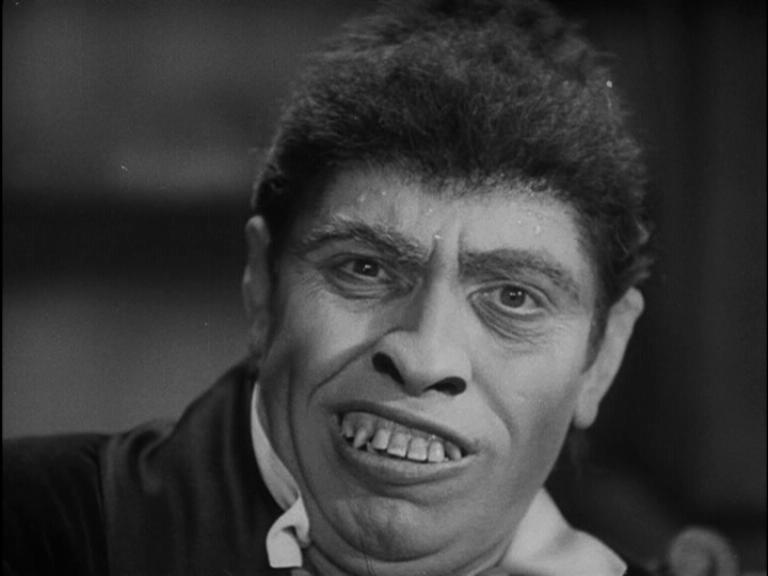
 Dr. Jekyll and Mr. Hyde (Rouben Mamoulian, 1931) A new version of Stevenson's "Strange Case of Dr. Jekyll and Mr. Hyde" seems to crop up every few years. There've been versions with John Barrymore, Basil Rathbone, Christopher Lee, Spencer Tracy (see below), and TV versions with Jack Palance and even one with Lionel Bart musical numbers that featured Kirk Douglas. But, this is the one people remember, for many reasons—first being Frederic March's portrayal (which won him an Oscar for Best Actor...in a Horror film, mind you), the effects, the outright sexiness of it (as the film was "Pre-Code,") and for director Mamoulian's stylish treatment—full of straight-on shots of the actors facing the audience, mirrored shots, and all the transformations, each one staged differently (and in a couple of instances using a combination of make-up that only becomes apparent in monochrome when struck by lights colored by different gels—with "Hyde" finally appearing as an ape-like creature in need of radical orthodentia.  March turns in an incredible performance (and he won an Oscar for it, the first actor to do so for a lead in a horror film—the second being Anthony Hopkins in The Silence of the Lambs), his Jekyll (pronounced Jee-kull as the Scottish Stevenson would have it) clearly conflicted but held in check and completely invisible in the form of the obstreperous Hyde, leaping over parapets and loudly enunciating (through those big false teeth) his intentions in a husked gravel.  When first confronting his new image in the mirror he cries "Free!  Free! At last!"


Now, in Dr. Jekyll and Mr. Hyde (Victor Fleming, 1941) the Dr. Jekyll (pronounced Jeh-kull) played by Spencer Tracy, is far more considering: "So, this is evil, then" he observes staring at his new countenance in the mirror.

Yes. Yes, it is. Tracy's Jekyll is a thinking, decent man with dark undertones, far less egocentric than the stentorian performance of March; his Hyde is shaggy dark eyebrows and hair, with a curled upper lip like a scar and a direct gaze and uncouthness, despite his pretensions of refinement. March's Hyde is a proto-human; Tracy's is just a sadistic sociopath. Jekyll's frustrations with his straight-laced potential father-in-law (Halliwell Hobbs in the first, Donald Crisp in the latter) are buried deep and Hyde releases that pent-up rage.  In the Tracy version, the intelligence is still there (as opposed to March's gleeful monkey-man) but used malevolently—the words are erudite and evenly spoken, but his actions are quick-silver and savage.  

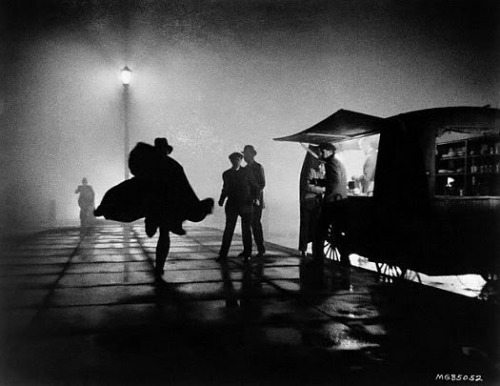
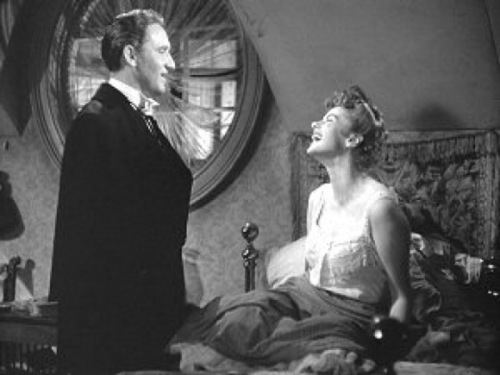
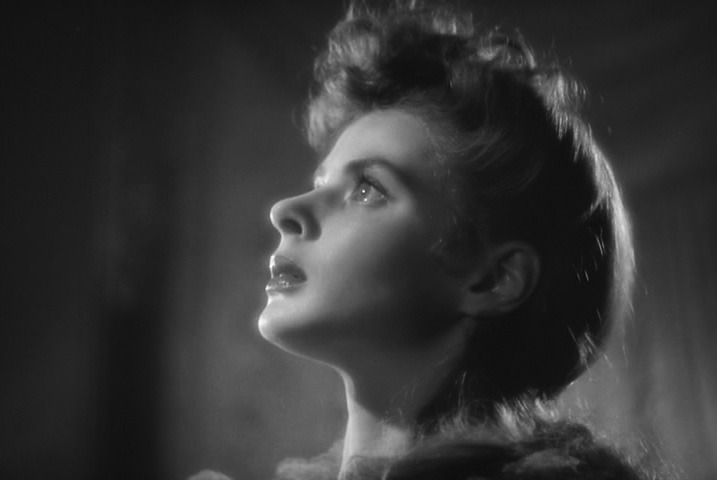
The Tracy version of the character depends less on make-up than the actor's own inventiveness (not that March was any slouch, far from it). Directed by Victor Fleming, with more emphasis on thick fog effects (where Hyde seems to be allowed to be swallowed in the thick mists, until he disappears like so much water vapor) and the psychology of evil, it is sumptuously produced and veers into the surreal during the transformation sequences. These are weirdly disturbing, shifting from surfacing lily-pads to Jekyll whipping a team of horses...which then turn into the two women in his life: his faithful fiance (played by a never-lovelier Lana Turner) and a bar-maid (a very early role for Ingrid Bergman, this one preceded Casablanca). One can only imagine the direction that the director gave his actresses for this sequence and the others ("Okay, Ingrid, you're a wine-cork, but a happy wine-cork!"). Whereas March's Hyde is all simian actions and attitudes, Tracy's is psychologically, adroitly cool, a genuinely mean bastard gleefully tripping up theater managers with his walking stick, and setting up Bergman's Ivy Petersen as a kept woman, scarring her physically and mentally. Both films stray from Stevenson's narrative, which only implies Hyde's actions, which seem to stay only in the realm of violence, but both Mamoulian's and Fleming's films features the story of the two women who suffer at the man's hands and split personalities. Bergman's performance is raw and heartbreaking, subtly letting emotions percolate under the surface of her skin, a luminous smile capable of dropping precipitously and tremulously, then escalating into hysteria. Turner's performance is pitch-perfect, but merely an ingénue role and she's not required to do too much of the tortured complexity she would display later in her career.

Mamoulian's film is fancy; Fleming's is fanciful, each taking different approaches to what is essentially the same screen-story, deviating just as far off the cobblestone streets of the novella, and each one coming to the same conclusion—different from the story's where Jekyll's fate is left in the air, seemingly condemned to live out his life as the evil Hyde—to satisfy the moralists in the audience, pre-Code or not. Interesting to see them back-to-back (to-back-to-back) and explore the similarities and differences—a bit like Jekyll and Hyde themselves.

Interestingly, these two Jekyll's, Tracy and March, squared off against each other in the courtroom drama Inherit the Wind.*

* And another parallel: March received his first Oscar nomination for playing the part of actor Tony Cavendish in The Royal Family of Broadway.  The role of Cavendish was based on John Barrymore who had a big success...playing Dr. Jekyll/Mr. Hyde in the 1920 film version.


"...Room for one more, honey?"

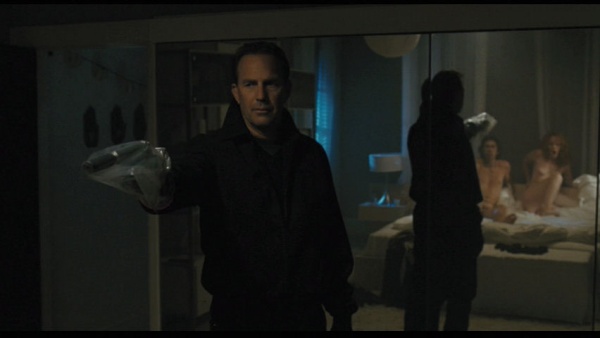
Mr. Brooks (Bruce A. Evans, 2007) A more modern take on the Jekyll/Hyde-in-plain-sight story (we won't talk about the various "Hulk" movies—the superhero version of it) is this creepy psychological thriller about another upstanding citizen and pillar of the community, Earl Brooks (Kevin Costner), CEO of a thriving box-making business. Brooks has a seemingly normal nuclear family: a loving, doting gorgeous wife (Marg Helgenberger) and a slightly spinning-out-of-orbit daughter (Danielle Panabaker), but the fourth member of the clan is the one with the most fission—the other voice in Brooks' head, Marshall, played by an on-screen William Hurt. The performances of the two men couldn't be more different: Hurt has the easier one—the all-leering, cackling, lip-smacking Id, while Costner (being in the "real" world) is restrained, cerebral, and calculating on the inside. Costner really is a fine actor, and his Brooks, in control of most situations unless Marshall convinces him otherwise, every so often goes on a killing binge that satisfies a weird craving. One entertaining aspect is that Brooks is self-aware enough of his situation to go to AA meetings. He's an addict and he knows it. But there aren't enough steps in any program to cure his issues. He's made enough of a blood-splash to attract the attention of local detectives (Demi Moore leading the investigation) and one fan-boy (Dane Cook) who wants in on the action. Earl and Marshall are caught in the middle (and with two personalities it gets very crowded in there), yinging and yanging between their two points of view and calculations. But the creepiest moments—the genuinely chilling ones—are when they combine, joining each other in a sick, twisted laugh for a shared joke, between the two personalities in the one man. For all the gruesome murders and gouts of blood on display, that's when Mr. Brooks gets really scary.

Wednesday, May 18, 2016

Seven Days in May (1964)

Seven Days in May (John Frankenheimer, 1964)  May 18th.

Mark it in your calendars (or in notes for future trivia contests). That is the day the government of the United States was scheduled to be overthrown by a military coup organized by the Joint Chiefs of Staff, over a nuclear treaty signed by the United States and Russia and ratified by the Senate.
 
But it never happened. Not even in the movies.

Still, May 18th was the day. The year was never mentioned...almost as a caution.

The early 60's were a great time for filmed political thrillers in the States. Kennedy was president, the world was at war (coldly) and the fictional machinations were filmed in a very appropriate black-and-white, just like the television sets that brought the news into our homes. It was a time distant from the years of World War II when the words of politicians and leaders were taken at face value, even if the individuals were two-faced. Cynicism about the government and political overreach began to settle over the populace with the threat of nuclear weapons, the McCarthy hearings, Ike lying about the U-2 incident, each in their own way chiseling at the foundations of the monuments we had in place in DC. 
Books and movies started to reflect that cynicism like The Best Man, The Manchurian Candidate, Advise and Consent, maybe Fail-Safe. And this one, Seven Days in May, from the the team that wrote "Fail-Safe," for this movie adapted by Rod Serling and directed by Manchurian director Frankenheimer, with an eye towards reflecting the world as it is...or as we would see them playing out on TV. Serling was overseeing "The Twilight Zone" series at the time, but this one was not too off his comfort "zone" by being equal parts suspense, intrigue, and character study, in words, terse, circumspect, and dripping with irony. Serling's writing could be a little ripe and on the nose, even spoken through gritted teeth and tight lips, as when Ava Gardner tells Kirk Douglas"I'll make you two promises: a very good steak, medium rare. And the truth, which is very rare."
Douglas plays Colonel Martin "Jiggs" Casey, adjutant to the fifth most powerful man in the world, but maybe the most charismatic, General James Mattoon Scott (Burt Lancaster), head of the Joint Chiefs of Staff under President Jordan Lyman (Fredric March). The nuclear arms treaty is extremely controversial, causing violent protests outside the White House.
Briggs is a good soldier, snap-to and does his job, he's loyal to his boss and doesn't make waves (important for a Marine). But, odd things are starting to add up. There's the office pool on the Preakness that's passing between official channels between the Joint Chiefs, which is odd. But, what's odder is the reaction of Scott's "body-man" Colonel Murdock (Richard Anderson) who gets hot under the collar-buttons when Briggs mentions that betting pool. It isn't casual water cooler talk, it's treated like an international incident with the grunt who mentioned getting stationed out of the way to Hawaii. Odd.
Then, Briggs gets a visit from an old pal, Colonel "Mutt" Henderson (Andrew Duggan) who tells him about his current assignment at a secret base in Texas designed for interrupting television signals and designed for "seizure," "like the Commies already had the stuff, and we had to get it back.." That and Scott's accelerating role on the political stage, aiming for a run for the White House.  A somewhat heated conversation with a saber-rattling Senator (Whit Bissell) at a Washington function is the final worry. Briggs follows the Senator back from the party to a clandestine meeting at General Scott's house...when the Senator has already mentioned he'd be out of town.
It's just enough incongruous parts and shady behavior for Briggs to go to the White House to vent his suspicions to the President—there's going to be a coup by the military to take over the government. The President is concerned but cautious. Briggs is sent out to get details on the wisps of evidence that he has, while the President's Aide (Martin Balsam) is sent to make a call on the one military chief, Vice-admiral Farley Barnswell (John Houseman-his first screen debut, although uncredited) who has not opted into the "pool" to provide written evidence of the conspiracy. One of Lyman's closest associates in the Senate, Senator (Edmond O'Brien) heads to Texas to see what he can find out about the hidden base, while Briggs starts to gather evidence, including from Scott's discarded mistress (Ava Gardner).
It soon becomes clear that there is, indeed, a coordinated effort from a particularly dedicated cabal to take over the government, either during a nuclear training exercise or the President's upcoming trip to his weekend retreat—the President maneuvers his schedule, making Scott adjust his plans, which are then monitored by government agencies. But, how will it play out? It's an elaborate chess game with many moving parts with the final component being the medium of television, the direct link to the populace on whom the ultimate decisions of governing rests.
There's a lot of talk, as Serling goes overtime with terse conversations behind locked doors. It's drama, but Serling disliked raised voices, just like Washington does (or used to). There was never a time when the theatrics of the circus didn't invade governance, but before entertainers and the pulpit entered the fray, the popular conception of government conversation was discourse and debate, not some hard-balling cross-fire competition to be the loudest voice that doesn't pause for breath as is the impression made by the info-tainment of today's television. Why, General Scott's braying passion sounds downright reasonable in today's age of clowns. "You got something against the English language, Colonel?" barks the President when Briggs tippy-toes around his suspicions. Now, everyone does. Today's government speaks the language or lawyers and liars. Snake-oil salesmen.
Frankenheimer films in high-contrast black-and-white, with the high light-levels of television lights and offices and the deep shadows of parking lots and other holes of skullduggery. It's like he wants to show pictorially that the best governance is the one in the light and not the ones that scurries away from it. And for all the surveillance gear on display, conspiracy can still hide in plain sight. Especially if no one is really looking.
Seven Days in May is a classic movie and a repudiation to the old saw that looks to a savior or "a man on a white horse." Those who engage in hero-worship or ignore the media of manipulation are just bound to be disappointed, if only they were smart enough to admit it. It is also a great movie that should play in the Church of the Eternally Naïve as they endlessly chant "It can't happen here."

March 18th.

Remember, the year isn't given.