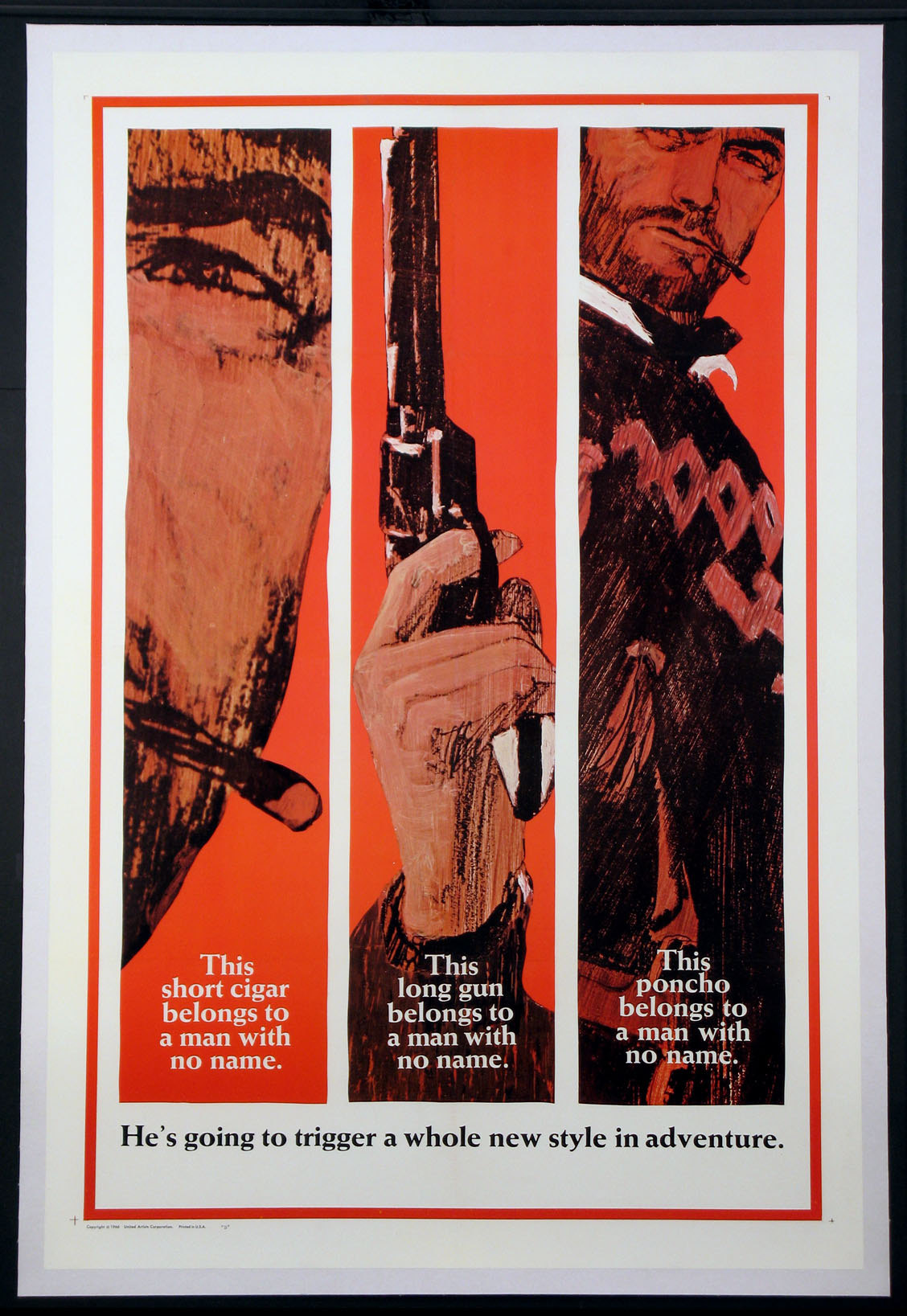
Sorry for the delay. I was preparing another of those "Don't Make a Scene" posts based on one of the old Premiere Magazine "Classic Scene" features—and worked on it for quite some time to completion—only to realize...that I'd already done it! Damn! I hate it when that happens. I don't like things getting by me.
Like the fact that I've been doing this blog for over 10 years now and have done nothing...nothing!...to celebrate it.
Well, let's make like a Clint Eastwood gun-man and kill two birds with one stone. Here's a "Redux" of the very first "Don't Make a Scene" from here. In the piece I mention that there would be a follow-up—the book-end of sorts—to this and quite a few other of Eastwood's "Last Man Standing" shoot-outs, and you can find that one here. The Story: "You makin' some kinda joke?"
Yeah, not so's you'd notice.
This week, Blogging by Cinema-light will be looking at the directorial career of Clint Eastwood, but we will book-end that with a semi-consistent curiosity in the actor's career that appeared in his first starring role, popped up throughout many of his films, and ended in what was supposed to be the actor's last starring role. The first awaits you here. The "last" will
be next Sunday.
"The Big Joke" in the films starring Clint Eastwood is the one that leaves one man standing. You start with Eastwood's hero of-a-sort standing alone against a clutch of targets and mowing them down without so much as a scratch to his instigator. The genesis of this ploy (as was the basic plot of A Fistful of Dollars) is Akira Kurosawa's Yojimbo,* and the sequence where Toshiro Mifiune's masterless ronin takes on a handful of samurai and economically dispatches them in the street (see the video below)—A Fistful of Dollars even uses the capping joke to the local undertaker. It's an improbable circumstance, but one that became accepted in Leone's films and in so many of the films Eastwood chose to participate in, no matter the director, be it Hollywood veteran or Eastwood himself, whether in a western or an urban crime drama. The trick is always to explain it, if one feels the need (the lazy slo-mo fall-back was that, well, it's Eastwood, of course he always bowls a strike, gun-fight-wise) whether it be a distraction, terrain, or that Eastwood's character is the one most cussedly unafraid in the circumstance—as was the case in Unforgiven.
Even the first shoot-out in Dirty Harry—a variation on this scene, adjusted for urban sprawl and scattered bank-robbers—also ends with a joke that the other guy doesn't get. The joke is that Harry doesn't keep track of the shots he's fired, so he's going to give the downed robber a "chance" to fight it out. But, the joke is: the robber never had a chance...ever. Harry's out of bullets. But he intimidates the guy into thinking he might. That's why the laugh after he squeezes off an empty chamber. You lose, pal. You were always going to lose one way or another...because you chose to rob that bank. The Eastwood protagonist always knows he'll triumph, either because he's better armed, better prepared, or because he knows something his opponents don't know—he has the fore-thought of the outcome that he will make reality. That idea runs throughout the many uneven shoot-outs throughout the director-actor's career right up until what he declared would be his last starring role**—in 2008's Gran Torino—the one film where he loses the battle, but, true to form, it is all part of the plan.
Part of the Sergio Leone design of this scene (which looks big and obvious but is defined by small details) is the "Huh?" factor. Notice when Eastwood's Joe first enters the shot that there is no one visible on the balcony. And Joe starts speaking out loud, like a crazy person. But once Joe leaves the frame, Leone cuts to the balcony to reveal Rojo standing behind one of the balcony's pillars, then moving across the balcony to get a better view of Joe's demonstration. The presence of Rojo was known all the time, which is why now Joe goes out into the street to confront his attackers, under-promising, but over-delivering.
So, here's the first. "Now I've Seen Everything: Clint Eastwood" arrives this week. We'll cap it off next Sunday.
The Set-Up: Joe (Clint Eastwood) has just wandered into town, looking for work. After been shot out from under his mule by three of Sheriff Baxter's men, he finds out from local gossips that the town is run by two warring factions, and his reaction is "There may be some money to be made in this town." He sets off to show off his talents, using the men who had shot at him earlier.
Action!


JOE: Don Miguel Rojo, I wanna talk to you.
JOE: Don Miguel, I hear you're hiring on men. Well, I might just be available.
JOE: I gotta tell ya before you hire me...
JOE: I don't work cheap.
JOE: Get three coffins ready.
PIRIPERO: Well...Huh?
BAXTER GUNMAN 1: Adios, amigo.
BAXTER GUNMAN 1: Listen, stranger, didn't you get the idea?
We don't like to see bad boys like you in town.
BAXTER GUNMAN 1: Go get your mule.
BAXTER GUNMAN 1: You let him get away from you? (Laughs)
JOE: Y'see, that's what I want to talk to you about.
He's feelin'...
JOE: ...real bad.
BAXTER GUNMAN 1: Huh?
JOE: My mule. You see, he got all riled up
when you went and fired those shots at his feet.
BAXTER GUNMAN 2: Hey, are you makin'...
BAXTER GUNMAN 2: ...some kinda joke?
JOE: Mm-mm. No. y'see, I understand you were playing around.
JOE: But the mule,
JOE: ...he just doesn't get it.
JOE: 'course, if you were all to apologize...
(Laughs)
(Laughs)
JOE: I don't think it's nice, you laughin'.
JOE: Y'see, my mule don't like people laughin'. Gets the crazy idea you're laughin' at him.
JOE: Now, if you apologize,
like I know you're going to,
JOE: ...I might...
JOE: ...convince him...
JOE: ...that you really didn't mean it.
SHERIFF JOHN BAXTER: I saw the whole thing. You killed all four of them.
SHERIFF: You will pay, all right. You will be strung up.
JOE: Who are you?
SHERIFF: Don't fire a shot.
SHERIFF: I'm John Baxter - Sheriff.
JOE: Yeah. Well, if you're the sheriff, you better get these men underground.
JOE: My mistake. Four coffins.
A Fistful of Dollars
Words by Victor Andres Catena, Adriano Balzoni, Sergio Leone, Fernado Di Leo, Duccio Tessari, Jaime Comas Gil, Tonino Valerii (after Akira Kurosawa and Ryuzo Kikushima).
Pictures by Massimo Dallamo and Sergio Leone.
A Fistful of Dollars is available on DVD and Blu-Ray from M-G-M Home Video.
* Yojimbo, it turns out, wasn't wholly original, either, as Kurosawa took the basic plot from American Dashiell Hammett's novel "Red Harvest" (that novel's protagonist "The Continental Op" is also a "man with no name") and transposed it to feudal Japan. The American release of Leone's film was pushed back to 1967, after Kurosawa successfully sued, winning 15% of Fistful's gross. According to IMDB, Kurosawa made more money from this remake than he did on his original film.
** Well, that's what he said, anyway. He then broke his promise by starring in a colleague's directorial debut Trouble with the Curve, in return for past services rendered.


 Meanwhile, Prospero's mistress, Juliana (Hazel Court), seeing the interest her lord is paying to his new pet, decides she's going to go over his head and appeals to Satan just to ensure her interests don't get overlooked. Such an act even impresses Prospero, but, as they all learn (but for a mere handful of worthy), whatever one does in life, Death will end it. It's merely a question of...when.
 Corman had looked commissioned many scripts for Masque, from Barboura Morris (an AIP company player, she'd starred in A Bucket of Blood), and even Robert Towne, who'd written The Last Woman on Earth for Corman, and who would become Hollywood's ultimate script-doctor, the Oscar-winning author of Chinatown and a director in his own right. None satisfied him, until Charles Beaumont, a short-story author and (along with Richard Matheson) one of the "go-to" writers for "The Twilight Zone," came up with the Satanist angle and the majority of the script, but by 1964, he was suffering from Pick's disease, and started farming out jobs to associates—he would be dead from something akin to Alzheimer's at the age of 39. R. Wright Campbell finished the screenplay, using ideas from other Poe works.