Showing posts with label John Frankenheimer. Show all posts

Saturday, July 11, 2020

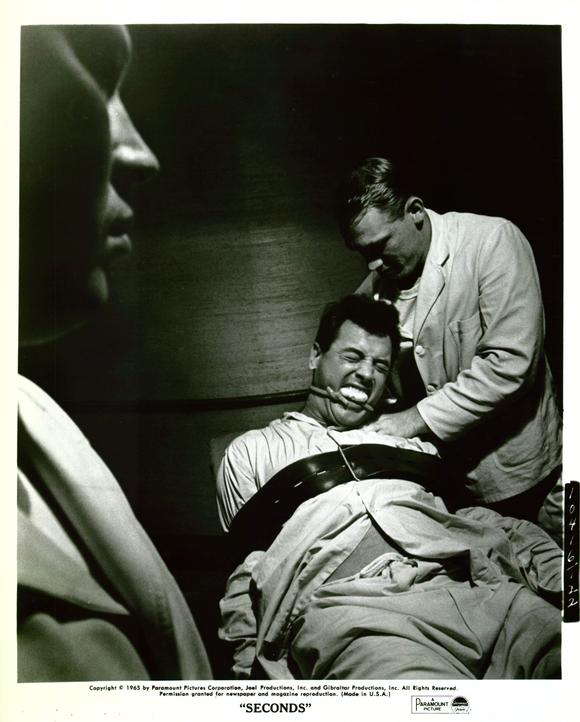
Seconds

Seconds (John Frankenheimer, 1966) Post "Star Wars," science fiction films have been pretty cookie-cutter—fleet-ships, a Hero with a Thousand Names, odd plasticized bi-ped creatures in supporting roles and quests that somehow or other usually get around to revenge. Even the "new" can become old hat.

Science Fiction used to be about concepts, and technology was just an aspect of futurism. For all the newly-conceptualized metal and plastic and wires and blinking lights, it is the organic that has to contend with the changes and evolution just can't keep up with the advancement of tools (especially when they're eventually turned into weapons). Who or what is being served? How does one adjust...if one adjusts? That's why to see Seconds is still a thrilling experience, as it calls to mind a feature-length, subtler "Twilight Zone" episode, that takes an idea and turns it around in its hand, exploring the angles...and the consequences.*
Bank executive Arthur Hamilton (John Randolph) is receiving mysterious phone-calls from someone who claims to be an old friend but doesn't sound like him. A note is slipped into his hand as he enters the subway, and upon further exploration (and prompting) learns that he is being offered a second chance in life. The anonymous corporation will transform him with plastic surgery (even replacing his finger-prints) and an exercise regimen, while setting up a planned "accident" with an unrecognizable "similar body-type" to explain his absence. To the world, he will die, but he'll be resurrected as a new man, with a new life, in a new community—everything re-arranged neatly and clinically. From the ashes of Arthur Hamilton will emerge Hamilton 2.0, Antiochus Wilson (Rock Hudson), bohemian painter. "Wilson" makes a go of his second chance, but he's still the man he used to be inside, and he struggles internally with his new choices...and the ones he left behind. Changing his mind becomes the greatest challenge.
Filmed in black and white—this film would have been over-powering and kinda ugly in color—by the master cinematographer James Wong Howe (with assistance by John A. Alonzo), Seconds is filmed in disorienting tight close-ups, and with unnerving wide-angle lenses that contort, bend and mold the right-angles of life into constricting prisons. The helter-skelter editing of David Newhouse and Ferris Webster keeps the viewer from becoming complacent, and Jerry Goldsmith's bizarre discomfiting score only adds to the unease. This is Hudson's best role—if you're like me and aren't into rom-com's—and his best movie. But it's contradictorily a one-sided performance—there's not an awful lot of joy (I think that may be the point), and he's unsure, disoriented or drunk throughout most of it. And, as Frankenheimer says in his commentary, he really worked hard in this role...especially towards the end.
One should also be aware that in one scene in the corporation's stark "briefing room," the cast is comprised of Randolph, Will Geer (he's especially creepy in this role, while being his most benevolent) and Jeff Corey—all "brethren" in the secret society of blacklisted actors.
This version of Seconds is not the one released in the States in 1966. A disorienting wine-making festival sequence with pre-hippie free-thinkers orgiastically stomping grapes in the buff was deemed too risque for its release (and Hudson wasn't comfortable with the sequence, as is evident in his performance), but it has been restored for the DVD release.

It's still an affecting film, even now, over 40 years later, a cautionary time-capsule of that era when the concerns of the speculative writer was society and not space-ships. Sometimes, fantasies have a nasty habit of becoming nightmares.

Saul Bass' disorienting Title Sequence gets you in the mood.
* Director Frankenheimer worked in the Golden Age of Live Television and worked with Rod Serling, pre-TZ, and post-TZ—Serling wrote the script for Frankenheimer's Seven Days in May.

Wednesday, June 3, 2020

Ronin (1998)


Ronin (John Frankenheimer, 1998) John Frankenheimer's long directorial career started out with him as a young television "turk," who wasn't afraid to be controversial or veer into the surreal. Early works like The Manchurian Candidate (the earlier, better one), Seven Days in May and Seconds (Rock Hudson's finest hour) showed a film-maker not afraid to tackle political and social issues in an entertaining, often satirical way. He'd veer off into odd territory like Grand Prix, and The Gypsy Moths, where the indifferent material would win out over his film-making expertise. The films would be a technical marvel, but descend into soap-opera when not behind the wheel, or falling through space. 

On occasion, he'd even hit the skids (Prophecy, The Extraordinary Seaman, 99 and 44/100% Dead). But then, there are his thrillers, like Black Sunday, and even French Connection II (which had Gene Hackman's "Popeye" Doyle in France to track "Frog One") that in their final acts are primers on how to stage chases and action finale's--bare-boned, fast-paced and visceral.
His master-class in action directing, Ronin, however, is like an entire final act--lean and mean, with no fancy motivations and cryptic dialogue. It is a job done among professionals (or at least those who consort themselves as professionals). It is the heist film reduced to the most rich of consommés. Even the "Object of Desire" (or "McGuffin," if you will) is obscure—it is never established what is in "that" suitcase that everybody wants, nor does it matter. They just want it, and are willing to plot, and double-cross and double-deal to get it. The characterizations are on the thin side--people just have their jobs to do, and their marks and targets to hit. Their history is their reputation and their reputation is why they're on the job. 
Nobody's going to be discussing their childhoods and nobody cares to ("You ever kill anybody?" "I hurt somebody's feelings once" is as close as anybody comes). The dialog is circumspect, ironic, and arrogant (in the french meaning of the term). The fact that they are there means they are good enough to have survived to be there. Do the job.
And the cast is superb. Robert DeNiro, Jean Reno, Sean Bean, Natascha McElhone (where's she been?), Stellan Skarsgard, Michael Lonsdale, and Jonathan Pryce, all doing professional, unsentimental work. The set-pieces are amazing, especially a car chase through the Paris tunnels. But just as much care goes into the staging of the planning. If anybody wants to see how the "Mission:Impossible" franchise should be done, this movie is the model.


Friday, February 2, 2018

Black Sunday (1977)

Black Sunday (John Frankenheimer, 1977) From the twisted mind of Thomas Harris (who would later write "Red Dragon" and "The Silence of the Lambs") comes this entry in the "disaster movie" cycle of the 1970's. Only this one seemed entirely credible. Harris' first novel (and the only one that doesn't have Hannibal Lecter in it) conceived of a terrorist plot by a cell of the PLO called Black September (the group behind the Israeli athlete massacre in Munich in 1972) to kill everyone in the stadium hosting the Super Bowl.

The film had the promotional tagline "It could be tomorrow!"


Robert Evans bought the movie rights in his independent production deal with Paramount after leaving the studio, Ernest Lehman was contracted to write the screenplay (it would prove to be his last, with additions by Ivan Moffat and Kenneth Ross) and John Frankenheimer hired to direct—he had just finished a sequel to The French Connection and was starting to be noticed (again) as a gifted film-maker, especially when it came to thrillers. From the beginning, Frankenheimer wanted to set Black Sunday apart from the normal string of disaster movies in vogue during the 70's* by making it seem as true-to-life as possible, giving it an almost documentary feel.

The movie begins with a night-time raid on a September cell by a ruthless Mossad squad (led by Robert Shaw's agent David Kabakov) that is brutally efficient in taking out the terrorists, with one notable exception: catching September agent Dahlia Iyad (Marthe Keller) in the shower, he lets her go with only an appraising gaze.
Big mistake. Dahlia has a plan...and a means to carry it out. She has been "grooming" the aid of a court-martialed Vietnam vet, Michael Lander (Bruce Dern), who is on the psychological edge—suffering from PTSD as a Vietnamese POW, and by the resulting collapse of his marriage upon his return, he is chronically suicidal. Curiously, that hasn't stopped him from getting a job driving the promotional blimp for the Goodyear Tire company. Bad for them. Good for Dahlia. She convinces Lander that if he is going to commit suicide, he should do it in the most spectacular way possible, striking back at the country he's convinced has betrayed him, taking out as many Americans as possible in a terrorist attack on the Orange Bowl during that year's Super Bowl.
Meanwhile, the Mossad has brought in the FBI—in the form of agent Sam Corley (Fritz Weaver) on the results of the raid. Kabakov is starting to realize his error; Iyad is a former Baader Meinhoff member now offering her services to the PLO...and he had her dead to rights. She's now dropped off the intelligence radar and the Israeli's want the assassination mission completed, something Kabakov takes on as his personal responsibility. A recording that was found at the compound leads the investigators to suspect some sort of action is imminent and that the tape was meant to be discovered after the attack...but where and when the recording isn't specific.
The movie begins to take two parallel paths, following both the terrorists in their preparations and the FBI/Mossad investigation about what they might be doing. Their first idea that something is about to happen comes from a report from the Coast Guard to the FBI—twelve crates have been unloaded from a freighter to a man and woman wearing masks, but when the CG tried to intervene they were outrun. Kabakov travels to Long Beach and sneaks aboard the freighter under cover of darkness to interrogate the captain who needs a little persuasion to talk. But, when the captain answers a telephone, he is killed in an explosion and Kabakov is injured by the blast.
Those smuggled crates contain statues of the Madonna—made out of plastique that will be shaped into a large bomb to be brought into the Orange Bowl by the blimp and detonated, releasing thousands of steel flechettes, enough to kill everyone in the stadium. An initial test in the desert convinces Lander that the explosion will be uniform enough to cause the most devastation within the bowl-shaped stadium. With the plot proven in theory, Lander and Dahlia start work on the details to be ready for the next Super Bowl, while Kabakov and Corley are delayed by the Mossad agent's hospitalization. But, an aborted attempt by Dahlia to kill Kabakov in his room, convinces them that what could have been a few unrelated clues is a very real plot, one that their suspects are trying to see to completion by eliminating the investigators.
Upon Kabakov's release from the hospital, the investigation becomes more intense: Kabakov threatens a Los Angeles based importer to tell him that the shipment was for explosives to be delivered to a woman named "Kaza," then meets with an Egyptian intelligence official (Walter Gotell) who eventually tells him that this "Kaza" is actually Dahlia Iyad; when she is seen on January first in the Miami vicinity, the team start concentrating their efforts there and their suspicions begin to point to one target—the Orange Bowl, the Super Bowl.
The film then becomes a race against time and a fight against obstacles for both sides—the path is smooth for neither the terrorists or the security forces and one is kept guessing along the way whether the plot will come apart at the seams due to its own dicey nature or whether it will succeed in spite of it because the game authorities just choose to "bureaucracy" themselves into suicide. Both sides are firmly dedicated to a fanatical extreme and by the time Frankenheimer has ramped up the tension of the final denouement, you're just about willing to believe anything can happen.
And that's where director Frankenheimer is the biggest co-conspirator in the whole plot; he knows how to set things up to make the audience put the framework together, and by game-time, he has the audience both wanting to see the plot come together at the Super-Bowl, but also to see it quashed in as viscerally satisfying a way as possible. His editing has been moving at an ever-quickening pace culminating with a shootout on a Miami Beach, but, the realization of the target becomes known, the film settles into a complicated rhythm due to all the pieces coming together. And at that point, he pulls out every visual trick in the book to try to convince you that there is a goddamn blimp flying into the middle of the freakin' Super-Bowl and using every suspense trope right down to a sputtering, burning fuse.
It's pretty amazing what the film-makers got away with back in the innocent days of 1977: First off, yes, Frankenheimer did film at the genuine Super-Bowl game—Super-Bowl X (Steelers/Cowboys), to be exact—with permissions from the NFL and the two vying teams to use their logo's**—and the shots of the blimp hovering into the stadium were filmed the days before and after, with a lot of crowd cooperation going on for the scenes of panic. In fact, at one point, there's a shot of Robert Shaw sprinting along the side-lines where he is nearly strong-armed by a very real stadium security guard who didn't recognize Shaw and maybe didn't realize the movie was being filmed (the many film camera's were disguised to look like CBS-television cameras to ensure that one wasn't caught inadvertently due to all the footage being shot).
One or two effects shots are a bit dodgy amidst the hundreds it took to construct the sequence and some of the process work stretches credulity—as if the methods used to subdue a runaway blimp weren't incredulous enough—but, that last half an hour of the film does have one on the oft-cited "edge of one's seat." When I see a film of this nature (and it's successful in its purpose) my left leg has a tendency to bounce in a nervous response that would resist any amount of sticky gum on the theater-floor and Black Sunday had that effect (and it had nothing to do with matching John Williams' "thrummy" tension music at that point in the proceedings).
At the time of the film's release (it's opening was basically swamped by the juggernaut of the first Star Wars movie), the film and story was a competent, if fanciful, thriller of the paranoid variety on the cusp of the "disaster" cycle of films. Now, it's a cautionary tale, a blueprint for terrorists to some—it and Tom Clancy's "Debt of Honor" are regularly brought up in terrorism discussions—a call for vigilance by others, but, unfortunately, no longer fanciful. We've seen worse, for real.

And it's tagline—"It could be tomorrow"—rather than a come-on, now sounds like a threat.


* After the heady rush of Irwin Allen hits of The Poseidon Adventure and The Towering Inferno, they were starting to ebb in popularity and ideas—another entry of that year was the rather ridiculous Rollercoaster (rather than a disaster movie, it might have been a "bad accident" movie) and a previous terror-in-the-football-stadium was the previous year's Two Minute Warning, which was "legacied" into the genre for the fact that it starred Charlton Heston.

** And, if we are trying to keep it in the real world, Frankenheimer used his clout with Goodyear Tire Company (he'd worked with them in filming 1966's Grand Prix) to get the actual Goodyear blimp—with the company's actual logo—to make it feel more like a credible event. Now, that is truly amazing. And a step above Harris' novel; the author sidestepped the issue by calling it "the Aldrich blimp," creating a fictitious and non-litigious company to sponsor the air-ship.

Wednesday, January 31, 2018

Olde Review: French Connection II

This was written November 5, 1975 at the time of the film's release. As with the ASUW Film series "Olde Reviews," I've left it alone (despite the temptation to "fix" things), giving the snarky, clueless kid I was back in the 1970's a break. More current thoughts are in the customary light gray.  

French Connection II (John Frankenheimer, 1975) Fortunately, Friedkin's original The French Connection was on television last week, so that I was able to refresh my memory somewhat, as to what was there. As FCII is a sequel, it begs to be compared with its parent film. There isn't much difference alphabetically between Friedkin and Frankenheimer, but they are night and day on the screen.

Friedkin in FCI punched the viewer with his action and cutting and forced people to crawl over the backs of their chairs because of it.

Frankenheimer ain't no slouch, either, as one can see by his sequence on the Marseilles docks (I wasn't on the edge of my seat, but I was flinching a lot), or "Popeye" Doyle's (
Gene Hackman) final chase down of "Frog One" Alain Charnier (Fernando Rey).

But Frankenheimer has a different emphasis in his film. Friedkin's characters are one-dimensional. Even the most fleshed-out character, Doyle, is reduced to quirks: his fetish for boots, his gun holster on his ankle, his "Didja ever pick your feet in Poughkeepsie?" line of questioning. Not so with Frankenheimer. He doesn't dwell on these (why should he, they've been done?), but fleshes them out. "Popeye," a stranger in a strange land, is reduced to having a drink with the only person who will, the bartender. A sympathy develops for him that was never attained in TFC (just as their was a twinge of disappointment when TFC's famous car-chase ended, so I felt a twinge, again, when Hackman's "cold turkey" scene with Bernard Fresson, where a pitiful "Popeye" talks about his Catholic upbringing and sports--just one of those moments that are instantly identifiable as "great.") Friedkin's people were there to be "blown away," an excuse for instant action, but Frankenheimer in most cases drags out the killing, allowing the viewer to get to know who's who before they're gone-gone.
Even the subject matter of the films reflect their directors. The French Connection was a pursuit film. We knew that "Frog One" was dealing in heroin, but heroin was an abstract term--it was bought and sold like candy--and Charnier could be afforded a little grudging admiration for his plot. Not so with Frankenheimer. In French Connection II heroin is no longer just a word. It's effects, its evil, is clearly displayed on the screen in vivid detail. Frankenheimer is a "feeling" director. Even Cathleen Nesbitt's "little old lady" is given sympathy by showing her a sweet, frail little thing, abandoned by her family, and then showing her gnarled hands, decimated arms and thieving habits.
Friedkin was action, with little heroics that weren't bordering on the obsessed. In FCII, even though battling for his life "Popeye" Doyle still has the time to try to save Barthélémy from drowning after being konked by a timber. When actions are obsessive and excessive (as in "Popeye" burning down the Hotel Del C______., as was his elevated train chase). Frankenheimer has the mind to show it as such by using a device common to Huston and Altman--by enveloping his subject in flame. The images that stick in my mind from this film are the ones that evoked a feeling in me from Frankenheimer's "feeling" direction--the ones already mentioned, Barthélémy's look of concern outside a locked door for that irritating foreigner jabbering inside the cell as he goes through withdrawal, the agony of stiffened limbs that is tangible to the viewer as "Popeye" tries to chin up, push-up, sit-up or jog. Oh, it is to be admired and appreciated.
French Connection II is a completely different animal from its Best Picture-winning predecessor, but in its way is a bit truer to the purposes of the original—it has more of a documentary (or should I say "verité") feel (despite the differences in style of the cinematography of Owen Roizman and Claude Renoir). Little moments are not made much of and you're allowed to notice them rather than have them telegraphed. Aiding that feeling is Frankenheimer's scrupulous adherence to french (without subtitles)* You feel like you've been dropped into a real scene and left to fend for yourself—much like Doyle, a couple years from the original film and sent to Marseilles...basically, to be a "sitting duck," to draw out Fernando Rey's Charnier.
What use could a stubbornly New Yorkish cop be to the French police other than that? But Hackman's Doyle is such a "dog-with-a-bone" that he won't let go, even if his best and worst instincts are being ham-strung by French "minders" from the department. Gene Hackman won the Oscar for Best Actor for The French Connection—ironic as he wasn't happy with the part, wasn't happy with the director** and had walked off the set once—but his performance as Doyle in the sequel is one of the best in a career filled with incredible work, showing the character so completely out of his depth, but pushing on with stubborn brio, stammering to be understood (Hackman ad-libbed through a lot of Pete Hamill's dialog work) by indifferent locals and blistering through the sequences where Doyle is nabbed, given a three-week crash-course in heroin addiction by the French mobsters, then dumped on the police doorstep to undergo the agonizing withdrawal symptoms of going cold turkey. It's as if Hackman is paying penance for the earlier Award by displaying such virtuosity. It's jaw-droppingly good work, a one-man show surrounded by a finely tuned film working at cross-purposes to support it.
It is always good to see a follow-up film—this was 1975 and "sequels" were not a part of the movie market-scheme nor were they automatically expected***—which builds on the foundations of the first film, but finds its own path, rather than giving us a reiteration of what has gone before. The French Connection II is a great follow-up, with greater breadth, depth, and ambitions and it ends with a decisive bang.


* Frankenheimer lived many years in France and insisted on French actors and crew, so there would be no compromise on the aesthetic. Non-French-speaking American audiences are as much at a disadvantage as Doyle is and his character's attempts to communicate make for a lot of frustration and humor. Curiously, the French-language version of the film has Doyle speaking French in an American accent, which confuses the issue and ruins the effect.

** Friedkin had made him doing the "Santa Claus" rundown seen at the beginning of The French Connection 27 times and Hackman had notoriously bad knees, as is evident in the chase in French Connection II

*** The Godfather Part II had only come out in December, 1974; French Connection II in May of 1975.

Sunday, September 4, 2016

Don't Make a Scene: The Manchurian Candidate

The Set-Up: This has got to be the loopiest, craziest scene not from a comedy ever put to film. But, then everything is suspect in The Manchurian Candidate, John Frankenheimer's 1962 Cold War satirical-thriller. The government can't be trusted. The Army, the Red Chinese, everyone is a potential enemy—the only thing not sure is how seriously to take the "potential." Because every war-hero is a walking time-bomb, every power-broker is a secret traitor, and every politician...well, we already know what they are—it's an election year, after all.

But what to make of this scene? Ben Marco is sitting on a train, going to see "the kindest, bravest, warmest, most wonderful human being I've ever known in my life."—Staff Sergeant Raymond Shaw, who, with his troop, was taken prisoner by the North Koreans, and secretly brain-washed by the Red Chinese. Ben's trying to make sense of it all, but he's got the shakes, the sweats—he can't even light a cigarette. To his rescue comes "Rosie," and they exchange some of the strangest dialogue ever written. These scenes are usually designated "meeting cute." This one is "meeting surreal."

What's it all about, the talk of "Chinese workmen," the bringing up of Ohio, the repeated question if he's Arabic, and the proffered address and phone number? Roger Ebert has speculated that it's code, and "Rosie" is a planted agent looking for some kind of "trigger" phrase that will set off Marco, and providing a safe house in an emergency.

It's as reasonable an explanation as any. Despite the wacky dialogue, the players, the ever-reliable Janet Leigh (heroine of so many classic films*) and the snapping-on-all-cylinders Frank Sinatra make the scene "play," as if it was your typical "boy-with-nervous-breakdown-meets-girl-speaking-gobbledygook" scene. Sinatra is particularly good, convincingly showing Marco weak and confused, but playing up the bizarreness of the scene, as if he can't believe all this is really happening...or if it's secretly another matter of the brain-washing kicking in. Reality is pretty unreliable in The Manchurian Candidate.

The Scene: Army Intelligence Major Ben Marco (Frank Sinatra) is having recurring nightmares that Raymond Shaw (Laurence Harvey), with whom he served in Korea, assassinated men in his troop. It may be post-traumatic stress working, but other members of the troop are having them, too, down to the exact details. Now, as part of his investigation, Marco is traveling to meet with Shaw, but, as he's also a victim of brain-washing—or as the Chinese agent hilariously calls it "dry-cleaning,"—he's having trouble holding it together.

Action, Baby!


In the smoking car of the train, Marco tries to steady his nerves with a drink and a cigarette, but he has "the shakes" so bad that he drops his cigarette into his glass.
He's observed by a woman sitting across from him, who can't help but notice his hands shake as he tries to light a cigarette in vain.
Marco: Do you mind if I smoke?-
Rosie: Not at all. Please do.

Finally, frustrated, and barely in control he rushes out of the smoking car and into a connector.
Rosie: Maryland's a beautiful state. -
Marco: This is Delaware.
Rosie: I know. I was one of the Chinese workmen who laid the track on this stretch. But, um...nonetheless, Maryland is a beautiful state. So is Ohio, for that matter.
Marco: I guess so. Columbus is a tremendous football town. You in the railroad business?-
Rosie: Not any more. However,
if you will permit me to point out, when you ask that question, you should say "Are you in the railroad line?" Where's your home?
Marco: I'm in the army. I'm a major. I've been in the army most of my life. We move a good deal. I was born in New Hampshire.
Rosie: I went to a girls' camp once on Lake Frances. It's pretty far north.
Marco: What's your name?
Rosie: Eugénie.
Marco: Pardon?
Rosie: No kidding. I really mean it. Crazy French pronunciation and all.
Marco: It's pretty.
Rosie: Well, thank you.
Marco: I guess your friends call you Jenny.
Rosie: Not yet, they haven't. For which I am deeply grateful. But you may call me Jenny.
Marco: What do your friends call you?

Rosie: Rosie.
Marco: Why?
Rosie: My full name is Eugénie Rose. Of the two names, I've always favoured Rosie, because it smells of brown soap and beer. Eugénie is somehow more fragile.
Marco: Still, when I asked you what your name was, you said it was Eugénie.
Rosie: It's quite possible I was feeling more or less fragile at that instant.
Marco: I could never figure out what that phrase meant, "more or less."
Rosie: Are you Arabic?
Marco: No. My name is Ben. It's really Bennett. I was named after Arnold Bennett.
Rosie: The writer?
Marco: No. A lieutenant colonel. He was my father's commanding officer at the time.
Rosie: What's your last name?
Marco: Marco. Major Marco.
Rosie: Are you Arabic?
Marco: No. No...
Rosie: Let me put it another way. Are you married?
Marco: No. You?
Rosie: No.
Marco: What's your last name?
Rosie: Chaney. I'm production assistant for a man named Justin, who had two hits last season. I live on 54th Street, a few doors from the Modern Museum of Art, of which I'm a tea-privileges member, no cream. I live at 53 West 54th Street. Apartment 3B. Can you remember that?
Marco: Yes.
Rosie: EL
dorado 5-9970. Can you remember that?
Marco: Yes.
Rosie: Are you stationed in New York? Or is stationed the right word?
Marco: I'm not exactly stationed in New York. I was... stationed in Washington, but... I got sick and now I'm on leave and I'm gonna spend it in New York.
Rosie: Eldorado 5-9970.
Marco: I'm gonna look up an old friend of mine who's a newspaper man. We were in Korea together.


The Manchurian Candidate

Words by George Axelrod and Richard Condon

Pictures by Lionel London and John Frankenheimer


The Manchurian Candidate is available on DVD from MGM Home Video.


* Jamie Lee Curtis, Leigh's daughter, mentions in one of those TCM profiles that the day her mother filmed this scene was the day her then-husband, Tony Curtis, Jamie Lee's' father, delivered divorce papers to her on the lot. You'd never know it. Leigh was such a professional.