Showing posts with label Jeff Corey. Show all posts

Thursday, October 27, 2022

In Cold Blood (1967)

In Cold Blood
(
Richard Brooks, 1967) The slaughter of the Clutter family of Holcomb, Kansas in 1959 by two random ex-cons was considered note-worthy—and shocking enough—that The New Yorker wanted to do a story about it. It was one of two story ideas offered to Truman Capote to write for the magazine. Capote's trip to Holcomb, accompanied by childhood friend Harper Lee, led to many interviews, 8,000 pages of notes and an escalating goal that Capote labored with until the publication of his book "In Cold Blood" seven years after the murders.* The publication became one of the best-selling books of the ghoulish genre and sparked debate over something that was called "New Journalism" where stories were written with the practices of fiction in mind, and what Capote, stoking his own embers, dubbed a "new art form, a nonfiction novel." Certainly it was different than a "just the facts, ma'am" account, but it was the first spurt in an increasingly lurid form of publication and presentation, where a moral center is replaced by an almost teasing glee for all the gory details. Just watch "Dateline" sometime ("Coming up, next...").
Richard Brooks, coming off the films Lord Jim and The Professionals, was reading drafts of Capote's novel, owing to their mutual friendship. Brooks bought the film rights for $400,000 and began the process of turning it into a film with an eye towards verisimilitude, noir theatrics, and, with the help of cinematographer
Conrad L. Hall, a look of neo-realism—as much as possible, the filmmakers tried to film in the actual locations, including the house where the multiple murders took place.
Perry Smith (
Robert Blake), newly released from prison, meets up with an old prison buddy Dick Hickox (Scott Wilson), who has word of "a big score" in Kansas, even though traveling there will break their paroles. Hickox has been told by another prisoner that $10,000 is being held in a safe by farmer Herbert Clutter, that prisoner's former employer. The film follows two parallel paths—of the day-to-day activities of the Clutters, and Smith and Hickox's travels up until the fateful night.
The next day, there's no answer at the Clutter household, but upon entering the house, a friend of one of the daughters' finds the family murdered. FBI Agents Alvin Dewey (
John Forsythe) and Roy Church (John Gallaudet) arrive at the scene, stunned that the murders took place, with no fingerprints and only bloody footprints at the scene. They reveal that Clutter never kept large sums of money at the house, only writing checks in his business.
The film then follows the investigation, while tracking the path of Hickox and Smith as they make their way to Mexico and then, running out of money, back to California and eventually to Kansas. As Dewey and Church follow leads, particularly one from Hickox's old prison pal, they are joined by a reporter Bill Jensen (Paul Stewart), as they talk to family members and try to follow disparate reports to try and track down the two ex-cons. Eventually, the two are arrested, stand trial and eventually executed.
The film, in wide-screen black and white, manages to fit into the genre of noir—the things Hall does with the monochrome textures is amazing, but even though the film strives for authenticity to the point of ghoulishness, there is still something just a little "off" in the way Brooks presents it. The angles are too showy, too precise, and except for a couple of shots, does not give you a "You Are There" quality ala neo-realism. It feels staged and artificial, rather than gritty and naturalistic.
The film is also a bit off-center morally, too. Although much time is spent with the Clutter family before the murders take place, and the investigators are shown as diligent and professional, where the most work on the film is in the depiction of the lives of Smith and Hickox. They're the ones given the most focus and I'm not going too far and saying that they're given the most sympathy, as well. No one tries to "explain" the Clutters. No one dives into the histories of the FBI men. But, the perpetrators, the murderers, are given long sequences showing their bad backgrounds and their dysfunctional parents. At least, Brooks rejected the original casting ideas for Smith and Hickox—Steve McQueen and Paul Newman. As it is, Brooks saw fit to cast the parts with two relatively unknown actors, who still managed to make the most of their roles.
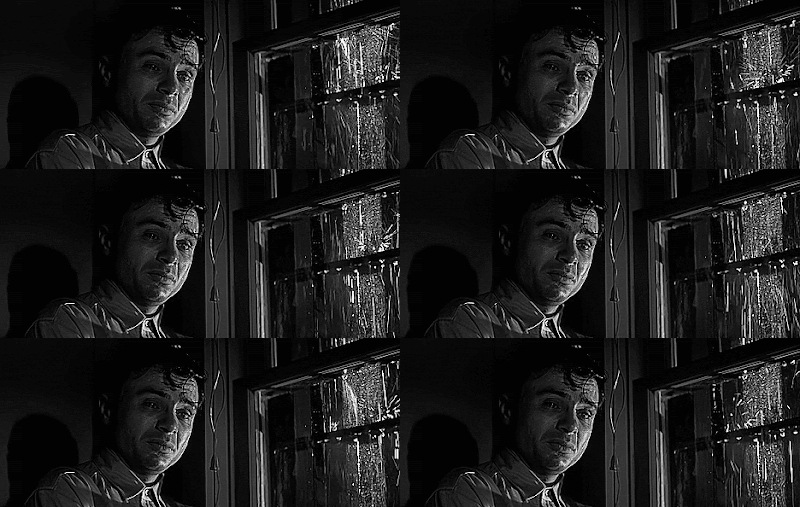
Conrad Hall's "lucky break" of the rain reflection.
 
Brooks saw the film as a damnation of capitol punishment, as it is. One cannot contemplate the title In Cold Blood without it reflecting both the killing of the Clutters and the state-sanctioned murders of those responsible. The death penalty's record of deterrence is only good for those that are killed, but looks mighty feeble when atrocities on the order of the ones by Hickox and Smith show up on the news every month when some wacko with a gun decides to make a name for himself (the choice of pronoun is deliberate—it's always a "him"). Bad guys should not be celebrities, no matter how low the bar for "celebrity" has sunk these days. And the justice system, built on politics, is so corrupt that one doesn't need "The Innocence Project" to speculate on how many innocent people have been killed in the name of justice. But, where's their justice? The system either works 100% of the time or we don't take actions that can't be taken back. Nobody is so infallible they can play God. That applies to good and bad alike.
 
In Cold Blood was voted into the National Film Registry in 2008.
Remembering the victims: the Clutter family

 * Two movies about Capote with the Holcomb murders serving as the centerpiece were made, as well. Capote and Infamous
.

Saturday, July 11, 2020

Seconds

Seconds (John Frankenheimer, 1966) Post "Star Wars," science fiction films have been pretty cookie-cutter—fleet-ships, a Hero with a Thousand Names, odd plasticized bi-ped creatures in supporting roles and quests that somehow or other usually get around to revenge. Even the "new" can become old hat.

Science Fiction used to be about concepts, and technology was just an aspect of futurism. For all the newly-conceptualized metal and plastic and wires and blinking lights, it is the organic that has to contend with the changes and evolution just can't keep up with the advancement of tools (especially when they're eventually turned into weapons). Who or what is being served? How does one adjust...if one adjusts? That's why to see Seconds is still a thrilling experience, as it calls to mind a feature-length, subtler "Twilight Zone" episode, that takes an idea and turns it around in its hand, exploring the angles...and the consequences.*
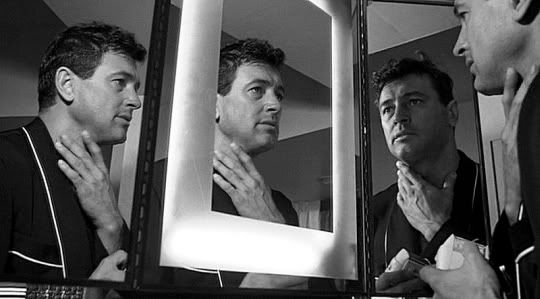
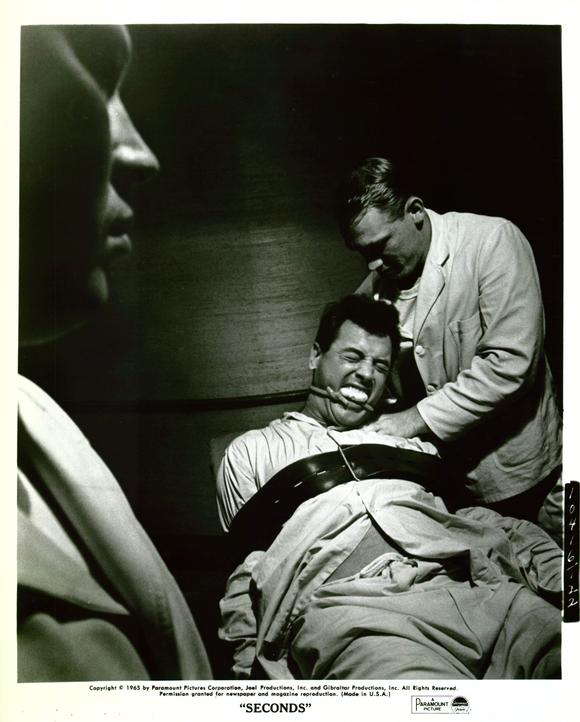
Bank executive Arthur Hamilton (John Randolph) is receiving mysterious phone-calls from someone who claims to be an old friend but doesn't sound like him. A note is slipped into his hand as he enters the subway, and upon further exploration (and prompting) learns that he is being offered a second chance in life. The anonymous corporation will transform him with plastic surgery (even replacing his finger-prints) and an exercise regimen, while setting up a planned "accident" with an unrecognizable "similar body-type" to explain his absence. To the world, he will die, but he'll be resurrected as a new man, with a new life, in a new community—everything re-arranged neatly and clinicallyFrom the ashes of Arthur Hamilton will emerge Hamilton 2.0, Antiochus Wilson (Rock Hudson), bohemian painter. "Wilson" makes a go of his second chance, but he's still the man he used to be inside, and he struggles internally with his new choices...and the ones he left behind. Changing his mind becomes the greatest challenge.
Filmed in black and white—this film would have been over-powering and kinda ugly in color—by the master cinematographer James Wong Howe (with assistance by John A. Alonzo), Seconds is filmed in disorienting tight close-ups, and with unnerving wide-angle lenses that contort, bend and mold the right-angles of life into constricting prisons. The helter-skelter editing of David Newhouse and Ferris Webster keeps the viewer from becoming complacent, and Jerry Goldsmith's bizarre discomfiting score only adds to the unease. This is Hudson's best role—if you're like me and aren't into rom-com's—and his best movie. But it's contradictorily a one-sided performance—there's not an awful lot of joy (I think that may be the point), and he's unsure, disoriented or drunk throughout most of it. And, as Frankenheimer says in his commentary, he really worked hard in this role...especially towards the end.
One should also be aware that in one scene in the corporation's stark "briefing room," the cast is comprised of Randolph, Will Geer (he's especially creepy in this role, while being his most benevolent) and Jeff Corey—all "brethren" in the secret society of blacklisted actors.
This version of Seconds is not the one released in the States in 1966. A disorienting wine-making festival sequence with pre-hippie free-thinkers orgiastically stomping grapes in the buff was deemed too risque for its release (and Hudson wasn't comfortable with the sequence, as is evident in his performance), but it has been restored for the DVD release.

It's still an affecting film, even now, over 40 years later, a cautionary time-capsule of that era when the concerns of the speculative writer was society and not space-ships. Sometimes, fantasies have a nasty habit of becoming nightmares.

Saul Bass' disorienting Title Sequence gets you in the mood.
* Director Frankenheimer worked in the Golden Age of Live Television and worked with Rod Serling, pre-TZ, and post-TZ—Serling wrote the script for Frankenheimer's Seven Days in May.

Saturday, November 10, 2018

Butch Cassidy and the Sundance Kid

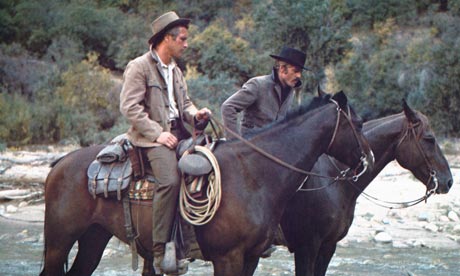
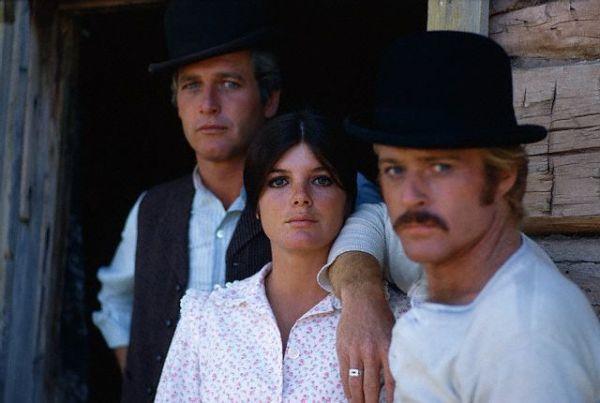
Butch Cassidy and the Sundance Kid (George Roy Hill, 1969)  It is probably for certain that Butch and Sundance were not as entertaining (or as well-scrubbed, with feathered hair) as Newman and Redford, nor that they rode bicycles to Burt Bacharach songs. But then the originals didn't have William Goldman writing for them, either, and though the script starts by saying "Most of what follows is true" you can also bet that much more of it isn't. As it is, it's not a history lesson. It's a grittier, more-influenced-by-European-film version of the previous season's Cat Ballou (which had earned Lee Marvin his Best Actor Oscar).*

And, in point of fact, I have a hard time thinking of it as a Western, despite the desert settings, the horse-chases, the posses, the train robberies, the clapboard houses, the sense of a passing age, all the traditional acoutrements of the classic westerns, but done coyly, cutely, and with an eye towards having a good punch-line (but not much point). It's a Western trying to be modern, but saying it's true to the period. 
Where it does bear the stamp of a traditional western is its through-line of Butch and the Kid being temporary things, caught in the period between the Civil War and the Industrial Age, where the "old ways," with their easily slipped-through dependence on civilization (and the inherent difficulties achieving it in a frontier environment), are replaced by organization, technology, and machine-like precision that are a threat to outliers, dependent on improvisation and fast getaways. The advancements of the 20th Century—bicycles and streets and (gulp!) dynamite—while all well and good, are an impending threat to scraping out an existence on the land, even if the way you do it is scraping other people's existence.  
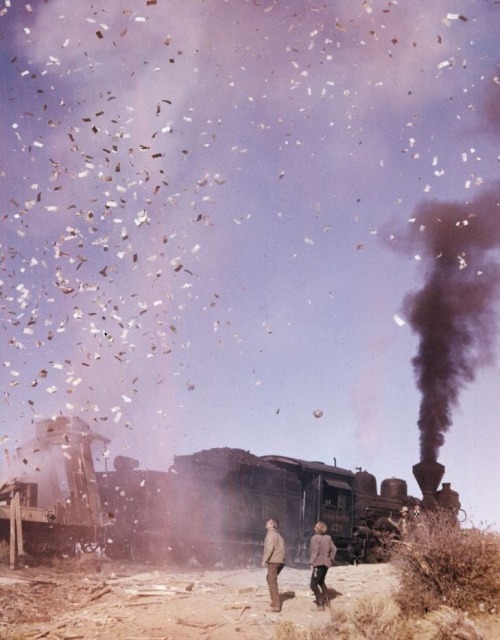
"Think ya used enough dynamite, there, Butch?"
And as much as Butch and Sundance try to adapt ("Think you used enough dynamite there, Butch?"), it ends up blowing up in their faces. It's why Butch's oft-repeated line (that always falls like a lead balloon and a quizzically raised audience eyebrow) "I've got vision and the rest of the world needs bifocals!" only works in that context, and in a cluelessly ironic way, at that.
No wonder they go to Bolivia. It's still the Wild West down South, while the U.S. becomes gentrified and outgrows outlaws. There's a serious thought in there amongst the yuck-lines and the counter-intuitive Bacharach bubba-bubba choruses glossing over the action sequences. As much as Hill, Goldman and Bacharach try to make it larky and fun, it's still doom-laden, without the inherent triumph of civilization over chaos that provides the spine and invigorates—and makes hopeful—most Western films. 
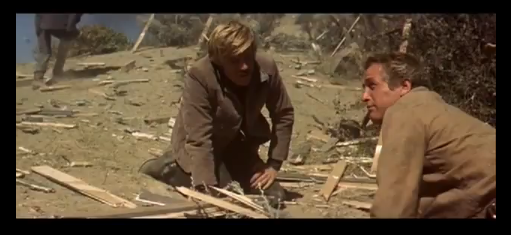
"You crazy? The FALL'll probably KILL you!"
It's never flat-out stated that, though never arrested, the Hole-in-the-Wall gang* are products of arrested development—a better name might be the "Stuck-in-the-Mud" gang—making the whole enterprise an exercise in feeling sorry for the kids who never grew up, or wised up, making the whole show a pitiable "Peter Pan" picture. Maybe it is better to have bifocals. You, at least, see your way clear.
One thing you can't fault is the cinematography of Conrad Hall.
Entertaining? Maybe. And in the short run. But kinda dumb, too.
The Final Shot

Period photography in the film (above)
and the real Sundance, Etta (Ethel) and Butch at Cholila Ranch (below)
* Just the year before, Sam Peckinpah made another Western about another Hole-in-the-Wall gang with the same arc of old-timers growing too old to see times change and survive. That movie was his masterpiece, The Wild Bunch, which created a revisionist kind of Western, that, along with Sergio Leone's Italian Western series, re-made the Western genre from the form that had become ubiquitous on American television sets in the late 1950's and early 1960's..

Saturday, February 10, 2018

Brute Force (1947)

Brute Force (Jules Dassin, 1947) Westgate Penitentiary, in the middle on nowhere identifiable—Its "gates only open three times: when you come in, when you've served your time, and when you're dead!" One of the latter is going out now, a 62 year old prisoner forced to work in the prison's most dangerous area, what they call "the drainpipe." His cellmates in Cell R17 crowd around the the barred window of their too-small enclosure to watch. They are Stack (Jeff Corey), Spencer (John Hoyt)-in for gambling and grifting, Kid Coy (John Overman)-ex-boxer in for assault just moved, in taking the place of the guy who died, Becker "the Soldier" (Howard Duff)-in for murder (he took the rap for his lover), Lister (Whit Bissell)-in for embezzlement. Their main interest is because one of their own is coming back: mobster Joe Collins (Burt Lancaster) is coming out of solitary after 10 days after a stool pigeon planted a knife on him. The Chief Guard Munsey (Hume Cronyn) talks briefly to him, telling him he needs to show respect, to not be so hard, and to cooperate. Collins tells him what he wants to hear and he goes back to his cell.
The others crowd around him and give him a dry cigarette and a light and updates on the situation, including their plans for taking care of the stoolie who ratted him out (without going into specifics) and tell him that everything is okay. Collins spits out his response (in just the way you can hear Lancaster doing it): "Everything's okay? What's okay? Nothing's okay. It never was, and it never will be. Not till we're out. You get that? Out."
Brute Force may be the Citizen Kane of prison movies. Or at least a "Grand Gray-Bar Hotel." Produced by Mark Hellinger in the same hard-bitten style of his previous movie The Killers and written by a young up-and-coming script-writer named Richard Brooks.* Brute Force is a prison movie on the surface and a life-metaphor once you get below around drainpipe level. And, except for some motivational flashback sequences demanded by Hellinger so he could throw some female exploitation into the mix, it's directed by Jules Dassin with a noir attitude so bleak it approaches hysteria...then burns right through it. At the time, it was remarked for its violence, but it's not so much the violence—there are patches that are arresting—it's the vehemence, the hot and cold anger behind it, that is truly remarkable.
"Ya know, I was just thinkin'. An insurance company could go flat broke in this prison." Beyond the casual cruelty of the guards, the first outbreak of violence is the one that settles all matters about Collins' framing: in the prison work-room, that stoolie (James O'Rear) begins to suspect that a diversionary fight clearing the area of guards is a trap; it is, as he's cornered by Coy, Spencer, and Stack triangulating him with acetylene torches until he backs into a working industrial press. Nobody knows anything. Nobody saw anything. Just bad luck, "falling" into that press.
This makes a bad situation worse for the warden (Roman Bohnen); he's already been called on the carpet by some lackey of the governor threatening the man with his job if there are any more violent incidents; the guy's just a mouth-piece—he doesn't have any more answers than anybody else in the room does. But, threatening the warden with his job stings. He's been doing the job so long he doesn't know what else he would do without it. He's in a similar situation as the prison doctor (Art Smith), who's doing a job he hates (and self-medicates to get through it), but he's too old to do anything else. Everybody at Westgate has their own flavor of prison, it seems.
Except Munsey. The Chief Guard sits back during that bitch-fest with the governor's man and the warden and the doctor and just listens, biding his time, feigning concern, and solicitously acting as a go-between and interpreter ("I think what the doctor is saying..."), but not revealing his hand. That's because he's a spider, waiting for the prey to be weakened before he takes them out. The prison is his web and he has full control of it, pushing the guards, brutalizing the men, using all the methods at his disposal to have absolute power over the facility and anyone unlucky enough to enter its gates. He's not above any torture, physical or psychological, to maintain his control—at one point, he'll even beat information out of a prisoner (Sam Levene) while listening to Wagner on the phonograph (as if the ties to fascism weren't obvious enough)
That's the situation the prisoners of R17 are in. But there's added urgency: Collins is told by his lawyer that the girl who's waiting for him on the outside (Ann Blyth) needs an operation for cancer, but she won't unless Collins is with her. She doesn't know he's in prison and the lawyer is under strict instructions not to tell her. Collins has to work the angles, but his plan is to escape and never look back, and with ideas from his cell-mates, he hatches an idea—but it will mean being assigned to the very duty that killed the prisoner at the beginning of the movie—working "the drainpipe."
It's mean, it's tough, and it's violent and sometimes a little florid in its prison-yard dialog, but the part the filmmakers weren't crazy about (except the producer) was the insistence on interrupting the story with flash-backs involving the women in their lives. Producer Hellinger wanted female appeal and so the characters played by Hoyt, Bissell, Duff, and Lancaster briefly escape the prison walls (cinematiclly, of course) for scenes with the women in their pasts (played by Anita Colby, Ella Raines, Yvonne De Carlo and Blyth). The scenes don't do much as far as back-story—Hoyt's is even done without dialog and simply his voice-over—and the effect is jarring and removes suspense, pacing, and an ever-increasing feeling of doom that permeates the entire movie. Director Dassin had a substitute in mind—a surreal portrait ripped from a magazine in the cell that reminds all of them of "the girl outside." That was as sentimental as they wanted to get. 
When the escape attempt comes, it is filmed with all the energy, desperation, and hopelessness that can be bled out of the material, both visually and viscerally, like an amped-up war movie—the attempt is based on an attack strategy seen by Duff's "Soldier" during the second world war—and it all seems a bit like a suicide mission that quickly turns from gaining freedom to merely getting revenge and taking out as many guards as possible.
It is dark, but once the smoke clears, the fires are put out, and the dead carried through those implacable doors—ultimately, they make it out, ironically, only when they're dead—the film gets even darker, equating life itself with a prison. Jules Dassin was a master of the film-noir—a genre he wasn't that crazy about—but, he was interested in social justice and in making statements—and his turgid prison/war movie is one of the darkest of the type. It's no wonder tough guys in film-noirs wanted to avoid prison—Brute Force shows a world bleaker than bleak.
"Nobody escapes. Nobody ever really escapes."


* Yeah, if you know anything about movies, the name will be familiar: Brooks would go on to direct, starting with 1950's Cary Grant picture Crisis, work with Bogart on Deadline U.S.A. and Battle Circus, break the rock and roll barrier with Blackboard Jungle, and then veer from programmers (Take the High Ground!, The Last Hunt, The Professionals) to high profile prestige pictures (Lord Jim, the Brothers Karamazov, Elmer Gantry, Sweet Bird of Youth), to exploitation films (In Cold Blood, Looking for Mr. Goodbar). His last film was Fever Pitch in 1985.