Saturday is traditionally "Take Out the Trash" Day. The music's good, though...
Black Patch (Allan H. Miner, 1956) Low budget western best known in film-music afficianado circles for being the first feature scored by Jerry (nee Jerrald ) Goldsmith.*Shot at Gene Autry's ranch town, the film benefited from being filmed in a television hiatus, its screenplay—penned by Black Patch bad guy Leo Gordon—started out as an idea for a "Gunsmoke" episode and utilizing crew from the recently wrapped "Dragnet" season (that show's crews were the fastest in Hollywood). Not quite as "B"-western as a lot of the early Republic Studios product, Black Patch tries to explore the psychological aspects of Westerns—motivations beyond "he wears a black hat"—that was finding its decade with the collaborations of Anthony Mann and James Stewart in the genre.
Black Patch can't hold a...er...patch to them.
George Montgomery plays Marshall Clay Morgan, but he's disparagingly called "Black-Patch" by the folks in Santa Rita, New Mexico for the eye-patch he sports over his right eye, a result from an old Civil War injury. Being one-eyed makes it tough to be a sharp-shooter with no depth perception. And one could say that it's affected him personally as he has a myopically steadfast approach to his job. It's cost him, and the town under his singular watch treat him with a suspicious respect.
So, things get a little squirrelly when Morgan's friend from The War, Hank Danner (screenwriter Leo Gordon) pays a visit to town with his wife Helen (Diane Brewster, who would play the late wife of Dr. Richard Kimble on TV). In a Casablanca-like set-up, Helen and Morgan were once lovers, and so the Marshall is both pleased and conflicted to see them. He starts to question how his actions towards Danner, a known bank robber, are lit by his sense of duty or the torch he's carrying for the man's wife.
It's a small town, so word gets around of the trio's pasts, but it starts to flame up when word comes that a bank on the way had been robbed and Morgan slams Danner in jail for the crime. But, there are "vultures, vultures everywhere," the most prominent being saloon owner "Frenchy" De'vere (Sebastian Cabot, who clearly relishes playing villainous roles) who conspires to spring Danner from jail with an idea to split the ill-gotten gains as a reward. It all further complicates Morgan's life, and threatens it, as things shake out, eventually seeing him put on trial for murder.
It's a good set-up, and the execution is fairly straight-forward—the film was shot in 14 days—but, there are some plot elements that stray into the area of contrivance, that one could only excuse by objecting that Santa Rita must be a pretty small town (with Contrivance being a nearby suburb). The motivations of one character seem extremely opportune, but only if it takes place in a town with very few women. And how quickly can you learn to be a fast-draw? At least to best someone who's been a gun-slinger for years?
It's not all that bad, just not something you want to write home and send pony-express** about. And, for a first score, Goldsmith did a great job...but, then, he'd been doing live-TV for awhile, making changes to his scores on the fly, even as it was being played. He certainly could have handled the technical intricacies of film scoring.
* It's also one of the Goldsmith "lost" scores—nobody can find acetates or tapes in "the vaults" (or somebody's hiding them) and there's never been a release. Although, a Kickstarter campaign was started to re-record the score for this and for The Man, an obscure political film from 1972. They were released by Intrada records.
** "When it absolutely, positively has to be there before two weeks..."
This was part of a series of reviews I did back in the '70's. Except for some punctuation, I haven't changed anything from the way it was presented, giving the snarky, clueless kid I was back in the '70's a break. Any stray thoughts and updates I've included with the inevitable asterisked post-scripts.
Written October, 27, 1975
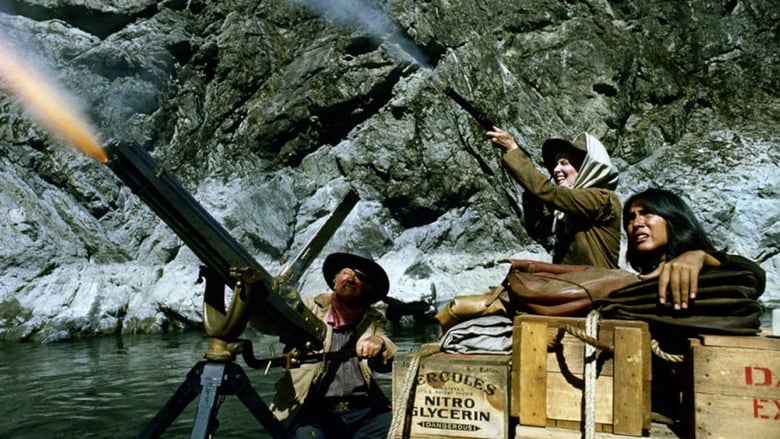
Rooster Cogburn(Stuart Millar, 1975) Stopped by the Renton*to see Stuart Millar's Rooster Cogburn. It was...pleasant. Not particularly exciting, but...pleasant. When I think of all the possibilities of a script involving John Wayne building on an earlier role and Katherine Hepburn....
I can even think of the possibilities of direction within the limitations imposed by the script....
Well, anyway, with the talent showcased there, let's just say the glass could have been cleaned a little better. The "Rooster Cogburn" character is described as "having gone to seed." I must agree. Cogburn is but a shadow of the characterization Wayne created in 1969, and as if to off-set it, Wayne overplays it, especially in the opening sequences, but his efforts come out looking like amateurish mugging.
Hepburn fares much better in her role but then why shouldn't she? She played the same type of character in The African Queen. The action sequences lack the punch that a more seasoned director like Howard Hawks or Henry Hathaway might've delivered. For example, the shoot-out at the Goodnight mission where a number of Indians and Eula Goodnight's father are murdered by a gang of desperadoes--the scene should have been frightening, a horrible thing to watch, as it must have been to the Hepburn character.. But after a well-used slow zoom into the growing commotion, Millar shows us the massacre from high overhead at least 30 feet away, showing all the action encompassed in the frame, keeping us at a safe and unparticipatory distance.
Another sequence that had great had great potential was the character "Breed's" (Anthony Zerbe) showdown with Hawk (Richard Jordan), as he is exposed for being a traitor to him. After a very lengthy series of shots between the two characters as Breed hesitates in handing over his gun, Hawk kicks him and he slides down the slope. Then, there's a shot of Breed's hat sliding down the slope (nice try, but it just doesn't work, symbolically or otherwise), and ALL OF A SUDDEN **there is a shot of Breed falling over a cliff (I remember thinking to myself "Was there a cliff there?" Yes, but we didn't know that until the character fell off it!) There was no suspense in this scene, but there certainly would have been if Millar had told us, somehow, that there was a cliff behind him. We would have been able to think ahead even further than we had when "Hawk" asked to see "Breed's" gun. We would have seen what was coming and squirmed a bit for the character. This way, nothing. A momentary shock and it's over.*** Rooster Cogburn is full of missed chances like this, and it really is too bad.
It really was (and is). I remember reading about the trials and tribulations director Millar had with his iconic, and feisty and flinty stars out on location in Oregon, and how they'd do a scene, and not do a re-take if they thought it was good. Wayne wasn't in the best of health, but felt he had to do his own horse-riding in front of Hepburn--the male-pride thing. And though Wayne and Hepburn got along like a house afire—Hepburn told her pal Peter O'Toole that where he was a willow, Wayne was a great oak—it was just an unpleasant shoot. And Millar was more of a producer than a director. He was 44 when he directed Rooster Cogburn but his "legacy" stars treated him like a snot-nosed kid.
It is too bad. This is the only movie that Wayne and Hepburn did together—at this point in her career, she was starting to go the rounds of veteran actors with whom she hadn't sparred before, like Henry Fonda, Laurence Olivier...and Wayne—and it would have been nice to have a good, decent script instead of this hashed-together combination of The African Queen and warmed-over True Grit (written by "Martin Julien", but actually actress Martha Hyer, the wife of producer Hal Wallis, and though she was an arresting and competent actress, as an author-by-nepotism, she was basically "copy and paste"). And whatever talents director Millar had, he didn't know how to gather enough material to make a film that could be cut together smoothly, or build anything approaching dramatic tension. John Ford, Howard Hawks, Don Siegel were directors who could shoot economically having already edited the movie in their head before filming, but Millar—if he had a plan—was undercut by what he could accomplish on location.
Sometimes projects are brought together on a whim and star-power but without the good foundation of a solid script or a director who could find gold in a coal-mine, it'd be like building a cardboard house on the sea-shore. The whole thing collapses before there's any equity. It usually happens when a screen-couple are re-united after a big hit. Anybody remember John Travolta and Olivia Newton-John's second pairing after Grease? Yeah, me, neither.****
Still, when they're together on-screen Hepburn and Wayne take the creases and mugging out of their performances and produce something that feels like grace. But, it is far from either of their best work. Wayne is gentlemanly in her presence and Hepburn rather school-girlish. I don't know if either of those serve the characters very well, and one appreciates such things in small doses when the characters should be more sand than sugar. Impressed with the amount of the stunt work they did on the Rogue and Deschutes Rivers, though.
Wayne regrouped with a brilliant performance in his last filmThe Shootist, and Hepburn remained iconic even to her last film 19 years after this one.
*** This is the basic "Hitchcock Rule:" A scene is much more exciting if you give the audience more information. If a bomb goes off on a train *BOOM* it's over, a little disorientation and shock and it's done. But tell the audience there's a bomb..show them where it is and what time's it's going to go off...and show all the people who might see it but don't, with the clock ticking down and you have a long period of suspense where people know the situation and are helpless to do anything about it. It's a much more effective scene.
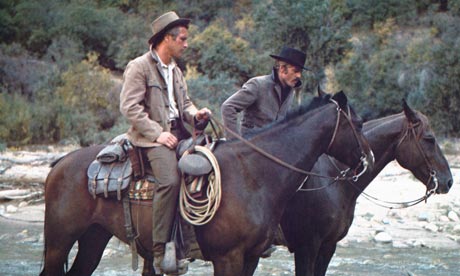
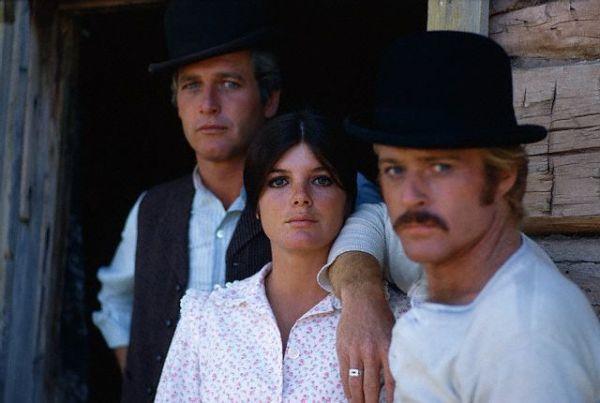
Butch Cassidy and the Sundance Kid(George Roy Hill, 1969) It is probably for certain that Butch and Sundance were not as entertaining (or as well-scrubbed, with feathered hair) as Newman and Redford, nor that they rode bicycles to Burt Bacharach songs. But then the originals didn't have William Goldman writing for them, either, and though the script starts by saying "Most of what follows is true" you can also bet that much more of it isn't. As it is, it's not a history lesson. It's a grittier, more-influenced-by-European-film version of the previous season's Cat Ballou (which had earned Lee Marvinhis Best Actor Oscar).*
And, in point of fact, I have a hard time thinking of it as a Western, despite the desert settings, the horse-chases, the posses, the train robberies, the clapboard houses, the sense of a passing age, all the traditional acoutrements of the classic westerns, but done coyly, cutely, and with an eye towards having a good punch-line (but not much point). It's a Western trying to be modern, but saying it's true to the period.
Where it does bear the stamp of a traditional western is its through-line of Butch and the Kid being temporary things, caught in the period between the Civil War and the Industrial Age, where the "old ways," with their easily slipped-through dependence on civilization (and the inherent difficulties achieving it in a frontier environment), are replaced by organization, technology, and machine-like precision that are a threat to outliers, dependent on improvisation and fast getaways. The advancements of the 20th Century—bicycles and streets and (gulp!) dynamite—while all well and good, are an impending threat to scraping out an existence on the land, even if the way you do it is scraping other people's existence.
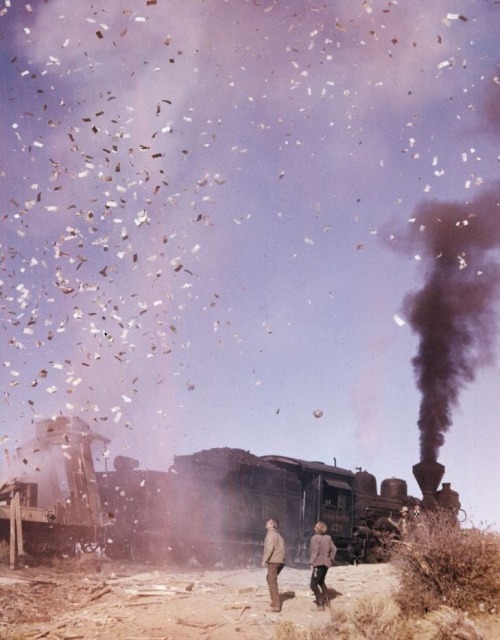
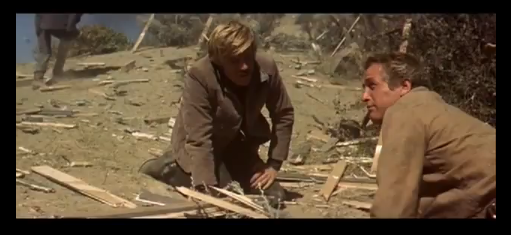
"Think ya used enough dynamite, there, Butch?"
And as much as Butch and Sundance try to adapt ("Think you used enough dynamite there, Butch?"), it ends up blowing up in their faces. It's why Butch's oft-repeated line (that always falls like a lead balloon and a quizzically raised audience eyebrow) "I've got vision and the rest of the world needs bifocals!" only works in that context, and in a cluelessly ironic way, at that.
No wonder they go to Bolivia. It's still the Wild West down South, while the U.S. becomes gentrified and outgrows outlaws. There's a serious thought in there amongst the yuck-lines and the counter-intuitive Bacharach bubba-bubba choruses glossing over the action sequences. As much as Hill, Goldman and Bacharach try to make it larky and fun, it's still doom-laden, without the inherent triumph of civilization over chaos that provides the spine and invigorates—and makes hopeful—most Western films.
"You crazy? The FALL'll probably KILL you!"
It's never flat-out stated that, though never arrested, the Hole-in-the-Wall gang* are products of arrested development—a better name might be the "Stuck-in-the-Mud" gang—making the whole enterprise an exercise in feeling sorry for the kids who never grew up, or wised up, making the whole show a pitiable "Peter Pan" picture. Maybe it is better to have bifocals. You, at least, see your way clear.
One thing you can't fault is the cinematography of Conrad Hall.
Entertaining? Maybe. And in the short run. But kinda dumb, too.
The Final Shot
Period photography in the film (above)
and the real Sundance, Etta (Ethel) and Butch at Cholila Ranch (below)
* Just the year before, Sam Peckinpah made another Western about another Hole-in-the-Wall gang with the same arc of old-timers growing too old to see times change and survive. That movie was his masterpiece, The Wild Bunch, which created a revisionist kind of Western, that, along with Sergio Leone's Italian Western series, re-made the Western genre from the form that had become ubiquitous on American television sets in the late 1950's and early 1960's..
When Orson Welles was asked what movies he studied before embarking on directing Citizen Kane he replied, "I studied the Old Masters, by which I mean John Ford, John Ford, and John Ford." Running
parallel with our series about Akira Kurosawa ("Walking Kurosawa's
Road"), we're running a series of pieces about the closest thing America
has to Kurosawa in artistry—director John Ford. Ford rarely made films
set in the present day, but (usually) made them about the past...and
about America's past, specifically (when he wasn't fulfilling a passion
for his Irish roots). In
"The History of John Ford" we'll be gazing fondly at the work of this
American Master, who started in the Silent Era, learning his craft,
refining his director's eye, and continuing to work deep into the 1960's
(and his 70's) to produce the greatest body of work of any American
"picture-maker," America's storied film-maker, the irascible, painterly,
domineering, sentimental puzzle that was John Ford, John Ford, and John
Ford.
The Horse Soldiers(John Ford, 1959) Ford made few Civil War dramas—he preferred seeing the Nation being built than coming apart at the seams—and The Horse Soldiers is more of a small skirmish movie, remarkably free of battles, but more of undercover work—and one battle that is notorious in Civil War history. That anyone might think of it as anti-war—how could it with John Wayne, and a decade before it became fashionable—would mean that they had to by-pass the promotional material and actually watch the thing. But, the older Ford, seeing the tight studio-hold begin to lighten as they began to lose power to television, might have thought that it was time to speak truth to legend. For the legend, he would go to Ireland, but in the 1960's and 1970's, he went back to his film-making roots, dug them up out of the desert scrap and examined a little more closely the truth behind some of his earlier films and the history of the country. He would present the weeds along with the garden.
Ford's framing takes a cue from Matthew Brady's daguerrotypes
The Horse Soldiers is based on history—the track of Col. Benjamin Grierson to de-stabilize supply routes to the Confederate forces, but the players are all fiction. Wayne plays Colonel John Marlowe, a railroad engineer, who uses his experience to find the weak points along rail routes—spending his time in war destroying what he might have built in the peace.
He is sent into the heart of the South to Tennessee and Mississippi on a route to Baton Rouge, with the main purpose to destroy a depot at Newton's Station that will cut off supplies to forces at Vicksburg. Marlowe's troop does a lot of skulking around trying to avoid detection by the Confederates, their mission is undercover, but that is a tough prospect commanding 1700 men, all dressed in blue.
Wayne out front, checking the progress of Confederates while his are concealed behind trees.
A troop behind enemy lines finds it tough to have their own supplies ferried to them if they want to avoid detection, so part of the mission is to raid local plantations, use the grounds as bivouac, and "commandeer" supplies, frequently "under protest." One of those so affected is the Greenbriar plantation, being overseen by Hannah Hunter (Constance Towers) and her remaining slave Lukey (tennis champ Althea Gibson). Although gracious to a fiddle-dee-dee, and outwardly manipulative, Miss Hunter holds great antipathy towards the Yankees, remains loyal to the South, and when it's been discovered—by the ever-mindful "saw-bones" Hank Kendall (William Holden)—that she's been listening (via fireplace vents) to the secret plans of the troop, Marlowe has no choice but to take her and Lukey on the campaign, lest she betray them to "Johnny Reb." That just makes her more resentful, causing clashes between her and Marlowe.
Anybody familiar with Ford films knows that such a situation can lead to an ambiguously heartfelt relationship—Marlowe and Hunter fall into a chaste yearning relationship, through a combination of her seeing the effects of battle on both sides rather than holding to an ideological ideal, and his being besieged from all sides—from his superiors and from his own men, including a begrudgingly supportive one from Kendall, on top of having to battle the Confederates, who at the late stage of the war are desperate enough to throw whatever they can at him, including children from a military academy.
Her protests, her new-found vulnerability in danger, and her work tending the wounded, cut through the Wayne crust and probably seem like a comfort amidst the rest of his situation. In the movie, that relationship doesn't play well, sadly, through no fault of Towers—she's great in this film (she usually is), able to bring up the fire that Ford's favorite, Maureen O'Hara, brought to his films and Ford would use her again in his next, Sergeant Rutledge—but Wayne isn't up to his part, managing the quaint courtliness required, but not the vulnerability needed to make it pay off, falling back on a shyness that runs counter to the character's actions, or to Wayne's strengths as an actor.
Marlowe finds Southern deserters in the form of Denver Pyle and Strother Martin who act and look like they dropped in from a future Sam Peckinpah movie.
Holden's role as a conscientious objector/surgeon who frequently clashes with Wayne over the troop's actions is also a bit under-developed. Look, this is William Holden here. He's one of the few male actors who could stand up to Wayne and by wily enough to not get blown off the screen. But, the character, while of some interest and giving Holden a uniform to fill, doesn't serve much of a point other than to be an irritant, something the movie already has plenty of. To that point, it seems a weakness of the film that Wayne's Marlowe is constantly under the gun and presented with no-win scenarios that reach the breaking point when he must command his troop to fire on civilians.
That slaughter leads to an extended scene in a bar where Marlowe gets drunk and lets down the reserve that has kept him going through what he'd earlier described as "this insanity." It's a powerful scene, even if one gets the sense that Wayne isn't fully committed to it. He can rail all he wants, but there's no sense of release or breaking here, again, not one of Wayne's strengths, as he tends to be at his most powerful in moments of stillness or circumspect emotion. Wayne is at his best when he's not "making a scene," but being the most powerful thread in a fabric.
This is not the John Ford of The Cavalry Trilogy, where one might snatch some phyrric victory out of defeat. There are no scenes of triumph in the film, and the scenes of battle have a bitter tinge to them: one is based on the Battle of New Market in which Union soldiers fought Southern forces that were joined by VMI cadets—children, really—which occurred on March 15, 1864. Ford mines it for irony, pathos, and some odd insertions of comedy for a situation that is so jingoistic that it is horrific and absurd simultaneously. That it is true, well, that is insanity.
The Horse Soldiers was filmed in vibrant color by William Clothier, who'd been working since 1923, but only in the 1950's did he start coming into his own as a director of photography for such directors as John Ford and William Wellman. He became John Wayne's favorite cinematographer and was renowned for masterful location work. The Horse Soldiers is one of his best, but the film fell into neglect and disrepair until restoration for Blu-Ray release suddenly revealed its stunning imagery and eye-popping color done under the direction of Ford.
I'd seen The Horse Soldiers before, but seeing it restored is like seeing it for the first time.
One of the most memorable sequences of The Horse Soldiers-
The Battle of New Market. Both funny and sad simultaneously.
The poster of this clip cut out Anna Lee taking her kid out of the procession,
When Orson Welles was asked what movies he studied before embarking on directing Citizen Kane he replied, "I studied the Old Masters, by which I mean John Ford, John Ford, and John Ford." Running parallel with our series about Akira Kurosawa ("Walking Kurosawa's Road"), we're running a series of pieces about the closest thing America has to Kurosawa in artistry—director John Ford. Ford rarely made films set in the present day, but (usually) made them about the past...and about America's past, specifically (when he wasn't fulfilling a passion for his Irish roots). In "The History of John Ford" we'll be gazing fondly at the work of this American Master, who started in the Silent Era, learning his craft, refining his director's eye, and continuing to work deep into the 1960's (and his 70's) to produce the greatest body of work of any American "picture-maker," America's storied film-maker, the irascible, painterly, domineering, sentimental puzzle that was John Ford, John Ford, and John Ford.
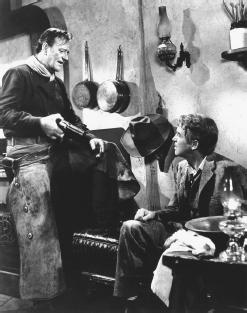
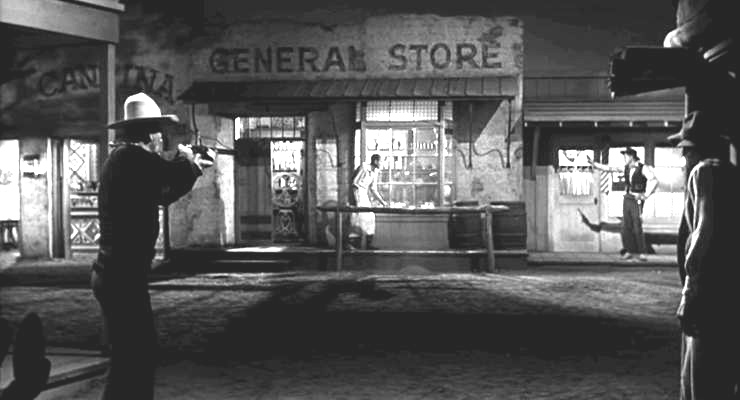
The Man Who Shot Liberty Valance(John Ford, 1962) Even the mention of the title invokes a cynical irony for those who have seen it. This crowning glory in the long accomplished (dare one say legendary) career of director John Ford, 68 at the time of its filming, is a bitter pill of a film and a meditation on the inexorable march of time and the brutal boots of history.
It is about "becoming"—not just in the strictest sense of transitioning (although the town of Shinbone, in which it is set, is in the midst of leaving its old West roots behind to take its place as part of the Union of States), but also in the less used sense: of reflecting favorably on the subject to its advantage.
It is also about, as so many of John Ford's films over the years, the taming of a wilderness, and the creation of a society. And the unbecoming truth that to create the veneer of civility, sacrifices must be made, just as sure as Sunday dinner.
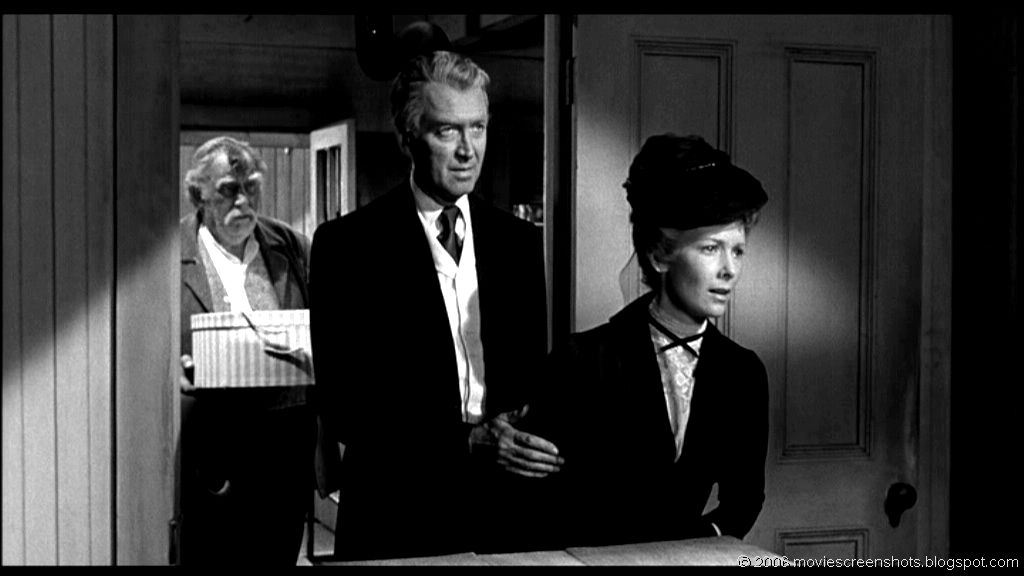
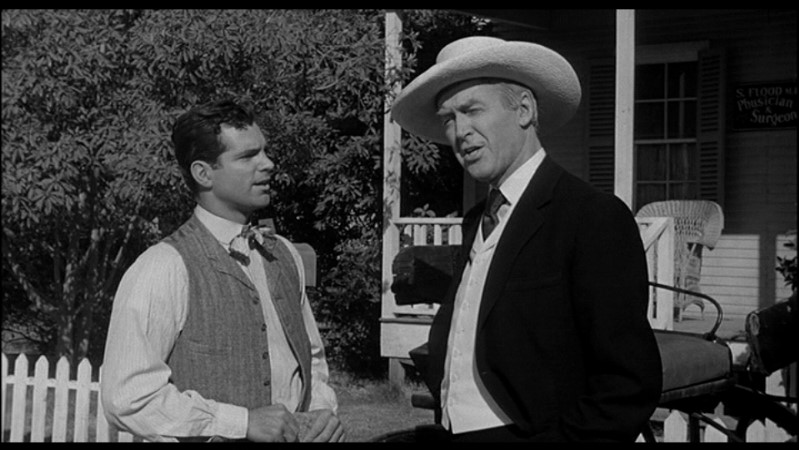
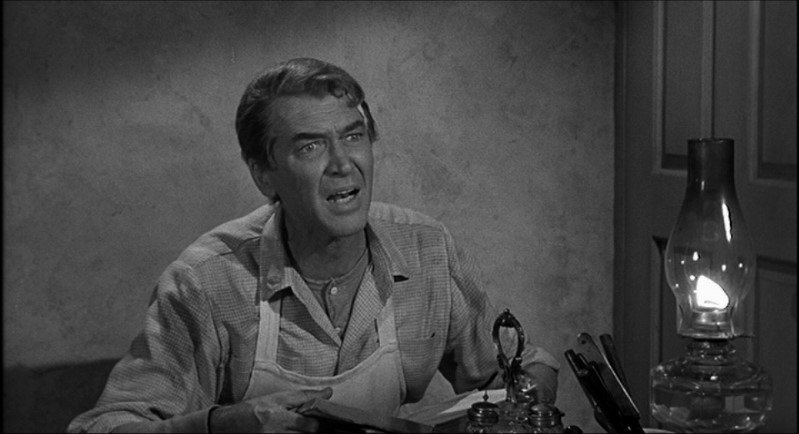
Senator Rance Stoddard and his wife Hallie (James Stewart, Vera Miles) return to the town of Shinbone to much hoopla. It is their home-town, of course, but as the Senator now spends all his time in Washington he doesn't get back there much. So the press start nosing around to get the where-fore's of why "The Man Who Shot Liberty Valance" (and rode that acclaim into politics), is there now. The occasion is a funeral for a man nobody knows (or has little regard for), but he's very important to the Stoddards—he is, after all, the man who brought them together. And as Hallie places a cactus on Stoddard's plain pine coffin, Stoddard relates the tale, one that blows away the Senator's folksy bluster with a scouring truth.
Even if it means the death of his way of life. Sacrifices must be made.
By the time the tale of Stoddard and his benefactor/mentor and rival is told, a bloom has, impossibly, appeared on the cactus, because like Stewart's lack of youth in the flash-backs and the old-age make-up for the young actors in the present, Ford is also playing with time, even going to his own past, using a piece of music from 1939's Young Mr. Lincoln (that put a melody to Lincoln's loss of his first love Ann Rutledge) for the scene of Hallie regarding Doniphon's burnt-out homestead. And so, the telling of the tale of a lifetime is enough time to ensure new life in movie terms.
In The Man Who Shot Liberty Valance, Ford goes so far as to state outright something he'd been alluding to throughout his career as a film-maker, story-teller and chronicler of the United States. Given a choice between printing the unvarnished truth or a myth for the common good, the newspaperman says, "This is the West, sir. When the legend becomes truth, print the legend."
There was never a better-stated justification of film-making.
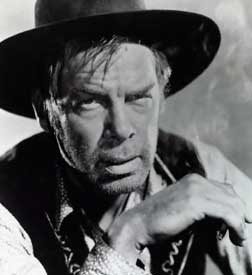
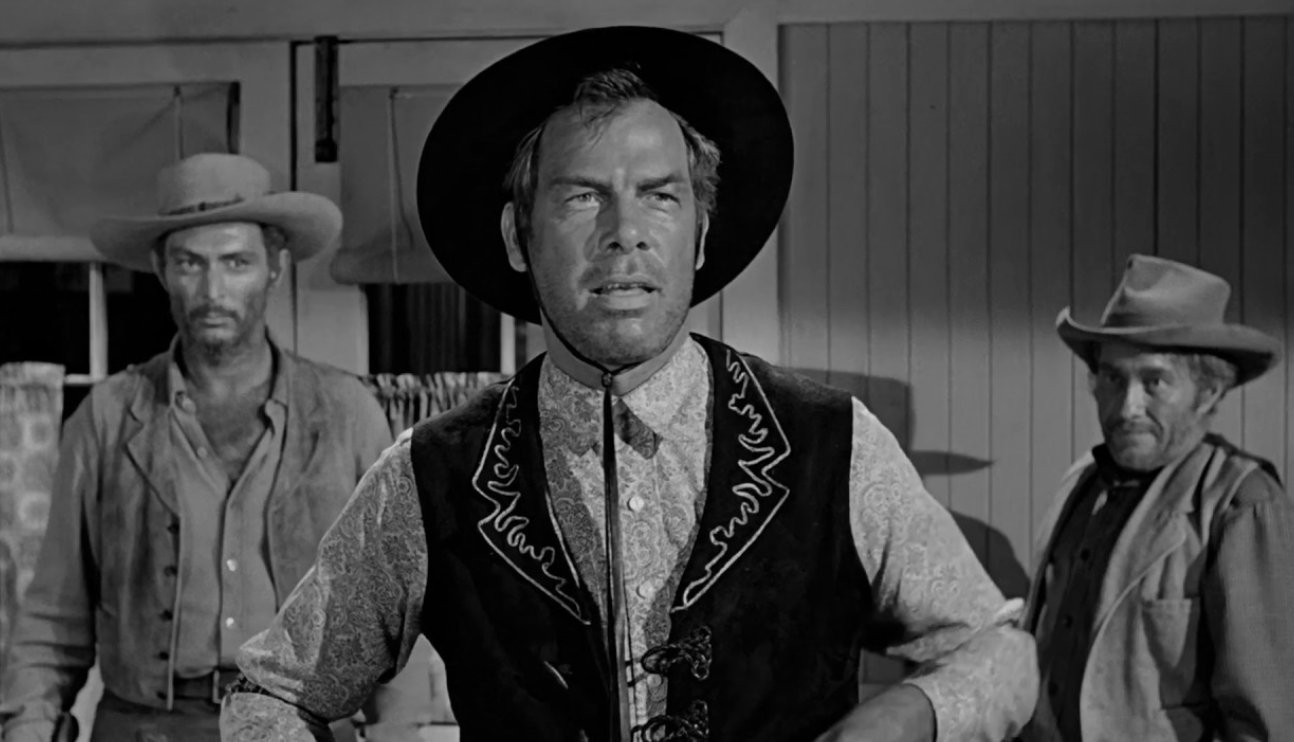
It's a definitive statement of Ford's career directing movies. But Liberty Valance is also a bridge from Ford's early Westerns to the "modern" "oaters" of the 60's as Valance's wormy toadies are portrayed by Lee Van Cleef (of Sergio Leone's "Dollar" trilogy) and Strother Martin (part of Sam Peckinpah's stock company). Those film-makers were inspired by Ford, and in their own revisionist methods of "printing the truth," made their own legends.
And so the film is its own truth, summarizing one director's past as a pioneer and presaging the future of the Western film, on the edge of its demise, both "becoming" even in the depth of their cynicism.
* One of the criticisms of the film is that both Stewart and Wayne are playing young men when the two were both in their 50's. Wayne can get away with it (as he always plays old...and other reasons), but Stewart doesn't come across as a man in his 20's. I have something to say about that towards the end of the review.
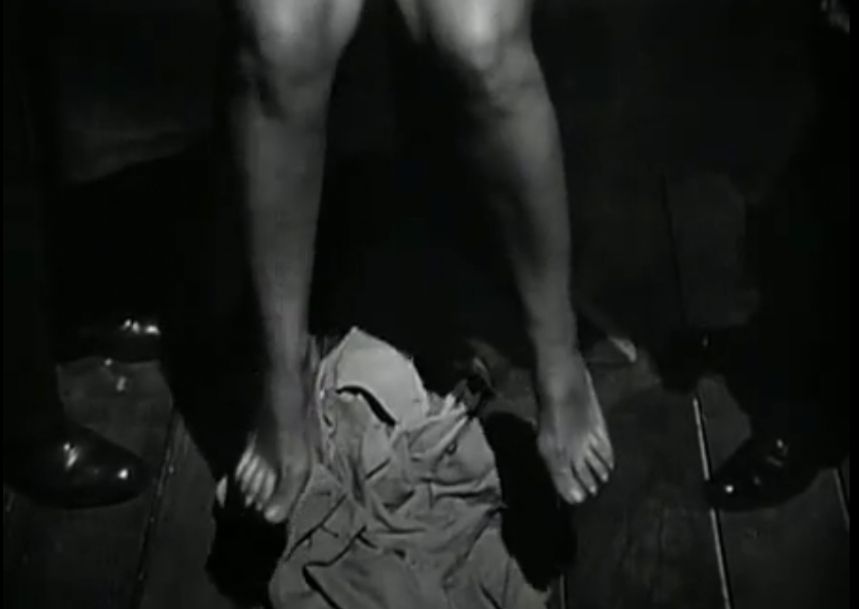
Kiss Me Deadly(Robert Aldrich, 1955) Kiss Me Deadly might be the greatest film noir film of all time. You know the genre—"When the streets are dark with something more than night"—implying that the lack of light goes far beyond foot-candles and is radiated by a void in the soul...or the permeating Evil in the World. Oh, there'd always been detective movies—but, they were usually played in a cocktail party environment, gussied up and prettified for the ladies...and there always had to be a pet. But, in the late 30's, with Hitler bringing real evil to our headlines and minds, that world changed, became darker, the booze cheaper, and the dames less dependable. After the war, we'd lost our innocence enough that the tarnished golden age of noir happened, its authors became legit, movie deals followed, and the resulting films rougher, because we could take it. Combined with what Hollywood saw coming out of the European neo-realist movement, things got grittier, less polished and the gangsters came out of the dark cracks of the wood-work to walk amongst us and make the lives of decent folk miserable, while in the mind's eye loomed the existence of mushroom clouds that could turn all of us, any of us, into ash and dust. By the time the 50's sneaked up on us, promising a better life (if we followed the rules), paranoia walked the streets, the board-rooms, and halls of government, setting the stage for Robert Aldrich's über-noir.
Mickey Spillane, author of "Kiss Me Deadly" in all its popular crudeness, didn't like the film version. It slapped his book around for its tough-guy attitude that puffed up its chest in the face of truly nihilistic forces that could wipe the sneer off its mug and dared to question the sexist-macho attitude of its protagonist. The script is by one of the better novelist-scriptwriter vagabonds, A.I. Bezzerides (whose novels were turned into the films They Drive By Night and Thieves' Highway). "I was having fun!" Bezzerides said of his adaptation of Kiss Me Deadly, and, indeed, it is a lot of fun in a savage, even cruel way, that has no truck with the merits of its source-book, and boils it down into a Maltese Falcon-ish quest of thugs for a "great whats-it," that (as is ultimately revealed) is not riches, but power—at the time, the most dangerous form of power extant.
Our savior—the point-man walking down these mean streets—is a private dick in all senses of the term, the not-subtly named Mike Hammer (Ralph Meeker), the bluntest of instruments, and where that other tool of the trade, Sam Spade, beat up bad-guys and gunsels, Hammer makes no character distinctions, he's as indiscriminate as a force of Nature, turning people, places and prized possessions into disaster areas so he can sort through the rubble.
The caper doesn't start very subtley—it doesn't come to him, knocking politely on the door of his offices—he nearly runs it over on the highway. A damsel in distress (Cloris Leachman—yes, her—in her film debut) is running down the street in a panic and only a trench-coat. She might have escaped from a mental institution, but Hammer, at her request, tries to take her to the nearest bus stop.
It's the way things have to be, because almost everyone is corrupt, no matter what their position on the intelligence scale, and that includes the guy behind the whole operation, Dr. G.E. Soberin (Albert Dekker), the type of character Sydney Greenstreet might play in earlier mysteries: brilliant, erudite, but not smart enough not to be brought down by baser instincts than his own. And, once he's gone, any hope of containing the evil about to be unleashed goes with him.
There are two endings to the film: in the first, Hammer and his sexy secretary Velda (Maxine Cooper) manage to escape from the traditionally burning building (burning quite non-traditionally) and seek refuge in the surf. But, somewhere along the way, the film was streamlined, so their fate is undecided and, indeed, the film screams "The End" in the middle of a growing apocalyptic nuclear conflagration. Does it ever end, or does Los Angeles go up with it, the match being struck by the sociopath who sold her soul for power.
It's the ending I first saw when I encountered the film and it's the ending I prefer: Kiss Me Deadly presents a world so far down the jungle path that even a thug like Mike Hammer can be considered a hero. Man has de-evolved so far but still managed to harness the power of God, that the inevitable happens. The film asks nihilistically, given how bad the world is, why not let the whole rotten system crash (sound familiar?). The quest for power has gone nuclear. Let 'em get what they deserve.
The opening of "The Great 'Whats-it:" a "Pandora's Box" that would "inspire" filmmakers Alex Cox, Steven Spielberg and Quentin Tarantino.
Given the view of the film Kiss Me Deadly, if the world is so corrupt, maybe the justice should be dealt in an uncontained fusion, where the shadows are permanently burned into the landscape. And so the world ends—not with a bang, not with a whimper, but with a high keening shriek, echoing the many screams that have occurred throughout the film.
Even in the glare of a nuclear light, you can't get more dark than that.










.jpg)