Showing posts with label Constance Towers. Show all posts

Wednesday, October 2, 2019

Fate is the Hunter

Fate is the Hunter (Ralph Nelson, 1964) Continental Flight 22 out of L.A. is bound for Seattle, but it will not make it.

That is not known to Sam McBane (Glenn Ford), who is a Continental air exec in charge of Flight Operations and has a lot of things on his mind. Right now, he's trying to make things go as efficiently as possible; there's a change in regime coming up and a vice-presidency position that McBane is probably going to fill. The thing is Ben Sawyer (Nehemiah Persoff), Director of Engineering and Maintenance, is up for the same job. The last thing he wants to do is banter with his old Korean War buddy Jack Savage (Rod Taylor), who's about to pilot Flight 22, but is thinking about the fishing trip to Walla Walla he's going to make afterwards. Savage has always been a devil-may-care pilot and a bit of a rake, while McBane is a by-the-book man. The two josh a bit, but Savage has a plane to catch. 
Things look normal, and there is the usual banter between the pilots and the stewardesses, one of whom is new and the other, Martha Webster (Suzanne Pleshette), has to warn her about Savage's reputation as a "ladies' man". It's going to be a nominal flight. The control tower gives them the go-ahead and they power up.
But, not too long after take-off, the right engine is struck by birds and flames out. Flight 33 is running on one engine. They radio for emergency landing instructions but there's an issue—three inbound flights are approaching LAX, all off-schedule. That's the last thing Savage and the flight crew here; their radio goes out and right after that, the left engine goes out, too. They're flying without power and have to ditch. Savage goes in for a belly landing on the beach and everything looks clear. Then, at the last moment, they see a pier coming up fast and it's too late. The plane crashes, and takes 53 souls with it. There's only one survivor—Martha Webster.
The crash-site is a melee of fire-fighters, reporters, on-lookers, and Continental execs. It's a disaster and everybody is looking for answers. The pier was supposed to be removed the week before, but the contractor had been off on a hunting trip and hunting was good. Then, the question comes up about sabotage—one of the passengers was a twitchy type who'd bought a lot of insurance before the flight. The Civil Aeronautics Board takes over control of the investigation and they make plans to take the plane pieces back to Continental to put the pieces back together and see what they can find out.
The sabotage angle doesn't pan out. And the right engine turns out to be perfectly alright. Listening to the radio-tapes, everybody sounds concerned but there's no panic. But, then a local reporter starts digging and it turns out that Savage was seen in a bar two hours before the flight and he and his companion seemed pretty lit. McBane protests; he knew Savage, had a log history with him, and sure, he could be a loose cannon but he'd never violate the 24 hour rule. And that's the usual story, isn't it? If you can't find another solution, it has to be pilot error. Blame the pilot. And the rumors seem to back it up.
But, McBane won't hear of it. There has to be another reason. The hell with the promotion. Savage was a good pilot. There had to be something. Something else. McBane starts investigating. First, he goes to the bar where Savage was supposed to be drinking, and the bartender verifies Savage and another guy were there two hours before the flight. One thing tears it: the one guy tipped the piano player to play "Blue Moon." 

It was Savage's favorite tune.
McBane interviews Webster, but she's too much in shock, too grief-stricken to be much help. Savage's landlady thinks he was a jerk. And his ex-fiancee Lisa Bond (an uncredited Dorothy Malone) calls him "the most unreliable, irresponsible and unregenerate man I ever met." There are two clues—the guy named "Mickey" that Savage was in the bar with, and "a Chinese girl" that he'd been seeing recently. 
McBane goes to interview a "Nancy Fraser" whom Savage named as beneficiary on his insurance. He finds a marine biologist (Nancy Kwan) who had been seeing Savage. The two had met while Savage was getting ready to break up with Lisa Bond, and the two were drawn to each other—the insurance, it was for her research. Nancy introduces the concept that it was Fate that caused the accident—given her familiarity with Savage and his very nature that he could not have caused the crash, by design or accident, and that the circumstances combined that the fatal results of the flight were inevitable...and if they were inevitable, there could be no fault.
Her ideas seem to fall in place with what Savage and McBane's old radio-man, Fred Bundy (Wally Cox), reveals about a particular mission from which most of the crew—including McBane—had bailed out. Bundy was too afraid to bail, and, instead of forcing the man to jump, Savage instead began to look for solutions to the dilemma that ultimately saved both men and the plane. Bundy also reveals Savage stayed in touch with him, even after the war and with most of his crew, maintaining friendships and never abandoning them.
The "Fate" theory does not sit well with the CAB, and McBane, out of options and looking for hard answers, decides to take another plane, under the same conditions to find out what happened that forced the plane into its precarious position that even a pilot like Savage could not compensate for. It's only then that he can satisfy himself that there might not be a fault, whether of plane or of man, but that, given the circumstances, it was inevitable.
Fate is the Hunter is by no stretch of the imagination a great movie. The effects are awful, the plane design for the fateful aircraft is something of an aerodynamic nightmare, some of the acting—especially by a hesitant Glenn Ford—is unimpressive*, and there's some amateurishness in the writing throughout—Max Showalter's pain-in-the-ass reporter is as subtle as a club and the final solution (and it is a solution) is, on first blush, a bit of an eye-roller.** But, the movie is, ultimately, a bit marvelous in going against the blame-game of finger-pointing and being simultaneously woo-woo and practical at the same time. Ultimately, it seems to be saying, shit happens and let's make sure it doesn't happen again...or else 53 people died for nothing. That sort of thing just doesn't fly in a litigious society.
The film has nothing—absolutely nothing—to do with Ernest K. Gann's 1961 book (and he was so embarrassed by it that he asked for his name to be removed on television airings, although it appears on the currently available DVD's and on the YouTube version). The film picks up the general philosophy that as pragmatic as one can be, you can't fix everything and every condition and that if one is out of options...well, one is out of options. It's a bit like the test pilots' job description of "eternities of boredom punctuated by moments of sheer terror." Hey, if you weren't going to take chances, you could have taken a bus. Aviation is, still in all, something of a miracle, and we've only been doing it for slightly more than 100 years. It's amazing that it the industry works as well as it does.

They could make the seats a bit less confining, though.
Rod Taylor ponders that while Susanne Pleshette hands him a fateful cup of coffee.
* Taylor is great in a role that could have made you wince, Pleshette is entirely believable and sympathetic in some of the toughest scenes and the troika of Savage apologists—Kwan, Cox, and Stevens—are endearing.

** Well, except that something similar happened to an Airbus flying from Frankfurt to Cancun in February 2019, causing the flight to be diverted to Ireland.

Saturday, June 30, 2018

The Naked Kiss

The Naked Kiss (Samuel Fuller, 1964) Samuel Fuller started as a reporter at the age of seventeen as a crime reporter for the tabloid The New York Evening Graphic. His style was tough, punchy, and sensationalistic—which he would carry over when he began writing pulp novels, then as a screenwriter, before making a deal to write three screenplays for producer Robert Lippert, but stipulating that he direct them as well. The first films—the low-budget westerns I Shot Jesse James, The Baron of Arizona did alright, but it was Fuller's timely Korean War drama The Steel Helmet, that catapulted his career as a film-maker, leading to a lucrative string of films for 20th Century Fox and Darryl F. Zanuck throughout the the 1950's. With studios losing audiences to television and stars forming their own production companies, Fuller did the same, creating Globe Productions in 1957, making low-budget independent films that would be picked up for distribution by the likes of Universal or Allied Artists, who would distribute his 1964 film, The Naked Kiss.
Everything about The Naked Kiss screams "tabloid" and the film certainly begins with a bang, if not an alright assault on the audience. Kelly (the gutsy and indefatigable Constance Towers, who had played in John Ford's The Horse Soldiers and Sergeant Rutledge and been featured in Fuller's previous film Shock Corridor*), a prostitute, from the opening frame is advancing on the camera, swinging her hand-bag as loud caustic jazz blares in the background, beating up her drunken pimp for holding money out on her.

The jerk is knocked flat-unconscious, but not before Kelly, in her exertions, has the wigged ripped off from her head revealing a shaved head—why will be revealed later. With the guy on the floor, she grabs his wallet, snatches "only what she's owed"—$75.00—stuffs it into her bra and gives the guy a final kick for good measure.
She then goes to the mirror, and as the credits roll over the view, she sets her wig back on her head, realigns it, and meticulously reapplies her make-up until she's satisfied, as romantic music swells in the background and she calms down. Pleased with her image in the mirror, she smiles and leaves.

Yee-owtch. What a way to start a movie. The visual pyrotechnics don't get any wilder for the rest of the film's running time, but, throughout, Fuller will be turning small-town soap-opera of the Douglas Sirk-directed variety on it's follicle-less head, veering into areas that make the travails of alcoholism and infidelity in the Sirk movies look like much ado about nothing which, given the way Fuller hated Sirk's direction of his 1949 screenplay Shockproof, it probably is.
It's a couple years later and Kelly arrives by bus to the on-the-surface perfect little burg of Grantville. It's perfect because of police like Griff (Anthony Eisley)—another "Griff' in a Fuller story— who happens to notice her arrival at the bus station because he's busy shipping out a JD who's causing too much trouble in town. Rather than having to deal with the kid, he gives him a bus-ticket and a way out of the jurisdiction. But, it's not so perfect that Griff doesn't notice Kelly the moment she steps off the bus and sniffs out that she's a hooker and helps himself to partaking of the goods—she is, after all, posing as a cheap champagne salesman (for the censors)—and after an evening at his place, he gives her the card for a local cat-house (" a salon, and I don't mean a beauty parlor")...across the river out of town. Cheaper than a bus ticket.
That's not good enough for Kelly, though—she's not the sort of woman who'll be pushed to the sidelines, or, for that matter, around. Nor will she let first impressions determine her destiny. Instead, she'll fight against them. She rents a room from a sweet old landlady and takes on a decent job as a nurse-therapist for crippled kids at the local children's hospital run by the town scion, J.L. Grant (Michael Dante). She runs her ward with an overlay of fantasy, with all the kids as pirates and her the captain. She doesn't allow for self-pity. She doesn't allow for doubt. She gives the kids marching orders and she expects them to march...some day.
She has a reputation for being tough, but committed, dedicated. But, the reputation doesn't know the half of it. She also makes herself the unasked-for caretaker of the nurses at the ward: she counsels a pregnant nurse; she watches in horror as Nurse Buff (Marie Deveraux), who is given money by the madam of the cat-house—the Candy Ala Carte—(Virginia Grey) to become one of the girls and convinces her to stay at the hospital and not take the easy money ("You'll turn into a block of ice. You'll be every man's wife-in-law, but no man's wife. .you'll hate all men and you'll hate yourself...because you'll become a social problem, a medical problem, a mental problem...and a despicable failure as a woman")  Not leaving it at that, she goes to the Candy Ala Carte, confronts Candy in the back-room, gives a quick beating with her hand-bag and stuffs the money Candy used to coerce Buff with in her mouth. Keep the change.
Then, at a party, she meets the town's benefactor, Grant. He's attracted. She's attracted—he's smart, rich, debonair, handsome, a man of the world, and a man of great generosity. A benefactor. She falls hard and allows herself the fantasy that she might be able to settle down with Grant. But, Griff sees what's happening and doesn't approve; Grant's his friend...and he's the town's favorite son and bank-roll. He tells Kelly that that's it. She's out and if she doesn't get on the next bus out, he'll tell Grant (who, innocently, has asked Griff to be best man at their wedding). But, she won't be blackmailed; in front of Griff, she phones Grant and tells him about her sordid past. 

But, instead of being shocked, instead of calling everything off, he becomes more committed than ever. Of course, he'll marry her. He loves her. He doesn't care. What a guy! Griff turns around and agrees to be best man.
Kelly couldn't be happier. It looks like everything is going to turn out just fine.

Sure, it is. "Denial's not just a river in Egypt, honey." Maybe, she's looking too much into the future to see the past, but just the fact that Grant is so accepting of her past should have set off alarm-bells. It certainly does in the audience; this is almost too good to be true. So, of course, there has to be something more to it than Grant's just a forgiving guy in love. And there is. And it goes to the very core of Grantville, looking picture-postcard perfect on the outside, but harboring secrets of such a sordid nature that it threatens the very fabric of the town. Before it's over, there will be a murder, with Kelly accused of it, and a fight for the soul of the town with truth on one side and sanctimoniously hypocritical self-interested lies on the other. With Kelly caught in the middle.
The Naked Kiss is pure pulp-opera, more than slightly sullied. And it rails against the hypocrisy of white picket-fence painting that hides the rot tearing things apart from the inside, making it tolerable because it's merely hidden from view. It looks at "polite society" and reveals it to be a contradiction in terms. Society isn't polite. It's messy...like politics. And, it's unfair. The powerful get away with stuff that the ordinary get locked away for. But, rules still apply, even if the powerful think they're above the rules, applying them to everybody below them. It's like the lawyer said about the Golden Rule: "The one with the most gold makes the rules." But, that's not what the Golden Rule actually says. The Golden Rule is about fairness, no matter how much gold one has, how much power can been acquired. Rules apply. And looking away from it, or locking yourself in a tower of ivory, doesn't make it go away.
Maybe The Naked Kiss is Fuller's answer to the more fashionable, "tony" films that Douglas Sirk was making over at Universal during the 1950's, which gussied up social problems, or the economical caste system of the United States, and then just glossed them over with a conveniently opportune solution in a re-write, allowing for an ending that can be matched with swelling strings and triumphant horns. There's nothing triumphant to The Naked Kiss. Exoneration, maybe. But, the real triumph, like Fuller had it in The Big Red One, is surviving. Surviving enough to be able to walk away.


* Towers' villainess role on "General Hospital" was finally killed off in 2017 after 20 years. She's still working at 85. Bless her.

Saturday, April 7, 2018

Shock Corridor

Shock Corridor (Samuel Fuller, 1963) If ever there was a title that needed an exclamation mark at the end of it, this was it. But, if you know Sam Fuller, gritty maverick director, and what he was trying to do with this bottom-of-the-barrel-budgeted pot-boiler, you know he probably wanted to call it simply "The Street," the nick-name for the communal "hallway" where the inmates of an insane asylum meet and greet...and interact, sometimes explosively, and reflect the madness of the world outside its walls.

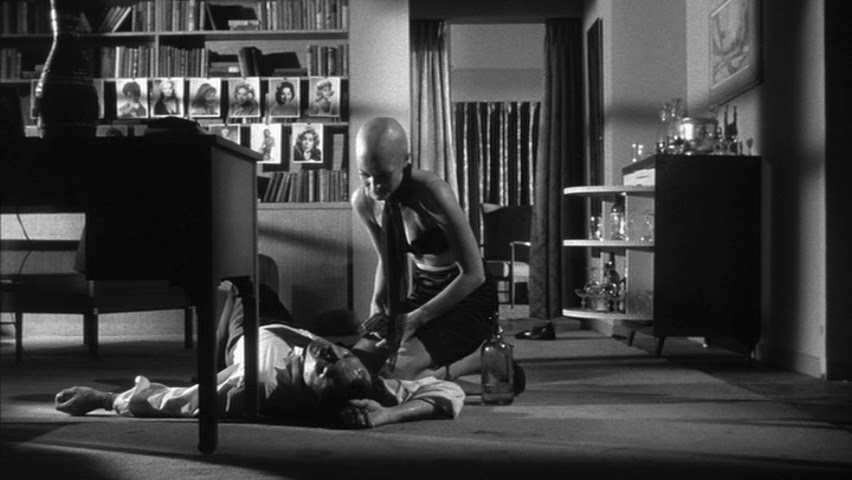
Reporter Johnny Barrett (Peter Breck, sometimes good, sometimes bad) is investigating the murder of a patient at an asylum, looking for an expose to win a Pulitzer. he's been training for a year to pull the wool over the diplomas of those weisenheimer shrinks so he can get inside. His editor, "Swannee," is all for it, but his stripper girl-friend Cathy (Constance Towers) thinks it's a bad, bad idea...real bad. But she plays along, posing as the worried sister whose fear of Johnny's "affections" creates the police report that sends him up (This is one of those police departments that doesn't do background checks, or investigations of any kind). 
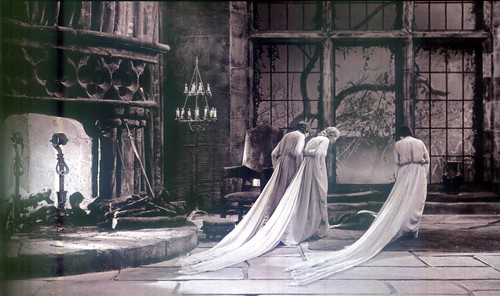
Johnny's encarcerated as a sex maniac, and we're thrown into the sordid exploitation stuff of sadistic guards, colorful loonies, and perversions. At one point, Johnny stumbles upon the woman's ward (Fuller cuts to a bug-eyed Barrett, realizing his situation and in echoe-y voice-over says one, hilarious word--"Nympho's!") and then is set upon, "Daughters of Dracula"-style in a genuinely creepy scene. Fuller walks a razor-thin line of silly exploitation and truly daring social commentary that slaps you across the face, and you realize--he's serious! 
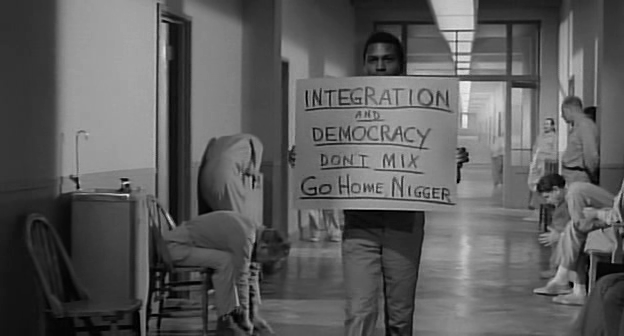
Sure, Cathy gets a performance scene as a stripper--although she it's a rather stodgy dance routine with a torch-song to go along with it (she's Mrs. Sam Fuller, after all, gotta keep the wife happy), but once we know one psychosis from another, and Johnny starts to interview the witnesses to the murder, Fuller starts doing something deeper than giving jollies to the mouth-breathers. His three murder witnesses are all victim's of the State's insanities. There's Stuart (James Best) a Korean war vet and victim of brainwashing but, as it's made clear, he's just as brainwashed by the racist upbringing he received growing up in the South. Then there's Boden (Gene Evans) genius missile engineer, whose so unhinged by the Mutually Assured Destruction scenarios his inventions have been targetted for, that he cracks to the abilities of a six year old child, capable only of drawing and playing hide-and-seek (although it looks suspiciously like duck and cover the way he plays it). Finally, in easily the best performance of the movie, is Hari Rhodes as Trent, a former student, allowed at gun-point to attend a previously integrated college, and in his efforts to be five times better than the white students, cracks under the pressure, becoming as bigotted as the protesters who tried to keep him out. Where Evans and Best can't seem to hurdle a mental block from turning their roles into melodrama, Rhodes plays it absolutely straight and he's the guy you remember.
Does all this actually lead to finding out who the murderer is, and what happens to Johnny? Well, I think you can guess given Fuller's cynical view of things. But he's trying to do more with it, and equate the U.S. circa 1963 with the trappings of an insane asylum. That's a brave statement, especially for a B-movie exploitation pic. But that's usually where Fuller preferred to be. He could rise above his genre and budget. There are times when the dialog tries so hard to rise above its exploitation roots and prove that it's read a book or two that it approaches Ed Wood ponderousness. But the trunk of the thing is a joy to behold, despite all the cheap tinsel and gaudy patter.
And along the way, Fuller scores a few hits against the psychiatric profession: the first shot is of a psychologist straightening his crooked diploma, and at one point during his psych evaluation, the prepped Johnny thinks "This is where he's going to ask if I hear voices.." and the shrink asks, "Johnny, do you ever hear voices?" It's a funny scene, but it also shows the limitations of the profession's pigeon-holing of individuals. (Hey, Tom Cruise! I got your next remake project for ya!) 
Ultimately, History is the judge. This cheap little grindhouse flick is part of the National Film Registry. That's not voices you hear in your head. It's the echoing cackle of Sam Fuller.

Thursday, July 14, 2016

The History of John Ford: The Horse Soldiers

When Orson Welles was asked what movies he studied before embarking on directing Citizen Kane he replied, "I studied the Old Masters, by which I mean John Ford, John Ford, and John Ford." 

Running parallel with our series about Akira Kurosawa ("Walking Kurosawa's Road"), we're running a series of pieces about the closest thing America has to Kurosawa in artistry—director John Ford. Ford rarely made films set in the present day, but (usually) made them about the past...and about America's past, specifically (when he wasn't fulfilling a passion for his Irish roots). 

In "The History of John Ford" we'll be gazing fondly at the work of this American Master, who started in the Silent Era, learning his craft, refining his director's eye, and continuing to work deep into the 1960's (and his 70's) to produce the greatest body of work of any American "picture-maker," America's storied film-maker, the irascible, painterly, domineering, sentimental puzzle that was John Ford, John Ford, and John Ford.

The Horse Soldiers (John Ford, 1959) Ford made few Civil War dramas—he preferred seeing the Nation being built than coming apart at the seams—and The Horse Soldiers is more of a small skirmish movie, remarkably free of battles, but more of undercover work—and one battle that is notorious in Civil War history. That anyone might think of it as anti-war—how could it with John Wayne, and a decade before it became fashionable—would mean that they had to by-pass the promotional material and actually watch the thing.

But, the older Ford, seeing the tight studio-hold begin to lighten as they began to lose power to television, might have thought that it was time to speak truth to legend. For the legend, he would go to Ireland, but in the 1960's and 1970's, he went back to his film-making roots, dug them up out of the desert scrap and examined a little more closely the truth behind some of his earlier films and the history of the country. He would present the weeds along with the garden.

Ford's framing takes a cue from Matthew Brady's daguerrotypes
The Horse Soldiers is based on history—the track of Col. Benjamin Grierson to de-stabilize supply routes to the Confederate forces, but the players are all fiction. Wayne plays Colonel John Marlowe, a railroad engineer, who uses his experience to find the weak points along rail routes—spending his time in war destroying what he might have built in the peace. 
He is sent into the heart of the South to Tennessee and Mississippi on a route to Baton Rouge, with the main purpose to destroy a depot at Newton's Station that will cut off supplies to forces at Vicksburg. Marlowe's troop does a lot of skulking around trying to avoid detection by the Confederates, their mission is undercover, but that is a tough prospect commanding 1700 men, all dressed in blue.
Wayne out front, checking the progress of Confederates while his are concealed behind trees.
A troop behind enemy lines finds it tough to have their own supplies ferried to them if they want to avoid detection, so part of the mission is to raid local plantations, use the grounds as bivouac, and "commandeer" supplies, frequently "under protest." One of those so affected is the Greenbriar plantation, being overseen by Hannah Hunter (Constance Towers) and her remaining slave Lukey (tennis champ Althea Gibson). Although gracious to a fiddle-dee-dee, and outwardly manipulative, Miss Hunter holds great antipathy towards the Yankees, remains loyal to the South, and when it's been discovered—by the ever-mindful "saw-bones" Hank Kendall (William Holden)—that she's been listening (via fireplace vents) to the secret plans of the troop, Marlowe has no choice but to take her and Lukey on the campaign, lest she betray them to "Johnny Reb." That just makes her more resentful, causing clashes between her and Marlowe.
Anybody familiar with Ford films knows that such a situation can lead to an ambiguously heartfelt relationship—Marlowe and Hunter fall into a chaste yearning relationship, through a combination of her seeing the effects of battle on both sides rather than holding to an ideological ideal, and his being besieged from all sides—from his superiors and from his own men, including a begrudgingly supportive one from Kendall, on top of having to battle the Confederates, who at the late stage of the war are desperate enough to throw whatever they can at him, including children from a military academy.
Her protests, her new-found vulnerability in danger, and her work tending the wounded, cut through the Wayne crust and probably seem like a comfort amidst the rest of his situation. In the movie, that relationship doesn't play well, sadly, through no fault of Towers—she's great in this film (she usually is), able to bring up the fire that Ford's favorite, Maureen O'Hara, brought to his films and Ford would use her again in his next, Sergeant Rutledge—but Wayne isn't up to his part, managing the quaint courtliness required, but not the vulnerability needed to make it pay off, falling back on a shyness that runs counter to the character's actions, or to Wayne's strengths as an actor.
Marlowe finds Southern deserters in the form of Denver Pyle and Strother Martin
who act and look like they dropped in from a future Sam Peckinpah movie.
Holden's role as a conscientious objector/surgeon who frequently clashes with Wayne over the troop's actions is also a bit under-developed. Look, this is William Holden here. He's one of the few male actors who could stand up to Wayne and by wily enough to not get blown off the screen. But, the character, while of some interest and giving Holden a uniform to fill, doesn't serve much of a point other than to be an irritant, something the movie already has plenty of. To that point, it seems a weakness of the film that Wayne's Marlowe is constantly under the gun and presented with no-win scenarios that reach the breaking point when he must command his troop to fire on civilians.
That slaughter leads to an extended scene in a bar where Marlowe gets drunk and lets down the reserve that has kept him going through what he'd earlier described as "this insanity." It's a powerful scene, even if one gets the sense that Wayne isn't fully committed to it. He can rail all he wants, but there's no sense of release or breaking here, again, not one of Wayne's strengths, as he tends to be at his most powerful in moments of stillness or circumspect emotion. Wayne is at his best when he's not "making a scene," but being the most powerful thread in a fabric.
This is not the John Ford of The Cavalry Trilogy, where one might snatch some phyrric victory out of defeat. There are no scenes of triumph in the film, and the scenes of battle have a bitter tinge to them: one is based on the Battle of New Market in which Union soldiers fought Southern forces that were joined by VMI cadets—children, really—which occurred on March 15, 1864. Ford mines it for irony, pathos, and some odd insertions of comedy for a situation that is so jingoistic that it is horrific and absurd simultaneously. That it is true, well, that is insanity.
The Horse Soldiers was filmed in vibrant color by William Clothier, who'd been working since 1923, but only in the 1950's did he start coming into his own as a director of photography for such directors as John Ford and William Wellman. He became John Wayne's favorite cinematographer and was renowned for masterful location work. The Horse Soldiers is one of his best, but the film fell into neglect and disrepair until restoration for Blu-Ray release suddenly revealed its stunning imagery and eye-popping color done under the direction of Ford.

I'd seen The Horse Soldiers before, but seeing it restored is like seeing it for the first time.
One of the most memorable sequences of The Horse Soldiers-
The Battle of New Market. Both funny and sad simultaneously. 
The poster of this clip cut out Anna Lee taking her kid out of the procession, 
despite his whining protests.

Friday, July 10, 2015

The History of John Ford: Sergeant Rutledge

When Orson Welles was asked what movies he studied before embarking on directing Citizen Kane he replied, "I studied the Old Masters, by which I mean John Ford, John Ford, and John Ford."

Running parallel with our series about Akira Kurosawa ("Walking Kurosawa's Road"), we're running a series of pieces about the closest thing America has to Kurosawa in artistry—director John Ford. Ford rarely made films set in the present day, but (usually) made them about the past...and about America's past, specifically (when he wasn't fulfilling a passion for his Irish roots). In "The History of John Ford" we'll be gazing fondly at the work of this American Master, who started in the Silent Era, learning his craft, refining his director's eye, and continuing to work deep into the 1960's (and his 70's) to produce the greatest body of work of any American "picture-maker," America's storied film-maker, the irascible, painterly, domineering, sentimental puzzle that was John Ford, John Ford, and John Ford.

When the Founding Fathers decreed that "All men are created equal" in the Declaration of Independence, released 239 years ago, they weren't speaking of civil rights. They were actually refuting the divine right of Kings—that just because you're born in the house of Tudor, Stuart, Plantagenet or Windsor does not give the inherent or even god-given right to rule over other people, whatever their circumstances. That's what the slave-owners who wrote the Declaration meant. But, because that document and the Constitution deal with fundamental ideals of human rights—base-line ideals—on which this country and its governance are formed, they have become "living, breathing documents," and are just as subject to evolution as the species that came up with them, and cannot, in good conscience, remain inert without undergoing re-interpretation, as this country has seen in the last couple weeks. Things change and our laws and our practicing of them, must change, if they are to remain true to the spirit with which this Nation announced itself. The United States of America, that most hopeful of country names, is an experiment in whether a people can put aside their differences, their tribalism and their prejudices and govern themselves, not relying on some potentate given that position by birth. It's an experiment that hasn't been perfected yet—and given those mentioned factors of human beings—may never be perfect to everyone's liking. There are only two ways we, as a people, can only be truly equal—by either putting aside our prejudices and practicing what we preach or by dying. Evolution or extinction will make us all equal. Those are the only choices. But, progress, like evolution, slowly, inexorably gets changed. If anything has defined the history of the United States, it is the story of the African-American, brought over in slave-ships to be propertied labor, no better than cattle, and the Nation's waking up from its privileged slumber to realize that it was deluding itself to say "all men are created equal" in theory while violating it in the worst way in practice. That struggle is the struggle of the United States—to back up its high-minded words with action in everyday life.

Sergeant Rutledge (John Ford, 1960) "Mr. Lincoln said we're free. But that just ain't so."

So says Sergeant Braxton Rutledge (Woody Strode) in another in a series of lesser known films by master director John Ford. This is another—his last, in fact*—look at the U.S. Cavalry, but fills in one of the "gaps" in the "Western" era of the United States, post-Civil War—the era of the Buffalo Soldier, when men who were former slaves were allowed to join the Armed Forces in service to the country that had previously condoned, by inaction, their forced servitude. Sergeant Rutledge (the film) is John Ford's acknowledgment of that conundrum and the hypocritical attitude of the Nation towards the rights of slaves. It is one thing to free them. It is quite another to not keep them enslaved by treating them as second-tier citizens, not equal to the whites under the law. Ford always populated his films of American history with a varied populace—Swedes, Irish, Poles, Germans, Caucasians, mostly, but the occasional Latino, as well—but his films are remarkably free of immigrants of color. It was prescient of him to do Rutledge on the cusp of the Civil Rights era, and before Sidney Poitier broke the box-office color barrier.
Based on the novel "Captain Buffalo" (a title that Ford clearly preferred but was overruled when the studio proved to be white-knuckled about it) by author James Warner Bellah (who wrote the stories for Ford's "Cavalry trilogy" and the subsequent screenplay for The Man Who Shot Liberty Valance, it tackles the service of the Buffalo Soldiers, who, even while defending the Nation, were not equal under the law and not equal in the hearts and minds of the civilian populace they served. Sergeant Rutledge was far afield of the mainstream in its purpose of pointing out and condemning official and social prejudice. John Huston had tackled the same issue in a sub-plot of In This Our Life in 1946, when the word of a black man could not hold the weight against that of a prominent (or even a non-prominent) white in a court of law (And Rutledge appeared before a similarly themed book To Kill a Mockingbird was presented as film in 1961). White truth counts more than black truth. In fact, a white lie counts more than a black truth. The same applies in Sergeant Rutledge: Mr. Lincoln said they're free. But it just ain't so. Not as long as the color of one's skin is a consideration for justice...for anything... no matter the official platitudes saying otherwise.
"They're laying it on a little thick for Sergeant Rutledge", says Lt. Tom Cantrell (Jeffrey Hunter, top-billed, although he has less screen-time than Strode, no doubt due to Warners' fears of effect on box-office revenues) and it applies to the tactics inside the film and that of the director. Ford toys with our prejudices in this one, pushing emotional buttons, challenging our own best intentions as an audience against established prejudices, which he pokes and prods, in images that provoke. Against that, he puts forth acts of character that should weigh more than the impressions those images inspire. Those images are informed (or mis-informed) by the testimony of the witnesses in a military court-martial and trial of the title character, and "character" is the chief concern of each attestant, for good or ill. Because of the differing impressions and opinions that are presented as fact, Sergeant Rutledge is Ford's version of Rasho-mon, a tip of the stetson to Japan's director Akira Kurosawa who had been, in turn, evoking Ford throughout his career.
Black man's hand against a white woman's face: images that provoke.
It all revolves around what Rutledge calls "white woman trouble:" A girl (Toby Michaels) is found raped and murdered, and her father (who just happens to be in charge of the 9th Cavalry) is also found slain. Disapproving locals have seen Rutledge helping the headstrong Lucy Dabney—and their prejudices are as much against her as Rutledge—and when she ends up dead, accusing eyes immediately turn to him. Her father ends up dead, and Rutledge is nowhere to be found, deserted. His own 9th Cavalry is sent out to track him down, headed by Lt. Cantrell, who has come out to meet his love Mary Beecher (Constance Towers, so excellent in Ford's The Horse Soldiers from the previous year). Once caught, Rutledge proves too capable to hold on to and escapes. But, when the 9th is under peril from an ambush, he returns to warn them, his sense of duty overriding his surety that he would be incapable of facing a fair trial from the white military commanders sitting in judgement, or the townspeople who'd as soon lynch him as try him.
Lucy Dabney is found murdered—it is only the image that implies she's been violated.
Cantrell, based on Rutledge's actions warning the troop, agrees to serve as defense attorney at his court-martial, but its an uphill struggle. The prosecutor (Carleton Young) bases his case on circumstantial evidence, as well as playing on the prejudices of the court and the spectators (which are not far afield from his own). Rutledge knows he will be damned, but stands trial anyway, lest the accusations besmirch the rest of the 9th. Like in previous Ford Cavalry pictures, the Corps is greater than any one man, or even the truth. The Corps must be preserved, whatever the cost.
The symbolism doesn't get more obvious than this:
The lily-white gloved hand of the prosecutor accuses Rutledge.
It's in the trial portion where Ford becomes his most expressive directing, using lighting and stage techniques to move us from the courtroom testimony to the flashbacks of the events of the witnesses' narratives. Naturalism, which has been prevalent from the beginning of the film, transitions as we move from present into the past of memory and perspective, splintering reality and truth, as the case for and against Rutledge is built. At the same time, Ford uses comedy to show the absurdity and irony of the court's officials charged with the heavy burden of judging a man's life, being far less. Those moments of farce (which disarm any protests of stereotyping as the whites get the brunt of it), especially in the form of Col. Otis Fosgate (Willis Bouchey, in a role that might have been played by Ward Bond, if he had chosen to participate) and his bickering with his harridan of a wife (played by Billie Burke), might seem out of a place if Ford 1) didn't want to break up the drama a bit—as was his wont, and 2) showing the foolishness of the officials raises the stakes (conversely) of the drama by making them less resolute and dependable as authority figures.
One of the great joys for me of Sergeant Rutledge is to see the lengthy performance of one of my favorite character actors, Woodrow Wilson Woolbine Strode, who was usually "tasked" with playing dialogue-less African princes and warriors (he would even play one for Stanley Kubrick this same year in Spartacus) who had a distinctive face that photographed well from any angle.
 
Strode's acting is varied in quality, stiff and a little too brittle on occasion, but in his break-down scene on the witness stand with Ford's camera bearing down on him, he cracks and suddenly you see an amazing performance, right from the umbraged tilt of Strode's head at the prosecution's veiled bigotry, to the crumbling of that stoic face as he must finally reveal himself, rather than keeping his counsel and expressing himself by example. Strode was always a better physical actor (the way Redford is, the way John Wayne is) and some of his most memorable performances (like in Spartacus the same year and Once Upon a Time in the West) he has no lines at all. And Ford, who got more out of actors with looks and gestures than from reams of dialogue, trusted the planes of the face to reveal thoughts and feelings that might move, and even terrify, an audience. 
Folks dismiss Rutledge as one of Ford's "atonement" movies, never questioning why other directors didn't do something similar, nor considering why it was important for Ford to continue to tell the history of the States by filling in some of the less known gaps in "the taming of the West" (especially considering that television at the time was glutted with more typically conventional Western fare) or that market forces might not demand his reassessment of the Western saga. Certainly, the timing for Sergeant Rutledge to garner more attention might have been more appropriate for the later 60's, as opposed to when Ford made it...in 1960. I think Rutledge is brave, stirring, and damning, not just for its time but for ours, as well. We haven't yet reached the point where (as one sage put it) people can be judged by the content of the character and not by the color of their skin." "Mr. Lincoln said we're free. But it just ain't so." And the line continues: "Maybe some day. But not yet." And still not yet, past the time-setting of the film, or the day it was made. Some day we'll live up to our birthright: "all men are created equal." It's why we keep fighting...in the streets and in our hearts. Until we've beat ourselves color-blind.

Woody Strode, along with Jack Robinson, and Ken Washington when they played for UCLA
* Well, he did do some Cavalry coverage in Cheyenne Autumn (which we'll take a look at soon), but the true focus of that film is The Trail of Tears from the First People's point-of-view.

** The publicity department at Warner Bros had to fight two battle to reach an audience: 1) the director was considered an "old codger" who, although he was the only director who'd won three Oscars, was thought a little "out of touch" for young audiences; 2) the story was about a black man in a time before the Civil Rights marches of the '60's. So, the question is this: how do you be ahead of your time for modern audiences but still be an "old codger" in the eyes of the studio? Makes no sense. Now, look at the posters for Rutledge from the Warner publicity department that downplay the story and Strode in favor of a more prominently positioned white. And Ford stalwarts John Wayne and Ward Bond chose not to participate in the film, except to lend their names to generically complimentary praise-plugs.