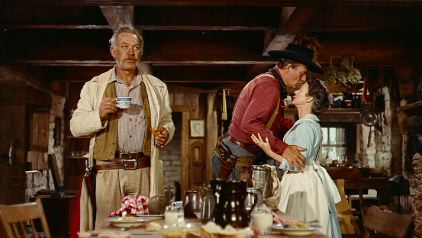
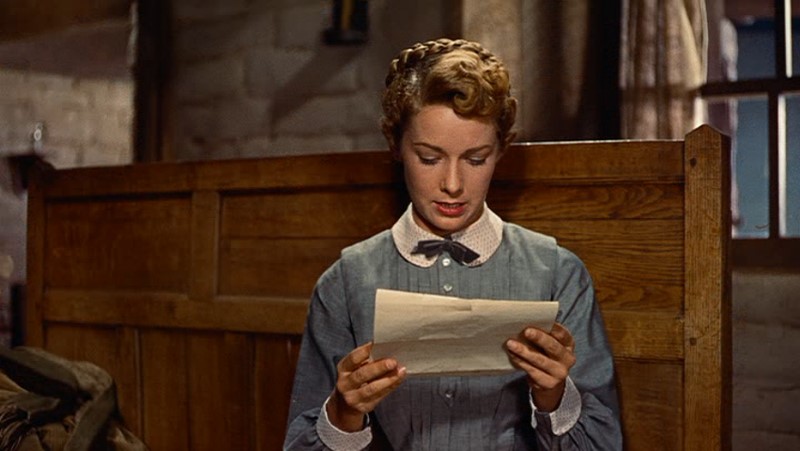
Showing posts with label Hank Worden. Show all posts

Friday, May 28, 2021

Anytime Movies #5: The Searchers

While I catch up on the reviews still in "Draft" phase here, I'll re-run a feature I ran when I first started this blog seven years ago,**** when it was suggested I do a "Top Ten" List.

I don't like those: they're rather arbitrary; they pit films against each other, and there's always one or two that should be on the list that aren't because something better shoved it down the trash-bin.

So, I came up with this: "Anytime" Movies.


Anytime Movies are the movies I can watch anytime, anywhere. If I see a second of it, I can identify it. If it shows up on television, my attention is focused on it until the conclusion. Sometimes it’s the direction, sometimes it’s the writing, sometimes it’s the acting, sometimes it’s just the idea behind it, but these are the movies I can watch again and again (and again!) and never tire of them. There are ten (kinda). They're not in any particular order, but the #1 movie IS the #1 movie.


It’s a film that chills me right down to my bones and makes me cry every single time.* It throws itself into the deepest pits of despair and within moments, prat-falls into low comedy. It’s a western…about race relations, and in the house of mirrors of a “genre” piece deflects the self-righteous tone of a sermon. It stares into the soul of people at their worst, and exults in their best.

It is arguably
John Ford’s best film (and he made many great ones). It is inarguably John Wayne's finest performance on-screen, while completely working against the image that Marion Morrison had built as “John Wayne,” American Hero.

Oh no. We’re talking about
The Searchersa “western” made during the somnambulant 50’s …and with John Wayne, ferchrissakes! How corny can you get?

Back up, pilgrim.

The Searchers has just been re-released (to mark its 50th anniversary**) in a
gloriously re-mastered DVD, and has come under critical review for being too corny, too obvious, and more than a little dated. 

Worse still, it has been branded a “film-school darling” that has skated too long on an undeserved reputation as a masterpiece.
Bullshit.

Like Pauline Kael’s faulty detective work
dissecting Citizen Kane and Elvis Mitchell’s naïve un-analysis of 2001, the work in Slate smacks of a critic either looking for something to write about or make a name for themselves bucking “conventional wisdom.” Having to spend a summer reviewing the third X-Men movie, the fifth “Superman” opus AND an entirely superfluous “Pirates of the Caribbean” sequel is bound to make anyone crabby.

But it shouldn’t lower one’s standards, and there’s enough slip-shod work in the article to indicate that’s the case. At the very least, it’s a terrible gloss-over.

At the worst, it displays a film reviewer who hasn't even seen the film he was supposedly watching for the prejudices and pre-conceived notions that he would rather cling to rather than objectivity.

The Searchers is a masterpiece—the culmination of decades of film-making experience that John Ford had accumulated since the silent era—while crystallizing Ford’s growing disenchantment with the Myth of the West. In a time when westerns were still basically built around the simplistic formula of “Cowboys vs. Indians,” Ford was starting to speak out more explicitly for the latter sixteen years before such accepted “consciousness-raising” films as Little Big Man or Soldier Blue. Like any masterpiece, it displays the sum of a body of work and breaks new ground, paving the way for the future.

The Searchers tells the story of an obsessive 10 year hunt for a lone family member taken in a violent Comanche raid. It’s led by the worst person possible: the child’s uncle--a hate-obsessed confederate soldier, self-exiled from his family, who still carries his saber on his hip, bitterness in his soul and his heart on his sleeve. Mix in a venomous race-hatred for all non-whites and you have the most flawed anti-hero to appear in movies. Ethan Edwards starts his search to bring his niece back alive, but as the years pass and she matures into womanhood, he gives her up as one of the Enemy, and sets out to kill her. At the center of the film’s black heart is that most archaic and useless word: miscegenation.
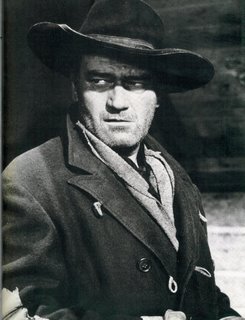
It’s rough stuff. Rougher still are the attitudes of the settlers towards the Indians that border on hysteria. There’s a haunting scene late in the film where Edwards and his fellow traveler (played by future "Star Trek" Captain Pike and “Teenage Jesus,” Jeffrey Hunter) ride into a fort on the Trail of Tears to inspect some kidnapped white women who have been re-captured—"rescued" they would say—by the Cavalry. 

“It’s hard to believe they’re white” a sergeant says. 

They ain’t white,” spits Edwards, and at the sound of a shriek from one of the women, he turns to look at her. Ford trucks in the camera fast onto Wayne’s face (mirroring the shot he used to introduce Wayne in their first film together, Stagecoach) and it’s amazing. Wayne was always blessed with a mug that the camera loved***—it could read every emotion that played across it—and in a performance minus the “hero façade” and that turns on the full after-burners that usually blew his co-stars off the screen, this one quiet moment radiates a combination of hate, disgustand abject fear. No words need to be said to make the point. No words could.

It's what made Ford a great director and Wayne a great actor.

"No, Ethan!  No, you don't!"
And yet, for all its depths of despair amid bloodshed and the race-hysteria, Ford tries to balance it with entertainment. That’s quite the tight-rope walk. But then, it’s not a sermon. It’s a Western. Ford was never so pretentious to be caught lecturing. He’d say if you want to send a message, use the Pony Express. Better to sneak the lessons into the fabric of the story, and distract with shenanigans about wayward lovers, goony old men, and green cavalrymen with pointy swords. One of the incidents involves the unintended marriage of Hunter’s character to a portly Indian maid. It’s the source of raunchy comedy in the vein of Ford’s The Quiet Man—all roughhouse and bad taste. But when Ford’s good guys “The Cavalry” decimate a Native village and the luckless character along with it, Hunter is left to ask “What’d they have to kill her for? She never hurt anybody!” The question hangs in the air with indictments all around.
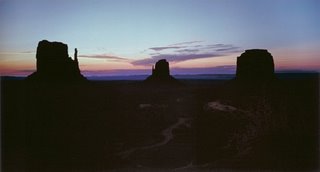
The Searchers begins and ends with a black screen. In the beginning, the blackness gives way to the vast magical vista of Monument Valley (which figures in two of my anytime movies. If God lives anywhere on Earth, I think it’s on that vast acreage of land overseen by the Navajo) that to Garry Wills suggests an irising lens, but to these eyes seems more of a proscenium arch. At the end it shuts out Ethan Edwards who is left out of the warmth of a family embrace to wander the desert (Of course, Wayne’s character is going to come in eventually and eat…but Ford chooses to leave Edwards outside). His prejudice does not belong with home and hearth...and society…and Civilization. Yet it is also Ford’s choice to leave the character alive, the wolf always at the door.
It’s as if having made his plea for tolerance, Ford cautions us that it will always exist, somewhere.

Will we ever...finally...lose the hate?

“That’ll be the day.”

Robert McGinnis' portrait of Wayne in The Searchers.
Anytime Movies:
The Searchers

* A comment on this post and movie—when it was stationed at another blog—asked: "
The Searchers makes you cry?!?!? Is it because of all the dead Indians?" Sure. Go with that. But, a lot of settlers are killed, too, and the hunt in The Searchers is precipitated by one such massacre, the matriarch of which is the one woman that Ethan Edwards loves. It's what entwines his search into one of need and of vengeance. 

No, the thing that makes me cry is the act that comes right before the line "Let's go home, Debbie." That line. From that character. At that time. Despite all evidence to the contrary. It's what gives one a small tiny quantum of hope that belies the sentiment of "That'll be the day..."

** And now, it's a few years shy of its 70th.  I wasn't even a year old when it was released.  It's like an old friend that's grown up with me.

*** Screenwriter Robert Towne has a better term for it, the "camera-love" phrase implying a happy accident that doesn't give enough credit to the actors, their craft and experience. He says that actors like Wayne, Henry Fonda, and Gary Cooper are "ruthlessly efficient" in that they can communicate differing emotions with an economy of expression. Those words are particularly apt for Wayne's performance in The Searchers.

**** And, on Sunday, we'll put up a "Don't Make a Scene" feature from each week's film.

Friday, April 3, 2020

The History of John Ford: Wagon Master

When Orson Welles was asked what movies he studied before embarking on directing Citizen Kane he replied, "I studied the Old Masters, by which I mean John Ford, John Ford, and John Ford."

Running parallel with our series about Akira Kurosawa ("Walking Kurosawa's Road"), we're running a series of pieces about the closest thing America has to Kurosawa in artistry—director John Ford. Ford rarely made films set in the present day, but (usually) made them about the past...and about America's past, specifically (when he wasn't fulfilling a passion for his Irish roots).


In "The History of John Ford" we'll be gazing fondly at the work of this American Master, who started in the Silent Era, learning his craft, refining his director's eye, and continuing to work deep into the 1960's (and his 70's) to produce the greatest body of work of any American "picture-maker," America's storied film-maker, the irascible, painterly, domineering, sentimental puzzle that was John Ford, John Ford, and John Ford. 


Wagon Master (John Ford, 1950) The western expansion of the American frontier is a standard theme of...the Western. John Ford had featured prospective settlers (and settling prospectors) in many of his films, but made the phenomenon the center of his film Wagonmaster, a modest black and white western, made in between When Willie Comes Marching Home and Rio Grande. Wagonmaster could well be the pilot episode of the television series "Wagon Train" (1957-1965)—which also starred Ward Bond in the first four seasons. There are no A-list stars—just the "Ford Stock Company" stepping front and center in the film, rather than filling the corners and back-stories.

Ford begins the movie bluntly with an almost silent sequence (Ford learned his craft making silent pictures)—the Clegg's (Charles Kemper, James Arness, Hank Worden, Fred Libby, and Mickey Simpson) are robbing the Crystal City Bank, resulting in Pa Clegg being shot in the wing, and, incensed by the inconvenience and the impertinence, shooting the chief clerk in the back without regard to the escalation. The bank's sole source of internal light, a hanging hurricane lamp, swings with the force and the temerity of it. There have been no titles, no studio accreditation, no introduction. The movie begins with a terrible act with no word of warning.
It is only then that the titles appear proudly, diametrically, over footage of a dogged wagon train (complete with dog) accompanied by the "Song of the Wagonmaster" by The Sons of the Pioneers emphasizing the highs and lows of the rolling life. There is a lot of music in Wagonmaster, over such montages, that one might be distracted from some of the more beautifully comp0sed shots, or the rigors it took to achieve them, but to say it's a "musical" (as some appreciative writers have stated) may be stating it too strongly, considering the amount of song and group-musicianship in others of his works.

As the Clegg's silently take to the hills, watching their backs, two horse-traders ("That's my business!"), Travis (Ben Johnson) and Sandy (Harry Carey, Jr.) ride  out of Navajo Country with their latest acquisitions, trying to calculate their fortunes at $30 a head. They pull into Crystal City, the town still recovering from the recent murderous bank robbery and the Sheriff makes a show of checking the ponies while actually appraising the men attached to them—they're neither the type nor the number.
Convincing the Sheriff enough of their innocence to sell him a pony—and play a prank that sets the horse, with the Sheriff temporarily attached, careening into the streets—the two plan to rest up in town to play a few rounds of "High-Low-Jick, Jack, Ginny and the Bean Gun," which, besides the passing of funds, will give Travis his own assessment of the town and his future fortunes, given a conversation he'd had previously that day.
"I'm in"
The film proper doesn't get underway until Travis and Sandy meet the blustery ("I repent my words of wrath") Elder Wiggs (Ward Bond) and a small contingent of his party of Mormons who are being run out of Crystal City by the "fine" folk there who do not like their ways ("that's why I keep my hat on—so the horns won't show"), Their aim is to wagon-train to a "valley reserved for us by the Lord," by the San Juan Rover, hoping to get there before the winter rains come, to set up an outpost for their brethren to follow to. They want to buy the ponies and are in need of "wagon-masters" to negotiate the trail. During an extended negotiation that involves whittling interspersed with some volatile umbrage by the elder over price and the pony-men's lack of availability (even though they don't drink, don't chaw, don't cuss—much—and display no vices, other than a propensity towards gambling), the elder walks away merely with horseflesh and the responsibility for the journey.
Well, if there ever was a gamble...; when the Mormon party is escorted to the city limits, Travis and Sandy are there to meet them as they inform Wiggs that his group is not facing hundreds of miles of unknown alone. Wiggs is grateful for the help, but not all of the party are thrilled, chafing from taking orders from ruffians not part of the flock—they have women and children, after all. Wiggs has to be peace-maker, which is an unusual role for him, and one he's not accustomed to.
It's a big country out West—it was filmed in Moab, Utah (out-of-reach in order to discourage visits by producers) and parts of Monument Valley (to take advantage of extras from the Navajo nation, some familiar faces from other Ford productions can be seen among the Natives), but being close to the outskirts of civilization—that being Crystal City—the wagon train comes across others of their outcasts, which the sheriff listed as "Mormons, Cleggses, showfolk, horsetraders." The Mormons are far enough along that water is in short supply when they come across #3 in the list: Dr. A. Locksley Hall (Alan Mowbray), travelling showman and rumored dentist, selling a healing elixir, accompanied by two women no one would confuse with nurses Fleuretty Phyffe (Ruth Clifford) and Denver (Joanne Dru, who had just featured in Ford's She Wore a Yellow Ribbon). When they're found, they have run out of water, and are staying alive—but not on their feet—with the doctor's snake-oil.
Liquor and loose women are usually not a good mix with Mormons, but as the party is in a terrible spot, they're allowed to be party to the train, at least until they reach water. Being show-folk, they don't quite understand the necessity of rationing water with no shaving and no showers.
But outcasts attract, and though the Mormons keep the "show-folk" at arm's length, Elder Wiggs has enough of a past with (what he calls) "hootchy-kootchy shows", he can see Miss Fleuretty as "a fine figure of a woman" (she's loyal to the doctor, however), and Travis and Denver have one of those passive-aggressive flirtations that pop up in Ford films with strong women and cowed boys. Although the journey involves struggle, generally everyone is doing the right thing, perhaps due to their empathy with their lot as outsiders or undesirables, perhaps to their religious beliefs, regardless of their faith—extending to the Native Nahajo's who welcome them into their camp, as Mormons have a reputation for being less dishonest than other whites.
And far less than the "Cleggses." It is inevitable in the rules of drama that in all the wilderness that they should eventually meet up with antagonists. It's where the good feelings generated within and by the wagon train are challenged and where their dreams are threatened. It's also crucial in the Ford Universe; sure, everybody is an outcast from "polite society," but that doesn't make everyone a saint by default. That list of "Mormons, 'Cleggses', show-folk and horse-traders" has one rough-hewn peg in it and the "Cleggses" have no best intentions other than fulfilling their basic needs with no aspirations beyond that. Ford's heroes, no matter their place in society (or outside of it) have hopes, dreams...plans...purpose.
But, his villains: they may have dreams, but also have no qualms ruthlessly—or cluelessly—quashing the dreams of others. In Wagonmaster, community is all, and once the stakes rise high enough to affect the future, that's when ultimate action must be taken against oppression, even on a wagon train that now, thanks to being overrun by the "Cleggses", has no guns.
Wagonmaster has no stars to bank on, (but, then, neither did Stagecoach)—the one Oscar winning actor of the bunch, Jane Darwell, has very few lines (maybe five) in the entire thing. Stars have a tendency to dominate story, and in the case of Wagonmaster, would distract from it. Better that the story remain distributed among the many, and that the focus be on the journey and the collective that it forms. As it's the story for the quest for settlement and the forging of a community with the best of intentions and with an eye toward the future.
It was one of director Ford's favorite films, despite it lack of success at the box-office. That maybe entirely due to the vision that he held for it and his view of how well the task was accomplished—what we now call the "signal to noise" ratio.* 
Better than The Searchers, though? To my mind, no. But, then, The Searchers is a study in human nature and its worst qualities in regards to race prejudices, whereas Wagonmaster points to the best instincts, despite the impact of such things. Wagonmaster has hope and looks ahead, not back.

It's a beautiful film to watch, and one to cherish.

* A modern example is George Lucas' Star Wars: Oh, sure, everybody loved it, but it was a film that he was disappointed in, despite its success—that he felt that need to tinker with it, erasing the flaws he constantly saw in it, to make it closer to what he originally had in mind.

Thursday, July 14, 2016

The History of John Ford: The Horse Soldiers

When Orson Welles was asked what movies he studied before embarking on directing Citizen Kane he replied, "I studied the Old Masters, by which I mean John Ford, John Ford, and John Ford." 

Running parallel with our series about Akira Kurosawa ("Walking Kurosawa's Road"), we're running a series of pieces about the closest thing America has to Kurosawa in artistry—director John Ford. Ford rarely made films set in the present day, but (usually) made them about the past...and about America's past, specifically (when he wasn't fulfilling a passion for his Irish roots). 

In "The History of John Ford" we'll be gazing fondly at the work of this American Master, who started in the Silent Era, learning his craft, refining his director's eye, and continuing to work deep into the 1960's (and his 70's) to produce the greatest body of work of any American "picture-maker," America's storied film-maker, the irascible, painterly, domineering, sentimental puzzle that was John Ford, John Ford, and John Ford.

The Horse Soldiers (John Ford, 1959) Ford made few Civil War dramas—he preferred seeing the Nation being built than coming apart at the seams—and The Horse Soldiers is more of a small skirmish movie, remarkably free of battles, but more of undercover work—and one battle that is notorious in Civil War history. That anyone might think of it as anti-war—how could it with John Wayne, and a decade before it became fashionable—would mean that they had to by-pass the promotional material and actually watch the thing.

But, the older Ford, seeing the tight studio-hold begin to lighten as they began to lose power to television, might have thought that it was time to speak truth to legend. For the legend, he would go to Ireland, but in the 1960's and 1970's, he went back to his film-making roots, dug them up out of the desert scrap and examined a little more closely the truth behind some of his earlier films and the history of the country. He would present the weeds along with the garden.

Ford's framing takes a cue from Matthew Brady's daguerrotypes
The Horse Soldiers is based on history—the track of Col. Benjamin Grierson to de-stabilize supply routes to the Confederate forces, but the players are all fiction. Wayne plays Colonel John Marlowe, a railroad engineer, who uses his experience to find the weak points along rail routes—spending his time in war destroying what he might have built in the peace. 
He is sent into the heart of the South to Tennessee and Mississippi on a route to Baton Rouge, with the main purpose to destroy a depot at Newton's Station that will cut off supplies to forces at Vicksburg. Marlowe's troop does a lot of skulking around trying to avoid detection by the Confederates, their mission is undercover, but that is a tough prospect commanding 1700 men, all dressed in blue.
Wayne out front, checking the progress of Confederates while his are concealed behind trees.
A troop behind enemy lines finds it tough to have their own supplies ferried to them if they want to avoid detection, so part of the mission is to raid local plantations, use the grounds as bivouac, and "commandeer" supplies, frequently "under protest." One of those so affected is the Greenbriar plantation, being overseen by Hannah Hunter (Constance Towers) and her remaining slave Lukey (tennis champ Althea Gibson). Although gracious to a fiddle-dee-dee, and outwardly manipulative, Miss Hunter holds great antipathy towards the Yankees, remains loyal to the South, and when it's been discovered—by the ever-mindful "saw-bones" Hank Kendall (William Holden)—that she's been listening (via fireplace vents) to the secret plans of the troop, Marlowe has no choice but to take her and Lukey on the campaign, lest she betray them to "Johnny Reb." That just makes her more resentful, causing clashes between her and Marlowe.
Anybody familiar with Ford films knows that such a situation can lead to an ambiguously heartfelt relationship—Marlowe and Hunter fall into a chaste yearning relationship, through a combination of her seeing the effects of battle on both sides rather than holding to an ideological ideal, and his being besieged from all sides—from his superiors and from his own men, including a begrudgingly supportive one from Kendall, on top of having to battle the Confederates, who at the late stage of the war are desperate enough to throw whatever they can at him, including children from a military academy.
Her protests, her new-found vulnerability in danger, and her work tending the wounded, cut through the Wayne crust and probably seem like a comfort amidst the rest of his situation. In the movie, that relationship doesn't play well, sadly, through no fault of Towers—she's great in this film (she usually is), able to bring up the fire that Ford's favorite, Maureen O'Hara, brought to his films and Ford would use her again in his next, Sergeant Rutledge—but Wayne isn't up to his part, managing the quaint courtliness required, but not the vulnerability needed to make it pay off, falling back on a shyness that runs counter to the character's actions, or to Wayne's strengths as an actor.
Marlowe finds Southern deserters in the form of Denver Pyle and Strother Martin
who act and look like they dropped in from a future Sam Peckinpah movie.
Holden's role as a conscientious objector/surgeon who frequently clashes with Wayne over the troop's actions is also a bit under-developed. Look, this is William Holden here. He's one of the few male actors who could stand up to Wayne and by wily enough to not get blown off the screen. But, the character, while of some interest and giving Holden a uniform to fill, doesn't serve much of a point other than to be an irritant, something the movie already has plenty of. To that point, it seems a weakness of the film that Wayne's Marlowe is constantly under the gun and presented with no-win scenarios that reach the breaking point when he must command his troop to fire on civilians.
That slaughter leads to an extended scene in a bar where Marlowe gets drunk and lets down the reserve that has kept him going through what he'd earlier described as "this insanity." It's a powerful scene, even if one gets the sense that Wayne isn't fully committed to it. He can rail all he wants, but there's no sense of release or breaking here, again, not one of Wayne's strengths, as he tends to be at his most powerful in moments of stillness or circumspect emotion. Wayne is at his best when he's not "making a scene," but being the most powerful thread in a fabric.
This is not the John Ford of The Cavalry Trilogy, where one might snatch some phyrric victory out of defeat. There are no scenes of triumph in the film, and the scenes of battle have a bitter tinge to them: one is based on the Battle of New Market in which Union soldiers fought Southern forces that were joined by VMI cadets—children, really—which occurred on March 15, 1864. Ford mines it for irony, pathos, and some odd insertions of comedy for a situation that is so jingoistic that it is horrific and absurd simultaneously. That it is true, well, that is insanity.
The Horse Soldiers was filmed in vibrant color by William Clothier, who'd been working since 1923, but only in the 1950's did he start coming into his own as a director of photography for such directors as John Ford and William Wellman. He became John Wayne's favorite cinematographer and was renowned for masterful location work. The Horse Soldiers is one of his best, but the film fell into neglect and disrepair until restoration for Blu-Ray release suddenly revealed its stunning imagery and eye-popping color done under the direction of Ford.

I'd seen The Horse Soldiers before, but seeing it restored is like seeing it for the first time.
One of the most memorable sequences of The Horse Soldiers-
The Battle of New Market. Both funny and sad simultaneously. 
The poster of this clip cut out Anna Lee taking her kid out of the procession, 
despite his whining protests.

Tuesday, May 17, 2016

The Big Sky

The Big Sky (Howard Hawks, 1952) A.B. Guthrie's novel about the exploration (and decimation) of the West by Eastern immigre's is considerably shortened by Hawks and Dudley Nichols, who start at the meeting of Jim Deakins (Kirk Douglas) and Boone Caudill (Dewey Martin) and their adventures of a keelboat going up the Missouri and leave it at that. Nothing about how Boone's a little savage who ran away from home after nearly killing his father, nothing about the unpleasantness that would follow, or the results of Boone's bad temper. No, this one's pretty much good times with some rough waters and bad rivals, and everybody gets along famously. It's vintage Hawks, but it ain't Guthrie. In fact, Hawks eliminates the one character in Guthrie's trilogy ("The Big Sky", "The Way West", "Fair Land, Fair Land") who endure throughout—trapper and guide Dick Summers.

Re-writing is nothing new to Hawks (as a work habit, he'd re-write the next day's script the night before just to keep things fresh, sometimes abandoning the plot altogether if he thought it wasn't going in the right direction).  His great western, Red River, was completed four years previously, he followed it up with a musical remake of his own Ball of Fire with Danny Kaye, gone overseas with Cary Grant to make I Was a Male War Bride, then made his first foray into science fiction (but very much in the Hawks tradition of team-building) with The Thing (From Another World).  The Big Sky is different—the 50's would be something of an experimental phase for Hawks, going deeper into his subjects and philosophies than previously—in that cowboys and cattle aren't the prime motivation. Fur trading is. And to do that, you don't go by horse, you go by boat and the challenges there are far different and maybe a bit more challenging than crossing the plains.  You go where the water goes and it's never a straight line and there are obstacles around every turn.

Guthrie's story is a bit like the Lewis and Clarke expedition (without the government funding), and both versions for page and film borrow the story of Sacagawea from the Corps of Discovery, whose presence (by coincidence) made acquiring ponies for the rugged trek across the Rocky Mountains from the Shoshones a foregone conclusion. This came about as, unbeknownst to the Corps, Sacagawea had been stolen from the Shoshones as a child and her translating skills brought her face to face with the standing chief...who happened to be her brother. In the same way, the character of "Teal Eye" (played by Elizabeth Threatt, in her only film) is brought back to her tribe to help in the fur negotiations. She also serves as a point of rivalry between Dawkins and Caudill, but it all gets resolved to everybody's satisfaction.  
It fits into the Hawks template of disparate groups coming together for a single purpose: Hawkins finds Caudill, they're looking for Zeb Calloway (Arthur Hunnicutt, nominated for an Oscar for this performance, and he'd be playing, basically, the same role in Hawks' 67' Western El Dorado), who they meet in jail (problem solved, efficiently), then once Zeb is bailed out by the keel-boat Captain "Frenchy" (Steven Geray, and we don't know if he's related to "Frenchy" in To Have and Have Not), and the adventure meanders, like a river, with some tributaries involving a rival fur trading company, Deakins' ability to get hurt (and heal rapidly, apparently, and at one point, Hawks makes a comic episode out of amputating one of the character's fingers!). He isn't nearly as concerned with ethnic authenticity as John Ford—he does use Ford's Hank Worden as a Shoshone guide as comic relief, but at least he's competent comic relief.
There have been a couple versions of this one floating around, and because it was done for RKO late in its life, and been passed from studio to studio, it's in fairly ragged shape. Russell Harlan's black-and-white cinematography was nominated for an Oscar, but it's a little dim to see why, given the shape the film is in, even the "complete" version that TCM is running on. It needs a major restoration, which is hard to come by if the film is in the second row seating of a director's Hall of Fame.
  
Perhaps one day, maybe, when someone mounts a Kirk Douglas retrospective, or decides to a DVD release of it, at all.

Wednesday, May 21, 2014

Anytime Movies (Transplanted): The Searchers

While I have a few reviews "in the works," It's as good a time as any to re-boot (actually transplant from the old movie blog) a feature I started years ago, when it was suggested I do a "Top Ten" List. 

I don't like those: they're rather arbitrary; they pit films against each other, and there's always one or two that should be on the list that aren't because something better shoved it down the trash-bin. 

So, I came up with this: "Anytime" Movies. 

Anytime Movies are the movies I can watch anytime, anywhere. If I see a second of it, I can identify it. If it shows up on television, my attention is focused on it until the conclusion. Sometimes it’s the direction, sometimes it’s the writing, sometimes it’s the acting, sometimes it’s just the idea behind it, but these are the movies I can watch again and again (and again!) and never tire of them. There are ten (kinda). They're not in any particular order, but the #1 movie IS the #1 movie.
It’s a film that chills me right down to my bones and makes me cry every single time. It throws itself into the deepest pits of despair and within moments, prat-falls into low comedy. It’s a western…about race relations, and in the house of mirrors of a “genre” piece deflects the self-righteous tone of a sermon. It stares into the soul of people at their worst, and exults in their best.

It is arguably
John Ford’s best film (and he made many great ones). It is inarguably John Wayne's finest performance on-screen, while completely working against the image that Marion Morrison built as “John Wayne.”

Oh no. We’re talking about
The Searchersa “western” made during the somnambulant 50’s …and with John Wayne, ferchrissakes! How corny can you get?

Back up, pilgrim.

The Searchers has just been re-released (to mark its 50th anniversary*) in a gloriously re-mastered DVD, and has come under critical review for being too corny, too obvious, and more than a little dated. Worse still, it has been branded a “film-school darling” that has skated too long on an undeserved reputation as a masterpiece.
Bullshit.

Like Pauline Kael’s faulty detective work dissecting Citizen Kane and Elvis Mitchell’s naïve un-analysis of 2001, the work in Slate smacks of a critic either looking for something to write about or make a name for themselves bucking “conventional wisdom.” Having to spend a summer reviewing the third X-Men movie, the fifth “Superman” opus AND an entirely superfluous “Pirates of the Caribbean” sequel is bound to make anyone crabby.

But it shouldn’t lower one’s standards, and there’s enough slip-shod work in the article to indicate that’s the case. At the very least, it’s a terrible gloss-over.

At the worst, it displays a film reviewer who hasn't even seen the film he was supposedly watching for the prejudices and pre-conceived notions that he would rather cling to rather than objectivity.

The Searchers is a masterpiece—the culmination of decades of film-making experience that John Ford had accumulated since the silent era—while crystallizing Ford’s growing disenchantment with the Myth of the West. In a time when westerns were still basically built around the simplistic formula of “Cowboys vs. Indians,” Ford was starting to speak out more explicitly for the latter sixteen years before such accepted “consciousness-raising” films as Little Big Man or Soldier Blue. Like any masterpiece, it displays the sum of a body of work and breaks new ground, paving the way for the future.

The Searchers tells the story of an obsessive 10 year hunt for a lone family member taken in a violent Comanche raid. It’s led by the worst person possible: the child’s uncle--a hate-obsessed confederate soldier, self-exiled from his family, who still carries his saber on his hip, bitterness in his soul and his heart on his sleeve. Mix in a venomous race-hatred for all non-whites and you have the most flawed anti-hero to appear in movies. Ethan Edwards starts his search to bring his niece back alive, but as the years pass and she matures, he gives her up as one of the Enemy, and sets out to kill her. At the center of the film’s black heart is that most archaic and useless word: miscegenation.

It’s rough stuff. Rougher still are the attitudes of the settlers towards the Indians that border on hysteria. There’s a haunting scene late in the film where Edwards and his fellow traveler (played by future Captain Pike and “Teenage Jesus,” Jeffrey Hunter) ride into a fort on the Trail of Tears to inspect some kidnapped white women who have been captured—"rescued" they would say—by the Cavalry. “It’s hard to believe they’re white” a sergeant says. 

They ain’t white,” spits Edwards, and at the sound of a shriek from one of the women, he turns to look at her. Ford trucks in the camera fast onto Wayne’s face (mirroring the shot he used to introduce Wayne in their first film together, Stagecoach) and it’s amazing. Wayne was always blessed with a mug that the camera loved*—it could read every emotion that played across it—and in a performance minus the “hero façade” and that turns on the full after-burners that usually blew his co-stars off the screen, this one quiet moment radiates a combination of hate, disgustand abject fear. No words need to be said to make the point. No words could.

It's what made Ford a great director and Wayne a great actor.

"No, Ethan!  No, you don't!"
And yet, for all its depths of despair amid bloodshed and the race-hysteria, Ford tries to balance it with entertainment. That’s quite the tight-rope walk. But then, it’s not a sermon. It’s a Western. Ford was never so pretentious to be caught lecturing. He’d say if you want to send a message, use the Pony Express. Better to sneak the lessons into the fabric of the story, and distract with shenanigans about wayward lovers, goony old men, and green cavalrymen with pointy swords. One of the incidents involves the unintended marriage of Hunter’s character to a portly Indian maid. It’s the source of raunch comedy in the vein of Ford’s The Quiet Man—all roughhouse and bad taste. But when Ford’s good guys “The Cavalry” decimate a Native village and the luckless character along with it, Hunter is left to ask “What’d they have to kill her for? She never hurt anybody!” The question hangs in the air with indictments all around.
The Searchers begins and ends with a black screen. In the beginning, the blackness gives way to the vast magical vista of Monument Valley (which figures in two of my anytime movies. If God lives anywhere on Earth, I think it’s on that vast acreage of land overseen by the Navajo) that to Garry Wills suggests an irising lens, but to these eyes seems more of a proscenium arch. At the end it shuts out Ethan Edwards who is left out of the warmth of a family embrace to wander the desert (Of course, Wayne’s character is going to come in eventually and eat…but Ford chooses to leave Edwards outside). His prejudice does not belong with home and hearth...and society…and Civilization. Yet it is also Ford’s choice to leave the character alive, the wolf always at the door.
It’s as if having made his plea for tolerance, Ford cautions us that it will always exist, somewhere.

Will we ever...finally...lose the hate?

“That’ll be the day.”

Robert McGinnis' portrait of Wayne in The Searchers.


The Searchers
Mr. Smith Goes to Washington
Chinatown
American Graffiti
To Kill a Mockingbird
Goldfinger

Bonus: Edge of Darkness


* And now, it's a couple years shy of its 60th.  I wasn't even a year old when it was released.  It's like an old friend that's grown up with me.

** Screenwriter Robert Towne has a better term for it, the "camera-love" phrase implying a happy accident that doesn't give enough credit to the actors, their craft and experience. He says that actors like Wayne, Henry Fonda, and Gary Cooper are "ruthlessly efficient" in that they can communicate differing emotions with an economy of expression. Those words are particularly apt for Wayne's performance in The Searchers.