Showing posts with label Ken Curtis. Show all posts

Friday, May 28, 2021

Anytime Movies #5: The Searchers

While I catch up on the reviews still in "Draft" phase here, I'll re-run a feature I ran when I first started this blog seven years ago,**** when it was suggested I do a "Top Ten" List.

I don't like those: they're rather arbitrary; they pit films against each other, and there's always one or two that should be on the list that aren't because something better shoved it down the trash-bin.

So, I came up with this: "Anytime" Movies.


Anytime Movies are the movies I can watch anytime, anywhere. If I see a second of it, I can identify it. If it shows up on television, my attention is focused on it until the conclusion. Sometimes it’s the direction, sometimes it’s the writing, sometimes it’s the acting, sometimes it’s just the idea behind it, but these are the movies I can watch again and again (and again!) and never tire of them. There are ten (kinda). They're not in any particular order, but the #1 movie IS the #1 movie.


It’s a film that chills me right down to my bones and makes me cry every single time.* It throws itself into the deepest pits of despair and within moments, prat-falls into low comedy. It’s a western…about race relations, and in the house of mirrors of a “genre” piece deflects the self-righteous tone of a sermon. It stares into the soul of people at their worst, and exults in their best.

It is arguably
John Ford’s best film (and he made many great ones). It is inarguably John Wayne's finest performance on-screen, while completely working against the image that Marion Morrison had built as “John Wayne,” American Hero.

Oh no. We’re talking about
The Searchersa “western” made during the somnambulant 50’s …and with John Wayne, ferchrissakes! How corny can you get?

Back up, pilgrim.

The Searchers has just been re-released (to mark its 50th anniversary**) in a
gloriously re-mastered DVD, and has come under critical review for being too corny, too obvious, and more than a little dated. 

Worse still, it has been branded a “film-school darling” that has skated too long on an undeserved reputation as a masterpiece.
Bullshit.

Like Pauline Kael’s faulty detective work
dissecting Citizen Kane and Elvis Mitchell’s naïve un-analysis of 2001, the work in Slate smacks of a critic either looking for something to write about or make a name for themselves bucking “conventional wisdom.” Having to spend a summer reviewing the third X-Men movie, the fifth “Superman” opus AND an entirely superfluous “Pirates of the Caribbean” sequel is bound to make anyone crabby.

But it shouldn’t lower one’s standards, and there’s enough slip-shod work in the article to indicate that’s the case. At the very least, it’s a terrible gloss-over.

At the worst, it displays a film reviewer who hasn't even seen the film he was supposedly watching for the prejudices and pre-conceived notions that he would rather cling to rather than objectivity.

The Searchers is a masterpiece—the culmination of decades of film-making experience that John Ford had accumulated since the silent era—while crystallizing Ford’s growing disenchantment with the Myth of the West. In a time when westerns were still basically built around the simplistic formula of “Cowboys vs. Indians,” Ford was starting to speak out more explicitly for the latter sixteen years before such accepted “consciousness-raising” films as Little Big Man or Soldier Blue. Like any masterpiece, it displays the sum of a body of work and breaks new ground, paving the way for the future.

The Searchers tells the story of an obsessive 10 year hunt for a lone family member taken in a violent Comanche raid. It’s led by the worst person possible: the child’s uncle--a hate-obsessed confederate soldier, self-exiled from his family, who still carries his saber on his hip, bitterness in his soul and his heart on his sleeve. Mix in a venomous race-hatred for all non-whites and you have the most flawed anti-hero to appear in movies. Ethan Edwards starts his search to bring his niece back alive, but as the years pass and she matures into womanhood, he gives her up as one of the Enemy, and sets out to kill her. At the center of the film’s black heart is that most archaic and useless word: miscegenation.
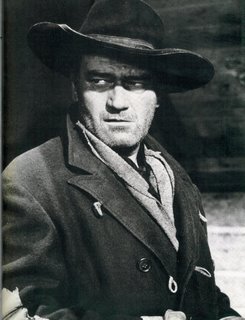
It’s rough stuff. Rougher still are the attitudes of the settlers towards the Indians that border on hysteria. There’s a haunting scene late in the film where Edwards and his fellow traveler (played by future "Star Trek" Captain Pike and “Teenage Jesus,” Jeffrey Hunter) ride into a fort on the Trail of Tears to inspect some kidnapped white women who have been re-captured—"rescued" they would say—by the Cavalry. 

“It’s hard to believe they’re white” a sergeant says. 

They ain’t white,” spits Edwards, and at the sound of a shriek from one of the women, he turns to look at her. Ford trucks in the camera fast onto Wayne’s face (mirroring the shot he used to introduce Wayne in their first film together, Stagecoach) and it’s amazing. Wayne was always blessed with a mug that the camera loved***—it could read every emotion that played across it—and in a performance minus the “hero façade” and that turns on the full after-burners that usually blew his co-stars off the screen, this one quiet moment radiates a combination of hate, disgustand abject fear. No words need to be said to make the point. No words could.

It's what made Ford a great director and Wayne a great actor.

"No, Ethan!  No, you don't!"
And yet, for all its depths of despair amid bloodshed and the race-hysteria, Ford tries to balance it with entertainment. That’s quite the tight-rope walk. But then, it’s not a sermon. It’s a Western. Ford was never so pretentious to be caught lecturing. He’d say if you want to send a message, use the Pony Express. Better to sneak the lessons into the fabric of the story, and distract with shenanigans about wayward lovers, goony old men, and green cavalrymen with pointy swords. One of the incidents involves the unintended marriage of Hunter’s character to a portly Indian maid. It’s the source of raunchy comedy in the vein of Ford’s The Quiet Man—all roughhouse and bad taste. But when Ford’s good guys “The Cavalry” decimate a Native village and the luckless character along with it, Hunter is left to ask “What’d they have to kill her for? She never hurt anybody!” The question hangs in the air with indictments all around.
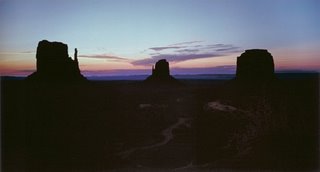
The Searchers begins and ends with a black screen. In the beginning, the blackness gives way to the vast magical vista of Monument Valley (which figures in two of my anytime movies. If God lives anywhere on Earth, I think it’s on that vast acreage of land overseen by the Navajo) that to Garry Wills suggests an irising lens, but to these eyes seems more of a proscenium arch. At the end it shuts out Ethan Edwards who is left out of the warmth of a family embrace to wander the desert (Of course, Wayne’s character is going to come in eventually and eat…but Ford chooses to leave Edwards outside). His prejudice does not belong with home and hearth...and society…and Civilization. Yet it is also Ford’s choice to leave the character alive, the wolf always at the door.
It’s as if having made his plea for tolerance, Ford cautions us that it will always exist, somewhere.

Will we ever...finally...lose the hate?

“That’ll be the day.”

Robert McGinnis' portrait of Wayne in The Searchers.
Anytime Movies:
The Searchers

* A comment on this post and movie—when it was stationed at another blog—asked: "
The Searchers makes you cry?!?!? Is it because of all the dead Indians?" Sure. Go with that. But, a lot of settlers are killed, too, and the hunt in The Searchers is precipitated by one such massacre, the matriarch of which is the one woman that Ethan Edwards loves. It's what entwines his search into one of need and of vengeance. 

No, the thing that makes me cry is the act that comes right before the line "Let's go home, Debbie." That line. From that character. At that time. Despite all evidence to the contrary. It's what gives one a small tiny quantum of hope that belies the sentiment of "That'll be the day..."

** And now, it's a few years shy of its 70th.  I wasn't even a year old when it was released.  It's like an old friend that's grown up with me.

*** Screenwriter Robert Towne has a better term for it, the "camera-love" phrase implying a happy accident that doesn't give enough credit to the actors, their craft and experience. He says that actors like Wayne, Henry Fonda, and Gary Cooper are "ruthlessly efficient" in that they can communicate differing emotions with an economy of expression. Those words are particularly apt for Wayne's performance in The Searchers.

**** And, on Sunday, we'll put up a "Don't Make a Scene" feature from each week's film.

Thursday, August 13, 2020

Mister Roberts

Mister Roberts (John Ford, Mervyn LeRoy, Joshua Logan, 1955) Hollywood wanted to make a movie of the hit Broadway play that was a sensation for Henry Fonda, and Fonda wanted to make it—a labor of love. But, the studios thought Fonda (just shy of 50 years of age) might be a little too old for the lead, like twice the age he should be (they were thinking of Marlon Brando or William Holden). And then, there was an issue with the property—it was a bit too critical of the Navy and cast it in a less than inspiring light. The Admiralty-that-be was reluctant to grant its cooperation or to lend any of its ships or facilities to lend the film any verisimilitude as long as the film was anything less than respectful.

Enter John Ford. Ford had served in the Navy during World War II. He was a "friend" in Hollywood to the military and his captaincy of the production reassured the Navy brass that attitudes wouldn't get out of hand (and the uniforms would be correct). Ford would take care of the Navy.
As for Warner Brothers, Ford insisted that Henry Fonda—and nobody but Henry Fonda—would star in Mister Roberts. This put Warners in a bind. They couldn't make Mister Roberts without John Ford and John Ford wouldn't make Mister Roberts with anybody else in the lead. To compensate for Fonda's age, Ford cast older actors in key roles—James Cagney and William Powell—as well as members of his "stock company"—Ward Bond, Harry Carey, Jr., Ken Curtis and Patrick Wayne. All was set in place for a good shoot of a stage classic.
And then, things got messy. When Ford met Cagney at the airport, he greeted him with a snarling threat that they would "tangle asses." Cagney showed up a bit late the first day of shooting and Ford was ready to lay into him. Cagney had worked with the director before—the remake of What Price Glory in 1953—and knew he could be a tyrant on-set, and told Ford he was ready to fight and make good on his threat at the airport. Ford backed down. He knew he would get a fight from Cagney, but he threw his way of belittling actors onto Powell, which infuriated Cagney. "I would have kicked his brains out." said Cagney to his biographer, Doug Warren. "He was so goddamned mean to everybody. He was truly a nasty old man."
Then, Ford began to drink on-set. His command of the production was being challenged and he didn't like it. When he'd had a little too much, he would let Ward Bond oversee a shot. Early on, Henry Fonda, who'd won a Tony Award for Best Actor in the stage version, was unhappy with the script, and started to feel that Ford was indulging in too much slap-stick into a project that was a personal mission. A "clearing-the-air" meeting between producer Leland Hayward, Fonda and Ford escalated to the point where the director punched his star in the face. There was an apology, but the relationship between the two (they'd made pictures together) was forever fractured.
The movie, set during the last days of the second world war, tells the story of Lt. Doug Roberts (Fonda), stationed aboard the U.S.S. Reluctant (nicknamed "The Bucket" by the crew). A Navy cargo ship, it sails between harbors shipping supplies on time and efficiently thanks to Roberts' efforts as executive officer/cargo chief, a fact not lost on the ship's commander Lt. Commander Morton (Cagney), a badgering weasel of a man who enjoys the perks and accolades that their record entitles him to. The ship's crew is not much, but are loyal to Roberts, who acts as a buffer between the men and Morton.
But, Roberts is dissatisfied—he didn't join the Navy to shuttle supplies between "backwater" stations and currying favor with port commanders—he joined to fight for his country and persistently puts in for transfers to other ships in action, attempts Morton constantly sabotages to keep Roberts under his command—so he can enjoy the rewards of Roberts good efforts. For Morton, there is an added bonus—after a lifetime of being looked down upon in menial jobs, he gets to "dish it out" to the "smart college boy" Roberts. In order to get the men a much-needed liberty, Roberts promises Morton that he won't request any more transfers—the repeated pleas are making Morton look bad. But, when the men's activities get Morton a reprimand, he doubles down on Roberts and the crew, implying that Roberts has turned against them for a promotion. It proves too much for Roberts, who takes decisive action.
One can see parallels between what was happening in front of the camera and behind-the-scenes. A frustrated star, who was never satisfied with the film as compared to the stage version. A director who kept control over his productions through abuse. A supporting cast that soldiered on, despite the turmoil on-set—it would be Powell's last film, Cagney's last for Warner Brothers, and the launching of Jack Lemmon's career with a performance that won him an Academy Award for his horny, puppy-dumb Ensign Pulver.
Ford eventually was shipped out to Hawaii to dry out, then came a gall-bladder attack, necessitating a replacement by LeRoy, who screened Ford's footage and tried to shoot it the way Ford had, but LeRoy's appreciation of light isn't there. Once LeRoy had finished, Hayward and Fonda got the play's director, Joshua Logan, to re-shoot many of the scenes (probably a lot of the interiors). The result is a mixed bag of some breath-taking images, flat attempts to reproduce them, and rather perfunctory interiors that play like they're from another movie—you can tell the Logan scenes because nobody's sweating in them.
Take a look at this sequence of shots—all from the penultimate scene of the film. I don't know for sure, but I'm willing to say that the top shot of Lemmon—an exterior shot—is by Ford, and the two below it, are by LeRoy—interiors intended to look like exteriors and with the same actors in the same positions, but not as natural and somewhat stiffly arranged.
And Logan—here are some interior shots, with their vast expanses of unused screen space, and everything just a little too neat and tidy, the decks recently swabbed, and just a little too orderly to be believed they'd been lived in. While not exactly a Frankenstein's monster of a movie, the shift in presentation does get under one's skin and undermines one's appreciation. Mister Roberts was not the sensation it was intended to be—not as realistic, not as salty, not as controversial, and a far cry from the initial intention of author Thomas Heggen in both book and play. Fonda basically disowned it.
And what of Ford? He would take a couple months away from features to do a couple television films, and returned to Warner Brothers with one of his best—and some would say his greatest film—1956's The Searchers.


Thursday, July 14, 2016

The History of John Ford: The Horse Soldiers

When Orson Welles was asked what movies he studied before embarking on directing Citizen Kane he replied, "I studied the Old Masters, by which I mean John Ford, John Ford, and John Ford." 

Running parallel with our series about Akira Kurosawa ("Walking Kurosawa's Road"), we're running a series of pieces about the closest thing America has to Kurosawa in artistry—director John Ford. Ford rarely made films set in the present day, but (usually) made them about the past...and about America's past, specifically (when he wasn't fulfilling a passion for his Irish roots). 

In "The History of John Ford" we'll be gazing fondly at the work of this American Master, who started in the Silent Era, learning his craft, refining his director's eye, and continuing to work deep into the 1960's (and his 70's) to produce the greatest body of work of any American "picture-maker," America's storied film-maker, the irascible, painterly, domineering, sentimental puzzle that was John Ford, John Ford, and John Ford.

The Horse Soldiers (John Ford, 1959) Ford made few Civil War dramas—he preferred seeing the Nation being built than coming apart at the seams—and The Horse Soldiers is more of a small skirmish movie, remarkably free of battles, but more of undercover work—and one battle that is notorious in Civil War history. That anyone might think of it as anti-war—how could it with John Wayne, and a decade before it became fashionable—would mean that they had to by-pass the promotional material and actually watch the thing.

But, the older Ford, seeing the tight studio-hold begin to lighten as they began to lose power to television, might have thought that it was time to speak truth to legend. For the legend, he would go to Ireland, but in the 1960's and 1970's, he went back to his film-making roots, dug them up out of the desert scrap and examined a little more closely the truth behind some of his earlier films and the history of the country. He would present the weeds along with the garden.

Ford's framing takes a cue from Matthew Brady's daguerrotypes
The Horse Soldiers is based on history—the track of Col. Benjamin Grierson to de-stabilize supply routes to the Confederate forces, but the players are all fiction. Wayne plays Colonel John Marlowe, a railroad engineer, who uses his experience to find the weak points along rail routes—spending his time in war destroying what he might have built in the peace. 
He is sent into the heart of the South to Tennessee and Mississippi on a route to Baton Rouge, with the main purpose to destroy a depot at Newton's Station that will cut off supplies to forces at Vicksburg. Marlowe's troop does a lot of skulking around trying to avoid detection by the Confederates, their mission is undercover, but that is a tough prospect commanding 1700 men, all dressed in blue.
Wayne out front, checking the progress of Confederates while his are concealed behind trees.
A troop behind enemy lines finds it tough to have their own supplies ferried to them if they want to avoid detection, so part of the mission is to raid local plantations, use the grounds as bivouac, and "commandeer" supplies, frequently "under protest." One of those so affected is the Greenbriar plantation, being overseen by Hannah Hunter (Constance Towers) and her remaining slave Lukey (tennis champ Althea Gibson). Although gracious to a fiddle-dee-dee, and outwardly manipulative, Miss Hunter holds great antipathy towards the Yankees, remains loyal to the South, and when it's been discovered—by the ever-mindful "saw-bones" Hank Kendall (William Holden)—that she's been listening (via fireplace vents) to the secret plans of the troop, Marlowe has no choice but to take her and Lukey on the campaign, lest she betray them to "Johnny Reb." That just makes her more resentful, causing clashes between her and Marlowe.
Anybody familiar with Ford films knows that such a situation can lead to an ambiguously heartfelt relationship—Marlowe and Hunter fall into a chaste yearning relationship, through a combination of her seeing the effects of battle on both sides rather than holding to an ideological ideal, and his being besieged from all sides—from his superiors and from his own men, including a begrudgingly supportive one from Kendall, on top of having to battle the Confederates, who at the late stage of the war are desperate enough to throw whatever they can at him, including children from a military academy.
Her protests, her new-found vulnerability in danger, and her work tending the wounded, cut through the Wayne crust and probably seem like a comfort amidst the rest of his situation. In the movie, that relationship doesn't play well, sadly, through no fault of Towers—she's great in this film (she usually is), able to bring up the fire that Ford's favorite, Maureen O'Hara, brought to his films and Ford would use her again in his next, Sergeant Rutledge—but Wayne isn't up to his part, managing the quaint courtliness required, but not the vulnerability needed to make it pay off, falling back on a shyness that runs counter to the character's actions, or to Wayne's strengths as an actor.
Marlowe finds Southern deserters in the form of Denver Pyle and Strother Martin
who act and look like they dropped in from a future Sam Peckinpah movie.
Holden's role as a conscientious objector/surgeon who frequently clashes with Wayne over the troop's actions is also a bit under-developed. Look, this is William Holden here. He's one of the few male actors who could stand up to Wayne and by wily enough to not get blown off the screen. But, the character, while of some interest and giving Holden a uniform to fill, doesn't serve much of a point other than to be an irritant, something the movie already has plenty of. To that point, it seems a weakness of the film that Wayne's Marlowe is constantly under the gun and presented with no-win scenarios that reach the breaking point when he must command his troop to fire on civilians.
That slaughter leads to an extended scene in a bar where Marlowe gets drunk and lets down the reserve that has kept him going through what he'd earlier described as "this insanity." It's a powerful scene, even if one gets the sense that Wayne isn't fully committed to it. He can rail all he wants, but there's no sense of release or breaking here, again, not one of Wayne's strengths, as he tends to be at his most powerful in moments of stillness or circumspect emotion. Wayne is at his best when he's not "making a scene," but being the most powerful thread in a fabric.
This is not the John Ford of The Cavalry Trilogy, where one might snatch some phyrric victory out of defeat. There are no scenes of triumph in the film, and the scenes of battle have a bitter tinge to them: one is based on the Battle of New Market in which Union soldiers fought Southern forces that were joined by VMI cadets—children, really—which occurred on March 15, 1864. Ford mines it for irony, pathos, and some odd insertions of comedy for a situation that is so jingoistic that it is horrific and absurd simultaneously. That it is true, well, that is insanity.
The Horse Soldiers was filmed in vibrant color by William Clothier, who'd been working since 1923, but only in the 1950's did he start coming into his own as a director of photography for such directors as John Ford and William Wellman. He became John Wayne's favorite cinematographer and was renowned for masterful location work. The Horse Soldiers is one of his best, but the film fell into neglect and disrepair until restoration for Blu-Ray release suddenly revealed its stunning imagery and eye-popping color done under the direction of Ford.

I'd seen The Horse Soldiers before, but seeing it restored is like seeing it for the first time.
One of the most memorable sequences of The Horse Soldiers-
The Battle of New Market. Both funny and sad simultaneously. 
The poster of this clip cut out Anna Lee taking her kid out of the procession, 
despite his whining protests.

Wednesday, May 21, 2014

Anytime Movies (Transplanted): The Searchers

While I have a few reviews "in the works," It's as good a time as any to re-boot (actually transplant from the old movie blog) a feature I started years ago, when it was suggested I do a "Top Ten" List. 

I don't like those: they're rather arbitrary; they pit films against each other, and there's always one or two that should be on the list that aren't because something better shoved it down the trash-bin. 

So, I came up with this: "Anytime" Movies. 

Anytime Movies are the movies I can watch anytime, anywhere. If I see a second of it, I can identify it. If it shows up on television, my attention is focused on it until the conclusion. Sometimes it’s the direction, sometimes it’s the writing, sometimes it’s the acting, sometimes it’s just the idea behind it, but these are the movies I can watch again and again (and again!) and never tire of them. There are ten (kinda). They're not in any particular order, but the #1 movie IS the #1 movie.
It’s a film that chills me right down to my bones and makes me cry every single time. It throws itself into the deepest pits of despair and within moments, prat-falls into low comedy. It’s a western…about race relations, and in the house of mirrors of a “genre” piece deflects the self-righteous tone of a sermon. It stares into the soul of people at their worst, and exults in their best.

It is arguably
John Ford’s best film (and he made many great ones). It is inarguably John Wayne's finest performance on-screen, while completely working against the image that Marion Morrison built as “John Wayne.”

Oh no. We’re talking about
The Searchersa “western” made during the somnambulant 50’s …and with John Wayne, ferchrissakes! How corny can you get?

Back up, pilgrim.

The Searchers has just been re-released (to mark its 50th anniversary*) in a gloriously re-mastered DVD, and has come under critical review for being too corny, too obvious, and more than a little dated. Worse still, it has been branded a “film-school darling” that has skated too long on an undeserved reputation as a masterpiece.
Bullshit.

Like Pauline Kael’s faulty detective work dissecting Citizen Kane and Elvis Mitchell’s naïve un-analysis of 2001, the work in Slate smacks of a critic either looking for something to write about or make a name for themselves bucking “conventional wisdom.” Having to spend a summer reviewing the third X-Men movie, the fifth “Superman” opus AND an entirely superfluous “Pirates of the Caribbean” sequel is bound to make anyone crabby.

But it shouldn’t lower one’s standards, and there’s enough slip-shod work in the article to indicate that’s the case. At the very least, it’s a terrible gloss-over.

At the worst, it displays a film reviewer who hasn't even seen the film he was supposedly watching for the prejudices and pre-conceived notions that he would rather cling to rather than objectivity.

The Searchers is a masterpiece—the culmination of decades of film-making experience that John Ford had accumulated since the silent era—while crystallizing Ford’s growing disenchantment with the Myth of the West. In a time when westerns were still basically built around the simplistic formula of “Cowboys vs. Indians,” Ford was starting to speak out more explicitly for the latter sixteen years before such accepted “consciousness-raising” films as Little Big Man or Soldier Blue. Like any masterpiece, it displays the sum of a body of work and breaks new ground, paving the way for the future.

The Searchers tells the story of an obsessive 10 year hunt for a lone family member taken in a violent Comanche raid. It’s led by the worst person possible: the child’s uncle--a hate-obsessed confederate soldier, self-exiled from his family, who still carries his saber on his hip, bitterness in his soul and his heart on his sleeve. Mix in a venomous race-hatred for all non-whites and you have the most flawed anti-hero to appear in movies. Ethan Edwards starts his search to bring his niece back alive, but as the years pass and she matures, he gives her up as one of the Enemy, and sets out to kill her. At the center of the film’s black heart is that most archaic and useless word: miscegenation.

It’s rough stuff. Rougher still are the attitudes of the settlers towards the Indians that border on hysteria. There’s a haunting scene late in the film where Edwards and his fellow traveler (played by future Captain Pike and “Teenage Jesus,” Jeffrey Hunter) ride into a fort on the Trail of Tears to inspect some kidnapped white women who have been captured—"rescued" they would say—by the Cavalry. “It’s hard to believe they’re white” a sergeant says. 

They ain’t white,” spits Edwards, and at the sound of a shriek from one of the women, he turns to look at her. Ford trucks in the camera fast onto Wayne’s face (mirroring the shot he used to introduce Wayne in their first film together, Stagecoach) and it’s amazing. Wayne was always blessed with a mug that the camera loved*—it could read every emotion that played across it—and in a performance minus the “hero façade” and that turns on the full after-burners that usually blew his co-stars off the screen, this one quiet moment radiates a combination of hate, disgustand abject fear. No words need to be said to make the point. No words could.

It's what made Ford a great director and Wayne a great actor.

"No, Ethan!  No, you don't!"
And yet, for all its depths of despair amid bloodshed and the race-hysteria, Ford tries to balance it with entertainment. That’s quite the tight-rope walk. But then, it’s not a sermon. It’s a Western. Ford was never so pretentious to be caught lecturing. He’d say if you want to send a message, use the Pony Express. Better to sneak the lessons into the fabric of the story, and distract with shenanigans about wayward lovers, goony old men, and green cavalrymen with pointy swords. One of the incidents involves the unintended marriage of Hunter’s character to a portly Indian maid. It’s the source of raunch comedy in the vein of Ford’s The Quiet Man—all roughhouse and bad taste. But when Ford’s good guys “The Cavalry” decimate a Native village and the luckless character along with it, Hunter is left to ask “What’d they have to kill her for? She never hurt anybody!” The question hangs in the air with indictments all around.
The Searchers begins and ends with a black screen. In the beginning, the blackness gives way to the vast magical vista of Monument Valley (which figures in two of my anytime movies. If God lives anywhere on Earth, I think it’s on that vast acreage of land overseen by the Navajo) that to Garry Wills suggests an irising lens, but to these eyes seems more of a proscenium arch. At the end it shuts out Ethan Edwards who is left out of the warmth of a family embrace to wander the desert (Of course, Wayne’s character is going to come in eventually and eat…but Ford chooses to leave Edwards outside). His prejudice does not belong with home and hearth...and society…and Civilization. Yet it is also Ford’s choice to leave the character alive, the wolf always at the door.
It’s as if having made his plea for tolerance, Ford cautions us that it will always exist, somewhere.

Will we ever...finally...lose the hate?

“That’ll be the day.”

Robert McGinnis' portrait of Wayne in The Searchers.


The Searchers
Mr. Smith Goes to Washington
Chinatown
American Graffiti
To Kill a Mockingbird
Goldfinger

Bonus: Edge of Darkness


* And now, it's a couple years shy of its 60th.  I wasn't even a year old when it was released.  It's like an old friend that's grown up with me.

** Screenwriter Robert Towne has a better term for it, the "camera-love" phrase implying a happy accident that doesn't give enough credit to the actors, their craft and experience. He says that actors like Wayne, Henry Fonda, and Gary Cooper are "ruthlessly efficient" in that they can communicate differing emotions with an economy of expression. Those words are particularly apt for Wayne's performance in The Searchers.