Having a Wild Weekend(aka Catch Us if You Can)(John Boorman, 1965) If you're old enough to remember "The British Invasion" back in the 1960's, you might remember the name of "The Dave Clark Five", one of the British pop bands that was dominating American air-waves and record charts after the barrier had been broken by The Beatles. The Beatles caused a sensation, making their American TV debut on The Ed Sullivan Show for three weeks in a row, but my memory remembers The DC5 being the group that appeared on Ed's variety show in the weeks following The Beatles' American tour...before The Animals and before The Rolling Stones.
They were a great group, with a tougher, fuller sound than their contemporaries, with great "hooks" that had an ability to become ear-worms instantly, even though their lyrics had little depth. But, you didn't care—they were free-wheeling, rocking musicians with throat-bleeding lead vocals by the inimitable Mike Smith.
Unlike in The Beatles films, The DC5 don't play themselves—indeed, they don't even "perform" any of their songs, but a couple of tunes are used as background for edited hi-jinks—they're stuntmen/extras who are being used in an ad campaign for a British meat-packing plant, the most prominent of the commercials and billboards featuring Dinah (Barbara Ferris) "The Butcher Girl" extolling the virtues of meat to the British public. That an ad agency would use a swinging Blond "bird" as their symbol for meat is an absurd concept (but one that isn't inconceivable in the advertising world) and Boorman has a fine time larking about London showing more and more of the incongruous campaign, which, evidently, is doing the job as the city seems festooned with billboards.
The plot starts when, on a commercial-shoot with Dinah and the boys, Steve (Dave Clark) strikes up a conversation with her and discovers that 1) she's bought her own private island in Devon and 2) she's bored and tired with her life. He could tell her that she is fundamentally well-off that she can afford to be bored and actually does have some agency and maybe she should sleep on it and give it 24 hours. Then, there wouldn't be a movie. But, no. He steals the ad agency's Jaguar and the two go off to find her island. Because that's what young, energetic, swinging 60's kids do, dad! And ad agency exec's—who are paying for studio-time—then send the police and whatever goon-squad they can find to bring them back.
Which is just what Dinah's ad-agency pygmalion, Zissell (David de Keyser) does. Hi-jinks and low social comedy ensue, cutting a swath through a limited number of 60's outliers like vagabond-Brit-hippies and upper-class eccentrics, where if a point was being made it's a bit hard to discern. The trip to the island doesn't prove pointless, but it does have a bit of a let-down in store ("It smells of dead holidays, doesn't it?"). Not the kind of "gas" they were expecting.
But, another way that Having a Wild Weekend separates itself from the usual pop-film fluff (aside from only leaving the band-mates as cyphers and concentrating on Clark's character—he was, after all, the group's manager and impresario) is decidedly down-beat ending, where all the gadabouting and free-thinking comes to naught when confronted by economic reality, power dynamics and the superficial benefits of fame. Hardly the message of peace, love, and understanding associated with the 1960's or rock n' roll. That could be why the film didn't do so well. But it did give Boorman enough attention to get his next gig directing Point Blank, a genre-piece with its own subversive take on noir, business, and corruptibility.
"Tried it once. Didn't fancy it."
* I remember, as a kid, having to suffer through Richard's film Summer Holiday, the first film of the double bill, at the Seattle premier of A Hard Day's Night. I have a vague memory of it as being insufferable and more amused at the Beatles-starved audience being impatient with it. Summer Holiday was directed by another up-and-coming director, Peter Yates. It was a hit in Britain, though, earning the position of the 2nd most popular film of 1963, right behind From Russia With Love.
Which is what Here is. Based on a graphic novel* (by Richard McGuire, which is done the same way), the film eliminates the one major creative decision for a director—"where do I put the camera?"—and takes it, literally, out of the picture. Zemeckis, as a director, is a weird cat. Where a lot of directors will look for thematic material and then build the technical aspects around it, Mr. Z seems to think of the technical challenge first and then find the story to fit it. He was ground-breaking in making mo-cap animation films and as the Uncanny Valley started to get flooded with product so that nobody could see it any more, he started to trust the CGI with drama. It can be done. But, as amazing as Zemeckis' films can look, they sometimes have the heart of a demonstration disc. Inspiration but not aspiration.
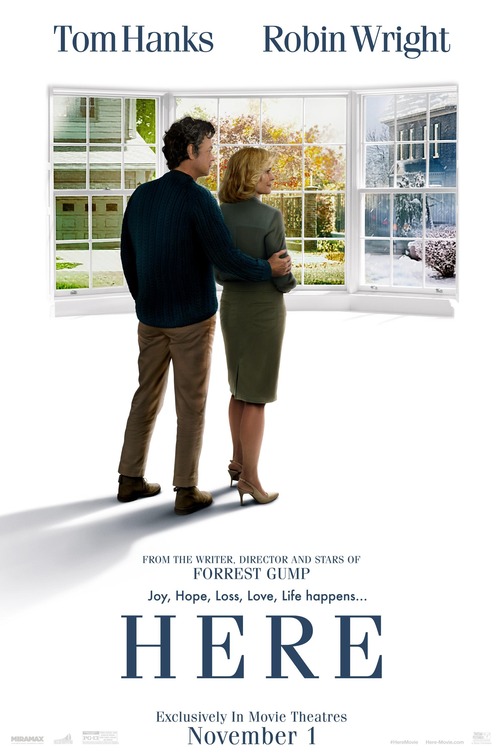
So, here's Here. And, technologically, it is pretty amazing, but for reasons that have nothing to do with story-line (except in some nicely worked-out places) or the fact that it re-teams Tom Hanks and Robin Wright nostalgically from Forrest Gump. They are basically irrelevant other than box-office draw (frankly, I was more intrigued to see Kelly Reilly—from "Yellowstone" and the Downey Jr."Sherlock"movies—and Michelle Dockery—from "Downton Abbey"—in it. It's not a movie where you can judge performances, scattered as they are in this movie's timeline.
And the incidences feel like snap-shots—or worse, like "Saturday Night Live" skits—they pop up, do a bit of business and generally exit on a laugh or a dramatic hit ("And...scene"). God forbid that they should interrupt one of those slices-of-life in mid-chaos and have it resolve later in the story. That would have felt random, instead of calcified and calculated as this movie too-often feels like.
It starts out with its gambit efficiently enough—that one angle—whether it's in a house on that particular parcel of real estate or in its origins as primordial ooze when the boxes start fading in, initially with subtle borders around them until we get the knack of it and then those borders start fading away and they begin to make transitions so we see the neighborhood go from dinosaur stomping ground to hellish landscape to ice age (only one of two times when the camera actually moves) to Native American habitat to the neighborhood of William Franklin (Benjamin's ever-loyal-to-the-king non-rebellious son) to the story-heavy 20th century.
The Franklins' eventual neighbors are The Harters (he's excited that an "aerodrome" will be built nearby and intends to fly—something his wife is dead-set against); there's the bohemian Beekmans, she's a free-spirit and he's an inventor, perfecting a chair he calls the "Relaxo-boy"; post WWII, the non-surnamed folks we'll spend most of the time with (let's call them "The Gumps") move in, sail through the 50's and television, raise Tom Hanks, who gets his girlfriend Robin Wright pregnant, they get married and move in with the folks and eventually age out of the house; then we get the Harris', the only minority couple—besides the Native Americans—that reside there. We get nudged a lot about how things change—the Harris' give their son "The Talk"—and not—frailty and death are inevitable, as apparently is influenza.
For the most part, these folks are chess-pieces that get moved around depending where the boxes show up and those boxes highlight the transitions between entertainment systems, gas-lights to electric, rugs versus hardwood (versus verdant forest), couches to sectionals. Art changes, but the view rarely does. Dramatically, the film underwhelms except in some key places. But, it's not a waste of time...or space. Not at all.
We are used to being manipulated in movies by mise-en-scene and blocking. Directors let us see what they want us to see and use blocking to change the focus of our attention. This gives us the illusion that we're peeping through a letter-boxed slot-view a 360° world-view (we're not, of course; it's an illusion). Here subverts that. We are given one angle to look at—the world may change within it, but it's basically that one section of cinema real-estate, like we're looking at the Closed Circuit Camera of Eternity.
That's where McGuire's boxes come in. Yes, blocking will direct the eye, but it's those moving boxes and their shifting perspectives through time (but not space) that directs your attention, whether it's what's on the television screen, or the silhouette of the car (or buggy) going by the window. Transitions flash in the wink of an electrical storm or a camera flash. Things shift, warp, grow their hair out and stoop but only for a moment of time. If only to have The Beatles on Ed Sullivan accompany the wedding shot (see below).
And—as with McGuire's work—that's the point it's making. Life seems long. But, in the scope of things, it's transitory, gone in the blink of an eye. And that little plot of space we inhabit will still be there, long after the seas rise, the epidemics cull us, idiots atomize us, and we're just dust. Like George Carlin said "Earth Day?! The Earth will be FINE! WE'RE screwed!" Enjoy the details, the movie seems to tell us. We're just passing through.
A couple of shots—little clever instances I liked. The one below, which is the only time we see the rest of the main floor courtesy of a moved bureau.
And this one haunts (and pays a little respect to the McGuire work): while Paul Bettany's "Dad" sleeps on the couch, a box appears to show an earlier version of his long-since-passed wife (Reilly) and she says the first words of McGuire's graphic novel: "Hmm. Now why did I come in here again?" That raised goose-bumps.
It's an interesting experiment for a movie that somebody might come up with a dramatic reason to exploit. But, the point's been made. Like the guy who invents the La-Z-Boy you have to ask yourself—what's it good for?
* McGuire's work is so seminal and so tied to the film's strategy—and expanded to different platforms—that the Zemeckis film is almost unnecessary. It started out in 1989 as a 6 page story in Raw Volume 2 #1:
The original's time-frame is from 500,957,406,073 BC to 2033 AD
In 1991, the story was adapted into a student film by Timothy Masick and Bill Trainor, students at RIT's Department of Film and Video.
In 2014, McGuire expanded "Here" into a 304-page graphic novel with vector art and watercolors and extending the timeline from 3,000,500,000 B.C. to A.D. 22,175:
That would be a herculean jump enough, but the Ebook addition of "Here" allowed you to scroll between pages with animated gifs inserted. Which is mind-blowing enough, but at the 2020 Venice Film Festival, a VR version of it was presented.
See what I mean about the 2024 movie being "unnecessary"—it feels like, artistically and technologically, we've already moved beyond it.
Hairspray(Adam Shankman, 2007) I'm not big on musicals. Rarely are they better than their source material and the songs, more often than not, are filler with "Moon/June" lyrics that fail to impress. My idea of clever musicals are "Guys and Dolls" and "The Music Man" that carry their music fantasies with a little bit of arrogant panache, daring you to not take it as seriously as regular dialog. My expectations of musicals are pretty low (which is good, I think, as it gves them more of a chance), and my expectations of "Hairspray"—despite rave reviews of the stage version that debuted*huzzah*in Seattle—were quite low. You just knew that a musical of "Hairspray"wouldn't be as edgy as the John Watersoriginal. It was going to have to be neutered to be made "safe."
Plus, it has John Travolta in it. I can't remember a John Travolta* movie where I was impressed with him. I was probably going in with the wrong attitude.
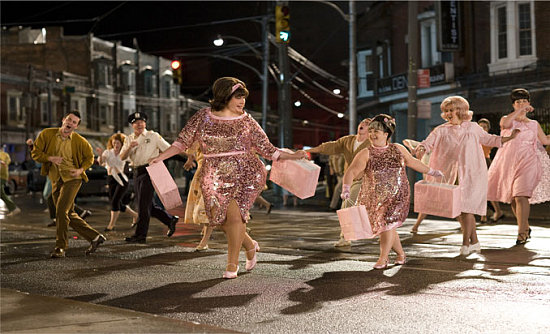
Because I enjoyed the Hell out of it. Word is that the movie version is a bit more stream-lined and a lot less camp than its stage-version. That may have helped, because "Hairspray" (the musical; the movie) is joyously anarchic, popping balloons gleefully as it goes—maybe laying it on a bit thick, as it goes—but as an expression of the freeing power of rock n' roll, few movies can top it. Especially the serious ones.
Now, here I must stop. Christopher Walken rarely fails to please, but it's a too-rare treat to see him sing-and-dance, which he obviously loves. And Travolta, in drag and dressed in a fat suit with a raspy ovah-the-"twop" Maryland accent?
Then there's Queen Latifah, who plays the "fill-in" host on Corny Collins' once-a-month "Negro Day"—the black dancers cordoned off from the white dancers by a rope partition—proving once again she is the Rock n' Roll Renaissance woman, who can rise above bad material, and soars with the good.
But it'd all be naught if not for the songs (well-staged with choreography-friendly directing by Shankman that recalls past movie musicals) by Scott Wittman and Marc Shaiman. Shaiman's ear for 60's rock styles is flawless and the words by Wittman and Shaiman are clever and sassy and occasionally downright rude.
Original "Hairspray" auteur John Waters even shows up (in an early cameo as a flasher) and there are quick appearances by the director, Shaiman and Stillman and the original's star Ricki Lake. Word is that he's working on a screenplay for a sequel.*** If the product is half as fun as this singing step-child of his work, it will be a must-see.
* Since writing this, I remember I thought he did an extraordinary job of carrying Nicolas Cage's tic's in Face/Off.
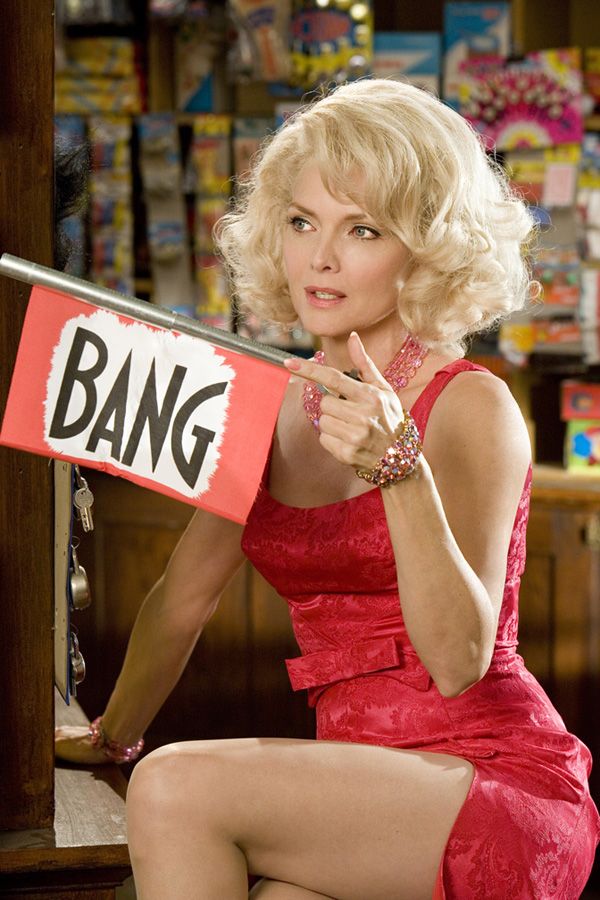
** Pfeiffer has a torchy song—"Miss Baltimore Crabs"—that she vamps though in such high-style that it catches one off-guard...until one remembers "Oh yeah...Susie Diamond."
*** Hairspray 2: White Lipstick was in the planning stages with a screenplay written by Waters, and preliminary cast mentioned , but in the words of director Adam Shankman "it got scrapped" and added “It's ok, I was so happy with the first one; let's leave well enough alone.”
The One True Religion (Stop Me If You've Heard This One)
or
A Reading from the Book of Iterations...(And Voltaire Never Said It)
Two Mormon missionaries, Sister Barnes and Sister Paxton (Sophie Thatcher and Chloe East) are doing door-to-door evangelizing for the Church of Jesus Christ of Latter-Day Saints (LDS) on a not-too-weather-friendly day in Colorado, inHeretic, the new film from the team that gave you 65(and wrote A Quiet Place). A storm's a-comin'. But, despite that, they take their bicycles for a requested "knock-knock" from an inquiry made by a Mr. Reed (Hugh Grant) at his out-of-the-way house in the woods. After some wait as he comes to the door, he welcomes them eagerly, assuring them that his wife (who is very shy) is in the back, baking. Reassured that there will be a female present during their visitation, the two young women enter the house and accept the hospitality...even after he casually informs them that the walls and ceilings have metal in them (that's no problem, is it? Oh, good, good). He then takes their coats like a good host and goes behind a door to fetch the Mrs. It is then that the two women remember that they have the key to their bicycle lock in one of those coats. They're going to have to get it back if they intend to leave. With their suspicions heightened due to a couple of other things, they try to make a cellphone call...they can't (metal, you know) and they find that the front door cannot be opened...know matter how hard they try (and one has to admit, they don't try very hard as they never consider destruction of property...lawsuits, I guess). But, the long and the short of it is...they're trapped. And they can't leave except through the largess of Mr. Reed, who has disappeared deeper into the house. Interestingly, one thing they don't do...is pray.
Maybe they should have.
I don't like horror movies as a rule (despite the seeming obsession with them during Hallowe'en month). I do think they're valuable in instances, certainly in film. It's where a lot of young directors learn their craft in how to levitate people out of their seats in popcorn explosions (think Carnival of Souls or Night of the Living Dead). Even great directors will dabble in instances of horror. I just stay away from them as a rule because so many of them of late, especially during my formative movie-watching years, are (literally) hack-jobs. The slasher-movie craze left me cold after the first John CarpenterHalloween, and those series devolved into repetitive gore-fests with indestructible purveyors that kept coming back sequel after sequel after sequel (nothing new in the horror genre—how many Frankenstein, Dracula and Wolfman movies did Universal crank out?).But, the main reason I don't watch them of late is that so many are based on the element of cruelty...and casual cruelty where the moral compass has gone astray. Frankly, if I wanted to watch that, I could watch the news.
But, getting back to Sister Barnes and Sister Paxton, clearly they are in a dangerous situation. They are stuck in a house with Mr. Reed—there's no sign of this "Mrs. Reed"—and even though he's curious and quite amiable (in that Hugh Grant "twitchy" way), it becomes quite clear that he doesn't need much evangelizing. He claims to be a theology student, and even has a well-annotated Book of Mormon on his shelf. And he explains that he's always wanted "a" religion in his life, but he couldn't settle for second-best (equating it with favorite fast-food franchises in a discussion with the Sisters), that he was on a life-long quest to find The One True Religion to devote to. He peppers them with questions about LDS and their beliefs and how their life-experiences fit into a belief system that's a bit late "in the game" and had its share of waffling on tenets.
But, the discussion becomes deeper the deeper they get into the house. By this time, the ruse that there's a "Mrs. Reed" is way-past accepting, just as Reed is way-past accepting that Sisters B and P (as he calls them) are not above being dishonest in their words as well. There's no cellphone call they feign accepting—cell service doesn't work—and they can't call out (even though an elder (Topher Grace) knows that they're out on a call and to whom) and the front door is on a timer and it won't unlock until the morning. He tells them they can leave at any time...but they have to go through the back door. And there are two doors in the room: which of them goes to the back door he's not saying.
But, first he has a little speech (of course he does). And it's all about "iterations" and how the Big Three Religions can be compared to the game of Monopoly or (more towards the Sister's younger spheres of culture) the case of a song that might be "inspired" by earlier songs. The Big Three Religions have as their basis previous theologies, and Protestantism, Calvinism, LDS, Scientology (what have you) are all further iterations of The Big Three. It's as if the latest prophet should start his religion with "Stop Me If You've Heard This One Before." But, they don't...because they have "the one true religion." And Reed isn't interested in copies.
But, there's the matter of those two doors—both lead to dark stairs leading downwards—neither of them seeming too appealing, and Mr. Reed has already demonstrated that he's not the most honest of people, and the Sisters, if they want to leave the house (he says), must choose between them if they do want to leave (and they truly do). And he ups the ante by marking them "Belief" or "Disbelief". Which of the doors will they choose?
But, before you think this will be an examination of Faith and its repercussions, one should recall that it's a horror film. A rather icky, grisly one, and one that takes a step or two back from the post-feminism horrors like Silence of the Lambs or even, say, Ready Or Not, and for all the intriguing aspects of the theological arguments, the film slides relentlessly downhill once those doors are opened. And however much some of the talking brings up some salient points (and a couple of attribution gaffs) it never builds on them or resonates through them, but turns into a simple gore-fest.
Slate Magazine calls Heretic "mansplaining as horror," which is a good line (and to be expected as the film is about religion where, outside of the world of Dune, women are tolerated, not elevated), but, unfortunately, that mansplaining is the best part of the movie (a lot of it due to Hugh Grant's performance, building on past roles as "man-monsters"). Once we start entering the house's sub-floor the movie never rises to the same level as those opening 45 minutes. The writer-directors Scott Beck and Bryan Woods make movies that have wonderful first acts—great concepts that can "sell" a movie to studios—but they fall apart and start regurgitating on cruise-control for the remainder of the film. There're no epiphanies or revelations at the end.*Nothing's earned. They just stop.
But, movies should be more than their elevator pitches. I have faith that someday Beck and Woods will get that. But, for now, they're stuck in the basement.
* The film has two good lines of dialogue at the end, but to show you what a big blood-soaked nothing burger the movie becomes, it could have been said an hour earlier and it would have made as much of an impact then as in its current place.
House of Wax(André de Toth, 1953) Oh, the money studio mogul Jack Warner invested in 3-D, only to see it fade away when the craze lost its "zhuzh" and no longer distracted Americans from their newly bought black-and-white broadcast television sets (epic films with wide-screen dynamics was more successful). The 1950's "3-D craze" had a little less dimension to it, fad-wise (and not very many other major studio productions were made in that format) but, that doesn't take away from the fact that Warner's investment in House of Wax created a technological achievement in film, being the first color 3-D movie with stereophonic sound—a feat that made it a surprisingly big hit at the box-office (more so than the monophonic color 3-D film, Bwana Devil) when it was first released (to those theaters that could actually accommodate the new processes), and also, ironically, made the film a staple of those new-fangled television sets (which is where I constantly ran into it in my youth). It also managed to revive the status of Vincent Price, who would spend the rest of his career starring in horror films, sometimes being the most expensive items in their budgets.
Jerrod and his Marie Antoinette—the wax-figure is "portrayed" by lead actress Phyllis Kirk
Based on an earlier Warner film, 1933's The Mystery of the Wax Museum—that was directed by Michael Curtiz in two color Technicolor—it tells the story of gifted sculptor Professor Henry Jerrod (Price), who is having a bit of a falling-out with his principal investor Matthew Burke (Roy Roberts)—Burke wants to see Jerrod's wax museum become a bit more sensational to attract business while Jerrod wants to concentrate on more life-like attractions on a par with his sculptures of Cleopatra, Joan of Arc, and his personal favorite, Marie Antoinette. While Burke is upstairs going over the books, Jerrod takes a meeting with art critic Sidney Wallace (Paul Cavanagh) to see if he'd be interested in buying Burke out.
Wallace is funding some archaeological dig of other and will be out of the country for three months, but fully intends to fund Jerrod's expansion of his wax museum when he returns. This is promising news for Jerrod, but not for Burke who won't wait three months and turns on Jerrod, starting a fire in the museum to burn the place to the ground to collect the insurance money. That he has left Jerrod unconscious in the burning building is of no concern to him. And the gas-lights in the structure only ensures the sculptor's doom, creating a spectacular explosion that destroys the man...and his life's work.
The unseemly Mr. Burke cashes his insurance check for 25k—nobody being very good at checking for accelerants in 1902—and doling out just enough of it to attract gold-diggers like Cathy Gray (a blonde, pre-"Addams Family" Carolyn Jones), reassured that the body of Jerrod was never found. He shouldn't be so presumptive, as when he goes to stash the remainder of his money in his safe (fireproof, I hope!), he is attacked in his room and strangled by a mysterious black-cloaked figure, who then takes a rope and hangs the body in the walk-up's elevator shaft to make it appear a suicide.
Cathy is preparing for her upcoming date with a new fella, being helped into her frills by her housemate, Sue Allen (Phyllis Kirk). Sue is having trouble making the rent, but Cathy assures her that she'll lend her some money if Sue's attempt to get a job as a hat-check girl falls through. It does, but after a shakedown by her landlord, Sue goes to her room and checks on Cathy, only to find her dead, and the perpetrator still in the room—a black-cloaked figure with a misshapen, scarred face. She screams and escapes through the window with the figure in hot pursuit.
She manages to lose the strange murderer in the foggy streets and finds shelter at the home of a friend (Angela Clarke) and her son Andrew (Paul Picerni), and the next day, they go to the police (in the form of Frank Lovejoy and Dabbs Greer), who are a bit skeptical of Sue's story. But, then, they're not much help in the case of Cathy's murder—as her body has gone missing from the morgue! It's the latest in a string of disappearing corpses that they can't explain.
Price, a young Charles Bronson, and Cavanagh
But, remember that art critic Sidney Wallace? He comes back into town to meet with Professor Jerrod, who is quite alive, but wheelchair-bound and his hands burned so horribly that he can only supervise the work of his assistants: Carl Hendricks (Nedrick Young) and the deaf/mute Igor (Charles Bronson, but at the time going by Charles Buchinskey). Jerrod has changed his mind about things since the previous museum's fire—now he's going to only focus on exhibits of the macabre, a chamber of horrors, if you will, of the past and present day. Including one exhibit of the suicide of Matthew Burke...with a remarkably life-like wax figure that, in the first real incident of fragrant 3-D usage falls forward into the screen—realistically enough that it must've seemed like it was falling in people's laps. With that little shock comes...
It's the half-way point of the film, and a reel change was required, but with both projectors each showing one part of the 3-D image, the proceedings had to be interrupted to manage it. I used to run projectors, but nothing as sophisticated as in the theaters, so how they managed to keep everything in sync, I wouldn't know (what happens if the film in one of the reels breaks...do they have to swap out as many frames in the other reel?*). Anyway, that's not the most interesting thing about the 3-D process. The most interesting thing was that director Andre dé Toth was blind in one eye and wore an eye-patch over it, so he couldn't have seen the 3-D images if he tried!
It's in the second part of the film where the 3-D tricks really start coming in fast, threatening to invade the audience's space: there are two more fainting spells toward the camera (as a result of squeamish reactions to Jerrod's house of horrors) as well as a rather gratuitous sequence involving the museum's barker enticing ticket-buyers with a paddle-ball breaking the fourth wall by threatening to knock the audience's popcorn out of their hands) and an equally unnecessary can-can sequence where the dancers threaten to kick out jaws, and one chorine throws her derriére in your face (the 3-D version of putting butts in seats?). But, there are subtler things—flying angel decorations, splintering doors, one prominent fist. And it must have been a shock to suddenly see Charles Bronson's henchman pop up in the frame during a critical juncture. It's not can-can girls, but it probably caused a lurch in the customers.
Still, the strength of the movie is dé Toth's direction, done in long, tracking takes (which would have really showed off the changing perspectives in 3-D), especially the tours of each of the wax museums usually done in one sweeping tour, aided by Jerrod's "waxing" poetic about his creations. And dé Toth had a good eye (but only one) for composition, so that when he did cut away, it was always to something interesting and striking.
And, say what you will about the "Perils of Pauline" style-finish, it is a nerve-jangler with our heroine threatened to be entombed in her own wax coffin for display, and if the elaborate device used to do so isn't exactly practical, it is impressive looking, rivaling the sparking laboratories of previous screen-villains, and there's another sequence involving split-second timing with a guillotine that provides an unexpected jolt (enough that the actor involved did it under protest).
But, dramatically, the movie doesn't fool anyone. One can guess the identity of the black-cloaked figure on a murderous (and covetous) rampage in turn-of-the-century New York nearly as soon as he appears—unless you're six (which is what I was when I first saw it and the revelation was as shocking as finding out who Darth Vader was much later in my film-watching) and have had no previous experience with movie-making sleight-of-hand. You'd have to be conked in the head with a paddle-ball to be surprised by it (hmmm...maybe that's why they did it...!). But, the movie is true to its melodramatic roots (the original play on which it and the earlier version premiered in 1932).
House of Wax was voted into The National Film Registry in 2014 for being "culturally, historically, or aesthetically significant." Given its breakthroughs in color 3-D and stereophonic sound one should add "technologically" as well.
* Answer: Yeah, they did, or the resulting de-synchronization of images would cause headaches or even nausea faster than you could say "des-synchronization"!

 Unlike in The Beatles films, The DC5 don't play themselves—indeed, they don't even "perform" any of their songs, but a couple of tunes are used as background for edited hi-jinks—they're stuntmen/extras who are being used in an ad campaign for a British meat-packing plant, the most prominent of the commercials and billboards featuring Dinah (Barbara Ferris) "The Butcher Girl" extolling the virtues of meat to the British public. That an ad agency would use a swinging Blond "bird" as their symbol for meat is an absurd concept (but one that isn't inconceivable in the advertising world) and Boorman has a fine time larking about London showing more and more of the incongruous campaign, which, evidently, is doing the job as the city seems festooned with billboards.
 The plot starts when, on a commercial-shoot with Dinah and the boys, Steve (Dave Clark) strikes up a conversation with her and discovers that 1) she's bought her own private island in Devon and 2) she's bored and tired with her life. He could tell her that she is fundamentally well-off that she can afford to be bored and actually does have some agency and maybe she should sleep on it and give it 24 hours. Then, there wouldn't be a movie. But, no. He steals the ad agency's Jaguar and the two go off to find her island. Because that's what young, energetic, swinging 60's kids do, dad! And ad agency exec's—who are paying for studio-time—then send the police and whatever goon-squad they can find to bring them back.
 Which is just what Dinah's ad-agency pygmalion, Zissell (David de Keyser) does. Hi-jinks and low social comedy ensue, cutting a swath through a limited number of 60's outliers like vagabond-Brit-hippies and upper-class eccentrics, where if a point was being made it's a bit hard to discern. The trip to the island doesn't prove pointless, but it does have a bit of a let-down in store ("It smells of dead holidays, doesn't it?"). Not the kind of "gas" they were expecting.




.jpeg)