Showing posts with label Topher Grace. Show all posts

Saturday, November 16, 2024

Heretic (2024)

The One True Religion (Stop Me If You've Heard This One)
or
A Reading from the Book of Iterations...(And Voltaire Never Said It)

Two Mormon missionaries, Sister Barnes and Sister Paxton (Sophie Thatcher and Chloe East) are doing door-to-door evangelizing for the Church of Jesus Christ of Latter-Day Saints (LDS) on a not-too-weather-friendly day in Colorado, in Heretic, the new film from the team that gave you 65 (and wrote A Quiet Place). A storm's a-comin'. But, despite that, they take their bicycles for a requested "knock-knock" from an inquiry made by a Mr. Reed (Hugh Grant) at his out-of-the-way house in the woods. After some wait as he comes to the door, he welcomes them eagerly, assuring them that his wife (who is very shy) is in the back, baking. Reassured that there will be a female present during their visitation, the two young women enter the house and accept the hospitality...even after he casually informs them that the walls and ceilings have metal in them (that's no problem, is it? Oh, good, good). He then takes their coats like a good host and goes behind a door to fetch the Mrs. It is then that the two women remember that they have the key to their bicycle lock in one of those coats. They're going to have to get it back if they intend to leave. With their suspicions heightened due to a couple of other things, they try to make a cellphone call...they can't (metal, you know) and they find that the front door cannot be opened...know matter how hard they try (and one has to admit, they don't try very hard as they never consider destruction of property...lawsuits, I guess). But, the long and the short of it is...they're trapped. And they can't leave except through the largess of Mr. Reed, who has disappeared deeper into the house. Interestingly, one thing they don't do...is pray.

Maybe they should have.
I don't like horror movies as a rule (despite the seeming obsession with them during Hallowe'en month). I do think they're valuable in instances, certainly in film. It's where a lot of young directors learn their craft in how to levitate people out of their seats in popcorn explosions (think Carnival of Souls or Night of the Living Dead). Even great directors will dabble in instances of horror. I just stay away from them as a rule because so many of them of late, especially during my formative movie-watching years, are (literally) hack-jobs. The slasher-movie craze left me cold after the first John Carpenter Halloween, and those series devolved into repetitive gore-fests with indestructible purveyors that kept coming back sequel after sequel after sequel (nothing new in the horror genre—how many Frankenstein, Dracula and Wolfman movies did Universal crank out?).But, the main reason I don't watch them of late is that so many are based on the element of cruelty...and casual cruelty where the moral compass has gone astray. Frankly, if I wanted to watch that, I could watch the news.
But, getting back to Sister Barnes and Sister Paxton, clearly they are in a dangerous situation. They are stuck in a house with Mr. Reed—there's no sign of this "Mrs. Reed"—and even though he's curious and quite amiable (in that Hugh Grant "twitchy" way), it becomes quite clear that he doesn't need much evangelizing. He claims to be a theology student, and even has a well-annotated Book of Mormon on his shelf. And he explains that he's always wanted "a" religion in his life, but he couldn't settle for second-best (equating it with favorite fast-food franchises in a discussion with the Sisters), that he was on a life-long quest to find The One True Religion to devote to. He peppers them with questions about LDS and their beliefs and how their life-experiences fit into a belief system that's a bit late "in the game" and had its share of waffling on tenets.
But, the discussion becomes deeper the deeper they get into the house. By this time, the ruse that there's a "Mrs. Reed" is way-past accepting, just as Reed is way-past accepting that Sisters B and P (as he calls them) are not above being dishonest in their words as well. There's no cellphone call they feign accepting—cell service doesn't work—and they can't call out (even though an elder (
Topher Grace) knows that they're out on a call and to whom) and the front door is on a timer and it won't unlock until the morning. He tells them they can leave at any time...but they have to go through the back door. And there are two doors in the room: which of them goes to the back door he's not saying.
But, first he has a little speech (of course he does). And it's all about "iterations" and how the Big Three Religions can be compared to the game of Monopoly or (more towards the Sister's younger spheres of culture) the case of a song that might be "inspired" by earlier songs. The Big Three Religions have as their basis previous theologies, and Protestantism, Calvinism, LDS, Scientology (what have you) are all further iterations of The Big Three. It's as if the latest prophet should start his religion with "Stop Me If You've Heard This One Before." But, they don't...because they have "the one true religion." And Reed isn't interested in copies.
But, there's the matter of those two doors—both lead to dark stairs leading downwards—neither of them seeming too appealing, and Mr. Reed has already demonstrated that he's not the most honest of people, and the Sisters, if they want to leave the house (he says), must choose between them if they do want to leave (and they truly do). And he ups the ante by marking them "Belief" or "Disbelief". Which of the doors will they choose?
But, before you think this will be an examination of Faith and its repercussions, one should recall that it's a horror film. A rather icky, grisly one, and one that takes a step or two back from the post-feminism horrors like Silence of the Lambs or even, say, Ready Or Not, and for all the intriguing aspects of the theological arguments, the film slides relentlessly downhill once those doors are opened. And however much some of the talking brings up some salient points (and a couple of attribution gaffs) it never builds on them or resonates through them, but turns into a simple gore-fest.
 
Slate Magazine calls Heretic "mansplaining as horror," which is a good line (and to be expected as the film is about religion where, outside of the world of Dune, women are tolerated, not elevated), but, unfortunately, that mansplaining is the best part of the movie (a lot of it due to Hugh Grant's performance, building on past roles as "man-monsters"). Once we start entering the house's sub-floor the movie never rises to the same level as those opening 45 minutes. The writer-directors Scott Beck and Bryan Woods make movies that have wonderful first acts—great concepts that can "sell" a movie to studios—but they fall apart and start regurgitating on cruise-control for the remainder of the film. There're no epiphanies or revelations at the end.* Nothing's earned. They just stop. 

But, movies should be more than their elevator pitches. I have faith that someday Beck and Woods will get that. But, for now, they're stuck in the basement.

* The film has two good lines of dialogue at the end, but to show you what a big blood-soaked nothing burger the movie becomes, it could have been said an hour earlier and it would have made as much of an impact then as in its current place.

Friday, August 5, 2022

Predators (2010)

The new "Predator" film, Prey, premieres today...and it's getting great reviews (Rolling Stone calls it "a masterpiece"—probably right before a fashion or fragrance ad), so guess what? Disney/Fox isn't releasing it to theaters, and has it streaming on Hulu.  Another "Mickey-Mouse" move from a studio that has surrendered to the online challenge and given up on "presentation".

And The Movies.

Here's a review of one of the series I thought was pretty darn good, written at the time of its release.

"Its Jungle. Its Game. Its Rules. You Run. You Die."
or
"Last Tango in the Game Preserve"

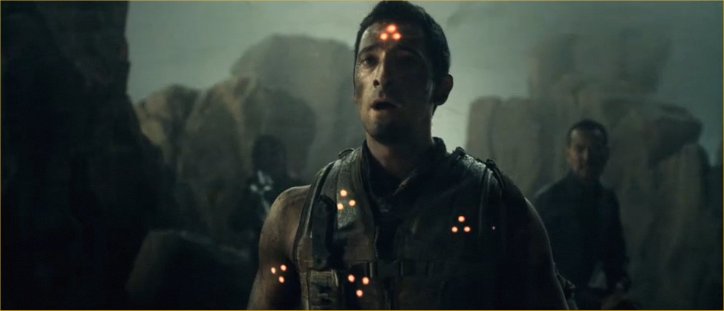
"Predators" drops you, literally, into itself. It opens as one of its combatants (Adrien Brody) is in free-fall, with no idea where he's dropped from and no idea where he's dropping to. All he knows is he's in free-fall. He doesn't even know if he'll survive the landing. Or how. All he knows is the panic, the wind, and the thing beeping on his chest in an increasingly accelerating rhythm.
 
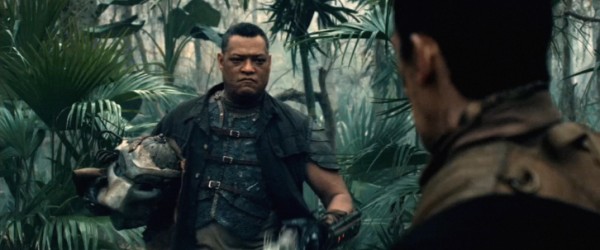
Once he makes land-fall, he finds himself surrounded, by an impenetrable hostile jungle and a rag-tag clutch of mercenaries (Alice Braga, Walton Goggins, Danny Trejo—a new trailer for Machete is attached to the print—Oleg Taktarov, Louis Ozawa Changchien, Mahershalalhashbaz Ali, Laurence Fishburnedoing something very, very different this time, brilliantly) and a doctor (Topher Grace?!), an odd-man-out in a team of hostiles from every hot-spot corner of the Earth.
First, they must learn to trust each other—
they're all loners, but Brody's character is more of a lone-wolf than others, interested only in survival, names are not important, and familiarity breeds empathy and weakness—which quickly becomes irrelevant when they discover that they are part of a deadly game—they are ruthless predators being pursued by an invisible implacable enemy for sport; these hawks have become quail, and they must use their inherent killer-instincts to put themselves in the running foot-steps of so may of their victims. The predators have become prey.

The "Predator" series
was never a great series of films. The first one, with Arnold Schwarzenegger (which is referenced here) was the only good edition and it quickly degenerated into an also-ran cousin of the "Alien" series (and Agatha Christie's "And Then There Were None"). The concept didn't have anywhere else to go; it was a "one-idea" pursuit film that resisted expansion or depth...until this one. Predators (directed by Nimród Antal) slightly expands the concept and heaps on the irony of cut-throats getting their just desserts, while also giving the participants more back-story than the "Dirty Half-Dozen-or-so" of the first film.
Antal crams a lot into the story, never sacrificing pace, suspense or the "wtf?" quality necessary for this kind of "out-of-their-depth" story. It also manages to pay homage to fiction's Rosetta Stone of this sub-genre,
Richard Connell's "The Most Dangerous Game." TMDG was at the core of the original, but "Predators" manages to take it several steps further, even incorporating that other "man-hunters-in-the-jungle" story, Joseph Conrad's "Heart of Darkness" (yes, the basis for Apocalypse Now) in a sub-plot.
Busy, busy film. And adroit. Tough-minded and unsentimental. Perverse and holding deeper truths...there's even a hint of a mystery story in there.  Entertaining and satisfying, if this is your bucket of blood.* Personally, this one tops the original, with a fine cast—who'd have though Academy-Award-winner Brody would be so effective in a role like this?**—and higher ambitions that it handles efficiently. A product of Robert Rodriguez's Troublemaker Studios, it shows how excellently this brand of B-movie entertainment can be produced.


* And it is violent...one scene has a predator ripping the spine and skull of a victim from its carcass and bellowing in its victory.  Despite the implausibility of such an act (ever try to do that with a chicken?), it's a powerful scene.  Filmed obliquely—the film is a hard "R," but doesn't stray into "X" territory (which you have to be REALLY over-the-top to earn from the Ratings Board)—it's a visceral moment.
 
** Roman Polanski, probably.  On second consideration, the whole of The Pianist is a similar story of being hunted during WWII, and Brody made you feel every twitch of his nerves in that one.  If you haven't seen that film (and I also delayed watching it for a long time because, frankly, I didn't want to see another film about The Holocaust), you owe yourself to get a copy and view it. Predators also features another Oscar-winner, the always terrific Mahershala Ali (under his original stage name).

Friday, August 17, 2018

BlacKkKlansman

Politics is Another Way to Sell Hate
or
You've Got No Skin in This Game

Any time Spike Lee does a movie, it's an event; he's one of the few filmmakers who can actually be called a "stylist" (along with Spielberg, Scorsese, and a handful of others), who even as he explores the story-telling form, advances film-language, expands the vocabulary and moves the art forward, stylistically, artistically, and in the form of content and how it can be effectively communicated to an audience.

His new film, BlacKkKlansman—based on a true story (or, as expressed in the film, "this joint is based on some for real, for real shit") tells the story of Ron Stallworth (played in the film by John David Washington, son of Denzel) who, working as the "first black recruit" in the Colorado Springs police department, decides to investigate the local chapter of the Ku Klux Klan—or, as it was preferred to be called internally, "The Organization" or "The Secret Society" (all in the interest of removing any "stigma" that might be associated with white supremacy or Neo-Nazi's of the past and selling bigotry and racism as inoffensively as white bread).

Now, how would a black officer do that, specifically? Well, it turns out, it takes a village, and making sure that you're targeting village idiots.

After Lee does some priming back-story for the youngsters—in the form of Alec Baldwin portraying a racist cleric making a propaganda film (for comedic effect, we get the out-takes) against a projected backdrop of D.W. Griffith's Birth of a Nation—we see young Stallworth—his 'fro is perfect—going to a job interview at the Colorado Springs precinct, where he is being considered as its first black officer, a position he is warned, that will make him the district's Jackie Robinson, breaking barriers but also having to endure the resistance of his fellow officers ("Do you really think a police officer would call me that?" he asks, rather naively, in front of dumbfounded interviewers). 
Well, he's a perfect candidate, a credit to his race. The thing is, the duties for the barrier-breaking first black officer is to work in the basement records department fishing for files on demand. As he tells his captain (Robert John Burke) this is not what he signed up for.
Then, a breakthrough: he's asked to go undercover at a speech given by radical Stokely Carmichael (Corey Hawkins), presented by the Colorado Black Student Union. See who's there, find out what the speech is, see if Carmichael, who was with the Black Panthers, is going to be stirring up any trouble in town. Stallworth will be the plant—as he's the only black officer—with the operation to be run by two other undercover cops: Jimmy Creek (Michael Buscemi, and, yeah, he's just like his brother) and "Flip" Zimmerman (Adam Driver). They wire Stallworth up for sound and monitor his activities, including chatting up the head of BSU, Patrice Dumas (Laura Harrier, from Spiderman: Homecoming), all in the interest of research, of course.
Patrice and Carmichael get roughed up after the speech, when she and Stallworth hook up at a bar later, and he asks her enough questions that she starts to suspect that he's a cop—"pig" is her word, and he tells her he doesn't use that term. But, he's clearly interested in her and she in him—it's too bad that this is the part of the story that's completely fictional, but it does give Lee a chance to openly contrast the merits of changing "the system" from within and without, using Ron and Patrice for point-counter-point.
His jaunt undercover lands him a promotion to detective, where he gets to decide what he wants to investigate—he doesn't want to do the drug detail—but a recruiting ad in the local paper for the KKK gets his attention. He calls it, gets a voice-mail, leaves a message. He gets a reply about joining "The Organization," to which he expresses enthusiasm using racial slurs and his fear that his sister is dating his sister and his revulsion at the man "touching her pure lily-white body." That sells him to the recruiter.
One little problem: Ron makes a rookie mistake on the phone call by giving the guy his real name. Since Ron is (ya know) "black" there is the distinct possibility (not certain, though) that the Kluxers might suspect something suspicious if he actually goes to one of the meetings himself. So, the police force decides to put its collective head together and decide that a white detective should  maybe go in his place, posing as Ron. In a line that evoked the biggest laugh in the theater, Ron says "With the right white man, anything is possible!"
It's decided that detective Flip will be Ron at the face-to-face meeting, as he has the closest sounding voice to Ron (Jimmy Creek, frankly, sounds like Steve Buscemi!). That has its own potential danger, even for a white guy—Flip is Jewish. But, then, whoever they pick would probably have something about them to offend the KKK. As Flip-Ron gets indoctrinated amid the misfits making up the small Klan chapter, Ron-Ron steps up his game, keeping Flip surveilled during his encounters, and keeping in touch with The Organization, developing a phone-relationship with Wizard David Duke (Topher Grace). Between the work of the two "Stallworth brothers," they raise their creation's prominence in the KKK, to the point where "Ron Stallworth" is in line to become the local chapter's next leader.
Things come to a climax when Duke comes to Colorado Springs to meet "the boys in the hoods" while the chapter plans to bomb another meeting of the Student Union. And, as if there isn't enough going on, Ron-Ron is picked by his boss for the job of protecting Duke while he's in Colorado Springs. Why any police captain in their right mind would do that is one of the biggest "Oh, Really?" moments in the film. 

The thing is...it really happened that way.
This is one of the least mannered films in Lee's career. It's as if the absurdity of the situation allows him to let loose of the clasped-tight reins that he usually keeps on his films. Maybe it's the setting or the time-frame, as he and cinematographer Chayse Irvin use a 70's pallet and some of the forms of 70's blax-ploitation films (split-screens, anyone?) to evoke the era. There's an almost Brooksian verve in the presentation of Ron-Ron on the phone, contrasted with the constant tension of Flip-Ron at his meetings. The KKK are never shown as less than dangerous, but concurrently shown as less than organized and structured, like a glorified Scout troop without a den-Mother.
But, loose as it might be, it still comes with a strategically designed "all-stories-come-together" climax that is as deft as anything Lee has made in the past, where stakes are high, and resolutions are not as easy as they may appear. And, once again, he caps it with a coda that easily transitions to current affairs, set to an amazing rendition of "Mary, Don't You Weep"—by Prince—that moves and reverberates long after leaving the theater.

Rest in Power, indeed.

BlacKkKlansman won the Grand Prix at this year's Cannes Film Festival.