A Hell-hole of His Own Design
or
"I Just Don't Appreciate It. I Cherish It"
These days get me down.
Brady Corbet
's The Brutalist (made for an incredibly modest $10 million) comes with all the showmanship brio of those old "roadshow" films of the 1950's and 1960's, back in the day before the trend today where every movie became its own sole inhabitor of a given theater's screen...when movies openly defied the "bargain-prices-for-the-masses" concepts of the now-extinct double-bill for the self-proclaimed "importance" of the single solitary roadshow attraction. Those "big, important" presentations did not survive the decade of the 1960's when the more independent and youth-oriented...and cheaper...films (which defied the portentousness ambitions of their more gaudy studio products) took over both screens and audiences' interests. The Brutalist has the ambitions and trappings of those roadshow attractions: VistaVision photography, an Overture (all 30 seconds of it, really) and an intermission at the 2/3rd mark to give you a recess to escape during its 3½ hour length.Not that it's really needed. The Brutalist moves along at a quick, if somewhat trance-like pace, but without any of the sweep that you'd expect in the blockbuster format. And that intermission comes at a time when there is an interruption of the story-line—a work-project is stopped—and the film takes up a few years later after everyone has moved on and must once again begin the project after law-suits are settled. A less time-consuming interstitial or an added narration might have been enough to impart that information, but I guess the filmmakers wanted to impart the sense of time being wasted...The Brutalist began production in 2018 and didn't start photography until March 2021 and was delayed by the pandemic until further work in 2023. An intermission probably felt organic to the process.
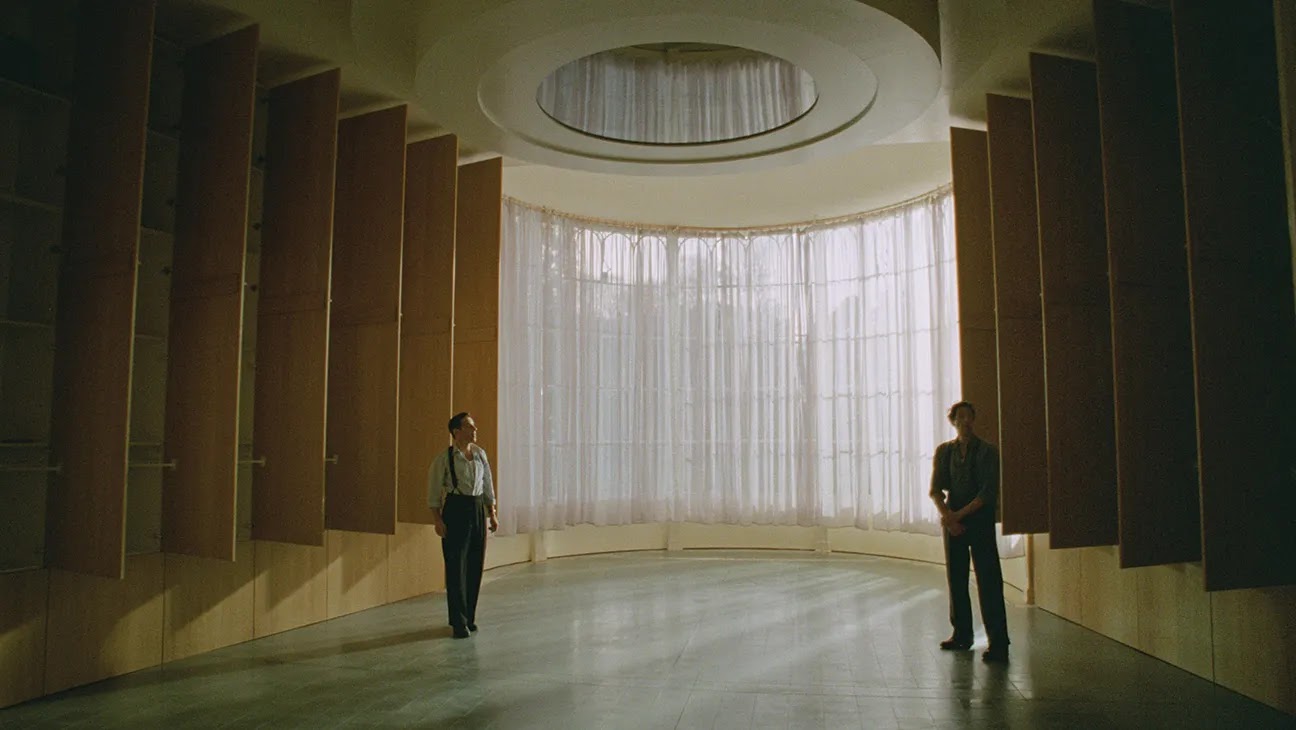
But, it isn't, really. It just marks the demarcation point where the movie starts to unravel. The "Part 1" of the film--and, yes, it has "chapters"--"The Enigma of Arrival" sees the arrival of László Tóth (Adrien Brody), a Polish architect, who has barely survived the Holocaust and arrives in post-war New York, ahead of his wife Erzsébet (Felicity Jones) and niece Zsófia (Raffey Cassidy), to do what so many refugees and migrants have done—try to make a new life for themselves after leaving a life with little prospects. At this point, Corbet is happy to provide every detail in his story-telling and make some bold choices doing so. Toth's arrival in New York—when he finally is able to emerge from the dark hold of the ship and into the sunlight—is highlighted by his first glimpse of the Statue of Liberty—but Corbet presents it to us upside-down, as if we were looking back at it from behind. This might have been just for practical purposes—you shoot up at Lady Liberty so you don't have to show the New York skyline, which looked very different in 1946 than it did at the time of filming.* It also says something, vaguely (if one is looking for such things) about the Ancestry.com fairy-tales of immigrants braving the unknown to "make a better life" for themselves than what they would find on their home-soil. But, The Brutalist takes those stories that have become so familiar on "Finding Your Roots" and turns it—like the Statue of Liberty—on its head. Ship's manifests and census records can tell you the "when" of things, but not the "how" of things—of prejudice by the already-established immigrants (all of them being immigrants, ironically, except for the indigenous tribes and there was a "final solution" reserved for them, as well), of huddled masses forced into "Little" communities of slums, and of hard-scrabble existences, supposedly based of hard work and fortitude, but mostly based on dumb, stupid luck and the seizing of opportunity. And will, a basic will to survive.The Brutalist rubs your broken nose in it. Toth is initially welcomed in Philadelphia by his cousin, Attila (Alessandro Nivola) who runs an established design-furniture store, Miller and Sons, and takes him in, hiring him for his design-work and giving him a little room in the back of the storeroom. The cousin has assimilated ("Who's Miller?" "Me" Who are the sons?" There aren't any"), changed his name, become Catholic, married a shiksa wife (Emma Laird) and she is less than pleased with the arrangement. An initial job to design a modernist chair for the store-window produces a tube-dominant functional design that would hardly attract customers. But, the company gets a commission—the children (Joe Alwyn, Stacy Martin)of a rich businessman, Harrison Lee Van Buren, Sr. (Guy Pearce), want a library constructed in his mansion while he is tending to his ailing mother. The job has its challenges—the desired location is all vaulted windows letting in sunlight that could fade the valuable first editions. What to do? Toth has a solution and it is a bold one.Keep the windows. Protect the books. Cantilevered doors hide the shelves and their precious burdens. But when Van Buren the Elder comes back, he isn't pleased ("I don't like surprises!"—Pearce, here, is at his foaming, berzerker best) because there's a BLACK man (one of the workers) in his drive-way, everything's different and his Mother's in the car. Get OUT! Get OUT NOW! No explanation is heard or good enough. "Miller and Sons" doesn't get paid for the commission. They have to pay the expenses. They'll be lucky if they're not sued. So, "of course", cousin László gets sacked by his own cousin. The assimilation gets set back a few years...if it was ever going to happen at all. The Brutalist has a pace, but it's a herky-jerky one, sort of like the phrase a friend reminded me of the other day: "The days go slow, but the years go quick." Flash forward three years. László is a laborer shoveling coal, living in a charity house, addicted to heroin, his only friend is Gordon (Isaach De Bankolé) a single father also down on his luck—he was the guy seen in the driveway that Van Buren was so incensed about—working at the same facility. Then, one day Van Buren the Elder shows up at his work, invites him to lunch, and tells him a story.At lunch, he shows Toth an article in an architectural magazine, extolling Van Buren and the library's aesthetic, and the magnate has done some digging, found out the name of the man who created the masterpiece he now owns and for which he, the owner, has been lauded. He's researched him, discovered the architectural work he did in Europe before the war, and...pays him for the work he did on the library. Toth's work has made Van Buren an exemplar of an aesthetic—even if he didn't know the name of the man who designed it or anything about why the fuss being made about his library—and he invites him to a dinner the next night so he can meet his society's circle and maybe...how he can be used in the future. Toth celebrates by taking the money and buying heroin.At the dinner, Toth is fêted by the Van Burens, where he is treated as an honored guest and treated with an air of "your not one of us but we like what you do." He meets Van Burens' lawyer, the only other Jew at the table, who offers his work to try and patriate Erzsébet and Zsófia out of Eastern Europe to America. And something else. The next day, Van Buren tells him of "a vision" he wants him to design and build. "Something boundless. Something new." There's a site on the highest point of his property overlooking the village of Doylesville, where he wants to build a tribute to his late Mother, a center consisting of a gymnasium, a library, a gathering center...oh, and per Doylesville request...a chapel. A Protestant chapel. Toth, thinks Van Buren—still aglow from his reflected light of Toth's work—is obviously the man for the job.Maybe he is, but he's certainly the most handy. And, given Van Buren's patronage, if not sponsorship, he's the one who can achieve Van Buren's "vision." But, first, Toth needs to get his own vision approved, which is where Van Buren, who pulls a lot of strings, is at his most useful—besides funding the project. And why shouldn't he fund it? It's a Van Buren version of a Pyramid, the grandest tombstone his mother—and probably any member of the Van Buren family could have. Toth's designs are different, large, blocky made of concrete and though not really brutalist in design, the brutalist school was very influential in the production of government buildings and slums—and prisons. But a prominent negative-space crucifix atop it seems to reassure the doubters. The rest of the movie is of Toth's struggles—and they are constant—in trying to keep the integrity of his design (despite middle-men, budget-cuts, capricious "second-thoughts") in a Sissyphussian environment of anti-semitism, xenophobia, and just plain interference for interference's sake.
Well, that's just bullshit. Only an artist—be they architect or a manipulative director—an entrepreneur or politician (with visions of dictatorship dancing in their heads) can go along with that "the ends justify the means" thinking. Human experience informs us, changes us, manipulates our thoughts and our ideas. Often it is the journey—not the destination—that is important (Erzsébet after coming to America says this: "This place is rotten. The landscape, the food we eat. This whole country is rotten."). Yes, it's good to have goals. But, what do you have to become to achieve them? Is it worth getting what you want by—where you want— by sacrificing everything but the dream?
The sportscaster Red Barber had a wonderful rejoinder for the old "whoever has the most toys, wins" mind-set: "God doesn't count the toys. He counts the scars."
But, the edifice will excuse it all. After all, people still flock to the Pyramids; nobody cares what kinds of horrors inspired them or carried them out. Our Edifice Complex negates all that. Why (he says sarcastically) maybe the slavery was worth it, Ozymandias...
Tell that to the wrecking ball. This piece has taken me forever to write—despite "The Last Word" at the bottom of the page I do not always find writing bad reviews "fun"—and I've been listening to and reading rave reviews for this film, trying to understand what they're seeing that I'm not. All I can conclude is that the framing, cinematography, and acting (all of which are quite good) have overwhelmed any critical thinking about content. "Style over substance".*** "Miller and Sons." That old trick. But not for me.
I like ambiguity. I cherish it in movies if it's not a stunt (as Hollywood so often makes it). You can even be vague about things. But, The Brutalist asks questions that it doesn't bother to answer, nor does it seem to care, as if a point of view was something beneath it to attempt. I shouldn't have to divine what it's attempting to say (if anything). It should be there on the screen so that I can share the artist's thoughts. That's the very basis of communication and the DNA of film. But, Corbet's film tries so hard not to tell a story, or to advocate for anything, other than that life, even a life devoted to your craft, is misery. In the end, The Brutalist is neither inspirational or aspirational. As such, as a work of art...it is useless.I wouldn't be at all surprised if this wins the Oscar for Best Picture.
These days get me down.
* I've always loved the story Sidney Lumet tells—in his book "Making Movies" (©1995, Vintage Press)—of meeting his hero, director Akira Kurosawa, and asking him why he had framed one particular shot in Ran the way he did and the Japanese Master told him that if he'd panned the camera one inch to the left, the Sony building would have been visible and one inch to the right, an airport, neither of which were appropriate to a samurai movie. It's not all inspiration and artistic intent.
** Here's the thing—not even Toth believes that, if we're to believe the screenplay. If he had, why then would his time at Buchenwald inspire the dimensions of the Van Buren Institute (in the same speech, his niece says this: "The
building referenced his time at Buchenwald as well as the deeply felt
absence of his wife, my Aunt Erzsébet. For this project, he re-imagined
the camp's claustrophobic interior cells with precisely the same
dimensions as his own place of imprisonment, save for one electrifying
exception; when visitors looked 20 meters upwards, the dramatic heights
of the glass above them invited free thought; freedom of identity. He
further re-imagined Buchenwald and his wife's venue of imprisonment in
Dachau on the same grounds, connected by a myriad of secret corridors
re-writing their history and transcending space and time so that he and
Erzsébet would never be apart again.") So...in other words...his journey through the war years inspired the destination. Or is the niece putting words in the mouth of the elderly Toth, for his benefit to burnish his image, and so is she also a part of the same self-aggrandizement as, say, the nefarious benefactor Van Buren? Is everybody in this movie corrupt?
*** I'm reminded of the story Jerry Lewis told about Stanley Kubrick, who was wandering around during the days of making 2001: a Space Odyssey while Lewis was struggling to edit his abortive The Day the Clown Cried. Kubrick was sitting in the back of the editing room just hanging out, taking it all in when Lewis said over a particularly frustrating "cut," "That's it! You can't polish a turd!" To which Kubrick responded (after a thoughtful pause): "You can if you freeze it..."

 Not that it's really needed. The Brutalist moves along at a quick, if somewhat trance-like pace, but without any of the sweep that you'd expect in the blockbuster format. And that intermission comes at a time when there is an interruption of the story-line—a work-project is stopped—and the film takes up a few years later after everyone has moved on and must once again begin the project after law-suits are settled. A less time-consuming interstitial or an added narration might have been enough to impart that information, but I guess the filmmakers wanted to impart the sense of time being wasted...The Brutalist began production in 2018 and didn't start photography until March 2021 and was delayed by the pandemic until further work in 2023. An intermission probably felt organic to the process.




 This piece has taken me forever to write—despite "The Last Word" at the bottom of the page I do not always find writing bad reviews "fun"—and I've been listening to and reading rave reviews for this film, trying to understand what they're seeing that I'm not. All I can conclude is that the framing, cinematography, and acting (all of which are quite good) have overwhelmed any critical thinking about content. "Style over substance".*** "Miller and Sons." That old trick. But not for me.
 I wouldn't be at all surprised if this wins the Oscar for Best Picture.


