Showing posts with label Scarlett Johansson. Show all posts

Tuesday, July 16, 2024

Fly Me to the Moon (2024)

Today is the 55th Anniversary of the launch of Apollo 11—the NASA space mission that did, indeed, land the first Earth-people on another world.

A Lie's Still a Lie If Everybody Believes It
or  
"Actually...Leave Them Up. Let Them Think About What They Did."
 
Fly Me to the Moon—which was saved from going straight to streaming by audience surveys—already has a couple strikes against it for me before I even see the movie.
 
1) It's a rom-com, a genre that leaves me cold for its predictability and formulaic structure: Meet Cute; Get Involved; Get Closer; Complications and Misunderstandings; Split Up and Simmer; Coming to Terms—Sacrifice; Ride Off into the Sunset. Two-step drama, with a mere distraction in the middle.
 
2) It floats that old chestnut of conspiracy theorists—the Apollo 11 moon landing in 1969 was faked. I hate that crap. I wasted too many hours online debunking them that I just gave up with some useful links to YouTube people using "facts" and not "feelings" against the absurdist arguments thrown up by others. The best reply is Buzz Aldrin's; he punched one of these nuts in the nose.* I won't waste time on it here, but a lot of the explanation for the origins of this vacuousness (and arguments against) are displayed here and here.  
 
Of course, this isn't the way things should be; one should go into a movie without prejudice, without expectations. I couldn't do that. Bear that in mind.
For the most part, Fly Me To the Moon gets its facts right ("with a lie or two"): there's the standard run-down of what set "The Space Race" up—Russia's Sputnik launch in 1957, America's fears leading to its fast ramp-up and militarization of a space program, and just as we were getting to the stage of moving out of Earth-orbit flights, there was a horrific fire on the launch-pad of Apollo 1 during a test exercise killing the astronauts and causing a significant pause to "get it right." A revamped Apollo capsule was tested, re-tested, and fire-proofed and missions were done to test it, the lunar landing craft (or LEM) and a sortee made around the Moon on Apollo 8. There was a lot of prep, a lot of testing, with the Apollo 1 fire reminding everyone that the mission was "to land a man on the moon and return him safely to Earth."
That's top of mind to Cole Davis (Channing Tatum), flight director at Kennedy Space Center—the place where they assembled the rocket and launched it—Fly Me to the Moon bases the fictional character on Deke Slayton, one of the original Mercury astronauts, who was not allowed to fly because of an atrial fibrillation—"an a-fib" they call it in the movie—a heart murmur. Slayton did not become "Flight Director of Kennedy Space Center" but managed "The Astronaut Office" until he flew on the Apollo-Soyuz joint mission. He is "gung-ho" on the Mission as he was present at the time of the Apollo fire and he takes everything, every nut, bolt, and screw, seriously. And semi-seriously as he's superstitious of the feral black cat that hangs around KSC.
Then there's Kelly Jones (
Scarlett Johansson), of "Kelly Jones Advertising." Her job has less to do with reality than it is does with "feelings" and the manipulation of same to win clients and thus, their customers. Like Cole, she's a problem solver, but with a different bent. Her area of expertise isn't science or engineering but psychology—Cole doesn't like weak spots; Kelly loves them. She'll use them to her advantage and if it's a little dishonest, the ends always justify the means. That's how it works in advertising and she sails through her territory friction-less and A-OK.
But, when she's approached by a Man in Black (
Woody Harrelson) from the Nixon Administration to "sell" the Moon landing to the American public, she can't resist—it's a government job! And she begins setting up interviews for the press (against NASA regulations but she hires actors to get around that little detail), selling space ad campaigns to willing clients (NASA didn't "do" ad campaigns, but a lot of their contractors were all too willing to crow about it), and doing a little influence-peddling with congressmen voting on funding bills (which certainly happened and is happening today).
For Cole, this is like sticking corporate logos on a capsule to make it look like a NASCAR. It's disrespectful, unnecessary to the program and...just dishonest. It's only when Harrelson's MIB starts interfering that things start turning into a major head-ache—putting cameras on the spacecraft (the idea! Even though*cough* it'd really been happening since Apollo 7). In space you can't change course, but the winds of politics keep threatening to blow things off course.
"You got your notebook?"
But, it's a ROM-COM, and they never stray off track! Cole and Kelly have their differences, so, of course, they have to bend a little and if that's in each other's direction....well...
How is it? Well, as I said on the recent Lambcast about it, it "didn't piss me off" (which, considering I had two strikes against it before entering the theater says a lot about the charm of the thing). Johansson and Tatum could orbit around this sort of material in their sleep, but she never misses an opportunity to display a worry-line and he makes stubborn male obstinancy attractive. Some of the writing is quite clever, the meticulousness of the art direction and the costuming is spot-on (especially for the casual-wear of the males) and 
Greg Berlanti has a much better eye directing movies than he does producing superhero shows for the CW.
"uhhh...how are they going to stand this thing up?"
(My plastic models of it broke apart in this configuration!!)
But, for criminy sake, one can't look at the movie and think that even the most gullible of audiences won't "buy" some of the stuff they see being shown on-screen. I'd mention some buy they'd be "spoilery" and that's one conspiracy I just won't stand for (some things should be left secret, dammit!).
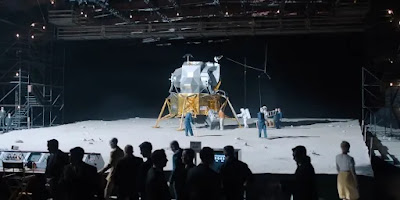
Let's just say that they got a lot of stuff wrong while maintaining just a bit of the right stuff.
It's a rom-com, so OF COURSE there's going to be a "flying scene!"

* The second best argument is the one for folks who know nothing about the space program (which I grew up watching): Okay...say you fake Apollo 11. Did they also fake Apollo's 12, 14, 15, 16, 17...all of which were larger in scope and covered terrains that couldn't be housed in the BIGGEST warehouse-studios...not to mention Apollo 10 (the dress rehearsal that got tantalizingly close—10 miles—to the lunar service)...and fake Apollo 13, which was a mission FAILURE! 
 
If you seriously believe there was still a conspiracy you're either obstinate in the light of facts, desperate, or certifiable. You need help. Get it. Start with research. 


Thursday, May 30, 2024

Vicky Christina Barcelona

Written at the time of the film's release...

"Juan is the Loneliest Number That You'll Ever Do"

or
"To Javier and Javier Not"


Vicky Christina Barcelona (Woody Allen, 2008) The latest film in what will, no doubt, be called Woody Allen's "Scarlett" period, Vicky Christina Barcelona was shot almost totally in Spain, and benefits from the change of location. It's a large part of what drives the plot and the two women who vacation in Spain for different purposes.

Vicky (Christina Hall) is studying Catalan architecture (particularly Gaudi), and spends the time in Spain as a prelude to getting married to staid, reliable Doug (Chris Messina). Christina (Scarlett Johansson) has just written and directed an 18 minute film starring herself, and broken up with the latest in a series of men in impetuous affairs. She has no business in Spain, but goes to spend time with Vicky and get away. Vicky values the safe and dependable. Christina is searching, "certain only of what she doesn't want," as explained by a ubiquitous Narrator (Christopher Welch), whose constant comments make the film feel less a visual experience than a story with pictures.
While in Spain, the two women are approached by darkly handsome artist Juan Antonio (
Javier Bardem) who offers to fly the women to the town of Oviedo for the weekend to view the Gaudi works, drink wine, and make love. Vicky thinks Juan is a creep. Christina is intrigued, but both women end up going, Vicky to protect her impetuous friend.
Juan is soulful, attentive, but it is obvious he is in love with his ex-wife Maria Elena (
Penelope Cruz), despite the fact a) they couldn't make it work, and b) she stabbed him in a rage. ("Oh, that..." she says dismissively when it's brought up).
Things get complicated, but never enough for the Narrator to be lost for words or explanations, and when Maria Elena shows up again in Juan Antonio's life, the movie turns, at equal turns poetic, and dangerous. Despite the mannered ways that Allen's films can frequently turn out, this group of actors is particularly well-suited to working outside of Allen's tic's and rhythms. The closest any of the characters come to the Allen neurotic persona (a staple in Allen's films, either played by Allen or a stand-in) is Vicky, but she's much more sure of herself, if not her situation.
Bardem is sadly relaxed in the film, but Penelope Cruz is a force of nature, this generation's
Sophia Loren. After being stuck in some unmemorable films with some straight-jacketed performances, the last few years and films have displayed a bravura presence, and she runs a gamut of emotions in this one to full effect. It's a tough role to pull off--she's held up as an icon until she appears, and when she shows up later in the film, arriving bedraggled from the hospital after a suicide attempt, Cruz more than fills the bill, with her extremes of behavior never seeming contrived or phony.
And Johansson has rarely been better represented on-screen—one close-up in particular of Christina listening to Juan Antonio explaining his love for his ex-wife fairly burns on the screen with resentment.
 
It may ultimately prove to be a minor Allen film, but as a change of pace and an expansion of style it couldn't be more successful.

Tuesday, September 12, 2023

Match Point

Match Point (Woody Allen, 2005) The box office was good for Match Point, Allen's first hit in years, and one wonders why. The film is accomplished and assured, simple in execution but morally complex, one of those little Woody Allen morality puzzles that update the classics (in this case, "Crime and Punishment", as well as any number of "bad-boy makes good" novels, where all you need is a compromised conscience to make it in the world). The BBC put in money, so the locations are in Great Britain (it's good to get out of New York once in awhile). The actors are young and skew to a lower movie-going demographic (although except for Scarlett Johansson, the actors are not box-office draws)--but there are no "tunes" on the soundtrack, merely ironically chosen opera extracts sung by Caruso (complete with vinyl surface noise).

Allen considers it one of his best films.
Despite the accents and strange new territory, it's undeniably Allen-town with its
chilly empty spaces pointedly deliberately composed, its couples colliding and splintering, an act of insanity out of the blue, and a late touch of magic that chills.
But it's one of those Allen movies where the literary seams show,
his long empty corridors reverberating with the classics of the past informing his movie, with some of the echoes coming from his old Brooklyn haunts; I kept thinking that Chris Wilton, the slippery tennis pro (the only thing that's true about him is, surprisingly, he is a tennis pro!) reminded me of Leonard Zelig, the "human chameleon," who, in his insecurity, would conform to whatever group he was with, even physically changing to accomplish it.
But more than the literary seams show.
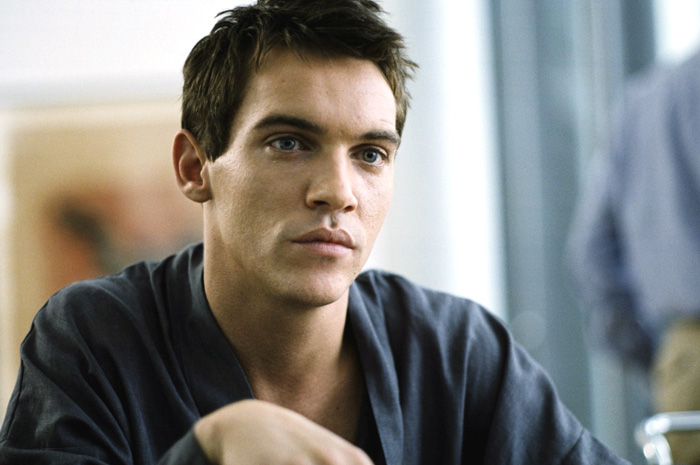
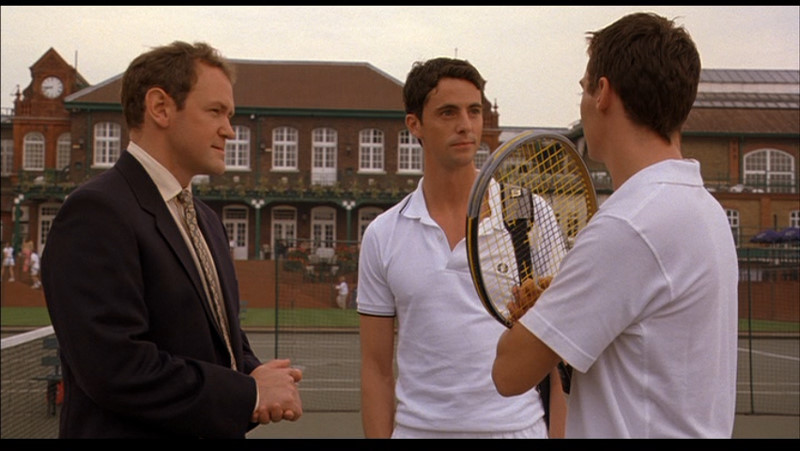
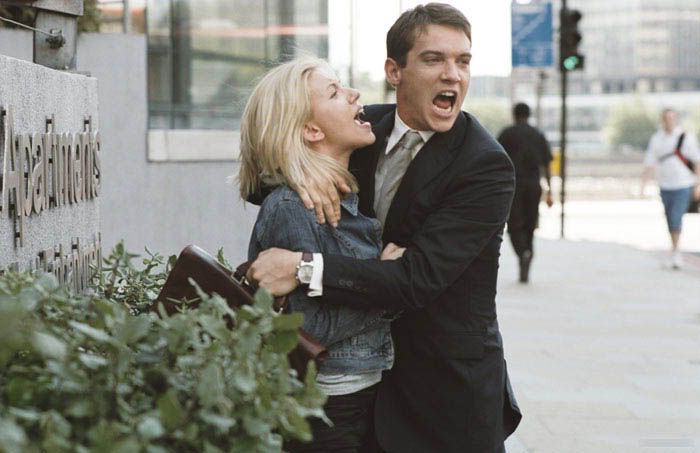
Jonathan Rhys Meyers, who plays Wilton, isn't a fast enough actor to make his sudden shifts of tone and snap-excuses sound credible; there needs to be an ad-libbed looseness to his answers, rather than the studied RADA responses Meyers provides. The rest of the cast play their parts as required: Brian Cox (always good), as Wilton's chief enabler; Matthew Goode (interesting to see him in this role after Watchmenin this part, he's much snappier playing a member of the effete elite); Emily Mortimer, thanklessly perfect in a thankless role; Scarlett Johansson as the Victim of Fate, smart enough to know herself, but not know her role in the world.

So, what's different? Why this Woody Allen movie doing well, when the previous ones hadn't? Allen had been, piece by piece, removing the musty-Woody-Allen-tropes from his movies to no effect at the box office. What made
this one different?
Then, it hit me.


There's no "Woody Allen" character in it. No stand-in's with comically stuttering neuroses. No "fools" that make a point. No sad clowns in the corner. This time, Woody Allen is behind the camera. For good.

Tuesday, June 27, 2023

Asteroid City

Meep! Meep!
or
Margot Robbie's in the Tupperware
 
Asteroid City does not exist. It is an imaginary drama created expressly for the purposes of this broadcast. The characters are fictional, the text hypothetical, the events an apocryphal fabrication."

Well, of course they are! It's a Wes Anderson movie!
 
Early on, with Anderson's movies—back before they got really stylistic with consistent lateral camera moves and a severe one-point perspective, and looked like they could have happened in the "real world"—there was a depth to the subject matter that was undeniable. That has remained to this day, even while the visual look of the films have become more juvenile and seem to be contained in toy-like play-sets that defy good construction practices or even three-dimensionality. Characters became types moving around in play-houses that seem to be defiantly artificial...like shooting in a western town that were deliberately shown to be propped up stage settings and mere facades. Most directors try to expand their horizons along with their budgets and to take pains to make things more realistic and less like pre-planned photographed dramatizations. Not Wes Anderson.
Hitchcock said of Spielberg that he was "the first one of us who doesn't see the proscenium arch" noting that Spielberg grew up with film, rather than the stage. But, Anderson is going a different direction. He WANTS you to see the proscenium arch, and will go out of his way...with a child-like glee...to make sure it's noticed and appreciated to be artificial. His new film, Asteroid City is one more step in that direction as it's story looks like it takes place in one of Maurice Noble's desert landscapes in the Road-runner cartoons.*
But, that's one aspect of Anderson's film (he usually has at least two he's presenting in his movies). Usually, he's as stringent in his story through-line as he is with a tracking shot (his The French Dispatch, with its a handful of stories, being an exception). This one, he's made a layered story, through several simulated media—television, stage, and film—each one has its place in the film and each one is subject to being violated, one by the other.
Now, Asteroid City tells the story of what happens when a bunch of "super-genius" kids arrive with their families at the titular city—famed for its vicinity to  the "Arid Springs Meteorite" impact crater—for the "Junior Stargazer/Space Cadet" convention put on by "The Larkings Foundation" and the U.S. Military under its United States Military-Science Research and Experimentation Division. They're to be given awards for their inventions—it should be noted that those inventions (jet-packs, destructo-rays, projecting on the Moon) were not viable in the setting of 1955, but would be just the sorts of things kids would want to invent. Each family have their issues and quirks, and they become unwitting witnesses to a major event in the history of mankind.
So, that's the plot. But, it's not the whole movie. We begin—in black-and-white and a square Academy ratio—with a television program (of the arts-programming "Omnibus" variety) where the host (
Bryan Cranston) intones that they are presenting a special production of a play by famed playwright Conrad Earp (Edward Norton) called "Asteroid City" and after a brief episode where Earp meets actor Jones Hall (Jason Schwartzman), we begin with a wide-screen version of the play in the colors of a faded post-card you'd find in a rack at a tourist trap.
Augie Steenbeck (played by Jones Hall played by Jason Schwartzman)—photographer—arrives (barely) at 'Roid City with his three daughters Andromeda, Pandora, and Casseiopeia as well as his son Woodrow (Jake Ryan), who is participating in the awards contest. Augie was a war photographer, still has shrapnel in his head, and takes his station wagon in to be serviced (by mechanic Matt Dillon)—it having given up the ghost miles down the road. It's decided that they will stay in town for the convention, rather than stay with Augie's father-in-law, Stanley Zak (Tom Hanks).
Stanley is concerned about this, but he's more distressed that Augie hasn't told the kids that Augie's wife/his daughter died two weeks ago, and don't you think it's about time to do that? So Augie stoically tells the kids—"Are we orphans now?" "No, I'm still alive."—which affects them all deeply, despite Woodrow being steeped in all things science and the three daughters, embracing mysticism seeing themselves as witches (well, two witches and one vampire). To allow the kids to grieve, Augie lets the kids bury their mother's ashes (contained in a Tupperware container) temporarily in the car-park until their grandfather can arrive to take them to his home for a more proper burial.
Also there for the awards ceremony is actress Midge Campbell (played by Mercedes Ford, played by
Scarlett Johansson), who is studying her lines for a new play and develops a curious relationship with Augie—seeing as their neighbors and all. Like the majority of the actor/characters, they are demonstratively undemonstrative, and—if I may use the word again—"stoic." These are, after all, adults in the 1950's, having lived through a ghastly world war, only to see it emerge with advances in technology and weaponry that dwarf, and could ultimately consume them. The many small inconveniences of living in a desert tourist trap not to far away from a nuclear test-site, leave them unfazed.
It is only when a cosmic event happens that is ultimately beyond their understanding that things change. Asteroid City, due to that happenstance is shut down and quarantined, leaving the temporary residents stranded. But, true to their nature—or perhaps the nature that Conrad Earp has given them—they react more to the minor annoyances that the quarantine imposes, rather than the perspective shock that its cause should have created.
Seems a bit like real life, doesn't it?
Anderson and consigliere Roman Coppola were writing this in 2020, so the COVID quarantine may not have been the genesis for the project, but filming during COVID restrictions certainly did, necessitating the recasting of Bill Murray when he came down with the plague. Still, when the outrage in real life is over the inconvenience of wearing masks rather than the loss of more than a million souls (you can't make this stuff up!), one can infer that it was on the creative minds.
Six feet apart?
But, there is one attitude shift present from the happenstance; Anderson abandons his persistent horizon-bisecting in the frame for something else—overhead shots looking down on the players. Oh, everything still has that one-point perspective, but from above with no horizon in sight, putting (in camera-terms) the people on screen at a disadvantage, making them smaller, vulnerable, putting them in their place—at least from the perspective of an observing extra-terrestrial. It's a bit jarring, but completely apt. It's the only evidence of a new perspective in the movie.
So, I found it fascinating, but then, I always look forward to Anderson's films. They may not come to an all-encompassing conclusion, but instead take on the mantle of a childish inquiry without answers. They make me feel a little younger, where playfulness was everyday, and not in those moments in between crises. They embrace innocence, but leave plenty of room for cynicism and mild bemusement, rather than a-musement. And the cultural touchstones he invokes are pretty sophisticated, even if he's not being sophisticated about them. I'm all in for that.
 
I hope he never grows up and loses it.
And Asteroid City is the perfect come-back for all those scary A-I generated parodies of "visionary director" Wes Anderson that are flooding YouTube now ad nauseum. Whatever the "brave new world" of AI generates, Anderson will always top it. I find that reassuring.

 * Anderson even throws in an occasional stop-motion road-runner just so we get the point.
"Wow"
 
Some more shots from Asteroid City, just because they amuse me...