Showing posts with label Rebecca Hall. Show all posts

Thursday, May 30, 2024

Vicky Christina Barcelona

Written at the time of the film's release...

"Juan is the Loneliest Number That You'll Ever Do"

or
"To Javier and Javier Not"


Vicky Christina Barcelona (Woody Allen, 2008) The latest film in what will, no doubt, be called Woody Allen's "Scarlett" period, Vicky Christina Barcelona was shot almost totally in Spain, and benefits from the change of location. It's a large part of what drives the plot and the two women who vacation in Spain for different purposes.

Vicky (Christina Hall) is studying Catalan architecture (particularly Gaudi), and spends the time in Spain as a prelude to getting married to staid, reliable Doug (Chris Messina). Christina (Scarlett Johansson) has just written and directed an 18 minute film starring herself, and broken up with the latest in a series of men in impetuous affairs. She has no business in Spain, but goes to spend time with Vicky and get away. Vicky values the safe and dependable. Christina is searching, "certain only of what she doesn't want," as explained by a ubiquitous Narrator (Christopher Welch), whose constant comments make the film feel less a visual experience than a story with pictures.
While in Spain, the two women are approached by darkly handsome artist Juan Antonio (
Javier Bardem) who offers to fly the women to the town of Oviedo for the weekend to view the Gaudi works, drink wine, and make love. Vicky thinks Juan is a creep. Christina is intrigued, but both women end up going, Vicky to protect her impetuous friend.
Juan is soulful, attentive, but it is obvious he is in love with his ex-wife Maria Elena (
Penelope Cruz), despite the fact a) they couldn't make it work, and b) she stabbed him in a rage. ("Oh, that..." she says dismissively when it's brought up).
Things get complicated, but never enough for the Narrator to be lost for words or explanations, and when Maria Elena shows up again in Juan Antonio's life, the movie turns, at equal turns poetic, and dangerous. Despite the mannered ways that Allen's films can frequently turn out, this group of actors is particularly well-suited to working outside of Allen's tic's and rhythms. The closest any of the characters come to the Allen neurotic persona (a staple in Allen's films, either played by Allen or a stand-in) is Vicky, but she's much more sure of herself, if not her situation.
Bardem is sadly relaxed in the film, but Penelope Cruz is a force of nature, this generation's
Sophia Loren. After being stuck in some unmemorable films with some straight-jacketed performances, the last few years and films have displayed a bravura presence, and she runs a gamut of emotions in this one to full effect. It's a tough role to pull off--she's held up as an icon until she appears, and when she shows up later in the film, arriving bedraggled from the hospital after a suicide attempt, Cruz more than fills the bill, with her extremes of behavior never seeming contrived or phony.
And Johansson has rarely been better represented on-screen—one close-up in particular of Christina listening to Juan Antonio explaining his love for his ex-wife fairly burns on the screen with resentment.
 
It may ultimately prove to be a minor Allen film, but as a change of pace and an expansion of style it couldn't be more successful.

Friday, April 9, 2021

Godzilla vs. Kong (2021)

We're Off to See The Lizard, the Marvelized Version of Kong
or
Four-Walling in the Time of Covid

Warner Bros. and Legendary Pictures have been making their own version of superhero movies for the past few years, starting with Godzilla in 2014, followed by Kong:Skull Island, and Godzilla: King of Monsters. The last movie teased a battle between the two movie-title monsters, now in the "Monarch" Monsterverse, referred to as "Titans" who usually hang out in the Hollow Earth, until we do something stupid to bring 'em out in the open. 

Personally, I think what brought out these movies was Guillermo del Toro's 2013 film of Pacific Rim, where he channeled his love of big monsters duking it out in big modern—vulnerable—cities. The filmed from a cell-phone version of Cloverfield (2008) might have had something to that...inspired as it is by Bong Joon Ho's The Host (2006) and Peter Jackson's remake of King Kong (2005). All that chance to use modern computer graphics and psuedo-technology to make a movie about big monsters fighting appeals to the child (and WWF fan) in all of us. If they didn't make money, they'd disappear into the sea with the setting sun— like Godzilla, but without the buzz-headache from hitting electrical lines.
So, here comes Godzilla vs. Kong, the mash-up of the two tent-poles in the "Monarch" Monsterverse, and "The Top of the Ticket" if one were to see this as an evening of boxing. It is a goofy affair, mixing up traditions of the earlier Toho films (with a much larger scale), a little Jules Verne mixed in for exotica, and a little "zhuzh" from the Marvel Universe to add merchandisable personality, and to keep the fights from seeming like endless slugfests. It also leeches any identifiable humanity out of its story, and, for that matter, The Earth, relegating people to "slow natives" status, and "chutes and ladders" to connect the big fights (of which there are four).
The film has four primary locations: Skull Island—home of King Kong—which is now encircled by a force-field enclosing the "King of the Beasts" from wandering into people's neighborhoods and eating their houses; Pensacola, Florida, where the APEX corporation is engineering A.I. technology with advanced robotics; the Antarctic, where a Monarch research station has made a foray into the "Hollow Earth" deep in the Earth (but wouldn't Skull Island be a more logical entryway, since that's where these beasties have come from?); and Hong Kong, where APEX has a vast engineering facility. With me so far? Good, because you'll get lost soon enough.
At Skull Island, Kong is being studied by Dr. Ilene Andrews (Rebecca Hall), the so-called "Kong Whisperer" who's a bit like Dian Fossey, except that her studies of The Big Guy are facilitated with the help of a native Iwi girl named Jia (Kaylee Hottle), a deaf-mute who can communicate with Kong. She is (evidently) the last Iwi tribesperson, her parents and everybody else being reduced to Skull-walker fodder or Kong toe-jam. Dr. Andrews has adopted the girl, and, as such, the whole movie would make damning evidence at a Child Welfare hearing.
She is approached by Dr. Nathan Lind (Alexander SkarsgÄrd), a former Monarch scientist, and developer of the "Hollow Earth" theory (which conjectures that the Earth doesn't have a core so much as a hollow center, like a chocolate bunny, from whence all the "Titans" have emerged, and evidently has never heard of the term "lava". As we get to witness (sort of) Godzilla has gone "rogue" and attacked the APEX facility in Pensacola, and Lind asks Andrews to use Kong to get a powerful energy source that emanates from the Hollow Earth to use as a weapon against The Lizard, should he ever show up and attack again. "Sounds nuts, Nathan. Even for you," she counters and then agrees to take Kong and Jia, and shackle him to a transport for a trip to Antarctica. "I regret this already," she rehearses for her trial. But, not as much as she's gonna regret it.
What caused Godzilla to attack the APEX plant is unknown to the public, but it might have something to do with a power source that is being developed there under the jurisdiction of its CEO, the laughably hissable Walter Simmons (DemiĂĄn Bechir), and it is he who has recruited Lind to find and contain the "Hollow Earth" "life force" because A) they can use it against Godzilla unless he wants to exert his "cancel culture" privileges on APEX, and B) he can use it to (dare I say it?) RULE THE WORLD. Elon Musk would have started a travel agency to "Hollow Earth" but, no, Simmons wants all the power he can, and he's not going to stop at voter suppression.
This is all suspected by wackadoodle conspiracy pod-caster (and former APEX employee) Bernie Hayes (Bryan Tyree Henry) who was stealing APEX secrets at the time of Godzilla's attack, and he has a big fan in Madison Russell (Millie Bobby Brown) who has seen Godzilla up-close (in King of the Monsters) and happens to have a Dad (Kyle Chandler) who's a research scientist—he invented the ORCA device in King of the Monsters—and a Mom who was killed by Godzilla in the same movie. But, she doesn't hold a grudge; she and school-pal Josh Valentine (Julian Dennison) steal his brother's van and seek out Bernie to help him in his investigations, looking for clues in the rubble of APEX. What they find is that APEX has another site in Hong Kong and faster than you can say "convenient plot contrivance" they find a convenient plot conveyance to get them to Hong Kong.
The doctors manage to get Kong to Antarctica, but not before the first of the battles between Kong and Godzilla, this time using Navy ships as both weapons and foot-falls, and to avoid any more meetings—Andrews keeps coming up with these little factoids ("Kong bows to no one," There can't be two Alpha Titans," "They have an ancient rivalry") like she was simultaneously Kong's promoter and ring-announcer, even though, she has as much knowledge (or psychological understanding) as the crazy podcaster does. They helicopter a sleeping Kong to Antarctica—Helicopters aren't all that good at high-altitude, cold mountain rescues, and their flights are under heavy restrictions in Antarctica, but, by this time, I've already thrown away any high expectations as dubious and abandoned my skepticism. It couldn't have come at a better time, as at that point, Kong, the docs and the kid with a bunch of APEX merc's all take a trip down the biggest rabbit-hole in the world and arrive at Hollow Earth...no molten core, no crushing pressure...it's a prehistoric paradise with a rocky ceiling for a sky.
And that's about where my "sense of wonder" died. The "Godzilla" have a rich history of fantasy, quirkiness and camp kitsch, evolving from a fantastical cautionary tale of messing with the ecological balance of Nature into forays of adolescent giddiness. This one is in the latter camp. The monster battles are CGI wonders—if one doesn't wonder about casualties—and even have their own humor imagining these behemoths planting haymakers like pugilists and slamming skulls into buildings like overgrown children doing battle in a room full of furniture. It's semi-amusing, even when one questions why the CGI department hedged on putting an atmospheric haze on distant objects, making the cityscapes look like actual models—of the type the Toho studios used to throw around their guys in rubber suits—and simultaneously paying homage to the past, while compromising their attempts at photorealism.
They're the "draw" of the movie, certainly the uninspired script isn't, with its undeserved aphorisms and its pointless reaction-jolts ("Oh, this doesn't look good!"), its transitions that happen just because they have to (how does Chandler's Dr. Russell get from Florida to Hong Kong so fast?) and techno-schtick without even an attempt at trying to explain what the hell is happening and why (besides "this is a science beyond our understanding"). What would be the point? One more haymaker or body-slam and it concusses right out of your mind.
And they give Kong a big glowing axe. Any reason besides Thor-identification? I couldn't see any. Godzilla can atomic breath a hole through the Earth's crust into Hollow World? News to me. And I'm still trying to wrap my mind around there being sunlight in "Hollow World" in the center of the Earth. But, the biggest question I have is...in the midst of a pandemic, THIS is the movie Warner Brothers decided to "four-wall" on multiple-plex screens? Whoever thought that up has cajones bigger than Kong's!
The actors are brave, saying their lines and keeping straight faces. But, they're completely unnecessary to this enterprise, as worthless as story-logic, and regarded just as less. They're mere grout—no, less than that, spackle to cover up holes in the fight-fest. They might as well be Ring girls holding up "Round" signs, filling up time between bells. The lack of character motivation except the cartoon variety indicates that in our entertainment, the beasts have won. With all the ruckus and rumble, who needs human beings?

Saturday, July 30, 2016

The Town

Written at the time of the film's release.

"Prince of Thieves, Pillar of the Community"
or
"Taking Down the Cathedral of Boston"

Ben Affleck's directorial debut for Miramax, Gone Baby Gone revealed a film-maker of complexity and subtle visual skills, creating an intriguing film noir of corruption in high places for the best of intentions and the moral ambiguity of holding true to an ideology versus the considerations of pragmatism. It was an ambiguous film that resolved the mystery, but not the implications of its characters' actions, and guaranteed lively debate long after its ending.

But what was clear was Affleck's ability to find the perfect shot and staging for making his points, along with a documentarian's eye for the lived-in detail; Affleck's vision extended beyond the bubble inhabited by the culprits in the scenario, and into a real recognizable, even mundane world.
So, my anticipation for his second film, The Town, has been high.  My respect for Affleck the actor has never been high (save his subtle work as TV-Superman George Reeves in Hollywoodland), but Gone Baby Gone made you sit up and take notice of Affleck the director and writer.
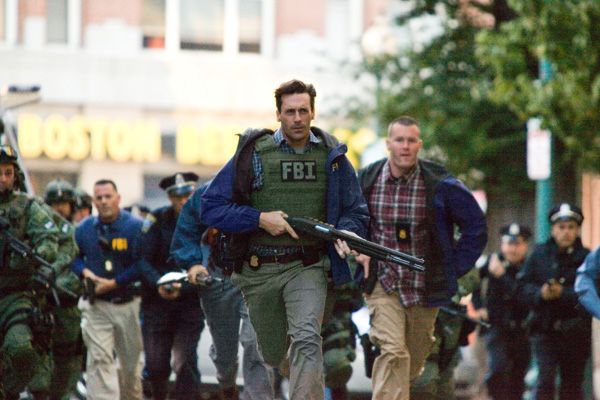
I'd have been happy with more of the same, but Affleck has changed gears impressively for this crime drama about a foursome of expert knock-over artists (the FBI agent assigned to the investigation—played by Jon Hammcalls them "The Not-Fucking-Around Crew") trained from endless hours of watching the endless array of CSI shows on TV, and the second generation of Charlestown townies doing the dirty work their fathers have engineered, or are paying the price for. It looks like robbery, but it's more like literal class war-fare (with automatic weapons) between the have-nots and the "Hahvard" elite of Cambridge. Affleck stages three intricate robberies, each one different in scope and technique and each with their own visceral power that catches one off guard with some truly impressive ways of presenting them. The first, a bank robbery, starts with a black and white silent image (save for some electronic telemetry sound-design) from a security cam that explodes into color and sound when they burst through the door. The second, an armored car robbery, with an elaborate get-away through tight streets and back alleyways that is truly frightening. The third...I won't even say. But, it recalls some doom-laden Alamo-like circumstances from a lot of fine film-makers of the past, and, like the other action set-pieces, it's filmed efficiently to provide just enough information, and propel forward to the next gut-wrenching development. Howard Hawks once said of Don Siegel's hard-hitting approach to film violence "That stuff's hard to do." Affleck makes it look easy, and he avoids embraced movie-cliches nimbly; he even provides one of the most inelegant fights since the fight in the bar in The Treasure of the Sierrra Madre.
The Town has a great screenplay, too. Frustrating, deep and complicated, it also provides nice grace notes that reverberate throughout the movie, and hang in the mind on the way home.
The story begins with that first robbery. One of the managers (Rebecca Hall, who plays fragility as well as she does brittleness) is forced at gun-point to open a time-lock safe, while the crew spends as much time destroying incriminating evidence, as they doing sacking the loot. An alarm is tripped and so she is taken hostage by the gang led by Jeremy Rennerdoing great repugnant work—and Affleck, and released at the ocean's edge. The trigger-men soon realize that she lives in their neighborhood, and it's decided to deal with her, which to avoid Renner's John Coughlin killing her, Affleck's Doug McRay takes over, and he becomes smitten as he sees the effects the trauma has wrought on her. Unaware of his part in their crisis, they begin a tentative relationship, and soon, he's caught in the middle, trying to hide double-truths from both his girl and his gang
"I'm sorry," he says (quite honestly) as she relates her fears about the incident.  "It's not your fault," she says, automatically...and the banal nicety hangs like an indictment between the two.
Affleck is less concerned with the expressive image here, and more concerned with the impactful presence, coding his film with broad strokes that link characters with circumstances and localesIt's a broader, more tough-as-nails approach to film-making than his first film, and that extends to his portrayal of violence which is presented unflinchingly and coldly and fast. Lives end in an instant, and the deaths are unromantic and not pretty. In the meantime, the tensions of all things good and bad unravel skeins of connection, and the film ends unresolved...but not ambivalent.

Friday, July 1, 2016

The BFG

Be Careful What You Wish For
or
Dreams That Go Bad

In 1982, a couple of big things happened in the world of kid's entertainment: Steven Spielberg directed E.T.: The Extra-Terrestrial, a re-imagining of an earlier screenplay idea in which evil aliens harass the residents of an American town—he became dissatisfied with it and reversed it with the help of screen-writer Melissa Mathison (who had written the equally magical The Black Stallion) to fashion it into the biggest movie hit of the year, and, for awhile, of all time; In London, Jonathan Cape published Roald Dahl's "The BFG," an expansion of a concept the author had dabbled with in his 1975 book "Danny, the Champion of the World," about a giant who makes frequent visits from "giant territory" to deliver dreams to sleeping Londoners. Both stories featured outcasts and their eventual relationships with their more-normal counterparts among the human community. It seems fated that the two would meld into a project that combined those two powerhouses of children's fantasy.


Producers Frank Marshall and Kathleen Kennedy, Spielberg's usual production partners, had been trying to make a live-action version since 1991 (an animated version was produced by ITV in 1989), but for one reason or another, never materialized, going through different screenwriters and directors until Melissa Mathison got the job from Dreamworks in 2011 (Spielberg's old production arm, Amblin, is credited as production studio so as to not imply a collaboration between distributor Disney and animation rival Dreamworks—"The Mouse" can get testy about such things). Spielberg came on board in 2014, filming began in March of 2015 and, incredibly, the thing got finished in time for a release by July 2016, including elaborate special effects by WETA that encompasses wholly 90% of the picture. Spielberg's upper ecehelon of collaborators all worked on it—cinematographer Janusz Kaminski, editor Michael Kahn, production designer Rick Carter, costume designer Joanna Johnston, and composer John Williams.
Melissa Mathison died, after battling cancer in November 2015, and the film is very early on in the credits dedicated "For Our Melissa"—not unlike Dahl's book being dedicated to his daughter Olivia, who died of measles encephalitis in 1962. A slight air of melancholy hangs over the project, which is fine as it frequently leavens Spielberg's penchant for the sugary, something that has been largely absent from his Senior work as a director.
And The BFG is remarkable—stunning in all sorts of applaudable ways. The effects work is stellar, making up the vast majority of the mise en scene of the movie with a fluidity and attention to detail that draws one in with fascination. This is spectacular world-building, similar to the care and beauty that went into Disney' 2016 version of The Jungle Book from earlier this Summer. And the motion-capture performances of Mark Rylance (who was the very sly stand-out for his underplayed work in Spielberg's Bridge of Spies), Jemaine Clement and the other giant actors is truly amazing, completely stepping over "The Uncanny Valley" as nimbly as if there truly were giants of great stride. Spielberg also retains his reputation as a deft director of children, getting a terrific performance from newcomer Ruby Barnhill as the heroine of the story, Sophie
Also, in this era of "no limits" cinema (thanks to the digital imaging revolution) it is refreshing that Spielberg takes care in the pacing, not throwing the movie into "editing over-drive" as seems to be the norm for "blockbuster-filmmaking" among the Spielberg acolytes. It is nice to see a movie not being made "by stop-watch" and trying to make Guinness by squeezing as many shots into a sequence as possible.
All noteworthy. But, I must confess for all the splendor there is to be seen, the overall effect left me uncharmed. This takes a certain amount of self-examination and confession. I am not the target audience, which is younger by decades. Saying that, I can still be moved by a film aimed at the youngsters and entertained—Pixar makes a regular habit of achieving that. And I'm a big fan of Spielberg as a filmmaker; I think he is the best of the current directors out there, eking out over Martin Scorsese by frames.
I was dissatisfied with the film, however, despite it hitting all its marks, and bringing the wonders and chills of childhood to the fore. Way past my sell-date, I can't imagine the reaction the film will have over young audiences. But, a great children's film should also appeal to adults, as well. And I found that the film dragged (despite my delight that it wasn't a roller-coaster). Bits of business and Spielberg's scrupulous sense of place by making sure the audience knows where it is at all times bogs the movie down no matter how fluid the camera work and intricacy of the choreography. I found myself drifting off, losing focus and the sense of caring about what was going on. Perhaps it was the circumstances under which the film was made. Maybe the filmmakers couldn't bear to part with a single word or sequence that had been worked out by "Our Melissa." Gifted she is, but in the editing room, a filmmaker must be equal parts story-teller and butcher. Maybe the affection for the screen-writer overwhelmed the cruelty of the knife that is required to make a tight, concise film that isn't in love with itself, so determined is its aim to win over the audience.
I always consider a Spielberg film "an event," so I went to an evening-before-opening screening of the film—saw it in 3-D—and sat down in the theater. Easy to find a seat, as I was the only one in the theater. True, 10 pm is past the bed-time of the targeted demographic, but I was still surprised at there being only an audience of one—the film is competing against the new "Tarzan" movie and the latest "Purge" film, both probably more suited for late night audiences. Still, I was shocked at the lack of humanity.
Hard to know what to make of this. Perhaps Spielberg has, indeed, become the director who makes great scenes but can't make a complete movie (as one internet snark put it—I really MUST stop reading comments sections). I don't think so. Bridge of Spies and Lincoln were both terrific films. I think this was a case of too much affection for the material to the point of protection, and maybe some hubris that a Spielberg children's film was a certain home-run. Nothing is certain in the market-place. This one may be big, it may be friendly, but its quite a few feet below giant stage.
Disney with Dahl at the time they were making their "Gremlins" short for the Armed Forces.