Showing posts with label Rafe Spall. Show all posts

Wednesday, August 28, 2024

One Day (2011)

Supposedly, there's a mini-series of this on Netflix released this year. I saw the movie version  in 2011, and I wrote about it at the time of the film's release.

"July 15ths with Emma and Dex"
or
"Same Time Next Year"

Can a man and woman "just" be friends? (the question posed by When Harry Met Sally)  I've gone 'round and 'round with this one. I've said "Yes" for many years, and then that became "No," then back to "Yes," and now, it's something of a toss-up. "It's possible," I say noncommittally (which is the basis for many of the male-female problems, friendship or no).

But anything is possible.
 
"One Day" was a nifty best-seller by David Nicholls, smart, tight and funny, a romance told in snap-shots of one day that was realistic about the vagaries of life and love and the "yin" and "yang" of both. What makes the novel special gets distilled somewhat in celluloid form, making One Day feel a bit less exceptional, the humor muted somewhat, and given the twenty year time-span of the movie, some of the anniversaries celebrated are given short shrift, skipping to the more complicated "good parts," as opposed to those years when nothing much happens...you know, like "life."*
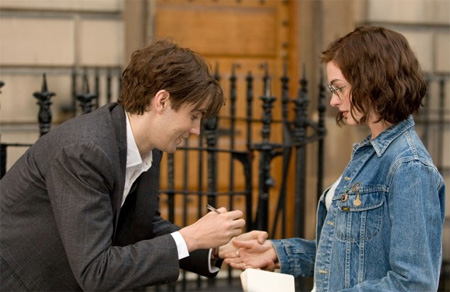
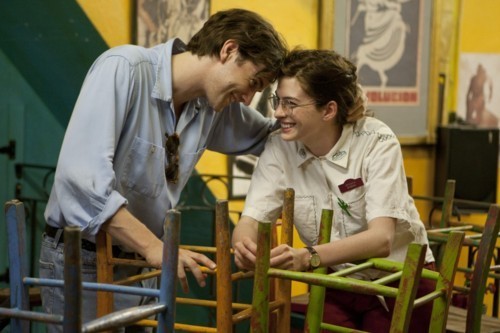
Dexter (Jim Sturgess) and Emma (Anne Hathaway) have "just met" at their graduation as they string along with their mutual friends, a couple. Emma is bookish, unstylish, a bit of a character—has a "nice personality"—Dexter is boyishly handsome and knows it, and Emma is "crushing." An awkward "overnight" happens, where it is unclear what transpired, but it's important enough that Dexter is helping Emma move when the next 15th of July occurs, but not important enough that Dexter isn't moving to Paris to teach.
July's come and July's go, as
Emma suffers through waitressing at a London Tex-Mex restaurant and Dexter jumps from job to job, eventually becoming  the smarmy host for a late-night dance teen program. Where Emma is a busy bee, droning through know-where jobs until she catches her big break, Dex is a moth attracted to the brightest (or blondest) thing in the room. They're devoted to each other, but only so far. As her star rises, his sets—first Mom (the ever-reliable Patricia Clarkson) dies of cancer, then his fortunes go South, followed by years of over-indulgence. Before you can say "This is Mrs. Norman Maine," he is seeking her out, where she has nearly given up. As traditional as this is, what is nice about One Day is that Emma does just fine without him, she makes her way in the world without a man's help (and frequently, they're a hindrance), whereas in most films of the romantic genre, everything can be solved by anything in pants.

The director,
Lone Scherfig, previously made An Education, which, while well-acted and elegantly directed, suffered from a distinct lack of heat and a little too much posh. The former problem still applies here. The film is decidedly chilly in tone, and while this is a welcome change from the day-glo color, syrupy music rom-coms that chirp incessantly about Moon, June, (premarital) Honeymoon," poking you in the heart-area that "Love is Great, right? RIGHT?" One Day makes it hard to feel anything beyond "Gee...that sucks."

Maybe it's the skipping around from year to year, but there's a distinct lack of focus in the story, as it spreads itself around a bit too thin, the ancillary characters populating the movie to make life difficult for Emma and Dexter, necessary irritants and bothers that will drive them into each other's arms every year. Plus, the story arcs of the two main characters run precipitously up and down, without any jolts of happiness amidst the gloom, or hurdles to happiness on the ascent.
**
Things settle down as people "settle" and, although One Day manages to avoid many of the cliches of the romantic genre, it also hasn't found anything as compelling to replace them. Plus, with the mutual reversals of fortune, there seems to be a dramatically required "leveling of the playing field" in order for things to resolve "the way they should".
One should be grateful that one is asking these questions about a romance movie (haven't done that in a while), so it's nice to see somebody making the attempt. But, one gets the idea that the same old "Love Potion No.9" is being hawked. All they've done is change the shape of the bottle.

* One of my favorite quotes is by Anton Chekhov: Any idiot can survive a crisis; it's the day-to-day living that wears you down.

**  Well, that's not entirely true, but we don't want to give anything away. 

Saturday, June 29, 2019

Men in Black International

MIBI. MIBI Not.
or
"...Some Next-Level Shit Going On"

The economics of the "Men in Black" series required some sort of re-boot; if they'd gone with previous stars, they'd have had to save on a cosmically scoped series by restricting their location work to Will Smith's voluminous trailer.

Besides, the series needed it. The "Men in Black" organization in the previous three films had a galaxy-wide perspective, but we never got to know anybody but the two leads, that film's chief antagonist, and the organization's leader, which it it feel like director Barry Sonnenfeld's perspective-warping visual-joke-tags. It was seriously about time to expand the series' event horizons and give it a little breadth. That they've done with Men in Black International by introducing a new recruit. Call her Molly (the charming Tessa Thompson), but she's agent M in MIB (Do they have only 26 agents?? Then they can't even get a decent group-rate insurance discount!), whose encounter with an alien (and the actions of the MIB organization during it) inspires her to become an agent with the super-secret agency as an adult. She's farmed out—by MIB head O (Emma Thompson, the only past cast to return—at least they're keeping the best)—to the foreign exchange to learn the ropes of alien wrangling and memory wiping.
O sends her to the London office where she meets former agent T (Liam Neeson) who has become the head of the department—he's now referred to as High-T (so precious).** He pairs her with Agent H (Chris Hemsworth), his former partner on a Paris mission to intercept and neutralize a group of aliens called "The Hive." H is well-regarded in the organization, but he is a kind of a Bondish Man in Black with a sloppy work ethic and walks around like he's coated in black teflon.  
The plot—such as it is—involves a version of the assassination of Archduke Ferdinand, who, with his dying exhalation entrusts M with a cosmic McGuffin that can be transformed into a powerful weapon capable of creating a Grand Canyon in any state without benefit of a a large river and millions of years. There could be details detailed that would expand the synopsis, but, they're exceptionally un-clever and we've seen them before. Aliens invade, assume human form, are looking for something with a power far greater than its tiny size would indicate, and...oh, yes, they're helped by an alien who has suffered at the hands of the invaders. This isn't writing, this is word-processing and the Ctrl, C, and V keys are getting a bit worn.
And that's it. This is going to be a very short review for a movie that doesn't deserve any more scrutiny, merely due to its lack of effort. Hemsworth and Thompson were delightful together in Thor: Ragnarok and they are not throughout this one, although Thompson tries mightily hard. They just don't seem to mesh, probably because Hemsworth's H isn't hamstrung and is allowed to lord it over the obviously more competent M, which rankles and flies in the face of what worked in the Marvel film. 
Or, it just might be that that film's director, Taiki Waititi, had a better sense of how to keep the two actors bouncing off each other, than this film's F. Gary Gray** does (although his work here is a fair imitation of Sonnenfeld's loopy roller-coaster ride that threatens to go off the rails at any second) and that seems to extend to the rest of the cast, including Rebecca Ferguson, who's great in the "Mission: Impossible" films, but is utterly charmless here.
Capitalizing on past glories in MIBI
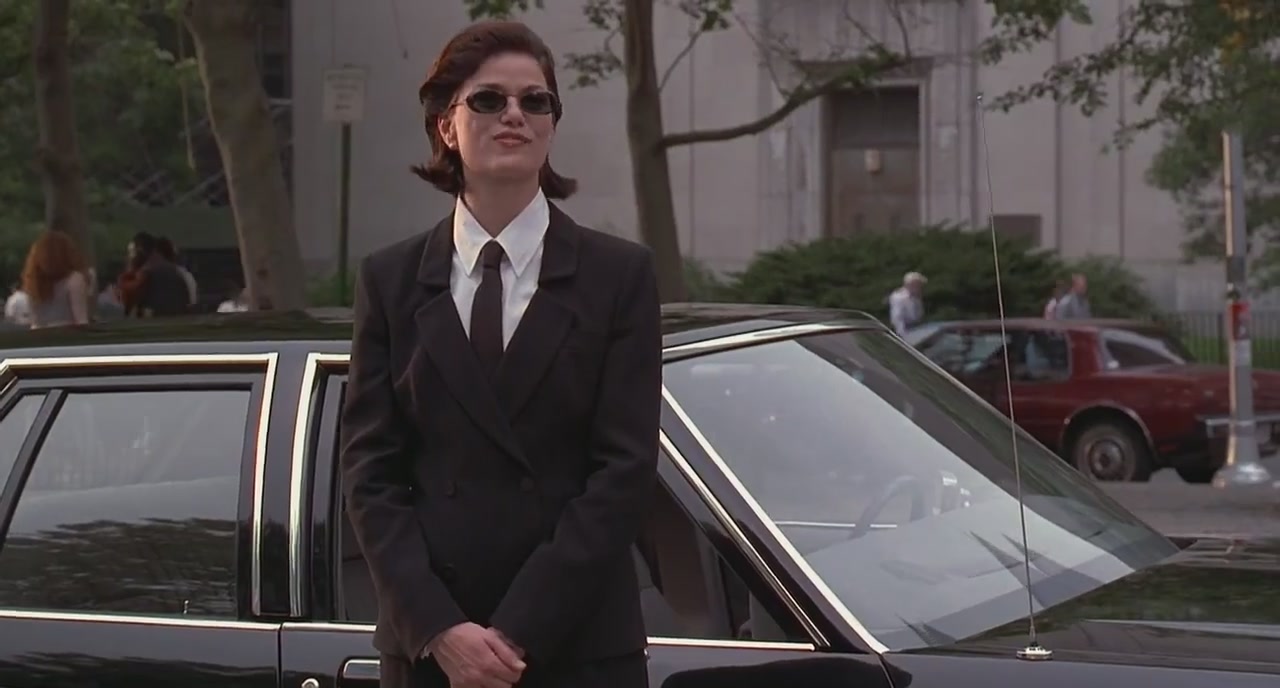
In a Universe of ideas and the expectation that science-fiction might go somewhere where no writer has gone before, why would anyone settle for this re-tread that doesn't even try hard to do something new or think a little differently. Geez, they couldn't even try to do a compare and contrast with the American version, the film being based in Europe and all? But, no, that might be doing something beyond anyone's scope, micro-or tele. Hey, guys, maybe bring back Linda Fiorentino's Agent L from the first movie? I mean...anything?

I don't think the franchise could stand another one like this: been there, zapped that.
Ya really didn't like it, huh?
* Hey, maybe they could do a cross-over with Taken, and this time, his daughter could be abducted by aliens—c'mon, it's as believable as the LAST one.

** Gray tried to leave the project, supposedly, as the film suffered from Studio "regime-Change" confusion, and its producer Walter Parkes re-wrote the script that Thompson and Hemsworth signed up for, and he even directed parts of it. Geez, maybe the next movie should have a race of incompetent aliens trying make sense of an invasion plot when their leader dies.
Just look here and let's forget it ever happened.

Thursday, March 14, 2019

Jurassic World: Fallen Kingdom

Jurassic World: Fallen Kingdom (J.A. Bayona, 2018) I didn't go see the latest installment of the "Jurassic Park" series when it was in theaters because its predecessor Jurassic World didn't do anything new, but merely switched out new characters for the old (with the exception of Jeff Goldblum), and continued with the idea that, despite the mayhem from three previous movies, someone—or some conglomerate—would still think it was a good idea to create a theme park around living, breathing, carnivorous, and entirely untrainable giant lizards. Then, they went with the crazy idea that someone—especially Chris Pratt's Owen Grady—could train veloci-raptors and—because science fiction reality isn't enough—that one could create NEW dinosaur types by tinkering with their DNA. There is just so much evidence that this is a Capital B-Capital I-Bad Idea on so many levels, but the movie had to track away from the original's "naivete of visionaries" theme to the naivete and craven greed of corporate interests. You can always count on corporations to do the wrong thing when a buck is concerned. So, the initial under-pinning of "just because you CAN do something, doesn't mean you should" gets lost in a message so obvious and ever-present, any novel new idea gets swamped by it.
Well, along comes Jurassic World: Fallen Kingdom, and it recycles Spielberg's (rare) sequel film The Lost World: Jurassic Park, like so much re-captured DNA, with only a few changes to people, places, and things.
In that, the ne'er-do-well nephew of park creator John Hammond decided that, despite the disasters evident in the first film, he would ship a bunch of the dino's over to the U.S. (that wasn't in Crichton's follow-up novel, but Spielberg really wanted to have rampaging T-Rex's tromping through city-streets before some hack did it) for profit—because it worked so well having them on Isla Nublar.
Again, very bad idea. But, it's the exact same premise of Fallen Kingdom. This very bad idea is predicated on the issue that the volcano on Isla Nublar has decided to go super-nova, and so a mission is undertaken—by Hammond's business partner Benjamin Lockwood (James Cromwell) to save as many different dino-types as possible and put them on a new island—don't most large  islands have volcano's?—where they'll be safe to wander around without trampling any tourists (and, evidently, there are dino-preservationists who, since we've already messed with the natural order of things, think we should protect dinosaurs because they're so warm and cuddly, fit right into our eco-system, and besides "what could go worng? This is how Claire Dearing (Bryce Dallas Howard) gets roped into the thing and this movie.
And if she's onboard, she'll get Pratt's raptor-trainer to coax "Blue" the remaining raptor from the last movie to get into a cage, or even sit on his lap, for the long flight to the new paleological digs.
This would be all fine-and-dandy (if a Bad Idea), if the intent was to actually re-locate the dinosaurs. But, no, it's a ruse by those shadowy corporate interests to auction off species for their potential uses of weapons of mass-stomping (they probably didn't show King Kong as the in-flight movie). Again, Bad Thing to do, but, then, a sequel was a bad thing to do, as well—so, one can imagine that such a thing might be possible.
The movie does have one nice little wrinkle to it that might be considered an interesting idea, and that is how they employ the standard "spunky little kid" into the scenario, which does utilize the "just because you CAN do it, doesn't mean you should" theme to its maximum and logical conclusion. It is the one interesting idea in this sorry mess.
It is a sad thing to see, especially considering the director. J. A. Bayona has made a couple of really good, if not especially profitable films—A Monster Calls and The Impossible. Both of them are miles apart in genre and subject matter—one based on a popular children's book and the other on a true incident that occurred during the catastrophic tsunami in Thailand in 2004. It must have been tempting to take this talented director and try and goose his box-office appeal with a franchise-piece. But, it might have better served the director (and movies in general) to have allowed him to merely go with his muse and develop a project of his own leanings to create something truly unique as has been seen in his work in the past.
That might have been a GOOD idea.


Saturday, July 21, 2018

Life of Pi

Written at the time of the film's release...

"The One with the Tiger..."
or
The Ocean in a Universe/The Universe in an Ocean

“The most terrifying thing about the universe is not that it is hostile but that it is indifferent; but if we can come to terms with this indifference and accept the challenges of life within the boundaries of death--however mutable man may be able to make them--our existence as a species can have genuine meaning and fulfillment. However vast the darkness, we must supply our own light.”  -- Stanley Kubrick

"It's a story that will make you believe in God" --Pi Patel


Life of Pi, Ang Lee's new film is the best film I've seen all year, and it will take something very spectacular to displace it (which I doubt will happen). A children's film that children probably should not see, its themes are so adult—having to do with survivor's instinct (and that only reveals itself at the end)—and is presented with such a visionary sense of wonder that it is quite overwhelming. It's the most glorious, funny, amazing film that ever made me weep at the end.

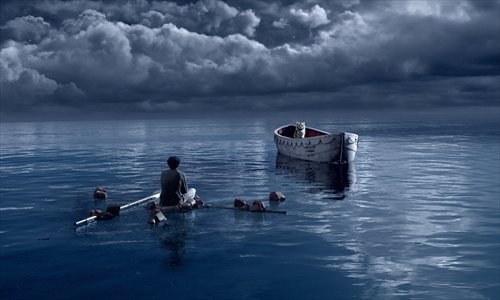
Based on Yann Martel's Booker Prize winning novel, it tells of the story of young Piscine Patel, who grows up affluently in Pondicherry, India in a resort-zoo run by his family. Growing up inquisitively, surrounded by animals, he begins a personal search for God that links him with several religions and interpretations of God.

He'll need all of them on his journey.
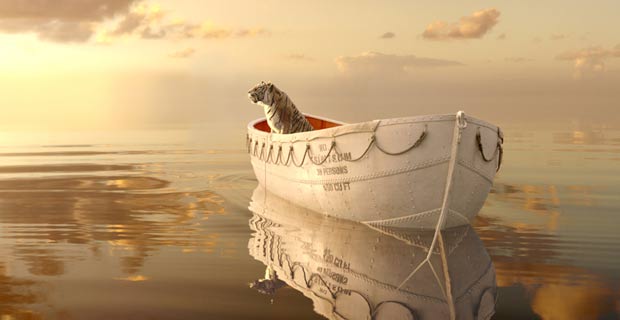
Political struggles in India leads the father to sell the zoo and embark for work in Canada, taking many of the animals with them on a Japanese freighter. The crossing becomes disastrous, the ship being capsized in a storm, leaving Pi, Ishmael-like, on a life-raft with a few stowaways that he rescues after the sinking. But, before long, it's just him and a Bengal tiger.
The journey then becomes a struggle for the two to survive, learning to cope with the hardships of surviving, stranded at sea, without killing each other.
That much you can glean from the previews and the poster, and to say anything else will spoil a lot of the charm of the story-telling. This is Ang Lee playing with film-making in God's paint-box. Forget that the film is seemingly impossible to pull off with the elements—filming on open water, with animals, some of them dangerous—Lee manages to make an amazingly entertaining film where the real and CGI flow seamlessly together, just as the story elements and philosophical arguments do, and done in such an imaginative way that one is frequently breathless as it unspools before your eyes.  
Lee has done wonders with CGI before, but (like Cameron and Scorsese before him), he also manages to make the 3-D element become an integral and, (this is a surprise), necessary function of the film, weaving it into the narrative, like tapestry, and giving the film a sense of scope and scale across time and space that, frankly, I've never seen anyone try before.
Now, the film is controversial in some parts: the critic for "People" magazine has written they "just hate" the ending, and I've read a few other reviews that have praised the film to the heavens, with some hedging about the ending not fulfilling the promise of the rest of the movie. They're missing the point, and in their defense, the visuals have a way of seducing and comforting, but also distracting from what is important (like any good belief system). The ending is part and parcel of what the movie is about, which is finding the path to make peace with the world by any means necessary, even if it is by using a little imagination and the application of myth and story-telling—to see things a little differently and make sense of an indifferent Universe. Pi's search for God in his youth prepares him for the trials of surviving the ship-wreck, submerging his grief, and the movie's story of his 221 day journey—a speck in the vast ocean—is a fable reflecting the life-journey for all of us, adrift or under sail, whether charting our course by our stars, our God, or our selves.


Thursday, June 1, 2017

Prometheus

Going to Meet Your Maker 
or 
"Eloi, Eloi, lema sabachthani?"*

Every time I see a poor copy of a good idea become the latest pop darling out there, I get the inevitable useless reply from someone who takes it personally: "There aren't any original ideas anymore! Just because it's been done before doesn't make it bad!" (And it certainly doesn't make it "good!") It's missing my point. I don't care that it's been done before (and I'll identify where if anybody wants to look it up), what I care about is that it isn't done as well. Jean-Luc Godard said "It doesn't matter where you take things from, it matters where you take things to."  

Succinct and right on.

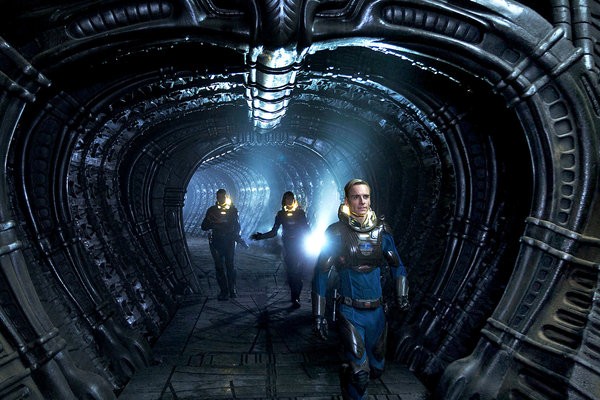
So, now, Prometheus—Ridley Scott's return to SCI-FI, and the world he created in Alien. If one goes in seeking another "Alien" movie, one might come out a little disappointed. Oh, there are chases with disoriented POV's, conflicted crews and amoral androids, "hair-in-the-drain" icky effects, H.R. Giger designs, shocks and revelations, but this isn't Alien.
It's better, richer, and more thought-provoking...while still being a rather nifty action-horror-science-fiction hybrid. It must be a hybrid, as Scott (and screenwriters Jon Spaihts of The Darkest Hour and "Lost"'s Damon Lindelhof) have stolen just about every science-fiction idea in the Universe.  

But, again, where they take it is original in its implications. SCI-FI always asks "What if...?" This one goes one question further in the interrogation and asks "But why?" Yes, it's a monster movie, but like so many of those, God plays a role. 
There's a significant amount of religion in this film, and speculation about God and our origins, but it still manages to find room for Faith in settings that remind one of Hell.
Dr. Elizabeth Shaw (Noomi Rapace, the first "Girl with the Dragon Tattoo") is an archaeologist who stumbles on the latest of a series of cave paintings that have the same image even though originating from different parts of the globe. This new one is in the Isle of Skye in Scotland. The paintings show a group of primitives praying to a huge humanoid figure who is gesturing towards a configuration of six planets.
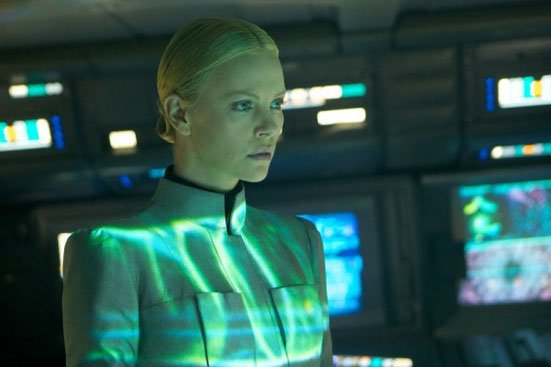
It's enough to fund Shaw and her lover-colleague Dr. Holloway (Logan Marshall-Green, in a performance that's trying too hard to find significance) on a trillion dollar excursion to find the only place in the Universe where the planets have that configuration at that point in the sky (??) aboard the good ship USCSS Prometheus, captained by Janek (Idris Elba, even more impressive than he was in Thor, in fact, I'd enjoy a movie centered around this character), overseen by Meredith Vickers (Charlize Theron, in brittle ice-queen mode) of The Weyland Corporation, caretakered by David (Michael Fassbender, in a terrific heavily-influenced performance), an android who serves as ships' H.A.L. in all manners, including a slightly unctuous air, but in movie choices fancies David Lean over Kubrick.** Once they get planet-side, a holographic image of the CEO of the Weyland Group (Guy Pearce, in extreme old-age make-up) introduces Shaw and Holloway to the dubious crew—the mission: to find that planet in the cave paintings and see if we can find the humanoids pointing us there. In simple terms, we want to find that ancient "god." They find a landing strip of sorts and settle there because "God does not build in straight lines."
Upon landing they find a semi-hostile environment with two ancient dome-like structures. They enter and begin digital cartographing with laser mapping drones. As they go deeper into the structures, things seem somewhat familiar to the sequel-oriented movie-goer, but not really. It's a clean environment, protected against savage wind-storms, snaking corridors and the occasional dead body of an alien species. What happened here?
If you think you know where it's going, you're wrong. This one's going somewhere else than running down a neon-lit corridor being chased by a monster (well, there's some of that, in fact quite a bit of it). But, it's a much bigger Universe than the Xenomorph of the first one (I've started calling them "glitches" after this movie), and if there is a sequel to Prometheus, it's going to be along a different track than Alien, and has bigger fish to light up with a flame-thrower.
It's technically stunning, and fun to see how they took all the unused stuff left on the drawing room floor in Alien and incorporated it here. And lest you think that this is a high-philosophy movie, no, it's scary, designed to make you jump and gross you out. It is a horror film, after all, but for all the shock stuff, it might also make you think, as it toys with big sci-fi ideas—"A Shaggy God Story" as acerbic critic John Simon called 2001: A Space Odyssey. But, it's Scott's best film in years, retracing old steps, sure, but finding a new path to go somewhere else, some place a lot more interesting.
"The answer, Dear Brutus, is not in our stars, but ourselves"

* No, it's not Klingon. It's Aramaic.

** In fact, he watches a scene that we featured in a "Don't Make a Scene" article.

Friday, July 1, 2016

The BFG

Be Careful What You Wish For
or
Dreams That Go Bad

In 1982, a couple of big things happened in the world of kid's entertainment: Steven Spielberg directed E.T.: The Extra-Terrestrial, a re-imagining of an earlier screenplay idea in which evil aliens harass the residents of an American town—he became dissatisfied with it and reversed it with the help of screen-writer Melissa Mathison (who had written the equally magical The Black Stallion) to fashion it into the biggest movie hit of the year, and, for awhile, of all time; In London, Jonathan Cape published Roald Dahl's "The BFG," an expansion of a concept the author had dabbled with in his 1975 book "Danny, the Champion of the World," about a giant who makes frequent visits from "giant territory" to deliver dreams to sleeping Londoners. Both stories featured outcasts and their eventual relationships with their more-normal counterparts among the human community. It seems fated that the two would meld into a project that combined those two powerhouses of children's fantasy.


Producers Frank Marshall and Kathleen Kennedy, Spielberg's usual production partners, had been trying to make a live-action version since 1991 (an animated version was produced by ITV in 1989), but for one reason or another, never materialized, going through different screenwriters and directors until Melissa Mathison got the job from Dreamworks in 2011 (Spielberg's old production arm, Amblin, is credited as production studio so as to not imply a collaboration between distributor Disney and animation rival Dreamworks—"The Mouse" can get testy about such things). Spielberg came on board in 2014, filming began in March of 2015 and, incredibly, the thing got finished in time for a release by July 2016, including elaborate special effects by WETA that encompasses wholly 90% of the picture. Spielberg's upper ecehelon of collaborators all worked on it—cinematographer Janusz Kaminski, editor Michael Kahn, production designer Rick Carter, costume designer Joanna Johnston, and composer John Williams.
Melissa Mathison died, after battling cancer in November 2015, and the film is very early on in the credits dedicated "For Our Melissa"—not unlike Dahl's book being dedicated to his daughter Olivia, who died of measles encephalitis in 1962. A slight air of melancholy hangs over the project, which is fine as it frequently leavens Spielberg's penchant for the sugary, something that has been largely absent from his Senior work as a director.
And The BFG is remarkable—stunning in all sorts of applaudable ways. The effects work is stellar, making up the vast majority of the mise en scene of the movie with a fluidity and attention to detail that draws one in with fascination. This is spectacular world-building, similar to the care and beauty that went into Disney' 2016 version of The Jungle Book from earlier this Summer. And the motion-capture performances of Mark Rylance (who was the very sly stand-out for his underplayed work in Spielberg's Bridge of Spies), Jemaine Clement and the other giant actors is truly amazing, completely stepping over "The Uncanny Valley" as nimbly as if there truly were giants of great stride. Spielberg also retains his reputation as a deft director of children, getting a terrific performance from newcomer Ruby Barnhill as the heroine of the story, Sophie
Also, in this era of "no limits" cinema (thanks to the digital imaging revolution) it is refreshing that Spielberg takes care in the pacing, not throwing the movie into "editing over-drive" as seems to be the norm for "blockbuster-filmmaking" among the Spielberg acolytes. It is nice to see a movie not being made "by stop-watch" and trying to make Guinness by squeezing as many shots into a sequence as possible.
All noteworthy. But, I must confess for all the splendor there is to be seen, the overall effect left me uncharmed. This takes a certain amount of self-examination and confession. I am not the target audience, which is younger by decades. Saying that, I can still be moved by a film aimed at the youngsters and entertained—Pixar makes a regular habit of achieving that. And I'm a big fan of Spielberg as a filmmaker; I think he is the best of the current directors out there, eking out over Martin Scorsese by frames.
I was dissatisfied with the film, however, despite it hitting all its marks, and bringing the wonders and chills of childhood to the fore. Way past my sell-date, I can't imagine the reaction the film will have over young audiences. But, a great children's film should also appeal to adults, as well. And I found that the film dragged (despite my delight that it wasn't a roller-coaster). Bits of business and Spielberg's scrupulous sense of place by making sure the audience knows where it is at all times bogs the movie down no matter how fluid the camera work and intricacy of the choreography. I found myself drifting off, losing focus and the sense of caring about what was going on. Perhaps it was the circumstances under which the film was made. Maybe the filmmakers couldn't bear to part with a single word or sequence that had been worked out by "Our Melissa." Gifted she is, but in the editing room, a filmmaker must be equal parts story-teller and butcher. Maybe the affection for the screen-writer overwhelmed the cruelty of the knife that is required to make a tight, concise film that isn't in love with itself, so determined is its aim to win over the audience.
I always consider a Spielberg film "an event," so I went to an evening-before-opening screening of the film—saw it in 3-D—and sat down in the theater. Easy to find a seat, as I was the only one in the theater. True, 10 pm is past the bed-time of the targeted demographic, but I was still surprised at there being only an audience of one—the film is competing against the new "Tarzan" movie and the latest "Purge" film, both probably more suited for late night audiences. Still, I was shocked at the lack of humanity.
Hard to know what to make of this. Perhaps Spielberg has, indeed, become the director who makes great scenes but can't make a complete movie (as one internet snark put it—I really MUST stop reading comments sections). I don't think so. Bridge of Spies and Lincoln were both terrific films. I think this was a case of too much affection for the material to the point of protection, and maybe some hubris that a Spielberg children's film was a certain home-run. Nothing is certain in the market-place. This one may be big, it may be friendly, but its quite a few feet below giant stage.
Disney with Dahl at the time they were making their "Gremlins" short for the Armed Forces.