Showing posts with label Jemaine Clement. Show all posts

Tuesday, July 22, 2025

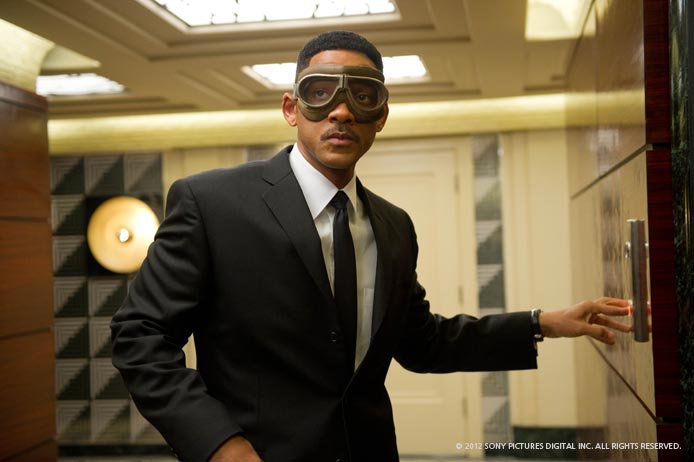
Men in Black III

Sunday was International Moon Day (yes, that's a "thing") commemorating the date that human beings first put boot-treads on the Moon. That historic mission figured fictionally in this movie.

Written at the time of the film's release. 

Time Wounds All Heels
or
"Don't Ask Questions You Don't Want to Know the Answer To..."

The third "Men in Black" film had to go somewhere else but up. The first two films were variations on the "illegal alien" theme about a government organization that monitored the activities of extraterrestrials in the world and specifically New York City, and revolved around alien invasions and the containment of said aliens. And when you've seen one alien invasion directed by Barry Sonenfeld, you've seen them all, and hyper-kinetically at thatAnd once it's been established that "aliens can be anywhere" the joke runs a bit dry pretty quickly, especially when the sub-species can contain pug-dogs and large cockroaches. The second film tried to expand on those concepts and felt a bit thin in the process, concentrating a bit too much on the secondary characters rather than the basic plot and the character interactions.

So, where does Men in Black III go from there?
One of the nice aspects of the series has been its ability to still think outside the box, while expanding the horizons of just what that box might contain, be it variations of scale and dimension, even if only in afterthought. With the infinite reaches of space seemingly exhausted, the group (based, supposedly on an idea by Will Smith) has the series going back in time. Naturally. It ostensibly revolves around an Earth-takeover plot by another alien (one must ask at some point "why always us?"), "Boris the Animal" (who seems based on the DC Comics "Hell's Angel in Space" Lobo and is played with growly gutteral responses by Jemaine Clement from "Flight of the Conchords") who escapes from his maximum (and we mean maximum) security prison to find the man who sent him there 40 years ago—Agent K (Tommy Lee Jones). When he's unable to kill him here, the Boglodite finds another means to do so, and Agent J (Smith) wakes up the next morning, the only one with any memories of K past July, 1969. Agent K has been killed by Boris in the past, and J must journey back to try and save him.*
Once back there, J negotiates his way through a 1960's era way of doing things. Everything's a little less high-tech (a little less), but the MIB Agency is still there, as is the much younger Agent K (Josh Brolin, doing a bang-on interpretation of Jones) and J must solve the puzzle of saving the Earth (of course), while keeping K safe. The past sequences are greatMen in Black has exploited the "fish-out-of-water" angle perpetually—and new corners are being thrown out the whole time (My favorite being a brief glimpse of a "Barbarella"-type being escorted around MIB, and although Smith is a bit too "Red Bull" throughout the entire movie, check out his understated reaction to some Black Panthers). 
Great cast, too. Rip Torn is gone, but David Rasche plays him in the past, Emma Thompson is on hand as the new MIB head, Will Arnett makes a brief appearance as does Bill Hader. Toss in the chameleon-like Michael Stuhlbarg as an alien able to read multiple time-lines and there's always someone to deflect the eye, or hand things off from Smith.
But, the best thing about this "Men-in-Black" installment is resonance. The other two were fine, the first better than the second just for its novelty, but had a shelf-life of three minutes. Part of it is Sonenfeld's way of comically undercutting any meaning to the thing, by changing perspective—"you think you got a handle on it yet? Well, let me throw THIS at you!" The whole "the Universe is so big and cosmic that there's no way you can understand it because there's so many mysteries, so nothing is real" concept, which is the backbone of the series (and the source for most of its humor) leaves one with a feeling of "meh"—nothing matters in a vast uncaring, unfathomable Universe. 
Not here. The cold of Space has nothing to do with the leavening of Time, and, in this case, the franchise plays it straight, without a wink, a nod, a reveal, or a goo-spraying splat. For once, something really means something in the "Men in Black" Universe, and that venturing into uncharted territory makes the third time the charm.

  * I'm not saying anything here that isn't revealed in the trailer.

Saturday, April 8, 2023

Dinner for Schmucks

Saturday is traditionally "Take Out the Trash" Day...

"It is Such a Pleasure to Laugh at the Misfortunes of Others"

Comedy is such a subjective thing. I don't know how many times I've quoted Mel Brooks' line that "Tragedy is when I cut my finger; Comedy is when you fall down a man-hole and die." And, as we are all individuals, one person's Bringing Up Baby* is another's Dumb and Dumber.** I know lots of fine folks who loved Date Night (Steve Carell's previous live-action movie), but I wasn't among them.

My tastes in comedy are not sophisticated; a good spit-take or prat-fall will make me howl with laughter. I like Jerry Lewis, as his movies will be guaranteed to contain at least one instance where I laugh 'til tears come out of my eyes. And I like good word-play, as my love for all things Marxian and Woody will attest. What I don't laugh at is regurgitation—recycled humor that is expected to be laughed at because, hey, it was funny the last time.  Thus, the charm of Mike Myers frequently eludes me.
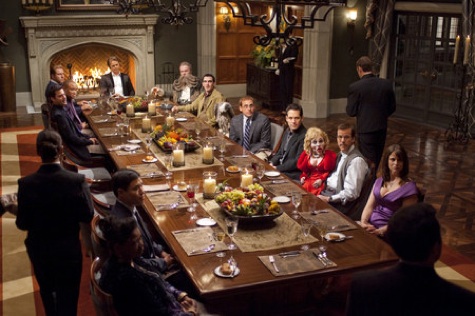
Now, Dinner for Schmucksthe latest film by the "Focker" and "Austin Powers" franchiser Jay Roach—he also directed the very fine HBO film Recount—is based on the French film Le Diner des Cons, so there is a French charm to it spoken with a flat American accent. An up-and-coming executive Tim Conrad (Paul Rudd) is welcomed into the higher echelon of the investment firm that employs him (run by Bruce Greenwood) by being invited to an executive dinner in which the firm's hoi-polloi bring along "idiots"—persons of a certain unique, and frequently inept, "talent" for the ridiculing entertainment of the host ("No mimes. It's a cliche").  Whoever has the best idiot is guaranteed a certain prestige position in the company, complete with corner-window office.
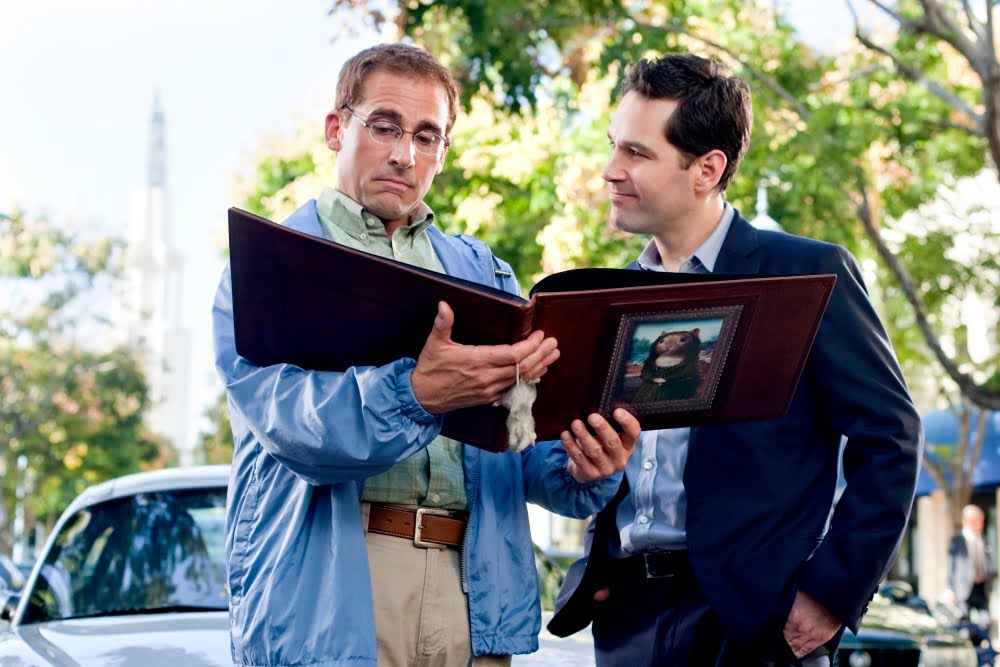
The idea horrifies his gallery contractor girlfriend (Stephanie Szostak) and only reinforces her instinct to refuse Tim's frequent marriage proposals.  He's just about to sacrifice his career and opt out of the dinner when Fate steps in front of his Porsche in the nerdly form of Barry Speck (Steve Carrell), an IRS drone whose hobby is to make bucolic fantasy dioramas using stuffed mouse road-kill, which he calls his "Mouse-terpieces." ***
Tim's destiny seems set, but the acquisition of the bone-head Speck turns his life upside-down in a series of
"Incredible Mess" scenarios that seem to nullify everything he might gain from winning the dinner game.  The film is a self-defeating trap that could have used a more harried leading man than Rudd (or more dead-pan, in which case, hey, Ron Livingston's in the cast!) that might have had more of a comedic pay-off, or at least have produced more dramatic risk out of the situations. As it is, everything feels a little safe, nowhere near creating the sort of comedic frisson this film so desperately needs.

For a movie specializing in cruel humor, it lobs only soft-balls, whether it's at the clutch of crazies at the dinner, a nastily predatory ex-girlfriend of Tim's (
Lucy Punch), or the what-comes-around come-uppance of the stuffy execs. Everything should be more manic, more crazy, and have a few more bite-marks that actually draw blood.
****
Points, though, for filling the cast with an array of good comedic talent including
Kristen Schaal and Jemaine Clement of "Flight of the Conchords" (series and group, respectively), Zach Galifianakis, the afore-mentioned Livingston, and Larry Willmore. The improvisational power of the cast is formidable, and (like Date Night) it feels a little too improvised at times as there are so many scenes that are barely gelled. However, a business lunch that is the definition of "awkward" is a highlight, as is a conversation between Speck and Clement's self-absorbed satyr-like artiste ("There are only two things that matter in life: wonderful, visceral sexy sex...and Death"), that benefits from the two comedians' off-kilter rhythms to big pay-offs. Such moments are few and far between.

* ...which I love.

** ...at which I didn't crack a smile.

*** The most charming part of the film is the title sequence, set to The Beatles' "The Fool on the Hill," of Speck putting the finishing touches on an out-sized version of his hobby.

 **** 2023 Update: Well, with that choice of words, maybe if they combined Dinner With Schmucks with The Menu. That would be...interesting? Maybe even "tasteless?"
"I hate tasteless!"

Thursday, January 19, 2023

Avatar: The Way of Water

It's All About...Family
or 
Fleeing Na'vi Dad
 
I was one of the few inhabitants of this planet that was unimpressed with James Cameron's Avatar—the most popular movie of all time (based on inflated movie receipts, truth be told). I felt it was Cameron at his worst—recycling shop-worn ideas under a veneer of technology and engineering—while also being a fun watch (if you didn't take it too damned seriously).
 
The sequel (first sequel) Avatar: The Way of Water was released at Christmas, and I was in no hurry to see it. I wanted to avoid big crowds, I wasn't "enthused" because I was underwhelmed (while being simultaneously over-stimulated) by the first and expected "more of the same." I also knew that it would be around in theaters for awhile, maybe even held in 3-D (where most movie-chains drop the refinements down to "Standard version" after a week). But, mostly I waited because James Cameron was in no hurry to release it, so why should I be in a hurry to see it. I mean, what's the rush? It wasn't going anywhere.
I did go see it, finally, in XD and 3-D. You might as well go the full yard. And, I found that to be a wise decision, as it brought up many aspects to the film, which I wouldn't even have noticed had I seen it "flat" and "standard." In fact, what is a tad revolutionary in the film and—to me, anyway—makes it worth seeing are the technical aspects of the film, which have achieved a new threshold in presentation of-screen.
 
It's certainly not the story, which can be Cameron's Achilles Heel. Concept, sure. But, what he does with it, not so much. His movies look good on paper, like an architect's sketch, but the blue-prints fleshing it out may reveal some flaws where hard reality conflicts with imagination.
A:TWOW
begins with Jake Sully (
Sam Worthington), now permanently on his surrogate-planet, Pandora, living with his mate Neytiri (Zoe Saldaña, who clearly knows how to eke out a subtle, effective performance from motion capture) and their kids, Notoyam (Jamie Flatters), Lo'ak (Britain Dalton), and Tuk (Trinity Jo-Li Bliss), as well as adopted kids Kiri (Sigourney Weaver), the child of Dr. Grace Augustine's avatar, produced by immaculate conception of something, and "Spider" (Jack Champion), the son of Col. Miles Quaritch (Stephen Lang), both of whom died in the original film.
Well, they're baaa-ack. Dr. Grace as a hologramatic image and spiritual Obi-Wan, and Quaritch as a hologramatic image and his own avatar (something, as I recall, that the original Col. Miles was dead-set against...oh, well...blue-prints). Quaritch's avatar is given one of those too-lame-to-be-inspirational Quaritch pep-talks about how he needs to man-up and take down Jake Sully because...well, he has to. Jake beat him last time fair and square, by having his wife shoot him, but...ya know...there was a conspiracy and rigged voting machines and Quaritch has no life but a huge ego and...blue-prints. There IS no reason for him to revenge himself against Sully, even if one doesn't include the fact the original character is dead and his avatar is only vengeful-by-proxy...and he's told to do it.
As specious as all this seems, it's enough to send Jake and family packing to another part of Pandora as refugees and depend on the kindness of the Metkayina tribe who live on Pandora's eastern seaboard and have a society based mostly on water and the denizens therein.* They must fight discrimination from the Metkayina ("they'll take our jobs!" and, more legitimately, "they'll lead the Earthers right to us!"). Along the way, Jake's kids want to sit at the BIG kid's table, and complicate matters. 
Not that there's much to contemplate. Earthers are bad. Pandorans are good. Earthers-gone-Native are good. Sometimes, parents just don't understand. At some point, Belle from The Little Mermaid should show up and do an "I know, right?"
"Jake! This is where we first met!"
 
But, as simple as it is, it's a three hour movie and Cameron fills the spaces with a lot of his Greatest Hits: two equally matched fighters slugging it out in an industrial setting (pick a Terminator, any Terminator), learning how to manage your breathing underwater (The Abyss) and finally, having to get out from under-deck of a sinking boat (Titanic). Things look different in Metkayina—the folks are greenish around their gills—but it doesn't matter where Cameron goes, there he is. It's very familiar.
Except when it's not. Kudos to the design team to make the Metkayina look like a different culture (I think, by now, movie-goers are hep to accepting and even embracing that concept). But, the real eye-opener is how good the CGI (mostly from New Zealand's WETA) has gotten. Performances are sharper and subtle (as I said, Saldana shines at this), and they even manage to make a Sigourney Weaver character look "right"—I remember there were audible grunts of disappointment at the appearance of her avatar in the last one as the CGI looked "uncanny-valleyish."
Look at the subtlety of expression in Saldana's character.
She is clearly giving Sully the "Dad's being a little heavy-handed" look
 
The CGI characters are so good and so realized that when a real-life human being shares the screen with them, they look flat and slightly less real (the human actors do have the disadvantage of being subject to gravity) than their pixelated counterparts. Maybe it's the effects of 3-D capture, or the differences between reflected lighting and computerized grading, but this is particularly true in the character of Spider, who often gets lost in the wash of images and is bound by the limits of movement bound by the laws of physics. Now, that will be an interesting challenge for Cameron and other film-makers in the future.
There are still issues with close objects "fritzing" as they move across the screen, so maybe objects should be less enfolded in the scenery.** Where the 3-D really, really works are in shots of floating screens and in the underwater shots that dominate the second hour of the film. Cameron went to the trouble of filming his motion-captured actors in a studio water-tank swimming about and there's something about the heavy influence of water and the languid way things move in it that feels particularly realistic with CGI rendering and 3-D projection, far more effectively than with the open-air scenes. It's a particularly effect feat of magical image-making that is incredibly credible and remarkable.
Now, if they could apply the same ingenuity to the scripting as they apply to the technology, that would be something. Maybe like losing the Quaritch character and its lunatic revenge story-line, would allow Cameron to concentrate on something worth the effort, both on his and our parts.
 
* Jake never once thinks that his leaving may not deter Quadritch from laying waste to the Omaticaya, anyway. Because he was so subtle and nuanced in his approach LAST time?

** There is a caveat to this: some of the "Ridley-Scott-fluff" that Cameron inserts into the frame doesn't always "work" but his insects were good enough to provoke the kid in the seat in front of me to reach out to try and grab them. That's a good (if amusing) testament.

Friday, August 26, 2022

DC League of Super-Pets

It's International Dog Day...and we're in kind of "dog days" at movie theaters...so...this...

The Secret Life of Secret Identity Pets (They Wear Masks...and They Fight Crime!!!)
or
"You Know Nothing Until You've Drunk From the Cold Steel Tube of POWER!"
 
So, discriminating comic-book readers—and I mean DISCRIMINATING comic-book readers—fall into the Marvel camp and the DC camp (All the others don't matter because we're talking about "discriminating"). They are COMIC-BOOKS, but the "truefans" treat them very seriously. Deadly seriously. Because they're guys...and they're TOUGH guys who wouldn't be caught DEAD reading the rival company comic book. So, they don't want to hear that Marvel comics are soap-operas with powers and tights—not too far afield from Stan Lee's True Romance writing (did you ever stop to think that Peter Parker having two girlfriends fighting over him was basically "Archie"?). And DC Comics are wimpy because, well, they're more adolescent (until Frank Miller showed up) and because they have things like super-pets.*
 
Yeah. DC has had "super pets" since the "Silver Age" of Comics. Superman (and Superboy) had Krypto, the Super-dog (and Beppo, the Super-Monkey). Supergirl had Streaky, the super-cat and Comet, the Super-horse (about which we don't say too much). The Atom had Major Mynah. Aquaman had Topo the octopus and Storm the seahorse (in his cartoon series, as well as the comics).

And Batman had Ace, the Bat-hound. Who used to wear a mask. Because he had a secret identity or something. Oh, you laugh now. But, hipster British writer Grant Morrison topped that when he created a character called "Bat-cow."
Bat-cow does not appear in DC League of Super-Pets.** Nor does Beppo, or Streaky, or Comet (or Cupid), or Topo, or Storm...not even Detective Chimp. But, Ch'p does. You know. Ch'p, the squirrel Green Lantern—he's called "Chip" now (and voiced by
Diego Luna). And "Merton" (voiced by Natasha Lyonne!) the speedster turtle from the Zoo Crew, a "funny animal" version of DC heroes, that starred Captain Carrot. I am not making this up.
But, the leads for DCLOSP are Krypto (Dwayne Johnson) and Ace (Kevin Hart), the World's Furriest (re-teaming from Central Intelligence). Plus, there's a pig (Vanessa Bayer ), who for some sexist misogynist reason is associated with Wonder Woman (Jameela Jamil). What, we're looking for logic here? It's a cartoon about super-animals, fer Rao's sake! And it's not canon! In fact, it's a toy commercial.
 
But, I digress...
DCLOSP picks up where every good's children's cartoon should start—with the destruction of an entire planet and race of people. Yeah, they "do" Krypton again, and it's amusing that Superman's parents, Jor-El (Alfred Molina, not even attempting Brando...that's restraint) and Lara (Lena Headey), wear glowing white suits like the first Christopher Reeve movie (they even use John Williams' "Krypton Theme" here). It seems that Jor-el's dog Krypto hitched a ride in that Krypton arc and, like his master Clark Kent (John Krasinski), gained super-powers (I live under a yellow sun and I never got super-powers...not even a lousy "S" t-shirt!). 
And they're the best of buddies...except for one nagging detail—I use the word "nagging" because it's Lois Lane (
Olivia Wilde). Jor-el didn't like her in "The Donner Cut" of Superman II, and Krypto IS his dog, after all, loyal way past death. Well, Clark and Lois are getting kind of serious, and Krypto, in his doggy way, knows that three's a crowd (if not a kennel) and he won't be getting bed-privileges anymore. Naturally, he's ready to concede that pecking orders are overrated and he will be happy to have Lois in his life because...two masters, right? 
Not!

Where's a super-villain when you need him to upset the status quo? Fortunately, Lex Luthor—while not busy "fixing" voting machines and stacking the courts and raising pharmaceutical prices...and...lobbying—is working on a nefarious plot: to use his ultra-powerful tractor beam to capture an asteroid made of (wait for it) "orange kryptonite." "Orange kryptonite?" What does that do? Turn you into a pillar of granules like "Tang?" No, Lex has it in his follicle-disadvantaged head—Chris Rock, don't make a joke!—that orange kryptonite gives you Earth-folks super-powers (maybe because of all that Vitamin-C!) and is determined to capture it. Well, the Justice League—Keanu Reeves voices Batman, which is just precious—prevents it, but it doesn't stop a former LexCorps test-animal, a guinea-pig named Lulu (Kate McKinnon, having a good, manic time)—now relegated to an animal shelter because of her bad attitude—from capturing a shard of orange K with her own tractor beam, thus giving her (bwa-ha-ha) super-powers.
It also affects that list of shelter animals mentioned previously and they all pack-up with a de-powered Krypto (someone put green kryptonite in his flea-and-tick collar) to make everything all right for Truth, Justice, and The Never-Ending Battle Against Dander. Nothing to sneeze at! By the end, all the super-powered pets have teamed up with super-humans and everybody lives fuzzily ever after. Even Wonder Woman and her pig.
Look, I wasn't fond of The Secret Life of Pets, and this is merely that movie with super-powers although some of the "in" jokes are kinda funny. The meta-acknowledgment of a required "training montage" is a nice touch (although it's not that prevalent). At one point, Lex Luthor crows to the captive Justice League: "I had my office turned into a rocket-ship! All the billionaires have one!" To which Batman replies "It's true. They do." That's almost as good as the pregnant pause in the middle of a confrontation where Batman blurts "I miss my parents..." or when he rejects having a canine partner by growling "I always work alone...except for Robin. And Alfred. And Commissioner Gordon. And that guy Morgan Freeman plays." This Batman isn't very self-aware.
My favorite joke comes when Ace (the Bat-hound with a mask, remember) trying to take the starch out of Krypto's cape supposes that his "dooky" doesn't stink. "My dooky doesn't stink," replies Krypto. "It smells more like sandalwood." Which, when your Master is The Big Blue Boy Scout, of course it does!
 
Those moments created some respite. But, don't take my opinion. The true test if an animated film works is with an audience of children (which is how I saw it). These kids could not keep still, running up and down the aisle, changing seats, running up and down the aisle, asking for a sugar IV drip, running up and down the aisle. It's like they wanted to do anything else than watch this movie and I couldn't blame them. I have scene films where the kids sat in rapt attention and didn't want to leave even when the film ended—E.T. and The Black Stallion come to mind—but this discriminating nest of rugrats wasn't "buying" any of it.
 
Personally, I blame the Snyderverse. This is why we can't have nice superheroes anymore...
"C'mon, Krypto," says Zack. "Let's see more of a snarl."
 
* We don't talk about Groot and Rocket Raccoon because they're soo bad-ass.
 
** The company name is actually IN the title, which tempts me to © it.

Tuesday, April 20, 2021

Moana

Moana (Ron Clements, John Musker, Don Hall, Chris Williams, 2016) I missed this in the theater, and I will regret that until I have the opportunity to rectify it (which is certainly on my list of things to do). Given the evidence on the inadequate video screen on which I saw this, Moana deserves, even begs, to be seen as big as it can in order to truly appreciate the beauty of the thing and to wonder at the details of it and to be whacked upside the eyeballs with its color palette.

Why the reluctance? I'd say "Frozen burn-out" (a variation of "Freezer Burn") even though I truly enjoyed that movie and thought it did a lot of good in rectifying some inherent issues with the fabled "Princess Movie." "Been there/Done That/Let it Go." Bad mistake. Because Moana does a lot of interesting story-telling things (like bridging the gap between fairy-tale, folk-tale and myth) and expanding the magical realm to take on broader themes than just personal satisfaction—all those "I Want" songs!—and taking up the theme of stewardship and responsibility. This is Disney (under John Lasseter's mentorship), but cousin Pixar Studios was putting its toe into that same ocean with its short, "Lava," released in 2014.
One may assume they were checking each other's work. Moana challenges and occasionally tops the photo-realism that was being attempted in "Lava," but pops with more detail and texture. One can argue the efficacy of making everything picture-postcard-perfect,* but one can't be anything but amazed at such imagery in motion. CGI can make magic realistic, but it very rarely makes it the visual poetry that Moana accomplishes.
The story starts a bit traditionally mixing the "Princess" mythology with "The Hero's Quest." We get a preamble of "what went wrong" when the shape-shifting (and vain-glorious) demi-god Maui (voiced eventually by Dwayne "The Rock" Johnson) sought to possess the pounumo stone, the heart of the mother island Te Fiti, with which she could create life from the oceans. Attaining the stone, Te Fiti collapses and Maui is attacked by the volcano-demon Te-Ka, who knocks him out of the sky, breaking his magical fish-hook and sending the stone into the depths of the sea. Legend has it that powerful forces still search for the stone that might still restore Te Fiti before the dark times befall the islands, unless a chosen warrior can find the heart, and travel past the island's reef, and convince Maui to restore the stone to its rightful place.
Cue Moana, who, if we're to believe the opening has been chosen by the sea to be that warrior, even if her parents, Chief Tui (Temuera Morrison) and Sina (Nicole Scherzinger), choose to ignore the signs and insist the their daughter stay at home and learn how to be the next chief. They're also ignoring the signs of blight on the island, ruining the crops and shrinking the fish-catches. Moana's already thinking ahead, arguing with her father to take their nets beyond the reef, and is determined to show him she's right by taking a skiff out herself, only to to be scuttled, her boat destroyed and her nearly drowning in the attempt. Her parents forbid her from ever taking another boat out into the ocean again. What's the Ma'ori word for "grounded?"
But, Moana's grandmother Tala (the amazing Rachel House) doesn't discourage her. She tells Moana the story of Maui and Te Fiti and leads her to a cave that houses the boats that originally brought her people to the island and how the demi-god's actions caused the oceans to turn against her people and never again leave the island. She gives her the "heart" stone and points to a hook in the stars, telling Moana to follow them to find Maui. Moana goes back to the cavern and takes one of the boats and heads out to sea to accomplish the task of saving the island and her people.
After a terrifying journey, guided by the spirit of her grandmother, Moana's craft capsizes in a storm and she and the craft are washed ashore on the island. But, hook drawings on the rocks assure her that she has actually reached the island where Maui, having lost the hook that allows him to shape-shift, has been stranded for a thousand years. Maui, understandably, is glad to see her—she has a boat; he can get off the island. Moana tells her of her plan but he won't have any of it; he's a demi-god, after all, and he's used to doing what he wants to do, and not taking orders from natives. Praying to him might help, but being out of activity for so long he's more than likely to ignore her.
Much bickering, much attitude. Moana thinks he's a jerk; he thinks she's ungrateful. Finally, he just takes her boat and leaves her stuck in a cave while he sails off. But, he's just a demi-god, and Moana has a powerful ally in the ocean, which is only too happy to deposit Moana back on the boat no matter how hard Maui can throw her off of it. He tries to throw the heart away. The ocean throws it back. He jumps overboard and starts swimming. Not for long before he's thrown back onto the boat. He's fighting a losing battle and he, understandably, does want to take on another one, liking returning the heart back to its source and confronting Ta Ka.
Despite it being a Disney movie, the course of those never run smoothly, and, besides the two sailors wanting to go in different directions, they have to deal with Kakamora pirates, regaining Maui's hook from a monster crustacean named Tamatoa (Jemaine Clement), and then, and only then, with Maui's powers intact, maybe taking on Te Ka, so that Moana can return the heart to Te Fiti—if it were only that easy. Oh, yeah, and there's a crazy chicken that keeps getting in the way. What would a Disney princess by without a "familiar?"
The songs are less traditional, more snappy with more patter, more rhythm and less melody, as they're crafted by Lin-Manuel Miranda, and, although the film is free of Broadway/Vegas showstoppers, they bounce along, don't outwear their welcome, and never impede the narrative. The animation department also compensates by ramping up the speed during those moments. The film never drags, although there are times the visuals are so gorgeous that you want to hang just a little bit longer.
It's also a solid story, combining folklore, anthropology, sociology, ecology, and fairy tale and myth. Tall order for a cartoon. Everything is hitting all cylinders and a joke never falls flat. Nor did the animation skimp on the scenery for the characters and vice versa. Vistas are photo-realistic (or better), and the expressions are rubbery and recognizable as human beings'. 
It all works amazingly well, enchanting entertainment for young and old alike. It's just that I wish I could have seen it on a big screen where all the amazing handiwork could be appreciated in all its glory. We'll make it a life-goal.

*