Showing posts with label Alan Tudyk. Show all posts

Tuesday, April 20, 2021

Moana

Moana (Ron Clements, John Musker, Don Hall, Chris Williams, 2016) I missed this in the theater, and I will regret that until I have the opportunity to rectify it (which is certainly on my list of things to do). Given the evidence on the inadequate video screen on which I saw this, Moana deserves, even begs, to be seen as big as it can in order to truly appreciate the beauty of the thing and to wonder at the details of it and to be whacked upside the eyeballs with its color palette.

Why the reluctance? I'd say "Frozen burn-out" (a variation of "Freezer Burn") even though I truly enjoyed that movie and thought it did a lot of good in rectifying some inherent issues with the fabled "Princess Movie." "Been there/Done That/Let it Go." Bad mistake. Because Moana does a lot of interesting story-telling things (like bridging the gap between fairy-tale, folk-tale and myth) and expanding the magical realm to take on broader themes than just personal satisfaction—all those "I Want" songs!—and taking up the theme of stewardship and responsibility. This is Disney (under John Lasseter's mentorship), but cousin Pixar Studios was putting its toe into that same ocean with its short, "Lava," released in 2014.
One may assume they were checking each other's work. Moana challenges and occasionally tops the photo-realism that was being attempted in "Lava," but pops with more detail and texture. One can argue the efficacy of making everything picture-postcard-perfect,* but one can't be anything but amazed at such imagery in motion. CGI can make magic realistic, but it very rarely makes it the visual poetry that Moana accomplishes.
The story starts a bit traditionally mixing the "Princess" mythology with "The Hero's Quest." We get a preamble of "what went wrong" when the shape-shifting (and vain-glorious) demi-god Maui (voiced eventually by Dwayne "The Rock" Johnson) sought to possess the pounumo stone, the heart of the mother island Te Fiti, with which she could create life from the oceans. Attaining the stone, Te Fiti collapses and Maui is attacked by the volcano-demon Te-Ka, who knocks him out of the sky, breaking his magical fish-hook and sending the stone into the depths of the sea. Legend has it that powerful forces still search for the stone that might still restore Te Fiti before the dark times befall the islands, unless a chosen warrior can find the heart, and travel past the island's reef, and convince Maui to restore the stone to its rightful place.
Cue Moana, who, if we're to believe the opening has been chosen by the sea to be that warrior, even if her parents, Chief Tui (Temuera Morrison) and Sina (Nicole Scherzinger), choose to ignore the signs and insist the their daughter stay at home and learn how to be the next chief. They're also ignoring the signs of blight on the island, ruining the crops and shrinking the fish-catches. Moana's already thinking ahead, arguing with her father to take their nets beyond the reef, and is determined to show him she's right by taking a skiff out herself, only to to be scuttled, her boat destroyed and her nearly drowning in the attempt. Her parents forbid her from ever taking another boat out into the ocean again. What's the Ma'ori word for "grounded?"
But, Moana's grandmother Tala (the amazing Rachel House) doesn't discourage her. She tells Moana the story of Maui and Te Fiti and leads her to a cave that houses the boats that originally brought her people to the island and how the demi-god's actions caused the oceans to turn against her people and never again leave the island. She gives her the "heart" stone and points to a hook in the stars, telling Moana to follow them to find Maui. Moana goes back to the cavern and takes one of the boats and heads out to sea to accomplish the task of saving the island and her people.
After a terrifying journey, guided by the spirit of her grandmother, Moana's craft capsizes in a storm and she and the craft are washed ashore on the island. But, hook drawings on the rocks assure her that she has actually reached the island where Maui, having lost the hook that allows him to shape-shift, has been stranded for a thousand years. Maui, understandably, is glad to see her—she has a boat; he can get off the island. Moana tells her of her plan but he won't have any of it; he's a demi-god, after all, and he's used to doing what he wants to do, and not taking orders from natives. Praying to him might help, but being out of activity for so long he's more than likely to ignore her.
Much bickering, much attitude. Moana thinks he's a jerk; he thinks she's ungrateful. Finally, he just takes her boat and leaves her stuck in a cave while he sails off. But, he's just a demi-god, and Moana has a powerful ally in the ocean, which is only too happy to deposit Moana back on the boat no matter how hard Maui can throw her off of it. He tries to throw the heart away. The ocean throws it back. He jumps overboard and starts swimming. Not for long before he's thrown back onto the boat. He's fighting a losing battle and he, understandably, does want to take on another one, liking returning the heart back to its source and confronting Ta Ka.
Despite it being a Disney movie, the course of those never run smoothly, and, besides the two sailors wanting to go in different directions, they have to deal with Kakamora pirates, regaining Maui's hook from a monster crustacean named Tamatoa (Jemaine Clement), and then, and only then, with Maui's powers intact, maybe taking on Te Ka, so that Moana can return the heart to Te Fiti—if it were only that easy. Oh, yeah, and there's a crazy chicken that keeps getting in the way. What would a Disney princess by without a "familiar?"
The songs are less traditional, more snappy with more patter, more rhythm and less melody, as they're crafted by Lin-Manuel Miranda, and, although the film is free of Broadway/Vegas showstoppers, they bounce along, don't outwear their welcome, and never impede the narrative. The animation department also compensates by ramping up the speed during those moments. The film never drags, although there are times the visuals are so gorgeous that you want to hang just a little bit longer.
It's also a solid story, combining folklore, anthropology, sociology, ecology, and fairy tale and myth. Tall order for a cartoon. Everything is hitting all cylinders and a joke never falls flat. Nor did the animation skimp on the scenery for the characters and vice versa. Vistas are photo-realistic (or better), and the expressions are rubbery and recognizable as human beings'. 
It all works amazingly well, enchanting entertainment for young and old alike. It's just that I wish I could have seen it on a big screen where all the amazing handiwork could be appreciated in all its glory. We'll make it a life-goal.

*

Saturday, August 29, 2020

42: In Memoriam

Written at the time of the film's release. Chadwick Boseman has gone on to play James Brown in Get On Up and "The Black Panther" in Captain America: Civil War.

Chadwick Boseman died of cancer on Friday at the too-young age of 43. He was great.


Changing the Face of the American Game
or 
The Saint of Swat

One of the great "unmade" movies is the story of Jackie Robinson of the Brooklyn Dodgers, the baseball player who broke the color barrier in the quintessential American game.

Oh, it has been made before: Robinson, himself, older and showing the effects of the strain the game and his task had put on him, starred in a B-movie version, The Jackie Robinson Story, in 1950; Ken Burns' definitive documentary Baseball made his story the lynch-pin of the parallel stories of The Game and race relations in America in the 20th Century (and will probably always be the best telling of what happened).*


But Robinson's story has been kicking the turf of home plate for a couple of decades lately—Spike Lee has been working tirelessly to make a film of his story for that long, and I've always wanted to see his version of it, as his directorial voice would absolutely put a distinctively personal philosophical spin on the heroics of it.  A Spike Lee "joint" might also provide some angry tension that was part and parcel of the Jackie Robinson Story, but could never be expressed, lest the long-delayed abolition of sanctioned (but unspoken) segregation of baseball fail in a double-play of racism posing as informed sports commentary (which still goes on today for some reason).

Brian Helgeland's film about Robinson, 42 (the number Robinson wore for the Dodgers and the only number permanently retired in the MLB), doesn't have the inflamed spirit that Lee might have imposed, and is content to stick to the facts, which are enough as the events were charged with over-laying race issues, prejudice posing as business politics, and the uneasy first faltering post-war steps to civil rights legislation.

Make no mistake. It was a super-human task to be the first black man in an all-white league. He was a fine hitter, a better runner, and a brilliant strategist who would earn runs without connecting bat to ball, merely by "freaking out" pitchers by stealing bases. Plus, he had a defiant spirit that would not let prejudice stand. He wouldn't "just take it." But, the "handshake" part of his signing with the Dodgers was that he would have to "take it," whatever was thrown his way, be they death-threats, or murderous pitches. He promised his manager that he would not fight back, show restraint, and be the model player. 


Oh. The bottom line was that he had to perform, as well.

Robinson and Rickey on the day he signed with the Dodgers
Robinson knew the opportunity that his role would provide, not only for him but also for other "Negro players." He was described as "a race man," passionate about the lot of African-Americans in a country with Jim Crow laws in place, segregated bathrooms, water faucets and diners, and prejudices not so public under the guise of "tolerance," that actually seemed to take pride in a sentiment like "separate but equal." And he shouldered it, showing the humility and great generosity of his spirit, always saying the "breaking of the color barrier" was not his story but Branch Rickey's.
But, as dramatized in the film, it was also the story of everyone in the Dodgers organization, especially the players, initially reluctant to allow Robinson in, and upon seeing the rough treatment he was getting from fans, other teams, and previously friendly hotels and restaurants, becoming his ally, team-mate, friend, and first line of defense. Robinson's imposed tolerance in the face of hate, naked or subtle, inspired empathy with his fellows, and his play raised their game, making all of them better players, and in the words of Dodger announcer Red Barber "better men."
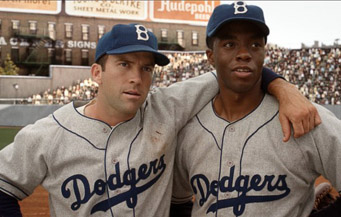
Performances are uniformly excellent. Harrison Ford is top-lined as Rickey, and Ford chews into the role the way John Wayne jawed Rooster Cogburn, growling and over-playing just a little bit to provide "character," Christopher Meloni of "Law and Order: SVU" does a fine job playing Dodgers coach Leo Durocher, soon replaced by "Barney Miller"'s Max Gail as Burt Shotton, Lucas Black plays Pee Wee Reese and Ryan Merriman plays Dixie Walker, and Nicole Beharie plays the devoted Rachel Robinson with a bracing mixture of grace and spine. Alan Tudyk surprises with a particularly unsympathetic portrait of Philadelphia coach Ben Chapman, whose taunts on-field But special praise has to be given to Chadwick Boseman's performance as Robinson, which he has down cold. There's enough footage of his play to copy, but what he nails is Robinson's expression, the enigmatic not-a-smile, and the wary eyes and darkened brow of the already burned and suspicious player, a bit of a caged lion not allowed to roar.
It's a good tribute to the man, if only missing a little bit of the fire that must have burned in the man to accomplish what he needed to, and that needed to be internalized amid so much pressure. He (with Rickey's patronage) turned the puerile accomplishments of a kid's game (the wins, the records) into something far greater for humankind (American division). He was the slugger who couldn't hit back, who turned the other cheek and turned America around. Babe Ruth was baseball's "sultan of swat."  

Robinson is its saint.


As dramatized in the film, Robinson posing with Phillies coach Ben Chapman who was criticized for shouting racial slurs at the player during a game. This photo op was Chapman's way of trying to fend off charges of "unsportsmanlike conduct." He was fired by Philadelphia in 1948. Looking at the smile on Robinson, casual and a bit cocky, "helping out" the guy by posing with him, always makes me smile.


* Just this year, Burns also produced a film dedicated solely to Robinson.

Tuesday, July 14, 2020

Serenity

Written at the time of the film's release...

Serenity (Joss Whedon, 2005) Enjoyable, if violent, genre-bendin' space-farin' Western spinning off from the one season wonder "Firefly." But Serenity (that's the name of the ship) passes the crucial test of movies that make the leap from small to big screen—you don't need to have seen the series to "get" the concept and enjoy the film (probably because the concepts are so familiar). Sharply written and directed by series creator Whedon, and played by the regular cast, it boasts an intensely underplaying Chiwetel Ejiofor as a government operative who ritualistically silences outliers.

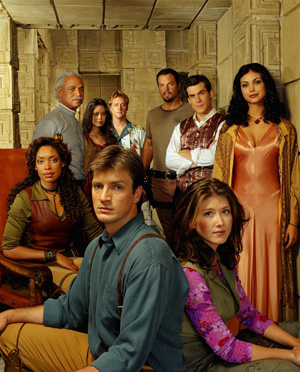
And outliers are exactly what the crew of the "Firefly"-class "Serenity" is comprised of; pirates, soldiers of fortune, outlaws, the scrappy veterans of the Galaxy's last civil war, who bounce from system to system dodging government entanglements and making a living by lying, cheating and stealing. Plus, they do good while doing bad.

The conceit of staging a Western in the infinitely wide-open spaces isn't new. "Star Trek" was sold to NBC as being "Wagon Train to the Stars"--not exactly true, but the suits got the point, "Star Wars" used Han Solo as a space cowboy ala Hondo (which Chewbacca as his faithful dog...or horse), and the "Wars" rip-off Battle Beyond the Stars was "The Magnificent 7 in Space." There isn't that much of a light-speed leap from horse-opera to space-opera. After all, the umbrella-genres of westerns and sci-fi can encompass all sorts of story-themes from Shakespeare to cleverly disguised issues of the day.
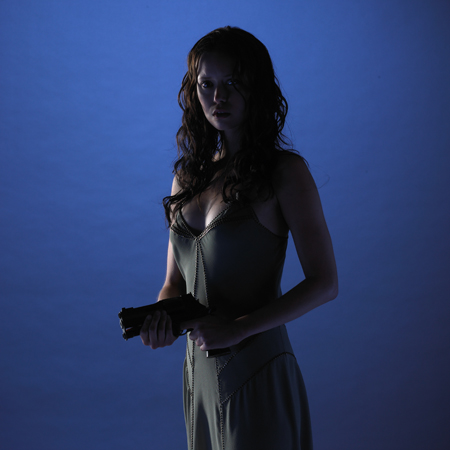
The plot for Serenity back-tracks a bit* to catch movie-goers up with the story of fugitives River Tam (Summer Glau) and her doctor-brother Simon (Sean Maher) and then resolves the conflicts their paid passage aboard Captain Mal Reynolds' (Nathan Fillion) ship of fools has created, and turns River from loose cannon on deck to a reliable asset. Along the way the crew stumbles on a gone-wrong planet-wide government experiment being kept under wraps. And since they're being pursued by "the op," anyway, they "aim to misbehave."
The characters are broadly drawn, easily discerned, and everyone is given significant plot-time (with the exception of Morena Baccarin's space-zen-hooker Inara, whose role was edited for time). Though not a success at the box office, it did spur interest in the series and kicked its box-set collection into hyper-drive. Though Whedon constantly discounts it, the crew of "Serenity" may fly again.

2020 aside: I'd still like to see it, as the film inspired a deep-dive into the TV series for me, although getting Fillion back would be a task—not to mention writer-director Whedon. And, given how everybody's aged a bit, it's going to have to surmount the "Star Trek movie-issue" of providing a sufficient reason for everybody getting back together, assuming that characters have gone separate ways and forged bonds elsewhere. Still, it was Whedon working on something he WANTED to work on and that usually entails his best work. I think a lot of it has to do with that I became a fan after it died...All that there was had already been done. And it was finite.

Maybe it's best to move on. 


* In a film-starting series of illusions that nest together like Matryoshka dolls.


Tuesday, April 21, 2020

The "3:10 to Yuma" Shoot-Out

Written at the time of the remake's release.


"Thar' Ain't Room in this Genre for Both of Us"

It's a truly fascinating experience to revisit Delmer Daves' strange little 1957 "oater" 3:10 to Yuma, and look at what James Mangold (Walk The Line) has done with it 50 years later. The original was a tight little psychological western based on an Elmore Leonard ("Get Shorty," "Out of Sight," "Hombre," "The Friends of Eddie Coyle") short story, but, as with his latter urban capers, character informs action. And it provided Van Heflin and Glenn Ford two of the finest roles of their careers. Ford, never the most inspired of actors, does wonders with the role of rogue-bandit Ben Wade, who's just as handy with his words as a gun, and is just as dangerous hand-cuffed and guarded as he is on the loose. No one is safe in his sphere and he rules a band of outlaws on sheer force of personality. 
Ford ekes out every subtlety, every nuance of his clever dialog and makes it look easy as taking a nap. His is a villain that never admits he's not in control of the situation. He's evenly matched by Van Heflin, looking haggard and down-trodden as a desert-farmer, who takes on a prisoner-transfer to save his farm, and maybe a touch of glory. Such a man is constantly in threat of temptation from the devil, and it's only his cussed stubbornness that makes him see through a job when other men give up. Heflin has the less fun role, but gives it his all, and is rewarded by a Divine Intervention that is announced by a choir of angels (who are backing Frankie Laine singing the inevitable Title Song).
So, 50 years on, what can Mangold bring to the material? Well, not much really. It's puffed up with some more action and the dialogue is retained (at least in spirit) a surprising amount of the time (original screenplay writer Hallstead Welles gets the lead screenplay credit). What new things are added are informed by earlier instances in the original and made explicit, some times thuddingly, and everything is tamped down in a nihilistic amoral rasp as is expected of a western post-Leone/Eastwood (but with none of the wit or stylism). 
More explosions (Two, instead of the none in the first), one in an unnecessary story-detour through a railroad camp. The one opportunity the modern makers had--that of fleshing out the denouement in terms of character, they manage to make even more false, by pumping up the action and circumstances, straining credibility to the snapping point. Russell Crowe's Ben Wade has the same dialogue, but none of the swagger, and enough skills that one wonders just what he's doing staying around the whole movie. Christian Bale's Dan Evans has the same motivations as the original, but his circumstances are worse, and to make his family connection explicit and situations more dire, his son sneaks along on the expedition. Still, its pretty obvious how much Mangold loves the original, seeing how much is retained, but the expansion of the story works against it, and we are left with what's good in the new one...being the old one.
But there are things missing, too. Besides the more colorful straight-ahead performances of Ford and Heflin, there is a marvelous one by the fine character-actor Richard Jaeckel, who makes Wade's lieutenant, Charlie Prince, a craftily-goofy rooster of a character. Ben Foster's performance has some of the characteristics, but is a stone-cold psycho (no doubt written that way) and pales by comparison.

And then there's that Frankie Laine song...

It's the 1957 version. The 2007 version goes to Boot Hill.


Saturday, December 8, 2018

Ralph Breaks the Internet

Pulling the Ol' Plugola
or
Life Among the Block-Heads

It's surprising how you can not want something until you need it.

For instance, "Lounge Seating." My first experience of it was at an early proponent of it, and the layout was haphazard and piece-meal—a flat floor with a bunch of barcaloungers underneath the screen. I found it uncomfortable and distracting...(or maybe it was because I was watching Baz Luhrmann's version of The Great Gatsby). Not even the new experience of being able to raise my feet —without interfering with the seat of the audience-member in front of me—into a semi-reclining position could dissuade me that this was not a step forward in the movie-going experience. Anyway, it was my first introduction to the trend and I found it lacking. But, then my thinking is that you go to the movies to see movies, not to eat popcorn (how can you eat popcorn when you're scribbling notes?). Ever since, I've curled my lip at the idea of "luxury seating" the way a dog curls its lip when it considers a raccoon.
But, I've now come around the other side of the debate after having watched Ralph Breaks the Internet, Disney's sequel to Wreck-It Ralph. "Lounge Seating" was a god-send, and a salvation. I knew I was in for it, when the super-quad-surround sound of the theater was prominently scrunched to the left side of the hall (to the point where the dialog out of the front speakers could be legible only if you stuck your finger...or a Milk-Dud, raisinet, rolled up Red Vine?...in your left ear) to the point where the dust from the vibrating plaster walls on that side were covering up the "row letters" on the aisle carpet.
There are Pop-Up's, Pop-Up's everywhere...
From what I was able to discern, Ralph and Venellope (voiced, as before, by John C. Reilly and Sarah Silverman) have become inseparable pals when they're not at the day-jobs as video-game characters in the copies of "Fix-It Felix" and "Sugar Crush" inhabiting the video arcade of the "Family Fun Center" of Mr. Litwak (voiced by Ed O'Neill). Ralph couldn't be happier, but Venellope is starting to get tired of the routine, the same-old, same-old of the three tracks that "Sugar Crush" provides—ya know, sort of like watching a lot of Tom Cruise movies (is this the one where he rides a motorcycle?...oh, right, he does that in ALL of them).
Then, disaster strikes. The steering wheel used by players to drive the "Sugar Crush" cars breaks—Ralph is indirectly involved this time—leaving Venellope "gameless." What to do, what to do. Well, as Litwak has installed a wi-fi router into Fun Center, it's only a matter of time before Ralph and Venellope travel to the Land of the Internet to see if they can find a replacement steering-wheel and get things going again. How they get to the Internet is a tortured path-way that made me think that somebody just applied the pop-psych landscapes of Inside Out and just applied it to dial-up.
The opportunities for satire are as seemingly endless as a YouTube conspiracy video, but given permission and copyright issues inherent in using those company names, the satire is as tough as a NERF™-ball. Ebay, YouTube, Amazon are all mentioned, but Google is confined to a character named Mr. KnowsMore (voiced by Alan Tudyk) who does searches around the Internet, like a kiosk lady at a mall—why they didn't just call him "BING™"* would take enough lawyer's briefs to create its own cease and desist order.
Through the search process, Ralph and Venellope find that they can bid on one of these "Sugar Crush" steering-wheels over at Ebay, but when they get there, they find themselves bidding against another user—all the avatars of real-world users are represented by bi-ped's with block-heads, which gives you an idea of how YOU rate in this movie—which they out-bid with a winning sum of $27,001. Their brief joy at getting it is extinguished when they go to check-out, and find that they don't have any of these dollar-things (being as they're just video-game characters who don't get out much) and are told they have to come up with the cash in 24 hours or they will lose the item.
They go about securing the funds in two ways: from one of the annoying pop-up sellers that zap in everywhere—this one named J.P. Spamley (voiced by Bill Hader), Ralph and Venellope learn they can earn money by playing video-games (imagine!), and their assignment for more than enough to claim the steering wheel is finding an easter-egg in the form of the top prize of a GTA video-clone called "Slaughter Race," the car belonging to the character Shank (voiced by Gal Gadot). Their efforts to get the car has unintended consequences—Shank hooks them up with a viral video channel called BuzzTube...and Venellope develops an interest in wanting to be one of the Fast and Furious in "Slaughter Race."
Ralph's appearance on BuzzTube brings him to the attention of Yesss (voiced by Taraji P. Henson) who uses him to increase traffic to the site, while he gets a pay-out for the number of "like's." Venellope helps out by doing her own pop-up selling, which lands her in...wait.

Let's stop there.
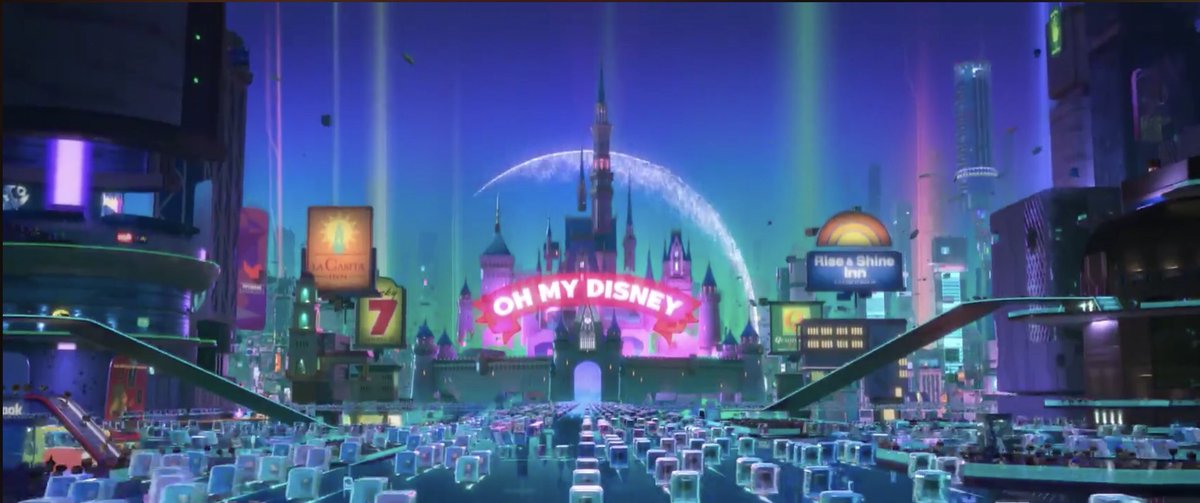
Sooooo...the barcaloungers, back to them. Why my obsession with them? It was around this point in the movie where I found myself sliding down my seat as if I was being pummeled into the very naugahyde fabric of it, from my upright position until I was practically prone. Not sure why; it could have been a number of things. Maybe it was that Venellope ends up at the Disney web-site, and I started to feel like I was being sucked into a corporate version of a black hole where mergered properties start to fold in on themselves, creating a sickening disorientation, like a meta-coma (I laughed when I saw the Disney site being called "Oh My Disney™," thinking it might be a satirical jab of "OMG" where "God"="Disney." But, no, the Disney website is—in reality—"Oh My Disney"). When its acquisitions are trotted out—Pixar, Marvel, Star Wars, Muppets, but not Fox (too soon for product to be produced, it seems), I sank a little further by the sheer heavy gravity that was being displayed.
And then, a bit of salvation—Venellope meets the Disney princesses™ (and the filmmakers put up the funds for the original voice-artists—the extant ones) and it is as funny and bitchy and irreverent as one would want and the movie gets a nice shot of counter-marketing to off-set the rest of the film's celebration of its own acquisitiveness. The film will, of course, continue on with its life-lessons, its action packed resolution (complete with a creature that seemed like a nightmare out of World War Z) that is the de rigueur denouement of these things, but the highlight of the film is the left-field Princess placement.
And one knows—one just knows—that Disney is thinking of how they can capitalize on it with their own stand-alone movie.

Yeah, spoil it, why doncha?


* As Stephen Colbert once said: "Bing—what you use when you want to 'Google' something."