Showing posts with label Temeura Morrison. Show all posts

Tuesday, April 20, 2021

Moana

Moana (Ron Clements, John Musker, Don Hall, Chris Williams, 2016) I missed this in the theater, and I will regret that until I have the opportunity to rectify it (which is certainly on my list of things to do). Given the evidence on the inadequate video screen on which I saw this, Moana deserves, even begs, to be seen as big as it can in order to truly appreciate the beauty of the thing and to wonder at the details of it and to be whacked upside the eyeballs with its color palette.

Why the reluctance? I'd say "Frozen burn-out" (a variation of "Freezer Burn") even though I truly enjoyed that movie and thought it did a lot of good in rectifying some inherent issues with the fabled "Princess Movie." "Been there/Done That/Let it Go." Bad mistake. Because Moana does a lot of interesting story-telling things (like bridging the gap between fairy-tale, folk-tale and myth) and expanding the magical realm to take on broader themes than just personal satisfaction—all those "I Want" songs!—and taking up the theme of stewardship and responsibility. This is Disney (under John Lasseter's mentorship), but cousin Pixar Studios was putting its toe into that same ocean with its short, "Lava," released in 2014.
One may assume they were checking each other's work. Moana challenges and occasionally tops the photo-realism that was being attempted in "Lava," but pops with more detail and texture. One can argue the efficacy of making everything picture-postcard-perfect,* but one can't be anything but amazed at such imagery in motion. CGI can make magic realistic, but it very rarely makes it the visual poetry that Moana accomplishes.
The story starts a bit traditionally mixing the "Princess" mythology with "The Hero's Quest." We get a preamble of "what went wrong" when the shape-shifting (and vain-glorious) demi-god Maui (voiced eventually by Dwayne "The Rock" Johnson) sought to possess the pounumo stone, the heart of the mother island Te Fiti, with which she could create life from the oceans. Attaining the stone, Te Fiti collapses and Maui is attacked by the volcano-demon Te-Ka, who knocks him out of the sky, breaking his magical fish-hook and sending the stone into the depths of the sea. Legend has it that powerful forces still search for the stone that might still restore Te Fiti before the dark times befall the islands, unless a chosen warrior can find the heart, and travel past the island's reef, and convince Maui to restore the stone to its rightful place.
Cue Moana, who, if we're to believe the opening has been chosen by the sea to be that warrior, even if her parents, Chief Tui (Temuera Morrison) and Sina (Nicole Scherzinger), choose to ignore the signs and insist the their daughter stay at home and learn how to be the next chief. They're also ignoring the signs of blight on the island, ruining the crops and shrinking the fish-catches. Moana's already thinking ahead, arguing with her father to take their nets beyond the reef, and is determined to show him she's right by taking a skiff out herself, only to to be scuttled, her boat destroyed and her nearly drowning in the attempt. Her parents forbid her from ever taking another boat out into the ocean again. What's the Ma'ori word for "grounded?"
But, Moana's grandmother Tala (the amazing Rachel House) doesn't discourage her. She tells Moana the story of Maui and Te Fiti and leads her to a cave that houses the boats that originally brought her people to the island and how the demi-god's actions caused the oceans to turn against her people and never again leave the island. She gives her the "heart" stone and points to a hook in the stars, telling Moana to follow them to find Maui. Moana goes back to the cavern and takes one of the boats and heads out to sea to accomplish the task of saving the island and her people.
After a terrifying journey, guided by the spirit of her grandmother, Moana's craft capsizes in a storm and she and the craft are washed ashore on the island. But, hook drawings on the rocks assure her that she has actually reached the island where Maui, having lost the hook that allows him to shape-shift, has been stranded for a thousand years. Maui, understandably, is glad to see her—she has a boat; he can get off the island. Moana tells her of her plan but he won't have any of it; he's a demi-god, after all, and he's used to doing what he wants to do, and not taking orders from natives. Praying to him might help, but being out of activity for so long he's more than likely to ignore her.
Much bickering, much attitude. Moana thinks he's a jerk; he thinks she's ungrateful. Finally, he just takes her boat and leaves her stuck in a cave while he sails off. But, he's just a demi-god, and Moana has a powerful ally in the ocean, which is only too happy to deposit Moana back on the boat no matter how hard Maui can throw her off of it. He tries to throw the heart away. The ocean throws it back. He jumps overboard and starts swimming. Not for long before he's thrown back onto the boat. He's fighting a losing battle and he, understandably, does want to take on another one, liking returning the heart back to its source and confronting Ta Ka.
Despite it being a Disney movie, the course of those never run smoothly, and, besides the two sailors wanting to go in different directions, they have to deal with Kakamora pirates, regaining Maui's hook from a monster crustacean named Tamatoa (Jemaine Clement), and then, and only then, with Maui's powers intact, maybe taking on Te Ka, so that Moana can return the heart to Te Fiti—if it were only that easy. Oh, yeah, and there's a crazy chicken that keeps getting in the way. What would a Disney princess by without a "familiar?"
The songs are less traditional, more snappy with more patter, more rhythm and less melody, as they're crafted by Lin-Manuel Miranda, and, although the film is free of Broadway/Vegas showstoppers, they bounce along, don't outwear their welcome, and never impede the narrative. The animation department also compensates by ramping up the speed during those moments. The film never drags, although there are times the visuals are so gorgeous that you want to hang just a little bit longer.
It's also a solid story, combining folklore, anthropology, sociology, ecology, and fairy tale and myth. Tall order for a cartoon. Everything is hitting all cylinders and a joke never falls flat. Nor did the animation skimp on the scenery for the characters and vice versa. Vistas are photo-realistic (or better), and the expressions are rubbery and recognizable as human beings'. 
It all works amazingly well, enchanting entertainment for young and old alike. It's just that I wish I could have seen it on a big screen where all the amazing handiwork could be appreciated in all its glory. We'll make it a life-goal.

*

Friday, January 4, 2019

Aquaman

Currying Favor ("You'll Believe a Man Can...Swim")
or
He's Not Just a Punch-Line from 'Entourage' Anymore

Two places where DC beat Marvel to the super-powered punch: the first superhero film featuring an iconic woman superhero-Wonder Woman (Catwoman and Elektra don't count) and the first underwater superhero movie—this one. Marvel's Namor: the Submariner, which is the Marvel version, debuted a couple years before Paul Norris and Mort Weisinger created Aquaman for the comics in 1941.

Aquaman always had it tough—he was always a straight-up hero—Namor was exotic looking (kinda Spocky) and could be a bad-boy-villain type when Marvel's writers didn't know what to do with him. Aquaman was a blond-haired Aryan in gold lame and fins who talked to fish and had a particularly weird weakness—if you wanted to kill Aquaman, you had to keep him out of the water for an hour, and that was a hard and fast hour; A-man would croak right at the hour mark, not 59 minutes, not 61 minutes--1 solid hour. And if he encountered a drop of sweat at 59:59, he'd be okay. He became popular—or at least "known"—when he shared the by-line of "The Superman/Aquaman Hour" back in 1967. Then, when Hanna-Barbera took over the DC heroes in the "Superfriends" cartoons, Aquaman became something of a joke—"the lamest of the superheroes." There was a running joke on the old "Entourage" series that had actor "Vincent Chase" starring in a James Cameron directed Aquman movie. 
Aquaman from TV's "Smallville"
The bad rep was so intense that when Zack Snyder came up with the character concept for him in Batman V Superman: Dawn of Justice, he made a "surf n' turf" Aquaman, beefing him up in the form of tattooed bad-ass Jason Momoa who looked like he'd rather be riding Harley's than giant sea-horses—as a matter of opinion, Momoa would have been fun playing DC's "Lobo"—their dirt-bag galaxy-spanning "Main Man." 
You laughed at Mamoa's Aquaman at your own risk because he'd beat your ass and take pictures while doing it. The concept worked, in no small measure to Momoa's charisma, so the blonde Aryan version of Aquaman just might be obliterated from popular culture. I'll drop no salty tears over that.
The Snyder-Aquaman carries over to his own film, directed by James Wan—he of Saw, Insidious and The Conjuring. So, you know it's going to be a bit different in style and substance. It even starts with that horror movie trope of shutters banging against a house. A lighthouse at that. Momoa narrates the story of how his father, Tom Curry (Temuera Morrison—you may remember him as Jango Fett—all of them—in Attack of the Clones), a lighthouse keeper, finds the figure of a woman (Nicole Kidman) on the rocks during a violent windstorm and takes her in. He cares for her and they fall in love and start a family with a young son they name Arthur. Turns out she's Princess Atlanna from Atlantis (uh...sure, honey) who has escaped from an arranged marriage.
Life is idyllic for the Princess and Curry, but there are problems with the relatives. At some point—it's never explained how—an attack squad from the sunken civilization of Atlantis comes calling to take her back. They should have brought a bigger army because Atlanna single-handedly takes them out, causing quite a bit of damage to the lighthouse at the edge of the ocean. Knowing that her family will never be safe, Atlanna bids Curry and her son goodbye and dives back into the sea to face the consequences.
Young Arthur grows up and decidedly takes after his mother—in flashbacks throughout the movie, we see him growing up under the tutelage of Atlantean emissary Vulko (Willem Dafoe) on how to be a bad-ass—it's the sort of training  where Vulko explains that Atlanteans can talk under water and the kid goes "Wow! I CAN talk underwater," in order to short-circuit any objections from logicians who'll accept underwater civilizations but insist that an air-pocket be created anytime someone has something to say (I have issues with Atlanteans riding around in aquatic skiffs when it's demonstrated they can swim just as fast as these Atlanteans do, but that's just me).
We first get to see Aquaman in action when he stops a bunch of pirates from hijacking a nuclear sub. Evidently it's a family affair because Dad Jesse Kane (Michael Beach) is showing son David (Yahya Abdul-Mateen II) that he's earned the right to lead the group. Then, Aquaman shows up, rescues the crew, but leaves a particularly bad situation—Dad's trapped on the sinking sub while David tries to free him, but must abandon the effort and him, leaving him to die. That creates the required revenge plot; he wants to kill Aquaman, by any means necessary, but more violently than leaving him out of the water for an hour.
Now, the sub attack did not come out of the deep blue—it was planned and engineered by Orm (Patrick Wilson), Atlanna's other son and half-brother to Aquaman and the current King of Atlantis. Orm is mightily P.O.'d that the underwater kingdoms have been the dumping grounds for the surface world's pollution and military activities. So, his intention is to launch an attack against the land-dwellers and unite the seven tribes (one per sea?) of ocean-dwellers in his efforts, effectively making him The Oceanmaster©®.
Oh, and by the way, he wants to eliminate any rivals to the throne, so he wants to kill Aquaman, too, putting his intentions in line with young Mr. Kane, whom he's recruited to attack Atlantean troops and create a motivation for other tribes to side with him in his crusade. In return, Orm gives him some Atlantean tech to make himself a villain called Black Manta. That effectively introduces all of the major Aquaman villains, with the exception of the Skipper's and Red Lobster franchises and all of the cruise lines.
Orm launches the first—er—wave of attack by unleashing tsunamis that beach a lot of aircraft carriers and garbage onto the beaches. One such section swamps Aquaman and his father, almost killing him, if not for the life-saving efforts of Princess Mera (Amber Heard), adopted daughter of King Nereus (Dolph Lundgren, surprisingly, and even more surprising is it's a good performance), who, with her powers of controlling water manages to yank all the briney out of Tom Curry's lungs. It isn't entirely altruistic—she wants Aquaman to come to Atlantis to stop Orm and take his place as King. Given that Aquaman has issues with Atlantis—that they consider him a half-breed mongrel and that they killed his mother by consigning her to "The Kingdom of the Trenches," he wants no part of it.
But, a clandestine meeting with Vulko convinces him that he should at least try, if he doesn't want to see a full-out war between land and sea, and the best way to do that is to find the powerful fabled trident of the original King Atlan of Atlantis, a quest that gets interrupted before it starts when Orm's troops drop in and capture Arthur. The King makes him an offer—leave Atlantis forever and live (if he survives the Earth-Sea War, of course)—but Arthur, given his lofty position as Orm's prisoner, instead, challenges the King to a fight for the crown...which Orm, being a jerk and slightly off his sea-horse, accepts.
Orm has the advantage of home-turf...or the watery soggy version of home-turf...and all but defeats Arthur in combat, but the A-man gets a last-minute rescue from none other than Orm's intended, Mera, who cancels her registry at Davy Jones' Locker and takes him on a a far-flung search for Atlan's magical trident, first to the Sahara desert where it was forged and then to Sicily for the final clues they need to find its final resting place.
How do you accessorize in Atlantis? With Portugese Man o' War, of course!
Of course, you can't go ten minutes in a super-hero movie without a fight, so Manta and some Atlantean guns pursue the two heroes through the streets and do a very good job of scorching a lot of Sicily before they are able to continue on their search...which will come with more than a few surprises (some of them quite cool, for instance, a vocal performance by Julie Andrews, anyone?) that they find under the sea (Don't cue the song, this isn't Disney, but the other guys).
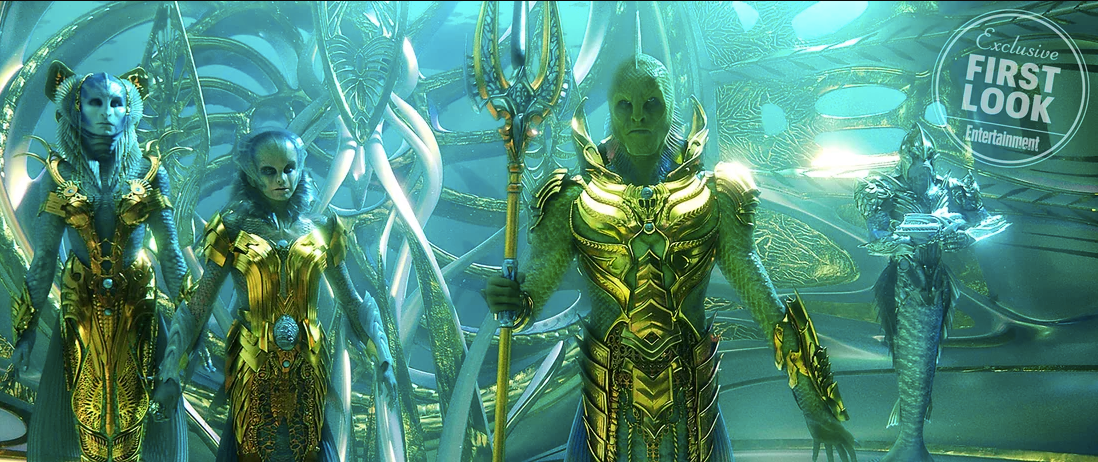
Well, that's quite a lot to fathom (cough). But Wan, working with a rather dense script by DC's Geoff Johns, David Leslie Johnson-McGoldrick, and Will Beall, manages to keep the story straight while not drowning it with various Atlantean cultures and their habits (there will be sequels to explain the tribe of "Fishermen"). He does all this while also coming up with some astonishingly epic visuals that are weirdly beautiful, vaguely threatening, and awash with fascinating detail.
It becomes apparent very early on that Wan is a horror film director, and not one of suspense, an interesting choice for this type of adventure film. Because just when you think things are nice and calm—*BOOM!*—something explodes with no warning, enveloping the actors and the screen and eliciting many a popcorn explosion in the theater. On the other hand, he's great at action set-pieces, creating whirling epic fights that are ingenious in the smaller scuffles, and downright "Lord of the Rings" epic in the big ones. In one sequence, two huge armies face off against each other, one riding great white sharks while the others are astride Jurassic seahorses (how cool is that?). In the Sicily sequence, he stages a running battle between the heroes and Black manta's goons that involves following them through walls and rooms and across roof-tops without any evidentiary edits to curb the momentum.
One wonders where it can possibly go next: the major Aquaman villains have been introduced, the family units established. I suppose they could go into Mera's story, although that would tend to swerve the series into a romantic story, which is problematic in the superhero genre. One hopes that it doesn't depend on Orm as an antagonist the way Marvel's Thor series has clung to Tom Hiddleston's Loki (Wilson's OceanMaster isn't nearly as fun).
Perhaps they can borrow from ancient mythology to build on the Arthurian legend that the series could naturally fall into. But, this is a good start, but not so exceptionally done that there isn't any room for improvement. Hopefully, the creators will venture into the deeper end of the pool, rather than stay in the shallows.