Showing posts with label Willem Dafoe. Show all posts

Wednesday, January 8, 2025

Nosferatu (2024)

Come To Me, My Melancholic Baby
or
"He's Italian!?"

Robert Eggers' new remake of F.W. Murnau's classic 1922 silent horror film Nosferatu: A Symphony of Horror, is respectful of the original—it's on the director's list of favorite films—but allows for Eggers' darker interpretations of myths, his sexualization of those myths, as well as his emphasis (as with David Lynch) on texture. 
 
Murnau's original (if we can use the phrase ironically) was a knock-off of Bram Stoker's "Dracula", the names changed to protect the filmmakers from copyright considerations—although they were sued by the Stoker estate—and is genuinely creepy, owing to the German Expressionist manner of lighting and filming. Plus, Murnau was an extraordinarily clever filmmaker who could use rudimentary special and camera effects to create arresting images. But, then, so is Eggers, and his version of Nosferatu* is respectful, but also tries to achieve Murnau's evocation of dread through its own means, given the advantages of modern cinematography and (something Murnau didn't have access to) sound. More on that in a bit.
Eggers also has an advantage in that he's had over a hundred years of cinema to be inspired by in the years between Murnau's version and his. Watching his Nosferatu one can see the debt he owes to Francis Ford Coppola's Bram Stoker's Dracula (with its shadow-play and use of miniatures), but also in the addition of making the attraction between Count Orlok (Bill Skarsgård) and Ellen Hutter (Lily-Rose Depp) a predestined certainty—Ellen has been diagnosed as "melancholic" for her sleep-walking and agitation in her youth and it only intensifies once her husband Thomas (Nicholas Hoult) falls into the orbit of the Count. This "love for the ages" concept wasn't originally part of the "Nosferatu" heritage.
The other major influence is from Stanley Kubrick's The Shining. Eggers shares Kubrick's love of framing his shots with the one-point-perspective, but here he employs it the way it was done in the Stephen King adaptation—that one-point-perspective leads the eye to a negative space, which is why the effect is so creepy and audience-disorienting. Here, all those tangential lines may lead only to an empty spot on the horizon...or a castle in the distance. There are whole sequences that give you a vertiginous feeling, as if one could fall into that screen, pulled by gravity and it's not a pleasant experience. For a horror movie, it's ideal. Unnerving, but ideal.
And he does something else: his camera may be fluid, but it's also austere. He'll frequently do a 360° turn of the camera and do it slowly, determinedly, placing the audience in the perspective of the character watching his environment, dreading whatever might be at the edge of the frame. It's been awhile since I've seen either movie, so I can't remember if it was Murnau or Carl Theodore Dryer's Vampyr where the camera makes similarly slow circular movements that, rather than make you wonder why you're making the trip, fill you with dread. They're nice touches and are nice little updates to the story-telling.
And it's a familiar story—anyone familiar with Stoker's "Dracula" knows it. A solicitor is sent to the castle of a count to finalize the selling of an estate. The man is sent through the machinations of his boss who is under the throes of the Count's influence, as the man is, in fact, a vampire. He makes his way to the new estate and begins to set upon the citizens there, most prominently, the woman closest to that poor solicitor.
This leads to visits by doctors, who, being scientists, cannot explain the malady and so a specialist in the "unconventional" is called upon, and it is he who deduces that the plague in their midst is a vampire and must be dispatched. This being Nosferatu, the names are changed, but the situations are basically similar. "Dracula" takes place in England; Nosferatu takes place in Germany. All the arcana we associate with vampires is stripped to the bone—no silver bullets or crucifixes (much in display but ineffectual), not even a clove of garlic is to be seen. Those killed by vampires die and stay dead, and although a stake through the heart is effective to kill them (if one comes prepared), the surest way is to distract him with a nice virginal meal until the sun comes up and...that vampire's toast.
The acting is quite good, with particular nods to the three leads, Hoult, Depp and Skarsgård. Hoult has the unenviable task of having to act like he has no idea what the audience is fully expecting to happen, but manages to make his Thomas Hutter still sympathetic when he makes the effort to complete his job even after all the signs tell him him should just turn around and go home. And Depp's performance is just plain scary. Her fits look truly traumatic with her eyes rolling back in her head and her body contorting and spasming into Exorcist-like exercises.
And Skarsgård's Count Orlok has been carefully distanced from Max Schreck's rat-like vampire. Described as "very old and very eccentric...he has one foot in the grave already" Orlok is a hulking figure, stooped and wrapped in a dark bear-like coat with a coarse, brushy mustache. He is barely visible in his first scenes, just a overpowering presence, but the more you see, the more he resembles a rotting corpse, his skin flayed off in places and as far afield from any semblance to a romantic figure (ala 1979's Dracula) as you could get.
But, it's his vocal performance more than anything that's fascinating. Speaking in a low, rattly and sepulchral growl (augmented electronically so it fills every speaker in the theater) every syllable is e-nun-ci-ated slowly only to be broken off by the driest asthmatic breath-intake you can imagine this side of an iron lung. If the theater allows such things, I would take a big bag of cough-drops or lozenges. Super-size the soft-drinks.
Face it, it's those new approaches to things are what you're looking to see the movie for, because the story has been done to death...and after...and has more lives than Christopher Lee's Dracula. Just when you think you can't squeeze any more blood out of the thing,** it comes back to haunt you. So, just remember: you're the one who invites him back.
 
In the meantime, Eggers' version will do...and do quite well...until the next vampire movie rises from the grave.

* His version? There have been other versions of Nosferatu—aside from the official remakes of the Dracula novel—including one that was released just a year ago. There's also Werner Herzog's 1979 Nosferatu the Vampyre and also 2000's Shadow of the Vampire, which told a tale of the making of the original with John Malkovich as Murnau and Willem Dafoe (who's also in Eggers' film) as Nosferatu player Max Schreck. Plus, little nods to the original can be found in vampire designs of the 1979 TV-version of "Salem's Lot" and in Taika Waititi's original What We Do in the Shadows.
 
** Geez, I didn't even mention the ghastly sucking sounds he makes when he's feeding on his victims.... 

Thursday, October 24, 2024

Saturday Night

"I Didn't Tape the Dress Rehearsal"

 or
"Who Are You in the Metaphor?"
 
I like director Jason Reitman's work, whether he's swinging for the fences (Thank You for Smoking, Up in the Air) or playing it safe (Ghostbusters: Afterlife, Juno, Young Adult). I'm sure with every single one of his projects he did not believe he was "playing it safe." All of his films, I'm sure, had challenges that I'd never be privy to, that affected his decisions to make the film, or how he made them. 
 
Maybe it's because these projects all hover around the same theme, "Lies we tell ourselves," which seems to show up in all of his work, where we're never sure if anybody's telling the truth because it's our instinct to believe the lie. That's quite a sophisticated thesis and sometimes the movie doesn't warrant the effort and sometimes it does, but it's a very American trait, and given his willingness to go back to it again and again, I don't think Reitman could ever make a movie not set in the United States. We seem to have that weakness, whether it be hope or hubris or merely sleeping through the sedative of "The American Dream".
It's hard to say where Lorne Michaels (played, again brilliantly, by
Gabriel LaBelle of The Fabelmans) falls in those options. I'd wager on "hubris" these days, but back in the days when "Saturday Night" (the first title of what would become "Saturday Night Live"*), who knows what it might have been. Lorne Michaels was Canadian, for one thing, but he'd had a lot of success in the States as a writer and when NBC was in one of their little tiffs with "Tonight Show" host Johnny Carson, they decided they wanted to prove to their late night star that they didn't need him and that they didn't have to fill an empty Saturday late-night slot with another re-run of one of his past shows. NBC Late-night "suit" Dick Ebersol (played by Cooper Hoffman) was charged with filling the time.
The idea was a "live" sketch comedy show with prominent musical acts who didn't show up on the likes of "The Dean Martin Show" and more in spirit with "The Smothers Brothers Comedy Hour" (which had been canceled after many problems with the network over material deemed too controversial), but without regular hosts—initially the idea was to have rotating hosts of Lily Tomlin (Michaels had produced one of her specials), Richard Pryor and George Carlin, but Pryor made NBC nervous—and, with that spirit, aimed for a younger audience demographic and a hipper crowd than NBC was used to garnering. Michaels wanted to make a show that parodied television for an age-group that grew up watching television (and now, ironically, is making a version that for kids who grew up watching "Saturday Night Live"!)
Having read the oral history "Live from New York: The Complete Uncensored History of Saturday Night Live as Told by Its Stars, Writers, and Guests" (by James Andrew Miller and Tom Shales), and I know a lot of the stories culled for Reitman's Saturday Night, some of which happened, some of which only happened later during the chaotic first season, and some of which didn't happen at all—the bit with Milton Berle (J.K. Simmons) dressing down Chevy Chase (Cory Michael Smith) didn't happen (although Berle did show off the size of his penis to SNL writer Alan Zweibel...at Zweibel's curious request). Yes, a lot of it is true (and Reitman goes into the whole Johnny Carson dilemma with the moment it's decided to go "live" with the show or roll the Carson tape being the dramatic high-point), but some of it is left out...like character actor George Coe's short tenure as a "Not Ready for Prime-Time Player" and an awful lot of short shrift is given the writers. But if you put all of it in, it would have been epic-length—not unlike Michaels' 3 hour dress rehearsal that has to be cut down to an hour and a half.
Even with the deletions, Reitman has to move his movie fast and it hurdles along in long tracking shots until it finds a conversation of interest or an arresting image—frequently involving a llama—then swings his camera between each side of the discussion before veering off with a passer-by who'll act as tour-guide to the next section, as sub-plots whirl in the background. It's not done in one continuous shot—something this complex would make Alfonso Cuaron's head, or
Alejandro González Iñárritu's continuity director, explode—but one gets the simulation of continuous unbroken action for a good part of the film and it ramps up the tension, if the myriad disasters falling around Michaels' head—be they flaming scripts or newly-installed studio lights or a Belushi-hurled ash-tray—weren't enough. 
Of course, it's tough to give this stuff any verisimilitude without threatening to turn it into caricature—Labelle assiduously avoids the Michaels-based "Dr. Evil" voice, for example**—but one wonders if the audience cares, since they know Chevy Chase from endlessly repeating "National Lampoon" movies or his "older" roles and probably don't know any of the writers at all. Some of the passing references to other "Saturday Night" bits might go over their heads. And one, rather sheepishly, admits that the movie will probably play with "the older crowd" beyond the show's originally intended demographic so that it becomes an episode of nostalgia. Yikes.
I remember "Saturday Night", initially, because it aired in rotation with NBC "Weekend", a brilliantly written news program with Lloyd Dobyns and Linda Ellerbee, that was a favorite of mine and I was always fairly irked when it wasn't on and "Saturday Night" was. It grew on me, however, when Paul Simon and then Richard Pryor hosted (in one of the best overall episodes of the show's first season). And although I think the past couple of seasons have been pretty strong, one can't help but be chagrined that the show is 50 years old and that it's audience is about the same as our folks' when they were watching "Dean Martin."
It would have been the ultimate irony if Reitman had ended the film with an acknowledgment of that fact. One would doubt it would get the approval of Michaels and his production company Broadway Video who had little to do with this movie other than to say "well, we won't say you can't can't do it" (and the "disclaimer" about "work of fiction" and "persons, living or dead" is a briar-patch of timorous legalese). Even self-described "revolutionaries" get old and stale after awhile...just as sure as "Generalissimo Francisco Franco is still dead".
The very first sketch on "Saturday Night":
Head-writer Michael O'Donahugh, John Belushi and Chevy Chase
* The reason they didn't use the the "SNL" title initially was because competing network ABC already had a variety show called "Saturday Night Live"...hosted by...Howard Cosell?
 
** And kudos must go to Nicholas Braun, who plays both Andy Kaufman AND Jim Henson.
 
Competing posters of Saturday Night
which, more, in spirit, tells of the difficulties they had.

Tuesday, September 10, 2024

Beetlejuice Beetlejuice

Revisiting Old Haunts
or
"I Dont Think That I Can Take It/
'Cause It Took SO LONG to Bake It/
And I'll Never Have That Recipe Agaaaaain"
 
Beetlejuice was an unlikely hit when it debuted away back in 1988. Director Tim Burton was virtually unknown. He'd made two shorts, one called Vincent and the other, his live-action version of Frankenweenie, the second of which convinced Paul Reubens to give him the directing job on Pee-wee's Big Adventure. That one had made money and when Burton became friends with writers Michael McDowell and Larry Wilson after directing their modern re-telling of "The Jar" for the television anthology re-boot "Alfred Hitchcock Presents", they began collaborating on McDowell and Wilson's original screenplay "Beetlejuice". As closely identified as he is with the film, it did not start as an original idea—Burton had already been working on his next film, Batman with writer Sam Hamm, but the project hadn't gotten out of the Warner Brothers' development Hell, when the McDowell-Wilson script found its way to him.
 
Beetlejuice changed everything. Burton's bizarre approach to the material garnered a large audience, and seeing the success that the young director had made of such a strange concept, Warner was more than happy to finance Batman. And Tim Burton became, if not a household name, a guarantor of original concepts and oddly-tilted projects that audiences fancied.
A sequel to Beetlejuice has always been talked about...but Burton has always been busy. For the longest time, it had been going through a series of concepts from many Burton collaborators under such titles as "Beetlejuice Goes to Hell," "Beetlejuice in Love" and..."Beetlejuice Goes Hawaiian" (I think that might have been a joke-title for the press) but Burton always seemed to find something that attracted him more. Now, a whopping 36 years—and several Batmen—later, it's finally manifested itself in theaters.
A bit of personal back-story here: I must confess that the first Beetlejuice movie...at first viewing...I wasn't that crazy about. Brilliantly designed, yes. Ingenious and funny, sure. Keaton, terrific...if used a bit sparingly. All the elements were there, but it just seemed a bit wanting. Some of it might be attributed to Alec Baldwin's performance—this was before he became "Alec Baldwin"—which was a little bland, almost protective of himself as an actor. But, the big thing is I got the impression that the movie wasn't exactly true to its own rules...like if something needed to be resolved, Burton would just come up with something and excuse it as "it'll work" rather than making sense. This was before I started to appreciate Burton as Burton.* With a couple more films, I learned to let Burton be Burton and my reservations blew away like dust that obscures a snow-globe. Oh, he could still do a less than satisfying film, but a fully-engaged Burton film is a joy to behold...and experience.
Which is why I found
Beetlejuice Beetlejuice such a breath of fresh air, albeit with a creepily crypt-like funk. One recalls that when Burton does a sequel—he's only done one, Batman Returns, far different in tone than the first one—he approaches it the same way he does one of his re-makes...as a "re-imagining." Yes, there will be call-backs (and there are plenty in Beetlejuice Beetlejuice), but, for the most part, Burton is vampire-staking new ground, and here he's doing it with such wild abandon that one turns giddy with each new development...however grisly or grotesque.
 
The story has three arcs that will progress and come together at the end.
1) It's 36 years later than the events of the first film and Lydia Deetz (Winona Ryder), the girl who could "see dead people," is the host of a cable-TV show called "Ghost House" where she visits haunted places. She has the experience. She is currently having the experience of seeing flashing visions of Betelgeuse (Michael Keaton)—well, he isn't "flashing" per se, but one wouldn't put it past him—which is making her more neurotic than normal and has her reaching for her anti-anxiety pills, much against the wishes of her producer/boyfriend Rory (Justin Theroux). Lydia is a mess, anyway. Her surrogate ghost-family, the Maitlands have "found a loophole" and moved on. Her husband, Richard (Santiago Cabrera) has disappeared exploring the Amazon, and her daughter, Astrid (Jenna Ortega), in boarding school, hates her, blaming her for driving her father away and because she considers her mother's work with the supernatural "a sham." Lydia's mother Delia (Catherine O'Hara) is now a popular artist with a gallery opening pending, when she learns that husband Charles () has died and she insists that the three generations of women return to their old home in Winter River for a proper memorial.
2) Betelgeuse is now a functionary in Afterlife Management, running a boiler-room of shrunken-head employees and still holding a torch for Lydia, when he is called off the job by "ghost detective" Wolf Jackson (
Willem Dafoe), B-movie action star in his past life, who warns him that his past wife Delores (Monica Bellucci), a soul-sucking witch who murdered him during the Black Plague has somehow managed to reassemble herself—Betelgeuse hacked her into parts after discovering she'd poisoned him (it was the Plague Years, after all)—and is now seeking him out for revenge. Betelgeuse knows he won't out-run her for long and knows his only real salvation is to try to get back into the mortal world.
3) Astrid, on break from her boarding school (which she hates) and with her Mother (whom she hates) and step-grandmother (whom she tolerates) and her Mother's boyfriend (whom she despises), does just enough family-duty to go through with Charles' service, but then lights out on her bicycle where, by accident, she meets Jeremy (Arthur Conti)
, who feels like as much of an outcast as she does. They plan to meet up for Hallowe'en. Jeremy is the first decent boy she's met...but then, she hasn't had much experience with boys. If she wasn't keeping it a secret her mother or grandmother might tell her that boys are only after one thing...
That's a lot of story, and there are a lot of characters, and a lot of detail and the movie sails by with hardly a bump. In the meantime, Burton is having fun mixing things up with stop-motion animation (the sequence is ingenious on so many levels), or by telling the story of Betelgeuse and Delores' relationship in the style of a Mario Bava giallo film, in black and white and with Italian narration, and his parade of recently deceaseds all visually communicate how they died, usually in ways that would make them win Darwin Awards.
One of those awards would surely be deserving of someone who kept rambling on and on talking about how they loved everything about the movie and proceeded to tell you everything they loved about the movie and spoiling it. Those were just a couple of things that made me grin and grimace throughout the movie and there's so much more that should be left unsaid for full appreciation. But, leave it to say that Burton is working on all cylinders and with at least the same amount of joy he did with the first film...nearly four decades ago.
This time, I had no quibbles, from the first sequence to the last, each with their in-jokes and sense of the macabre to their giddy reveling in kitsch—a key component to understanding most of Tim Burton's work—all topped off with another happily galumphing Danny Elfman score. If I could grin any more, the top of my head would have rolled back like a PEZ dispenser. 
 
And laugh?  I thought I'd die.

* I had a REAL problem with Edward Scissorhands when the titular character stabbed his arch-nemesis to death, destroying the innocence of the character. The thing is...that was kind of the point. The "real world" of suburbia finally broke him, and it's why he HAS to go back to The Inventor's castle in self-exile. In practical terms, the death is unresolved—the police should be showing up at the castle-door (maybe with torches and pitch-forks), but—in story-terms, Edward's already punishing himself...in his own prison.
 
Burton tells stories with dream-logic. Real-world issues do not apply.

Friday, January 5, 2024

Poor Things

Candy'd
or
"I Have Found This World To Be Full of Sugar and Violence"
 
Yorgos Lanthimos' film of Poor Things immediately grabs you by the "hairy business" and never lets go. Even the titles starting the movie refuse to be conventional, emerging like stitching around a baby blanket. Then, the film starts proper with a low-res black-and-white sequence shot with a distorting wide-angle lens of Bella Baxter (Emma Stone) waddling around the ornate interior of the work-home of Dr. Godwin Baxter (Willem Dafoe), eccentric scientist and anatomist, whom Bella calls "God."

And so he is, scarred and etched by much surgery-presumably self-inflicted-he teaches anatomy at a London University, where he regularly dissects corpses for the education of his students and puts them back together for his. "What's the purpose of putting the organs back in?" asks one of his audience. "My amusement!" He bellows, and one dare not question him.
Evidently. His estate is populated by hybrid creatures constructed and tended by him: pug-ducks and pig-chickens (with their heads swapped out), all experiments to test the limits of what can be done. Speaking of predecessors, he says they "pushed the boundaries of what was known. And paid the price."
But, Bella is the most important one, an opportunity that arose by accident, and Dr. Baxter made the most of it...uh, her. Now, he tracks Bella's development, her growing vocabulary, her skill-sets, all in an environment meant to keep her safe, despite her abundant curiosity. Bella wants to learn, most particularly about the world outside the Baxter flat, and that, as he notes, is a problem: "So many things in the world can kill you, Bella."
Still, she seeks to learn. Baxter recruits one of his more sensitive students, Max McCandles (
Ramy Youssef) to do the research work that his busy schedule can't accommodate, and, given Bella's combined increasing abilities and interests, someone has to keep an eye on her so she doesn't get in trouble. Dr. Godwin allows a brief foray into the park, but even that doesn't go smoothly, and it's only through the use of chloroform that he and Max are able to get her home.
But, things start to go south when Bella becomes sexually aware, and Godwin suggests that Max marry her as there is obvious affection between the two of them. A marriage contract is proposed and Godwin brings in lawyer Duncan Wedderburn (
Mark Ruffalo) to draw it up. But, Wedderburn is unscrupulous and a cad and his interest in who would inspire such a contract makes him seek out Bella and propose that, instead of marrying Max, that she go off with him on a "grand adventure" traveling the world. To Bella, this seems the best of all possible ideas and she insists that she travel with Wedderburn and will marry Max when she returns. Dr. Godwin objects and tries to warn her, but, ultimately lets her go, realizing that Bella is "a being of free will" and can make up her own mind.
Of course, Wedderburn's intentions are the worst, indulging Bella in what she describes as "furious jumping" and acting a man of the world when all he really wants is control over her. Plus, being sheltered for all her time at Baxter's flat, Bella is unused to the "polite society" that Wedderburn loathes, and still has instinctual issues ("I must go punch that baby!") to the point where he commands her that she is to say only three things at dinner conversation: "Delightful" "How marvelous" and "How do they get the pastry so crisp." She starts to assert herself, slapping Duncan and making her own friends, while he drinks and gambles and begins a downward spiral of self-pity.
It's a coming-of-age story of the innocent learning about the world and the hardships and disillusionments that are learned along the way as her travels teach her in ways being cloistered in the doctor's care could not. Experience is the best teacher, whether you're "Candide" or "Candy" and Bella's travels, the people she meets, the hardships she endures, the sacrifices she makes are all in the benefit of her becoming a complete human being by the time she makes her way back to London.
You might think you've heard this one before, but you've certainly never seen anything like Poor Things. As anyone who's seen his The Favourite can attest, Lanthimos does things differently, using different film formats, lenses, distortions, and with no regard to realism or verisimilitude. His extreme world-building is not unlike Wes Anderson's or Tim Burton's, or Terry Gilliam's, but with a free-wheeling scatter-shot explosion of any expectations or any sort in a delirious mash-up of Dali and Magritte surrealism that ignore the laws of physics and architectural rigor while staying true to the possibilities of psychology and motivation. Think of the films of Tarsem Singh and tilt them another 90° and you'll be closer to Lanthimos' wheel-house.
Even while you're mind is reeling and your eyes are agog at what he presents, one can't help but be amazed at the performances he gets. As creepy as the visage of Willem Dafoe is in this film, his performance as a mad scientist is still heart-felt and, as bizarre as it is, just a little wise. Mark Ruffalo hasn't been this funny...ever. 
But, the miracle of this movie is Emma Stone. One doesn't want to reveal too much of the movie...or the "why" of it...but her Bella Baxter starts out as a fully-formed child and progresses to a cerebral philosophical mind while taking every idiosyncrasy and playing it with a crack comic timing that makes you shake your head in wonder at the inventiveness and sheer "go-for-broke" ingenuity of it. For all the special effect wizardry going on in the thing, she is the glue that holds the thing together for a solid 2½ hours. And her transformation from wobbling infant to sophisticated lady is a triumph. It's all pretty astounding.
And the movie will make an excellent double bill with Barbie.


Friday, December 24, 2021

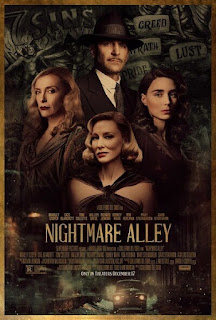
Nightmare Alley (2021)

The Smartest Man in the Room
or
"...It's All Geek To Me"
 
We meet Stanton Carlisle (Bradley Cooper) in the middle of committing a crime; in a soon-to-be-abandoned house, he drags a body to a waiting hole in the floor-boards, strikes a match—we see a gas-can on the floor behind him—and sets the room and the clapboard structure on fire. Then he simply walks away, next stop...anywhere, U.S.A.
 
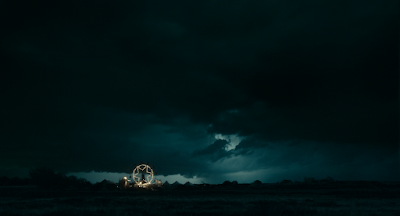
It's a bus-ride to where he's going. And he gets off at the designated restaurant, but he moves on to the glowing lights of a carnival, drawn to it like a moth to a flame. He moves over to a structure blanketed with "'Odd'-i-torium" and he goes in; for a quarter, he can see "The Geek" described by carny boss Clem Hoatley (Willem Dafoe) as a "supreme oddity—is he man of beast?" And as the slack-jawed crowd of curious gawkers gathers around a small arena, "The Geek," mangy and disheveled, is let out of his cage and thrown a live chicken which he bites in the neck and tears its head off. Repulsed, Stan leaves but is followed by Hoatley: "What's your pitch, pal? You on the low?" 
Within ten minutes Carlisle is hired as a roustabout, and one of his jobs is to round up the geek when he escapes his cage. Stan is sent in through the demonically-themed fun-house, it's signs warning of damnation and sees the geek, cowering. Ignoring Hoatley's advice, he tries to entice the man on his own and ends up getting concussed by a brick. Before any more damage can be done, he's found, the geek trussed up and Hoatley, fearing repercussions, offers him a steady job with the carnival. At night, he dreams dreams of flames, but in the morning, he helps fold up the tent and move on with the show—they're meeting up with another troupe down the road.
The spot they stop is a lot with an already-established carnival and across the dirt road is the house of Madame Zeena (Toni Collette) and her husband, Pete (David Strathairn), a once very successful mentalist act, gone on to hard times because of Zeena's philandering and Pete taking to drink. There is still talent in the older gentleman, but his will is broken, but he sees talent in the young man who's come to the house with the newly-arrived vagandonds and wants a bath. Zeena sees something in him, too, and seduces him—not that it takes much—and reads his fortune with her Tarot cards and it's ominous. Carlisle doesn't believe in such nonsense, not believing in fate, but only in the weakness he notices in others. He thinks he'll do very well.
If you've seen the 1947 version, you'll recognize a lot of what's going on as gone before. Watching this version of Nightmare Alley, though, evokes the same feeling one had when watching Martin Scorsese's version of Cape Fear after having seen the original.  It's the same story, but in another location, one steeped in the obsessions of the director. Where the first story was done to get the material down, the new one is richer, more grandiose, and more nuanced. No one's worried about time or hurrying the scene along. There is so much detail that to have it go any faster would be to miss something. The screenplay—by director Guillermo del Toro and his wife Kim Morgan—author of the "Sunset Gun" blog—is based on the original novel by William Lindsay Gresham, not on the original's screenplay by Howard Hawks scribe Jules Furthman. As such, it's a bit more "on the nose" and spells things out, announcing its themes and intentions so that no one misses the point. Rather than hurting the movie, it only gives it more depth, as the story can take the weight.
The casting is top-notch in the way the original couldn't be—there everyone was attractive—and populated by character actors of great depth. Cooper is Tyrone Power handsome, but he has a boyish "something" that makes him attractive—a kid in a man's body. Rooney Mara plays Molly, who is far more waif-like, but still evokes an inner strength and del Toro veteran Ron Perlman plays her guardian, Bruno, the carnival strong-man. Collette and Strathairn are both studies in washed-up talent, resigned to their fates but capable of showing glimpses of their glory days, and as Dr. Lilith Ritter, a fellow con artist as psychiatrist, Cate Blanchett risks parody by playing a creature of constantly challenging seduction, as if Lauren Bacall was playing a villain. 
This is something of a first for del Toro, who leaves behind the monsters' realm (temporarily, I assume), even while keeping one separated foot planted firmly in the grotesque. It's not his usual genre, as it's not a horror movie (and hewing closer to noir), but it flirts with it, the way that Carlisle will flirt with the mystical and the spiritual when he thinks using mentalist tricks isn't enough of a high-stakes racket for him. Because it's not enough to play tricks on people, to "read" them and use it against them, convince them that you have a power that they don't have. It's an endlessly escalating mind-game for both players. But, the hubris that results can make the fall from great heights higher than it appears. 

And Carlisle is just a beginner. He's not a mind-reader. He's a weakness-reader. A need-reader. It would have been better if he'd learned the tarot, so he could learn the future, but even when he's told what it is, even when it's spelled out in so much detail, he doesn't believe it. And maybe that has something to do with control. The future isn't written; he has no way to sway it. No way to read it, like the past on a man's face. And he's as much a paying customer—a rube—as anybody else is when it comes to Fate.
And that just doesn't cut it for the smartest man in the room, the man who knows everything about everybody. 
 
Except himself. Except that he's not as smart as he thinks he is.
 
It's a cautionary tale, as so much of film noir is. And it's one people should listen to.