Showing posts with label N. Show all posts

Friday, August 8, 2025

The Naked Gun (2025)

Serving 20 Years for Mans Laughter
or
"Usual is Unusual, Usually" 
 
I was worried about this one. The original "Naked Gun" series (the ones that starred Leslie Nielsen as Lt. Frank Drebin) came out of of the Z-A-Z team—the guys that made the original Airplane!—they would be David and Jerry Zucker and Jim Abrahams, who had a free-wheeling style of evergreen comedy and an impeccable sense of timing that made their movies work, despite production values that would have been suited for a Hallmark movie. That stuff's tough to duplicate—just ask anyone who saw the non-Z-A-Z sequel, Airplane 2, which was a desperate cash-grab and desperately unfunny despite writers credits by two of the geniuses behind "The Simpsons". 
 
"The Naked Gun" films came out of a Z-A-Z TV series that lasted all of six episodes (before being cancelled) called "Police Squad!" and I remember it as being fitfully funny and not quite up to par with the laugh-a-minute styles of Airplane! or their "Elvis-fights-the-Nazis" follow-up, Top Secret! The ideas were good, playing with the tropes of television and especially cop shows, but they were slightly hampered by 1980's TV censorship and the comedic pace never matched their movie work. That changed eight years later when they revived the concept for feature films and everything went up a few notches. Three "Naked Gun" films were produced between 1988 and 1994, the last only having David Zucker involved with the writing. The complete Z-A-Z team acted as producers. There'd been talk about doing a fourth "Naked Gun" movie with Nielsen, but nothing came of it. His death in 2010 put the stopper in it.
Now, thanks to producer Seth McFarlane's clout, there's a new one, the duplicate-titled The Naked Gun
, featuring Liam Neeson as Frank Drebin, Jr., the son of Leslie Nielsen's character, and he's a chip off the old blockhead. Not the most original of concepts, but Neeson does such an amazing job of playing it absolutely straight while still nailing the comic timing that it's a pleasure to see him make the Nielsen transition from drama to high comedy with nary a misstep. The review for the movie at RogerEbert.com stated that it is "legitimately" Neeson's best screen performance, and one comes out of The Naked Gun actually believing it, so deft is his way of fusing comedy with the deadly-serious "I have skills" intensity that he brought to his "action-star" phase.
What's the plot? Who cares? Surely, you don't think the efficacy of a "Naked Gun" entry lies in the carefully crafted screenplay. No, this is a matter of throwing all kinds of shit at a fan—which became a literal joke in Airplane!—and seeing what sticks. But, loosely, it's about a tech billionaire (
Danny Huston, who's sounding more and more like his Dad every movie), who's into breaking things and starting from scratch...including populations. Somehow, Junior Drebin gets involved in all this, as well as getting involved with the sister (Pamela Anderson, who's actually quite good) of an "accident" victim.
One is struck by how good the movie looks, with lots of mood-lighting and leaning into noir styles (as opposed to the Z-A-Z approach of key lighting everything, lest you miss a joke in the shadows, and also aping the style of its inspiration, "'M' Squad"). That's a bit of a shock, but seeing as this one is a couple generations removed from its source, it's a good shock.
Is it funny? Comedy is always subjective (he hedged)—one man's laugh-riot is another's snooze-fest—but, the first hour or so provided some genuine howlers and some inspired bits of business...then right about the time director Shaffer cuts to a shot of the house band of the villain's "Bengal Club" (and does nothing with it), the movie coasts to the end, wasting joke opportunities, occasionally perking up, but seemingly on comedy auto-pilot until the end. That wouldn't be so discouraging if the first two acts weren't so darned good.
Hopefully, there'll be more. It's refreshing to find a movie that's funnier and sillier than watching the nightly news. 
 
Oh. And don't call me "Shirley."

  Wilhelm Alert: @ 01:15.00

Friday, April 4, 2025

The Next Three Days

Written at the time of the film's release...

Thinking Outside the Cell-Block
or
"It Doesn't Matter What We Believe"

Director Paul Haggis, you either love or you hate. The haters find him manipulative and obvious (I'll buy the second charge, but movies, even documentaries, are—du-uh!—manipulative by their very nature) and will never forgive him for making Crash, which beat out Brokeback Mountain for the Best Picture Oscar.* The lovers, well, there aren't too many of them outside the movie industry—but Clint Eastwood and the Bond producers love him, and that's good enough for me.

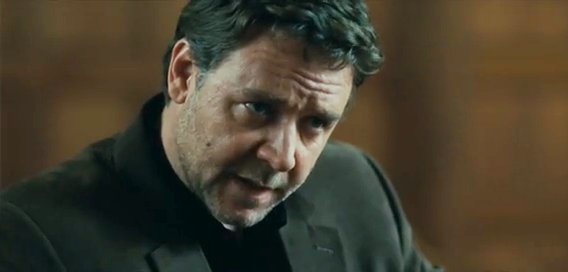
His third film, The Next Three Days, which he wrote and directed,** tells the story of a couple (with child) who are separated, when she (Elizabeth Banks) is arrested, tried and convicted for murder. Her husband (Russell Crowe), a school teacher, exhausts their finances—selling two homes—and all legal recourse, trying to prove her innocence. After three years of incarceration, her child doesn't even acknowledge her (having lived half his life without her), and after her last appeal is turned down, she attempts suicide.
Time to think outside the box...the legal system, and the penal system. The civilized courses have failed...as a matter of course. It's time to take action, and matters...into one's own hands.
In a way, this is the same movie Haggis has been making all along, his thesis converted into an action plot device more positive in its usage than negative in its omission. Both Crash and In the Valley of Elah feature protagonists trying to do more than the expected by-the-book (or society) response, to subvert the easy knee-jerk "comfortable" reaction, and (I dunno) think a little deeper. He seeks the help of a multi-prison escapee (Liam Neeson, in a too-short cameo), who gives him a broad picture of the strategies of going over the wall, and more importantly, staying out. One of the first things he says may be what's written on the first page of Haggis' screenwriting notebook, as it informs so much of his work: "You have to do a lot of lookin'—things that disrupt the day-to-day routine." That semi-somnambulent day-to-day routine has been the loam Haggis has toiled in over the years, and in this film, he finds a protagonist who tries to take advantage of it, rather than subvert it.***
It's a heist film, basically, with human valuables. It is also, for a brief time,
an "incredible mess" movie as Crowe's John Brennan must—painfully—learn the ropes of the outlaw life (and occasionally be beaten with them). This pays off later in the film—well, nearly everything pays off later in the film—as the "anything that could go wrong" scenarios start piling up in the film's nerve-rattling desperate finale, and one remembers how those early efforts only served to make matters worse.
The barriers that Brennan must overcome are represented by a filming scheme that places so much of the film behind screens and windows of various opacities—
a traditional trope of prison films (it just doesn't happen so much out in the so-called open, as it does in here—Haggis wants us to know there are traps inside and outside prison).
Great cast.
Crowe is nicely casual initially, then gradually turns into the ragged obsessive/compulsive he needs to be, Banks does drama as well as she does comedy (very), and, beyond Neeson, there are nice cameos by Daniel Stern, Olivia Wilde (as a divorcee...really?)...and particularly, Brian Dennehy, who, with the least amount of dialogue, makes the most of his scenes.
There will, no doubt, be an increase in interest in
"bump"-keys, and breaking into vehicles with tennis-balls, and Haggis even throws a bone to his critics by purposely leaving a plot-thread frustratingly unresolved. It's a good film, professionally done, and with enough twists and turns to keep one engaged, while still taking the time—one of the critical elements the film focusses on—to keep things realistic, and not turning the down-to-earth perps into clairvoyant superheroes.

* A decision I've always agreed with: I think Crash was reaching for something to say—especially about the 7-10 split of a city that is Los Angeles, and the casualness of racism as the easy way out.  Brokeback Mountain, although I admired its photography and I thought Heath Ledger had the best cowboy voice in movie history (great work, that—Jake Gyllenhaal, not so much) felt too much like a Joan Crawford movie in reverse-drag.  Mellerdrama at its sawdustiest.

** After Crash and In the Valley of Elah, The Next Three Days is not original—it is based on the French film Pour Elle (Anything for Her, 2008)

*** Even a late-minute extreme act by one of the protagonists is an expression of trying to break out of the routine, to think outside the box (or in this case, the van) and break the lock-step the other is in.

Sunday, March 2, 2025

Nickel Boys

Walk a Mile in My Shoes
or
"Not My Elwood. Not My Elwood."

Impressionistic and impressive, Nickel Boys tells its story of Elwood Curtis, from Tallahassee, Florida ("Frenchtown" he'll add), who hitchhiking to attend a technical college in New York, is picked up by a car-thief and arrested as an accessory and sent to "Nickel Academy" a segregated reform school with a checkered history.
 
Raised by his grandmother (Aunjanue Ellis-Taylor
), Elwood (played by Ethan Herisse) had received exemplary marks at school, got a scholarship to that college, and had been active in civil rights actions, but being sent to "juvie" merely by association has derailed his life and his prospects, and somewhat his spirit. 

But not his conscience. Sticking up for a weaker kid being picked on, he is punched in the face by the bullies, knocked out, and sent to the hospital. 

And he has one friend. A good friend, Turner (Brandon Wilson), who is as cynical as Elwood is principled, and the two kids bond, help each other out and talk out their problems, confiding in each other. One seems to complete the other.
Our first glimpse of Elwood, reflected in his grandmother's iron.
Which is interesting, considering how the movie's filmed. It's all shot from a first-person singular point-of-view, initially Elwood's, but then once the two boys meet, the movie will switch off from one to the other.*  Sounds like it could be confusing, but director RaMell Ross manages to clue you in even if it isn't obvious which of the kids' eyes you're seeing the world through.
Elwood watches Dr. King in a store-front window.
Now, I haven't read Colson Whitehead's Pulitzer Prize winning novel (entitled "THE Nickel Boys") from which the film is based, but I'm getting the impression its not from a first person narrative.So, this re-imagining of the film is a pretty radical shift, boiling the novel down to just dialog and leaving the descriptive to be handled by the director and cinematographer (which you'd think would be natural—it's a movie, made of visual storytelling *duh*), but Ross does it with such discipline, one is never confused and only disoriented when the subject is disoriented.
Turner, from Elwood's perspective.
And Ross presents these unique perspectives in an almost-stream-of-consciousness way. He presents impressions of scenes. Glimpses of details that the characters' perspectives latch onto, whether it be their own reflection or in how you can tell someone's nervous by how their knees shake. In that way, it reminded of no other movie so much as The Tree of Life, but with a much-more controlled narrative structure and ...an actual story, rather than fleeting memories played at seeming random (as Tree does).
Elwood, from Turner's perspective.
And POV perspectives rarely work in movies, except for brief sequences where the sight of the actor on screen talking right at the audience is arresting. Here, the entire movie puts us in Elwood's—or Turner's—skin and we see what they see. We see their world and what attracts their attention. This is the sort of cinema I love...where the visuals tell the story more than the circumspect dialogue does. And Ross respects the audience enough to not resort to narrative hand-holding to explain what's on the screen (so many movies over-explain). It's all right there to see, if you're paying attention. It's a rich narrative dance that Ross creates, and it's one of the best films of the year.

* Director Ross does this in an interesting way. He first shoots Elwood meeting Turner sitting across a cafeteria table from him. THEN, Ross repeats the sequence all from Turner's point of view. There is really no differentiation between how the two perspectives look, but if you see Elwood, you know you're seeing things from Turner's point of view and vice versa. And if you're not looking at one or the other, you're given enough clues to figure out which character we're seeing the world through.

Wednesday, January 8, 2025

Nosferatu (2024)

Come To Me, My Melancholic Baby
or
"He's Italian!?"

Robert Eggers' new remake of F.W. Murnau's classic 1922 silent horror film Nosferatu: A Symphony of Horror, is respectful of the original—it's on the director's list of favorite films—but allows for Eggers' darker interpretations of myths, his sexualization of those myths, as well as his emphasis (as with David Lynch) on texture. 
 
Murnau's original (if we can use the phrase ironically) was a knock-off of Bram Stoker's "Dracula", the names changed to protect the filmmakers from copyright considerations—although they were sued by the Stoker estate—and is genuinely creepy, owing to the German Expressionist manner of lighting and filming. Plus, Murnau was an extraordinarily clever filmmaker who could use rudimentary special and camera effects to create arresting images. But, then, so is Eggers, and his version of Nosferatu* is respectful, but also tries to achieve Murnau's evocation of dread through its own means, given the advantages of modern cinematography and (something Murnau didn't have access to) sound. More on that in a bit.
Eggers also has an advantage in that he's had over a hundred years of cinema to be inspired by in the years between Murnau's version and his. Watching his Nosferatu one can see the debt he owes to Francis Ford Coppola's Bram Stoker's Dracula (with its shadow-play and use of miniatures), but also in the addition of making the attraction between Count Orlok (Bill SkarsgÃ¥rd) and Ellen Hutter (Lily-Rose Depp) a predestined certainty—Ellen has been diagnosed as "melancholic" for her sleep-walking and agitation in her youth and it only intensifies once her husband Thomas (Nicholas Hoult) falls into the orbit of the Count. This "love for the ages" concept wasn't originally part of the "Nosferatu" heritage.
The other major influence is from Stanley Kubrick's The Shining. Eggers shares Kubrick's love of framing his shots with the one-point-perspective, but here he employs it the way it was done in the Stephen King adaptation—that one-point-perspective leads the eye to a negative space, which is why the effect is so creepy and audience-disorienting. Here, all those tangential lines may lead only to an empty spot on the horizon...or a castle in the distance. There are whole sequences that give you a vertiginous feeling, as if one could fall into that screen, pulled by gravity and it's not a pleasant experience. For a horror movie, it's ideal. Unnerving, but ideal.
And he does something else: his camera may be fluid, but it's also austere. He'll frequently do a 360° turn of the camera and do it slowly, determinedly, placing the audience in the perspective of the character watching his environment, dreading whatever might be at the edge of the frame. It's been awhile since I've seen either movie, so I can't remember if it was Murnau or Carl Theodore Dryer's Vampyr where the camera makes similarly slow circular movements that, rather than make you wonder why you're making the trip, fill you with dread. They're nice touches and are nice little updates to the story-telling.
And it's a familiar story—anyone familiar with Stoker's "Dracula" knows it. A solicitor is sent to the castle of a count to finalize the selling of an estate. The man is sent through the machinations of his boss who is under the throes of the Count's influence, as the man is, in fact, a vampire. He makes his way to the new estate and begins to set upon the citizens there, most prominently, the woman closest to that poor solicitor.
This leads to visits by doctors, who, being scientists, cannot explain the malady and so a specialist in the "unconventional" is called upon, and it is he who deduces that the plague in their midst is a vampire and must be dispatched. This being Nosferatu, the names are changed, but the situations are basically similar. "Dracula" takes place in England; Nosferatu takes place in Germany. All the arcana we associate with vampires is stripped to the bone—no silver bullets or crucifixes (much in display but ineffectual), not even a clove of garlic is to be seen. Those killed by vampires die and stay dead, and although a stake through the heart is effective to kill them (if one comes prepared), the surest way is to distract him with a nice virginal meal until the sun comes up and...that vampire's toast.
The acting is quite good, with particular nods to the three leads, Hoult, Depp and Skarsgård. Hoult has the unenviable task of having to act like he has no idea what the audience is fully expecting to happen, but manages to make his Thomas Hutter still sympathetic when he makes the effort to complete his job even after all the signs tell him him should just turn around and go home. And Depp's performance is just plain scary. Her fits look truly traumatic with her eyes rolling back in her head and her body contorting and spasming into Exorcist-like exercises.
And Skarsgård's Count Orlok has been carefully distanced from Max Schreck's rat-like vampire. Described as "very old and very eccentric...he has one foot in the grave already" Orlok is a hulking figure, stooped and wrapped in a dark bear-like coat with a coarse, brushy mustache. He is barely visible in his first scenes, just a overpowering presence, but the more you see, the more he resembles a rotting corpse, his skin flayed off in places and as far afield from any semblance to a romantic figure (ala 1979's Dracula) as you could get.
But, it's his vocal performance more than anything that's fascinating. Speaking in a low, rattly and sepulchral growl (augmented electronically so it fills every speaker in the theater) every syllable is e-nun-ci-ated slowly only to be broken off by the driest asthmatic breath-intake you can imagine this side of an iron lung. If the theater allows such things, I would take a big bag of cough-drops or lozenges. Super-size the soft-drinks.
Face it, it's those new approaches to things are what you're looking to see the movie for, because the story has been done to death...and after...and has more lives than Christopher Lee's Dracula. Just when you think you can't squeeze any more blood out of the thing,** it comes back to haunt you. So, just remember: you're the one who invites him back.
 
In the meantime, Eggers' version will do...and do quite well...until the next vampire movie rises from the grave.

* His version? There have been other versions of Nosferatu—aside from the official remakes of the Dracula novel—including one that was released just a year ago. There's also Werner Herzog's 1979 Nosferatu the Vampyre and also 2000's Shadow of the Vampire, which told a tale of the making of the original with John Malkovich as Murnau and Willem Dafoe (who's also in Eggers' film) as Nosferatu player Max Schreck. Plus, little nods to the original can be found in vampire designs of the 1979 TV-version of "Salem's Lot" and in Taika Waititi's original What We Do in the Shadows.
 
** Geez, I didn't even mention the ghastly sucking sounds he makes when he's feeding on his victims.... 

Friday, December 20, 2024

Niagara (1953)

Niagara
(
Henry Hathaway,* 1953) An odd little film-noir (in daylight and in three-strip Technicolor yet!) filmed on location by one of Hollywood's adepts at maximizing the footage all done in a documentary style, Henry Hathaway. Hathaway was an early pioneer of both noir and cinema verité) Niagara is also the film that made Marilyn Monroe a star (followed quickly by Gentlemen Prefer Blondes and How to Marry a Millionaire to complete her break-out troika of 1953).

And the curious thing is...it's Monroe's most atypical role. We're familiar with the Monroe persona as sexual force of nature in various stages of self-awareness, from naif all the way through to temptress. But, to my mind we'd never seen her as a "femme fatale", not even when she'd previously crossed over into shadowy noir territory (as in The Asphalt Jungle). But, then, there are a lot of peculiar things about Niagra.
But, first, a little context: before we get to the dark side of things, we follow a happily-married couple, Ray and Polly Cutler (Max Showalter—for some reason going under the name "Casey Adams"—and Jean Peters), who have come to Niagara Falls for a delayed by three years honeymoon. They're meeting Ray's boss (which in itself is peculiar), but he and the little woman have been delayed, leaving the Cutlers on their own, thankfully. But, there's a complication: their room isn't ready. 
Now, there's a whole other movie about how when one expects a room with a view, you should get a room with a view—and, I mean, how often do you get to Niagara Falls?—but, the couple who haven't vacated the Cutlers' room aren't ready to leave and according to "the wife" (Monroe), they don't expect to leave any time soon. It's only by the Cutlers' charity that she and her husband aren't evicted by the motel manager. Why they're not leaving the Cutlers have no idea...but they're not alone in that. The husband (
Joseph Cotten) doesn't really know, either.

So, the room the Cutlers get doesn't have a view, but they'll have plenty of sights to see, thanks to the Loomises. For instance, you don't see much of him, but she gets out quite a lot. Shopping, she says. But, Polly sees her out by the falls making out with a man not her husband—"she sure got herself an armful of groceries" she tells Ray (the screenplay was co-written by Billy Wilder's sharp-tongued collaborator, 
Charles Brackett). Then, there's the night Rose Loomis got all slinked up and started crooning to a sultry love song, only to have her husband George make an appearance and smash the record in front of the crowd and everybody. The record leaves him a nasty cut and Polly, good-hearted soul that she is, gets out the mercurochrome to patch him up.
It's not just the shadows and venetian blinds that make this a noir!
Loomis is bitter. He started out as a rancher, met the much-younger Rose working as a barmaid, and married her just in time for the ranch to go bust. He's just gotten out of an Army hospital stay following his service in Korea. He knows he has his hands full with Rose, and that's why they're at the Falls, as an opportunity to patch things up, but it's not going well. He tells Polly: "Let me tell you something. You're young, you're in love. Well, I'll give you a warning. Don't let it get out of hand, like those falls out there. Up above... d'you ever see the river up above the falls? It's calm, and easy, and you throw in a log, it just floats around. Let it move a little further down and it gets going faster, hits some rocks, and... in a minute it's in the lower rapids, and... nothing in the world - including God himself, I suppose - can keep it from going over the edge. It just - goes!"
He doesn't realize how prescient he is. 
 
Because Rose has other plans and a trip to the Falls provides her another opportunity entirely. For one thing, they're right on the Canadian border for easy escape and those Falls have a convenient way of hiding motivations. Pretty soon, Rose is spending a lot of time looking around corners and becoming wary.
As well she should. This character is out-and-out bad with murder on her mind, manipulative
, selectively heartless, and not afraid to give her target-husband a pity-boink to soften him up for the kill. Monroe's career is full of characters not afraid to use sex and sexuality as a motivator, but, here, they're used as a weapon. It's not unusual to find toxicity in the female characters in film-noir (which, despite the daylight and national park surroundings, this certainly is), but it's certainly unusual to base a movie around them. Here, Monroe isn't just naughty, she's just plain bad.
And yet. The way the screenplay is written and the way Monroe plays it, there's a perverse element of sympathy generated there. Partially, it's the dark noir form and that Rose Loomis isn't some criminal mastermind—and credit to Joseph Cotten playing his role without an ounce of mercy (you end of thinking worse of him...and he's the intended victim here!). Maybe it's the eternal American quandary: choosing the better of two sociopaths and anybody but Anita Loos would have a moral dilemma about that...unless, of course, you're of a similar mental state.
Some John Dunne might be appropriate here.
But, that's the sort of thing film-noir does, by challenging positivity and lightness with a shaft of dark. It was the 1950's and people were still recovering from World War II with a shaky sigh of relief, and in the midst of that re-building came film noir to act as a literary Civil Defense measure to unassure us that though the war was over and the enemy (Fascists, specifically Nazis, for any younger readers who might be only slightly familiar with the terms) was defeated...people could still be bad. Very bad. And this one is so dark that it threatens the conjugal bed and the unfissionable nuclear family.
Director Hathaway could make an innocent parking garage look like an inexorable path to doom.
It's amazing that they let this one escape. But, the 1950's was the perfect Petri dish to grow such a concoction. It is only the Cutlers, doing the typical American honeymooning thing of going to one of the continent's most dangerous natural wonders, who give us something to cling to, some sense of normalcy amidst such perfidy and despair.
Jean Peters, hanging on for dear life.
Ultimately, it boils down to a cautionary tale of a happily married honeymooning couple observing the consequences of another couple whose versions of their futures are quite different from one another's. And surviving it. Maybe even growing stronger because of it.

And at the black-hearted center of it all is Monroe, doing some of the most complex work of her career, right at the start, before she became America's Sex Symbol, and so could toy with the darker aspects of that role without it tarnishing her image. Monroe was always good. But, as the famous Mae West line goes, when she was bad, she was better.
Rose looks at her husband with contempt, wariness, and just a hint of vulnerability.
Be dismissive of Monroe's talent if you want, but this character is complex!

"I'm not bad. I'm just photographed that way."

* Did you know Hathaway was born the Marquis Henri Léopold de Fiennes? 

Saturday, October 19, 2024

The Neon Demon

It's still October, still Hallowe'en month, and today is "Take Out the Trash" Day. But, instead of a trash-bag, this garbage has a highly stylish wrapping. It's still garbage, though.

The Neon Demon
(Nicolas Winding Refn, 2016) I remember this hitting theaters and purposefully not seeing it for a couple reasons—1) it was directed by Nicolas Winding Refn, whose Drive I found half-baked and a bit pretentious (looked nice, though...) and 2) because it was getting a reputation for being "sick"—never a good word-of-mouth for me. And its star was 16 year old Elle Fanning, whose acting I've found competent but not compelling. The fledgling Amazon Studios bought it for distribution and that signaled to me that if I missed it in theaters, it would show up—and quickly—in their streaming service.
 
It did. But I never watched it. That's on me, not the film.

I occasionally do podcasts where the host, guests, and I talk about movies—they being articulate, me being hesitant, umming and uhhhing and nattering on until I forget the point of what I was saying (Thank God for editing!) and The Lambcast had me scheduled for one of their Movie of the Month podcasts, where people submit films they want to talk about and it gets voted on by folks with the Large Association of Movie Blogs, the winner getting its time in the spotlight. Last March, The Neon Demon was voted to be the MOTM and I dutifully watched it, so that I might give my thoughts on it.
Those thoughts were pretty damn dark. "I hate it with the heat of a thousand suns" I recall saying. Hyperbolic that may be, but it was only a matter of degree. For Refn's film, under the guise of making a point of exploitation, only reflects that exploitation while not saying anything new, unique, or even realistic about its subject. "The Demon" that the movie tangentially and unsuccessfully tries to make some sort of analogous reference to (the title's use of "neon" suggests the city) is basically the film itself, and it's just as clumsy, despite its scrupulous framing and art direction. It's a gilt-wrapped presentation that opens to find...absolutely nothing, lovely to look at (on occasion), but hollow not only to its core, but everywhere.
Stylish—but to a fault—The Neon Demon follows the path of 16 year old Jesse (Fanning) who's come to Los Angeles following the death of her parents and the film opens with a blood-soaked static photo-shoot she's having with a photographer she's met on the internet. As it's the first thing we see, we wouldn't be surprised that Jesse is already dead, as she lies lifeless on a couch, blood dripping down her arm onto the floor. That's all that's required of her—no personality, no expression—she's just an image, a concept, a commodity to sell something (god knows what...). After, Jesse is struggling to wipe the red Karo syrup off her body and is helped by her makeup artist Ruby (Jena Malone), who doubles as a mortuary cosmetician (natch!).
♪I love L.A.♫
Through Ruby, she gets a room at a fleabag hotel (run by a sleazy Keanu Reeves in one of his "please, don't speak" roles) and an interview at a modeling agency. She falsely signs a parental consent form and is told she should answer to 19...as 18 is a little..."you know." She then starts to make the rounds of cattle-calls, where she runs into two models in particular, Gigi (Bella Heathcote)—who's all about cosmetic surgery—and Sarah (Abbey Lee)—who's all about sleeping around to get jobs. They're catty and jealous and more than a little aggressive in their judging Jesse (I mean why not, the job's all about judging), who's a neophyte, probably a virgin, and has nothing going for her except her looks...like them.
But, Gigi and Sarah are more so. After one of those casting sessions that Jesse gets but Sarah is passed over for, Jesse cuts her hand in the bathroom and is shocked when Sarah tries to suck her blood. See where we're going with this?
The toxic male gaze; the female ambivalence to it
Yeah, that's where it's going...so I'd find the nearest cut-off (believe me, there'll be plenty of that later in the movie). Refn is portraying a predatory L.A.—something I admit I've always felt deep in my bones whenever I would visit the city—where the young models must contend with the predations and the manipulations of agents, the whims of self-designated artistes, and the jealousies and resultant scorn of their competitors and its products visited upon them. The predators being both male and female, there's plenty of blame to go around.
But, the movie only works as a metaphor and The Neon Demon gets it ass-backwards. Most horror films use the horror as a metaphor for everyday life, but Demon uses real-life to get to the horror. I don't see it as spoiling anything by revealing what eventually happens, but more of a public service. In their covetousness and jealousy, Ruby, Sarah and Gigi kill Jesse in a swimming pool and eat her. That's not a euphemism or a typing error. They eat her. Apparently to consume her youth, which they want. Great metaphor, huh?
Now, we don't see this past Jesse bleeding out at the bottom of the pool, but at the next photo-shoot, during a break, Gigi hoarks up one of Jesse's eyeballs...which Sarah then eats (waste not, want not, apparently). One might "buy" this, but the fact of the matter is Jesse was...what 5'9" and weighs 54 kg (according to some Elle Fanning web-site or other) and it beggars the imagination that the two rail-thin, near-anorexic models who supposedly consumed her don't look like they've had any more caloric intake lately than what one could suck from a celery stick. Argue all you want that they probably did some purging in the meantime, but...c'mon. Ozempic couldn't have solved this one.
I mean, yuck. The Neon Demon doesn't work as body horror, metaphor, or "pieces-of-meat" societal critique and for all the professions of "the cinematography is great" that is true in only some instances throughout the film's length and even then, those images are static, stylized, and sporadic. Most times, Refn is just "getting the shot" that he can. And although I hate to use this Pauline Kael quote (because when—panning Barry Lyndon—she used it she was wrong) but sometimes it's true that a director "
isn’t taking pictures in order to make movies, he’s making movies in order to take pictures."
 
And Refn has a great future filming obtuse perfume commercials.
"The Neon Demon...only at Macy's"