Showing posts with label 1953. Show all posts

Friday, December 20, 2024

Niagara (1953)

Niagara
(
Henry Hathaway,* 1953) An odd little film-noir (in daylight and in three-strip Technicolor yet!) filmed on location by one of Hollywood's adepts at maximizing the footage all done in a documentary style, Henry Hathaway. Hathaway was an early pioneer of both noir and cinema veritĂ©) Niagara is also the film that made Marilyn Monroe a star (followed quickly by Gentlemen Prefer Blondes and How to Marry a Millionaire to complete her break-out troika of 1953).

And the curious thing is...it's Monroe's most atypical role. We're familiar with the Monroe persona as sexual force of nature in various stages of self-awareness, from naif all the way through to temptress. But, to my mind we'd never seen her as a "femme fatale", not even when she'd previously crossed over into shadowy noir territory (as in The Asphalt Jungle). But, then, there are a lot of peculiar things about Niagra.
But, first, a little context: before we get to the dark side of things, we follow a happily-married couple, Ray and Polly Cutler (Max Showalter—for some reason going under the name "Casey Adams"—and Jean Peters), who have come to Niagara Falls for a delayed by three years honeymoon. They're meeting Ray's boss (which in itself is peculiar), but he and the little woman have been delayed, leaving the Cutlers on their own, thankfully. But, there's a complication: their room isn't ready. 
Now, there's a whole other movie about how when one expects a room with a view, you should get a room with a view—and, I mean, how often do you get to Niagara Falls?—but, the couple who haven't vacated the Cutlers' room aren't ready to leave and according to "the wife" (Monroe), they don't expect to leave any time soon. It's only by the Cutlers' charity that she and her husband aren't evicted by the motel manager. Why they're not leaving the Cutlers have no idea...but they're not alone in that. The husband (
Joseph Cotten) doesn't really know, either.

So, the room the Cutlers get doesn't have a view, but they'll have plenty of sights to see, thanks to the Loomises. For instance, you don't see much of him, but she gets out quite a lot. Shopping, she says. But, Polly sees her out by the falls making out with a man not her husband—"she sure got herself an armful of groceries" she tells Ray (the screenplay was co-written by Billy Wilder's sharp-tongued collaborator, 
Charles Brackett). Then, there's the night Rose Loomis got all slinked up and started crooning to a sultry love song, only to have her husband George make an appearance and smash the record in front of the crowd and everybody. The record leaves him a nasty cut and Polly, good-hearted soul that she is, gets out the mercurochrome to patch him up.
It's not just the shadows and venetian blinds that make this a noir!
Loomis is bitter. He started out as a rancher, met the much-younger Rose working as a barmaid, and married her just in time for the ranch to go bust. He's just gotten out of an Army hospital stay following his service in Korea. He knows he has his hands full with Rose, and that's why they're at the Falls, as an opportunity to patch things up, but it's not going well. He tells Polly: "Let me tell you something. You're young, you're in love. Well, I'll give you a warning. Don't let it get out of hand, like those falls out there. Up above... d'you ever see the river up above the falls? It's calm, and easy, and you throw in a log, it just floats around. Let it move a little further down and it gets going faster, hits some rocks, and... in a minute it's in the lower rapids, and... nothing in the world - including God himself, I suppose - can keep it from going over the edge. It just - goes!"
He doesn't realize how prescient he is. 
 
Because Rose has other plans and a trip to the Falls provides her another opportunity entirely. For one thing, they're right on the Canadian border for easy escape and those Falls have a convenient way of hiding motivations. Pretty soon, Rose is spending a lot of time looking around corners and becoming wary.
As well she should. This character is out-and-out bad with murder on her mind, manipulative
, selectively heartless, and not afraid to give her target-husband a pity-boink to soften him up for the kill. Monroe's career is full of characters not afraid to use sex and sexuality as a motivator, but, here, they're used as a weapon. It's not unusual to find toxicity in the female characters in film-noir (which, despite the daylight and national park surroundings, this certainly is), but it's certainly unusual to base a movie around them. Here, Monroe isn't just naughty, she's just plain bad.
And yet. The way the screenplay is written and the way Monroe plays it, there's a perverse element of sympathy generated there. Partially, it's the dark noir form and that Rose Loomis isn't some criminal mastermind—and credit to Joseph Cotten playing his role without an ounce of mercy (you end of thinking worse of him...and he's the intended victim here!). Maybe it's the eternal American quandary: choosing the better of two sociopaths and anybody but Anita Loos would have a moral dilemma about that...unless, of course, you're of a similar mental state.
Some John Dunne might be appropriate here.
But, that's the sort of thing film-noir does, by challenging positivity and lightness with a shaft of dark. It was the 1950's and people were still recovering from World War II with a shaky sigh of relief, and in the midst of that re-building came film noir to act as a literary Civil Defense measure to unassure us that though the war was over and the enemy (Fascists, specifically Nazis, for any younger readers who might be only slightly familiar with the terms) was defeated...people could still be bad. Very bad. And this one is so dark that it threatens the conjugal bed and the unfissionable nuclear family.
Director Hathaway could make an innocent parking garage look like an inexorable path to doom.
It's amazing that they let this one escape. But, the 1950's was the perfect Petri dish to grow such a concoction. It is only the Cutlers, doing the typical American honeymooning thing of going to one of the continent's most dangerous natural wonders, who give us something to cling to, some sense of normalcy amidst such perfidy and despair.
Jean Peters, hanging on for dear life.
Ultimately, it boils down to a cautionary tale of a happily married honeymooning couple observing the consequences of another couple whose versions of their futures are quite different from one another's. And surviving it. Maybe even growing stronger because of it.

And at the black-hearted center of it all is Monroe, doing some of the most complex work of her career, right at the start, before she became America's Sex Symbol, and so could toy with the darker aspects of that role without it tarnishing her image. Monroe was always good. But, as the famous Mae West line goes, when she was bad, she was better.
Rose looks at her husband with contempt, wariness, and just a hint of vulnerability.
Be dismissive of Monroe's talent if you want, but this character is complex!

"I'm not bad. I'm just photographed that way."

* Did you know Hathaway was born the Marquis Henri LĂ©opold de Fiennes? 

Tuesday, October 29, 2024

House of Wax

House of Wax
(AndrĂ© de Toth, 1953) Oh, the money studio mogul Jack Warner invested in 3-D, only to see it fade away when the craze lost its "zhuzh" and no longer distracted Americans from their newly bought black-and-white broadcast television sets (epic films with wide-screen dynamics was more successful). The 1950's "3-D craze" had a little less dimension to it, fad-wise (and not very many other major studio productions were made in that format) but, that doesn't take away from the fact that Warner's investment in House of Wax created a technological achievement in film, being the first color 3-D movie with stereophonic sound—a feat that made it a surprisingly big hit at the box-office (more so than the monophonic color 3-D film, Bwana Devil) when it was first released (to those theaters that could actually accommodate the new processes), and also, ironically, made the film a staple of those new-fangled television sets (which is where I constantly ran into it in my youth). It also managed to revive the status of Vincent Price, who would spend the rest of his career starring in horror films, sometimes being the most expensive items in their budgets.
Jerrod and his Marie Antoinette—the wax-figure is "portrayed" by lead actress Phyllis Kirk
 
Based on an earlier Warner film, 1933's The Mystery of the Wax Museum—that was directed by Michael Curtiz in two color Technicolor—it tells the story of gifted sculptor Professor Henry Jerrod (Price), who is having a bit of a falling-out with his principal investor Matthew Burke (Roy Roberts)—Burke wants to see Jerrod's wax museum become a bit more sensational to attract business while Jerrod wants to concentrate on more life-like attractions on a par with his sculptures of Cleopatra, Joan of Arc, and his personal favorite, Marie Antoinette. While Burke is upstairs going over the books, Jerrod takes a meeting with art critic Sidney Wallace (Paul Cavanagh) to see if he'd be interested in buying Burke out.
Wallace is funding some archaeological dig of other and will be out of the country for three months, but fully intends to fund Jerrod's expansion of his wax museum when he returns. This is promising news for Jerrod, but not for Burke who won't wait three months and turns on Jerrod, starting a fire in the museum to burn the place to the ground to collect the insurance money. That he has left Jerrod unconscious in the burning building is of no concern to him. And the gas-lights in the structure only ensures the sculptor's doom, creating a spectacular explosion that destroys the man...and his life's work.
The unseemly Mr. Burke cashes his insurance check for 25k—nobody being very good at checking for accelerants in 1902—and doling out just enough of it to attract gold-diggers like Cathy Gray (a blonde, pre-"Addams Family"
Carolyn Jones), reassured that the body of Jerrod was never found. He shouldn't be so presumptive, as when he goes to stash the remainder of his money in his safe (fireproof, I hope!), he is attacked in his room and strangled by a mysterious black-cloaked figure, who then takes a rope and hangs the body in the walk-up's elevator shaft to make it appear a suicide.
Cathy is preparing for her upcoming date with a new fella, being helped into her frills by her housemate, Sue Allen (
Phyllis Kirk). Sue is having trouble making the rent, but Cathy assures her that she'll lend her some money if Sue's attempt to get a job as a hat-check girl falls through. It does, but after a shakedown by her landlord, Sue goes to her room and checks on Cathy, only to find her dead, and the perpetrator still in the room—a black-cloaked figure with a misshapen, scarred face. She screams and escapes through the window with the figure in hot pursuit.
She manages to lose the strange murderer in the foggy streets and finds shelter at the home of a friend (Angela Clarke) and her son Andrew (
Paul Picerni), and the next day, they go to the police (in the form of Frank Lovejoy and Dabbs Greer), who are a bit skeptical of Sue's story. But, then, they're not much help in the case of Cathy's murder—as her body has gone missing from the morgue! It's the latest in a string of disappearing corpses that they can't explain.
 Price, a young Charles Bronson, and Cavanagh
 
But, remember that art critic Sidney Wallace? He comes back into town to meet with Professor Jerrod, who is quite alive, but wheelchair-bound and his hands burned so horribly that he can only supervise the work of his assistants: Carl Hendricks (Nedrick Young) and the deaf/mute Igor (Charles Bronson, but at the time going by Charles Buchinskey). Jerrod has changed his mind about things since the previous museum's fire—now he's going to only focus on exhibits of the macabre, a chamber of horrors, if you will, of the past and present day. Including one exhibit of the suicide of Matthew Burke...with a remarkably life-like wax figure that, in the first real incident of fragrant 3-D usage falls forward into the screen—realistically enough that it must've seemed like it was falling in people's laps. With that little shock comes...
It's the half-way point of the film, and a reel change was required, but with both projectors each showing one part of the 3-D image, the proceedings had to be interrupted to manage it. I used to run projectors, but nothing as sophisticated as in the theaters, so how they managed to keep everything in sync, I wouldn't know (what happens if the film in one of the reels breaks...do they have to swap out as many frames in the other reel?*). Anyway, that's not the most interesting thing about the 3-D process. The most interesting thing was that director Andre dé Toth was blind in one eye and wore an eye-patch over it, so he couldn't have seen the 3-D images if he tried!
It's in the second part of the film where the 3-D tricks really start coming in fast, threatening to invade the audience's space: there are two more fainting spells toward the camera (as a result of squeamish reactions to Jerrod's house of horrors) as well as a rather gratuitous sequence involving the museum's barker enticing ticket-buyers with a paddle-ball breaking the fourth wall by threatening to knock the audience's popcorn out of their hands) and an equally unnecessary can-can sequence where the dancers threaten to kick out jaws, and one chorine throws her derriĂ©re in your face (the 3-D version of putting butts in seats?). But, there are subtler things—flying angel decorations, splintering doors, one prominent fist. And it must have been a shock to suddenly see Charles Bronson's henchman pop up in the frame during a critical juncture. It's not can-can girls, but it probably caused a lurch in the customers.
Still, the strength of the movie is
dé Toth's direction, done in long, tracking takes (which would have really showed off the changing perspectives in 3-D), especially the tours of each of the wax museums usually done in one sweeping tour, aided by Jerrod's "waxing" poetic about his creations. And dé Toth had a good eye (but only one) for composition, so that when he did cut away, it was always to something interesting and striking.
And, say what you will about the "Perils of Pauline" style-finish, it is a nerve-jangler with our heroine threatened to be entombed in her own wax coffin for display, and if the elaborate device used to do so isn't exactly practical, it is impressive looking, rivaling the sparking laboratories of previous screen-villains, and there's another sequence involving split-second timing with a guillotine that provides an unexpected jolt (enough that the actor involved did it under protest).
But, dramatically, the movie doesn't fool anyone. One can guess the identity of the black-cloaked figure on a murderous (and covetous) rampage in turn-of-the-century New York nearly as soon as he appears—unless you're six (which is what I was when I first saw it and the revelation was as shocking as finding out who Darth Vader was much later in my film-watching) and have had no previous experience with movie-making sleight-of-hand. You'd have to be conked in the head with a paddle-ball to be surprised by it (hmmm...maybe that's why they did it...!). But, the movie is true to its melodramatic roots (the original play on which it and the earlier version premiered in 1932).
House of Wax was voted into The National Film Registry in 2014 for being "culturally, historically, or aesthetically significant." Given its breakthroughs in color 3-D and stereophonic sound one should add "technologically" as well.

* Answer: Yeah, they did, or the resulting de-synchronization of images would cause headaches or even nausea faster than you could say "des-synchronization"!
 
"The film's out of SYNC!!"
 

Friday, March 8, 2024

Roman Holiday

Roman Holiday
(
William Wyler, 1953) The legend has it that when Gregory Peck returned from filming Roman Holiday with Audrey Hepburn on location in Rome, he advised someone at Paramount that they might have to change the billing and put her name above the title—"that girl's going to win an Academy Award!"
But, getting to that point was a long, involved road. It originated with Dalton Trumbo, who, following a year-long stint in prison for contempt of Congress for not "naming names" to the House Un-American Activities Committee, was living in Mexico City. He was in financial straits, not being able to sell scripts to Hollywood—who'd provided a good income to him since 1935—owing to being "blacklisted" by the industry. He still wrote, producing 10 screenplays, and forwarded them to "fronts" who would sell the ideas to the studios for a cut of the proceeds. Trumbo's reverse-Cinderella story, Roman Holiday, was sold to Frank Capra's Liberty Films by one such front, Ian McLellan Hunter for $50,000 (all of which he paid to Trumbo), and Hunter was hired by the studio to work on the script.
 
The first director attached to it was Frank Capra himself, who wanted Cary Grant and Elizabeth Taylor for the parts of the deceptive reporter and princess, respectively. Taylor was unavailable and Grant, after reading the script, decided his part would be overshadowed by the part of the princess. Capra left the project when his budget demands would not be met, and he sold the script back to Paramount.
George Stevens was briefly attached, but it ended up with director William Wyler, who had some stipulations: a larger budget, Jean Simmons and Cary Grant to star, and filming to be done totally in Rome. Grant—again—wouldn't do it and Simmons was under contract to RKO and its owner Howard Hughes wouldn't loan her out except for a sizable fee. So, Wyler opted to cut his losses—he insisted on filming in Rome (and Paramount had some frozen funds that could be utilized and Rome's studio CinecittĂ  was back up and running). Gregory Peck—who was looking for lighter roles than he was being offered—was signed (although he, too, was worried about being overshadowed by the female lead), and Wyler decided to look for an unknown actress, which is when he heard about a new European actress, who was doing theater in small parts in movies.

 
Wyler left instructions to keep the camera rolling after the screen test—so the story goes—and the young actress was asked questions about her background, including her time growing up in Belgium during World War II. Everyone who saw the test was charmed by it. Hepburn got the role. But, first, she had a commitment to a Broadway role starring in "Gigi"—she had been picked by Collette herself for the role—and as Peck was held up in over-runs shooting The Snows of Kilimanjaro, the production was delayed.

In the meantime, many writers' hands worked on Roman Holiday besides Hunter, including Ben Hecht, Preston Sturges, Valentine Davies, and—when in Rome—John Dighton, who was there to punch up scenes whenever a location found by Wyler would peak his interest. Cast and crew were not afraid to make changes or make suggestions.
The film begins with a Paramount Newsreel examining Princess Ann (Hepburn) from "one of Europe's oldest ruling families" (although they never mention of what country
*) on a tour to "improve trade relations" and although she projects a serene calmness publicly she's starting to crack. She's 19, royally supervised and expected to amiably meet and greet hundreds of dignitaries, all of whom seem to belie the term. And although this is a reverse-Cinderella story, she does have one thing in common with her fairy-tale predecessor—she has shoe problems. There's only so much time you can spend standing in the damn things! Plus, although she is touring Europe, she sees very little of it, cloistered in luxurious quarters with her only bed-time reading her full itinerary for the next day. And yet outside her window, life is happening, people are partying and enjoying life. And Rome, even though it's the Eternal City, can't wait forever.
 
She melts down. to the point where she has to be sedated to get some sleep so she can keep up the busy tour. And maybe it's the sleep-drug talking, but the princess gets it in her crowned head to escape her gilded dignitary's cage and go out into the night, un-escorted, unchaperoned, and unceremoniously. Where Cinderella wanted to see how the other 2% lived, Ann wants the 98% of possibility the world just within her regal wave can offer. She sneaks out of her embassy and finds her way into town.
And then, the sedative kicks in. 
 
Lucky for her, Joe Bradley (Peck), a reporter for a Rome-based wire service is late coming home from an evening poker game among colleagues and happens upon her. Thinking her drunk, he tries to get her on her feet, then pours her into a cab and, with no place else to put her, takes her to his apartment ("Is this the elevator?" she bleerily asks when they get there) to sleep it off. There is some chaste teasing about sleeping arrangements that ends up with Bradley being late for his day's assignment—an interview with Princess Ann—only to discover...she's been sleeping in his bed. And suddenly he concocts a scheme to get a big story, given his special "access."
Her government has put out a cover story to explain her mysterious disappearance has had to cancel all activities due to a "sudden illness"...so Joe makes a bet with his boss that he can get an exclusive with the princess. All well and not exactly good. A lot of subterfuge has to be done to get that story. The princess wants to have her adventure but not let on that she's at any way royal. Joe conspires to get his story without letting on that he's a reporter—and he wants pictures, which he gets with the third wheel of the adventure, bohemian photographer Irving Radovich (an ebullient and funny 
Eddie Albert), who is constantly taking photographs with camera concealed in a lighter.
The production was, basically, a working holiday for cast and crew, and the incidents on the princess' "day off" center on aspects and sights of an elaborate tour of Rome with the Colosseum, the Trevi Fountain, the Spanish Steps, with stops for gelato, vespa-hopping, dinner and dancing and, ironically, "the Mouth of Truth" which might prove to be daunting to two people who spend the day under false identities.
Peck has rarely been allowed to be this light—and he's surprisingly subtle and slyly humorous playing a roguish Prince Charming, and Hepburn is perpetually adorable as a princess with the crown off. As Pauline Kael remarked "when she smiles, we're all goners," but leavened somewhat by eyes that always have a shade of melancholy—her wartime childhood probably had something to do with that—and it comes in handy for her scenes as a princess trying to escape the weight of her heritage while knowing that she'll never be able to get away with it...or from it.
Just as Cinderella had to return from the ball and back to the ashes, Princess Ann's fantasy has to come to an end and she must return to her origins. But, Cinderella got to have a happy ending. For Princess Ann, no ending can be completely happy. But, Roman Holiday does, at least, provide a modicum of satisfaction where the lies fall away along with the fantasies. If someone can only acknowledge the truth...however painful it might be...one can at least admit that they're being true...to themself.
 
And that's the lovely thing about Trumbo's story. It's not a sad ending (although not a happy one), but there is a level of satisfaction in the warm glow of memory, free of fairy tales, despite all the pomp and circumstances getting in the way. And the memory of Roman Holiday always brings an admiring smile to my face.
Dalton Trumbo was finally acknowledged to have written the story that won the 1953 Academy Award and in 1993 an Oscar was given to his widow. Trumbo died in 1976. 
"...She has us all in thrall, and when she smiles we're all goners."
Pauline Kael

* The film never says, but one can assume that it isn't any of the stops on the tour which include London, Amsterdam, Paris or Rome. Although I did find an example of a script excerpt, which names the country as "Coravia" (wherever that is).


Thursday, July 28, 2022

Mogambo

Mogambo  (John Ford, 1953) It's good to be The King. When you're Clark Gable, King of Hollywood, you can forgive a lot of shortcomings on the acting front. Mogambo, situated in Africa, and for a large part photographed there, makes Gable the King of the Jungle and no less predatory than some of the denizens. If the film has a shortcoming, and it has a few, it's that it depends so much on Gable's charisma to carry what is essentially an under-written "man's man" of a role—one who will take a woman in his arms and plant one with a mere change in the barometer, his, hers or Nature's. Gable's Vic Marswell is so fragile in his moods, he's practically bi-polar, swinging from cranky to rapacious to "I don't care," running hot and cold and more than a little unreadable either way. And for the women in the film, Eloise "Honey Bear" Kelly (a plucky Ava Gardner), a recklessly adventurous widow—she has a great summing-up line: "There's a lot of snarling in this joint!"—and Lina Nordley (Grace Kelly, still in her neurotic, fragile period), wife of Marswell's current client, it creates a weird triangle that I.Sosceles himself couldn't figure out. 
Maybe it's the heat of Africa, or maybe it's the wild life of the wildlife, but both of these women, with lots going for them, still neurotically slam themselves like meteors into Winslow's orbit. And while the heat and flash are nice, things burn out mighty quick. And the only explanation is "it's Gable," in a writer's shorthand that defies logic, common sense, or understandable motivation (other than box-office). It's just assumed that any woman's going to throw themselves at the King, no matter how much of a tiger trap he might be.
That shaky "given" aside, it's a nice adventure entertainment, directed by John Ford with a painterly eye trained on a new canvas. The Technicolor cinematography—by Freddie Young (doing the English studio shots) and Robert Surtees—is absolutely gorgeous, whether in the blinding sunlight of a native village, or the shadowy slats of a "civilized" encampment (The film's second unit was directed by famed stunt-man Yakima Canutt). Ford is a long way from the locations he favored in his Westerns, but adjusts, employing his fascination with native culture in the same diversions of including the faces of the tribes, distinguishing them from each other and, in a single set up, putting the flavor of the place on obvious display. He's truly recharged and energized by Africa, his camera roaming all over, finding the picturesque and telling details.
*

And it's interesting to note (to me, anyway) that Ford is essentially making a Howard Hawks movie: a group of professionals and semi-professionals trying to eke out a living (and a kind of focused community) despite their differences. Hawks and Ford would knowingly tip their hats to each other in their projects—if it didn't interfere with their own process—and there are a lot of the Hawks hallmarks here—the group sing-along, the loaning and sharing of a cigarette as relationship sub-text, the strong females (one of whom is "just one of the boys"), and the alpha male who has a code, few words, and manages to mangle them around the opposite sex.
**

Even if the emotions run a little too high and there's way too much drama to get any real work done, there's a lot in Mogambo to like, that is pleasing to the eye. The story's not much, but it sure is interesting to see how Ford tells it.


Gardner and Kelly-revealed in their environments


* One of my favorite shots is a simple one of Gable and company walking the high grass on a trapping trip, shot at ground level, looking up through the wisps at the party.  How much less interesting would that shot have been from any other angle?  How much less would it have said about the conditions there, while making the most of the surroundings?  Ah, I'm probably getting all "academic" here.  Ford probably shot it that way to avoid seeing a garbage heap in the distance.  

** Hawks made his own version of the "African trapper" story—Hatari—ten years later with John Wayne (although internet sources say Gable was to co-star "but who believes the Internet?") with a more cohesive group (the kids have the relationship problems, not the leader) turning the story into a metaphor for a film-making crew).  The differences are night and day—in style and atmosphere—despite the similarities in subject matter.  In Hawks, the relationships are background, while the job is center-stage.  In Ford, it's the other way around.  They'd make an interesting double-bill.

Wednesday, June 30, 2021

Donovan's Brain

Donovan's Brain (Felix E. Feist, 1953) Turgid and over-the-top '50's sci-fi pot-boiler (based on Curt Siodmak's 1942 sci-fi thriller) about a scientist, Dr. Patrick Cory (Lew Ayres) experimenting with trying to keep alive what Woody Allen called his "second favorite organ:" the human brain.
 
Volunteers are, naturally, hard to find.
 
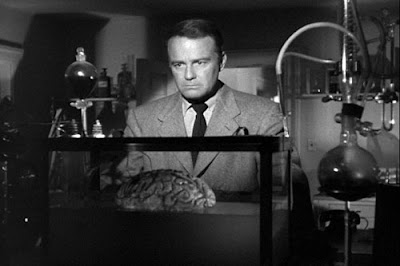
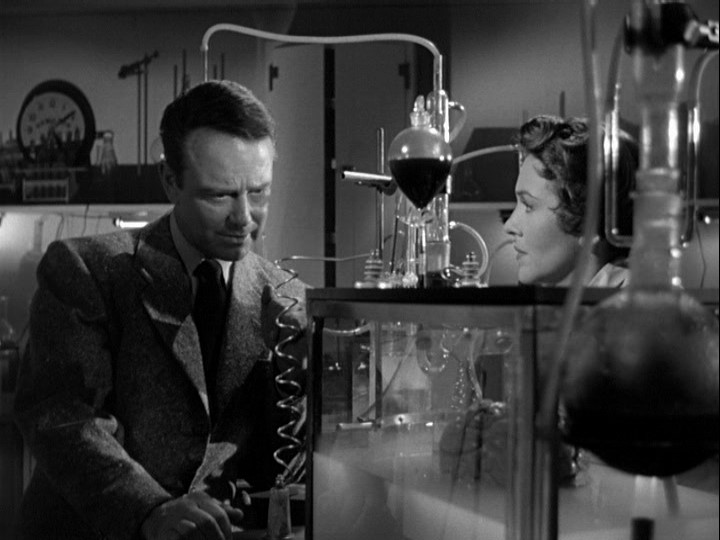
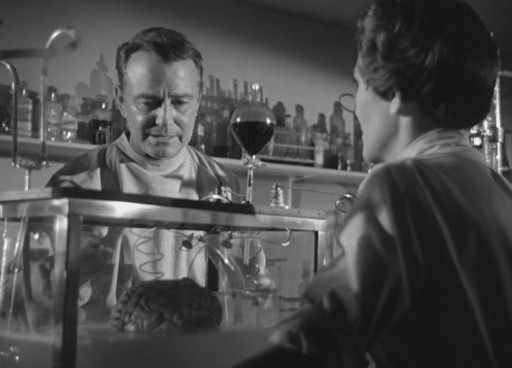
After limited success with monkey-brains, opportunity falls from the sky with the conveniently nearby plane-crash that kills millionaire-industrialist H. W. Donovan--but leaves his brain undamaged (these millionaire industrialists have pretty thick skulls). And before you can say, "The ganglia's all here!" Donovan's brain squats in one of those big aquariums that can hold all sorts of veiltails and comets (there must have been one in the waiting room!) 

Now, this film was made in the "Ameri-CAN" era of the 1950's, so there is no thought given to defeatist talk like "Just because we CAN, doesn't mean we SHOULD" Not when Cory's wife is played by Nancy Davis, the-soon-to-be Mrs. Ronald Reagan! "You get in there, Daddy, and pickle that brain!"* 

Now, now. I'm letting my leftist agenda get in the way. The future First Lady is the best thing in the movie (Mr. Ayres being a little bit...restrained for the material, as maybe he thought he was still playing Dr. Kildare or something) and her palm-outward-looks of horror at the intractability of her favorite brainiac's single-minded purpose rise above the studio-prescribed requirements of the science-plagued ingenue. 

Now, because a brain in an aquarium is a lonely thing (despite being surrounded by bubbling water, flashing lights and the instrument that goes *ping!*), Cory devises a system for the brain to communicate (Davis could have told him that as it was a man's brain, he shouldn't make it a priority, but there's no stopping Cory). There being no cadavers lying around (but, boy, just you wait) and because Universal Pictures has the film-rights to "Frankenstein," he sets up a system so Donovan can electrically communicate via brain-waves, telepathically sending messages to the team. Sort of like using lawyers while he was alive. But requests to have his water changed just isn't enough for the industrialist. Suffering from unrequited lobe, once he gets Cory's ear, he soon wants the whole body, and Cory is helpless to resist Those Big Business Brain-Waves. 

Usually when you combine an entrepreneurial spirit with a scientist, you get a snow-storm of government-grant proposals. But Cory...goes to the lawyers, instructing them to turn over Donovan's fortune to him, so he can...Mwah-hah-hah...expand his empire. Living in an aquarium does that to you. 
Not very good, really. But, a bit ahead of its time when dealing with the possibility of altering brain-chemistry for purposes of rehabilitation. And Dr. Cory goes in with the best of intentions—to find a cure for alcoholism. 

But the story screams like a B-actress for a re-make that can touch political, social and pharmacological fronts. What if Donovan was on Xanax before the crash, and afterwards, the brain becomes stronger, but more hostile? What would an entrepreneur do given the power to control others? Well, control more, I'd think. He'd want to corner the market. What if the brain could be used as a power-source—a self-regulating power-source? And what might it do with that power? In an age of wireless gadgets and computers, and artificial limbs controlled by brain-impulses, what couldn't the brain do (besides the dishes—it's a man's brain, after all)? Think of the movie you could make now...if you had a mind to. 

Low-angle indicates dominance...
* Actually, I can hear Nancy Reagan saying that...