Showing posts with label Gene Evans. Show all posts

Wednesday, June 30, 2021

Donovan's Brain

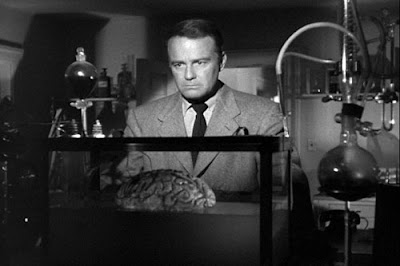
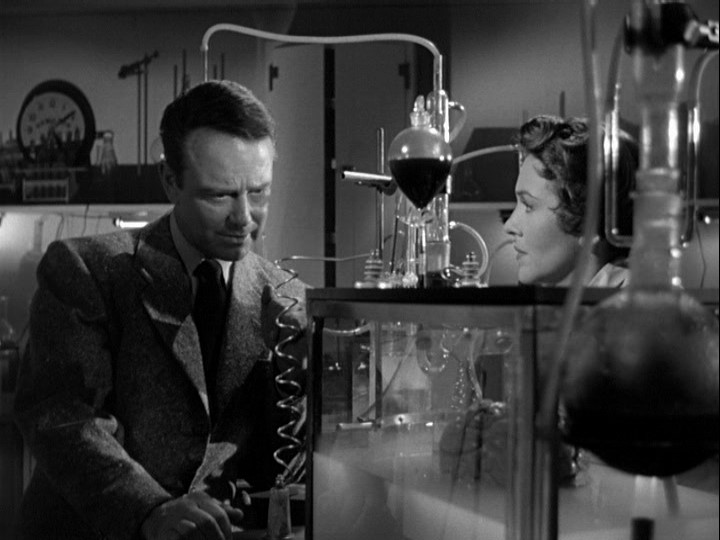
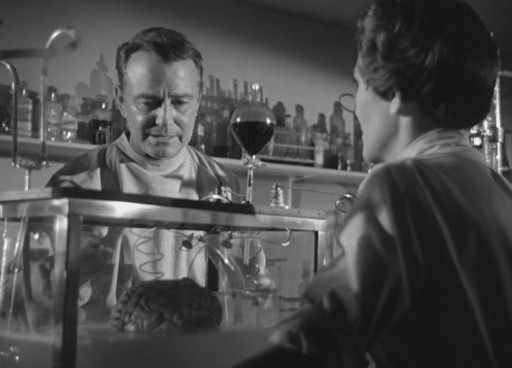
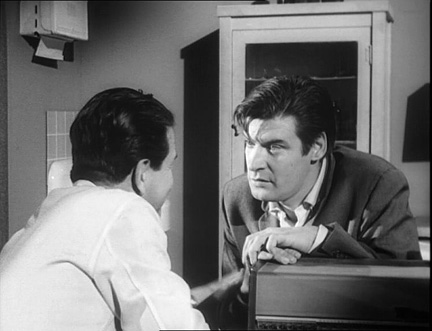
Donovan's Brain (Felix E. Feist, 1953) Turgid and over-the-top '50's sci-fi pot-boiler (based on Curt Siodmak's 1942 sci-fi thriller) about a scientist, Dr. Patrick Cory (Lew Ayres) experimenting with trying to keep alive what Woody Allen called his "second favorite organ:" the human brain.
 
Volunteers are, naturally, hard to find.
 
After limited success with monkey-brains, opportunity falls from the sky with the conveniently nearby plane-crash that kills millionaire-industrialist H. W. Donovan--but leaves his brain undamaged (these millionaire industrialists have pretty thick skulls). And before you can say, "The ganglia's all here!" Donovan's brain squats in one of those big aquariums that can hold all sorts of veiltails and comets (there must have been one in the waiting room!) 

Now, this film was made in the "Ameri-CAN" era of the 1950's, so there is no thought given to defeatist talk like "Just because we CAN, doesn't mean we SHOULD" Not when Cory's wife is played by Nancy Davis, the-soon-to-be Mrs. Ronald Reagan! "You get in there, Daddy, and pickle that brain!"* 

Now, now. I'm letting my leftist agenda get in the way. The future First Lady is the best thing in the movie (Mr. Ayres being a little bit...restrained for the material, as maybe he thought he was still playing Dr. Kildare or something) and her palm-outward-looks of horror at the intractability of her favorite brainiac's single-minded purpose rise above the studio-prescribed requirements of the science-plagued ingenue. 

Now, because a brain in an aquarium is a lonely thing (despite being surrounded by bubbling water, flashing lights and the instrument that goes *ping!*), Cory devises a system for the brain to communicate (Davis could have told him that as it was a man's brain, he shouldn't make it a priority, but there's no stopping Cory). There being no cadavers lying around (but, boy, just you wait) and because Universal Pictures has the film-rights to "Frankenstein," he sets up a system so Donovan can electrically communicate via brain-waves, telepathically sending messages to the team. Sort of like using lawyers while he was alive. But requests to have his water changed just isn't enough for the industrialist. Suffering from unrequited lobe, once he gets Cory's ear, he soon wants the whole body, and Cory is helpless to resist Those Big Business Brain-Waves. 

Usually when you combine an entrepreneurial spirit with a scientist, you get a snow-storm of government-grant proposals. But Cory...goes to the lawyers, instructing them to turn over Donovan's fortune to him, so he can...Mwah-hah-hah...expand his empire. Living in an aquarium does that to you. 
Not very good, really. But, a bit ahead of its time when dealing with the possibility of altering brain-chemistry for purposes of rehabilitation. And Dr. Cory goes in with the best of intentions—to find a cure for alcoholism. 

But the story screams like a B-actress for a re-make that can touch political, social and pharmacological fronts. What if Donovan was on Xanax before the crash, and afterwards, the brain becomes stronger, but more hostile? What would an entrepreneur do given the power to control others? Well, control more, I'd think. He'd want to corner the market. What if the brain could be used as a power-source—a self-regulating power-source? And what might it do with that power? In an age of wireless gadgets and computers, and artificial limbs controlled by brain-impulses, what couldn't the brain do (besides the dishes—it's a man's brain, after all)? Think of the movie you could make now...if you had a mind to. 

Low-angle indicates dominance...
* Actually, I can hear Nancy Reagan saying that...

Friday, July 17, 2020

Park Row

Park Row (Samuel Fuller, 1952) One of those movies that I really wanted to see—it was writer director Sam Fuller's personal favorite, but finding it has been a challenge. Thanks to TCM, it finally showed up on a night of Sam Fuller movies and it more than satisfies the anticipation for its story about a fledgling New York newspaper going up against "the bigs" in the "lusty days of the golden 80's." Made with Fuller's own money—he went broke—it's also, more than any of his other films, of his blood, soul and passion. Big, broad, and loud, it saves subtlety for other stories. This one's about the field where Fuller grew up—he started as a copy-boy at 13 and was a crime reporter by the age of 17 ("a byline was the thrill of my life" he'd later say)—and obviously the one he was most nostalgic for, and the film, as a result, is wildly theatrical, almost operatic and wears its heart on its ink-stained sleeve.

Fuller could always be counted on to start his movies with a bang (sometimes literally) and he begins his tribute to newspaper publishing with a screen filled with the names of newspapers—each in their distinctive fonts—with a preamble linking them to his movie—"These are the names of 1,772 daily newspapers in the United States/One of them is the paper you read/All of them are the stars of this story"—and crescendoed with a "Dedicated to American Journalism" in the cinematic equivalent of 120 point type.

"Go jump off the Brooklyn Bridge!"

It's a thesis big and bold and approaching camp with a zeal that flavors the entire movie, starting with the first image when "Samuel Fuller Productions" is revealed to be a type-block held by a statue of Johannes Gutenberg, the first statue of the many lining "the most famous newspaper street in the world," New York's Park Row, "where giants of journalism mix blood and ink to make history across the front page of America."
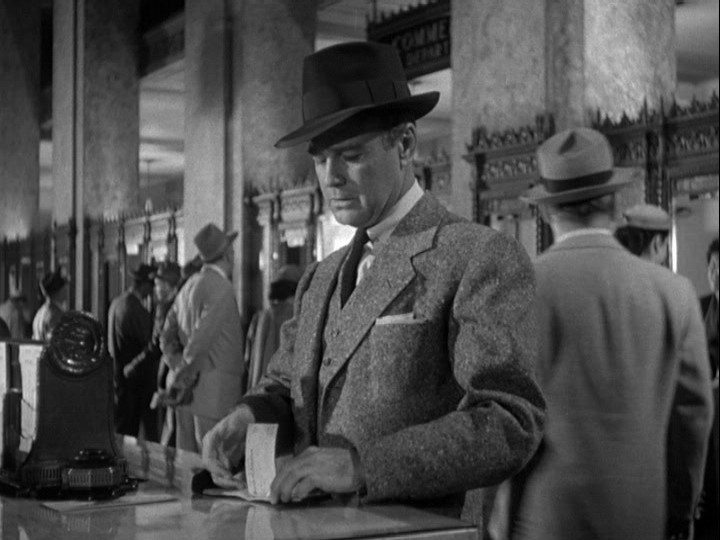
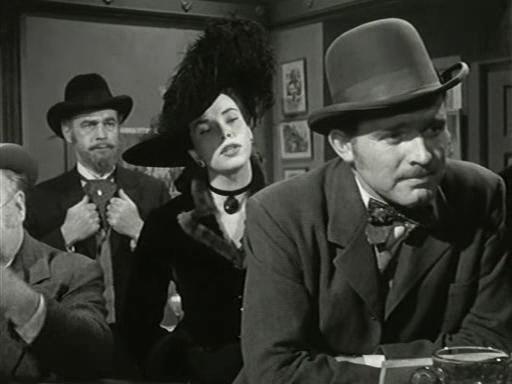
On this street—a stage-filling street set that we will be going up and down quite a bit—on this night, one door will shut and another open for Phineas Mitchell (Gene Evans in a gale-force performance) of the editorial department of The Star, as he stomps into O'Rourke's pub, intercepts the beer sudsily slid in his direction, and glowers, upset at something he's seen in the publication of his employ. A glory hound, Steve Brodie (George O'Hanlon), walks in and asks him what a guy has to do to get his name in the newspaper around here. Mitchell snarls "go jump off the Brooklyn Bridge," and then announces he doesn't work for The Star anymore. He's about to get himself fired.
He goes to the potter's field grave of recently hanged Charles Mott and nails up a makeshift head-stone "Here lies..." with a birth-year and death-date with the epithet "Murdered by The Star." That little act of defiance gets the attention of the publisher of The Star, Charity Hackett (Mary Welch), who isn't even aware Mitchell's on her payroll, but makes it to O'Rourke's to find the responsible party and, finding her prodigal son, fires him. She is unrepentant for the role her paper paid in the execution and Mitchell excoriates her for her "trial by publication."
Mitchell: He was tried by your paper.
Hackett: He was tried by a jury.
Mitchell: You sprung the trap.
Hackett: I simply broke the story.
Mitchell: The story broke his neck!
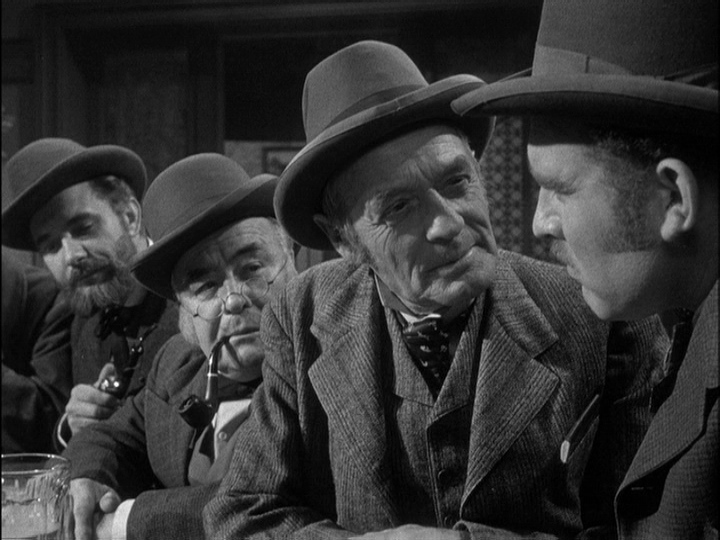
Whatever rhetoric he might employ, he's still fired. Hackett leaves; she's got a newspaper to put out. But, two more incidents happen at O'Rourke's that evening: Brodie comes back to tell everybody he jumped off the Brooklyn Bridge and a local printer who's been listening to Mitchell mutter about the paper he'd publish—"The Globe"—finally decides to put his money where Mitchell's mouth is and stake his dream-paper. With a key to the front door, a couple of the O'Rourke-habituating news-hounds in his employ, a compositor who can't read English, and a bail of butcher paper, he puts out Vol.1; No.1 of The Globe, four pages of "a newspaperman's newspaper." The lead story is how Steve Brodie got sprung from the clutches of the local authorities (the story doesn't mention that Mitchell turned him in so he could get him out and get the story).

"The press is good or evil according to the character of those who direct it."

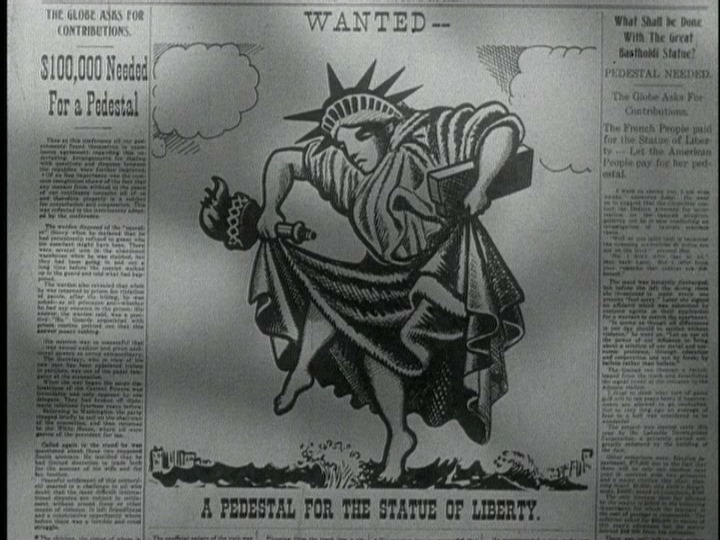
There will be other headline-grabbers—The Globe will start a fund for getting a pedestal for the Statue of Liberty (currently sitting around in pieces in New York) and that will start a small crime-ring of grifters selling false certificates, and, internally, that illiterate compositor will be inventing the linotype machine. But the Big Story will be the rivalry between The Star and The Globe, a love-hate relationship that will reflect the regard held between Mitchell and Hackett, but turn ugly in the ruthless competition to stay in business. She'll try to hire Globe reporters and compositors, he'll rail against her business practices, she'll try to buy up all the newsprint, he'll get in a brawl with a Star thug who started that grifting ring (in a long travelling shot that covers the length of Fuller's Park Row set and ends up with Mitchell using the statue of Ben Franklin as a weapon).
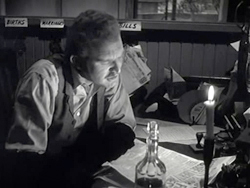
Fuller makes full use of his all-inclusive set, which includes both interiors and exteriors—thresholds are crossed in one unbroken camera move—and even when inside, there's bustle out on the street as seen through the windows and doors, filled with details of the day-to-day for all to see (one nice little bit of business is the pike-board at Mitchell's editorial desk with the obligatory spaces for Births, Deaths, Marriages and Bills—the "Bills" pike is never empty). Fuller was a director of the image and would far prefer to show you what's going on than tell you. And despite the speed with which he made the film—it was shot in 14 days—the compositions are careful with an eye towards crafting a painterly image, especially given the way he would crowd characters into the frame to direct the eye to its focal point. Fuller was never afraid of close-up's or two-shots, but here his film fairly busts with characters jammed to fill the frame, making use of every available use of space.
When a director makes his dream project there is often a let-down in quality—the opportunities come at their greatest success and the budgets expand and there's less of a critical eye and the burden of constraints. Dream projects suffer because of the indulgence and the ego of its creator. 

But, this is one dream project where the love is on the screen and the director's infatuation informs every shot, every beat and every edit. This is the movie that Fuller had his heart and soul set on—and he put his money on it to back them up (and set the constraints). The result is a love that isn't embarrassing in the least, but forthright, honest, and as bigger-than-life as the guy what made it.

There are lots of good Fuller movies—ones so brazen they'll make ya squirm—but, this one might make you proud. Just as it did its creator (even though it didn't make a dime). 

-30-

Saturday, August 4, 2018

Hell and High Water (1954)

Hell and High Water (Samuel Fuller, 1954) Sam Fuller was a tabloid journalist before he became a film-maker, and when he switched careers—after stints writing pulp novels and screenplays—he had his first big hit with a topical Korean War picture, The Steel Helmet. From then on, Fuller kept his eyes on the headlines for his subject matter in order to attract audiences in such of something new. It kept his already edgy film-making style on the bleeding edge of topical audience-grabbers.

So, you can hardly blame him when he starts his atomic-age spy adventure, Hell and High Water, with a literal bang—an atomic bomb explosion, created with a high-octane initial explosion inter-cut with government approved nuclear footage (carefully color-corrected, evidently, as the actual colors  might reveal atomic secrets via the boiling colors inside the conflagration.

That bomb blast is preceded by opening titles: 
In the summer of 1953, it was announced that an atomic bomb of foreign origin had been exploded somewhere outside of the United States. Shortly thereafter it was indicated that this atomic reaction, according to scientific reports, originated in a remote area in North Pacific waters, somewhere between the northern tip of the Japanese Islands and the Arctic Circle. This is the story of that explosion.

A French atomic scientist, Prof. Montel (Victor Francen) on his way to a conference goes missing at Orly Airport; the headlines around the world assume that he has defected behind the Iron Curtain. But one man is about to find out differently. 

Retired submarine commander Adam Jones (Richard Widmark) is traveling anonymously in Tokyo.  A former sub-mate recognizes him, but he brushes him off. $5,000 will do that. He's been wired the money as down payment for a job in Japan; what it entails he has no idea, but he's traveled there to find out. Instructions take him to a hidden base, where an eclectic group of officials and atomic scientists—including the missing Frenchman—have summoned Jones for a particular mission.
They've taken possession of a scuttled Japanese submarine to do some investigating of a remote island in the Bering sea above the Arctic Circle, where a Chinese freighter has been making frequent deliveries, and where a recent surveillance plane has been shot down. The pilot was a friend of Jones' so he's already hooked to take on the mission, plus, he'll get an additional $45 grand  if he pulls it off, but he has two demands—he wants his pick of his old crew to get the submarine into shape...and he wants it armed.

The first one he gets, but the committee, in a hurry to get going because that targeted freighter has once again sailed, doesn't give Jones the time to test the torpedo tubes...or, for that matter, give the sub an extended dive test. Well, it wouldn't be a secret mission without some form of handicap. But, it doesn't stop the handicaps from increasing by taking on Marcel as an observer, and he brings along his assistant, Professor Denise Gerard (Bella Darvi*), whose presence is perpetually disruptive—initially because the crew-members of Jones' old command see her as a sign of bad luck for an all-male crew, but eventually, because she inspires a lot of unwanted attention, causing fist-fights and a general lack of focus.
The problem is solved by the Captain, by cracking down on his crew and placing her off-limits—to everyone, but himself, of course. Rank evidently has its privileges.
Fuller did his research aboard an active submarine, and he was able to use the relatively new Cinemascope widescreen process to advantage aboard the cramped quarters of the submarine sets, showing that it could be used for more than religious epics. One of the benefits of that research is in the using of red interior lights in a submarine—which were used to keep light from being emitted from a raised periscope and to allow crewmen's eyes on watch to adjust to the dark. It creates an eerie glow that Fuller uses to great advantage during one of the improbable love scenes between Jones and Gerard.

Fuller stages some nifty little underwater sequences as the sub plays cat-and-mouse games with a Chinese submarine and the freighter only to find that the island that it's going to is a feint for a second island, where there is a marked difference in detectable radioactivity and a secret that reveals a plot that would be re-run in the Cold War James Bond films of the '60's. 
This wasn't one of Fuller's favorite assignments or results, which he dismissed as "a sea picture where we never went to sea" (although Fuller is a clever magician with stock footage that you never know that, despite the set-bound nature of many of the set-pieces)—but it is fondly remembered—recycled footage was used in the "Voyage to the Bottom of the Sea" TV series and Steven Spielberg used it as research for 1941, and proudly showed Fuller a print of it in the trunk of his car when Fuller filmed a cameo for that film (as Fuller chortled in his autobiography).
Still, it is a diverting adventure yarn, with some surprises and shocks along the way, even if it's muted Fuller (perhaps because the original writer, Jesse Lasky, Jr. was allowed a re-write of Fuller's re-write of his script).  It is rare that you could call a film by Sam Fuller "a programmer" but Hell and High Water is as close as the man would come in his career.


* Fuller took on the assignment out of loyalty to producer Darryl F. Zanuck, who stood by the director after FBI Director J. Edgar Hoover had strong, and censorious, objections to Fuller's Pickup on South Street. But, along with taking on the job, Fuller had to put up with some of Zanuck's casting suggestions—Bella Darvi being one of them. Darvi was discovered by Zanuck's wife Virginia—her stage name is a combination of the first syllable of the Mr. and Mrs. Zanuck's first names—who insisted she move into the Zanuck home after her divorce from her husband. Soon after, she became Darryl Zanuck's mistress. Widmark protested Davi's casting, but was overruled. Fuller did have a problem with Darvi's heavily accented English, so he used Zanuck's tric of calling in a favor, employing his frequent co-star Gene Evans to function as her dialogue coach.

Saturday, April 7, 2018

Shock Corridor

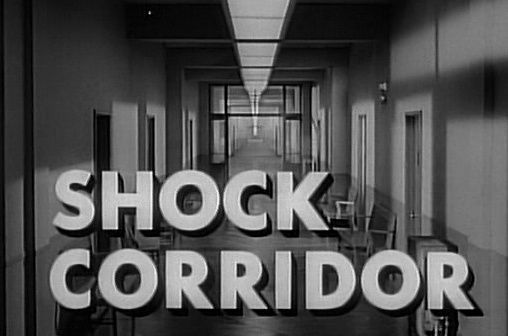
Shock Corridor (Samuel Fuller, 1963) If ever there was a title that needed an exclamation mark at the end of it, this was it. But, if you know Sam Fuller, gritty maverick director, and what he was trying to do with this bottom-of-the-barrel-budgeted pot-boiler, you know he probably wanted to call it simply "The Street," the nick-name for the communal "hallway" where the inmates of an insane asylum meet and greet...and interact, sometimes explosively, and reflect the madness of the world outside its walls.

Reporter Johnny Barrett (Peter Breck, sometimes good, sometimes bad) is investigating the murder of a patient at an asylum, looking for an expose to win a Pulitzer. he's been training for a year to pull the wool over the diplomas of those weisenheimer shrinks so he can get inside. His editor, "Swannee," is all for it, but his stripper girl-friend Cathy (Constance Towers) thinks it's a bad, bad idea...real bad. But she plays along, posing as the worried sister whose fear of Johnny's "affections" creates the police report that sends him up (This is one of those police departments that doesn't do background checks, or investigations of any kind). 
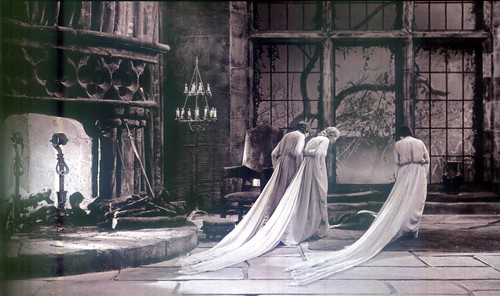
Johnny's encarcerated as a sex maniac, and we're thrown into the sordid exploitation stuff of sadistic guards, colorful loonies, and perversions. At one point, Johnny stumbles upon the woman's ward (Fuller cuts to a bug-eyed Barrett, realizing his situation and in echoe-y voice-over says one, hilarious word--"Nympho's!") and then is set upon, "Daughters of Dracula"-style in a genuinely creepy scene. Fuller walks a razor-thin line of silly exploitation and truly daring social commentary that slaps you across the face, and you realize--he's serious! 
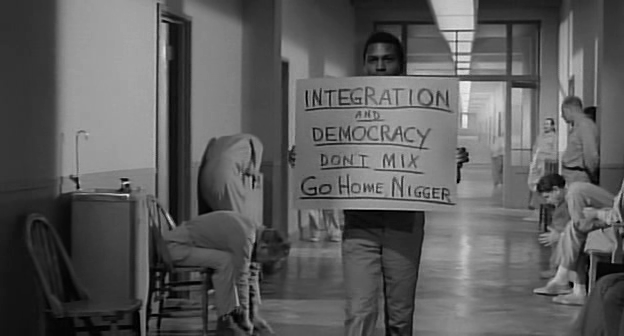
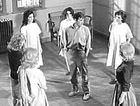
Sure, Cathy gets a performance scene as a stripper--although she it's a rather stodgy dance routine with a torch-song to go along with it (she's Mrs. Sam Fuller, after all, gotta keep the wife happy), but once we know one psychosis from another, and Johnny starts to interview the witnesses to the murder, Fuller starts doing something deeper than giving jollies to the mouth-breathers. His three murder witnesses are all victim's of the State's insanities. There's Stuart (James Best) a Korean war vet and victim of brainwashing but, as it's made clear, he's just as brainwashed by the racist upbringing he received growing up in the South. Then there's Boden (Gene Evans) genius missile engineer, whose so unhinged by the Mutually Assured Destruction scenarios his inventions have been targetted for, that he cracks to the abilities of a six year old child, capable only of drawing and playing hide-and-seek (although it looks suspiciously like duck and cover the way he plays it). Finally, in easily the best performance of the movie, is Hari Rhodes as Trent, a former student, allowed at gun-point to attend a previously integrated college, and in his efforts to be five times better than the white students, cracks under the pressure, becoming as bigotted as the protesters who tried to keep him out. Where Evans and Best can't seem to hurdle a mental block from turning their roles into melodrama, Rhodes plays it absolutely straight and he's the guy you remember.
Does all this actually lead to finding out who the murderer is, and what happens to Johnny? Well, I think you can guess given Fuller's cynical view of things. But he's trying to do more with it, and equate the U.S. circa 1963 with the trappings of an insane asylum. That's a brave statement, especially for a B-movie exploitation pic. But that's usually where Fuller preferred to be. He could rise above his genre and budget. There are times when the dialog tries so hard to rise above its exploitation roots and prove that it's read a book or two that it approaches Ed Wood ponderousness. But the trunk of the thing is a joy to behold, despite all the cheap tinsel and gaudy patter.
And along the way, Fuller scores a few hits against the psychiatric profession: the first shot is of a psychologist straightening his crooked diploma, and at one point during his psych evaluation, the prepped Johnny thinks "This is where he's going to ask if I hear voices.." and the shrink asks, "Johnny, do you ever hear voices?" It's a funny scene, but it also shows the limitations of the profession's pigeon-holing of individuals. (Hey, Tom Cruise! I got your next remake project for ya!) 
Ultimately, History is the judge. This cheap little grindhouse flick is part of the National Film Registry. That's not voices you hear in your head. It's the echoing cackle of Sam Fuller.

Saturday, September 27, 2014

The Steel Helmet

The Steel Helmet (Samuel Fuller, 1951) Shot in ten days for a budget of $100,000, The Steel Helmet was the first film dealing with the, by-then, six month old Korean War. It was Fuller's third job as a director and his first established hit, but it marks a big contrast with the World War II films that were still making their way into theaters at that point.

The credits appear over a single steel helmet in the dirt. Once Fuller's director's credit fades away, the helmet begins to move. Underneath it is Sergent Zack (Gene Evans), tied and crawling out of his place in a pit where his entire captured squad was executed, he being the one survivor. He is untied and aided by a Korean orphan (William Chun), whom Zack dubs "Short Round" and while a bit of an annoyance, the kid is kept around while the soldier looks for other Americans.


Already Fuller is differentiating this film and this war from the squadron of films that came out of WW II. By the time of the film's release, movies made about the second world war were comfortably moving into the realm of myth, sanitizing the conflict and its hardships in the name of a "good war." But Zack is a different breed. He's scraggly, bearded, and a bit of a jerk, but a survivor. Suspicious of everyone and everything, he'll at least cut some slack if you're wearing the same uniform. But you have to prove yourself.

The rag-tag soldiers of The Steel Helmet
After fending off an attack from soldiers disguised as villagers praying at a small shrine, he and Short Round run into Cpl. Thompson (James Edwards), a medic, also the last survivor of his platoon. Thompson stitches Zack up and soon, they come across another group of dog-faces, lost in transit to a mission: to find a particularly strategically located Buddhist temple and establish a post. Along the way, the make-shift patrol is attacked by snipers hiding in the trees and attempt to disarm a booby-trap...unsuccessfully.

By this time, personalities have come to the fore. Every soldier is a "type," but not the usual religious and ethnic melting pot from the second World War films. Among the group is a yokel, a soldier who doesn't say much, a conscientious objector, a "green" college-educated officer, a Nisei soldier (who'd been to the West Coast concentration camps during the second world war and portrayed by veteran actor Richard Loo), and Thompson, who's black. This is stronger stuff than the Jews, Poles and Italians who provide "color" to white-washed war films of the previous decade. These guys are scruffy, too, and though typed, there's enough personality and grit to make them stand out as individuals, not tokens.

The crew makes their way to the temple, little suspecting there's a Korean sniper already entrenched there, outnumbered and biding his time, hiding in the shadows. As the soldiers set up a bivouac, the Korean takes out another of the rank and gets wounded in the process. The squad starts to squabble about what to do with their prisoner, while the whole time the huge Buddha observes mute in the background.  Eventually, Thompson treats the wounded captive, but once he's healthy again, the English-speaking prisoner starts to try to subvert Thompson and Tanaka by questioning why they would fight for America, given the racial prejudice visited on both their races.
That scene got Fuller in trouble with the FBI and the Army (who provided the film with stock footage) both for its portrayal of American troops and for bringing up American social deficiencies that might provide aid and comfort to the enemy (The Daily Worker also criticized the film for being too "right-wing"—leaving Fuller caught in the middle between idealized ideologies, something that would happen throughout his career).  
Thompson patches up "The Red."  Notice who's holding up the IV.
Warring ideologies inform the film, as well, especially over the POW. The GI's must battle between practicalities and the "better angels" of their natures over his fate. But, the point may be moot as a squad of North Koreans is advancing on the temple. Before the fight is over, more men will die and Zack will come to a greater understanding of his place in the war and rather than being hardened by his experience, learns to yield.
On an extremely small budget and a limited scope, The Steel Helmet still manages to pack more ideas and challenging points of view than most other war films, probably because there's less emphasis on battle and more on camaraderie, there's more getting along and survival skills than actual combat, which sets it apart. In typical Fuller fashion, the film is blunt, tough, practical and makes the most of its budget, while nudging insistently out of audience's comfort zones. Despite that (or maybe because of it) the film became a minor hit and launched Fuller into a Hollywood career directing and becoming a maverick doing it.