Showing posts with label Samuel Fuller. Show all posts

Sunday, February 23, 2025

Underworld U.S.A.

Saturday is traditionally "Take Out the Trash" Day, even when the trash is pretty damn good, like this pulpy one by maverick director Sam Fuller.

Underworld U.S.A.
(Samuel Fuller
, 1961) A Saturday Evening Post serial about organized crime during the 1930's was the source material for this pot-boiler that had gotten Humphrey Bogart's interest as a project. But Bogart died of cancer in 1957, and Columbia still had the property on their hands.
 
By this time, the Hays Code was dying a deserved death and the mobsters and racketeers, that had been pretty much hush-hushed by the movies since they'd caused hissy-fits among the pearl-clutchers in the 1930's, were making their way back to the screens. Billy Wilder even used them in his comedy Some Like It Hot in 1959! So, with the Hays hand-cuffs taken off, Columbia looked to see if they could toss out their own mob movie, and they latched onto one of the movie's most exploitative fire-brands, Samuel Fuller, who took one look at the material and tossed out the time-frame. There were mobsters making a lot of coin NOW! And some of them gave off the stink of legitimacy, so why treat it as something as quaint and antiquated as a buggy-whip? Fuller was proposing a tale of the Mafia violently opposing a prostitute's union, but Columbia rejected the idea. The Hays Code may have been crippled and toothless, but you still couldn't go too far in pushing the plain-brown envelope.
Fuller's next idea was of a kid making his way through the ranks of organized crime to avenge the murder of his father which he witnessed when he was a punk kid of 14. He swears revenge, and growing older, he moves from rolling drunks to break-in and robbery. Oh. And the kid, named Tolly Devlin, goes from being played by
David Kent to Cliff Robertson.
And with his meager lone-wolf means, he gets wind that one of the guys—the guy whose name he knows—Vic Farrar (Peter Brocco) is dying in prison. Tolly wants to help the old guy along, but how to get to a guy in in the joint? Never one to think too elaborately, Tolly decides to be just a little sloppy on a safe-job, gets caught in the act and winds up in the same prison with Farrar. He becomes a good enough trustee that he talks his way into being an assistant to the prison saw-bones and before long it's curtains for Vic Farrar, but not before he gets the names of the other guys who killed his father. Being a safe-cracker, the one thing Tolly has is patience.
One down. Three to go. Tolly's good behavior (despite his secret extra-curricular activities) gets him parole and, with a new suit, and new set of targets, he goes to the only home he has, the one owned by Sandy (
Beatrice Kay), who used to run a gin-mill until she was bought out by a thug named Gela (Paul Dubov), who, under the guise of cleaning up the town of booze-halls has turned them into "coffee shops" serving java in the front...and heroin in the back. Sandy tells Tolly the whole sad story, and he recognizes the names Farrar mentioned of all the thugs who murdered his Dad: Gela, the dope king; Gunther (Gerald Milton) the crooked labor leader, and Smith (Allan Gruener), who runs prostitution. Now, he's got faces to the names—they all have respectable business fronts—and Sandy warns him that they're better protected than the President of the United States.
 Gela, Gunther, and Smith
Well, if you can't beat up, join 'em—that way you can mingle with the muscle protecting the mob. He breaks into Gela's main "coffee shop," "The Elite Espresso"—the one Sandy used to own—and cracks the combination of the safe he used to practice on when he was a kid. He's interrupted by one of Gela's gun-men, Gus (Richard Rust), who's using one of Smith's girls to make a heroin delivery. Her name's "Cuddles" (Dolores Dorn) and before the gunsel can follow orders and kill her for welching, Tolly clocks him over the head and he and the girl make a clean getaway with the key to the stash.
"Cuddles"
Tolly tells her he's a narcotics cop and gets her to show him where the "junk" is—so he'll "go easy" on her—then steals it so he can use it to get to Gela and takes her back to Sandy's place for safe-keeping. Despite Sandy's misgivings, he sets up a meeting with this Gus hoodlum to extort 50k from Gela to get his own drugs back. It's a meeting that doesn't start well at first, with Tolly getting a gun put to his temple, but it does get him in the same room with Gela, where he tells the dope king that he was trying to find the killers of his father, but spins a story that Farrar told him all those hoods died. Them he makes a big show of giving the heroin back for nothing...because Gela and his Dad were such good pals. Gela hires him as a bag man—supervised, of course—because Gela ruefully admits he's a sentimental slob.
So, Tolly's inside, trying to worm his way through the organization to find the weak spots. Cuddles tells him how she saw Smith kill a girl once and he decides to make a fast move to get one of his Dad's killers out of the way. He calls John Driscoll
(Larry Gates) Chief Counsel for the Federal Crime Commission that is trying to take down the mob troika and their big boss Earl Connors (Robert Emhardt), who runs his own front with the generic name of National Projects. Driscoll gets a promise from Cuddles to testify against the guy, and suddenly there are two out of the way.
Newspaperman Fuller's way of disposing of the mob—banner headlines!!
What's going on here is writer-director Fuller's version of Yojimbo, Akira Kurosawa's samurai transfiguration of Dashiell Hammett's story "Red Harvest"—just as Yojimbo would be transported to the Western genre as A Fistful of Dollars—where a lone operative finagles his way into the confidences of rival gangs, and, in so doing, pits them against each other. Here he turns the mobsters into setting onto themselves because "there's no honor among thieves" but with the added wrinkle that he's also working for Driscoll—unbeknownst to the Mob—with a clandestine way of lighting fuses, playing everybody against each other...but leaving himself untouched. He's his own man, does things "my own way" and he's just manipulating both groups to get his revenge faster and more completely. It's a lovely distillation of Hammett, while coming out the same year as Kurosawa's version.
"Suckers..." he says
He'd done something like it with his Pickup on South Street, a movie so cynical about ideals that it even hacked off J. Edgar Hoover. Fuller who both wrote and directed Underworld U.S.A. always was a firebrand—he started his career as a newspaperman on a crime beat—and loved speaking truth to power and he has a cackling good time with "the Fed", Driscoll, in an exposition-dump scene that compares the mob to as respected an American institution as the U.S. Armed Forces with its ranks and divisions and chiefs of staff—"Top Brass" he calls them—doing The Godfather one better painting Organized Crime as American as Big Business Apple Pie and doing it ten years earlier.* 
But, Fuller isn't so radical that he can't choose sides among the riff-raff. His mobsters can lay no claim to being colorfully romantic as in The Godfather series and they're 180° from heroes. They're out trolling schools and using their recreational programs for getting kids addicted and girls into prostitution. At one point, the head-boss Connors, instead of addressing a recent screw-up, berates his heads that their numbers are down and he gives a pep-talk out of a nightmare: "There's 13 million kids between the ages of 10 and 15. Don't tell me the end of a needle has a conscience. Put more field men to work around the schools. We'll always be strong as long as we're tough."
It's over the top drama (Fuller is not a subtle man—the score's major motif is based on "Aud Lang Syne" as in "should auld acquaintance be forgot"), but also a little heart-pumping how much energy the film enjoys on a miniscule budget. And, although Fuller may cut-away from the violence, he does spare you the gory details, setting up mob-hits on the young daughters of snitches, setting a live guy on fire in his car, and a constant trail of broken people being exploited for money by guys in good suits. Fuller takes his outrage and takes it out on us, not holding back because he was never one for sugar-coating. But giving it to you straight and no chaser, except to make it entertaining and not a lecture.
I'm getting to the end of seeing everything in Fuller's lengthy career. And I gotta tell you, I'm going to miss the shocks and surprises.

* Funny enough, Fuller auditioned for the part of Hyman Roth in The Godfather Part II for Coppola before securing Lee Strasberg for the role.

Wednesday, September 30, 2020

The Crimson Kimono

The Crimson Kimono (Samuel Fuller, 1959) When TCM was programming their "Asian Movie Month" this one ran three times (that I could count). It's an odd choice, but I was grateful as it's one of those Fuller movies that hasn't been all that available from any of the sources I search for these things.

As usual, it's a mixture of Fuller's higher sensibilities and his cynical carnival-barker understanding of what 'sells" to the public. Take a look at that poster; if that isn't "red meat" for an audience living in the America of 1959 where a third of the nation had laws against "mixed-race" marriages, I don't know what is. Fuller had an understanding and affection for Japanese culture—his House of Bamboo was filmed there and was one of the first American films post Second World War to do so—but, Japanese-American culture and the conflicts it imposes is a different matter. Visually, he marks the contrast by filming in L.A.'s International District with the L.A. courthouse looming only a few blocks away.

But, if you think this is a serious study of post-World War II prejudice and the intolerance of American white patriarchal traditions (it was, after all, okay for Robert Stack to woo Shirley Yamaguchi in 1955...), then you don't know Samuel Fuller.

How does he begin it? With a strip-tease sequence and the murder of same stripper (Gloria Pall) being gunned down in an L.A. street after witnessing a murder in her dressing room (a sequence that Fuller shot—with three hidden cameras—on Sixth and Main at night, without permits, which would have ruined the verisimilitude of the shot). Two detectives, Det. Sgt. Charlie Bancroft (Glenn Corbett) and Det. Joe Kojaku (James Shigeta) are assigned to the case. The two partners are as thick as thieves: they share the same apartment, and are blood-brothers, literally, as, during their Korean War service, Kojaku gave blood to save Bancroft's life. The pair are secure in their knowledge that they have each other's backs, and nothing could complicate that.

In the course of their investigations, they're going to learn different.

Their initial investigation is to the strip club in Little Tokyo, where the "ecdysiast," "Sugar Torch" was working. Her dressing room is a-clutter with renderings of Japanese-style sketches, as it turns out she was working up an act that has a little more content than the usual bump-and-grind solo, with kimono costumes and a love triangle story where she and her love are killed by a jealous karate practitioner. I guess everybody has ambitions. Charlie seeks the artist to see if he can get any background on Sugar's acquaintances, while Joe hits the local dojo's to see if Sugar had contacted them about the act.

The artist turns out to be Christine Downs (Victoria Shaw), a USC art student living in a sorority. Christine tells Charlie that the kimono drawing was a commission by a Mr. Hansel, working for Sugar on the act, and—here's a convenience!—Christine can do a pretty good sketch of the man. Also (another convenience) Charlie is attracted to Christine and flirts with her ferociously, to which she responds.
Joe's investigation bears some fruit, too. He tracks down the guy who was supposed to provide the stunts for Sugar's act, but when Joe confronts him, he panics and Joe loses him in a chase through Little Tokyo. Christine finishes her sketch and the detectives release it to the newspapers as part of their investigation. What they don't know is that this will complicate things...on many fronts. Charlie is warned by his bohemian artist-pal Mac (Anna Lee, of John Ford's stock company) that once the sketch has hit the papers, Christine won't be safe, and, indeed, someone takes a pot-shot at her at her sorority. Although it may not be the best of ideas, Charlie and Joe decide that Christine be put under police protection...by moving into their apartment—while they're working, Mac keeps an eye on her.

Joe and Charlie try to run down Hansel, fearing another attempt on Christine's life, and they talk to Roma, a wigmaker, who was doing the hair for Sugar's act. Turns out Hansel's real name is Paul Sand and used to work for the library as an "Asian specialist" and has disappeared, "gone to ground" somewhere. But, he'll show up, probably to make another attempt on Christine's life, so the search intensifies. But, the circumstances add another complication—one that is Fuller's true focus rather than the lurid murder investigation.

Joe has developed feelings for Christine. Deep feelings. And Christine has them for him. Complications lead to conflict—Joe and Charlie are best friends, but also partners in a dangerous profession. Joe knows Charlie is smitten with Christine, and he feels guilty about his coming between that. He doesn't even want to bring it up and hides it from him. But, he's of two minds in more ways than that: he also has some cultural clashes—the woman he's been seeing is Japanese, born, bred and living there and he's Nisei. His American roots has led to some doubts about continuing his relationship. And then, along comes Christine... From her side, Joe is the better man, more caring, more sensitive, less egotistical: how to break it to Charlie? As Mac sagely tells her, "Love is like a battle...Someone has to get a bloody nose."
Now, when Fuller was making this, he got push-back about it from the studio. There was pressure on Fuller to make Corbett's character "a sonofabitch" (in Fuller's words—from his biography "A Third Face"). For the studio, this would make Joe the more obvious suitor, and reassure audiences—white audiences—that the Christine character would prefer Joe and reject Charlie "even though he's white." Fuller wouldn't have any of it. "The girl chooses the Japanese guy because he's the man for her, not because the white guy's a sonofabitch. The whole idea of my picture is that both men are good cops and good citizens. The girl just happens to fall in love with the Nisei. They've got chemistry."
It's as simple as that. Joe's a good guy—Charlie's a good guy, too—but Christine is drawn more towards Joe because of who he is as a man, in colloquial terms "he's more her type." The tragedy comes, as in most triangles—if there's any conscience involved—for the third making a crowd. Joe, in this position and being sensitive to it (the very aspect that attracts her to Joe over Charlie), buries his feelings in frustration and Christine is hesitant and seemingly aloof around Joe when Charlie's around—which Charlie, at first, reads as racism on her part. It all gets very complicated, as the three stop being people and act as though they're relegated to "proper roles." Everybody begins to make assumptions about things they don't understand, and this triangle gets a little bumpy.
It's tempting to say that the story of the investigation gets pushed aside for the "love story," but, in fact, the two are mirrors of each other, both involving secrets and others filling in the holes with their own interpretations of what's going on. The film resonates more once the crime has been solved, but it only provides context for a story that, on the face of it, looks to be about racial identity. Given the completion of the movie, it looks to be more about suppression of self in order to satisfy a perceived role, especially where emotions are concerned. I've written elsewhere that love can be perceived as a form of madness—it certainly can put one off one's game, and make you do things you wouldn't do "where calmer heads prevail." It make look like prejudice, but it is subjugation, even if it's self-imposed.
The Crimson Kimono is rough around the edges. It's a pot-boiler, frequently filmed with guerilla techniques, and temperatures—and performances—can run a little hot. But, Fuller, who had a reporter's sensibilities (and a huckster's sense of flamboyance and salesmanship) tells a story fully intended to knock one out of one's safely-balanced comfort zone. His action sequences are kinetic, sometimes frantic, and he wasn't afraid to go overboard when making a point—I always imagine him directing by jabbing two fingers, with his ever-present cigar between, for emphasis. He wasn't subtle, but he'd take you places you may never have thought of before—or places you didn't want to consider. "Maverick" is the most obvious adjective. "Human" is another.

He despised that poster, by the way. Pure racism, and that is what he was railing against.
A word about James Shigeta: this was his first film role after years as a singer. It was Corbett's first film, too, but where both men are comfortable in front of the camera, Shigeta acts like he lives there, far more relaxed, less on-guard, and not afraid to take chances. He'll chew an apple through a scene, casually grilling a lead, and he's more than believable in action scenes. Fuller gave his most notable parts to women (usually), whereas the men, even men in conflict, could be stoic and pretty stiff. Not Shigeta. He's actor enough to let the audience in to feel his pain, but not enough to lose their respect. It's a very impressive debut, and one wishes he'd been given more opportunities like this throughout his career.

Of COURSE, Christine's character prefers him; who wouldn't?

Friday, July 17, 2020

Park Row

Park Row (Samuel Fuller, 1952) One of those movies that I really wanted to see—it was writer director Sam Fuller's personal favorite, but finding it has been a challenge. Thanks to TCM, it finally showed up on a night of Sam Fuller movies and it more than satisfies the anticipation for its story about a fledgling New York newspaper going up against "the bigs" in the "lusty days of the golden 80's." Made with Fuller's own money—he went broke—it's also, more than any of his other films, of his blood, soul and passion. Big, broad, and loud, it saves subtlety for other stories. This one's about the field where Fuller grew up—he started as a copy-boy at 13 and was a crime reporter by the age of 17 ("a byline was the thrill of my life" he'd later say)—and obviously the one he was most nostalgic for, and the film, as a result, is wildly theatrical, almost operatic and wears its heart on its ink-stained sleeve.

Fuller could always be counted on to start his movies with a bang (sometimes literally) and he begins his tribute to newspaper publishing with a screen filled with the names of newspapers—each in their distinctive fonts—with a preamble linking them to his movie—"These are the names of 1,772 daily newspapers in the United States/One of them is the paper you read/All of them are the stars of this story"—and crescendoed with a "Dedicated to American Journalism" in the cinematic equivalent of 120 point type.

"Go jump off the Brooklyn Bridge!"

It's a thesis big and bold and approaching camp with a zeal that flavors the entire movie, starting with the first image when "Samuel Fuller Productions" is revealed to be a type-block held by a statue of Johannes Gutenberg, the first statue of the many lining "the most famous newspaper street in the world," New York's Park Row, "where giants of journalism mix blood and ink to make history across the front page of America."
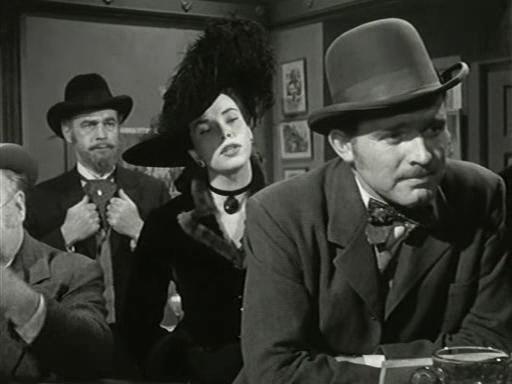
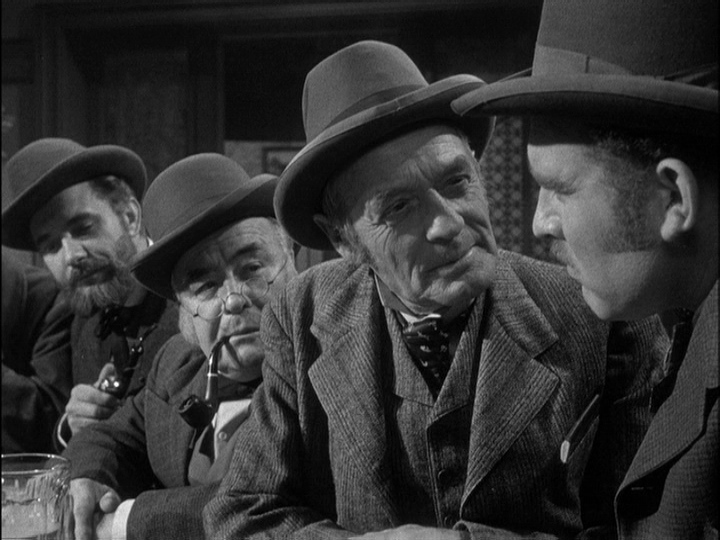
On this street—a stage-filling street set that we will be going up and down quite a bit—on this night, one door will shut and another open for Phineas Mitchell (Gene Evans in a gale-force performance) of the editorial department of The Star, as he stomps into O'Rourke's pub, intercepts the beer sudsily slid in his direction, and glowers, upset at something he's seen in the publication of his employ. A glory hound, Steve Brodie (George O'Hanlon), walks in and asks him what a guy has to do to get his name in the newspaper around here. Mitchell snarls "go jump off the Brooklyn Bridge," and then announces he doesn't work for The Star anymore. He's about to get himself fired.
He goes to the potter's field grave of recently hanged Charles Mott and nails up a makeshift head-stone "Here lies..." with a birth-year and death-date with the epithet "Murdered by The Star." That little act of defiance gets the attention of the publisher of The Star, Charity Hackett (Mary Welch), who isn't even aware Mitchell's on her payroll, but makes it to O'Rourke's to find the responsible party and, finding her prodigal son, fires him. She is unrepentant for the role her paper paid in the execution and Mitchell excoriates her for her "trial by publication."
Mitchell: He was tried by your paper.
Hackett: He was tried by a jury.
Mitchell: You sprung the trap.
Hackett: I simply broke the story.
Mitchell: The story broke his neck!
Whatever rhetoric he might employ, he's still fired. Hackett leaves; she's got a newspaper to put out. But, two more incidents happen at O'Rourke's that evening: Brodie comes back to tell everybody he jumped off the Brooklyn Bridge and a local printer who's been listening to Mitchell mutter about the paper he'd publish—"The Globe"—finally decides to put his money where Mitchell's mouth is and stake his dream-paper. With a key to the front door, a couple of the O'Rourke-habituating news-hounds in his employ, a compositor who can't read English, and a bail of butcher paper, he puts out Vol.1; No.1 of The Globe, four pages of "a newspaperman's newspaper." The lead story is how Steve Brodie got sprung from the clutches of the local authorities (the story doesn't mention that Mitchell turned him in so he could get him out and get the story).

"The press is good or evil according to the character of those who direct it."

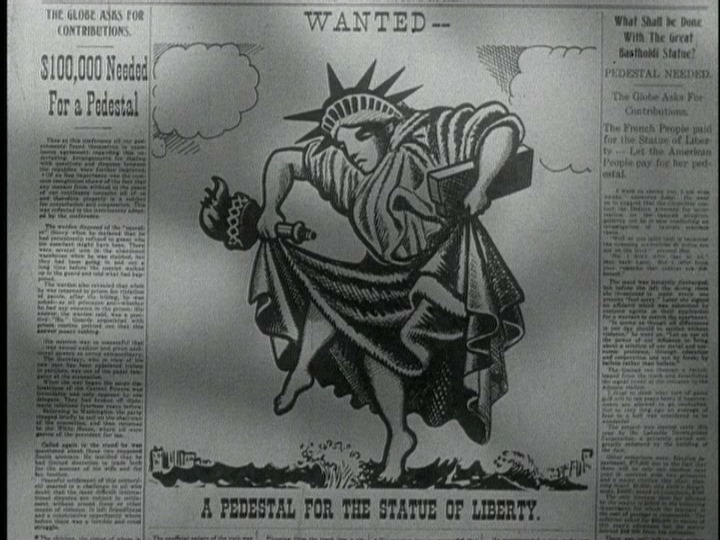
There will be other headline-grabbers—The Globe will start a fund for getting a pedestal for the Statue of Liberty (currently sitting around in pieces in New York) and that will start a small crime-ring of grifters selling false certificates, and, internally, that illiterate compositor will be inventing the linotype machine. But the Big Story will be the rivalry between The Star and The Globe, a love-hate relationship that will reflect the regard held between Mitchell and Hackett, but turn ugly in the ruthless competition to stay in business. She'll try to hire Globe reporters and compositors, he'll rail against her business practices, she'll try to buy up all the newsprint, he'll get in a brawl with a Star thug who started that grifting ring (in a long travelling shot that covers the length of Fuller's Park Row set and ends up with Mitchell using the statue of Ben Franklin as a weapon).
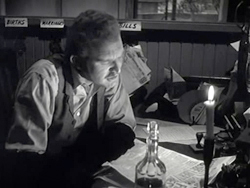
Fuller makes full use of his all-inclusive set, which includes both interiors and exteriors—thresholds are crossed in one unbroken camera move—and even when inside, there's bustle out on the street as seen through the windows and doors, filled with details of the day-to-day for all to see (one nice little bit of business is the pike-board at Mitchell's editorial desk with the obligatory spaces for Births, Deaths, Marriages and Bills—the "Bills" pike is never empty). Fuller was a director of the image and would far prefer to show you what's going on than tell you. And despite the speed with which he made the film—it was shot in 14 days—the compositions are careful with an eye towards crafting a painterly image, especially given the way he would crowd characters into the frame to direct the eye to its focal point. Fuller was never afraid of close-up's or two-shots, but here his film fairly busts with characters jammed to fill the frame, making use of every available use of space.
When a director makes his dream project there is often a let-down in quality—the opportunities come at their greatest success and the budgets expand and there's less of a critical eye and the burden of constraints. Dream projects suffer because of the indulgence and the ego of its creator. 

But, this is one dream project where the love is on the screen and the director's infatuation informs every shot, every beat and every edit. This is the movie that Fuller had his heart and soul set on—and he put his money on it to back them up (and set the constraints). The result is a love that isn't embarrassing in the least, but forthright, honest, and as bigger-than-life as the guy what made it.

There are lots of good Fuller movies—ones so brazen they'll make ya squirm—but, this one might make you proud. Just as it did its creator (even though it didn't make a dime). 

-30-

Saturday, April 18, 2020

I Shot Jesse James

I Shot Jesse James (Samuel Fuller, 1949) "Well, what're you waitin' for, Bob? There's my back!" That ironic line comes early on in Samuel Fuller's first director's effort, a low-budget Western he shot in 10 days and runs a quick hour twenty minutes. In it, he traces (somewhat truthfully) the story of Bob Ford, a member of the James Gang who shot Jesse James for the amnesty for past crimes and an offered reward (which was rescinded).

And a legendary status as a turncoat and a "dirty little coward" which was never rescinded.

Weep no tears for Jesse James. The guy was a psychopath drunk on his fame, a racist murderer of women and children, and loved his reputation as a Robin Hood who stole from the rich...and kept it. Forget that it was the money of ordinary citizens. It's those same ordinary citizens who lionized the creep. Fuller thought James was a rat and didn't want to romanticize him the way 20th Century Fox did.
But, he doesn't really paint the picture of James by historical record, either. The way James is portrayed (by Reed Handley), he's a smart, level-headed guy who robs banks and has a steely glare and a bit of a hair-trigger. Fuller always liked a "wow" beginning and after a Title sequence of wanted posters, he whip-pans to the "Cattlemens' Bank" as he holds a bank official at gun-point, while Ford (played by John Ireland) stuffs his money-bag. Fuller builds tension with close-ups of James and the official, who starts sweating more and more. The reason? He's inching his foot millimeter by millimeter to a foot-activated alarm button, as the sweat runs down his face. 
It's a new deal for Jesse and Bob—they've never seen anything like that alarm mechanism before. But, it causes enough confusion for Bob to get shot in the getaway—and drop the money. James decides to lay low for a while with the wife under the alias Tom Howard, and Bob and his brother stay with the James family. "Mrs. Howard" doesn't like it, is suspicious of Ford, but James won't relent. In fact, he gives no argument.
"So, what are you waitin' for, Bob? There's  my back!" The line comes when Jesse is taking a hot bath in the barn, Ford delivering freshly steaming buckets of water. James gives Ford a new pistol, and for long moments he stares at Jesse's naked back in the tub, thinking it would be so easy. But, what Jesse is talking about is scrubbing his back with a brush. The film has a few of these little Fuller tricks, raising expectations of one thing and totally subverting those expectations, keeping one step ahead of the audience.
Where Fuller departs from History is the back-story and what will comprise the main motivation behind the fatal shot to Jesse James. When Ford learns that his old sweetheart, actress Cynthy Waters (Barbara Britton) is in town appearing in a "heart-warming drama" (as they all seem to be), and he sees the amnesty promised for James' death as a way to have a future with Cynthy, who also has an interested suitor with John Kelley (Preston Foster), which only makes Ford more anxious to be able to walk free from regret. Killing James will only speed the way to his marrying Cynthy.
The opportunity will come soon enough, although there will be ample chances to make it happen, chances that Ford lets slip by for one reason or another. But, while James has his back turned, adjusting a picture on the wall, Ford shoots, using the same gun James has given him as a gift and seals both their fates. Ford gets his amnesty, but no reward, and when he rushes to Cynthy to tell her he's a free man, she's aghast, especially as he cites her as his main motivation—"It's just as if I pulled that trigger myself..." Ford is disappointed and confused by her reaction and her hesitancy to marrying him and becomes just as committed to making a stake so that he can have a foundation for a marriage not based on murder and betrayal.

Sounds reasonable, but not to Ford's twisted bubble of reality.
The remainder of the film is a mixture of some (but not much) of the history of Ford subsequent to the shooting of James—yes, he did tour towns doing dramatic re-enactments of the shooting (but no, he didn't quit doing them from experiencing guilt-ridden flashbacks), and yes, he was targeted for reprisals—but, there's more Fuller fictionalization—no, he didn't go into silver prospecting and make a fortune (he ran a series of taverns and dance-halls, usually ruinously), the major character of John Kelly who spirals in and out of Ford's life, and Cynthy's affections, is entirely fictitious (although Ford was eventually killed by an Edward O'Kelley). Given the contrivance of the love interest, and Ford's less-than-thrilling post-assassination career, one can hardly blame him. Besides, Fuller's interest is internal, not external; Ford's fate as a pariah in the eyes of the public, despite ridding the world of a murderous thug is far more interesting than how he earns his money. 
Bob Ford relives his shooting of Jesse James on-stage.
One of most tense scenes parallels that initial bank-robbery where it's done mostly in close-up, as the faces get more tense—it's when Ford is at a bar and a troubadour comes in to sing for drinks and tips and starts to sing a song "that everybody likes." He starts to sing "Jesse James"*, not realizing that one of the bar-patrons is the "dirty little coward" that is mentioned in the song. Once Ford identifies himself, he dares the singer to continue the song to the end, which he does, while sweat pours down his face. 

It's a tense scene with merely the threat of violence at its core. Fuller makes it excruciating and does it entirely in close-up, pushing the audience uncomfortably close, enough to make it squirm with the tension. It's the sort of in-your-face film-making that Fuller would perfect throughout his career. 


* Jesse James (Traditional)

Jesse James was a lad that killed many a man,
He robbed the Glendale train,
He stole from the rich and he gave to the poor,
He'd a hand and a heart and a brain.

Well it was Robert Ford, that dirty little coward,
I wonder how he feels,
For he ate of Jesse's bread and he slept in Jesse's bed,
And he laid poor Jesse in his grave.

(chorus)

Well Jesse had a wife to mourn for his life,
Three children, [now] they were brave,
Well that dirty little coward that shot Mr. [Mister] Howard,
He laid poor Jesse [Has laid Jesse James] in his grave.

Jesse was a man, a friend to the poor,
He'd never rob a mother or a child,
There never was a man with the law in his hand,
That could take Jesse James alive.

Jesse was a man, a friend to the poor,
He'd never see a man suffer pain,
And with his brother Frank he robbed the Chicago bank,
And stopped the Glendale train.

It was on a Saturday night and the moon was shining bright,
They robbed the Glendale train,
And people they did say o'er many miles away
It was those outlaws, they're Frank and Jesse James

(chorus)

Now the people held their breath when they heard of Jesse's death,
And wondered how he ever came to fall
Robert Ford, it was a fact, he shot Jesse in the back
While Jesse hung a picture on the wall

Now Jesse went to rest with his hand on his breast,
The devil will be upon his knee.
He was born one day in the County Clay,
And he came from a solitary race.

(chorus)

Saturday, October 13, 2018

China Gate (1957)

China Gate (Samuel Fuller, 1957) "...still fighting for her life, 100 miles from the China Gate is the dying village of San Toi, the last hold-out in the North. Her supplies have been ambushed, her ammunition depleted. But she fights, as she starves. Her only chance for survival is the American food air-drop from the South. The year, 1954. The day, Thursday. The time, 10 o'clock in the morning. All animals have been eaten. All but one." 

That one animal is a dog in the care of a small, semi-cross-eyed boy (William Hsieh), clever enough to avoid the citizens who might want to make a meal of the puppy. He probably gets it from his mother, Lia (Angie Dickinson, improbably), also known as "Lucky Legs", who has made an existence out of the rubble running a bar in VietNam—"Lucky's Bar," ironically, given the circumstances of French occupation and attacks from communist forces in the North and from China—and distributing liquor, mostly cognac, among the troops on both sides. 
But, "Lucky" wants out. She wants a better life for herself, but, most especially, for her boy. It's why, when approached by French Legionnaires under Col. De Sars (Maurice Marsac) for a tough job—to take mercenaries on her floating delivery system up the river to the communist headquarters at the China Gate with the intention of blowing up their ammo dump embedded in the tunnels. For this, they offer her $5,000 and a new bar, but "Lucky" changes the terms. She'll do it if the French guarantees the boy's passage to America.
She's skeptical, of course; it's a dangerous mission and the China Gate is overseen by a Major Cham (Lee Van Cleef), who is in love with "Lucky." But, there's an added down-side—one that makes her refuse the job—the munitions expert charged with blowing up the stockpile is Sergeant John Brock (Gene Barry), "Lucky's" former husband and father of her child. He walked out on her when the boy was born, ashamed that the child looked so "asian." Brock appeals to Father Paul (the wonderful Marcel Dalio of Le Grande Illusion and The Rules of the Game...and Casablanca and To Have and Have Not and Catch-22 and so many others), who offers no assistance, blaming Brock for "Lucky's" falling on hard times after his rejection.
Brock must "man up" and appeal to "Lucky" to put aside her animosity towards him and take on the mission, if only for the child's sake. She relents and she joins the motley crew of mercenaries: French Captain Caumont (Paul Dubov); Brock and Goldie (Nat "King" Cole, who also sings the title song by Harold Adamson and Victor Young—his last score, completed by "his old friend" Max Steiner), both Korean War vets; Private Jaszi (Sasha Harden), a Czech anti-communist suffering from PTSD; Pvt. Andreadas (Gerald Milton) a Greek freedom fighter; and a combination of French and Vietnamese troops—including Charlie (the seemingly immortal James Hong).
The friction between Brock and "Lucky" is all too obvious to the band, leading to some division in the ranks—Goldie, in particular, resents Brock, despite their history together, as Goldie and his wife could never have kids and Brock's rejection of his own child due to racism and his treatment of "Lucky" is particularly galling. On the practical side, Brock divides up the primers for their explosives between the two of them, should something happen to him along the way.
There's plenty that goes wrong, with Jaszi's nightmares, night-time firefights and mined roads, while Brock struggles with his feelings and "Lucky" struggles with the duties of distracting the guards, while around her, men are dying and Brock is unrelenting—he still has feelings for her, but, with so much going around, his focus must be on the mission. He doesn't give himself a chance for thinking about the future. Goldie steps up and vows to "Lucky" that he will get her son back to the United States.
The tenor of things change when "Lucky" gets to the China Gate. She finds Cham there and he tells her that he loves her and will be happy to take her and her son to Moscow when his position there is done. She reminds Cham that he once hated the Communists and war, but he counters that, now that he has some power and a future with the Communists, things have changed. He shows her the ammo dump, housed in one of the tunnels and vows to take him with her to Moscow once victory is secured.
She reports back to Brock that she knows where the cache of explosives is, and finds that he's had a change of heart—he will take her and her son to the U.S. once the mission is over. Plans are made to infiltrate the tunnels and destroy them once darkness falls. All "Lucky" has to do is distract the guards, giving Brock and the men enough to plant the charges.
Fuller has always been one to chase the headlines, given his reporter background, and just as he made the first Korean war film at the time of the conflict, he anticipated the struggles in Vietnam before the U.S. became engaged. Filmed in Cinemascope and returning to black and white (color might have been fine for something like The House of Bamboo and its exoticism, but for the war-torn Vietnam and the preponderance of night-scenes, monochrome is far more dramatic), he also tackles the subject of race and prejudice—as he would again in later films—while it still simmered in the background of public consciousness.
He gets uniformly good performances out of all involved—even Barry and Dickinson seem to rise above the melodrama—but Fuller took a chance on noted recording artist Cole and was rewarded with a completely lived-in performance devoid of theatricality, but much depth, a risk given his role as the "conscience" of the film.
This would be the last film Fuller would direct for 20th Century Fox. His next, a Western called Run of the Arrow was filmed for RKO, but so impressed Universal that they picked it up for distribution. Fuller would continue his career as an independent film-maker.