Showing posts with label U. Show all posts

Thursday, September 11, 2025

United 93

United 93 (Paul Greengrass, 2006) "The War on Terror" turned the tide before it was even declared. The efforts of the crew and passengers of United flight 93 insured that, as they assessed the situation quickly, made decisive plans and executed them unselfishly, in the process saving an unimaginable number of lives. Who knows, besides the dishonored dead, what the target was? We don't know. We can't know. But, after that, every airline passenger became more vigilant, and everybody who didn't put their seats in an upright position (or try to light their shoes) was seen with suspicion. Anyone who attempted anything—short of hogging the overhead compartments, blocking the aisles in conversation, stealing somebody else's honey-nuts, or (god forbid) talking incessantly about themselves THE ENTIRE FLIGHT—against the common good, would be taken down and taken down hard, if not by security officers, then by the passengers themselves (and you had better luck with the security officers). Flight 93 was when the terrorists started losing 55 minutes after the battles had begun.
Greengrass' ingenious attempt to recreate the events on 9-11 leading up to and during that horrific flight (in real time, one might add) crackles and pops with a cinema verité energy that makes the most mundane of the circumstances take on an ironic heft. We all know how the story went—only if merely how it ends—and it makes all the participants victims and their every action and utterance weighted with irony, their moments, being finite, that much more important. The dawning realization that their rudimentary transport had become part of an organized plot to turn their flight into a weapon of targeted destruction is both horrific and inspiring, moving fast through the stages of grief, they decide to make the best of the situation in which they suspected they would not survive, and acted unselfishly to at least stop any further loss of life wherever they were heading, and, maybe, doubtfully, save their own. In an unfolding world of uncertainty, they acted for the greater good.  

It's an amazing story—civilians becoming warriors, victims not settling for that role. And Greengrass' version is done without stars, no grand-standing, just the director's insistence on verisimilitude and energy, not amping the story with false heroics, but only the genuine ones, and enhanced by its own choice not to editorialize.

Sunday, February 23, 2025

Underworld U.S.A.

Saturday is traditionally "Take Out the Trash" Day, even when the trash is pretty damn good, like this pulpy one by maverick director Sam Fuller.

Underworld U.S.A.
(Samuel Fuller
, 1961) A Saturday Evening Post serial about organized crime during the 1930's was the source material for this pot-boiler that had gotten Humphrey Bogart's interest as a project. But Bogart died of cancer in 1957, and Columbia still had the property on their hands.
 
By this time, the Hays Code was dying a deserved death and the mobsters and racketeers, that had been pretty much hush-hushed by the movies since they'd caused hissy-fits among the pearl-clutchers in the 1930's, were making their way back to the screens. Billy Wilder even used them in his comedy Some Like It Hot in 1959! So, with the Hays hand-cuffs taken off, Columbia looked to see if they could toss out their own mob movie, and they latched onto one of the movie's most exploitative fire-brands, Samuel Fuller, who took one look at the material and tossed out the time-frame. There were mobsters making a lot of coin NOW! And some of them gave off the stink of legitimacy, so why treat it as something as quaint and antiquated as a buggy-whip? Fuller was proposing a tale of the Mafia violently opposing a prostitute's union, but Columbia rejected the idea. The Hays Code may have been crippled and toothless, but you still couldn't go too far in pushing the plain-brown envelope.
Fuller's next idea was of a kid making his way through the ranks of organized crime to avenge the murder of his father which he witnessed when he was a punk kid of 14. He swears revenge, and growing older, he moves from rolling drunks to break-in and robbery. Oh. And the kid, named Tolly Devlin, goes from being played by
David Kent to Cliff Robertson.
And with his meager lone-wolf means, he gets wind that one of the guys—the guy whose name he knows—Vic Farrar (Peter Brocco) is dying in prison. Tolly wants to help the old guy along, but how to get to a guy in in the joint? Never one to think too elaborately, Tolly decides to be just a little sloppy on a safe-job, gets caught in the act and winds up in the same prison with Farrar. He becomes a good enough trustee that he talks his way into being an assistant to the prison saw-bones and before long it's curtains for Vic Farrar, but not before he gets the names of the other guys who killed his father. Being a safe-cracker, the one thing Tolly has is patience.
One down. Three to go. Tolly's good behavior (despite his secret extra-curricular activities) gets him parole and, with a new suit, and new set of targets, he goes to the only home he has, the one owned by Sandy (
Beatrice Kay), who used to run a gin-mill until she was bought out by a thug named Gela (Paul Dubov), who, under the guise of cleaning up the town of booze-halls has turned them into "coffee shops" serving java in the front...and heroin in the back. Sandy tells Tolly the whole sad story, and he recognizes the names Farrar mentioned of all the thugs who murdered his Dad: Gela, the dope king; Gunther (Gerald Milton) the crooked labor leader, and Smith (Allan Gruener), who runs prostitution. Now, he's got faces to the names—they all have respectable business fronts—and Sandy warns him that they're better protected than the President of the United States.
 Gela, Gunther, and Smith
Well, if you can't beat up, join 'em—that way you can mingle with the muscle protecting the mob. He breaks into Gela's main "coffee shop," "The Elite Espresso"—the one Sandy used to own—and cracks the combination of the safe he used to practice on when he was a kid. He's interrupted by one of Gela's gun-men, Gus (Richard Rust), who's using one of Smith's girls to make a heroin delivery. Her name's "Cuddles" (Dolores Dorn) and before the gunsel can follow orders and kill her for welching, Tolly clocks him over the head and he and the girl make a clean getaway with the key to the stash.
"Cuddles"
Tolly tells her he's a narcotics cop and gets her to show him where the "junk" is—so he'll "go easy" on her—then steals it so he can use it to get to Gela and takes her back to Sandy's place for safe-keeping. Despite Sandy's misgivings, he sets up a meeting with this Gus hoodlum to extort 50k from Gela to get his own drugs back. It's a meeting that doesn't start well at first, with Tolly getting a gun put to his temple, but it does get him in the same room with Gela, where he tells the dope king that he was trying to find the killers of his father, but spins a story that Farrar told him all those hoods died. Them he makes a big show of giving the heroin back for nothing...because Gela and his Dad were such good pals. Gela hires him as a bag man—supervised, of course—because Gela ruefully admits he's a sentimental slob.
So, Tolly's inside, trying to worm his way through the organization to find the weak spots. Cuddles tells him how she saw Smith kill a girl once and he decides to make a fast move to get one of his Dad's killers out of the way. He calls John Driscoll
(Larry Gates) Chief Counsel for the Federal Crime Commission that is trying to take down the mob troika and their big boss Earl Connors (Robert Emhardt), who runs his own front with the generic name of National Projects. Driscoll gets a promise from Cuddles to testify against the guy, and suddenly there are two out of the way.
Newspaperman Fuller's way of disposing of the mob—banner headlines!!
What's going on here is writer-director Fuller's version of Yojimbo, Akira Kurosawa's samurai transfiguration of Dashiell Hammett's story "Red Harvest"—just as Yojimbo would be transported to the Western genre as A Fistful of Dollars—where a lone operative finagles his way into the confidences of rival gangs, and, in so doing, pits them against each other. Here he turns the mobsters into setting onto themselves because "there's no honor among thieves" but with the added wrinkle that he's also working for Driscoll—unbeknownst to the Mob—with a clandestine way of lighting fuses, playing everybody against each other...but leaving himself untouched. He's his own man, does things "my own way" and he's just manipulating both groups to get his revenge faster and more completely. It's a lovely distillation of Hammett, while coming out the same year as Kurosawa's version.
"Suckers..." he says
He'd done something like it with his Pickup on South Street, a movie so cynical about ideals that it even hacked off J. Edgar Hoover. Fuller who both wrote and directed Underworld U.S.A. always was a firebrand—he started his career as a newspaperman on a crime beat—and loved speaking truth to power and he has a cackling good time with "the Fed", Driscoll, in an exposition-dump scene that compares the mob to as respected an American institution as the U.S. Armed Forces with its ranks and divisions and chiefs of staff—"Top Brass" he calls them—doing The Godfather one better painting Organized Crime as American as Big Business Apple Pie and doing it ten years earlier.* 
But, Fuller isn't so radical that he can't choose sides among the riff-raff. His mobsters can lay no claim to being colorfully romantic as in The Godfather series and they're 180° from heroes. They're out trolling schools and using their recreational programs for getting kids addicted and girls into prostitution. At one point, the head-boss Connors, instead of addressing a recent screw-up, berates his heads that their numbers are down and he gives a pep-talk out of a nightmare: "There's 13 million kids between the ages of 10 and 15. Don't tell me the end of a needle has a conscience. Put more field men to work around the schools. We'll always be strong as long as we're tough."
It's over the top drama (Fuller is not a subtle man—the score's major motif is based on "Aud Lang Syne" as in "should auld acquaintance be forgot"), but also a little heart-pumping how much energy the film enjoys on a miniscule budget. And, although Fuller may cut-away from the violence, he does spare you the gory details, setting up mob-hits on the young daughters of snitches, setting a live guy on fire in his car, and a constant trail of broken people being exploited for money by guys in good suits. Fuller takes his outrage and takes it out on us, not holding back because he was never one for sugar-coating. But giving it to you straight and no chaser, except to make it entertaining and not a lecture.
I'm getting to the end of seeing everything in Fuller's lengthy career. And I gotta tell you, I'm going to miss the shocks and surprises.

* Funny enough, Fuller auditioned for the part of Hyman Roth in The Godfather Part II for Coppola before securing Lee Strasberg for the role.

Friday, June 23, 2023

U.S. Marshals

U.S. Marshals (Stuart Baird, 1998) A sequel to The Fugitive, but where that film's Dr. Richard Kimble had been captured and cleared of the murder of his wife, it would seem a little silly to have him go through the same situations, innocent of another horrible crime with which he's charged. 

Talk about "Double Jeopardy!"


But, Tommy Lee Jones received a much-deserved Oscar for his portrayal of U.S. Marshal Sam Gerard, so if the success of The Fugitive dictated a follow-up, best that it concentrate on Gerard and his team of dedicated if eccentric agents working with him, that made so much of an impact in the earlier film. So, along with Jones, came back Joe Pantoliano, Daniel Roebuck, Tom Wood, and LaTanya Richardson Jackson, their wise-cracking timing just as smart-alecky and operating just enough off the rails for "Big Dog" Gerard to rein them in.
But, whereas Gerard in the first film is the active member of a squad seeking to run down a fugitive from justice, here he stumbles into the assignment, accidentally becoming involved in the case in a situation not unlike how the character—with a different first name—was directly, and personally, involved in the escape of the TV "Fugitive." He's part of the deputized contingent escorting prisoners when the transport carrying them suffers a catastrophic accident.
How did he get there? A fugitive-round-up that goes a bit South leading to "excessive force" complaints puts him in dutch with his commander (Kate Nelligan), and as "punishment" he's assigned to escort his prisoners to their holding facility by plane.
Too bad that he doesn't know that the movie's been following a parallel track of following an unrelated investigation into the murder of two Diplomatic Security Service agents trying to stop an exchange of diplomatic secrets. The main suspect of that case is one Mark Roberts (Wesley Snipes), who has been posing as a truck driver but was arrested following a traffic accident. Roberts' fingerprint was found on the scene of that double-murder and now he's being transported on that same plane. Trouble is, he's been targeted for assassination, and that attempt led to the plane crashing. Roberts escapes and Gerard leads the investigation to find him.
He's not alone, though. Along with his usual squad, he's saddled with DSS agent Royce (
Robert Downey Jr.), who's a special kind of cocky that just rubs everybody the wrong way, and who's in a big "hurry-up" to apprehend Roberts, even if it means disobeying procedure and going all-cowboy, moves that turn Gerard twenty-five shades of cranky.
While Roberts is working underground to find out why he's been framed, Gerard and crew go to the source to find out about their quarry. Security footage of that double homicide shows two things—that Roberts' actions were self-defense and that he was wearing gloves, contrary to the fingerprint evidence he'd been assured of. But, Gerard being Gerard, he still pursues leads leading to Roberts, while also wanting to find out what the story is. Complications arise to make him double-down on his efforts to find Roberts—who he learns is actually a CIA operative named Mark Sheridan, suspected of trying to sell U.S. intelligence to the Chinese.
Director Stuart Baird started his career in film as an editor—and a great one, at that--editing Tommy, Die Hard 2, and several films of Richard Donner's including The Omen, Superman, and the first two Lethal Weapon films. His first film as director, the Kurt Russell starrer Executive Decision, was a Warner Bros. programmer that proved to be a trial by fire with quarreling actors—only slightly mollified by million dollar pay-checks—and he was able to deliver a fast, furious hijacking drama that had the momentum to keep plot-holes pushed to the backs of audience's minds.*
U.S.Marshals was his second stint in the director's chair** and he had big expectations to fill. The Fugitive had been a big action hit and Baird and his scripter (John Pogue) stacked the film with chases, a couple of spectacular stunts, and shifting narratives and divided loyalties. He also had a bigger canvas--Executive Decision was claustrophobically centered around the interior of a 747 Boeing passenger jet--and he took advantage of it, not only employing varying urban environments, but also Louisiana swamps, even a massive grain freighter.
But, the highlight stunt is one that parallels the "Kimble jumps the dam" sequence in The Fugitive—although appearing much later in its respective film—is Sheridan's jump from the roof-ledge of a building to catch a moving train. It is absolutely ludicrous in imaginable consequences and injuries, but Baird's set-up and editing makes it look plausible...and thrilling...even if Gerard is slow in firing his pistol.

This is the second film for much of the cast and they're all uniformly great.  The only exception being Robert Downey jr. who, frankly, "protests too much" in his role as the square peg in Gerard's posse. Downey is a miracle-worker as an actor, no one could dispute that, but, here, he works against the movie as much as he seems to work against bringing this fugitive in. Where someone in his position should be a bit more low-key, Downey's performance is a grand-stander that immediately puts him in the audience's cross-hairs as somebody "not right." And for all the tsuris his character causes Gerard, you wonder why Deputy Marshal Sam doesn't just keep him out of the way by assigning him clerical work.
U.S.Marshals is almost a very good movie, if it didn't stumble so much trying to be as good as The Fugitive, but, unfortunately, it takes a very simple formula and complicates it to no good effect. In raising the stakes, it instead just diminishes the returns.

* For example: Sheridan heals awfully fast—his auto accident at the beginning of the film breaks his arm and puts him in a neck-brace, yet that doesn't seem to slow him down any; "Mythbusters" proved that a Smith & Wesson pistol couldn't shoot out the window of an passenger plane, so a less-powerful zip-gun CERTAINLY shouldn't, which would've stopped the movie in its tracks; and although I appreciate Irène Jacob (as Sheridan's girlfriend) running around in a little black dress, it's absolutely ludicrous that Sheridan would attempt to go on the run with her in the cemetery scene—even if she was wearing sensible shoes.
 
** Baird's third--and so far last—directing effort was the fourth--and last—film featuring the "Star Trek: The Next Generation" cast, Nemesis. He has continued to edit films, most notably two James Bond films of the Daniel Craig era, Casino Royale and Skyfall.

Thursday, May 5, 2022

The Unbearable Weight of Massive Talent

The Insufferable Height of Perpetual Narcissism
or 
Putting the "Meh" Back in "Meta"
 
I like "meta" in movies, when the Hollywood fantasy machine suddenly turns transparent, and something walks into frame that reminds you that "it's just a movie." The painted back-drop rolls out of frame to show the less-than-inspiring back-lot and makes the point that everything is calculated to make you believe in the situation portrayed and not that everything is "designed" to reinforce the falsehood. "Pay no attention to the man behind the curtain" shouts Oz. Or the gaffer. Or the boom-operator. Or the perpetual green-screen. We want you to see what we want you to see. 
 
As Johnny Carson once joked "I can't believe 'Survivor' because I know that just off-camera there's a camera-grip eating a cruller."
 
But, it's a nice little joke to sometimes see the cruller. To see reality sneak in and wink. Like all the celebrity cameos in The Player. Like Julia Roberts (playing Tess Ocean in Oceans Twelve) trying to pretend to be movie-star Julia Roberts to pull off a scam (until Bruce Willis shows up and wonders why she can't remember their kids' play-dates).* Or when John Malkovich plays himself—or an actor named John Malkovich—in Being John Malkovich. Or, as in another Charlie Kaufman-penned screenplay, Adaptation., which is about the struggles of a screenplay-writer trying to write an "unfilmable" movie. Which starred Nicolas Cage.
Tom Gormicon's film The Unbearable Weight of Massive Talent is one shallow dive into the madness of the "meta"-verse while being a love-letter to the star appeal of Nicolas Cage, its star. The film is plastered and puttied with references and clips of past Cage films and roles as it builds up the character of Nick Cage—not Nicolas, notice—an actor of many iconic roles, beloved by a fan-base, but struggling with finding parts to pay off his massive debts, stemming from a recent (fictional, mind you) divorce.**
The problem is that "Nick"—fictional Nick—is an actor of intense sensibilities who has a tendency to go "all in" in his roles and that can be discouraging to directors who are looking for stable and not mercurial. Nick is a star ("of course, I don't have to do a 'read'") but hovering below the A-list ("Of COURSE, I'll do a 'read'!"), who has had a good run but now is in the doldrums of his career, discouraged by all the film-makers wanting "to go another direction." For a self-involved narcissist like Nick, this is a situation he cannot process and he endlessly obsesses over the unfathomable consideration that he might not be in demand. In another Cage-career reference, he debates with an Adaption.-like twin of his former self, Nicky (
Nicolas Kim Coppola, Cage's birth name), who has all the insufferable grand-standing of...young Nicolas Cage. Nicky wants Nick to remember that he's not an actor, he's a *STAR* and the id/ego clashes between the two are the best parts of the movie (and though my view of the film is marginal, kudo's to real-life actor Nicolas Cage for being so brutally satiric in doing a brilliant imitation of himself!)
With a sizable hotel bill mounting up and no prospects, he decides to take an offer from his agent, Richard Fink (
Neil Patrick Harris) to appear at a millionaire's birthday party for a sizable fee, despite his artistic ambivalence to the idea ("I'm not a trained seal!"). The millionaire is Javi Gutierrez (Pedro Pascal, at his puppy-dog best), who has made his fortune in olive oil (sounds familiar...), but under surveillance by the CIA in the form of agents Tiffany Haddish and Ike Barinholtz who suspect Javi of being a drug kingpin and the mastermind behind the kidnapping of a local politician's daughter.
Javi is, in fact, a massive fan of Cage's—maybe more so than Cage, himself) and, after some initial truculence on the actor's part, they bond over movies ("Paddington 2—it made me want to be a better man"), their mutual love for Nick Cage, and the possibility to collaborate on a screenplay. But, soon, Nick is in conflict as he's approached by the CIA agents to help their kidnapping investigation by being their inside man at Javi's compound, a task that he's thoroughly incapable of handling. No amount of "nouveau shamanic" acting can prepare him for "spy-craft, subterfuge, what-have-you."
The first blush of the movie and its premise is enjoyable, sometimes even brave, but pretty soon the movie is too meta for it's own good—especially when it starts to follow the two main characters' screenplay breakdown of "character driven opening—typical Hollywood blockbuster—we need to clear our heads and work on the third act." Boy-Howdy! That third act consists of a deliberately (but not amusingly) clumsy action chase that culminates in Cage suddenly proving competent—at gun-point—even while suffering from a vicious knife wound in his leg. What starts out as a mildly interesting little satire of narcissism and fan adulation finally succumbs to a by-the-numbers plot that would only energize a rom-com...or the vehicle for a flavor of the month comedic actor graduating from television.
Oh, the potential was there. And every once in a while there's a glimmer that either the writers or the director were waking up to the idea that this could lead up to something interesting...but the movie finally succumbs to formula and wasted potential, like an actor "settling" for a project, finally showing that it doesn't even have the courage to have anything less than an "everybody's happy" ending. Paddington 2 took more chances. You think massive talent has unbearable weight, consider that there's no heavier burden than a great potential.
One has to review the movie that's there, though, not its possibilities or its potential, so leave any worthless suggestions in the "might've been" section of the blog (there isn't one). But, one story intrigues me—that Nicolas Cage (the real one) liked the script but kept turning it down, and once he agreed, really wanted to play the "Javi" part.
 
Another reason that Nicolas Cage should keep working.

* On television, two of the best "meta" shows were "It's Gary Shandling Show" where Gary Shandling played himself in a sit-com or the blisteringly satirical high-wire act of "The Colbert Report" where Stephen Colbert played a windy blow-hard news reporter named Stephen Colbert.
 
 ** Cage in real life is in his fifth marriage. The ex-wife he's talking about in the movie is a fictional make-up artist he met while making Captain Corelli's Madolin, which is a real movie Cage made in 2001. Yeah, I know, it's confusing, but just keep in mind that the real-life Nicolas Cage is playing a fictional actor named Nick Cage, who looks, sounds and acts like Nicolas Cage and starred in all of Nicolas Cage's films. Got it?

Friday, March 11, 2022

Underdog

Underdog (Frederik Du Chau, 2007) Cute little adaptation of the humorous (which is the polite word when something is not funny) cartoon show of the 60's that featured Wally Cox as the voice of the anthropomorphic pooch, "Shoeshine Boy," who becomes the crusading canine of courage whenever Society is threatened by the Forces of Evil--personified by the mad scientist Simon Bar Sinister. "Underdog" was limited animation of the "Rocky and Bullwinkle" codec, and one would have mistaken "U-dog" as a Jay Ward Production if it had managed to produce even a half-hearted chuckle or two.

As it is the film struggles mightily to work as a live action quickie--the effects work starting with Babe and continuing on with every talking animal movie since probably convinced the producers to not go the expensive CGI animation route. Plus, they'd miss another opportunity to star Jim Belushi in a lackluster movie. I kid, but actually...okay, I don't like Jim Belushi. But casting is not the film's problem. As the designated audience surrogate Alex Neuberger isn't all that bad--he does have to play most of his scenes with a dog (that, hate to break it to you, isn't really talking), but there is much joy to be had in the way the villains have been cast. As Simon Bar Sinister, Peter Dinklage gets to show off his comedy chops, and given that his sidekick is played by the dry as dust Patrick Warburton, one begins to pine whenever this mutt-and-jeff act is not on-screen.

Along the way, the filmmakers do some nice little parodies of Superman's greatest hits--scaring a cat-burglar off his suction cups, taking a flight among the stars with his favorite bitch (look, sorry, it's accurate), and because it's Disney, even throw in a plug for Lady and the Tramp. With Jason Lee providing U-Dog's voice and the ubiquitous Amy Adams as gal-pal Polly, it's pretty good for a talking dog movie, and quite good for a flying, talking dog movie.

As anything else...well, there's a need to fear.

Tuesday, June 29, 2021

Unstoppable (2010)

Written at the time of the film's release...

"The Braking of Pelham 4-5-6"
or
"So...Now What the Hell Do We Do?"

Tony Scott's last film was the very "meh" update of The Taking of Pelham 1-2-3 with Denzel Washington as a harried subway supervisor on the day that crazy terrorist John Travolta decides to take a train (and its passengers) hostage. The movie was hysterical in the "hair-on-fire" way (and not in the "ha-ha" way) where the earlier Joseph Sargent-directed version was cleverly funny, the film-makers leaching colors out of the picture and backing it with a hip-hop beat. It was a dull and lifeless movie with all sorts of editing tricks and false drama trying to make the thing seem more like an action movie than the material had the capacity to fulfill. So, what you got was a movie that felt like it was suffering from inappropriate  'roid-rage.

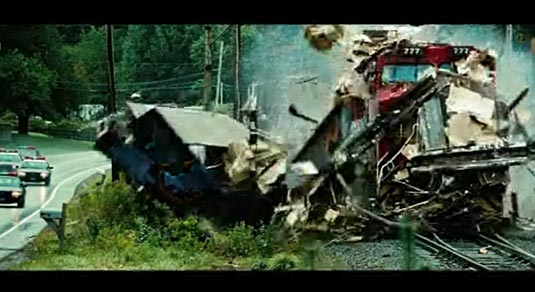
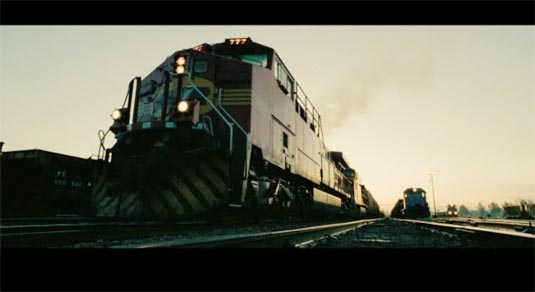
Perhaps they should have skipped Pelham and gone straight to Unstoppable (called that because, presumably, Andrey Konchalovskiy already made Runaway Train in 1985!). Based on the "Crazy 8's" incident in 2001, where an engineer-less train—train 777, making it, apparently, that much closer to "the Choo-Choo of the Beast"—carrying dangerous chemicals (the "molten phenol" used in the film), moved unimpeded and under power at speeds up to 48 mph, it has, like Pelham, been ginned up with drama and death and derring-do, and the inevitable "countdown to disaster" that could end Scranton, Pennsylvania as we know it.
"Hello, do you read?"
Everything that can go wrong can and does. The train is under power due to an operator error—he was under pressure from co-workers to move a heavily laden train quickly, and left the cab to try and move a track-switcher—with its brakes disconnected, on a collision course with another filled with school-kids on a "train-safety" field-trip (Oooooh, the irony!), but there seem to be enough Pennsylvanians on the track that you suspect it was "Go Stand on a Railroad Track Day" in the state (at least, the film-makers kept it free of nuns, widows, orphans and puppies—although one shot of a raccoon crossing the track with the train hurtling at us in the background provoked an inappropriate fit of the giggles). It's carrying the afore-mentioned molten phynol "used in the manufacture of glue"—and in case we don't get it (a problem with this movie) it is reiterated that it is "very toxic, highly volatile" and the place the train will most likely derail is in the middle of Scranton on a curve that overlooks (conveniently) a large collection of fuel oil storage tanks. Now, ladies and gentlemen, that is bad city planning.
"Yeah, I read. I CAN read. Are you talking about genre?"
On top of that, the corporate heads irresponsibly want to stop it in the least expensive way possible, meaning that it probably won't work, and the two engineers also on a collision course with "a missile the size of the Chrysler Building" consist of a bitter company vet and a kid on his first day on the job with a court appearance that he has to make.

This is one over-loaded train. Scott pulls out all the stops—he doesn't have any brakes, either—skip-and ramp-editing the train footage to move it faster, swooping around the trains to give everything more momentum, constantly changing perspective to keep one ill at ease (until the two Mutt and Jeff engineers—Denzel Washington and Chris Pine—share a laugh—and a frame—half-way through the film, their conversations consist of separate shots of each speaking their lines from opposite perspectives of the engine compartment), it is a busy, busy movie. Credit to Scott, he keeps you informed what's going on so you never get lost in the spinning images. If anything, there is too much information—needlessly identifying various locations at the beginning when they're all 200 miles of each other, and not trusting any piece of information to not be re-iterated (after a terse conversation with the corporate HQ, do we need to have the gal in charge (Rosario Dawson) call her callous supervisor "an asshole?"). The entire plot is summed up a couple times during the movie ("So, what you're telling me is....") to the point where you're feeling slightly talked down to. Still, it is a bit of a fun ride for all the lapses in passenger-service.
"What is this, a book-club? Stop the damn train!"
One funny aspect of the film is its constant thrusting of Fox News coverage of the event (the film is a 20th Century Fox release and both entities are holdings of News Corp.). But it may be a bit of a miscalculation: the circling news helicopters buzzing the train seem to not only distract, but also interfere with the rescue efforts, to the point where they're actually one of the things hampering the struggles of the people to resolve the situation. Fox runs the risk of making one of their own divisions look poor in their attempt to cross-promote, derailing their own efforts throughout the film.


Sunday, February 9, 2020

The Unholy Wife

I'm going to try to cut down some of the long-drafted posts that I haven't gotten around to. So, since we haven't done too many of these Saturday posts in awhile, let me re-acquaint you that the spot is traditionally "Take Out the Trash Day."

The Unholy Wife (John Farrow, 1957) One of the last films produced by RKO's film division, this one is an exercise in pure pulp, originally a TV presentation on the CBS "Climax!" anthology series (the second season episode called "The Prowler") gussied up with some religious pretensions to assuage those who didn't show up to ogle starlet Diana Dors portraying a "bad girl" who confesses to committing "the perfect murder" just hours before her execution.

Well, to say it's "the perfect murder" may be a delusion of grandeur, nor is it in any way shape or form true, so the audience is already having to deal with an unreliable narrator as we watch her unfold the tale. But, given the convoluted machinations that Dors' Phyllis Hochen takes to get what she intends, one is tempted to just give up on the character and have them gas her early.

But, the film (filmed in Technicolor—and one is tempted to say that, despite the poor quality of the available images, it's not likely anyone will mourn it not being remastered) begins with a black and white view of morality that will be ignored throughout the film: "I know that in your book, there's no such thing as a perfect crime. Right always comes out on top. Good always triumphs over evil. The guilty always punished. And yet, I did manage it. The perfect crime." Then, in flashback, she walks out the front door of "the house I hated—the one they now call "The House of Death" and fires a deliberately aimed bullet from a revolver.

Subtle.
It's a hell of an opening, but it's a false flag. She's not shooting anybody. She's just trying to convince her doddering mother-in-law (Beulah Bondi) that there's nobody out prowling around the house. This may be a little extreme outside anything but an NRA convention, but extreme is usually the way Phyllis plays it, as will become evident throughout the movie, even if Dors' performance of it is rarely above the cool, calm, and colluded variety. At any rate, daughter-in-law randomly firing a gun outside the house seems to assuage Mom's jitters (eh?), so off she goes to bed.
That allows Phyllis to have a little rendezvous in The House of Death's kitchen—The Kitchen of Death?—where she meets up with rodeo cowboy San Sanders (Tom Tryon), the fellow who's been prowling outside the house, who she's evidently having a fling with, as her husband...well, who the Hell knows where her husband is at this point because Phyllis is telling her story in flashback and only gives us the set-up—she doesn't tell us how it all started. 

And it starts with her being a floozy.

Phyllis is a single-mother, originally from England (in case Dors' accent slips), married to an Air Force sergeant who seems to have flown leaving her with a young son while she hangs out at bars trying to latch onto a high-roller. In comes sauntering vintner Paul Hochner (Rod Steiger) from the Valley and his pal, Gino (Joe DeSantis). Paul's in a good mood and finding Phyllis (not a tough thing to do) just makes him that much happier. Paul is smitten and proposes that they spend the next day at the beach, so he can get to know her son, Michael. Paul, due to a war-wound, can't have children, but Michael would realize his dream of having an heir for the vineyard that has been in his family for generations. Phyllis sees Michael as a burden, but Paul and Michael bond, despite Michael's jealousy of Paul's new attention to his mother.
Phyllis tries to warn off Paul by telling him of her past, but he is not swayed and the two marry. But, from her perspective, the marriage is not a happy one, and Phyllis takes up with the rodeo cowboy. Phyllis tries to send Michael off to a boarding school so she can have more time unsupervised, but Paul refuses the idea and so, thwarted, she begins to plot. That shot in the dark at the beginning of the movie sets up the circumstance. When there's a dust-up between Paul and Gino at an industry fair, Phyllis runs home to shoot Paul when he comes in the door. When the person she kills turns out to be Gino, returning to apologize, Paul determines to take the blame to keep her from being deported, rather than calling the sheriff and portraying the shooting as an accident.
Phyllis plants evidence on the body implicating Paul, and the police arrest him and charge him with murder. This might seem like enough for Phyllis, but when she learns—from Paul's priest-brother—that the judge may acquit him, she doubles-down testifying on his behalf, implicating herself in such an amateurish and clumsy way that everyone believes that she's just lying for her husband and so he MUST be guilty. It's tortured logic and how everything get resolved is even more tortured and a bit convenient for things to come around to the point at the beginning of the film.
If you're wondering why the emphasis on "Unholy" in the title, it's because of the presence of Paul's brother, a priest, who spends a lot of time doing unpriestly things, but still has enough credibility—despite his obvious prejudices—of being able to convince a lot of righteous people about the errors of their ways. Everything is just a little on the hysterical side, but, then the thing has so much pulp in it, you wonder if it might even extend to the wine Paul produces. Everyone tries gamely, especially Dors (who could be better and seemed to excel at comedy), but no one can rescue this one.
Speaking of pulp, you can't find a DVD of The Unholy Wife anywhere—the only copies available are on VHS (hence the quality of the screen-grabs—inspiring one of those rare "I cleaned my glasses for this?" moments)—but until that time when some video-house decides the time is right and the demand is there for a "Diana Dors Collection" there won't be any remastering project in the future. So don't hold your breath, but considering holding your nose when watching this unholy mess.