Thursday, May 5, 2022
The Unbearable Weight of Massive Talent
Thursday, July 1, 2021
Knowing
Knowing (Alex Proyas, 2009) The director's last film was the "in-name-only" bastardization of Isaac Asimov's "I, Robot," with its rule-breaking chrome figure-models that couldn't take apart a car convincingly. The movie benefited from Proyas' dark imagery and sense of imagination, but in the end it was another sci-fi film that finished with a fist-fight among the art direction. How....uh, "retro." The best thing about it was it gives somebody another chance to do Asimov right.
One walks in to Knowing, with the same kind of dread—another apocalypse movie, oh joy—only to come away impressed. More than that, you come away thinking thoughts that maybe Proyas knows science fiction better than most film-makers today, because Knowing does what really good science fiction does—show us an aspect of "now" that we don't consider and "us" that we finally recognize.
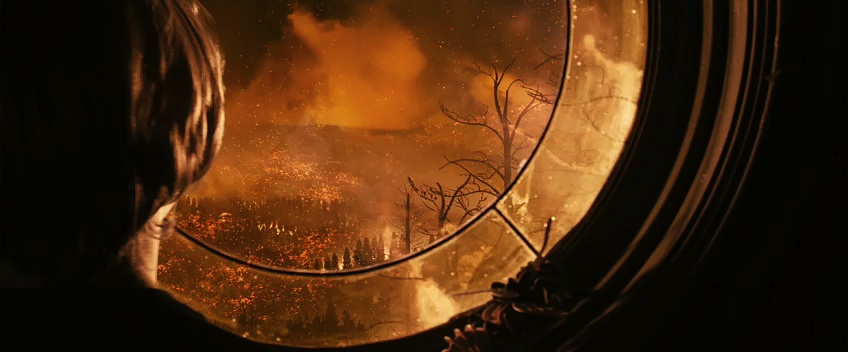
Forget the details, it's all hooey. They're just levels of Hell in Proyas' "Inferno," a means for John Koestler, college professor (Nicolas Cage) to drop the "Doubting Thomas" act, and "find religion." He's a man of science, after all, and doesn't believe in pre-determination...unless, of course, he unlocks, scientifically, the battle plan himself. Then, he believes, Lawd A'mighty.But, once he reaches his cross-roads (and Proyas points it out with all the subtlety of a pick-up truck) that's when the certainty arrives and the movie reveals itself to be something different: a metaphor for Death.And that's where the title comes in: we go through out lives sure of our mortality, and aware of the clock ticking in our chest, but we ignore it—we don't face it. It's penciled into the Day-Planner like that trip to France, but we never firm it up, we just delay it a day at a time. Some day, not today. Manana. There's no "drop-dead" deadline.Until there is. And then, you have to face it and walk the Kubler-Ross steps, knowing (knowing) time's a-wastin.' And the priorities and everyday details knock over like those endless arrangements of dominoes, revealing what needs to be done right here, right now. You can rant, you can rave, you can find God (Hint: He's always the last place you look), you can put your affairs in order, have your last meal and cigarette and say your good-byes at the door. That's just all delaying the inevitable.Wednesday, August 19, 2020
Adaptation.
But Adaptation. is another animal. It's "Charlie Kaufman in crisis," and a bit of a cheat, while also being an ingenious way to solve a problem—that is, writing a screenplay for a book that is, basically, un-filmable. Given the opportunity (and contract) to write a treatment based on Susan Orlean's best-selling book "The Orchid Thief,"** Kaufman readily accepted the job, being attracted to the odd obsessive themes of the book, and found himself unable to translate it into a film-story.
So—he thought outside of the box and the story itself—he wrote about his difficulties translating it into a film-story! The book's subject, John Laroche, the poacher who was seeking the "Ghost Orchid" in the Florida Everglades was a real person who was determined to find the rare flower to clone it and sell it. The screenplay's subject is about Charles Kaufman, screenwriter, who's trying to adapt Susan Orlean's book, "The Orchid Thief," and wrestling with its themes and his own inability to create the screenplay.
Impeding his process is his twin, simpler brother Donald (both played by Nicolas Cage), who's decided he's also going to write screenplays, none of which Charlie likes. Susan Orlean figures in it (played by Meryl Streep), as does Laroche—he's the bespectacled fellow pictured to the right, not Chris Cooper's snaggle-toothed (though Oscar-winning) portrayal (pictured above)—but they're fictionalized versions of the real people, adapted to fit a more commercial film. Laroche is using the orchids to make a drug and sell it, hooks Orlean, and she begins a needy affair with him and, fueled by her addiction, becomes as obsessed with the Orchid Thief as much as he's obsessed with the orchids. Is any of that true? No. Are the people real? Yes. The website, Chasing the Frog.com had done a fairly succinct job of separating the fact from fiction here. Yes, these people do exist, as does screen-lecturer Robert McKee,*** but they're fictionalized versions of the real people. Can Kaufman get away with doing that? Yes, he obviously did, but they had to get permission from the real-life counterparts to do so (just as Jonez had to get permission from John Malkovich for Kaufman's Being John Malkovich or that would have been a moot project).Look up the word "Adaptation" in the dictionary. "Any change in the structure or functioning of an organism that makes it better suited to its environment." There couldn't be a better explanation of the screen treatment of Adaptation. Kaufman couldn't, as they say in the trades, "crack it," so he changed the structure of the scenario...transplanted it, if you will...to make it work as a movie—especially a movie in the current environment of movie-making. And he made the debate between what he wanted to do and what he had to do part of the story in the form of the arguing screenwriting twins, Charles and Donald Kaufman.
Any writer of success must at some point deal with "the Other." The other writer, whose ideas are dismissed and shelved for work accomplished. Steven King did an experiment once to see if his writing would be as successful in other genres as opposed to the "scary fiction" writer, Steven King. So he created a psuedonym, Richard Bachman, much to the consternation of his publisher. Bachman sold well, but King had to deal with the success of his dopple-scrivener after several books were published. Ultimately, it inspired the concept of his novel "The Dark Half."
Noms de plume are as old as Bashō (and I'd bet cave paintings had false signatures, as well), and Adaptation. is credited to both Charlie and Donald Kaufman. Donald Kaufman is the first completely fictional person to be nominated for an Academy Award (at least not as a nom de plume). Donald also serves as a way for Charles to have conflict while doing something solitary—writing. For all the preciousness of the conceit, it still manages to work in a weirdly clear way, and it provides the means of this exchange, which re-defines the whole picture and sums it up: Donald and Charlie are talking about a time in school when Donald approached a girl he had a crush on, and when his back was turned, she and her gaggle of "Heathers" made fun of him.
Donald Kaufman: I knew. I heard them.
Charlie Kaufman: How come you looked so happy?
Donald Kaufman: I loved Sarah, Charles. It was mine, that love. I owned it. Even Sarah didn't have the right to take it away. I can love whoever I want.
Charlie Kaufman: But she thought you were pathetic.
Donald Kaufman: That was her business, not mine. You are what you love, not what loves you. That's what I decided a long time ago.
You are what you love. Not what loves you. For that little gem of a thought—multi-faceted, flawless and fundamental—I have enormous respect for Adaptation. for all its problems.
Oh, one more thing: My first impression of Adaptation. was to recall a punch-line from an ancient Warner Brothers cartoon (actually a couple of them, one of them being "Show Biz Bugs," another "Curtain Razor")—but because of what transpires (and the fear that kids would duplicate it) it's not much in circulation anymore. In it, the indefatigably fame-seeking Daffy Duck is auditioning for stage-time for his act. Each one fails miserably and he's rejected. "Next!" Finally, he shows up in a devil's costume. He eats gunpowder. He drinks gasoline and nitro-glycerine. Then...dramatically, he swallows a lit match. BOOM! There's a huge explosion. "That's incredible!" cries the ecstatic agent. "I can book you immediately!" "Yeah yeah," says the ghost of Daffy, drifting heavenward. "But I can only do it once!"****
The fictional Charles Kaufman—or is it Donald? (Nicolas Cage)—on-set with the non-fictional Susan Orlean.
For Ned', who asked...on July 9th, 2008
* There are others who take that switcheroo-based style of writing, including M. Night Shamyalan, and Alejandro Amenábar.
**You can read the original Laroche article here, at Orlean's web-site.
***McKee suggested Brian Cox (the original Hannibal Lecter) to play him in the movie. Good suggestion, actually.
**** Because the bit is dangerous, violent...and, if improbable, actionable, it has, over the years, been censored, as has been catalogued by this YouTuber.
Wednesday, December 26, 2018
Spider-Man: Into the Spider-Verse
or
"Aw, Did That Feel Like a Cartoon?"
Back in "the day", before the super-hero glut in multi-plexes, James Cameron was trying to untangle the web-like rights to the Spider-Man character to make the first Spider-Man movie. Rumors were that it was going to be prohibitively expensive as well, as Cameron's story involved multiple dimensions—that was a rumor, but in those pre-Titanic days, everything associated with Cameron was considered prohibitively expensive, despite the fact that he could squeeze every last drop of screen quality out of his budgets just by clever movie-making legerdemain. It also seemed like a big leap in concept for that first introductory "Spidey" movie—audiences needed to be able to "buy" into things like radioactive spiders, web-shooters, urban web-slinging, sticking to walls, and fooling your old "biddy" aunt that you were at the library when you came home bruised after fighting a giant lizard before we got into any story with any real dimension—or many of them. With great powers comes great amounts of time justifying them to an audience that still doesn't quite believe a man can fly.
But, if you're going to crank out comics monthly (or bi-weekly), you have to come up with something besides a story about a villain that dresses up like an aardvark for the hero to fight, so writers—being writers—came up with the "multiple earths" theory where you could have stories with a "what if?" hook. DC started it with their "Flash of Two Worlds" story in a 1961 issue of The Flash comic book, where that book's hero visited the alternate Earth of "The Flash" from the 1940's—although Wikipedia makes a case for it starting in a 1953 issue of "Wonder Woman." Marvel started their multiple Universes with 1984's "Captain Britain" series, but, recently, the various media in which superheroes appear have dabbled with "Alternate Earth" story-lines, the most recent (and I'd argue at first viewing) and among the best of any super-hero films is Spider-Man: Into the Spider-Verse with a story written by Phil Lord and Rodney Rothman and energetically directed by Bob Persichetti, Peter Ramsey, and and Rothman.
A bit premature, that. After another spat with Dad about having to go to BVU, Miles goes to visit his Uncle Aaron, who encourages his graffiti-art and takes him to the subway, where Miles gets to practice painting the wall of a blocked-off section. It is here where Miles gets bitten by a radioactive spider, because, hey, it's happened before, and he finds that things get a bit sticky and has him climbing the walls...quite literally. That's something that doesn't happen with puberty, and it causes all sorts of mishaps that he can't explain and does not understand.
While strolling up the side of a building, he's noticed by Spider-Man—the established Spider-Man—who takes Miles under his web to learn the...webs. Unfortunately, on that night, Wilson Fisk—the New York gangster called "The Kingpin" (voiced by Liev Schreiber) is testing a new device that creates a trans-dimensional bridge because...well, that's a spoiler that's revealed in a lovely sequence based on the art-style of Bill Senkiewicz...but Fish doesn't care that it causes city-wide earthquakes and a "glitching" transformation of pieces of New York. He's a big, bad dude, after all, and he proves it by killing Spider-Man when he tries to stop the destruction.
New York mourns Peter Parker, the twenty-something who was Spider-Man, except that...he's blond! The Peter Parker "we" know has dark hair and we have that verified when he shows up on Miles' Earth, having been sucked out of his world due to Fisk's foolhardy experiments. THIS Parker—Peter B. Parker (voiced by Jake Johnson)—is also 20-something, not in the best of shape (Miles calls him the "brink old-joke hobo Spider-Man") and is going through an emotional upheaval after the collapse of his marriage to Mary Jane Watson (Zoë Kravitz). Despite that, he's the only "one-and-only" Spider-Man in town, and Miles looks to him to help him become the Spider-Man he wants to be. As Peter B. wants to get back to his own world, he agrees, especially since Miles has a doo-hickey needed to shut off the Fisk-machine—except that...he broke it. So the two make a trip to Fisk Tech-Labs to try and find a replacement, because, as Peter B says, "the best way to learn is intense, life-threatening pressure."
Thursday, October 20, 2016
Heroes and Villains, Part 2: Snowden
The wisdom of the mob plays tricks with reality. You see it a lot, especially as age gives you longevity and experience. You remember incidents that time glosses over in pertinent detail. On the other hand, the demands of the "24 hour news cycle" creates an urgency for happenstance when the "tube" needs to be filled, often with speculation and mis-information that gets refuted later with the clarity of time. Information and time yin and yang separating truth from fiction—but not everybody gets the message. And depending on when the hearing happens, people tend to hear something and believe it, even if it gets refuted. People believe what it is easier to believe...or merely what they want, never mind the facts.
Over the next couple of days, recent movies about individuals who are judged by single acts, and whether they are heroes or villains, depends on your point of view in the audience.
Epic Shelter
or
...a Very Frustrating Individual
It's always difficult to say that an Oliver Stone film is "based on a true story." Every subject he makes a film about goes through "The Stone Filter," injecting his views, his "Daddy issues," his prejudices, whether they're called for or not. It's tough to separate the man from his movies, like Howard Hawks or John Ford (but even those film veterans changed over time). Stone is stuck in his mind-set and screenplay-template, and he will tailor the facts to meet his own expectations. Film-makers do this all the time, compressing characters into one, juggling time, and even inventing incidents and people to help drive home a dramatic point. But Stone is egregious about it and unapologetic. He is an auteur, and so, rather than serve the story or the material, he serves himself. And so, his films, be they fiction or non-fiction, biography or fantasy, whatever genre they're in, feel much the same.
Snowden, his latest, follows the same pattern,* showing the transformation of the young tech-savvy, politically-conservative** veteran (played by Joseph Gordon-Levitt) to eventual whistle-blower, after serving time in the military to timing servers in the CIA, working on intricate hacking scenarios and data collection, but running afoul of inter-agency politics and becoming paranoid and disenchanted with the breadth and depth of intelligence gathering and interpretation.
Stone starts the film in Tokyo, where Snowden has flown from his job in Hawaii after smuggling NSA files using a rigged Rubick's cube (wonder how high that is on the TSA lists these days). Snowden is in limbo. He's taken files, but that activity has not yet been discovered, and that won't happen until the contents have been published. To accomplish this, he needs documentation and verification. He meets documentary film-maker Laura Poitras (Melissa Leo), who will eventually make the film Citizenfour and Guardian reporter Glenn Greenwald (Zachary Quinto). Once they're informed, it's a race against time. He'll be tracked, investigated and hunted. There will be no room for error.
In the down-time waiting for confirmations before transmitting the files, he goes into his back-story negotiating his military service, discharge for injuries, his entree into the CIA. Why any of this back-story involves meeting his eventual girlfriend (Shailene Woodley), it's tough to say, but I'm sure it serves some journalistic function and might demonstrate some level of sacrifice for going into hiding.
During the course of the story, we meet some influences: Professor Hank Forrester (Nicolas Cage), who, himself, has worked in the intelligence community and found the experience dispiriting and demoralizing. At the CIA, he meets another mentor, Corbin O'Brian (Rhys Ifans, a wonderfully creepy performance without much effort), who, impressed with Snowden's skills, champions his course through intelligence. For Stone's by-the-book story-telling, the protagonist must choose between two opposed father-figures, each serving a role as angel or devil on the protagonist's shoulders. Lately, Stone has gotten subtler in his dependence on the "Daddy" trope—he even managed to undersell the huge one in W. But, in his early films, like Platoon and Wall Street, those conflicts form the very basis of the films. In such scenario's, you need to have the conflicting world-views in order for the guy in the middle to reach his own path, and Stone returns to the formula to tell Snowden's story. It isn't enough that he's frightened by the cavalier way his fellow intel-minders collect data. Any back-door, any un-shaded camera, anything can give them access into people's private lives. Snowden goes from disenchanted to paranoid, beginning to cover his laptop's camera aperture with tape, questioning motivations for the details, while also beginning to question "The Big Picture."
![]() |
| The special effects crew get their cameo's. |
Back in Tokyo, the trio are joined by The Guardian's Ewen McAskill (Tom Wilkinson) and the four send the data to The Guardian's offices, where the managing editor (Joely Richardson) is being ultra-careful in deciding to publish. Greenwald finally loses it under the pressure and threatens other avenues of dissemination, post-scripted with a mention of The Guardian's reluctance. They get assurance that it will be published at a certain time and plans are made to book Snowden out of the hotel and to the next "undisclosed location."
![]() |
| "My name's O'Brien...oh, sorry...it's spelled O'Brian....what year is this?" |
** Just HOW conservative Snowden is/was, Stone keeps a little nebulous. During his first date with his soon-to-be girlfriend, she makes a crack about the government under Bush, and Stone has him say "I just don't like people bashing our government." Okay. It fits the "Stone Filter" that Snowden have a hero's journey from one extreme to another, ala Born on the Fourth of July, or JFK, while keeping an idealism that fuels both ends of the spectrum.
*** I've always loved Steven Colbert's analysis: "Of course, they're checking personal phone records looking for terrorists. If you've ever called Verizon Wireless for customer service, pretty soon you're GOING to become a terrorist!"